

With SSTC volumes down approximately 8% year-on-year and completion delays persisting across England and Wales, sellers who commission pre-listing surveys before going to market are gaining a measurable edge over those who do not. Sellers' pre-listing surveys: strategic tool for accelerating sales in Q2 2026's slower transaction pipeline, that phrase captures precisely what the current market demands. A structured survey completed before the For Sale board goes up reduces buyer hesitation, sharpens pricing, and gives solicitors cleaner paperwork to progress. This article explains how and why, drawing on Q2 2026 market data and RICS best practice.
Key Takeaways
- Q2 2026 market data shows a shift toward balance between buyers and sellers, reducing the automatic advantage sellers held in prior years [2]
- 48% of agents in a mid-2026 survey cited unrealistic seller price expectations as the primary driver of longer selling times [3]
- Pre-listing surveys address both pricing misalignment and condition uncertainty, the two main causes of renegotiation and fall-through
- Sellers who document property condition upfront reduce the likelihood of post-survey price reductions and abortive legal costs
- The Scottish upfront-information model points toward a direction England is likely to follow; early adoption gives sellers a competitive advantage now
Why Q2 2026 Is a Different Market for Sellers
The housing market that sellers face in Q2 2026 is structurally different from the post-pandemic seller's market of 2021-2023. In CNBC's Q2 2026 Housing Market Survey, 44% of agents described conditions as balanced between buyers and sellers, the highest share recorded since tracking began, up from 30% in Q3 2025 [2]. That shift matters because it removes the margin for error that sellers previously enjoyed.
Slower transaction flow compounds the challenge. Real Brokerage's August 2026 Agent Survey recorded a Transaction Growth Index of 44.6, down from 52.5 in July, with 41% of agents reporting fewer transactions year-on-year and 75% saying homes are taking longer to sell than a year ago [3]. Pending sales data for July 2026 showed a 2.3% month-on-month and 2.2% year-on-year decline [10].
Rising supply adds further pressure. Inventory was up 2.3% in May 2026, with months' supply jumping from 9.3 to 10.3, a 10.8% monthly increase [10]. In that environment, buyers have more choice and less urgency. Sellers who present their property without adequate preparation risk sitting on the market, attracting low offers, and ultimately accepting less than they would have achieved with better upfront groundwork.
The good position is not lost for sellers, it simply requires more deliberate preparation. Pre-listing surveys are one of the most direct ways to achieve that.
What a Pre-Listing Survey Actually Involves
A pre-listing survey is a structured assessment commissioned by the seller before the property is marketed. It differs from the buyer's survey in one important respect: the seller controls it, uses it to inform their own decisions, and can share it selectively to reduce buyer uncertainty.
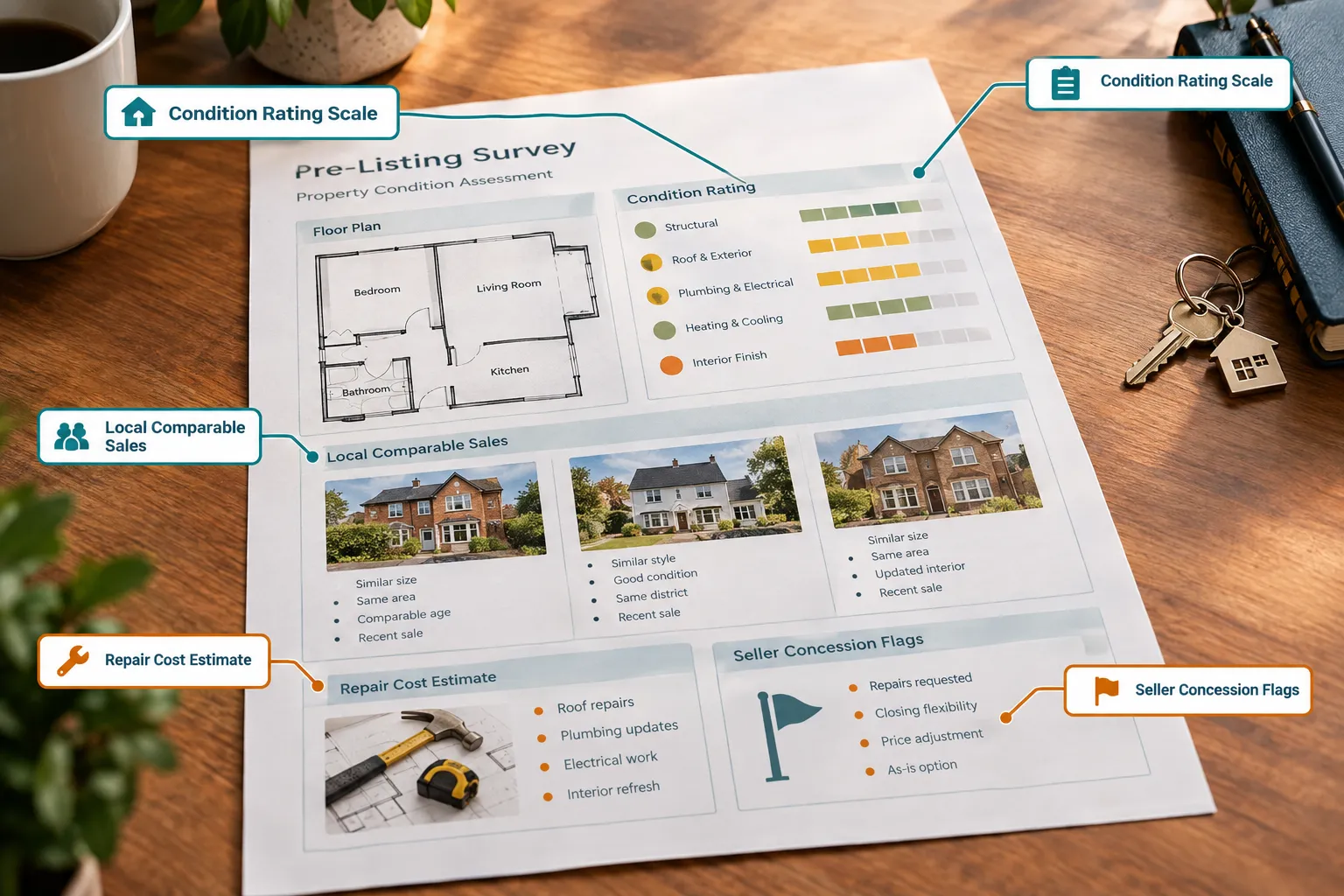
In the UK context, a pre-listing survey typically draws on RICS Level 2 or Level 3 methodology, depending on the property's age, construction type, and condition. A Level 2 HomeBuyer Report covers condition ratings, damp, structural movement, roof condition, and services in a standardised format. A Level 3 Building Survey goes further, it describes construction methods, traces the cause of defects, and provides repair recommendations. For older or non-standard properties, the Level 3 is the more appropriate starting point.
The survey report gives the seller three things:
- A condition baseline, documented evidence of the property's state at the point of listing
- A repair priority list, distinguishing issues that affect value from those that are cosmetic
- A pricing anchor, objective data to support the asking price or justify any pre-sale remedial work
Sellers can also commission a standalone RICS Red Book valuation alongside the building survey, which provides a professionally justified market value figure. This is distinct from an estate agent's appraisal, which carries no regulated liability. For a clear explanation of that distinction, see professional valuation versus estate agent appraisal.
The Pricing Problem Pre-Listing Surveys Solve
Overpricing is the single largest avoidable cause of slow sales in Q2 2026. In the August 2026 Agent Survey, 48% of agents identified unrealistic seller price expectations as the primary driver of longer selling times [3]. That is not a minor footnote, it is the dominant variable.
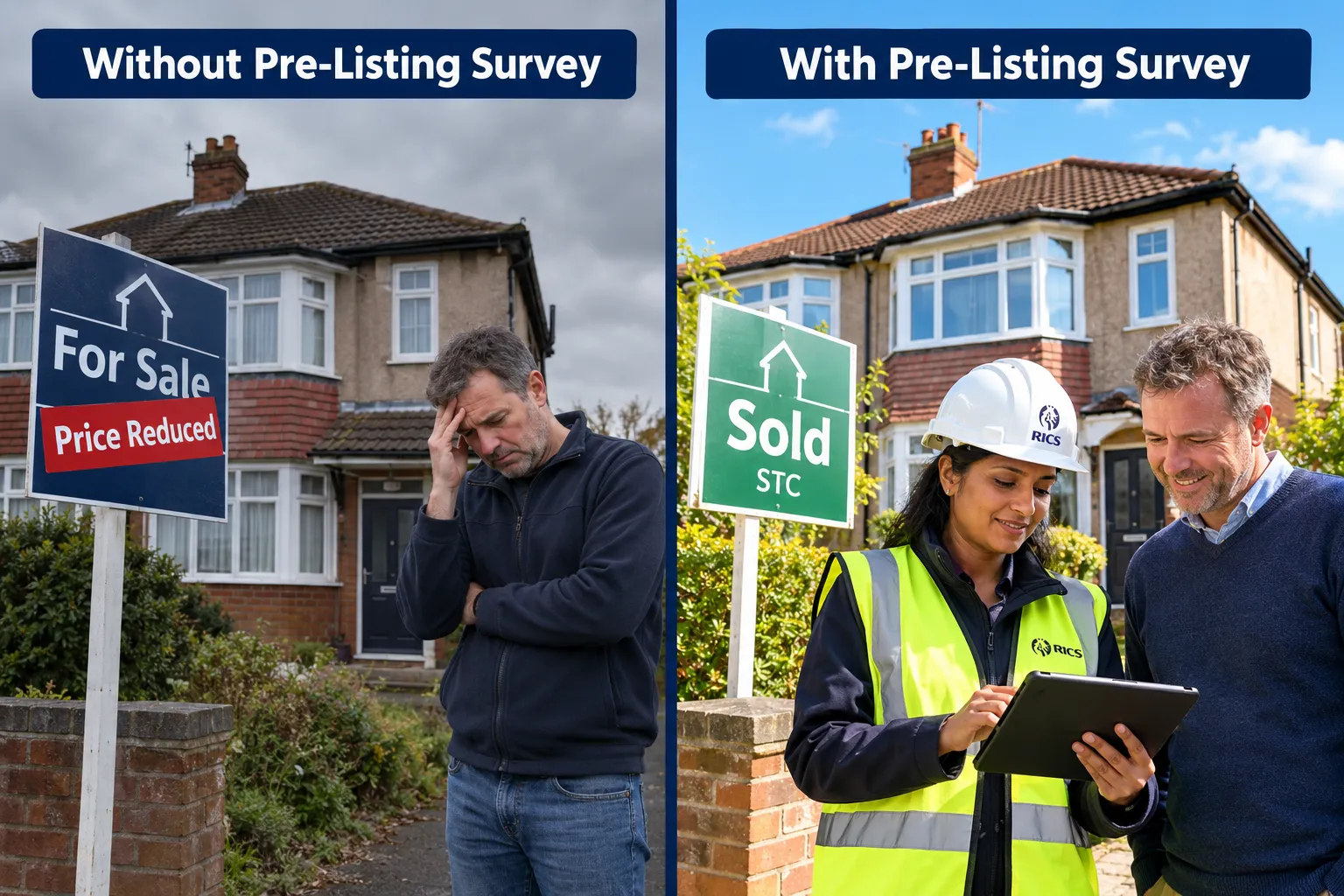
The data on price reductions reinforces this. In CNBC's Q2 2026 Housing Market Survey, 57% of agents had at least one price cut among their active listings, down from 89% in Q3 2025, suggesting that initial pricing is improving but still affects more than half of all active sellers [2]. Listing prices per square foot were falling year-on-year in 60 of the top 100 metros as of June 2026, compared with 46 metros in 2025 [7]. Sellers who price ahead of the market face a compounding problem: each week on market signals weakness, accelerating the need for further reductions.
A pre-listing survey addresses this directly. When a RICS surveyor produces a condition report and the seller uses it alongside recent comparable sales data, the asking price is grounded in documented evidence rather than aspiration. Estate agents can use the survey to justify the price to prospective buyers and their solicitors, reducing the scope for post-offer renegotiation.
The average price reduction after survey is a recurring concern for sellers. Commissioning a survey upfront, and addressing the issues it identifies before listing, substantially reduces the probability of a buyer's surveyor flagging the same defects later and using them to negotiate a discount.
Typical Pre-Listing Survey Costs vs. Potential Savings
| Property Type | Approx. Survey Cost (RICS Level 2) | Approx. Survey Cost (RICS Level 3) | Typical Post-Offer Renegotiation Risk (if defects found by buyer) |
|---|---|---|---|
| Flat / maisonette | £400,£600 | £600,£900 | £2,000,£10,000+ |
| Victorian terraced house | £500,£700 | £700,£1,200 | £5,000,£20,000+ |
| 1930s semi-detached | £500,£700 | £700,£1,100 | £3,000,£15,000+ |
| Pre-1900 detached | £600,£900 | £900,£1,800 | £10,000,£40,000+ |
Costs vary by location and property size. For current fee ranges, see how much is a Level 2 survey in 2026 and professional building survey fees explained.
Reducing Transaction Friction and Fall-Through Risk
Transaction friction, deals that stall, renegotiate, or collapse entirely, is a defining feature of the Q2 2026 pipeline. Elevated relist rates in major markets and an increase in deals that stall or fail to complete have been widely noted by analysts tracking mid-2026 activity [3]. In England and Wales, where contracts are not exchanged until late in the process, the window for a buyer to withdraw or renegotiate remains open for weeks or months after an offer is accepted.
Pre-listing surveys function as a risk-screening tool that closes much of that window. When a seller discloses condition information upfront, supported by a RICS report, the buyer's solicitor has less reason to raise requisitions, the buyer's surveyor is less likely to produce a report that surprises the buyer, and the overall chain moves with greater confidence.
The specific risks a pre-listing survey can identify and allow the seller to address before listing include:
- Damp and drainage issues, among the most common causes of post-survey renegotiation
- Roof condition, flat roofs, missing slates, and failed flashings are frequently flagged by buyer surveyors
- Electrical installation age, particularly relevant given the extension of Awaab's Law provisions; see electrical hazard assessments in building surveys
- Structural movement, cracks, lintel failure, and subsidence indicators that buyers find alarming without context
- EPC rating and retrofit liability, buyers are increasingly sensitive to energy efficiency costs; a pre-listing survey can identify measures that improve the EPC rating before listing, as explored in building surveys for EPC upgrades in 2026
Sellers who resolve or disclose these issues before going to market give buyers the information they need to make a confident offer, and give solicitors cleaner paperwork to progress.
The Seller Questionnaire: Capturing Motivation and Flexibility
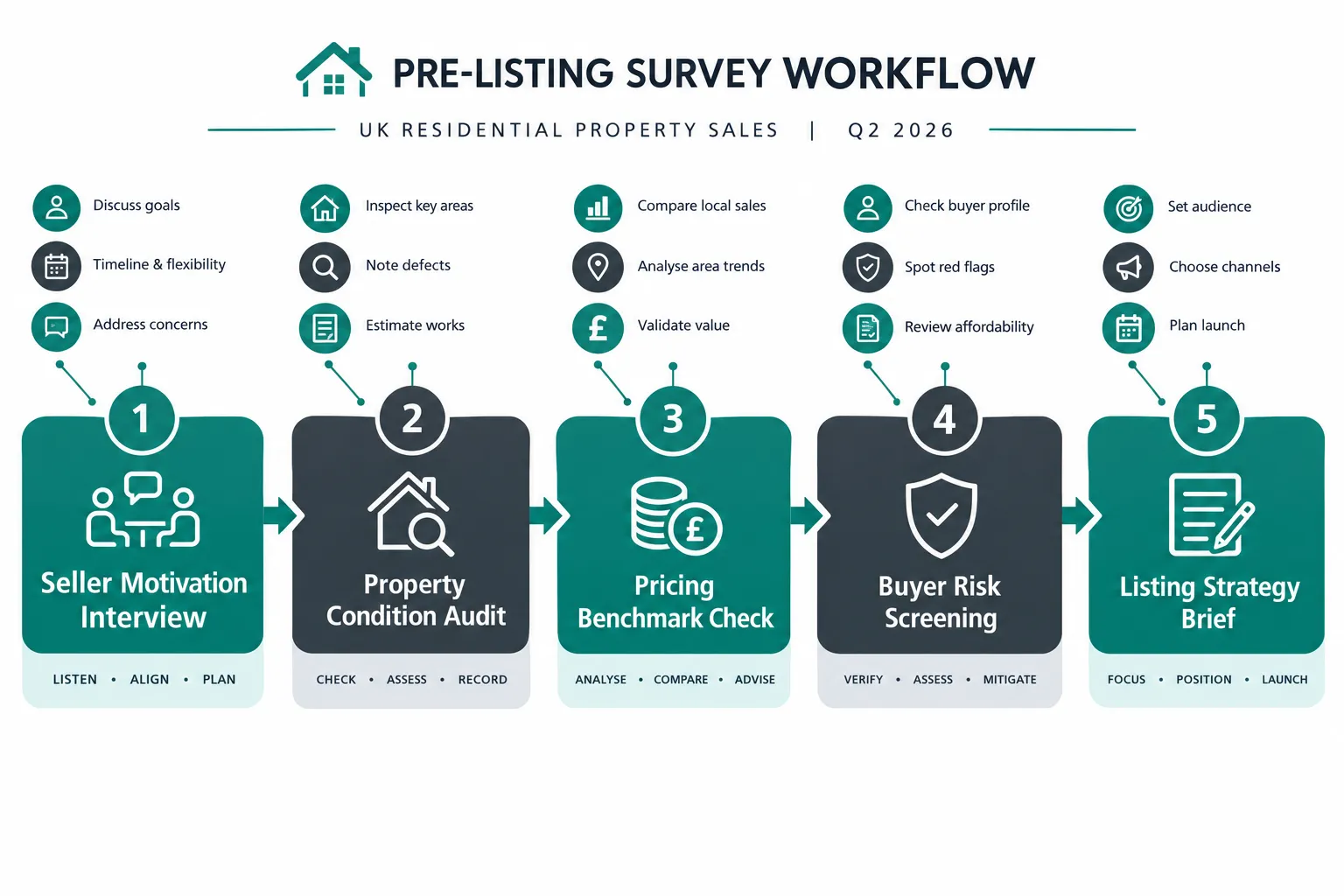
A pre-listing survey is not only a physical inspection. It also encompasses a structured seller questionnaire that captures motivations, timescales, and flexibility, information that shapes the entire listing strategy.
Consumer research published in April 2026 by Zillow found that 60% of soon-to-be sellers said real-time pre-market buyer data, such as views, saves, and tour requests, would be extremely or very valuable when deciding how to price and present their home [9]. The same survey found that 85% of sellers would be more likely to instruct an agent who could pre-market to the broadest online audience [9]. These findings point to a seller population that is ready to engage with data, but needs a structured process to act on it.
A well-designed seller questionnaire addresses:
- Motivation, relocation, upsizing, downsizing, probate, or financial pressure each imply different priorities around speed versus price
- Timescale flexibility, sellers who can accommodate a buyer's preferred completion date have a negotiating asset that costs nothing to offer
- Repair tolerance, whether the seller is willing to carry out works, offer a credit, or sell strictly as-seen affects how the property should be priced and described
- Chain position, whether the seller has already found a property to buy, or is selling with no onward chain, directly affects a buyer's risk assessment
- Disclosure history, known defects, planning applications, boundary disputes, or Japanese knotweed should be captured before solicitors draft the TA6 form
When this questionnaire is combined with the physical survey findings, the estate agent has a complete picture of the property and the seller's position. That allows the marketing strategy, pricing, photography brief, description emphasis, and target buyer profile, to be aligned from day one rather than adjusted reactively after weeks on the market.
The Scottish Model as a Reference Point
Scotland's Home Report system, which requires sellers to commission a survey, single survey, and energy report before marketing, provides a working example of what upfront seller disclosure achieves. Transactions in Scotland move more quickly through the legal process because buyers receive condition information before making an offer rather than after. The Scottish upfront survey model for England is a subject of active discussion among RICS members and policymakers, and Q2 2026's slower pipeline makes the case for voluntary adoption more pressing.
England and Wales have no equivalent statutory requirement. Sellers who adopt the practice voluntarily are therefore differentiating their listing in a market where most competing properties carry no upfront condition information. In a balanced market where buyers have genuine choice, that differentiation can be the deciding factor in which property attracts an offer first.
Practical Steps for Sellers Considering a Pre-Listing Survey
- Instruct a RICS-regulated surveyor, check the RICS Find a Surveyor register to confirm the surveyor holds the appropriate accreditation for the survey level required
- Choose the right survey level, Level 2 for post-1930s properties in reasonable condition; Level 3 for older, extended, or non-standard construction
- Complete the seller questionnaire, work with the estate agent to capture motivation, timescale, and disclosure information before the survey takes place
- Review the report with the agent, identify which defects to remedy before listing, which to disclose with a repair credit, and which are genuinely minor
- Obtain repair quotes, for any works the seller decides to carry out, get at least two quotes from qualified contractors before adjusting the asking price
- Share the report selectively, the seller is not obliged to share the survey with buyers, but doing so with serious applicants reduces the risk of a buyer's survey producing a conflicting assessment
- Pair with a RICS valuation, if the property is unusual, high-value, or in a market with limited comparables, a Red Book valuation alongside the building survey provides a defensible asking price
For a broader view of how chartered surveyors are approaching the 2026 market, see chartered surveyor strategies for greater certainty in 2026 residential transactions.
Frequently Asked Questions
Does a pre-listing survey replace the buyer's survey?
No. A buyer is entitled to commission their own independent survey, and mortgage lenders will require a valuation regardless. The pre-listing survey reduces the probability of the buyer's survey producing unexpected findings, but it does not substitute for independent due diligence.
Is the seller obliged to disclose the pre-listing survey to buyers?
There is no statutory obligation to share the report. However, if the report identifies a material defect and the seller knowingly conceals it, that may give rise to a misrepresentation claim. Solicitors should advise on disclosure obligations in the context of the TA6 property information form.
What if the pre-listing survey finds serious defects?
The seller has three options: carry out remedial works before listing, adjust the asking price to reflect the condition, or market the property as-seen with full disclosure. The survey gives the seller the information needed to make that choice before a buyer's solicitor raises the same point during conveyancing.
How long does a pre-listing survey take to arrange?
A RICS surveyor can typically inspect and report within one to two weeks of instruction, depending on diary availability and property size. In areas where surveyor capacity is under pressure, allowing three to four weeks before the planned listing date is advisable.
Can a pre-listing survey help with EPC compliance questions?
A Level 3 Building Survey will identify fabric deficiencies, insulation, glazing, heating systems, that affect energy performance. This can inform decisions about retrofit works before listing. For detailed guidance, see energy efficiency retrofits and building surveys in 2026.
Is a pre-listing survey worth the cost on a lower-value property?
The cost-benefit calculation depends on the property's condition and the local market. On a property where a buyer's survey is likely to flag significant defects, the cost of a pre-listing survey is almost always recovered through avoided renegotiation. On a recently renovated flat in good condition, the benefit is more modest but the survey still provides a documented baseline.
Conclusion
Sellers' pre-listing surveys: strategic tool for accelerating sales in Q2 2026's slower transaction pipeline, the phrase describes both a method and a market reality. With 44% of agents now describing the market as balanced [2], 48% citing unrealistic seller expectations as the primary cause of slow sales [3], and transaction volumes under sustained pressure, the sellers who move quickly through the pipeline are those who arrive at the negotiating table with documented evidence rather than assumptions.
The practical steps are straightforward. Instruct a RICS-regulated surveyor before the property is listed. Complete a structured seller questionnaire to capture motivation, timescale, and disclosure obligations. Use the survey findings to make informed decisions about remedial works, pricing, and marketing strategy. Share the report with serious buyers to reduce the scope for post-offer renegotiation.
The cost of a pre-listing survey is modest relative to the cost of a price reduction, an abortive legal transaction, or a failed sale. In a market where buyers have more choice and less urgency than at any point since 2019, that modest investment in upfront preparation is one of the most direct ways a seller can protect both their asking price and their timeline.
References
[1] 44 Of Real Estate Agents Now Report A Balanced Market Ending Years Of Seller Dominance – marketscale.com
[2] Cnbc Housing Market Survey Balanced Market – cnbc.com
[3] mpamag – mpamag.com
[4] 44 Of Real Estate Agents Now See A Balanced Market The Highest Share Since Tracking Began – marketscale.com
[5] Market Pulse Survey Q226 – etnrealtors.com
[7] Market Clock Report 2026q2 – realtor.com
[8] Us Housing Market Shifts Toward 072251014 – finance.yahoo.com
[9] 2026 05 15 Survey While Some Brokers Push Private Listing Networks, Most Soon To Be Sellers Want Their Homes Seen By Every Buyer – zillow.mediaroom.com
[10] Monthly New Residential Construction Analysis Nar Pending Amjad Wjizf – linkedin.com