

Last updated: July 24, 2026
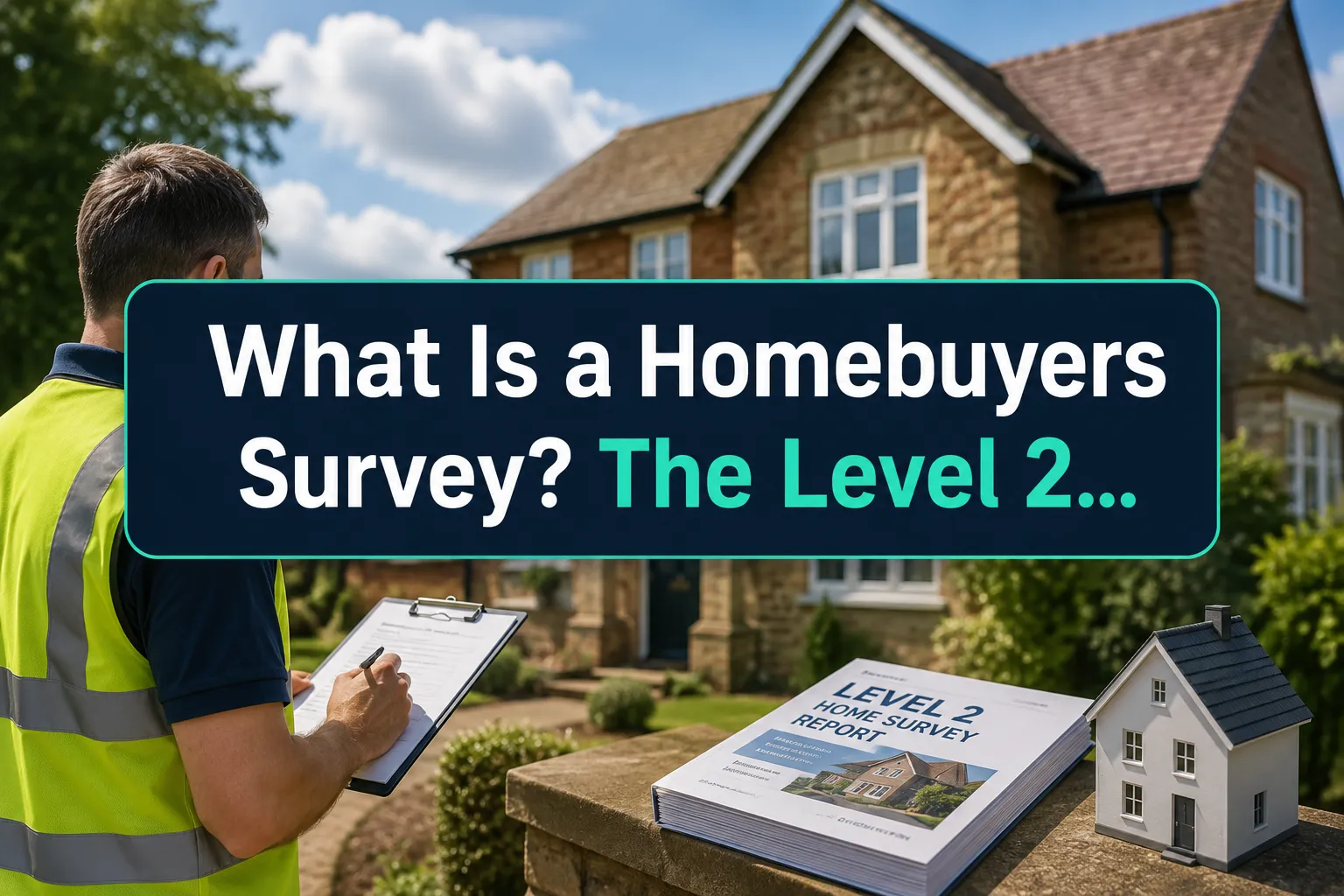
Quick Answer: A homebuyers survey (formally called a Level 2 Home Survey) is a professional inspection of a property's condition, carried out by a qualified surveyor before you complete a purchase. It identifies visible defects, flags maintenance issues, and uses a traffic-light rating system to help buyers make informed decisions. It is the most widely used survey type in England, Wales, and Northern Ireland for conventional residential properties built after 1900.
Key Takeaways
- A homebuyers survey is a Level 2 inspection that covers visible and accessible parts of a property, rated using a three-colour condition system.
- It is not the same as a mortgage valuation, which only protects the lender, not the buyer.
- A Level 2 survey is best suited to conventional properties in reasonable condition; older, extended, or structurally complex homes may need a Level 3 building survey.
- Typical costs range from around £400 to £900 depending on property size and location, though prices vary by surveyor.
- The report does not include structural calculations, drain inspections, or specialist tests unless separately instructed.
- Surveyors must be RICS-registered or members of the Residential Property Surveyors Association (RPSA) to carry out a homebuyers survey.
- A survey finding does not automatically delay exchange, but it can trigger renegotiation or further specialist investigations.
- Skipping a survey on a new-build is still a risk; snagging inspections serve a different purpose.
What Is a Homebuyers Survey and Who Is It For?
A homebuyers survey is a standardised, non-invasive inspection of a residential property, designed to give buyers a clear picture of its condition before they commit to purchase. The surveyor inspects all visible and accessible elements, from the roof and walls to floors, windows, and services, and presents findings in a structured written report.
The Level 2 survey is aimed at buyers of:
- Conventional houses, bungalows, or flats built after approximately 1900
- Properties in a reasonable state of repair with no obvious major structural concerns
- Standard construction (brick or stone walls, pitched tiled roofs)
It is not designed for listed buildings, properties with significant alterations, or homes showing signs of serious structural movement.
What Does a Level 2 Report Actually Include?
The Level 2 homebuyer report covers all visible and accessible parts of the property without moving furniture, lifting floorboards, or opening up walls. A qualified surveyor will assess:
- Roof structure and covering (from ground level or accessible loft hatch)
- Chimneys, flashings, and guttering
- External walls, pointing, and render
- Windows, doors, and joinery
- Internal walls, ceilings, and floors
- Damp, timber condition, and insulation (where visible)
- Services (gas, electricity, plumbing), noted but not tested in detail
- Grounds, boundaries, and outbuildings (brief visual inspection)
The report also includes a market valuation and reinstatement cost estimate in the standard RICS HomeBuyer Report format, though some surveyors offer a condition-only version without valuation.
What is excluded: Drains, specialist electrical or gas testing, areas concealed by furniture or finishes, and any part of the structure that cannot be safely accessed.
For a full breakdown of what the Level 2 Homebuyer Survey covers and how it works, Prince Surveyors provides a detailed service overview.
What Do the Traffic-Light Ratings Mean?
Every element in a Level 2 report is assigned one of three condition ratings, making it easy to prioritise action:
| Rating | Colour | What It Means |
|---|---|---|
| Condition 1 | Green | No repair needed; normal maintenance only |
| Condition 2 | Amber | Defects that need attention but are not urgent |
| Condition 3 | Red | Serious defects requiring immediate or significant repair |
A Condition 3 rating does not necessarily mean the deal should fall through, but it does mean getting specialist quotes before exchange. Multiple Condition 2 ratings in older properties are normal; a cluster of Condition 3 ratings in key structural elements warrants serious attention.
What Is the Difference Between a Level 1, 2, and 3 Survey?
The RICS Home Survey Standard defines three levels of inspection, each suited to different property types:
- Level 1 (Condition Report): Basic traffic-light overview; no advice or valuation. Best for new or near-new homes in excellent condition.
- Level 2 (Homebuyer Report): The standard choice for most conventional residential properties. Includes condition ratings, advice on defects, and usually a valuation.
- Level 3 (Building Survey): A detailed, open-ended inspection for older, extended, unusual, or structurally complex properties. Includes more invasive investigation and greater narrative detail.
Choosing between Level 2 and Level 3 is the most common decision buyers face. If the property was built before 1900, has been significantly extended, shows signs of movement, or uses non-standard construction, a Level 3 is the safer choice. The Level 2 vs Level 3 survey comparison at Prince Surveyors sets out the key differences clearly.
When Is Level 2 the Wrong Choice?
A Level 2 homebuyer report is not appropriate for every property. Choose a Level 3 building survey instead if:
- The property was built before 1900 or uses timber frame, cob, or other non-standard construction
- There is visible cracking, subsidence, or significant structural alteration
- The property has a large extension, conversion, or complex layout
- You plan major renovation work and need detailed cost guidance
- The property is listed or in a conservation area
Choosing Level 2 for a property that needs Level 3 is one of the most common and costly mistakes buyers make. The survey may miss issues that a more thorough inspection would have caught.
How Much Does a Homebuyers Survey Cost?
A Level 2 homebuyers survey typically costs between £400 and £900 in the UK, though prices vary by property size, location, and the surveying firm. London and the South East generally attract higher fees. The valuation element, if included, can add to the cost.
This is a small fraction of the overall purchase cost and should be viewed as risk management, not an optional extra. For a detailed look at what affects the price, see this guide on building survey costs in 2026.
How Long Does a Homebuyers Survey Take to Complete?
The physical inspection typically takes two to four hours on site, depending on property size. The written report is usually delivered within three to five working days of the inspection, though some firms offer faster turnaround.
Booking lead times vary by area and season. In busy markets, allow one to two weeks from instruction to receiving the report.
Is a Homebuyers Survey Required by My Mortgage Lender?
No. A homebuyers survey is not a legal requirement and most mortgage lenders do not require one. Lenders commission their own mortgage valuation, which is a brief assessment to confirm the property is adequate security for the loan. That valuation protects the lender, not the buyer.
Buyers who rely solely on the mortgage valuation have no independent assessment of the property's condition. A homebuyers survey is commissioned separately, at the buyer's expense, for the buyer's benefit.
What's the Difference Between a Homebuyers Survey and a Home Inspection?
In the UK, the term "home inspection" is not a formal or regulated category. A homebuyers survey (Level 2) is the standard professional inspection carried out by a RICS or RPSA-qualified surveyor. In the US, "home inspection" refers to a similar but separately regulated process.
UK buyers should always use a RICS-registered or RPSA-member surveyor to ensure the report meets professional standards and carries professional indemnity insurance.
Do I Really Need a Level 2 Survey When Buying a House?
Yes, for most conventional property purchases, a Level 2 survey is strongly advisable. Surveys regularly uncover defects that are not visible during a viewing, including damp, roof deterioration, failing pointing, and timber decay. These findings can support price renegotiation, help buyers budget for repairs, or, in serious cases, prompt withdrawal from a purchase that would have been financially damaging.
The cost of not having a survey typically far exceeds the cost of commissioning one.
Can I Skip the Survey If the House Is New?
A new-build property is not automatically defect-free. New homes often have snagging issues, from poorly fitted windows to incomplete insulation. A Level 1 Condition Report or a specialist new-build snagging inspection is appropriate here, rather than a Level 2 survey.
New-build buyers should also check that the property is covered by a structural warranty such as NHBC Buildmark, which provides protection for major structural defects for ten years.
What Problems Do Surveyors Find That Buyers Miss?
Surveyors are trained to spot issues that are not obvious during a standard viewing:
- Rising or penetrating damp hidden behind furniture or decoration
- Roof defects visible only from a ladder or through binoculars
- Subsidence or movement indicated by crack patterns and door alignment
- Timber decay or woodworm in floor joists and roof timbers
- Inadequate ventilation causing condensation and mould risk
- Boundary anomalies that may require legal investigation
What Happens If the Survey Finds Boundary Issues?
A Level 2 survey notes visible boundary features but does not provide a legal determination of ownership. If a boundary discrepancy is flagged, the buyer should instruct a solicitor to check the title plan against the physical boundaries and, if necessary, commission a measured boundary survey.
Boundary disputes can delay exchange and, in some cases, affect mortgage offers, so early legal advice is essential.
Can a Survey Delay My Home Closing?
A survey itself does not cause legal delay, but the findings can. If the report recommends specialist investigations (structural engineer, damp specialist, drain survey), arranging those reports takes time. Renegotiating the purchase price based on findings also adds time to the process.
Build survey time into your overall purchase timeline. Instructing a surveyor as soon as an offer is accepted minimises delay.
How Do I Know If My Surveyor Is Qualified?
In the UK, look for membership of:
- RICS (Royal Institution of Chartered Surveyors), the primary professional body; members carry the designation MRICS or FRICS.
- RPSA (Residential Property Surveyors Association), an independent body for residential surveyors.
Both bodies require members to hold professional indemnity insurance and follow published standards. Always verify membership directly on the RICS or RPSA website before instructing.
What Should I Do If the Survey Report Has Errors?
Contact the surveyor in writing as soon as possible, setting out the specific errors or omissions. Most firms will review and, if warranted, issue a corrected report. If the matter is not resolved, raise a formal complaint through the firm's internal complaints procedure, then escalate to the RICS Dispute Resolution Service or the RPSA if the surveyor is a member of those bodies.
FAQ
What is a homebuyers survey in simple terms?
It is a professional inspection of a property's visible condition, carried out before purchase by a qualified surveyor. The report uses a traffic-light system to rate defects and advise buyers on what needs attention.
Is a homebuyers survey the same as a valuation?
No. A mortgage valuation is a brief check for the lender. A homebuyers survey is a detailed condition report for the buyer. They serve different purposes and are commissioned separately.
How long is a Level 2 survey report valid?
There is no fixed expiry, but a report older than three to six months may no longer accurately reflect the property's condition, particularly if the property has been vacant or if the market has changed significantly.
Can a homebuyers survey be used to renegotiate the price?
Yes. If the report reveals defects not apparent at the time of the offer, buyers commonly use the findings to request a price reduction or ask the seller to carry out repairs before exchange.
What is the difference between a homebuyers survey and a snagging list?
A homebuyers survey is a formal RICS-standard inspection for any residential property. A snagging list is an informal checklist of minor defects used specifically for new-build properties, typically to hold the developer to account before legal completion.
Do I need a survey if I am buying with cash?
Yes. Without a mortgage lender requiring any form of valuation, cash buyers have even more reason to commission an independent survey, as there is no other professional review of the property's condition.
Conclusion
Understanding what a homebuyers survey is and choosing the right level of inspection is one of the most practical steps a buyer can take. A Level 2 homebuyer report gives a clear, structured assessment of a property's condition before money changes hands, using plain traffic-light ratings that make it straightforward to act on the findings.
The key actions to take now:
- Confirm the property type and age to decide between Level 2 and Level 3.
- Instruct a RICS or RPSA-registered surveyor as soon as your offer is accepted.
- Read the full report before exchange and follow up on any Condition 3 ratings with specialist quotes.
- Use the findings to inform price negotiations if significant defects are found.
Book a Level 2 Home Survey – 0204 579 8270
Interactive Survey Level Selector
.cg-sel-wrap{font-family:Arial,sans-serif;max-width:520px;margin:24px auto;border:2px solid #1a3c6e;border-radius:10px;padding:22px 24px;background:#f8f9fc;box-sizing:border-box}
.cg-sel-wrap h3{margin:0 0 14px;color:#1a3c6e;font-size:1.1rem}
.cg-sel-label{display:block;font-size:.9rem;color:#333;margin-bottom:6px;font-weight:600}
.cg-sel-wrap select,.cg-sel-wrap input[type=radio]{accent-color:#1a3c6e}
.cg-sel-wrap select{width:100%;padding:8px 10px;border:1px solid #b0bcd4;border-radius:6px;font-size:.95rem;margin-bottom:14px;background:#fff}
.cg-radio-group{display:flex;gap:16px;flex-wrap:wrap;margin-bottom:14px}
.cg-radio-group label{font-size:.9rem;color:#333;cursor:pointer}
.cg-btn{background:#1a3c6e;color:#fff;border:none;padding:10px 22px;border-radius:6px;font-size:.95rem;cursor:pointer;width:100%}
.cg-result{margin-top:16px;padding:14px;border-radius:7px;font-size:.92rem;display:none}
.cg-r1{background:#e6f4ea;border-left:4px solid #2e7d32;color:#1b4d1e}
.cg-r2{background:#e8f0fe;border-left:4px solid #1a3c6e;color:#1a3c6e}
.cg-r3{background:#fff3e0;border-left:4px solid #e65100;color:#7a3200}
.cg-result strong{display:block;margin-bottom:4px;font-size:1rem}
Which Survey Level Do I Need?
function cgCalc(){
var yr=document.getElementById(‘cg-year’).value;
var st=document.querySelector(‘input[name=”cg-struct”]:checked’);
var li=document.querySelector(‘input[name=”cg-listed”]:checked’);
document.getElementById(‘cg-res1′).style.display=’none’;
document.getElementById(‘cg-res2′).style.display=’none’;
document.getElementById(‘cg-res3′).style.display=’none’;
if(!yr||!st||!li){alert(‘Please answer all questions.’);return;}
var sv=st.value,lv=li.value;
if(lv===’yes’||yr===’old’||sv===’yes’){document.getElementById(‘cg-res3′).style.display=’block’;}
else if(yr===’new’&&sv===’no’&&lv===’no’){document.getElementById(‘cg-res1′).style.display=’block’;}
else{document.getElementById(‘cg-res2′).style.display=’block’;}
}
Tags: homebuyers survey, Level 2 survey, home buyers survey, homebuyer report, what does a Level 2 survey cover, RICS survey, building survey, property inspection, survey costs, Level 2 vs Level 3, UK property buying, condition report