

A 2026 study of UK property transactions found that estate agents overvalued properties by an average of 5-10% compared to the eventual agreed sale price, a gap that can cost buyers tens of thousands of pounds and leave sellers exposed to collapsed chains. Understanding the difference between a professional valuation and an estate agent appraisal is not a technicality. It is a financial safeguard.
The debate around Professional Valuation vs Estate Agent Appraisal: How Chartered Surveyors Protect UK Buyers and Sellers sits at the heart of every major UK property decision in 2026. Whether purchasing a family home, settling an estate, or resolving a matrimonial dispute, the type of valuation obtained can determine whether the outcome is legally defensible, financially accurate, or simply a marketing estimate dressed up as expert opinion. [1]
Key Takeaways
- An estate agent appraisal is a sales tool designed to win listings, not a regulated professional opinion on market value.
- A RICS Red Book valuation is a legally binding document accepted by HMRC, courts, and mortgage lenders.
- Chartered surveyors follow mandatory global valuation standards and carry professional indemnity insurance.
- For mortgages, probate, capital gains tax, and dispute resolution, only a formal professional valuation will be accepted.
- The cost difference between an appraisal (free) and a professional valuation (typically £300,£1,000+) reflects fundamentally different levels of analysis, liability, and legal weight. [10]
What Separates a Professional Valuation from an Estate Agent Appraisal
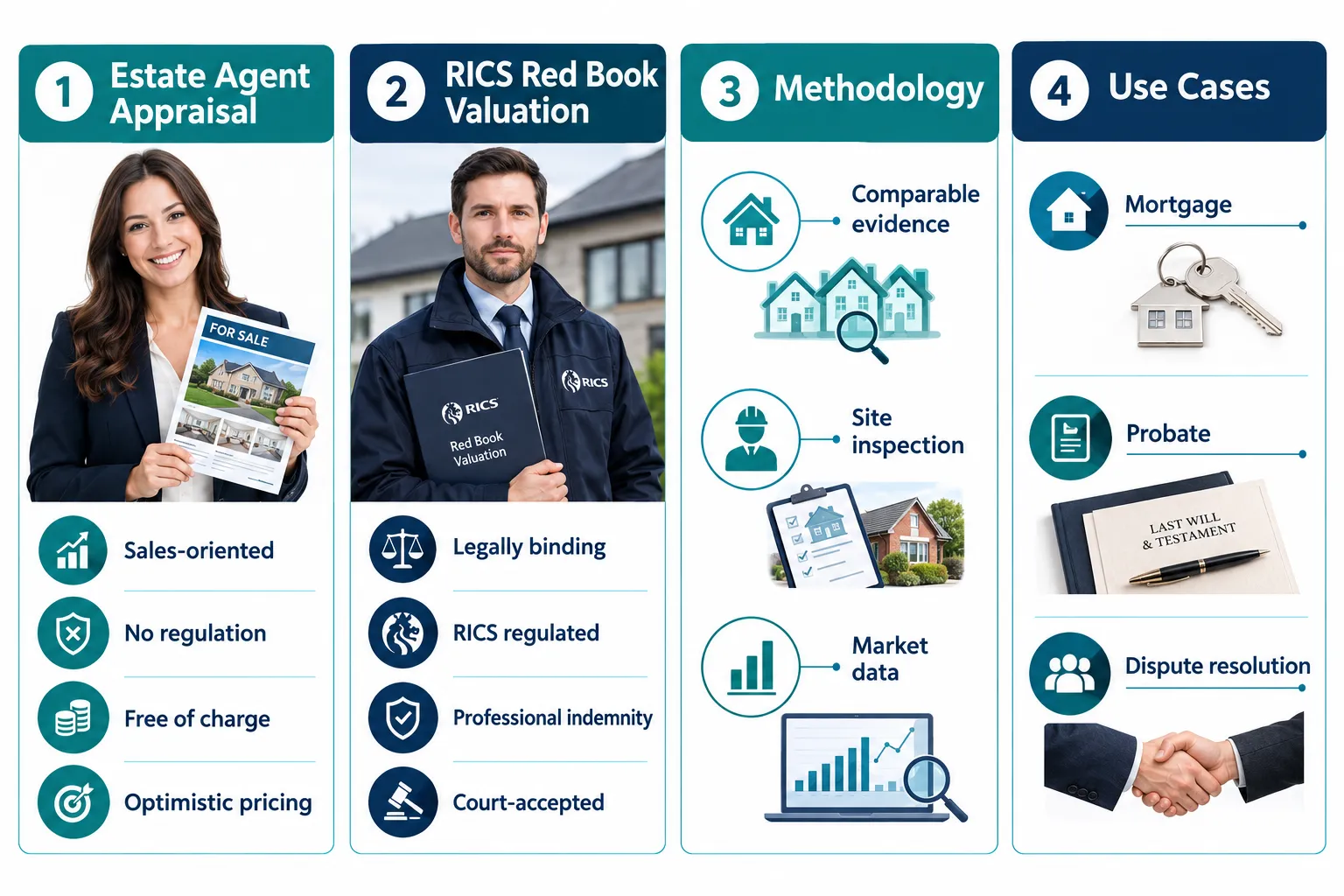
At first glance, both an estate agent appraisal and a chartered surveyor's valuation appear to answer the same question: what is this property worth? In practice, they are entirely different products serving entirely different purposes. [1]
Estate agent market appraisals are, by design, marketing instruments. An agent visits a property, reviews recent local sales, and produces a recommended asking price, typically free of charge. The motivation is to win the instruction to sell. This creates an inherent tension: agents who quote higher figures are more likely to be selected by sellers, which can result in systematically optimistic valuations that bear little relation to what a buyer will actually pay or what a lender will accept. [10]
Chartered surveyor valuations, by contrast, are regulated professional services. They follow the RICS Valuation, Global Standards, commonly known as the Red Book, the latest edition of which took effect on 31 January 2025, with a UK national supplement specifying that market value or market rent are the primary bases for residential property. [3] These valuations are produced by RICS-registered valuers who carry professional indemnity insurance and are subject to RICS disciplinary processes. The resulting report is a legal document, not a sales pitch. [10]
The Regulatory Gap
Estate agents in the UK must belong to an approved redress scheme under government rules, which gives consumers a complaints mechanism. However, this imposes no technical valuation standards comparable to those required of RICS-registered valuers. [12] RICS-regulated firms operate under detailed practice standards, ethics frameworks, and disciplinary regimes that make their valuations consistent, transparent, and defensible for UK buyers and sellers. [2]
This regulatory gap has real consequences. An informal letter from an estate agent stating an opinion of value is routinely rejected by HMRC, mortgage lenders, and the courts. A Red Book valuation from a chartered surveyor is routinely accepted by all three. [10]
| Feature | Estate Agent Appraisal | RICS Chartered Surveyor Valuation |
|---|---|---|
| Cost | Free | Typically £300,£1,000+ |
| Regulatory framework | Redress scheme only | RICS Red Book + UK supplement |
| Legal acceptance | Not accepted | HMRC, courts, lenders |
| Professional indemnity | Not required | Mandatory |
| Primary purpose | Win the listing | Impartial market value |
| Comparable evidence | Selective | Verified and documented |
"A chartered surveyor's valuation is an impartial assessment at a specific valuation date using verified comparable evidence, tenure details and stated assumptions, designed to withstand scrutiny from tax authorities, courts and opposing legal counsel." [1]
For buyers and sellers navigating the 2026 market, understanding this table is not optional. It is the foundation of every sound property decision.
When a Professional Valuation Is Legally Essential
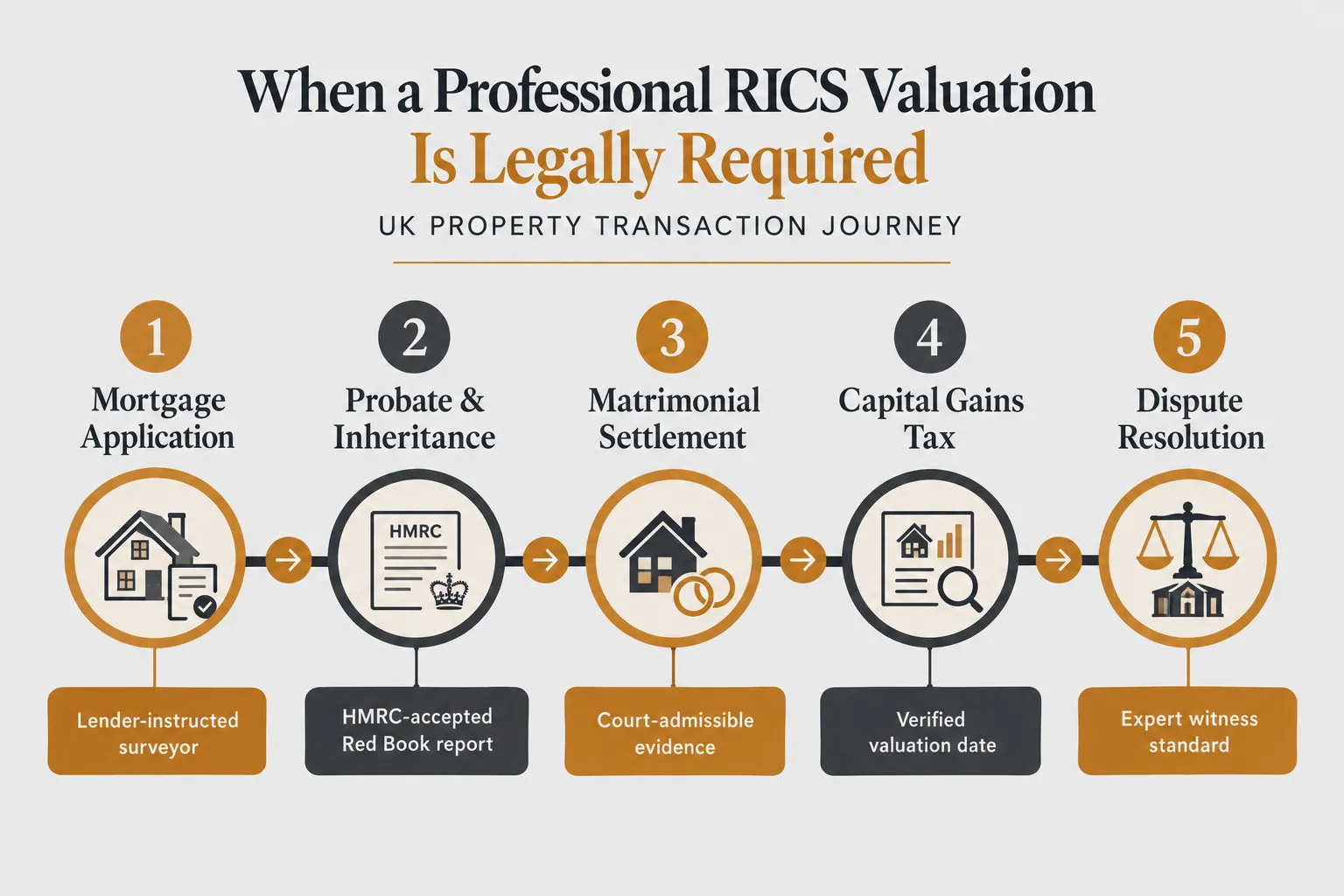
There are specific circumstances in which a professional valuation is not merely advisable but legally required. In each of these situations, an estate agent appraisal will be rejected, and relying on one can result in costly delays, penalties, or failed transactions.
Mortgage and Secured Lending
Mortgage lenders require a valuation before advancing funds. While lenders instruct their own valuers, typically at a cost starting around £150 for a basic mortgage valuation, this is distinct from an independent chartered surveyor valuation. Buyers are strongly advised to commission their own survey in addition to the lender's valuation, as the lender's report protects the bank, not the buyer. [13]
For a comprehensive assessment of condition and value, a Level 3 building survey provides the most detailed professional opinion available, particularly for older or non-standard properties.
Probate and Inheritance Tax
When a property forms part of a deceased estate, HMRC requires a formal valuation to calculate inheritance tax liability. This must be a Red Book valuation from a chartered surveyor. An estate agent's opinion of value, however experienced the agent, will not satisfy HMRC's requirements and can expose executors to penalties if the figure is later challenged. [10]
Capital Gains Tax
When a property has been used as a rental investment or a second home, capital gains tax is calculated on the gain between acquisition value and disposal value. HMRC requires professionally supported figures at specific dates. A chartered surveyor's Red Book valuation provides the documented, defensible evidence needed. [10]
Matrimonial Settlements and Disputes
Family courts require impartial, professionally produced valuations when property is divided as part of a divorce or separation. The surveyor may also be required to act as an expert witness. RICS has published guidance on expert witness preparation for 2026 valuation disputes, recognising that conflicting price signals in the current market make rigorous methodology more important than ever.
Lease Extensions and Enfranchisement
Leaseholders seeking to extend their lease or purchase the freehold under the Leasehold Reform Act require formal valuations from chartered surveyors. The figures produced directly affect the premium payable, and both parties typically instruct their own valuers.
How Chartered Surveyors Protect UK Buyers and Sellers: Methodology and Standards in 2026
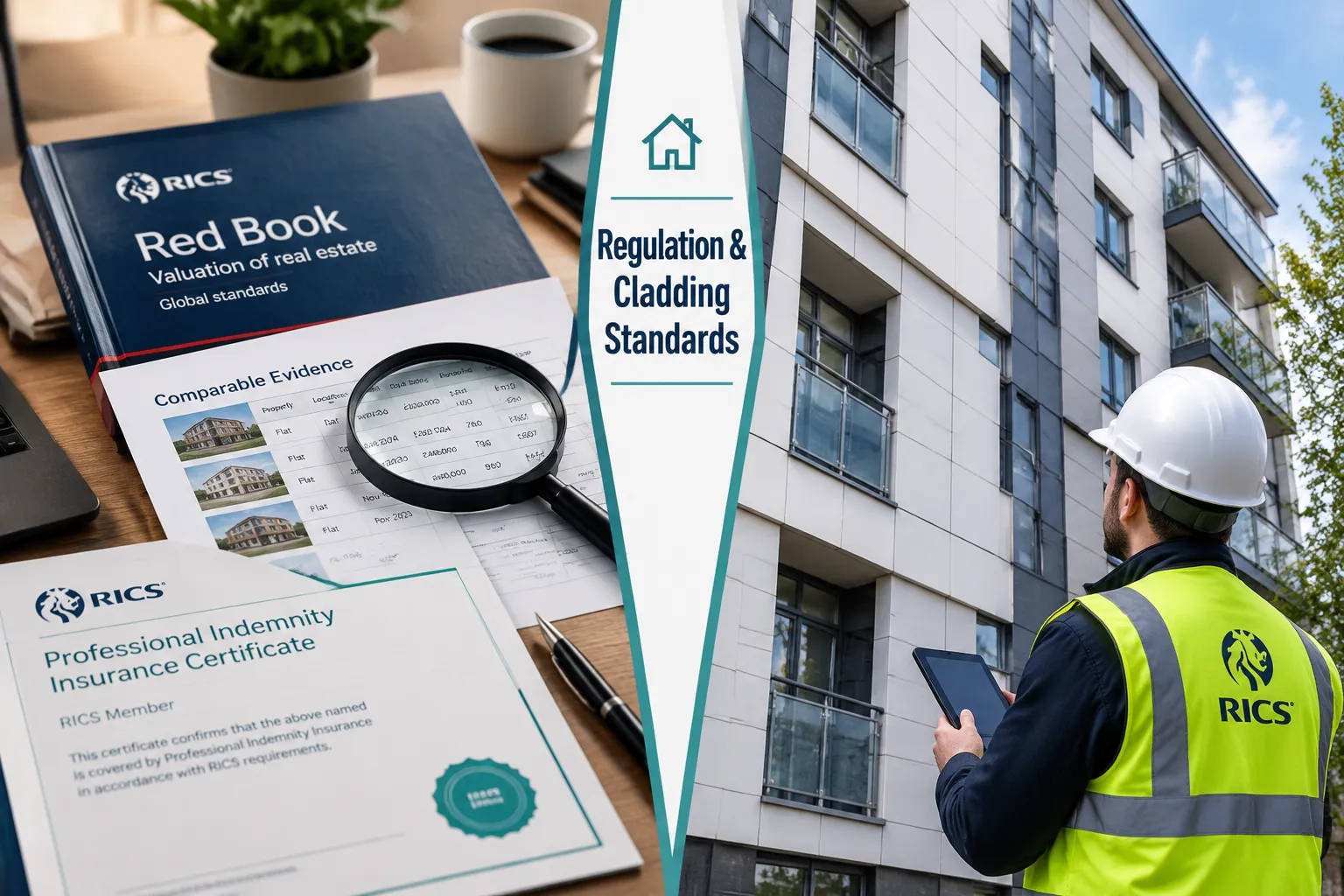
The protection that chartered surveyors provide to UK buyers and sellers in 2026 goes beyond producing a number. It lies in the methodology, the standards framework, and the ongoing evolution of professional practice in response to market conditions.
The Red Book Framework
The RICS Valuation, Global Standards (Red Book) sets out the mandatory requirements for all RICS-registered valuers. The UK national supplement specifies that market value or market rent are the primary bases for residential valuations. [3] This codified framework ensures that valuations are consistent across different surveyors, transparent in their assumptions, and defensible under challenge. [14]
RICS is actively developing the standards further. A dedicated professional standard for residential property valuation for owner occupation is being separated from the Red Book UK national supplement, with a new standard expected around mid-2026 following consultation on legal changes including commonhold. [4] [8] This signals a continued commitment to raising the bar for residential valuers.
Comparable Evidence and Objectivity
One of the most significant methodological differences between a professional valuation and an estate agent appraisal is how comparable evidence is selected and documented. Estate agents may rely on selective or optimistic comparables to support a higher asking price. Chartered surveyors are required to use verified, documented comparable evidence. [7]
RICS launched a 2026 public consultation on its revised global practice guidance "Comparable Evidence in Real Estate Valuation" (2nd edition), with feedback open until 9 September 2026. [7] Refining how comparable evidence is selected and documented directly strengthens the objectivity of chartered surveyors' valuations, a protection that directly benefits buyers and sellers who need accurate figures.
For buyers and sellers in regions experiencing rapid price changes, the Midlands valuation surge and chartered surveyor strategies for 3-4% price growth illustrates how professional methodology adapts to local market conditions.
Cladding and Fire Safety: A Specialist Protection
For buyers of flats in multi-storey buildings, the professional valuation vs estate agent appraisal distinction becomes particularly acute. RICS published a second-edition UK professional standard on secured-lending valuation of multi-storey, multi-occupancy residential buildings, effective from 1 November 2026. [5] [9]
This standard sets proportionate criteria for when EWS1 forms are required, based on building height, visible cladding, curtain wall glazing, and balcony configurations. Critically, it emphasises that EWS1 is only for valuation and lending purposes, protecting buyers from unnecessary delays and inconsistent lender demands. [5] An estate agent appraisal has no mechanism to address these requirements. Only a chartered surveyor's valuation can navigate this regulatory landscape correctly.
Buyers of properties affected by fire safety issues should also review updated building survey protocols for fire safety and cladding remediation to understand the full scope of professional assessment available.
AI and Technology in Professional Valuations
RICS is issuing guidance on the responsible, proportionate, and practical use of AI in valuation practice. [12] Future professional valuations will increasingly integrate advanced data and modelling tools while maintaining human oversight and ethical safeguards. This is an area where estate agent appraisals currently lack equivalent formal governance, meaning that as technology evolves, the quality gap between professional and informal valuations is likely to widen rather than narrow.
For buyers and sellers seeking certainty in property transactions, the data-driven solutions that surveyors use to build client confidence in 2026 represent the direction of travel for the profession.
Market Sentiment and Independent Evidence
RICS's monthly survey, reported in February 2026, shows a net balance of 35% of chartered surveyors in England and Wales expecting an increase in house sales over the following year. [6] This independent, evidence-based view of market trends provides a counterweight to more sales-driven narratives from estate agents, giving buyers and sellers a grounded perspective on where the market is actually heading.
For those considering property in Scotland, chartered surveyor approaches for Scotland property valuations in 2026 explores how professional methodology adapts to a distinct legal and market environment.
Proposed Changes to the Home Survey Standard
Proposed updates to the RICS Home Survey Standard (2nd edition) for 2026 would allow a valuation to be included at any survey level, not just the Level 2 HomeBuyer Report. [11] This means buyers could obtain a full Level 3 building survey with an integrated valuation, improving risk assessment for complex properties and giving sellers professionally backed figures from a single instruction. For buyers of new-build properties, understanding what a Level 3 building survey involves is an important first step.
The broader context of RICS homebuying reforms in 2026 and how mandatory upfront surveys will reshape chartered surveyor workflows signals that the profession is moving toward greater integration of condition assessment and valuation, a development that will further widen the gap between professional valuations and informal estate agent appraisals.
Conclusion
The core message of Professional Valuation vs Estate Agent Appraisal: How Chartered Surveyors Protect UK Buyers and Sellers is straightforward: these are not two versions of the same service. They are fundamentally different products with different purposes, different standards, and different legal weight.
An estate agent appraisal is a free, sales-oriented guide price. It may be a useful starting point for understanding the market, but it carries no regulatory backing, no professional indemnity, and no legal acceptance. A chartered surveyor's Red Book valuation is a regulated, legally defensible professional opinion backed by verified evidence, mandatory standards, and personal professional liability.
Actionable next steps for buyers and sellers in 2026:
- Never rely solely on an estate agent appraisal for any transaction involving a mortgage, probate, tax, or legal dispute. Commission an independent RICS valuation.
- Check the surveyor's credentials. Confirm that the valuer is RICS-registered and that the report will comply with the Red Book and the UK national supplement.
- Match the survey to the property. For older, complex, or cladding-affected properties, instruct a Level 3 building survey with an integrated valuation rather than a basic mortgage valuation.
- Budget appropriately. Independent chartered surveyor valuations typically cost £300,£600, with formal Red Book valuations starting from around £500 and exceeding £1,000 for complex cases. [13] This cost is negligible relative to the financial exposure of proceeding without one.
- Stay informed about evolving standards. RICS is actively revising residential valuation standards in 2026, including cladding guidance effective from November 2026 and new comparable evidence practice guidance. Working with a surveyor who is current with these developments is essential.
The chartered surveyor profession exists precisely to provide the independent, evidence-based, legally defensible assessment that the property market cannot safely function without. In 2026, with market conditions shifting and regulatory standards evolving, that protection matters more than ever.
References
[1] Chartered Surveyors A Professional Guide To Rics Property Valuations – winfieldssurveyors.co.uk
[2] Valuation Standards – rics.org
[3] Residential Valuations – rics.org
[4] Rics Valuation Standards Programme And How To Contribute – rics.org
[5] Valuation Of Properties In Multi Storey Multi Occupancy Residential Buildings With Cladding – rics.org
[6] Housing Market In England Wales Rics Sales House Prices – theguardian.com
[7] Comparable Evidence Changing Valuation Landscape Consultation Update – ww3.rics.org
[8] Residential Property Valuation – community.rics.org
[9] Rics Publishes Updated Standard For Multi Storey Residential Buildings With Cladding – rics.org
[10] Rics Valuation The Definitive Guide To Professional Property Valuations 2026 – winfieldssurveyors.co.uk