

A single unregistered app could cost a landlord £10,000. From 1 October 2026, that is the sharp reality facing anyone in England who checks a tenant's immigration status using a digital provider that is not on the government's official register. The Home Office has quietly rewritten the rulebook on Right to Rent checks, and the Right to Rent changes 1 October 2026 landlords now face arrive at a moment when compliance is already the single most stressful part of letting a property, according to industry research published this week.
This article, published by Prince Surveyors on 3 October 2026, sets out exactly what has changed, how to run a compliant check, and why the wider compliance burden on landlords makes independent property documentation more important than ever.
Key Takeaways
- From 1 October 2026, registered Right to Rent Digital Verification Service Providers (RtR DVSPs) can check certain expired British and Irish passports and digitally issued documents.
- Using any commercial digital checking service that is not on the government's Digital Verification Services Register means the landlord does not get a statutory excuse.
- Manual checks remain fully lawful. No landlord is forced to adopt digital verification.
- Evidence must be kept for the whole tenancy plus one year afterwards; Home Office online check evidence must then be securely destroyed.
- Civil penalties are unchanged at £10,000 per occupier (first breach) and £20,000 (repeat), against a backdrop of lengthening void periods and rising landlord compliance stress.
What Changed on 1 October for Right to Rent Checks
The Home Office's updated landlord's guide to Right to Rent checks took effect in England on 1 October 2026. The core legal duty has not changed: landlords must still confirm that every adult occupier has the right to rent a property in England before granting a tenancy. What has shifted is the technology landlords are permitted to rely on, and the precision required when using it.
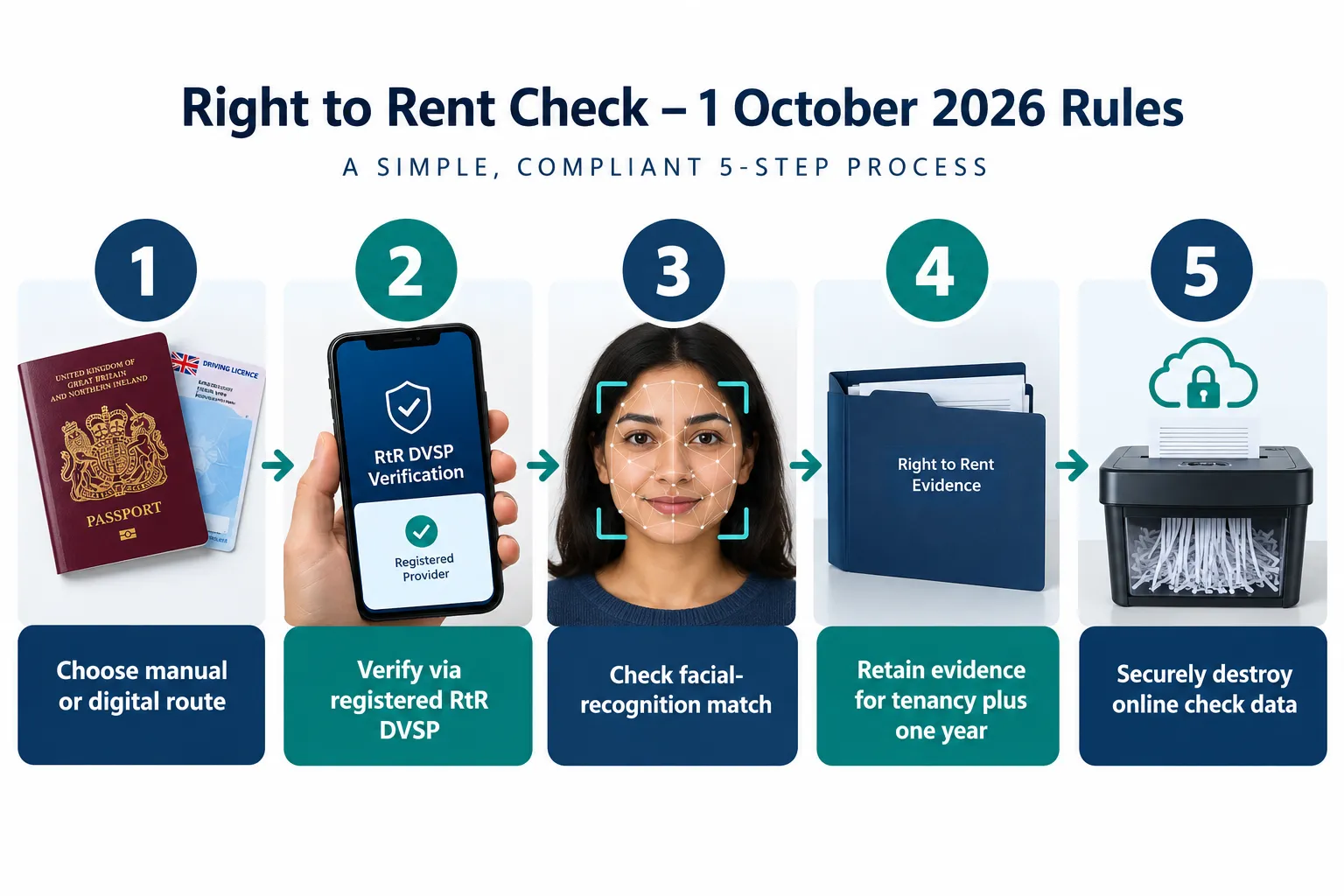
Four points matter most:
- Expanded digital coverage. Registered RtR DVSPs can now check certain expired British and Irish passports, plus digitally issued documents that appear on the prescribed lists. Previously, some of these document types sat outside the scope of digital checking.
- Registration is non-negotiable. Any commercial digital identity service used for a Right to Rent check must appear on the government's Digital Verification Services Register. If it does not, the landlord has not obtained a statutory excuse, full stop, regardless of how convincing the app looks.
- Facial recognition rules tightened. Where a document is matched to the person in front of the landlord using facial-recognition technology, that matching must be carried out through a registered provider. If the technology fails, the applicant keeps the right to prove their identity another way, landlords cannot simply refuse a tenancy because a facial scan glitched.
- Digital documents in manual checks. Documents issued digitally by an authoritative source can now be used as part of a manual check, bridging the old manual/digital divide.
Crucially, manual checks remain entirely lawful. Nothing in the 1 October update obliges any landlord or letting agent to go digital. For portfolios where landlords prefer face-to-face document checks, that route still delivers a full statutory excuse when done correctly.
Step-by-Step: A Compliant Right to Rent Check Under the New Rules
Whichever route is chosen, the process should follow a consistent sequence.
Manual route
- Obtain original documents from List A or List B of the prescribed lists (for example, a valid passport or biometric residence permit).
- Check the document in the presence of the holder, confirming the photo matches and dates are current.
- Make a clear copy and record the date the check was carried out.
- Retain that evidence throughout the tenancy and for one year after it ends.
Digital route
- Confirm the provider appears on the government's Digital Verification Services Register before using it, this step is now the single biggest compliance risk point.
- Use the registered RtR DVSP to verify the document, including newly eligible expired British and Irish passports or digitally issued documents where relevant.
- Where facial-recognition matching is used, ensure it runs through the registered provider's system; offer an alternative verification route if the match fails.
- Store the verification output securely for the tenancy duration plus one year.
- After that retention period, securely destroy any Home Office online check evidence, indefinite retention is not compliant either.
Follow-up checks for time-limited status
Where a tenant's right to rent is time-limited (for example, a visa with an expiry date), landlords must schedule a follow-up check before that status expires, or within the prescribed period set out in the guide. Diarising these dates, not relying on memory, is the practical safeguard most portfolios lack.
Common Mistakes and the Penalties That Follow
The most frequent error is trusting an unregistered digital tool because it feels modern and efficient. It does not matter how accurate the technology is, if the provider is absent from the Digital Verification Services Register, no statutory excuse exists, and the landlord is exposed exactly as if no check had taken place at all.
Other recurring mistakes include failing to repeat checks for time-limited status, destroying evidence too early (before the one-year post-tenancy window closes), or retaining Home Office online check data indefinitely instead of securely destroying it once the retention period ends.
Civil penalties for illegal letting remain unchanged:
| Breach type | First breach | Repeat breach |
|---|---|---|
| Lodger | £5,000 | £10,000 |
| Occupier (landlord) | £10,000 | £20,000 |
These figures apply per lodger or per occupier, so a property with multiple unauthorised occupants can quickly multiply the exposure.
The Bigger Compliance Picture Under the Renters' Rights Act
Right to Rent sits inside a much heavier compliance load. The Landlord Law Newsround of 2 October 2026 highlighted a Rushbrook survey, via Property118, showing that 74% of self-managing landlords say managing property is harder than three years ago. Maintenance and repairs were named the most time-consuming task by 52% of respondents, while compliance itself was identified as the most stressful. Crucially, appointing a managing agent does not transfer legal liability, landlords remain personally accountable for Right to Rent failures and other statutory breaches even when a third party manages the property.
The same report notes average void periods have lengthened to 23.2 days in 2026, up from 17.5 days in 2023, costing roughly £1,357 per void in London and £859 in the West Midlands. Registry Trust data shows consumer CCJs up 11.6% year on year, and industry reporting suggests the Renters' Rights Act is bedding in, with some landlords weighing rent increases or market exits. For a fuller picture of that reform, see the Prince Surveyors guide to the Renters' Rights Act and what landlords must do now, and the detailed breakdown of Section 21 abolition and the new tenancy regime.
Why Documenting Property Condition Still Matters
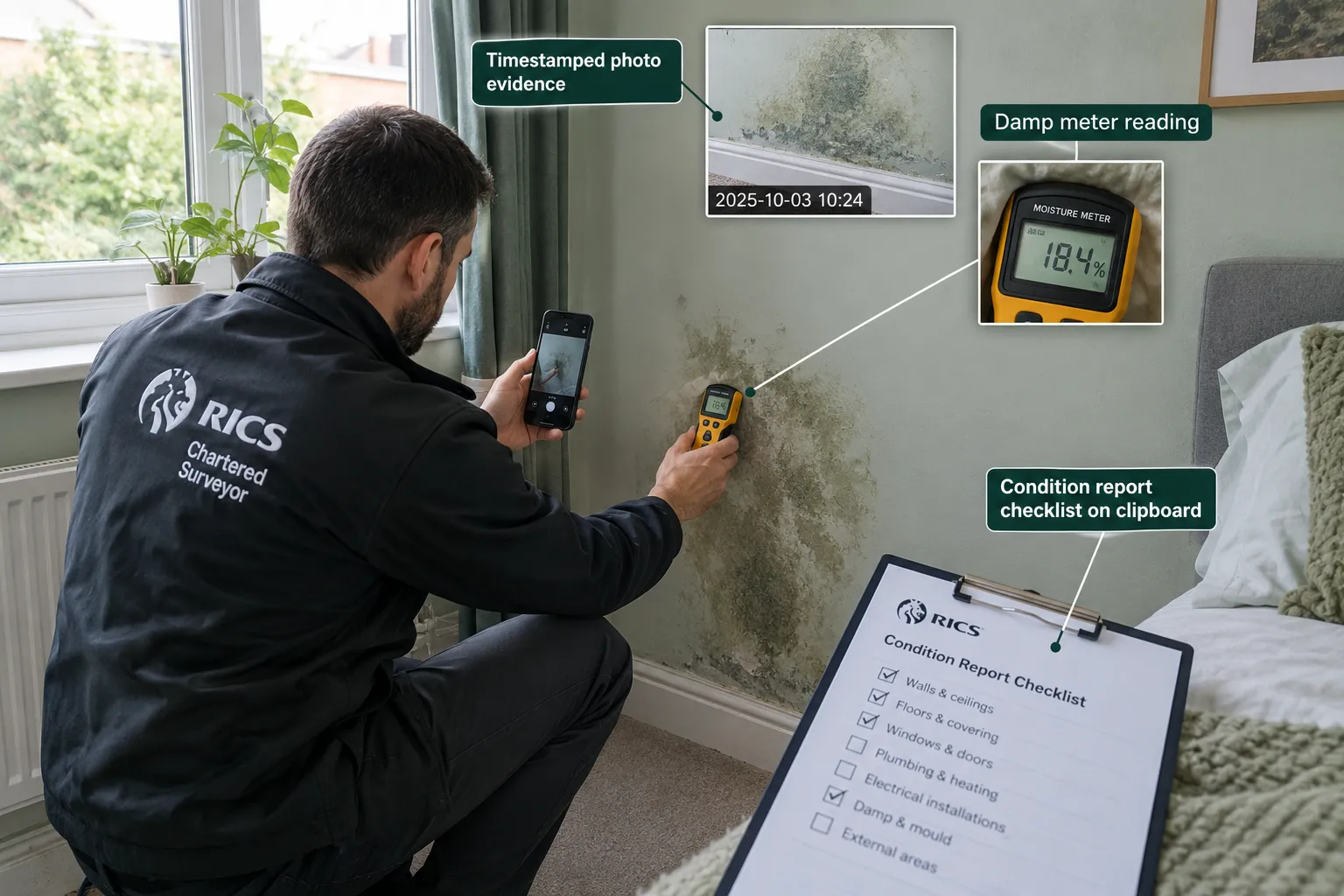
Against rising CCJs and lengthening voids, disputes over deposits and disrepair are becoming more common, and more costly when evidence is thin. An independent inventory, a schedule of condition, or a RICS condition report taken at check-in gives landlords an objective record that stands up when a tenancy ends in disagreement.
This matters particularly for damp and mould claims, where photographic and moisture-reading evidence taken by a qualified surveyor can be the difference between a successful deposit deduction and a lost adjudication. Prince Surveyors' work on damp and mould surveys and private sector landlord protocols sets out the standard evidence landlords should hold. Equally, landlords facing rent or valuation challenges should understand how expert witness valuations support ombudsman and rent review disputes under the new framework.
Autumn 2026 Landlord Checklist
- Confirm whether your digital Right to Rent provider is listed on the government's Digital Verification Services Register.
- Decide deliberately between manual and digital checks, do not default to whichever app a letting agent suggests without verifying registration.
- Diarise follow-up checks for every tenant with time-limited immigration status.
- Set retention reminders: keep evidence for the tenancy plus one year, then securely destroy online check data.
- Commission an independent schedule of condition or RICS condition report at the start of every new tenancy.
- Review void-period costs and compliance workload honestly, consider whether professional support reduces risk, since appointing an agent does not remove personal liability.
- Read up on the Renters' Rights Act bedding-in period, including guidance on buy-to-let risk assessments under the new regime.
FAQ
Do all landlords have to use digital Right to Rent checks now?
No. Manual document checks remain lawful under the 1 October 2026 rules. Digital verification is an option, not an obligation.
What happens if I use a digital provider that isn't on the government register?
You do not obtain a statutory excuse, meaning you carry the same civil penalty risk as if no check had been done at all.
How long must I keep Right to Rent evidence?
Throughout the tenancy and for one year afterwards. Home Office online check evidence must then be securely destroyed.
Does using a letting agent protect me from Right to Rent penalties?
No. Research cited in the Landlord Law Newsround confirms appointing an agent does not transfer legal liability to that agent.
Are the civil penalty amounts changing in October 2026?
No. Penalties remain £10,000 per occupier (first breach) and £20,000 (repeat), and £5,000/£10,000 for lodgers.
Conclusion
The Right to Rent changes 1 October 2026 landlords must now navigate are technical rather than revolutionary, but the margin for error is unforgiving. A single unregistered digital provider can strip away a landlord's statutory excuse entirely, while the wider compliance landscape, lengthening voids, rising CCJs, and a bedding-in Renters' Rights Act, leaves little room for avoidable mistakes. The practical next step is straightforward: confirm registration status before relying on any digital check, diarise retention and follow-up dates, and pair immigration compliance with robust, independent documentation of property condition. Prince Surveyors' RICS chartered surveyors support landlords across England with condition reports, schedules of condition, and expert evidence that reduce risk long after the tenancy begins.
Right to Rent, landlord compliance, Home Office guidance, digital verification, Renters Rights Act, civil penalties, tenant checks, letting agents England, property inspection, RICS surveyors, deposit disputes, void periods