

Nearly 4 million privately rented homes in England show some evidence of damp — yet the legal framework compelling landlords to act swiftly and systematically is only now reaching the private rented sector (PRS). Damp and Mould Surveys Under Awaab's Law Pre-May 2026: Protocols for Private Sector Landlords represents one of the most significant compliance challenges facing buy-to-let investors and property managers in 2026. With the full PRS extension anticipated around May 2026, the window for proactive preparation is narrow — and the consequences of inaction are serious.
Key Takeaways 📋
- Awaab's Law extends to the private rented sector around May 2026, requiring landlords to investigate and remediate damp and mould within strict timeframes.
- Proactive damp and mould surveys conducted before the deadline dramatically reduce legal liability and remediation costs.
- Category 1 hazards under the Housing Health and Safety Rating System (HHSRS) carry the highest risk — surveyors must identify these first.
- Survey protocols must align with both Awaab's Law requirements and the overlapping obligations introduced by the Renters' Rights Act.
- Chartered surveyors play a critical role in producing defensible, evidence-based reports that protect landlords in enforcement proceedings.
What Is Awaab's Law and Why Does It Matter to Private Landlords?
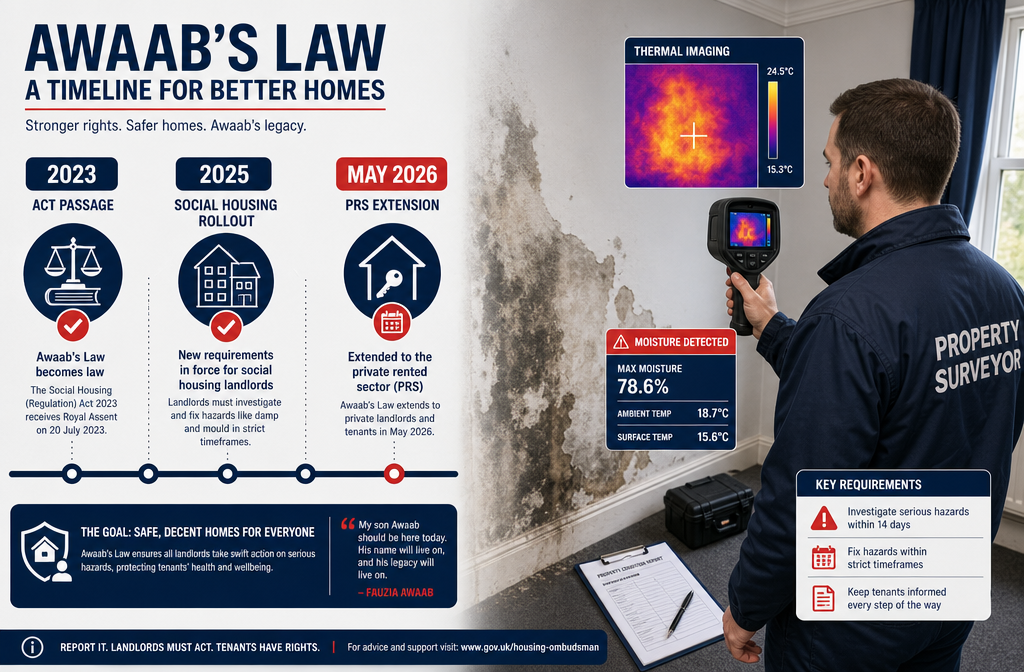
Awaab's Law takes its name from Awaab Ishak, a two-year-old boy who died in 2020 as a direct result of prolonged exposure to black mould in a social housing property in Rochdale. The subsequent inquest and public outcry led Parliament to introduce Section 42 of the Social Housing (Regulation) Act 2023, creating legally enforceable timeframes for landlords to investigate and fix damp and mould hazards.
Initially applied to registered social landlords from late 2025, the legislation is being extended to the private rented sector with effect from approximately May 2026. This extension means that private landlords — including individual buy-to-let investors, portfolio landlords, and letting agents — face the same statutory obligations that social housing providers have been preparing for since the Act's passage.
The Core Legal Obligations
Under Awaab's Law, once a tenant reports damp or mould:
| Obligation | Timeframe |
|---|---|
| Acknowledge and begin investigation | 14 days |
| Complete a written hazard assessment | Within investigation period |
| Begin emergency repairs (where a health risk exists) | 24 hours |
| Complete all remediation works | 7 weeks (standard cases) |
| Provide written confirmation of completion | On finishing works |
💡 Pull Quote: "Awaab's Law does not give landlords the option to dismiss damp complaints as cosmetic. Every report triggers a legal clock."
These are not aspirational targets. Failure to comply exposes landlords to enforcement action by local housing authorities, rent repayment orders, and civil liability. Understanding the implications of property market legislation changes is now essential for any landlord operating in 2026.
The Renters' Rights Act Overlap: A Compounding Compliance Burden
Awaab's Law does not operate in isolation. The Renters' Rights Act, which abolishes Section 21 "no-fault" evictions and strengthens tenants' rights across the board, creates a compounding compliance environment. Landlords who previously relied on eviction as a response to difficult maintenance disputes now have no such escape route.
This means:
- Damp and mould complaints cannot be managed by removing the tenant — they must be resolved.
- Tenants have stronger grounds to challenge landlords at the First-tier Tribunal.
- Local councils have enhanced enforcement powers, including civil penalties of up to £40,000 for serious breaches.
The overlap between these two pieces of legislation makes pre-May 2026 damp and mould surveys not just advisable but strategically essential. Landlords who commission thorough surveys now can demonstrate good faith, identify latent defects before they become Category 1 hazards, and create a documented baseline that protects them in any future dispute.
Understanding HHSRS Category 1 Hazards in Damp Surveys
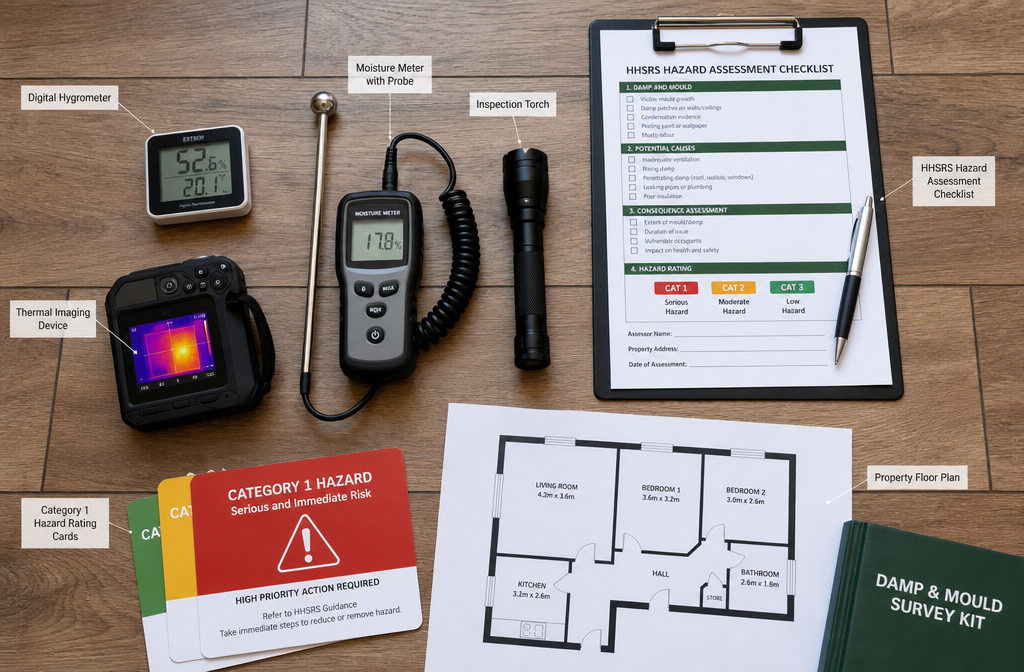
The Housing Health and Safety Rating System (HHSRS) is the technical framework surveyors use to assess hazards in residential properties. It scores hazards by the probability of harm and the severity of potential outcomes. Category 1 hazards are those where the risk is judged to be the most serious — and damp and mould frequently qualify.
How Damp Becomes a Category 1 Hazard
Damp and mould fall under the HHSRS hazard profile for "Damp and Cold" and "Biological Agents" (including mould spores). A Category 1 rating is triggered when:
- 🔴 Mould growth covers significant surface areas, particularly in bedrooms or living spaces
- 🔴 There is evidence of penetrating or rising damp affecting habitable rooms
- 🔴 Condensation is chronic and linked to inadequate ventilation or heating
- 🔴 Vulnerable occupants (children, elderly, immunocompromised individuals) are present
Local housing authorities are legally required to take enforcement action when a Category 1 hazard is identified. This can include improvement notices, prohibition orders, or emergency remedial action at the landlord's expense.
Why Proactive Surveys Change the Risk Profile
A landlord who commissions a building defects survey before receiving a formal complaint is in a fundamentally different legal position from one who waits. Proactive surveys:
- Identify hazards before they reach Category 1 severity
- Generate a documented record of the property's condition
- Allow remediation on the landlord's timeline rather than a statutory one
- Demonstrate the "reasonable steps" defence in enforcement proceedings
Protocols for Damp and Mould Surveys Under Awaab's Law Pre-May 2026: Protocols for Private Sector Landlords
A compliant damp and mould survey is not a simple visual inspection. It requires a structured methodology, appropriate instrumentation, and a written report that meets evidential standards. The following protocol reflects best practice for private sector landlords preparing ahead of the May 2026 deadline.
Step 1: Commission a Qualified Surveyor
Only a RICS-accredited chartered surveyor or a surveyor with recognised competence in building pathology should conduct a damp and mould survey for Awaab's Law compliance purposes. The surveyor should have experience in building pathology — the diagnostic science of identifying why buildings fail.
What to look for in a surveyor:
- RICS membership (MRICS or FRICS)
- Experience with HHSRS assessments
- Familiarity with Awaab's Law obligations
- Ability to produce court-ready reports
Step 2: Pre-Survey Data Gathering
Before the physical inspection, the surveyor should collect:
- Tenancy history and any previous maintenance records
- Prior complaints or correspondence about damp
- Details of any previous remediation attempts
- Building age, construction type, and any known defects
- Heating and ventilation system specifications
Step 3: The Physical Inspection
A thorough inspection covers every room, including roof spaces, cellars, and outbuildings. Key instruments include:
| Instrument | Purpose |
|---|---|
| Moisture meter | Measures moisture content in walls, floors, and ceilings |
| Thermal imaging camera | Reveals cold bridges, hidden condensation, and insulation gaps |
| Digital hygrometer | Records relative humidity and temperature |
| Borescope | Inspects cavities and voids without destructive opening |
| Damp proof course probe | Assesses DPC integrity at ground level |
The surveyor should also assess ventilation adequacy — a critical factor in condensation-related mould growth. Poor mechanical ventilation is one of the most common and correctable causes of damp in UK rental properties. Understanding why mechanical ventilation is essential in buildings provides useful context for landlords unfamiliar with ventilation standards.
Step 4: HHSRS Hazard Scoring
Every identified damp issue must be scored using the HHSRS methodology. The surveyor calculates:
- Likelihood of harm (probability of an occurrence causing harm within 12 months)
- Spread of harm (range of outcomes from minor discomfort to death)
- Hazard score (product of likelihood and harm weighting)
Scores above 1,000 indicate a Category 1 hazard requiring urgent action.
Step 5: The Written Report
The survey report must be:
- ✅ Dated and signed by the surveyor
- ✅ Specific about the location and extent of each defect
- ✅ Clear on HHSRS hazard classification
- ✅ Accompanied by photographic evidence
- ✅ Inclusive of a prioritised remediation schedule with cost estimates
- ✅ Referenced to relevant legislation and standards
This report becomes the landlord's primary defence document in any enforcement or tribunal proceedings.
Practical Remediation: What Surveys Typically Uncover

The most common findings in pre-compliance damp surveys of private rental properties in 2026 include:
1. Condensation and Surface Mould — The most prevalent issue, typically caused by inadequate heating, poor ventilation, and lifestyle factors. Remediation often involves improved extraction fans, trickle vents, and tenant education.
2. Penetrating Damp — Water ingress through defective roofing, guttering, or external walls. A roofing surveyor assessment is frequently required as a follow-up to identify the precise source.
3. Rising Damp — Moisture travelling upward through walls from the ground, usually indicating a failed or absent damp proof course. Less common than condensation but more structurally significant.
4. Interstitial Condensation — Moisture forming within wall or roof structures, often invisible until significant damage has occurred. Thermal imaging is essential for detection.
5. Structural Defects Allowing Water Ingress — Cracked render, failed pointing, and defective window seals. These may require urgent or dangerous building issue assessments where structural integrity is compromised.
Remediation Priority Matrix
| Severity | Category | Action Required | Timeframe |
|---|---|---|---|
| Mould covering >1m² in habitable room | Category 1 | Immediate investigation + repair | 24–48 hours |
| Active water ingress through roof/wall | Category 1 | Emergency repair | 24 hours |
| Minor surface mould, no vulnerable occupants | Category 2 | Planned remediation | Within 7 weeks |
| Condensation with adequate ventilation | Below threshold | Preventive measures | Scheduled |
Awaab's Law Pre-May 2026 Survey Protocols: Managing Liability Through Documentation
One of the most underappreciated aspects of Damp and Mould Surveys Under Awaab's Law Pre-May 2026: Protocols for Private Sector Landlords is the documentation trail. Landlords who conduct surveys, act on findings, and maintain records are substantially better protected than those who rely on informal inspections or verbal assurances.
Record-Keeping Best Practice
- Keep all survey reports for a minimum of six years (the standard limitation period for contract claims)
- Document all tenant communications about damp and mould in writing
- Photograph remediation works before, during, and after completion
- Obtain contractor sign-off confirming works meet the required standard
- Re-survey after major remediation to confirm hazard elimination
For landlords managing multiple properties, a regular property inspection schedule is the foundation of proactive compliance. Quarterly inspections with documented outcomes create a defensible record that demonstrates ongoing due diligence.
The Role of Construction and Condition Surveys
For older properties or those with complex defect histories, a construction and condition survey provides a comprehensive baseline assessment that goes beyond a standard damp inspection. This level of survey examines the building fabric holistically — identifying not just active damp but the underlying construction vulnerabilities that make recurrence likely.
Cost Considerations and Return on Investment
Landlords sometimes resist commissioning professional surveys due to cost. This is a false economy. Consider the financial exposure:
- Rent repayment orders: Up to 12 months' rent returned to the tenant
- Civil penalties: Up to £40,000 per offence
- Emergency works: Local authority remediation at the landlord's expense, often at premium rates
- Legal costs: Tribunal representation and expert witness fees
- Reputational damage: Adverse publicity and difficulty re-letting
A professional damp and mould survey typically costs between £400 and £1,200 depending on property size and complexity — a fraction of the potential liability. For portfolio landlords, bulk survey agreements with chartered surveyors can reduce per-property costs significantly.
Conclusion: Act Now Before the Clock Starts
The pre-May 2026 period is the last opportunity for private sector landlords to get ahead of Awaab's Law on their own terms. Once the PRS extension takes effect, every damp and mould complaint triggers a statutory clock — and landlords without documented survey baselines will be responding reactively rather than proactively.
Actionable Next Steps for Private Landlords
- Audit your portfolio — Identify properties with known or suspected damp issues as a priority.
- Commission RICS-accredited surveys — Engage a chartered surveyor experienced in building pathology and HHSRS assessments before May 2026.
- Act on findings immediately — Remediate Category 1 hazards without delay; schedule Category 2 works within a planned maintenance programme.
- Review ventilation across all properties — Address condensation risk proactively through improved extraction and heating controls.
- Establish a documentation system — Create a compliance file for each property containing survey reports, remediation records, and tenant communications.
- Seek construction law advice — For complex cases or disputed liability, specialist construction law advice can clarify obligations and protect landlord interests.
The landlords who will navigate Awaab's Law most successfully are those who treat damp and mould surveys not as a regulatory burden but as a professional standard of property management. The evidence is clear, the legislation is coming, and the time to act is now.