

Last updated: July 24, 2026
Quick Answer: Party wall surveyor fees in 2026 typically range from £900 to £2,700 per appointment for straightforward domestic projects, with London rates running 20-40% higher. Building owners can reduce costs by proposing an agreed surveyor, serving notices early, and negotiating fixed-fee arrangements, all legitimate strategies under the Party Wall etc. Act 1996.
Key Takeaways
- Party wall surveyor fees for domestic projects range from approximately £900 to £2,700 per appointment in 2026, with hourly rates between £150 and £300.
- The building owner who initiates the work is legally responsible for paying the reasonable fees of both their own surveyor and the adjoining owner's surveyor.
- Appointing a single agreed surveyor instead of two separate surveyors can reduce combined costs by 25-35%.
- Around 45% of party wall notices are consented to by neighbours, which eliminates the need for surveyor appointments entirely.
- Fixed-fee arrangements are increasingly available in 2026 and offer better cost certainty than open-ended hourly billing.
- London and South East fees are consistently higher than national averages due to demand and project complexity.
- Building owners have the right to challenge excessive surveyor fees through formal dispute mechanisms.
- Ignoring the Party Wall etc. Act 1996 can result in injunctions, legal costs, and significant project delays.
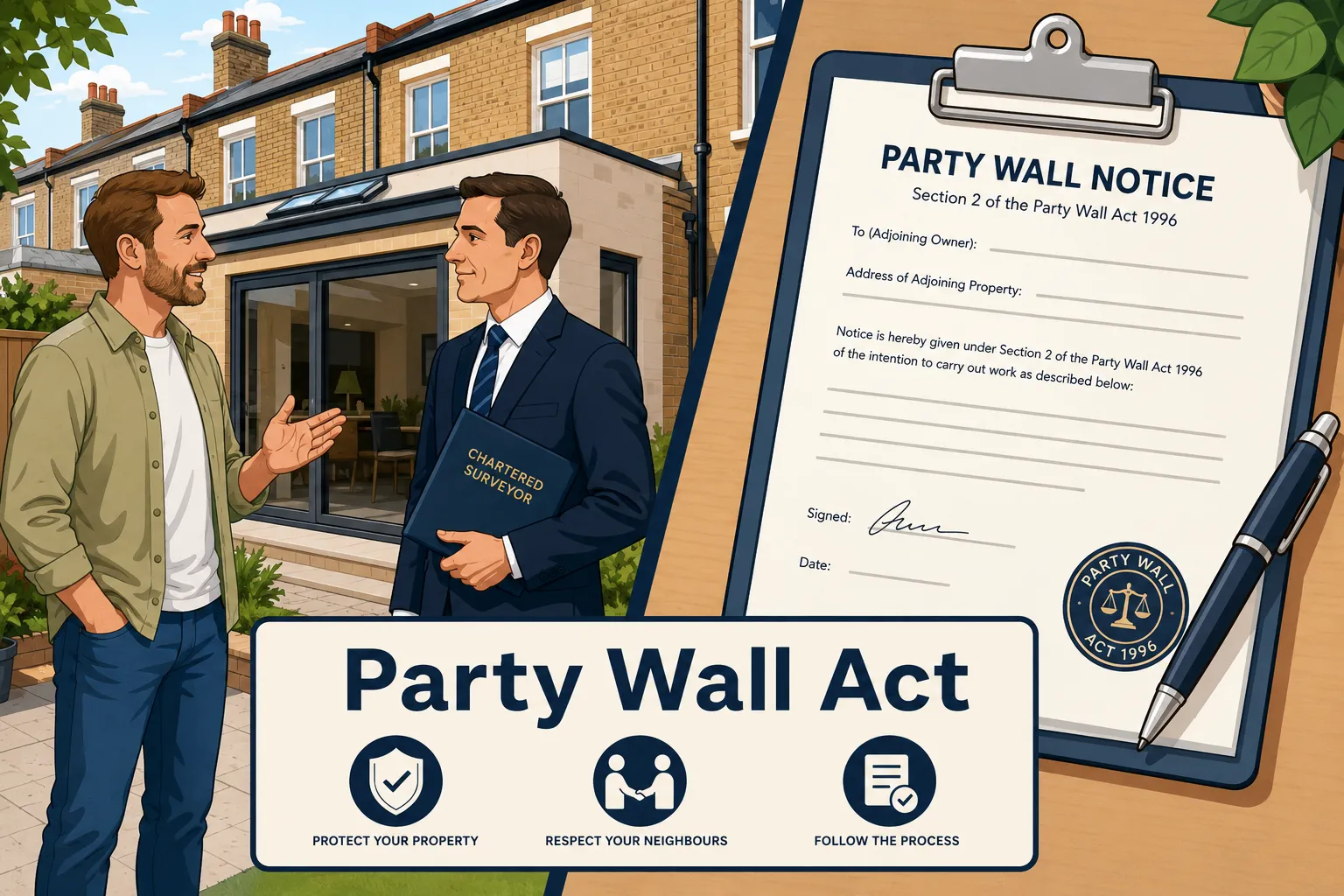
What Is a Party Wall Surveyor and Why Do You Need One
A party wall surveyor is a specialist, usually a chartered building surveyor, appointed to administer the Party Wall etc. Act 1996 when building works affect a shared wall, boundary, or structure between neighbouring properties. Their role is to protect both the building owner and the adjoining owner by producing a legally binding Party Wall Award.
You need one when your planned works fall under the Act. This includes:
- Rear or side extensions that involve cutting into or building on a party wall
- Loft conversions requiring steel beams to be inserted into a party wall
- Basement excavations within 3-6 metres of a neighbour's foundations
- Demolition and rebuilding of a shared wall
Without a valid Party Wall Award in place, you risk injunctions that halt your project mid-build. For a fuller explanation of when the Act applies, see this guide on whether you need a party wall surveyor.
How Much Does a Party Wall Surveyor Cost in 2026
In 2026, fees for a straightforward domestic party wall appointment range from £900 to £2,700. Hourly rates sit between £150 and £300 depending on the surveyor's seniority and location.
When both parties appoint separate surveyors, which happens when a neighbour dissents from a notice, combined fees can reach £1,800 to £5,400 for more complex cases. The building owner typically pays both sets of fees. For a detailed breakdown, see our dedicated guide on the cost of a party wall surveyor.
Key cost drivers in 2026:
| Factor | Impact on Fees |
|---|---|
| London / South East location | 20-40% above national average |
| Multiple adjoining owners | Additional fee per appointment |
| Complex works (basement, underpinning) | Higher hourly time commitment |
| Agreed surveyor vs. two surveyors | 25-35% saving with agreed surveyor |
| Fixed fee vs. hourly billing | Fixed fee offers cost certainty |
What Are RICS Recommended Fees for Party Wall Surveys
RICS (the Royal Institution of Chartered Surveyors) does not publish a fixed mandatory fee scale for party wall work. Instead, RICS guidance requires that fees be "reasonable and proportionate" to the work involved. Surveyors are expected to justify their charges based on time, complexity, and expertise.
This means fee negotiation is not only possible, it is expected. A surveyor who cannot explain their fee structure in clear terms is a red flag. When negotiating party wall surveyor fees and RICS scales and strategies for building owners in 2026, the key benchmark is whether the fee reflects the actual time and skill the instruction demands.
What RICS guidance does say:
- Fees must be transparent and agreed in writing before work begins.
- Surveyors acting under the Act owe a duty to both parties, not just the one who appointed them.
- Excessive or disproportionate charges can be challenged through the Third Surveyor mechanism in the Act.
Can You Negotiate Party Wall Surveyor Fees
Yes, and in many cases you should. Negotiating party wall surveyor fees using RICS scales and strategies for building owners in 2026 is a practical and legitimate approach, not an adversarial one.
Effective negotiation strategies:
- Request a fixed fee upfront. Fixed-fee arrangements are more widely available in 2026. Ask for a written quote that covers the full scope: notice preparation, schedule of condition, and the Award itself.
- Propose an agreed surveyor. If your neighbour is willing, a single agreed surveyor acting for both parties typically costs 25-35% less than two separate appointments. See our complete guide to the agreed surveyor role.
- Get three quotes. Fees vary significantly between firms. Comparing quotes from RICS-registered surveyors gives you a market benchmark.
- Scope the work clearly. Vague instructions lead to open-ended billing. Provide your surveyor with full plans and a clear brief before they start.
- Serve notices early. Early notice gives surveyors more lead time, which can reduce rushed-work premiums and gives neighbours time to consent without appointing a surveyor at all.
"The single most cost-effective action a building owner can take is to talk to their neighbour before serving any formal notice. Consent from a neighbour eliminates surveyor fees entirely."
What Is Included in a Party Wall Survey Fee
A standard party wall surveyor fee covers several distinct stages of work, not just a single site visit.
Typical inclusions:
- Drafting and serving party wall notices on adjoining owners
- Preparing a schedule of condition (a photographic and written record of the neighbour's property before works begin)
- Negotiating and drafting the Party Wall Award, the legally binding document governing how works proceed
- Site inspections during construction
- Post-completion inspections if damage is alleged
What may be charged separately:
- Additional adjoining owners (each requires a separate appointment)
- Specialist structural calculations or party wall drawings
- Attendance at Third Surveyor proceedings
Understanding what is and is not included helps avoid invoice surprises. Always ask for a written scope of service before appointing.

Party Wall Surveyor Fees for Different Types of Work: Extensions vs Lofts
The type of work directly affects the time a surveyor must spend, and therefore the fee. Extensions and loft conversions are the two most common domestic triggers.
Rear extensions: These typically involve notifiable works to a party wall (cutting in, building up, or using the wall as a support). Fees at the lower end of the range (around £900,£1,400) are common for straightforward single-storey extensions with one adjoining owner.
Loft conversions: Steel beam insertions into a party wall are standard in loft work. Complexity depends on beam size and the number of walls affected. Fees in the £1,200,£2,000 range are typical. For specific guidance, see do you need a party wall agreement for lofts.
Basement excavations: These are the most fee-intensive category. Excavation within 3-6 metres of a neighbour's foundations triggers the Act, and the structural risk is higher. Fees can reach £2,700 or more per appointment. For basement-specific considerations in Surrey and South London, see our article on basements and party wall surveyors.
Party Wall Surveyor Fees for Listed Buildings or Conservation Areas
Works to listed buildings or properties in conservation areas attract higher fees because the surveyor must account for additional regulatory constraints, specialist materials, and greater documentation requirements.
Surveyors working on listed buildings need familiarity with Listed Building Consent requirements and the potential for Historic England involvement. This specialist knowledge justifies a premium above standard domestic rates. For background on what these designations mean for your project, see our guide on listed buildings and conservation areas.
Practical advice: When your property or your neighbour's is listed, budget at the upper end of the fee range and confirm in writing that your chosen surveyor has relevant listed building experience.
Party Wall Surveyor Fees vs Structural Engineer Costs
Party wall surveyors and structural engineers serve different functions, and their fees reflect that. A party wall surveyor administers the legal process under the Act. A structural engineer designs and certifies the structural elements of your project.
For most extensions and loft conversions, you will need both. Structural engineer fees for domestic projects typically range from £500 to £2,000 depending on scope, broadly comparable to party wall surveyor fees at the lower end, but for a different service. The two are not interchangeable, and one does not replace the other.
For guidance on when you need additional professional input alongside your surveyor, see 4 reasons why property owners hire surveyors.
How to Find Affordable Party Wall Surveyors Near You
Affordable does not mean cheapest. The goal is value: a qualified, RICS-registered surveyor who delivers a clear, enforceable Award without unnecessary delays or costs.
Steps to find good-value surveyors:
- Search the RICS Find a Surveyor directory and filter by party wall specialism.
- Ask your architect or planning consultant for a referral, they work with surveyors regularly.
- Request written quotes from at least three firms and compare scope, not just headline price.
- Check whether the firm offers fixed-fee packages, which are increasingly standard in 2026.
- Verify the surveyor is a Member or Fellow of RICS (MRICS or FRICS) and carries professional indemnity insurance.
Avoid surveyors who quote verbally without a written scope, or who cannot explain what the fee covers.
Do You Really Need a Party Wall Surveyor, or Can You Skip It
You cannot legally skip the Party Wall etc. Act 1996 if your works fall within its scope. However, you may not need to appoint a surveyor at all if your neighbour consents in writing to your notice.
Around 45% of party wall notices are consented to, which means no surveyor appointment and no fees. The key is serving a clear, accurate notice and maintaining a good relationship with your neighbour. For more on what happens when neighbours refuse, see what to do when a neighbour refuses party wall works.
Common misconceptions: Many building owners believe the Act only applies to major works. In fact, even minor works like cutting a flashing into a party wall can trigger it. See 5 common misconceptions about party wall agreements for a full breakdown.
What Happens If You Do Not Hire a Party Wall Surveyor
Proceeding without complying with the Act exposes you to serious legal and financial risk. An adjoining owner can apply to the courts for an injunction to stop your works immediately, even mid-build. You may also be liable for the cost of making good any damage, plus your neighbour's legal costs.
The consequences of ignoring the Party Wall Act can far exceed the cost of proper compliance. Injunctions are expensive and cause project delays that typically cost more than the surveyor fees avoided.
How to Dispute or Challenge Party Wall Surveyor Fees
If you believe a surveyor's fees are excessive or unjustified, you have formal routes to challenge them. This is a legitimate part of negotiating party wall surveyor fees using RICS scales and strategies for building owners in 2026.
Grounds for challenge include:
- Hourly rates significantly above market rates without justification
- Time claimed for work that was not necessary or not performed
- Appointment of unnecessary specialist consultants
- Failure to provide a written fee agreement before starting work
How to challenge:
- Request an itemised fee breakdown in writing.
- If the fee relates to the adjoining owner's surveyor (which you as building owner must pay), raise the issue with your own surveyor first.
- If the two surveyors cannot agree, the matter is referred to the Third Surveyor named in the Award, this is a formal mechanism under the Act and does not require court proceedings.
- For persistent disputes, RICS offers a dispute resolution service for complaints against its members.
Party Wall Surveyor Taking Too Long: What Should You Do
A party wall surveyor who is causing unreasonable delays can hold up your entire project. The Act does not set strict timescales for producing an Award, but surveyors have a professional duty to act promptly.
Practical steps:
- Write formally to the surveyor requesting a completion date for the Award.
- If both parties have separate surveyors, your surveyor can press the adjoining owner's surveyor directly.
- In extreme cases, the Third Surveyor can be asked to intervene if one surveyor is obstructing the process.
- Document all communications in writing so there is a clear record if escalation becomes necessary.
Delays are more common when surveyors are handling high volumes of instructions. Appointing a surveyor with capacity, not just the cheapest available, reduces this risk.
Party Wall Surveyor Fee Calculator
.pwf-wrap{font-family:Arial,sans-serif;max-width:480px;margin:0 auto;background:#f7f9fc;border:1px solid #d0d8e4;border-radius:8px;padding:20px;box-sizing:border-box}
.pwf-wrap h3{margin:0 0 14px;font-size:1.1rem;color:#1a2e4a}
.pwf-row{margin-bottom:12px}
.pwf-row label{display:block;font-size:.85rem;color:#333;margin-bottom:4px;font-weight:600}
.pwf-row select{width:100%;padding:7px 10px;border:1px solid #b0bec5;border-radius:5px;font-size:.9rem;background:#fff}
.pwf-btn{width:100%;padding:10px;background:#1a2e4a;color:#fff;border:none;border-radius:5px;font-size:1rem;cursor:pointer;margin-top:4px}
.pwf-btn:hover{background:#2a4a6e}
.pwf-result{margin-top:14px;background:#e8f0fe;border-left:4px solid #1a2e4a;padding:12px 14px;border-radius:4px;display:none}
.pwf-result p{margin:4px 0;font-size:.9rem;color:#1a2e4a}
.pwf-result strong{font-size:1.05rem}
Party Wall Fee Estimator 2026
Estimated total fee range:
function pwfCalc(){
var w=document.getElementById(‘pwf-work’).value;
var l=document.getElementById(‘pwf-loc’).value;
var a=document.getElementById(‘pwf-arr’).value;
var lo=[900,1400],hi=[1400,2700],note=””;
if(w===’ext’){lo=[900,1100];hi=[1300,1800];}
else if(w===’loft’){lo=[1100,1300];hi=[1600,2200];}
else if(w===’basement’){lo=[1500,1800];hi=[2400,3200];}
else{lo=[900,1100];hi=[1300,1800];}
if(l===’london’){lo[0]=Math.round(lo[0]*1.3);lo[1]=Math.round(lo[1]*1.3);hi[0]=Math.round(hi[0]*1.3);hi[1]=Math.round(hi[1]*1.3);}
var mult=a===’two’?1.8:1;
var flo=Math.round(lo[0]*mult/50)*50;
var fhi=Math.round(hi[1]*mult/50)*50;
note=a===’two’?”Includes estimated fees for both surveyors (building owner typically pays both).”:”Agreed surveyor can reduce costs by 25-35% vs two separate appointments.”;
document.getElementById(‘pwf-range’).textContent=’£’+flo.toLocaleString()+’, £’+fhi.toLocaleString();
document.getElementById(‘pwf-note’).textContent=note;
document.getElementById(‘pwf-result’).style.display=’block’;
}
Frequently Asked Questions
Who pays the party wall surveyor fees?
The building owner who initiates the notifiable works is responsible for paying the reasonable fees of both their own surveyor and the adjoining owner's appointed surveyor. This is a default position under the Party Wall etc. Act 1996, though surveyors can apportion costs differently in exceptional circumstances.
Can my neighbour appoint an expensive surveyor and send me the bill?
Your neighbour can appoint a surveyor of their choice, but the fees must be "reasonable and proportionate." If you consider the charges excessive, you can formally challenge them through the Third Surveyor mechanism. Keeping records of all fee correspondence strengthens your position.
What is an agreed surveyor and how does it save money?
An agreed surveyor is a single surveyor appointed jointly by both the building owner and the adjoining owner. Because only one set of fees is incurred rather than two, costs typically fall by 25-35%. Both parties must consent to this arrangement. See our agreed surveyor guide for full details.
How long does the party wall process take?
For straightforward projects where a neighbour consents, the process can be completed within two to four weeks of serving notice. Where an Award is required, six to ten weeks is typical, though complex projects or uncooperative surveyors can extend this significantly.
Can I serve my own party wall notices to save money?
Yes, building owners can serve their own notices without a surveyor. The saving is modest, typically £150 to £350, but errors in notice content can invalidate the process and cause delays that cost far more. Many surveyors include notice preparation within their fixed fee.
Do party wall fees vary for flats and maisonettes?
Yes. Flats often share party floors and ceilings as well as walls, and a single project may trigger obligations to multiple adjoining owners above, below, and beside the property. Each adjoining owner requires a separate appointment, so fees can multiply quickly in flatted buildings.
Conclusion
Negotiating party wall surveyor fees using RICS scales and strategies for building owners in 2026 is a practical, achievable goal, not a confrontational one. The most effective approach combines early neighbour communication (which can eliminate fees entirely if consent is given), a clear fixed-fee agreement with a qualified surveyor, and the option of an agreed surveyor where both parties are willing.
Actionable next steps for building owners in 2026:
- Talk to your neighbour before serving any formal notice. Consent costs nothing.
- Obtain at least three written fixed-fee quotes from RICS-registered party wall surveyors.
- Propose an agreed surveyor arrangement to your neighbour in writing.
- Ensure your chosen surveyor provides a written scope of service before any fees are incurred.
- If fees seem excessive at any stage, request an itemised breakdown and escalate to the Third Surveyor if needed.
- Never proceed with notifiable works without complying with the Act, the legal and financial consequences far outweigh the cost of proper compliance.
For further guidance on the full range of surveying services relevant to your project, explore the party wall services available from Prince Chartered Surveyors.