

Roughly one in five UK homes has a damp or mould problem serious enough to affect occupant health, yet fewer than half of buyers commission a survey detailed enough to distinguish a cosmetic condensation patch from a failing damp-proof course. Understanding Mould Damage vs Structural Damage: How Your Building Surveyor Assesses Risk and Repair Costs is no longer a niche concern for surveyors alone, it is a critical skill for buyers, landlords, and property managers navigating a regulatory environment that now treats visible mould as a statutory defect comparable to structural hazard [1][2].
This article explains how a qualified building surveyor separates superficial mould from moisture-related decay and deeper structural failure, what diagnostic tools and frameworks are used, and what realistic repair costs look like in 2026.
Key Takeaways
- Surface mould and structural damp are legally and technically distinct defects, but they share the same root cause: uncontrolled moisture entering or trapped within the building fabric.
- Regulators and housing providers now apply tiered severity systems that treat serious mould alongside structural defects, triggering mandatory response timescales [2][6].
- A building surveyor uses moisture meters, thermal imaging, and borescopes to trace moisture back to its source before assigning a condition rating.
- Mould remediation typically costs hundreds of pounds; structural damp repairs often run into the thousands, and untreated cases can require complete fabric replacement.
- Survey reports are increasingly written to be litigation-ready, meaning clear, defensible distinctions between surface and structural damage matter more than ever [3].
Why the Distinction Between Mould and Structural Damage Matters
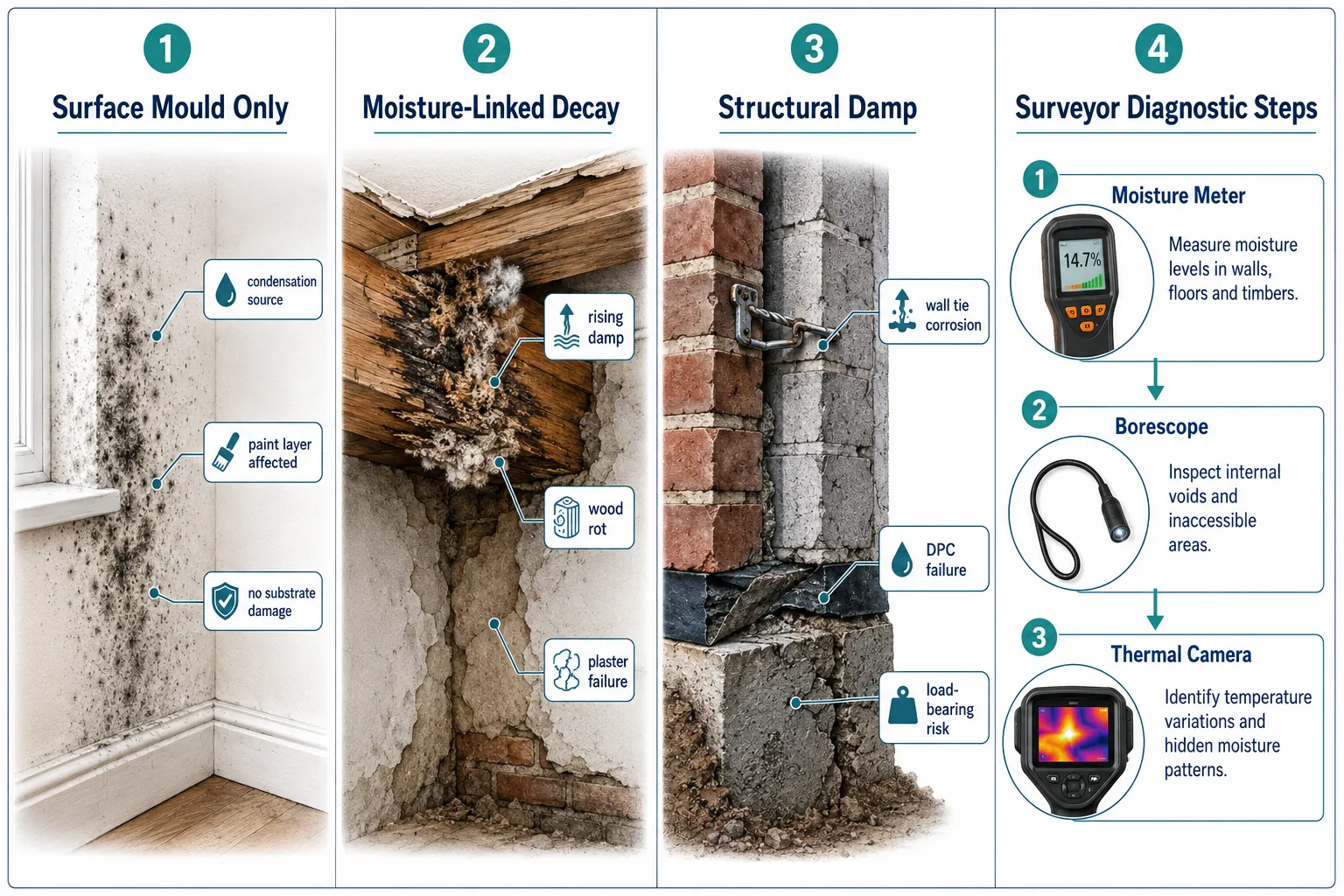
The words "damp" and "mould" are often used interchangeably in property listings and informal conversations, but they describe fundamentally different conditions with very different repair trajectories. Surface mould, the black or green patches most commonly seen on bathroom ceilings or behind wardrobes, is primarily a biological growth driven by condensation. It affects paint, grout, and the outermost layer of plaster. Left untreated, it poses a genuine health risk through spore inhalation, particularly for children and people with respiratory conditions [8]. However, the underlying building fabric may be entirely sound.
Structural damp, by contrast, refers to moisture that has penetrated or is migrating through load-bearing or envelope elements: masonry walls, floor slabs, roof timbers, and joists. When water saturates these elements over time, it triggers a cascade of secondary damage, mortar decay, wall tie corrosion, timber rot, and plaster delamination. In severe cases, it compromises the structural integrity of the building itself.
"Simply cleaning visible mould without fixing the underlying structural moisture source is not an acceptable response.", Authoritative guidance cited across multiple UK housing provider policies [1][9]
This distinction drives everything that follows in a survey: the diagnostic approach, the condition rating, the recommended remediation, and the cost estimate. For buyers considering a purchase, understanding which category a defect falls into can be the difference between a negotiated price reduction and walking away entirely.
The Regulatory Context in 2026
Regulators have sharpened this distinction considerably. Awaab's Law, now embedded in social housing regulation, requires landlords to investigate damp and mould within strict timeframes and to treat serious cases with the same urgency as structural hazards [2][6]. For a detailed breakdown of what surveyors must now report under this framework, see Awaab's Law: damp and mould, what surveyors must now report in building surveys and as expert witnesses.
Many housing providers now use tiered severity systems. A typical three-tier model works as follows:
| Tier | Description | Example | Response Timescale |
|---|---|---|---|
| 1, Minor | Surface mould, limited area, no fabric damage | Bathroom ceiling patch | 28 days |
| 2, Moderate | Recurring mould, early plaster damage, elevated moisture readings | Bedroom wall behind furniture | 7-14 days |
| 3, Severe | Structural damp, fabric deterioration, health risk | Rising damp through DPC failure | 24-48 hours |
This tiered approach mirrors the response protocols used for serious structural defects and reflects how seriously regulators now view the health implications of mould exposure [6][9].
How Your Building Surveyor Assesses Risk: The Diagnostic Process
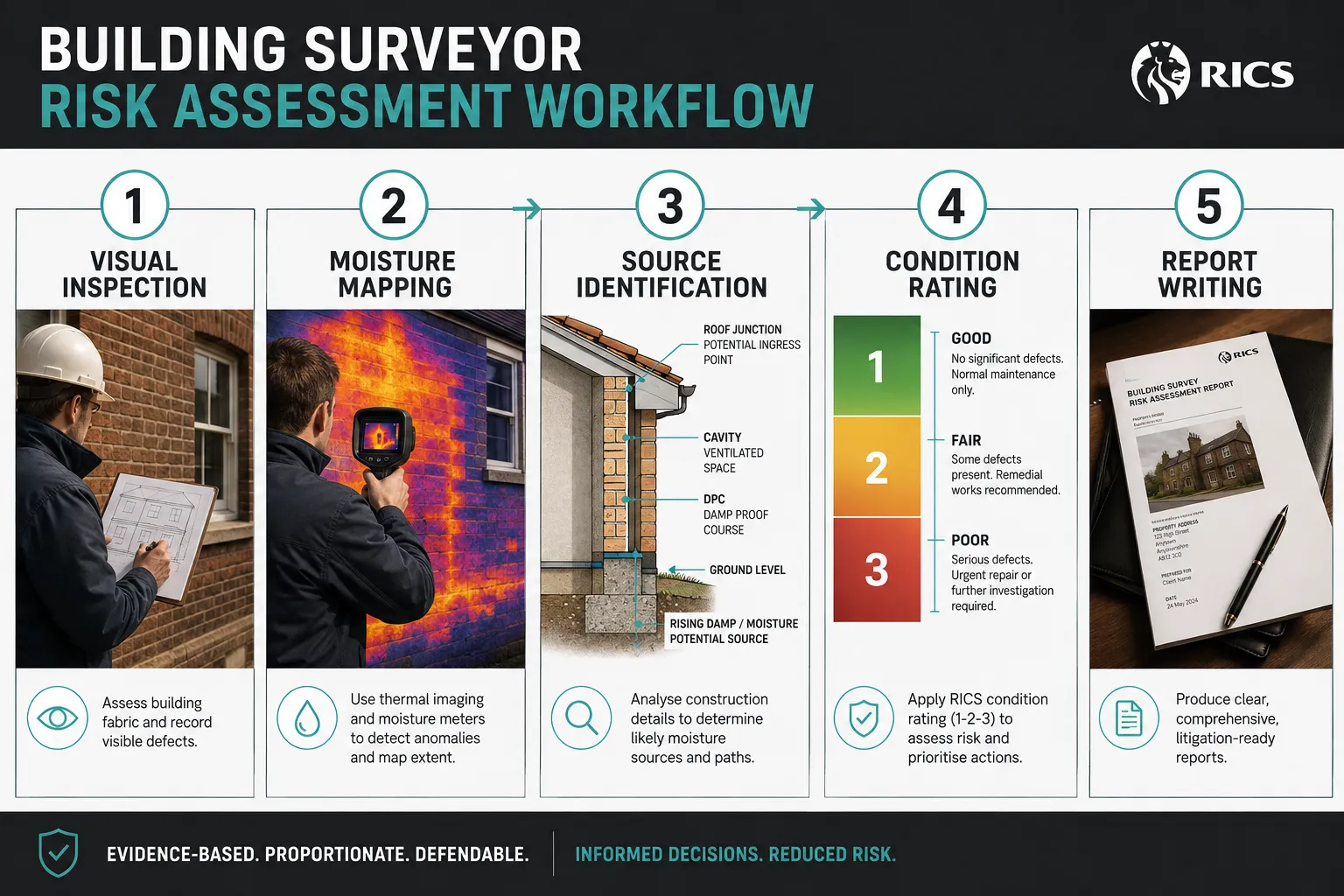
The core task in Mould Damage vs Structural Damage: How Your Building Surveyor Assesses Risk and Repair Costs assessment is tracing moisture back to its source. A competent surveyor does not simply note the presence of mould and move on. They follow a structured diagnostic sequence designed to answer three questions: Where is the moisture coming from? How far has it penetrated the building fabric? And what damage has it caused to structural elements?
Step 1, Visual Inspection and Pattern Recognition
The surveyor begins with a systematic visual inspection of all accessible surfaces, noting the location, extent, and pattern of mould growth or staining. Pattern is critical. Mould concentrated at cold bridges (window reveals, external corners, behind furniture) typically indicates condensation, a ventilation and thermal performance problem rather than a structural one. Mould rising from the base of walls, or staining that follows the line of a damp-proof course (DPC), points toward rising damp. Horizontal bands at mid-wall height may indicate penetrating damp from a failed cavity or defective pointing.
For buyers using a building survey protocols guide for first-time buyers in 2026, understanding these visual patterns before the survey appointment helps frame the right questions for the surveyor.
Step 2, Moisture Measurement
Visual inspection is followed by quantitative moisture measurement. Surveyors use:
- Electrical resistance moisture meters, rapid surface readings that flag elevated moisture in timber and plaster
- Capacitance meters, non-invasive scanning of walls to map moisture distribution without drilling
- Thermo-hygrometers, measuring relative humidity and dew point to assess condensation risk
- Thermal imaging cameras, revealing cold surfaces and moisture evaporation patterns invisible to the naked eye
Humidity-control standards are now being integrated into survey assessments to predict future mould risk, not just document existing damage [4][8]. A wall that reads within acceptable moisture limits today but sits in a poorly ventilated room with high occupancy may be flagged as a future risk.
Step 3, Building Fabric Investigation
Where elevated moisture is confirmed, the surveyor investigates the building fabric. This may involve:
- Inspecting the DPC for bridging, failure, or absence
- Checking roof junctions, parapets, and flashings for water ingress points
- Examining cavity walls for debris bridges or failed wall ties
- Probing timber elements (floor joists, lintels, roof members) for decay
In some cases, a borescope, a small camera inserted through a drilled hole, allows inspection of cavities without invasive opening up. Where structural damage is suspected, the surveyor may recommend specialist investigation by a structural engineer.
Step 4, Condition Rating and Report
Under RICS Home Survey Standards, defects are rated on a 1-3 scale: Condition 1 (no repair needed), Condition 2 (repair or replacement needed but not urgent), and Condition 3 (urgent repair or replacement required). Structural damp defects almost always attract a Condition 3 rating. Surface mould without underlying fabric damage may attract a Condition 2 rating, with advice on ventilation improvement.
Survey reports are increasingly written to be litigation-ready, with clear, defensible distinctions between surface and structural damage [3]. This matters for buyers seeking price reductions, landlords facing regulatory enforcement, and insurers assessing claims. For context on how survey scope is evolving, the building survey scope expansion guide on upfront condition assessments and evolving RICS consultation requirements provides useful background.
Repair Costs: Mould Remediation vs Structural Damp Repairs
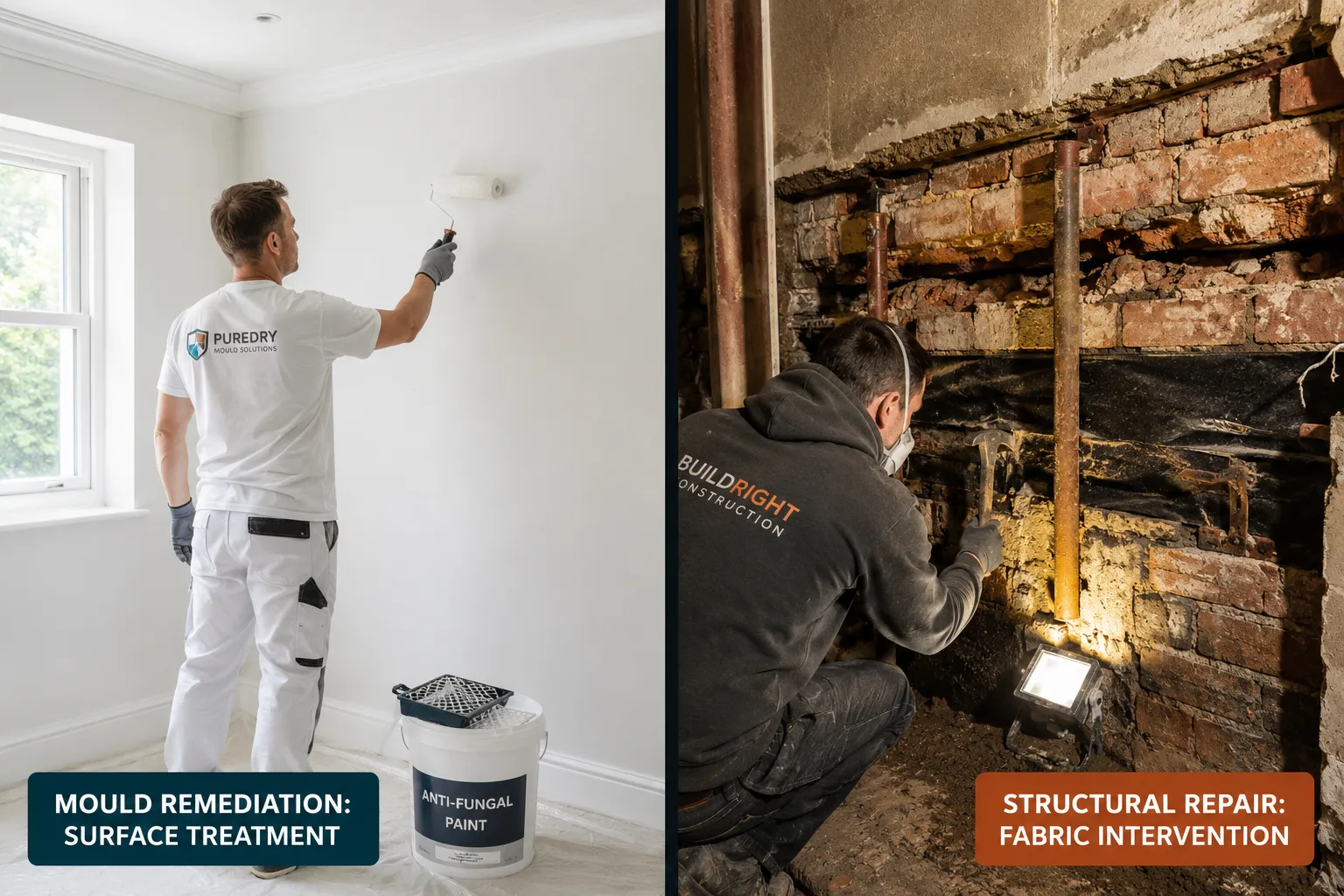
Cost is where the distinction between mould damage and structural damage becomes most consequential for buyers and property owners. The gap between treating surface mould and repairing structural damp is significant, and it directly affects negotiating leverage and investment decisions.
Mould Remediation Costs
Surface mould treatment is a relatively straightforward process: remove the growth, treat the substrate with a biocidal wash, address the condensation source (typically through improved ventilation or insulation), and redecorate. In 2026, typical costs break down as follows [5][10]:
- Small area treatment (under 1 m²): £150,£300
- Medium area (1-5 m²): £300,£700
- Large-scale remediation (multiple rooms or whole-property): £1,000,£3,000+
- Ventilation upgrades (MVHR or PIV systems): £500,£1,500 per unit
These figures assume no underlying structural damage. If the mould has penetrated plasterwork or caused timber decay, costs escalate into the structural repair bracket.
Structural Damp Repair Costs
Structural damp repairs are categorically more expensive because they involve the building fabric itself [10]:
- DPC injection (rising damp): £800,£2,500 for a standard terraced house
- Cavity wall re-tie (corroded wall ties): £1,500,£5,000+ depending on property size
- Roof repair to stop penetrating damp: £500,£5,000+ depending on extent
- Timber treatment and joist replacement: £1,000,£8,000+
- Full replastering after damp treatment: £1,500,£4,000 per floor
In severe cases, where rising damp has been left untreated for years, or where penetrating damp has caused widespread timber decay, total repair costs can exceed £20,000. At this level, the surveyor's report becomes a critical document for renegotiating the purchase price or, in some cases, advising the buyer to withdraw entirely.
Survey and Diagnostic Costs
Before any repair work begins, buyers and landlords need a reliable assessment. In 2026, diagnostic survey costs typically fall in the following ranges:
- RICS Level 2 Home Survey (HomeBuyer Report): £400,£700
- RICS Level 3 Building Survey (full structural): £600,£1,500+
- Specialist damp and timber survey: £200,£500
- Thermal imaging add-on: £100,£300
The investment in a thorough survey is almost always justified when structural damp is suspected. A Level 3 Building Survey that identifies a £15,000 structural damp problem before exchange saves multiples of its cost. For guidance on how survey demand is evolving in the current market, see the building survey demand surge guide for 2026.
When to Walk Away
Not every damp problem is fixable within a reasonable budget or timescale. The following scenarios typically warrant serious reconsideration of a purchase:
- Multiple simultaneous moisture sources, rising damp, penetrating damp, and roof failure in the same property suggest systemic neglect
- Structural timber decay affecting load-bearing elements, floor joists, lintels, or roof members with significant rot
- Wall tie failure across the full elevation, a whole-house re-tie is expensive and disruptive
- Vendor unwilling to reduce price or provide warranties, without price adjustment, the buyer absorbs all repair risk
- Evidence of previous remediation that has failed, repeat treatment without source resolution is a red flag [1]
Landlords and investors evaluating buy-to-let properties face additional regulatory exposure. A property with unresolved structural damp may fail the Decent Homes Standard or trigger enforcement action under Awaab's Law. For investors assessing rental stock, the building surveys for buy-to-let investors, due diligence checklists as rental supply tightens in 2026 provides a practical framework.
Common Misconceptions That Cost Buyers Money
Several persistent myths make Mould Damage vs Structural Damage: How Your Building Surveyor Assesses Risk and Repair Costs harder to navigate without professional guidance.
Myth 1: "A bit of mould is just cosmetic."
Surface mould is never purely cosmetic. It signals a moisture problem that, if unresolved, will recur and may eventually penetrate the substrate. Regulators explicitly reject the idea that cleaning visible mould without fixing the source is an acceptable response [1][9].
Myth 2: "If the walls look dry, there's no structural damp."
Structural damp is often invisible at the surface. A failed DPC may be saturating the base of a wall that has been replastered and painted over. Only moisture meter readings and, in some cases, invasive investigation will reveal the true condition.
Myth 3: "A damp-proof injection always solves rising damp."
DPC injection is effective when rising damp is the sole cause of moisture ingress. However, if the property also has a bridged DPC (from raised external ground levels), failed cavity trays, or inadequate subfloor ventilation, injection alone will not solve the problem.
Myth 4: "The vendor's damp survey is sufficient."
Vendor-commissioned surveys may not be independent. Buyers should always commission their own survey from a RICS-regulated surveyor. For context on how the homebuying process is evolving around survey requirements, the homebuying process reforms 2026 guide on mandatory building surveys is worth reviewing.
Health Risk and Structural Risk: A Dual Assessment Framework
Modern survey practice combines two previously separate risk assessments into a single framework. The health risk dimension addresses mould spore exposure, particularly relevant for vulnerable occupants including children, the elderly, and those with asthma or compromised immunity [7][8]. The structural risk dimension addresses fabric deterioration and its implications for the building's long-term performance and value.
This dual framework is reflected in updated professional guidance and training for surveyors [4]. A surveyor assessing a property in 2026 is expected to flag both dimensions explicitly in their report, rather than treating mould as a health matter and damp as a structural matter in isolation.
For landlords managing portfolios, this dual assessment approach has direct implications for compliance. Properties that score poorly on either dimension may require urgent intervention. The valuation impacts of 2026 stricter rental regulations, surveyor guidance for landlord compliance explores how these requirements are affecting property values and investment decisions.
Conclusion
The gap between a surface mould patch and a failing damp-proof course can represent the difference between a £300 remediation job and a £15,000 structural repair programme. For buyers, landlords, and investors in 2026, commissioning a survey that explicitly addresses Mould Damage vs Structural Damage: How Your Building Surveyor Assesses Risk and Repair Costs is not optional, it is the foundation of an informed property decision.
Actionable next steps:
- Commission a RICS Level 3 Building Survey for any property showing visible mould, staining, or damp odour, a Level 2 report may not probe deeply enough to identify structural moisture sources.
- Ask the surveyor explicitly to distinguish between condensation-driven mould and structural damp in their report, with moisture meter readings included.
- Use the survey findings as a negotiating tool, documented structural damp repair costs provide a defensible basis for price reduction requests.
- Do not accept a vendor's assurance that mould has been "treated" without independent verification that the moisture source has been resolved.
- For rental properties, check whether identified defects trigger obligations under current housing health and safety regulations or Awaab's Law timescales before completing a purchase.
A thorough, source-tracing survey is the single most cost-effective step any buyer or landlord can take before committing to a property with visible damp or mould.
References
[1] Damp And Mould Policy 2025 Web – believehousing.co.uk
[2] Damp And Mould Policy 1.3 Aa – portsmouth.gov.uk
[3] Awaabs Law Damp And Mould What Surveyors Must Now Report In Building Surveys And As Expert Witnesses – Awaabs law damp and mould what surveyors must now report in building surveys and as expert witnesses
[4] Resources – mouldexperts.org.uk
[5] Mould Treatment Pricing Guide – squote.app
[6] Damp Mould Procedure October 2025 – democracy.newark-sherwooddc.gov.uk
[7] D+M Advice Code Enf Final ADA – cdph.ca.gov
[8] Guidelines For Managing Mould And Dampness Related Public Health Risks In Buildings V20 – health.wa.gov.au
[9] Damp Mould And Condensation Policy 2025 – hhs.org.uk
[10] Mould Removal Cost – mouldnews.co.uk