

Last updated: July 24, 2026
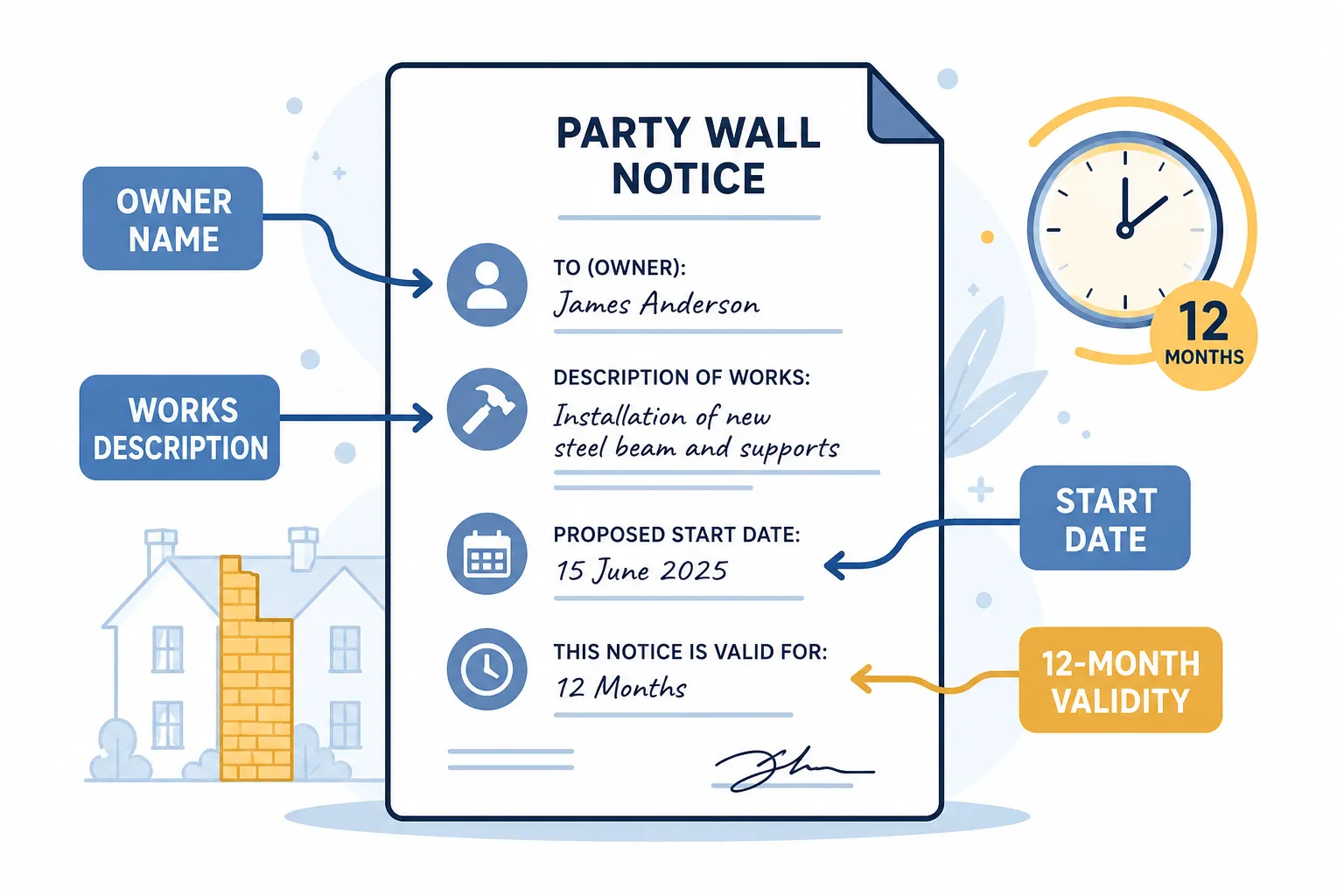
Quick Answer: A party wall notice is valid for 12 months from the date it is served. If construction work has not started within that window, the notice lapses and a fresh one must be served. Under the Party Wall etc. Act 1996, a valid notice must include the building owner's name and address, a clear description of the proposed works, and the intended start date, served at least two months before work begins on a party wall or one month before excavation or line-of-junction works.
Key Takeaways
- A party wall notice expires 12 months after service if work has not started or is not pursued with due diligence.
- Notices must be served at least two months before party wall works and one month before excavation or new boundary wall works.
- Missing required information, such as the works description or start date, can invalidate a notice entirely.
- Neighbours have 14 days to consent in writing; silence triggers a dispute, which requires appointment of a surveyor.
- A party wall notice is not the same as a party wall award; the award is the formal agreement that follows.
- Electronic service of notices is now widely accepted in practice, provided the recipient has agreed to receive documents digitally.
- In 2026, digital platforms and surveyor-led software tools are reducing errors and cutting turnaround times significantly.
- Ignoring the Act entirely can expose building owners to injunctions, legal costs, and claims for damage.
What Makes a Party Wall Notice Valid
A party wall notice is legally valid when it satisfies the specific requirements set out in the Party Wall etc. Act 1996. The notice must state the building owner's full name and address, describe the nature and particulars of the proposed works (including details of any special foundations), and specify the date on which work is intended to begin. It must be served within the correct timeframe, at least two months before works to a party wall or party structure, or at least one month before excavation near a neighbour's structure or construction of a new boundary wall.
Three core validity tests:
- Correct content, name, address, works description, start date all present
- Correct timing, served the required number of months in advance
- Correct service, delivered to the right person at the right address
A notice that omits any of these elements risks being challenged as defective. Courts and surveyors have consistently held that a vague works description, for example, "building works" without specifying whether foundations are being excavated, is insufficient.
How Long Is a Party Wall Notice Valid For
A party wall notice is valid for 12 months from the date of service. If the notified works have not begun within that 12-month period, or are not being pursued with reasonable diligence, the notice ceases to have effect. A fresh notice must then be served before work can lawfully proceed.
This 12-month rule catches many homeowners off guard when projects are delayed by planning permission, contractor availability, or financing. Serving a notice too early, say, 18 months before a realistic start date, means the notice will expire before work begins. Government guidance updated in July 2026 explicitly reiterates that notices are "only valid for a year," making timing one of the most common sources of procedural failure.
Practical rule: Serve the notice no more than two to three months before the minimum required notice period ends and the project is genuinely ready to start.
What Happens If You Do Not Serve a Party Wall Notice Properly
Failing to serve a valid notice is not a criminal offence, but the consequences can be severe and costly. An adjoining owner can seek an injunction from the court to halt works until a proper notice is served and the process is followed. If damage occurs to a neighbouring property and no notice was served, the building owner loses the protections the Act provides, including the ability to rely on a schedule of condition to dispute damage claims.
For a detailed breakdown of the legal and financial risks, see this guide on the consequences of ignoring the Party Wall Act.
Common outcomes of improper service:
- Court injunctions stopping work mid-project
- Liability for neighbour's surveyor fees without the usual cost protections
- Difficulty selling the property if a buyer's solicitor identifies the procedural gap
- Disputes that escalate to the county court
Party Wall Notice vs Party Wall Award: What Is the Difference
A party wall notice and a party wall award are two distinct stages of the same process. The notice is the formal communication served on an adjoining owner to inform them of proposed works. The award is the legally binding document produced by appointed surveyors that sets out the rights and obligations of both parties, the manner in which works are to be carried out, and any compensation arrangements.
Think of the notice as the trigger and the award as the outcome. One cannot exist without the other, but they are not interchangeable. Many homeowners mistakenly believe that once a notice is served and a neighbour consents, the process is complete. In reality, consent in writing simply means work can proceed without a formal award; a dispute (or silence) leads to the award process.
For a full explanation of what a party wall award contains and when one is needed, see the party wall awards guide.
Can You Serve a Party Wall Notice Electronically
Yes, electronic service is accepted in practice, provided the recipient has agreed to receive documents by email or through a digital platform. The Party Wall etc. Act 1996 pre-dates widespread email use, so it does not explicitly authorise electronic service, but case law and professional practice have evolved to accept it where consent is clear and delivery can be evidenced.
Best practice for electronic service in 2026:
- Obtain written confirmation that the neighbour accepts email service before sending
- Use a read-receipt or delivery confirmation where possible
- Keep a timestamped record of all correspondence
- Consider a follow-up hard copy by recorded post for high-value or contentious projects
If there is any doubt about whether an adjoining owner has agreed to digital service, default to personal delivery or recorded post to avoid a validity challenge.
What Are Common Mistakes When Issuing Party Wall Notices
This is where the evergreen guide to party wall notice validity earns its name, the same errors appear repeatedly, regardless of the year. Understanding them in advance prevents costly delays.
The most frequent pitfalls:
- Vague works description: Writing "loft conversion" without specifying whether the party wall is being cut into, or whether new beams will bear on it
- Wrong notice period: Using a one-month notice for party wall works that require two months
- Serving the wrong person: Sending the notice to a tenant rather than the freeholder, or missing a co-owner
- Incorrect address: Serving at the property address when the owner lives elsewhere
- Serving too early: A notice served 14 months before works begin will lapse before the project starts
- No start date: Omitting the intended commencement date, which is a statutory requirement
- Assuming consent: Proceeding without written consent or a formal award after the 14-day response window
For a deeper look at misconceptions that trip up homeowners and developers alike, the 5 common misconceptions about party wall agreements article is worth reading before serving any notice.
How Do I Know If I Need a Party Wall Notice
A party wall notice is required whenever proposed works fall within the scope of the Party Wall etc. Act 1996. The Act covers three main categories of work:
- Works to an existing party wall or party structure, cutting into, raising, underpinning, or demolishing and rebuilding a shared wall
- Excavation near a neighbouring structure, digging within three metres of a neighbour's building to a depth below their foundations, or within six metres under a 45-degree line from the base of their foundations
- New walls at or astride the boundary line, constructing a wall on the line of junction between two properties
Works entirely within your own property that do not affect a shared wall or involve excavation near a neighbour's structure generally do not trigger the Act. However, loft conversions, rear extensions, basement excavations, and underpinning almost always do.
If you are unsure, the party wall services overview provides a useful starting point, and a brief consultation with a chartered surveyor will confirm whether the Act applies to your specific project.
"When in doubt, serve the notice. The cost of serving an unnecessary notice is negligible compared to the cost of an injunction or dispute arising from failing to serve one at all."
What Should Be Included in a Valid Party Wall Notice
A valid party wall notice must contain, at minimum:
| Required Element | Detail |
|---|---|
| Building owner's name | Full legal name, not just a trading name |
| Building owner's address | A service address where documents can be sent |
| Description of works | Nature, extent, and method, specific enough to inform |
| Special foundations | Must be stated if relevant to the works |
| Intended start date | The date on which work is proposed to begin |
The description of works is the element most often challenged. It should be specific enough that a surveyor reading it could understand what structural impact the works will have on the shared wall or neighbouring structure. Drawings are not legally required to accompany the notice, but attaching them significantly reduces the risk of a dispute about scope. For complex projects, party wall drawings prepared by a surveyor provide the clearest possible record.
What Is the Deadline for Responding to a Party Wall Notice
An adjoining owner has 14 days from receipt of a party wall notice to respond in writing. There are three possible responses:
- Consent in writing, work can proceed without a formal award
- Dissent and agree to appoint an agreed surveyor, one surveyor acts for both parties
- Dissent and appoint their own surveyor, each party appoints a surveyor; the two may appoint a third if they cannot agree
If no response is received within 14 days, a dispute is deemed to have arisen automatically under the Act. The building owner can then appoint a surveyor on the adjoining owner's behalf if they refuse to engage. This deemed dispute mechanism means silence is never a safe option for either party.
For guidance on what happens when a neighbour refuses to engage, see what to do when a neighbour refuses party wall works.
Do I Need a Party Wall Notice for Minor Renovations
Not all building work triggers the Act. Minor internal works, redecorating, replacing kitchen units, or fitting a new bathroom, do not require a party wall notice. The Act is concerned with structural works that affect shared walls or involve excavation near a neighbouring building.
Works that typically do NOT require a notice:
- Internal non-structural alterations
- Replacing windows or doors in a non-party wall
- Re-roofing without altering the party wall
- Garden landscaping away from the boundary
Works that typically DO require a notice:
- Removing a chimney breast on a party wall
- Installing a steel beam bearing on a party wall
- Rear extensions with foundations near the boundary
- Loft conversions involving the party wall
For loft-specific guidance, the article on party wall agreements for loft conversions covers the common scenarios in detail.
How Much Does a Party Wall Surveyor Cost
Party wall surveyor fees vary depending on the complexity of the works, the number of adjoining owners, and whether a single agreed surveyor or two separate surveyors are appointed. As a general guide, fees for a straightforward residential project with one adjoining owner typically range from around £700 to £1,500 per surveyor for the full process including the award. More complex projects, basements, underpinning, or multiple adjoining owners, can cost considerably more.
The building owner usually bears the cost of both surveyors in a standard dispute scenario, though this can vary. For a detailed breakdown of what drives costs up or down, the cost of a party wall surveyor guide provides current figures and practical advice on keeping fees proportionate.
Appointing an agreed surveyor, one surveyor acting for both parties, is often the most cost-effective route where the relationship between neighbours is cooperative. See the agreed surveyor complete guide for a full explanation of how this works.
Can a Party Wall Notice Be Challenged or Disputed
Yes. An adjoining owner can challenge a notice on the grounds that it is defective, for example, if the works description is inadequate, the notice period was insufficient, or it was served on the wrong person. A defective notice may be treated as a nullity, meaning the entire process must restart.
Beyond procedural challenges, the substantive terms of how works are carried out can be disputed through the award process. Surveyors have wide powers to determine the time, manner, and conditions under which works proceed. If either party is dissatisfied with a surveyor's award, they have 14 days to appeal to the county court.

How Does Technology Help with Party Wall Compliance in 2026
In 2026, digital tools are materially reducing the rate of defective notices and procedural delays. This section of the evergreen guide to party wall notice validity reflects a genuine shift in how the industry operates.
Key technology developments in 2026:
- Notice generation platforms: Web-based tools guide building owners through the statutory requirements, prompting for each required field and flagging incomplete entries before submission
- Digital service with audit trails: Platforms now generate timestamped delivery records that satisfy evidential requirements for service, removing ambiguity about when a notice was received
- Calendar and validity tracking: Automated reminders alert building owners when a notice is approaching its 12-month expiry, preventing inadvertent lapse
- Drone and 3D survey integration: Surveyors are increasingly using drone surveys and photogrammetry to produce accurate schedule-of-condition records, reducing disputes about pre-existing damage
- Shared document portals: Both parties and their surveyors can access the same document set in real time, reducing the back-and-forth that historically extended award timelines
The practical effect is that a process which once took weeks of postal correspondence can now be managed in days, with a clearer paper trail and fewer opportunities for procedural error. That said, technology does not replace the legal judgment required to describe works correctly or assess whether the Act applies, a chartered surveyor remains essential for anything beyond the most straightforward project.
Party Wall Notice Requirements: UK Jurisdiction Note
The Party Wall etc. Act 1996 applies in England and Wales only. Scotland and Northern Ireland have separate legal frameworks governing boundary and shared wall disputes, and the 1996 Act's notice requirements do not apply there. Within England and Wales, the requirements are uniform, there are no regional variations. Building owners in Scotland should seek advice under Scots property law, while those in Northern Ireland should consult local legal guidance.
FAQ
Q: Can I start work before the notice period expires if my neighbour consents immediately?
A: Yes. If the adjoining owner provides written consent within the 14-day response window, work can begin as soon as the minimum statutory notice period has elapsed, you do not need to wait the full two months if consent is given sooner.
Q: What if I own a leasehold flat, do I still need to serve a party wall notice?
A: Yes, if the proposed works fall within the Act's scope. Leaseholders can be building owners under the Act. However, you may also need your freeholder's consent under the terms of your lease, and the freeholder may need to be served as an adjoining owner depending on the structure involved.
Q: Does a party wall notice need to be signed?
A: The Act does not explicitly require a signature, but including one is best practice and helps confirm the identity of the building owner. Unsigned notices have been accepted in practice, but a signature reduces the risk of a validity challenge.
Q: Can I serve a party wall notice on behalf of my neighbour if they refuse to appoint a surveyor?
A: Under the Act, if an adjoining owner refuses to appoint a surveyor within ten days of being asked to do so, the building owner may appoint a surveyor on their behalf. This is a specific statutory mechanism, not a general right to act for the other party.
Q: Is a party wall notice the same as planning permission?
A: No. They are entirely separate processes. Planning permission is granted by the local planning authority and governs whether a development is acceptable in land-use terms. A party wall notice is a private legal notice served on a neighbour under the 1996 Act. Both may be required for the same project, but one does not substitute for the other.
Q: What happens if works go beyond what was described in the notice?
A: Works that exceed the scope of the notice are not covered by it or any resulting award. The building owner would need to serve a fresh notice for the additional works, and any award already made may need to be revisited. Proceeding with out-of-scope works exposes the building owner to injunction risk and potential liability.
Conclusion
The evergreen guide to party wall notice validity comes down to a handful of non-negotiable rules: serve the right notice, to the right person, with the right information, at the right time, and make sure work starts before the 12-month clock runs out. The Party Wall etc. Act 1996 is not complex legislation, but its procedural requirements are strict, and the consequences of getting them wrong range from project delays to court proceedings.
Actionable next steps:
- Confirm whether your proposed works trigger the Act by consulting a chartered surveyor before any design work is finalised.
- Identify all adjoining owners, including freeholders, leaseholders, and mortgagees where relevant, before serving notices.
- Use a digital notice platform or surveyor-prepared notice to ensure all statutory content is included.
- Serve notices at the right time: close enough to the project start that the 12-month validity window will not expire, but far enough in advance to satisfy the minimum notice period.
- Keep a complete record of service, timestamped email receipts, postal tracking references, or signed acknowledgements.
- If a neighbour dissents or fails to respond, appoint a surveyor promptly rather than allowing the process to stall.
For any project where the Act applies, working with a qualified party wall surveyor from the outset is the most reliable way to avoid the pitfalls covered in this guide.
.pw-checker{font-family:Arial,sans-serif;max-width:520px;margin:24px auto;border:2px solid #1a3a5c;border-radius:8px;padding:20px;background:#f8fafc;color:#1a3a5c}
.pw-checker h3{margin:0 0 14px;font-size:1.1rem;color:#1a3a5c}
.pw-checker label{display:block;margin:10px 0 4px;font-size:.9rem;font-weight:600}
.pw-checker input[type=date],.pw-checker select{width:100%;padding:7px;border:1px solid #aac;border-radius:4px;font-size:.9rem;box-sizing:border-box}
.pw-btn{margin-top:14px;background:#1a3a5c;color:#fff;border:none;padding:10px 22px;border-radius:4px;cursor:pointer;font-size:.95rem;width:100%}
.pw-btn:hover{background:#2a5a8c}
.pw-result{margin-top:14px;padding:12px;border-radius:5px;font-size:.9rem;display:none}
.pw-ok{background:#e6f4ea;border:1px solid #4caf50;color:#256029}
.pw-warn{background:#fff8e1;border:1px solid #f9a825;color:#7a5200}
.pw-bad{background:#fdecea;border:1px solid #e53935;color:#7a1a1a}
Party Wall Notice Validity Checker
function checkValidity(){
var served=new Date(document.getElementById(‘pw-served’).value);
var start=new Date(document.getElementById(‘pw-start’).value);
var months=parseInt(document.getElementById(‘pw-type’).value);
var res=document.getElementById(‘pw-result’);
res.className=’pw-result’;res.style.display=’none’;
if(isNaN(served)||isNaN(start)){res.className=’pw-result pw-warn’;res.style.display=’block’;res.textContent=’Please enter both dates.’;return;}
var expiry=new Date(served);expiry.setFullYear(expiry.getFullYear()+1);
var minStart=new Date(served);minStart.setMonth(minStart.getMonth()+months);
var today=new Date();today.setHours(0,0,0,0);
if(startexpiry){res.className=’pw-result pw-bad’;res.style.display=’block’;res.textContent=’Notice will expire before works begin (expires ‘+expiry.toDateString()+’). Serve a fresh notice closer to your start date.’;}
else{res.className=’pw-result pw-ok’;res.style.display=’block’;res.textContent=’Notice appears valid. Works can start from ‘+minStart.toDateString()+’ and must begin before ‘+expiry.toDateString()+’.’;}
}