

Last updated: July 24, 2026
Quick Answer: A party wall agreement is a legal process under the Party Wall etc. Act 1996 that protects both building owners and their neighbours when notifiable works are carried out near or on a shared boundary. Serving the correct notice at the right time, understanding what counts as notifiable, and appointing a qualified surveyor are the three steps that prevent the majority of disputes and legal complications.
Key Takeaways
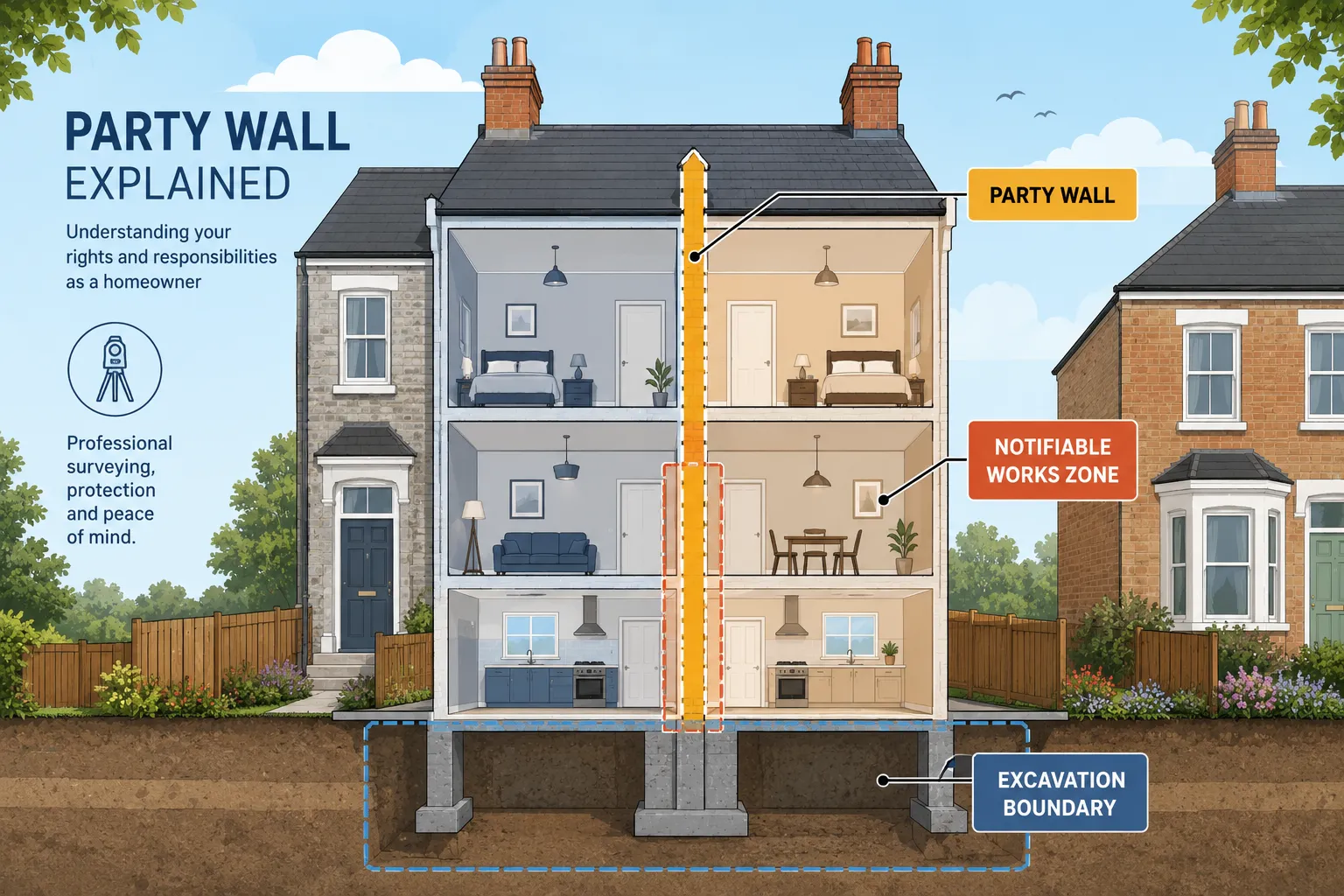
- The Party Wall etc. Act 1996 applies to three categories of work: works to a party structure, new buildings on the line of junction, and excavations within 3 or 6 metres of a neighbour's structure.
- A party wall notice must be served before work begins, not after, with statutory minimum notice periods of one or two months depending on the work type.
- Failing to serve notice does not make works illegal, but it removes your legal protections and can expose you to injunctions and damage claims.
- A party wall award is the legally binding document produced by surveyors; a party wall agreement is the informal term used when a neighbour consents in writing.
- Either party can appoint an agreed surveyor jointly, which typically reduces costs and speeds up the process.
- Deficiencies in the notice itself, wrong description of works, wrong address, missing details, are the leading cause of procedural failures.
- Listed buildings and conservation areas add planning layers but do not exempt a property from the Party Wall etc. Act 1996.
- A party wall award can be appealed to the County Court within 14 days of service.
What Is a Party Wall Agreement and Why Do You Need One
A party wall agreement confirms that a neighbour has consented to building work on or near a shared wall, boundary, or structure. Under the Party Wall etc. Act 1996, building owners in England and Wales must notify adjoining owners before carrying out notifiable works, and the agreement (or award, if consent is withheld) provides the legal framework for how those works proceed.
Without this process, a building owner has no statutory right to enter a neighbour's land, no agreed record of the pre-work condition of adjoining property, and no clear mechanism for resolving damage claims. The Act exists to balance the rights of both parties: the building owner's right to develop their property and the adjoining owner's right to protection from damage and disturbance.
For a broader overview of your rights under the legislation, see what are my party wall rights, a useful starting point before serving any notice.
Who needs one: Any owner of a property in England or Wales planning works that fall within the Act's scope, whether they own a terraced house, a semi-detached, a flat, or a commercial building.
What Counts as Notifiable Works Under Party Wall Law
Notifiable works fall into three statutory categories under the Party Wall etc. Act 1996:
| Notice Type | Section | Typical Works | Notice Period |
|---|---|---|---|
| Party Structure Notice | Section 3 | Cutting into, underpinning, raising, or demolishing a party wall | 2 months |
| Line of Junction Notice | Section 1 | Building a new wall on or astride the boundary | 1 month |
| Adjacent Excavation Notice | Section 6 | Excavating within 3m (or 6m for deeper works) of a neighbour's structure | 1 month |
Common examples of notifiable works include:
- Loft conversions that involve cutting into or raising a party wall
- Rear extensions requiring underpinning or new foundations close to the boundary
- Basement excavations within the statutory distances
- Removing a chimney breast that forms part of a party wall
- Installing a damp-proof course through a party wall
Minor cosmetic work, repainting, fitting shelves, or replacing skirting boards, does not trigger the Act. The test is whether the work affects the structural integrity or position of a shared wall or boundary structure.
For specific guidance on loft work, see do you require party wall agreements for lofts and for basement projects, basements and party wall surveyors in Surrey provides detailed context.
Do I Need a Party Wall Agreement for an Extension
Yes, most rear and side extensions trigger the Party Wall etc. Act 1996, though the specific notice type depends on the proximity to the boundary and the nature of the foundations. If new foundations are being dug within 3 metres of an adjoining owner's structure and to a depth lower than that structure's foundations, a Section 6 notice is required. If the extension wall sits on or is built astride the boundary line, a Section 1 notice applies.
Extensions that involve cutting into an existing party wall, for example, to insert a steel beam or remove a chimney breast, require a Section 3 Party Structure Notice with two months' advance notice.
Decision rule: If your extension footprint comes within 3 metres of a neighbour's building at any point, assume a notice is needed and confirm with a chartered surveyor. The cost of getting advice early is far lower than the cost of resolving a dispute mid-build.
For renovation-specific guidance, top party wall agreement tips for renovations covers the most common scenarios homeowners face.
What Should Be Included in a Party Wall Notice
A valid party wall notice must contain specific information. Deficiencies in notices are a leading cause of procedural failures, so accuracy matters from the outset.
A compliant notice must include:
- Full name and address of the building owner serving the notice
- Full name and address of the adjoining owner being notified
- A clear description of the proposed works, including materials and method where relevant
- The address of the property where works will take place
- The intended start date (respecting the statutory notice period)
- A statement that the notice is served under the Party Wall etc. Act 1996, citing the relevant section
- A response form allowing the adjoining owner to consent or dissent
Notices served by email are generally accepted, but it is advisable to also send a hard copy by recorded post to create a clear paper trail. If the adjoining owner does not respond within 14 days of receiving a notice, dissent is deemed and the dispute resolution process is triggered automatically.
Party Wall Agreement vs Party Wall Award: What Is the Difference
These two terms are often used interchangeably, but they describe different outcomes. A party wall agreement (sometimes called a consent agreement) is what happens when an adjoining owner receives a notice and signs a written consent, no surveyors are formally required, and works can proceed after the notice period expires.
A party wall award is a formal legal document prepared by one or more appointed surveyors when the adjoining owner dissents or fails to respond. It sets out the rights and obligations of both parties, the permitted scope of works, working hours, access arrangements, and the procedure for dealing with any damage.
A party wall award is legally binding on both parties and can be enforced through the courts. A simple written consent is sufficient where neighbours agree, but it offers less protection if a dispute arises later.
For a detailed breakdown of what awards cover, see party wall awards explained.
How Much Does a Party Wall Agreement Cost
The cost of a party wall agreement varies depending on the complexity of the works and whether surveyors are appointed. When both neighbours agree and no surveyor is needed, the only cost is the time spent preparing and serving the notice, which can be done by the building owner directly or by a surveyor on their behalf.
When surveyors are appointed, fees typically range from a few hundred pounds for a straightforward award to over a thousand pounds per surveyor for complex projects. Where two surveyors are appointed (one for each party), both sets of fees are usually paid by the building owner initiating the works.
For a full breakdown of what to expect, the cost of a party wall agreement and how much does a party wall surveyor cost provide current market guidance.
Cost-saving tip: Appointing an agreed surveyor, a single surveyor acceptable to both parties, is permitted under the Act and typically reduces total fees significantly compared to two separate appointments.
Who Pays for the Party Wall Surveyor
In almost all cases, the building owner who initiates the works pays the surveyor's fees, including the fees of any surveyor appointed by the adjoining owner. This is a statutory default under the Party Wall etc. Act 1996 and applies unless the surveyors determine that the adjoining owner has acted unreasonably in dissenting or in their choice of surveyor.
There are exceptions: if the adjoining owner requests additional works or surveys beyond what is strictly necessary, they may bear those additional costs. The appointed surveyors determine who pays what, and their decision on costs forms part of the award.
For guidance on the agreed surveyor route and how it can reduce overall costs, see the complete guide to agreed surveyors.
How Long Does a Party Wall Agreement Take to Process
The minimum statutory notice period is one month for Section 1 and Section 6 notices and two months for Section 3 Party Structure Notices. These periods begin from the date the notice is received by the adjoining owner, not the date it is sent.
If the adjoining owner consents in writing within 14 days, works can begin after the notice period expires. If they dissent or do not respond, surveyors must be appointed and an award prepared, this typically adds four to eight weeks to the timeline, depending on the complexity of the works and the responsiveness of all parties.
Practical timeline for a typical rear extension:
- Serve Section 3 and/or Section 6 notice: Day 0
- Adjoining owner dissents or fails to respond: Day 14
- Surveyors appointed and schedule of condition prepared: Weeks 2-4
- Party wall award agreed and served: Weeks 4-8
- Works commence: After award is served
Starting the notice process early, ideally before finalising your build programme, prevents costly delays on site.
What Happens If You Don't Get a Party Wall Agreement
Failing to serve a party wall notice does not automatically make the works illegal, but it removes the legal protections the Act provides and creates significant risk. An adjoining owner can apply to the court for an injunction to stop works, and if damage occurs, the building owner loses the evidential protection of a pre-work schedule of condition.
Courts have generally found that works carried out without notice are a trespass if they involve entering or affecting a neighbour's property. The costs of retrospective surveys, legal proceedings, and remediation can far exceed the cost of following the correct process from the start.
For a detailed look at the consequences, what happens if you ignore the Party Wall Act sets out the legal and practical risks in full.
Common mistake: Some building owners assume verbal agreement with a neighbour is sufficient. It is not. The Act requires written consent, and verbal agreements offer no protection if the relationship deteriorates during the build.
Can You Do Party Wall Works Without Telling Your Neighbour
No. The Party Wall etc. Act 1996 requires formal written notice before notifiable works begin. There is no exemption for friendly neighbours, minor works that happen to be notifiable, or urgent repairs, though emergency works to prevent danger may be carried out without prior notice in genuine emergencies, with notice served as soon as practicable afterwards.
Proceeding without notice is one of the most common and costly mistakes homeowners make. Even where a neighbour has no objection, the absence of a formal notice and schedule of condition means there is no agreed baseline if a damage claim arises later.
For a full list of misconceptions that lead to this mistake, 5 common misconceptions about party wall agreements is essential reading before starting any project.
What If My Neighbour Refuses to Sign a Party Wall Agreement
An adjoining owner cannot block notifiable works indefinitely by refusing to engage. If they dissent or fail to respond within 14 days, the dispute resolution mechanism under the Act is triggered. Both parties appoint surveyors (or agree on a single surveyor), and those surveyors prepare a party wall award that allows works to proceed under defined conditions.
The adjoining owner's refusal to sign a consent form is not a veto, it is the start of the formal process, not the end of the project. The award, once served, is legally binding on both parties.
For a step-by-step guide to this scenario, what to do when a neighbour refuses party wall works covers the process in detail.
Party Wall Agreement for Listed Buildings or Conservation Areas
Listed buildings and properties in conservation areas are subject to additional planning and listed building consent requirements, but these sit alongside the Party Wall etc. Act 1996, they do not replace it. A building owner must comply with both regimes: obtaining any necessary listed building consent or planning permission and serving the correct party wall notices.
Works to a listed building that affect a party wall may also require consent from the local planning authority under the Planning (Listed Buildings and Conservation Areas) Act 1990. Surveyors dealing with listed properties should be aware that the schedule of condition and award may need to address heritage elements specifically.
Edge case: If the adjoining property (not the building owner's property) is listed, the building owner's obligations under the Party Wall etc. Act 1996 remain unchanged. The listed status of the neighbour's property does not alter the notice requirements but may affect how works are specified and what protections are included in the award.
Can You Appeal a Party Wall Award
Yes. Either party can appeal a party wall award to the County Court within 14 days of the award being served. The court has the power to rescind or modify the award, though appeals are relatively rare in practice because the surveyors' decision is given considerable weight.
Grounds for appeal typically include: the award was made without jurisdiction (for example, the works were not notifiable), there was a procedural error, or the award is unreasonable on its face. Simply disagreeing with the outcome is unlikely to succeed as a ground of appeal.
If a dispute arises during or after works, party wall disputes: what you need to know provides practical guidance on resolution options.
What Are the Most Common Party Wall Mistakes Homeowners Make
Understanding this evergreen guide to party wall agreements and avoiding common pitfalls in notifiable works means recognising where things most often go wrong. Based on the structure of the Act and the most frequent sources of dispute, the following mistakes account for the majority of problems:
Top mistakes to avoid:
- Serving notice too late: Starting works before the statutory notice period has expired.
- Incorrect notice content: Missing the description of works, wrong section cited, or incomplete owner details.
- Assuming verbal consent is sufficient: Only written consent under the Act provides legal protection.
- Not commissioning a schedule of condition: Without a pre-work record, damage claims become difficult to defend or prove.
- Appointing an unqualified surveyor: The Act requires surveyors to act impartially; appointing someone without party wall experience creates procedural risk.
- Ignoring the Act for "minor" works: Homeowners frequently underestimate the scope of notifiable works, particularly for extensions and loft conversions.
- Failing to notify all adjoining owners: In terraced properties or flats, multiple owners may need to be notified.
For more on what every homeowner should know before starting a project, party wall agreement things you must know is a practical companion to this guide.

Party Wall Agreement Checklist: A Step-by-Step Process
Applying this evergreen guide to party wall agreements in practice means following a clear sequence. The checklist below covers the key steps for building owners:
Before works begin:
- Identify whether works are notifiable under Section 1, 3, or 6 of the Act.
- Identify all adjoining owners (including leaseholders with leases of more than one year).
- Prepare a compliant written notice for each relevant section.
- Serve notices with the correct notice period (one or two months as applicable).
- Wait for written responses within 14 days.
If consent is given:
- Obtain written consent and retain it with project documentation.
- Commission a schedule of condition of the adjoining property before works start.
If dissent is given or no response received:
- Both parties appoint surveyors within 10 days (or agree on a single agreed surveyor).
- Surveyors prepare and serve a party wall award.
- Works commence only after the award is served.
During and after works:
- Comply with all conditions in the award, including working hours and access arrangements.
- Address any damage claims promptly through the surveyors.
A party wall schedule of condition prepared before works begin is one of the most effective ways to protect both parties from disputed damage claims.
Conclusion: Practical Next Steps for Homeowners and Property Professionals
The Party Wall etc. Act 1996 is not a bureaucratic obstacle, it is a framework that protects building owners and their neighbours equally. The most common pitfalls in this evergreen guide to party wall agreements all share a single root cause: acting before understanding the process.
Actionable next steps:
- If works are planned, identify the relevant notice type and start the clock early. The notice period cannot be shortened, but it can run concurrently with planning and design stages.
- Use a chartered surveyor to prepare and serve notices if there is any doubt about the correct form or content. A defective notice can restart the process from scratch.
- Commission a schedule of condition before any notifiable works begin, regardless of how cooperative the relationship with neighbours appears.
- If an adjoining owner dissents, treat it as a standard procedural step rather than a conflict. The award process exists precisely to allow works to proceed fairly.
- For complex projects, basements, listed buildings, properties with multiple adjoining owners, appoint a surveyor with specific party wall experience from the outset.
For a full introduction to the party wall process and professional surveying services, visit Prince Surveyors' party wall services or contact the team for free initial advice.
Frequently Asked Questions
Q: Does a party wall agreement expire?
A: A party wall award remains valid for the duration of the works it covers. If works are significantly delayed or the scope changes materially, a new or supplementary award may be required. There is no fixed expiry date, but the award is tied to the specific works described in it.
Q: Can a tenant serve a party wall notice?
A: Yes. A tenant with a lease of more than one year qualifies as a "building owner" under the Act and can serve notices. However, the tenant must have the right under their lease to carry out the proposed works, and the freeholder may also need to be notified depending on the circumstances.
Q: Is a party wall agreement the same as planning permission?
A: No. They are entirely separate legal processes. Planning permission is granted by the local planning authority and controls what can be built. The party wall process governs how notifiable works are carried out in relation to adjoining owners. Both may be required for the same project.
Q: What if the adjoining property is empty or the owner cannot be found?
A: The Act provides that if an adjoining owner cannot be found after reasonable enquiry, the building owner may apply to the court for permission to proceed. A surveyor can be appointed to act in the absent owner's interest.
Q: Does the Act apply to flats and leasehold properties?
A: Yes. In a block of flats, the party wall between floors (a party floor/ceiling structure) is covered by the Act. Both the leaseholder and the freeholder may be adjoining owners depending on the nature of the works, and both may need to be notified.
Q: Can works start before the party wall award is served?
A: No. Once dissent has been registered or deemed (through non-response), works cannot lawfully begin until the award is served. Starting works before the award is a breach of the Act and can result in an injunction.
.pw-checker{font-family:Arial,sans-serif;max-width:560px;margin:2em auto;background:#f7f9fc;border:1px solid #d0d8e4;border-radius:8px;padding:24px}
.pw-checker h3{margin:0 0 6px;font-size:1.1rem;color:#1a2e4a}
.pw-checker p.pw-sub{margin:0 0 18px;font-size:.88rem;color:#555}
.pw-q{margin-bottom:14px}
.pw-q label{display:block;font-size:.92rem;font-weight:600;color:#1a2e4a;margin-bottom:6px}
.pw-q select{width:100%;padding:8px 10px;border:1px solid #b0bec5;border-radius:5px;font-size:.9rem;background:#fff}
.pw-btn{display:block;width:100%;padding:11px;background:#1a2e4a;color:#fff;border:none;border-radius:5px;font-size:.95rem;font-weight:700;cursor:pointer;margin-top:6px}
.pw-btn:hover{background:#243f63}
.pw-result{margin-top:16px;padding:14px;border-radius:6px;font-size:.9rem;display:none}
.pw-result.show{display:block}
.pw-result.green{background:#e6f4ea;border:1px solid #7dc98a;color:#1e4d2b}
.pw-result.amber{background:#fff8e1;border:1px solid #f0c040;color:#5a3e00}
.pw-result.red{background:#fdecea;border:1px solid #e57373;color:#5c1010}
.pw-result strong{display:block;margin-bottom:4px}
Party Wall Notice Type Checker
Answer two quick questions to identify which notice, if any, your project may require.
function pwCheck(){
var w=document.getElementById(‘pw-work’).value;
var a=document.getElementById(‘pw-adj’).value;
var r=document.getElementById(‘pw-result’);
r.className=’pw-result’;r.innerHTML=”;
if(!w||!a){r.classList.add(‘show’,’amber’);r.innerHTML=’Please answer both questions.‘;return;}
if(a===’no’||w===’none’){r.classList.add(‘show’,’green’);r.innerHTML=’No party wall notice likely required. The Party Wall etc. Act 1996 does not appear to apply to your project. Always confirm with a chartered surveyor for certainty.’;}
else if(w===’s3′){r.classList.add(‘show’,’red’);r.innerHTML=’Section 3 Party Structure Notice required. Serve at least 2 months before works begin. Adjoining owner has 14 days to consent or dissent. Consider appointing a party wall surveyor.’;}
else if(w===’s1′){r.classList.add(‘show’,’amber’);r.innerHTML=’Section 1 Line of Junction Notice required. Serve at least 1 month before works begin. Written consent from the adjoining owner is needed to build astride the boundary.’;}
else if(w===’s6′){r.classList.add(‘show’,’amber’);r.innerHTML=’Section 6 Adjacent Excavation Notice required. Serve at least 1 month before works begin. Applies when excavating within 3m (or 6m for deeper works) of a neighbour’s structure.’;}
}