

Last updated: July 24, 2026
Quick Answer: The Evergreen Party Wall Act Toolkit for Surveyors covers every stage of the Party Wall etc. Act 1996 process, from serving notices to issuing awards, giving UK surveyors and homeowners a repeatable framework for resolving extension disputes without court intervention. In 2026, new regulatory developments including the RICS 8th Edition consultation and the extension of Awaab's Law to private landlords have made a structured, up-to-date toolkit more critical than ever. Using this framework correctly keeps projects on schedule, protects both parties legally, and reduces costly delays.
Key Takeaways
- The Party Wall etc. Act 1996 applies to any work on or near a shared wall, boundary excavation, or new wall built on the boundary line.
- Homeowners must serve formal written notice at least two months before starting most notifiable works on party structures.
- Approximately 60% of party wall disputes in England and Wales stem from misunderstandings about garden walls and boundary structures, not the walls themselves.
- The RICS 8th Edition consultation (April to June 2026) has strengthened guidance on activating the third surveyor mechanism to break deadlocks faster.
- Basement extensions now account for nearly 40% of urban party wall disputes, making specialist knowledge essential.
- The building owner initiating work generally pays all surveyor fees, including those of the adjoining owner's surveyor.
- Parties have only 14 days from the date a party wall award is served to appeal to the county court.
- Ignoring the Party Wall etc. Act 1996 can result in injunctions, forced demolition orders, and significant legal costs.
What Is the Party Wall Act and Why Does It Matter for 2026 Extensions
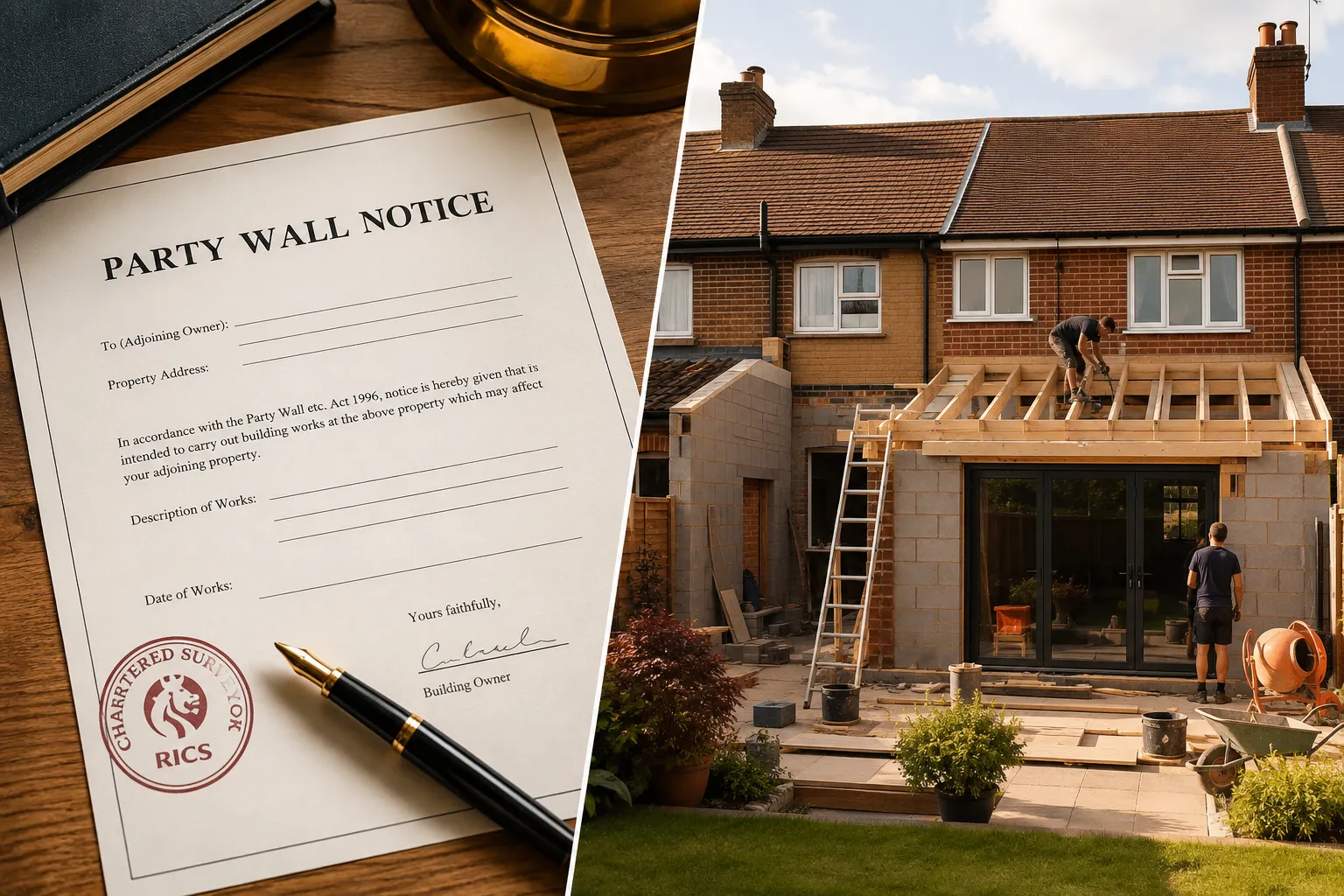
The Party Wall etc. Act 1996 is a piece of UK legislation that gives building owners the right to carry out specific works on or near shared walls, while protecting adjoining owners from damage or disruption. It matters in 2026 because the volume of home extension applications has risen sharply, and two significant regulatory changes have added new compliance layers for surveyors and landlords.
Two key 2026 developments every surveyor must know:
- Awaab's Law extended to private landlords (May 2026): This law now requires private landlords in England to address damp and ventilation issues within strict timeframes. For properties with shared walls, particularly converted terraces and Victorian subdivisions, any party wall works must now also account for these health and safety obligations. A surveyor conducting a schedule of condition on a shared wall in a rented property must flag damp risks as part of the award process.
- RICS 8th Edition consultation (April to June 2026): The Royal Institution of Chartered Surveyors consulted on a draft 8th edition of "Party Wall Legislation and Procedure." The revised guidance places greater emphasis on activating the third surveyor mechanism early, reducing deadlocks and avoiding court proceedings.
For homeowners planning rear extensions, loft conversions, or basement works in 2026, understanding these changes is not optional, it is a legal and financial safeguard.
Who Needs a Party Wall Act Surveyor for Home Extensions
Anyone carrying out notifiable works under the Party Wall etc. Act 1996 needs to engage a surveyor if a neighbour dissents or fails to respond to a notice. The Act applies to three main categories of work:
- Works to a party wall or party structure, cutting into, raising, demolishing, or underpinning a shared wall.
- New building at or astride the boundary line, constructing a wall on or near the legal boundary.
- Excavation near neighbouring foundations, digging within 3 metres of a neighbour's structure to a depth that would undercut their foundations, or within 6 metres under a 45-degree line.
Choose a party wall surveyor if:
- Your extension will involve a rear wall that is shared with a neighbour.
- You are digging foundations for a side or rear extension close to the boundary.
- Your loft conversion requires cutting into a chimney breast or party wall.
- You are a landlord with a rented property and the works affect a shared structure (especially post-Awaab's Law).
For more on whether your specific project triggers the Act, see do you need a party wall surveyor?
Party Wall Act Notice Requirements and Procedures Explained
Serving the correct notice is the foundation of the entire process. Failure here can invalidate all subsequent steps and expose the building owner to injunctions.
There are three types of notice under the Act:
| Notice Type | Trigger | Minimum Notice Period |
|---|---|---|
| Party Structure Notice | Works to an existing party wall | 2 months |
| Line of Junction Notice | New wall on or at the boundary | 1 month |
| Three/Six Metre Notice | Excavation near foundations | 1 month |
Critical requirements for a valid notice:
- Must be in writing and served on every adjoining owner.
- Must describe the proposed works clearly, including start date and plans where relevant.
- Must include the building owner's name and address.
- Solar panel retrofits on terraced properties require 14 days' written notice before accessing a neighbouring property for roof works, a growing issue in 2026 given the surge in net-zero installations.
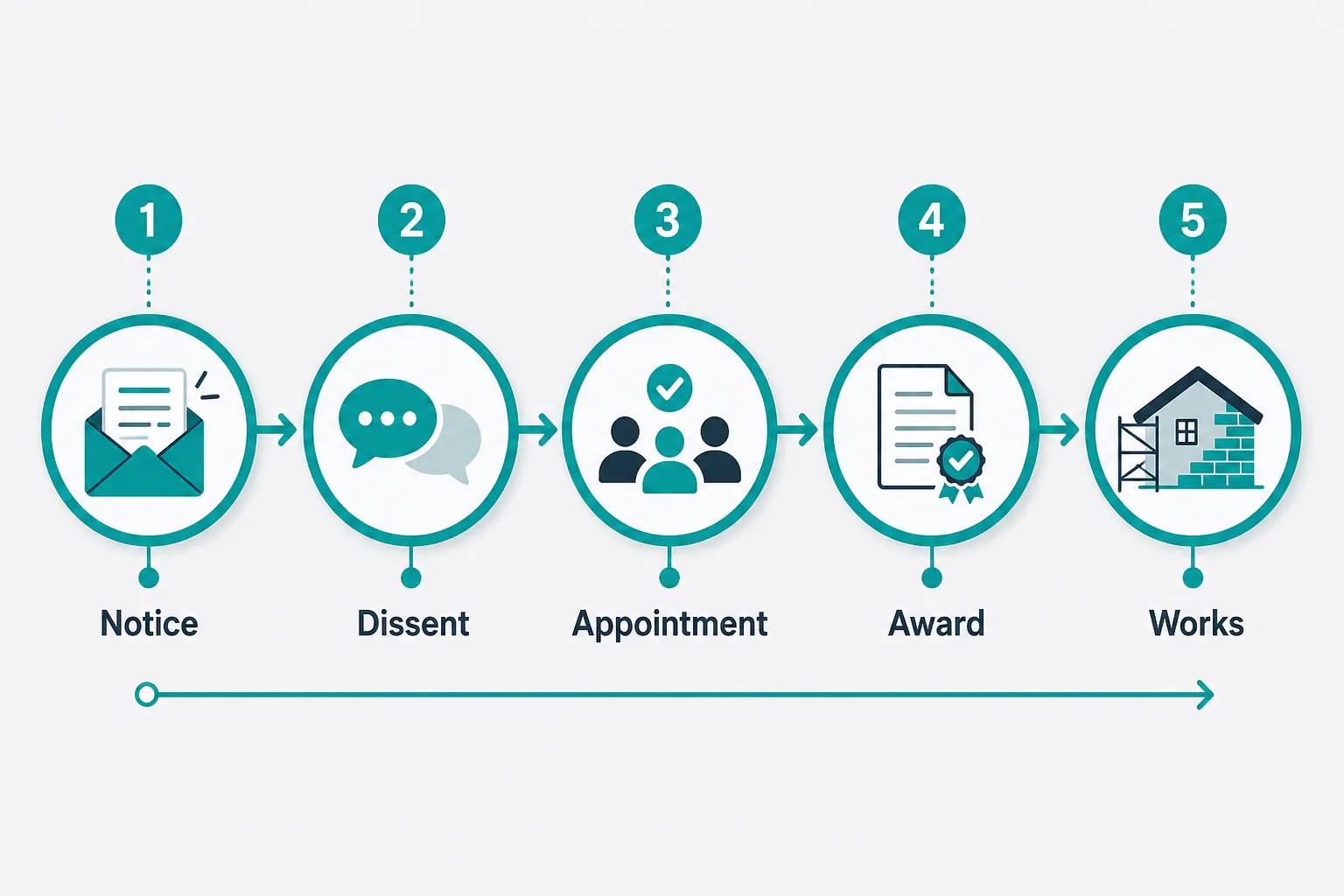
Once a notice is served, the adjoining owner has 14 days to respond. Consent in writing means work can proceed. Dissent or silence triggers the dispute resolution process. For a detailed breakdown, read party wall agreement things you must know.
How Surveyors Use the Evergreen Party Wall Act Toolkit
The Evergreen Party Wall Act Toolkit for Surveyors is a structured, reusable framework that takes a surveyor from initial instruction through to final award without reinventing the process each time. It is "evergreen" because its core steps apply regardless of the type of extension or the year, only the regulatory context changes.
The core toolkit components:
- Pre-notice review, Confirm whether the Act applies, identify all adjoining owners, and review title plans.
- Notice drafting and service, Prepare legally compliant notices for each applicable category.
- Schedule of condition, Document the existing state of the adjoining property before works begin. This is the single most important protective step for both parties. See party wall schedule of condition for what this involves.
- Appointment and award, If dissent occurs, appoint surveyors, agree (or disagree) on an agreed surveyor, and issue a party wall award.
- Monitoring during works, Conduct site visits, respond to concerns, and document any damage.
- Post-works sign-off, Confirm the adjoining property is in the same condition as recorded pre-works.
2026 toolkit additions:
- A damp and ventilation checklist aligned with Awaab's Law for shared-wall properties.
- A third surveyor activation protocol based on the RICS 8th Edition draft guidance.
- Basement-specific risk matrices, given that basement extensions now account for nearly 40% of urban party wall disputes.
For basement-specific guidance, see basements and party wall surveyor in Surrey.
Party Wall Act Extension Disputes: What Are the Common Issues
The most common party wall disputes arise from procedural failures, not the physical works themselves. Knowing where disputes cluster helps surveyors and homeowners avoid them.
Top causes of extension disputes in 2026:
- Invalid or missing notices, The single most frequent trigger. An incorrectly worded notice or one served on the wrong person can void the entire process.
- Boundary and garden wall confusion, Around 60% of disputes in England and Wales involve misunderstandings about garden walls and boundary structures. Many owners assume timber fences and hedges carry the same legal weight as masonry walls under the Act. They do not.
- Damage claims post-construction, Without a pre-works schedule of condition, disputes about who caused a crack or settlement issue become almost impossible to resolve fairly.
- Basement and excavation works, Vibration, waterproofing failures, and underpinning disputes are increasingly common as basement extensions grow in popularity.
- Disagreement between appointed surveyors, When the two party-appointed surveyors cannot agree, the matter goes to the third surveyor. The RICS 8th Edition guidance now encourages earlier activation of this mechanism.
For a deeper look at how disputes escalate, see party wall disputes explained.
Party Wall Act 2026 Timeline, Deadlines, and Requirements
The Act operates on fixed statutory deadlines. Missing any of them can stall a project or expose the building owner to legal action.
Standard extension project timeline:
- Week 1-2: Confirm whether the Act applies; instruct a surveyor.
- Week 2-4: Draft and serve all required notices.
- Week 4-6 (from notice service): Awaiting neighbour response (14-day response window).
- If consent given: Proceed to schedule of condition and then works.
- If dissent or no response: Appoint surveyors within 10 days of dissent.
- Award issued: Typically 4-8 weeks after surveyor appointment, depending on complexity.
- Appeal window: 14 days from the date the award is served to appeal to the county court.
- Works commence: Only after the award is issued (or consent given).
Key 2026 deadline to note: The 14-day appeal window for party wall awards is strictly enforced. Courts have no discretion to extend this deadline, so both building owners and adjoining owners must act quickly if they believe an award is flawed.
How Much Does a Party Wall Surveyor Cost for Extension Disputes
The building owner who initiates the works is generally responsible for all party wall surveyor fees, including the fees of the adjoining owner's surveyor. This is a source of surprise for many homeowners.
Typical fee ranges (2026 estimates):
- Single agreed surveyor (both parties use one): lower cost, typically more efficient.
- Two surveyors (one per party): higher combined cost but provides independent representation.
- Third surveyor referral: adds further cost and delay.
Costs can shift in specific circumstances:
- When both owners benefit from the works (costs may be shared).
- When the adjoining owner causes unnecessary delays or unreasonable demands.
- When damage occurs and an additional inspection is required.
For a full breakdown of what affects the final bill, see cost of a party wall surveyor and cost of a party wall agreement.
Common mistake: Assuming the adjoining owner pays their own surveyor. They do not, the building owner pays, which makes choosing an agreed surveyor a cost-effective option where the relationship between neighbours is cooperative.
Can You Resolve Party Wall Disputes Without a Surveyor
In limited circumstances, yes, but only if the adjoining owner gives written consent within 14 days of receiving a valid notice. In that case, no surveyor appointment is needed and works can proceed.
However, even with consent, commissioning a schedule of condition is strongly advisable. Without one, any post-works damage claim becomes a neighbour's word against the building owner's.
When you cannot avoid a surveyor:
- The adjoining owner dissents or does not respond within 14 days.
- The works are complex (basements, underpinning, significant excavation).
- The adjoining property is tenanted and Awaab's Law obligations apply.
- There is already a dispute in progress.
An agreed surveyor, appointed jointly by both parties, is often the most cost-effective and efficient route. See agreed surveyor: complete guide to roles, appointment, and benefits for how this works.
What Happens If You Ignore Party Wall Act Requirements
Ignoring the Party Wall etc. Act 1996 is one of the most expensive mistakes a building owner can make. The consequences are not theoretical, courts regularly grant injunctions that halt construction mid-project.
Potential consequences of non-compliance:
- Injunction to stop works, A neighbour can apply to court immediately, even if works are already underway.
- Order to demolish completed work, Courts have the power to require removal of work done without proper notice.
- Liability for all costs, The building owner bears the legal costs of the injunction application and any remediation.
- Damage claims without a schedule of condition, Without pre-works documentation, the building owner has no defence against inflated or spurious damage claims.
- Project delays, Retrospectively serving notices and obtaining awards after works begin is far more complex and time-consuming than doing it correctly upfront.
For a detailed account of what non-compliance looks like in practice, see consequences of ignoring the Party Wall Act.
Party Wall Act Mistakes Surveyors Need to Avoid
Even experienced surveyors make procedural errors that create liability or delay. The Evergreen Party Wall Act Toolkit for Surveyors is designed specifically to eliminate these recurring mistakes through a consistent, checklist-driven approach.
The most common surveyor errors in 2026:
- Serving notice on the wrong person, Always verify the Land Registry title for the adjoining property. Tenants are not the correct recipient; the freeholder is.
- Inadequate schedule of condition, Photographs alone are insufficient. A written schedule with measurements and condition ratings is required.
- Failing to activate the third surveyor early enough, The RICS 8th Edition guidance now explicitly encourages early appointment of the third surveyor to prevent deadlocks from dragging on.
- Missing the Awaab's Law damp check, For shared walls in rented properties, failing to flag damp or ventilation risks in the award now carries regulatory exposure.
- Issuing an award before all notices are valid, If a notice is defective, the award built on it is also defective and vulnerable to appeal.
- Overlooking solar panel and net-zero works, Roof access for solar installations on terraced properties now requires its own notice procedure.
Party Wall Act vs Standard Surveying: What Is the Difference
Party wall surveying is a specialist discipline within the broader surveying profession. A standard building survey assesses the condition of a property for a buyer or owner. A party wall surveyor acts as a quasi-judicial officer under the Act, their primary duty is to the Act itself, not to the party who appointed them.
Key distinctions:
| Aspect | Building Survey | Party Wall Survey |
|---|---|---|
| Purpose | Assess property condition | Administer statutory process |
| Duty of care | Client | The Act (impartial) |
| Output | Survey report | Party wall award |
| Trigger | Voluntary | Statutory (when Act applies) |
| Fees paid by | Client | Building owner (generally) |
This impartiality is why the agreed surveyor model works, both parties can trust a single surveyor to act fairly because the law requires it. For broader surveying services, see Prince Chartered Surveyors party wall services.
When the Party Wall Act Does Not Apply: Situations and Exceptions
The Act does not apply in every situation involving a shared wall or boundary. Understanding the exceptions prevents unnecessary notices and costs.
The Act does NOT apply when:
- Works are entirely within the building owner's own property and do not affect the party wall or boundary.
- The work involves only internal alterations with no structural impact on the shared wall.
- The structure in question is a timber fence, hedge, or non-masonry boundary feature (these are not "party walls" under the Act).
- The property is a detached house with no shared walls and excavation is well clear of neighbouring foundations.
- Decorating or plastering one side of a party wall without cutting into or structurally altering it.
Edge case to watch: A garden wall built on the boundary line may or may not be a party wall depending on ownership. Always check the title deeds and Land Registry records before advising a client that the Act does not apply.
How Long Does Party Wall Act Dispute Resolution Take
The timeline depends on whether the neighbour consents or dissents, and on the complexity of the works. A straightforward consent can take as little as two to three weeks from notice to works commencing. A contested dispute with a third surveyor referral can take four to six months.
Typical timeframes:
- Neighbour consents: 2-3 weeks from notice service.
- Neighbour dissents, agreed surveyor appointed: 6-10 weeks to award.
- Two surveyors appointed, agreement reached: 8-12 weeks to award.
- Third surveyor referral required: 3-6 months, sometimes longer.
The biggest delay factor is not the legal process, it is the time owners spend trying to negotiate informally before engaging surveyors. Instructing a surveyor at the first sign of dissent is almost always faster than attempting to resolve the dispute without professional help.
Best Party Wall Act Software Tools for Surveyors in 2026
Surveyors managing multiple party wall cases simultaneously benefit from dedicated case management software. While no single platform dominates the market, the most effective tools in 2026 share common features.
What to look for in party wall software:
- Automated notice generation with legally compliant templates.
- Deadline tracking for notice periods, dissent windows, and appeal deadlines.
- Document storage for schedules of condition, photographs, and correspondence.
- Award drafting tools with version control.
- Integration with Land Registry data for ownership verification.
Practical note: Software tools support the process but do not replace professional judgment. The Evergreen Party Wall Act Toolkit for Surveyors works best when the surveyor uses technology to handle administrative tasks, freeing time for the legal and technical analysis that determines award quality.
.pw-calc { font-family: Arial, sans-serif; max-width: 480px; margin: 24px auto; background: #f4f7fb; border-radius: 10px; padding: 22px 24px; box-sizing: border-box; }
.pw-calc h3 { margin: 0 0 14px; font-size: 1.1rem; color: #1a3a5c; }
.pw-calc label { display: block; font-size: 0.88rem; color: #333; margin-bottom: 4px; }
.pw-calc select, .pw-calc input[type=”date”] { width: 100%; padding: 8px 10px; border: 1px solid #c5d0de; border-radius: 6px; font-size: 0.9rem; margin-bottom: 14px; box-sizing: border-box; background: #fff; }
.pw-calc button { background: #1a3a5c; color: #fff; border: none; padding: 10px 22px; border-radius: 6px; font-size: 0.95rem; cursor: pointer; width: 100%; }
.pw-calc button:hover { background: #245080; }
.pw-results { margin-top: 16px; background: #fff; border-radius: 8px; padding: 14px 16px; border-left: 4px solid #1a3a5c; display: none; }
.pw-results p { margin: 6px 0; font-size: 0.88rem; color: #222; }
.pw-results strong { color: #1a3a5c; }
.pw-note { font-size: 0.78rem; color: #666; margin-top: 12px; }
Party Wall Notice Deadline Calculator
Notice served:
Neighbour response deadline:
Earliest works start date:
Award appeal deadline (if applicable):
Estimates only. Always confirm deadlines with a qualified party wall surveyor.
function pwCalc() {
var d = document.getElementById(‘pw-serve-date’).value;
if (!d) { alert(‘Please select a notice date.’); return; }
var days = parseInt(document.getElementById(‘pw-notice-type’).value);
var base = new Date(d);
function addDays(dt, n) { var r = new Date(dt); r.setDate(r.getDate() + n); return r.toLocaleDateString(‘en-GB’, {day:’2-digit’,month:’short’,year:’numeric’}); }
document.getElementById(‘r-served’).textContent = base.toLocaleDateString(‘en-GB’, {day:’2-digit’,month:’short’,year:’numeric’});
document.getElementById(‘r-response’).textContent = addDays(base, 14);
document.getElementById(‘r-start’).textContent = addDays(base, days);
document.getElementById(‘r-appeal’).textContent = addDays(base, days + 14) + ‘ (14 days from award)’;
document.getElementById(‘pw-results’).style.display = ‘block’;
}
Frequently Asked Questions
Do I need a party wall surveyor for a single-storey rear extension?
Yes, if the extension involves building on or near the boundary line, cutting into a shared wall, or excavating within 3 metres of a neighbour's foundations. Serve the appropriate notice at least one to two months before works begin.
What is a party wall award?
A party wall award is a legally binding document issued by appointed surveyors that sets out the rights and obligations of both parties during and after the works. It typically includes the schedule of condition, permitted working hours, and any protective measures required.
Can my neighbour stop my extension by refusing to agree?
No. A neighbour can dissent from a notice, which triggers the formal dispute resolution process, but they cannot veto the works outright. The surveyor process exists precisely to allow works to proceed fairly even when neighbours disagree.
How do I appeal a party wall award I believe is unfair?
You must file an appeal at the county court within 14 days of the award being served. This deadline is absolute, courts have no power to extend it. Appeals must be based on a genuine legal or factual error in the award, not simply a preference for a different outcome.
What is the third surveyor and when are they used?
The third surveyor is a neutral party agreed upon by the two appointed surveyors at the start of the process. If the two surveyors cannot agree on an award, either surveyor (or either owner) can refer the matter to the third surveyor for a binding decision. The RICS 8th Edition guidance encourages earlier use of this mechanism to reduce delays.
Does the Party Wall Act apply to loft conversions?
It can, if the loft conversion involves cutting into or raising a party wall, or if it requires structural work on a chimney breast shared with a neighbour. See do you require party wall agreements for lofts? for specific guidance.
What happens if a neighbour ignores my party wall notice?
Silence counts as dissent under the Act. If a neighbour does not respond within 14 days, the dispute resolution process is automatically triggered and surveyors must be appointed.
Conclusion
The Party Wall etc. Act 1996 remains one of the most misunderstood pieces of property legislation in England and Wales, and in 2026, the stakes have risen with Awaab's Law obligations, updated RICS guidance, and a sharp increase in complex basement and solar-related disputes. The Evergreen Party Wall Act Toolkit for Surveyors: Resolving 2026 Extension Disputes Efficiently provides a consistent, legally sound framework that protects building owners, adjoining owners, and the surveyors who serve them.
Actionable next steps:
- Before planning any extension, check whether the Party Wall etc. Act 1996 applies using the three trigger categories (party structure works, boundary line building, and excavation).
- Instruct a qualified party wall surveyor early, ideally before finalising your architect's drawings, to avoid costly notice errors.
- Always commission a schedule of condition, even when a neighbour consents, to protect against post-works damage claims.
- If you are a landlord with shared-wall properties, review your Awaab's Law obligations alongside any party wall works planned for 2026.
- For a full overview of your rights and responsibilities, start with party wall rights explained and top questions about party wall surveys.
A structured approach to party wall compliance is not bureaucracy, it is the most reliable way to keep a project on time, on budget, and out of court.