

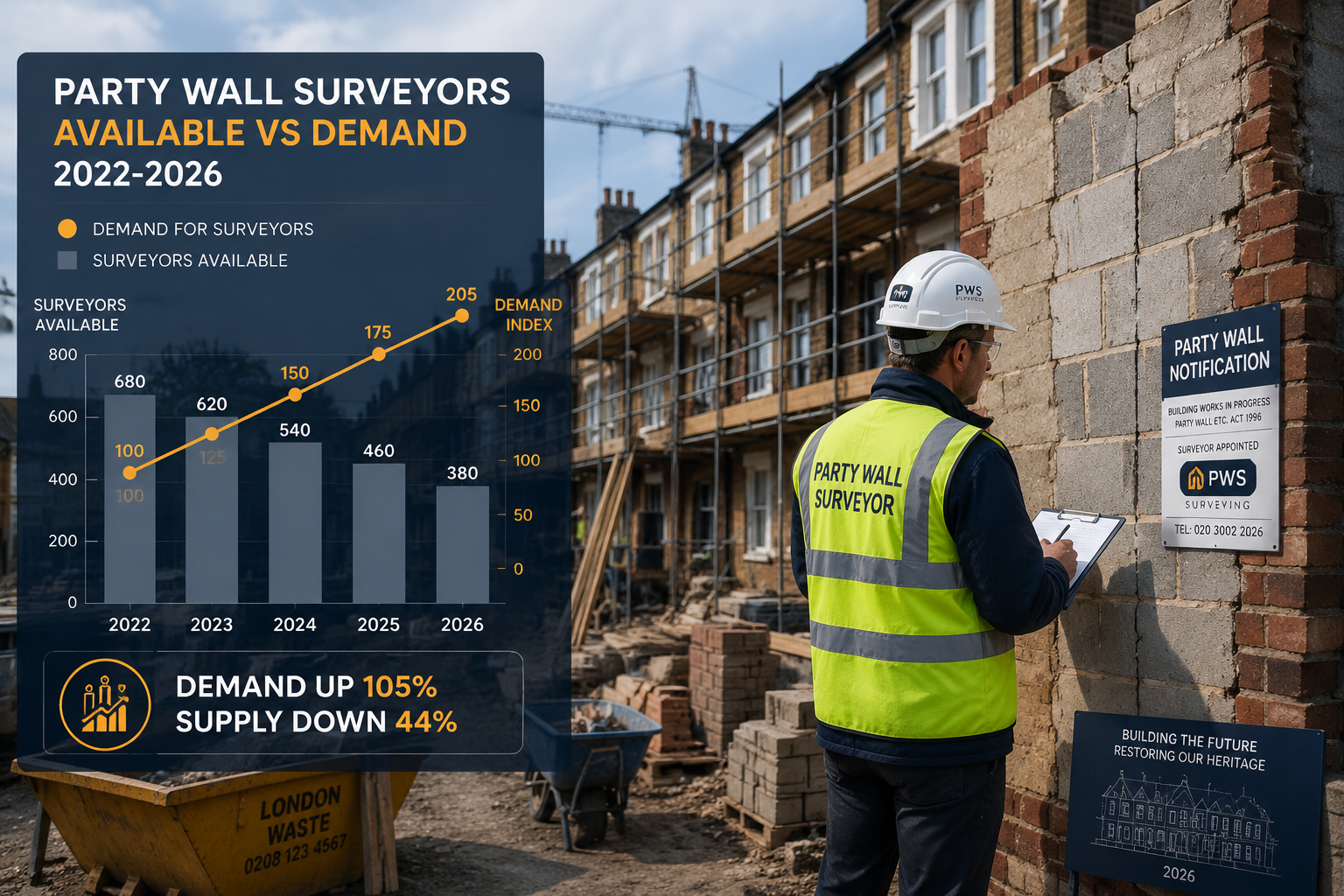
Eighty-seven percent of surveying professionals in the UK report that skills shortages are actively disrupting their work — and for the party wall sector, that disruption is now measured in weeks lost on construction sites [4]. As the UK government presses toward its target of 1.5 million new homes by 2029, the volume of party wall notices being served has climbed sharply, exposing a gap between the number of qualified specialists available and the scale of demand now placed on them [5]. The challenge of Party Wall Surveyor Talent Shortages in 2026 Recovery: RICS Pathways to Meet Reformed Demand sits at the intersection of housing policy, professional regulation, and workforce strategy — and the consequences of inaction are already visible in booking queues that have stretched from two weeks to ten.
Key Takeaways
- Booking windows for party wall surveyors have extended to 6-10 weeks in high-demand areas, threatening project timelines across the UK.
- RICS launched a consultation on the draft 8th edition of its Party Wall guidance in April 2026, raising the bar for conduct and procedural standards.
- New RICS professional pathways — including Residential Retrofit Surveying and Data Analytics — are designed to widen the talent pipeline.
- An aging surveying workforce is accelerating the urgency of graduate recruitment and CPD investment.
- Digital tools, including AI-assisted workflows, are beginning to ease administrative pressure but cannot substitute for qualified professionals.
The Scale of the Problem: Why Shortages Are Hitting Party Wall Work Hardest
The party wall sector is not suffering in isolation. A 2026 ManpowerGroup survey found that 72% of employers globally report difficulty filling roles, with the most acute shortages now appearing in technically specialised fields [7]. In the UK built environment, the picture is sharper still: 27% of surveying professionals describe the impact of skills shortages as critical, with building surveying among the hardest-hit disciplines [4].
Party wall work is particularly vulnerable for three reasons.
First, demand has surged. The government's housebuilding ambitions have triggered a wave of extensions, basement conversions, loft projects, and terrace renovations — all of which commonly trigger obligations under the Party Wall etc. Act 1996. If you are unsure whether your project requires formal notification, the guide to when you need a party wall surveyor provides a clear starting point.
Second, the workforce is aging. A significant proportion of RICS-accredited party wall surveyors are approaching retirement age, and the profession has not historically attracted large cohorts of younger entrants at the pace needed to replace them [5]. This demographic pressure compounds the raw numbers problem.
Third, the work is specialised. Party wall surveying is not a generic skill. It requires detailed knowledge of the Act, strong dispute resolution instincts, and the ability to produce legally binding party wall awards that withstand challenge. That depth of expertise takes time to develop, meaning short-term fixes are limited.
Booking Delays Are Costing Projects Real Money
In London and the South East, booking windows for party wall surveyors have extended from the historical norm of two to three weeks to between six and ten weeks in 2026 [5]. For a homeowner planning a loft conversion or a developer managing a terrace refurbishment, that delay can push back planning conditions, affect mortgage drawdown schedules, and create friction with neighbours who are waiting for formal procedures to begin.
The knock-on effects are not trivial. Construction teams standing idle, contractors rescheduling, and adjoining owners growing impatient — these are the real-world consequences of a talent gap that policy documents rarely capture.
"A six-to-ten week wait for a party wall surveyor is not an administrative inconvenience. For many projects, it is the difference between a build that runs on time and one that runs over budget."
For those navigating an active dispute or a complex boundary situation, understanding the range of party wall disputes that commonly arise can help set realistic expectations about process length.
RICS Pathways Responding to Party Wall Surveyor Talent Shortages in 2026 Recovery

The Royal Institution of Chartered Surveyors has responded to the talent crisis on two parallel tracks: raising professional standards through updated guidance, and widening the routes into the profession through new qualification pathways.
The 8th Edition Party Wall Guidance Consultation
In April 2026, RICS launched an eight-week consultation on the draft 8th edition of its Party Wall Legislation and Procedure guidance, with the consultation period closing on 5 June 2026 [1]. The update is significant for several reasons.
The revised guidance aims to:
- Clarify how the Party Wall etc. Act 1996 applies in complex or ambiguous situations
- Strengthen standards of professional conduct for surveyors acting under the Act
- Provide updated templates for notices and awards that reflect current practice
- Align procedural expectations with the broader RICS professional standards framework
The conduct provisions are particularly notable. The draft 8th edition places renewed emphasis on ethical behaviour and the surveyor's duty to act impartially — a reminder that party wall surveyors serve the process, not either party. This matters in a market where demand pressure can tempt shortcuts. Understanding the full scope of what a party wall award entails helps both surveyors and clients appreciate why procedural rigour cannot be sacrificed for speed.
New Professional Pathways: Widening the Talent Pipeline
RICS has announced pilot programmes for new professional pathways designed to attract entrants from adjacent disciplines and broaden the profession's appeal [2]. Two pathways are of particular relevance to the party wall talent shortage:
| Pathway | Level | Focus Area |
|---|---|---|
| Residential Retrofit Surveying | AssocRICS | Energy efficiency, existing housing stock |
| Sustainability Advisory | Chartered Surveyor | ESG, built environment sustainability |
| Data Analytics and Intelligence | Chartered Surveyor | Data management, valuation, cyber security |
The Residential Retrofit pathway is especially significant. As the UK retrofits millions of existing homes to meet energy targets, surveyors working on those projects will increasingly encounter party wall obligations — particularly where works involve shared walls, foundations, or boundary structures. Building a cohort of AssocRICS-qualified retrofit surveyors who also understand party wall procedure creates a natural feeder pool for the specialist sector [2].
The Data Analytics and Intelligence pathway signals a broader shift in what RICS considers core competency [3]. Surveyors who can manage data workflows, interpret digital survey outputs, and apply governance frameworks will be better equipped to handle the administrative complexity of high-volume party wall caseloads.
CPD as a Retention and Upskilling Tool
Continuing Professional Development is not just a regulatory obligation — in the current market, it is a retention strategy. Firms that invest in structured CPD programmes for their surveyors signal a commitment to career development that matters to younger professionals weighing their options.
For party wall specialists, targeted CPD might cover:
- Updates to the 8th edition guidance and procedural changes
- Dispute resolution techniques under the Act
- Digital tools for notice management and award drafting
- Structural engineering interfaces — because understanding how engineers interact with party wall processes is increasingly relevant as projects grow more complex
Firms that treat CPD as a checkbox exercise risk losing mid-career surveyors to competitors who offer genuine development pathways.
Recruitment, Technology, and the Road Ahead for Party Wall Specialists
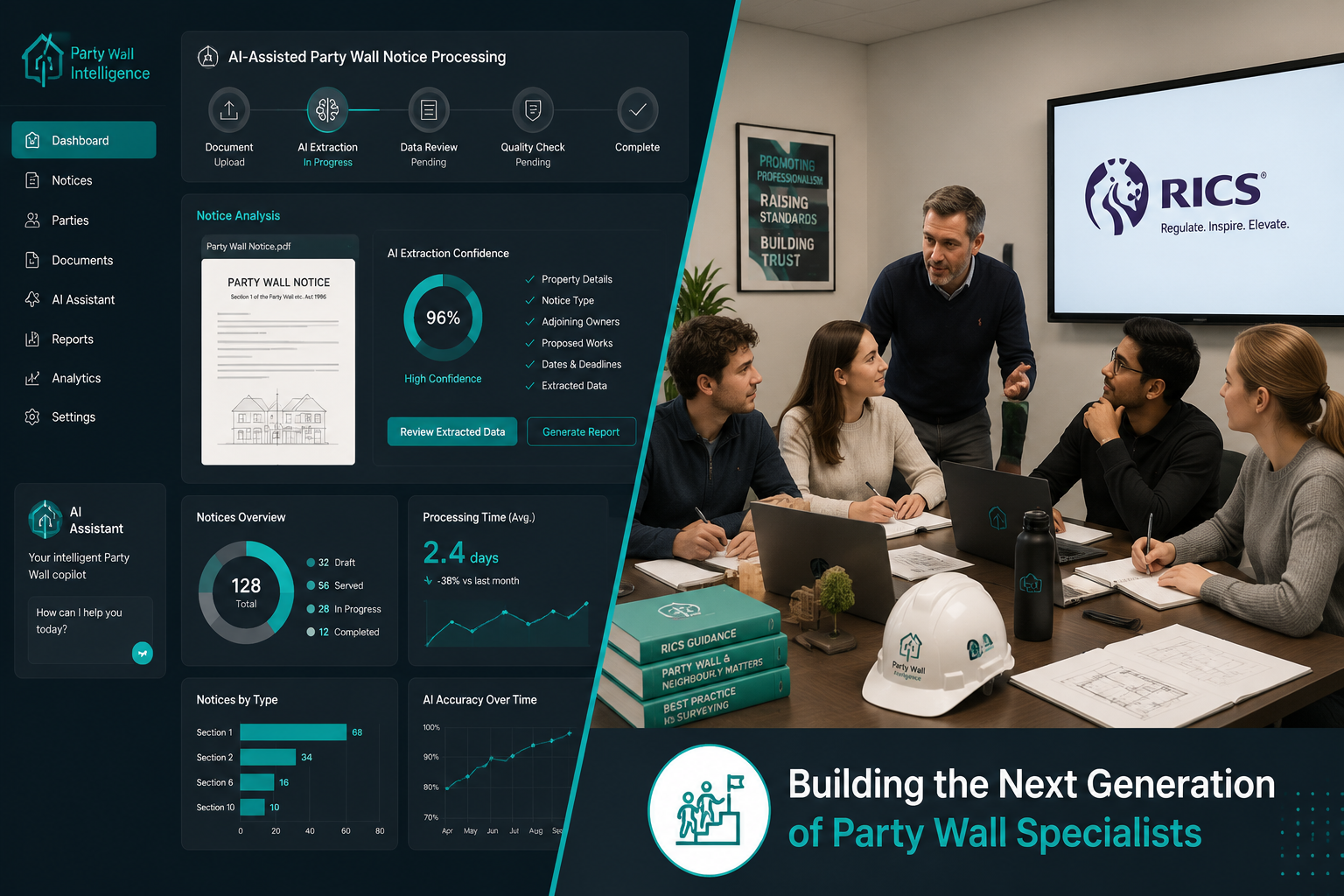
Addressing Party Wall Surveyor Talent Shortages in 2026 Recovery: RICS Pathways to Meet Reformed Demand requires more than new qualifications. It demands a coordinated approach to recruitment, technology adoption, and the structural conditions that make party wall surveying an attractive long-term career.
Graduate Recruitment: Building the Pipeline Early
The most sustainable solution to a talent shortage is always to build the pipeline before the shortage becomes critical. That moment has passed — but it is not too late to accelerate graduate entry into the party wall sector.
Several approaches are proving effective in 2026:
- University partnerships: Firms collaborating with built environment faculties to introduce party wall law and procedure into undergraduate and postgraduate curricula
- Apprenticeship routes: Degree apprenticeships in building surveying that incorporate party wall modules, allowing candidates to earn while they learn
- Early careers programmes: Structured graduate schemes that rotate candidates through party wall, building surveying, and valuation work before specialisation
For firms actively hiring, open roles in chartered surveying and early careers programmes represent concrete entry points for candidates considering the profession.
The agreed surveyor model — where both parties to a party wall dispute appoint a single surveyor rather than two — is worth understanding for those entering the field. A thorough guide to the agreed surveyor role, appointment, and benefits illustrates how this approach can reduce cost and delay, and why competence in this role is particularly valued by clients.
Technology as a Force Multiplier
Technology cannot replace a qualified party wall surveyor, but it can dramatically increase the throughput of a surveyor who is already qualified. RICS published a professional standard on the responsible use of artificial intelligence in surveying practice, effective from March 2026, providing a framework for integrating AI tools without compromising professional standards [6].
In the party wall context, AI-assisted tools are beginning to support:
- Notice drafting: Template generation and compliance checking for party wall notices
- Schedule of condition reports: Photographic analysis and automated condition logging
- Award preparation: Structured drafting tools that flag missing provisions or procedural gaps
- Caseload management: Prioritisation and deadline tracking across multiple live matters
None of these functions eliminate the professional judgement required to serve a valid notice, conduct a proper inspection, or resolve a dispute between neighbours. But they do reduce the administrative burden that currently consumes a disproportionate share of a surveyor's working day. A surveyor who previously managed twenty active cases might, with the right digital tools, manage thirty — which is a meaningful contribution to capacity without adding a single new entrant to the profession.
What Clients and Developers Can Do Now
While the profession rebuilds its capacity, those commissioning party wall work can take practical steps to reduce delay and risk:
- Serve notices early: Given extended booking windows, serving party wall notices at the earliest possible stage of project planning — rather than waiting until works are imminent — is now essential
- Use agreed surveyors where appropriate: The agreed surveyor model can reduce the number of surveyors required and speed up the award process
- Brief surveyors thoroughly: Providing complete structural drawings and party wall drawings upfront reduces the back-and-forth that extends timelines
- Ask the right questions: Knowing the top questions to ask about party wall surveys before engaging a surveyor leads to better-scoped instructions and fewer surprises
For loft conversion projects specifically — one of the most common triggers for party wall obligations — understanding whether party wall agreements are required for loft works before instructing a surveyor saves time and avoids procedural errors.
Structural Reforms That Would Help
Beyond what individual firms and surveyors can do, several structural changes would materially improve the supply-demand balance:
- Streamlined RICS assessment routes for candidates with relevant adjacent experience — structural engineers, building control officers, and architectural technologists who already understand construction law and building pathology
- Reciprocal recognition for surveyors qualified in other jurisdictions who wish to practice party wall work in England and Wales
- Government investment in built environment apprenticeships, particularly in disciplines that directly support housebuilding targets
- Clearer statutory guidance on the Act itself — the 8th edition consultation is a step in this direction, but legislative clarification of certain ambiguous provisions would reduce the volume of disputes that require surveyor intervention
Conclusion
The Party Wall Surveyor Talent Shortages in 2026 Recovery: RICS Pathways to Meet Reformed Demand challenge is real, measurable, and worsening without deliberate intervention. Booking delays of six to ten weeks are already affecting live projects. An aging workforce is reducing supply at the same time that government housebuilding policy is driving demand upward. The RICS 8th edition consultation and new professional pathways represent meaningful steps, but they will take time to produce qualified practitioners at scale.
Actionable next steps for different stakeholders:
- Developers and homeowners: Serve party wall notices as early as possible in the project lifecycle and engage surveyors before design is finalised
- Surveying firms: Invest in CPD, structured graduate schemes, and digital tools that increase per-surveyor capacity
- RICS and professional bodies: Accelerate the new pathway pilots, create bridging routes for adjacent professionals, and ensure the 8th edition guidance is accompanied by accessible training resources
- Government: Align housebuilding targets with workforce development investment, treating surveyor supply as infrastructure in the same way that bricks and mortar are
The talent gap will not close overnight. But firms and professionals who act now — building pipelines, adopting technology responsibly, and engaging with the new RICS pathways — will be best positioned when the market reaches equilibrium. Those who wait will find the queue only grows longer.
References
[1] RICS Launches Consultation on Updated Party Wall Practice Guidance – rics.org
[2] RICS Calls Expressions of Interest for Pilot Programmes for New Professional Pathways – rics.org
[3] RICS Announces New Data Pathway to Become Chartered Surveyor – buildingengineer.org.uk
[4] Surveyor Talent Pipeline 2026: RICS Training for Reform-Driven Building Survey Demand Surge – nottinghillsurveyors.com
[5] Party Wall Awards in 2026: Construction Boom Safeguarding Projects Amid Surveyor Shortages – partywallsurveyorlondon.uk
[6] What Surveyors Think About AI – ww3.rics.org
[7] ManpowerGroup 2026 Talent Shortage Press Release – manpowergroup.com