

Last updated: July 24, 2026
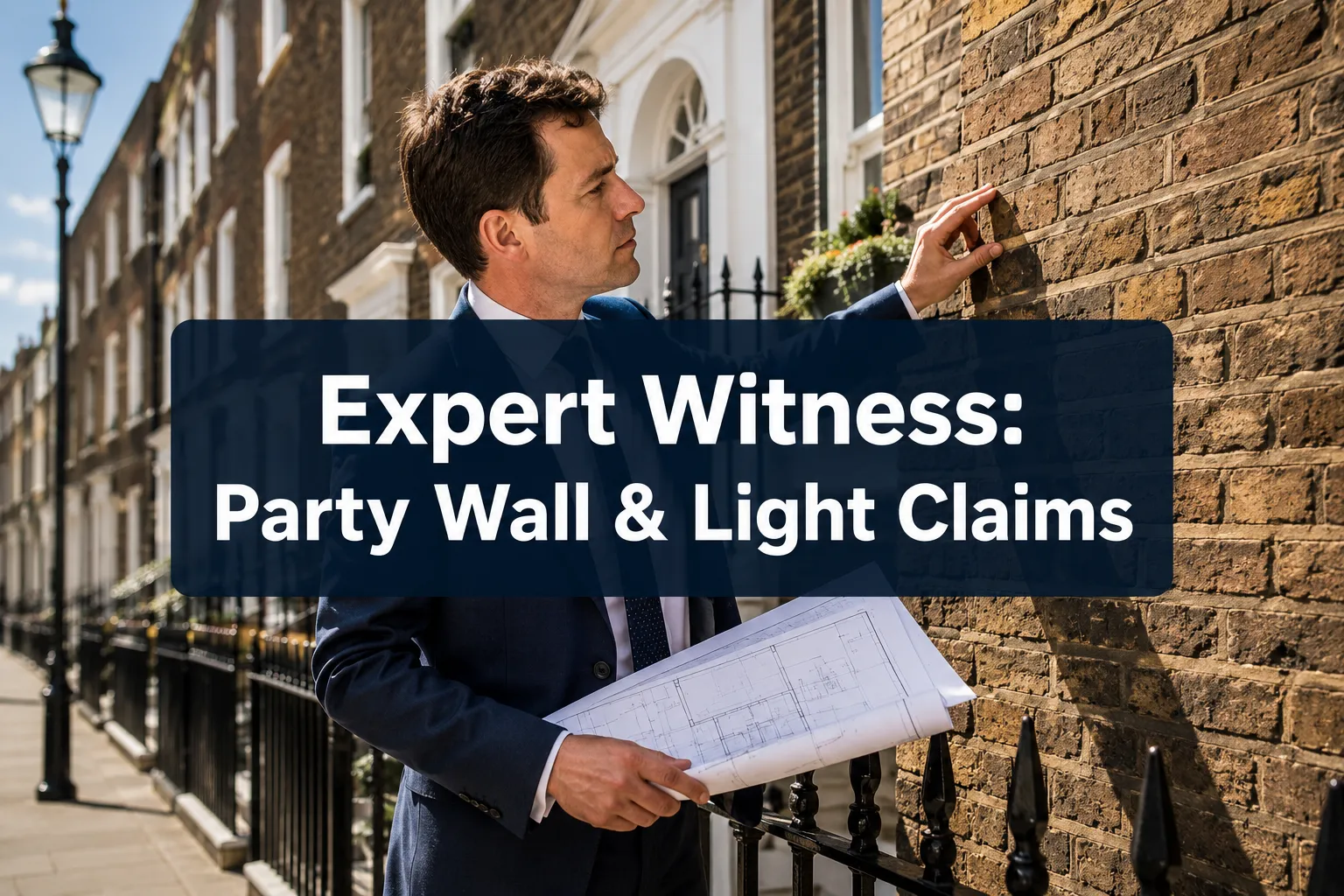
Quick Answer: Workman LLP Building Consultancy and similar specialist firms deploy expert witnesses in party wall damage and rights to light disputes by producing CPR Part 35-compliant reports, conducting rigorous causation analysis, and presenting daylight assessments that courts and tribunals treat as authoritative. Property owners in the UK who face construction damage or loss of natural light need a qualified chartered surveyor acting as expert witness to secure fair compensation or injunctive relief. The strength of the expert's evidence, its independence, methodology, and compliance with professional standards, almost always determines the outcome.
Key Takeaways
- Expert witnesses in party wall and rights to light cases must comply strictly with Civil Procedure Rules Part 35 and RICS professional standards to be credible in court.
- Over a third of surveying expert witness reports in recent UK litigation contained opinions that exceeded the expert's stated area of competence, a critical mistake that undermines cases.
- Rights to light claims require a combination of physical building inspections, daylight and sunlight assessments, and property valuations to succeed.
- Party wall damage claims depend on accurate causation analysis: distinguishing pre-existing defects from new damage caused by notifiable works.
- Courts expect both repair costs and diminution in property value to be addressed separately in party wall damage assessments.
- Ignoring Party Wall Act requirements exposes building owners to injunctions, mandatory demolition orders, and significant financial liability.
- Expert witnesses appointed in party wall award appeals must focus narrowly on their area of competence, scope creep is the most common reason reports are discredited.
- Resolving disputes without expert witnesses is possible through mediation, but complex technical cases almost always require one.
What Is Party Wall Damage and How Does It Affect Neighbouring Properties
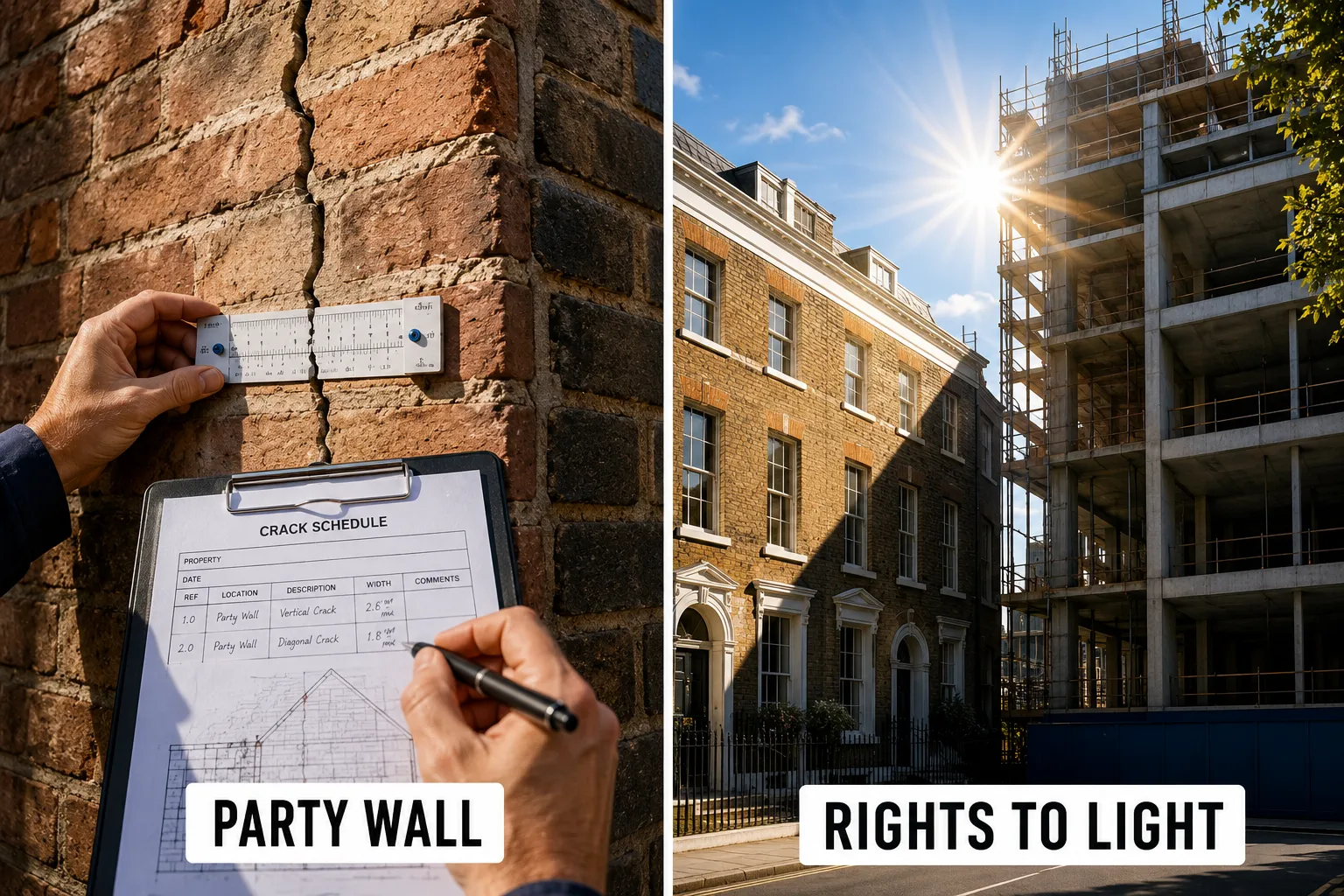
Party wall damage occurs when construction or excavation works carried out under the Party Wall etc. Act 1996 cause physical harm to a shared wall, boundary structure, or adjoining owner's property. It affects neighbouring properties through cracking, settlement, water ingress, and structural movement that can reduce both habitability and market value.
Under the Act, a building owner must serve formal notice before undertaking notifiable works such as loft conversions, basement excavations, or extensions that affect a shared boundary. When those works cause damage, the adjoining owner has a legal right to compensation. The challenge lies in proving that the damage was caused by the works, not by pre-existing conditions.
Common types of party wall damage include:
- New or widened cracks in internal and external walls
- Settlement or subsidence linked to excavation
- Damage to plasterwork, ceilings, or floor finishes
- Water ingress through a compromised shared wall
- Structural movement affecting doors, windows, and roof lines
A schedule of condition prepared before works begin is the single most effective tool for establishing what damage is genuinely new. Without one, causation disputes become far harder to resolve.
Rights to Light Claims Explained: What Property Owners Need to Know
A right to light is a legal easement that gives a property owner the right to receive natural light through defined apertures, typically windows, that have enjoyed unobstructed light for at least 20 years. When a new development substantially reduces that light, the affected owner can pursue a claim for damages or an injunction.
Rights to light claims are not automatic. The affected party must demonstrate that the reduction in daylight is more than a minor inconvenience, courts apply the "45-degree rule" as a starting benchmark, but specialist daylight and sunlight assessments using the BRE methodology carry more weight in litigation.
What property owners need to establish:
- The aperture has received natural light for 20 or more years (establishing the easement)
- The new development substantially interferes with that light
- The interference causes measurable harm, such as reduced amenity or diminished property value
Strategic advice from specialist consultancies includes feasibility studies, massing safe envelope studies, and cut-back analysis, all designed to quantify the extent of interference before proceedings begin.
How Do Expert Witnesses Help with Party Wall Disputes
Expert witnesses help courts resolve party wall disputes by providing impartial technical analysis that neither party can credibly supply on their own. Their role covers advising on the validity of party wall notices and awards, establishing causation of damage, and assessing whether the surveyor's conduct during the process was appropriate.
In party wall award appeals under section 10(17) of the Party Wall etc. Act 1996, expert witnesses are frequently appointed to scrutinise the award itself. Their evidence helps the court determine whether the award was made correctly and whether any compensation awarded is proportionate.
Core functions of a party wall expert witness:
- Reviewing crack schedules and comparing them against pre-works condition records
- Conducting structural assessments to attribute damage to specific causes
- Calculating repair costs and diminution in value
- Advising on whether the building owner followed correct statutory procedures
- Preparing CPR Part 35-compliant reports for use in court
For a detailed overview of how party wall disputes escalate and what parties can expect, see this guide to party wall disputes.
What Is the Difference Between Party Wall Act Violations and Rights to Light Issues
Party wall violations and rights to light issues are legally distinct, though both can arise from the same development project. Party wall violations relate to breaches of statutory procedure under the Party Wall etc. Act 1996, while rights to light claims are common law easement disputes that exist independently of the Act.
| Feature | Party Wall Act Violation | Rights to Light Claim |
|---|---|---|
| Legal basis | Statutory (1996 Act) | Common law easement |
| Trigger | Notifiable construction works | New development blocking light |
| Notice required | Yes, formal party wall notice | No statutory notice required |
| Remedy | Compensation, injunction, award | Damages or injunction |
| Expert type | Party wall / building surveyor | Daylight and sunlight specialist |
A single development can trigger both. For example, a basement extension may breach party wall procedures AND block a neighbour's window light. Understanding which claim applies, and which expert is needed, is essential before committing to legal proceedings.
For more on what your party wall rights actually are, including notice requirements and timelines, that resource covers the fundamentals clearly.
How Much Does It Cost to Hire an Expert Witness for Building Disputes
Expert witness fees for building disputes in the UK typically range from £150 to £400 per hour for a qualified chartered surveyor, with full report preparation costs commonly falling between £2,000 and £8,000 depending on complexity. Costs for rights to light cases, which require specialist daylight modelling software and valuation evidence, tend to sit at the higher end of that range.
These figures are estimates based on typical market rates in 2026 for RICS-accredited surveyors in England and Wales. Actual costs depend on:
- The complexity of the damage or light obstruction
- Whether the case proceeds to court or settles early
- The expert's seniority and specialist credentials
- The volume of documentation that must be reviewed
"The cost of an expert witness is almost always proportionate to the value of the claim. For a property worth £600,000, a £5,000 expert report that secures fair compensation or prevents an injunction is rarely money wasted."
For context on broader surveying costs, this breakdown of party wall surveyor costs is a useful reference point.
What Evidence Do You Need for a Successful Rights to Light Claim
A successful rights to light claim requires a combination of physical building inspections, daylight and sunlight assessments, and property valuations. Courts and tribunals expect all three elements to be present in an expert's report, any gap weakens the claim significantly.
Evidence checklist for a rights to light claim:
- Proof of 20+ years of uninterrupted light through the affected aperture (title deeds, photographs, planning records)
- A BRE-compliant daylight and sunlight assessment quantifying the reduction
- A physical inspection confirming the aperture's position and dimensions
- A property valuation demonstrating the impact on market value
- A CPR Part 35-compliant expert report tying all evidence together
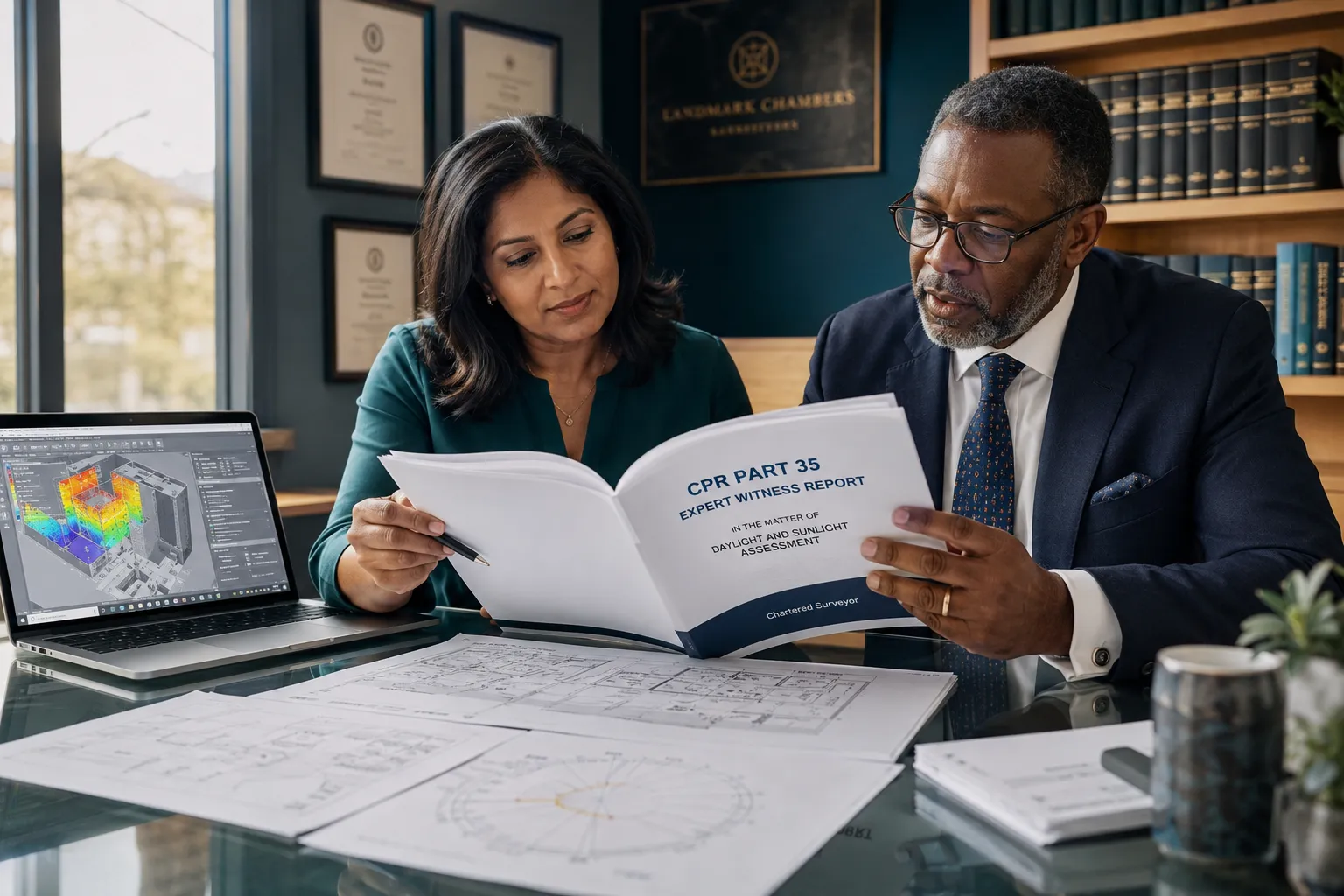
The expert's report must comply with both Civil Procedure Rules Part 35 and RICS professional standards to be admissible. Reports that stray outside the expert's stated area of competence, for example, a daylight specialist offering valuation opinions without supporting credentials, are routinely challenged and can sink an otherwise strong case.
Common Mistakes People Make in Party Wall Damage Cases
The most damaging mistake in party wall damage cases is failing to commission a schedule of condition before works begin. Without that baseline record, proving that specific damage was caused by the notifiable works becomes a matter of argument rather than evidence.
Other frequent errors include:
- Waiting too long to act. Damage that is not reported promptly can be attributed to other causes, weakening the claim.
- Appointing an expert who oversteps their competence. Recent UK litigation found that over a third of surveying expert witness reports contained opinions beyond the expert's stated area of expertise. Courts notice this and discount the entire report.
- Confusing repair costs with diminution in value. Courts expect both to be assessed separately. An expert who addresses only repair costs leaves money on the table.
- Ignoring the Party Wall Act entirely. Building owners who proceed without serving notice face injunctions, potential demolition orders, and personal liability for all costs. The consequences of ignoring the Party Wall Act are severe and well-documented.
- Choosing an agreed surveyor without understanding the implications. See this complete guide to agreed surveyors for how that appointment works and when it is appropriate.
How Long Does a Party Wall or Rights to Light Claim Typically Take
Party wall damage claims that settle through the award process typically resolve within three to six months of the damage being identified. Contested cases that proceed to the County Court can take 12 to 24 months. Rights to light claims, which often involve injunction applications and complex valuation evidence, frequently take 18 months or longer to resolve fully.
Factors that extend timelines:
- Disputes over causation requiring multiple expert reports
- Appeals against party wall awards under section 10(17)
- Injunction applications where the development is ongoing
- Delays in obtaining daylight modelling data or comparable valuation evidence
Early appointment of a qualified expert witness compresses timelines. When both parties have credible expert evidence, settlements before trial become far more likely.
When Should You Hire an Expert Witness for Building Damage
Hire an expert witness as soon as a dispute moves beyond informal negotiation. For party wall damage, that means the moment a building owner disputes causation or refuses to compensate. For rights to light, it means when a planning application is submitted for a development that could substantially reduce your light.
Specific triggers for appointing an expert witness:
- A party wall award is being appealed
- The building owner denies that their works caused the damage
- A rights to light claim is being contested in court
- An injunction application is being prepared or defended
- The value of the claim exceeds the small claims threshold (currently £10,000)
For smaller disputes, a party wall surveyor acting in their standard capacity may be sufficient. Expert witness appointment is specifically needed when the matter enters formal legal proceedings.
What Qualifications Should an Expert Witness Have for Construction Disputes
An expert witness for party wall or rights to light disputes should hold RICS membership (MRICS or FRICS), have completed the RICS Expert Witness training scheme, and be able to demonstrate direct experience with the specific type of dispute at hand. CPR Part 35 compliance is not optional, it is a baseline requirement for any report used in UK civil proceedings.
Qualification checklist:
- RICS accreditation (MRICS or FRICS)
- Completion of RICS Expert Witness training
- Demonstrable experience in party wall or rights to light cases specifically
- Familiarity with Civil Procedure Rules Part 35
- Ability to act independently of the instructing party
The expert's duty is to the court, not to the client who pays their fee. Any expert who appears to advocate for their instructing party rather than provide impartial analysis will be challenged, and often disqualified. Surveyors increasingly complete formal RICS Expert Witness training schemes precisely to guard against this.
Can You Win a Rights to Light Case Without an Expert Witness
Winning a contested rights to light case without an expert witness is extremely unlikely. Courts require technical evidence, daylight assessments, valuation reports, and physical inspection findings, that a lay party cannot credibly provide. Without an expert, the opposing party's evidence goes unchallenged.
In lower-value or uncontested matters, a formal expert witness report may not be required. But for any case involving an injunction application or damages above the small claims threshold, expert evidence is effectively mandatory. The cost of the expert is almost always recovered if the claim succeeds.
Alternatives to full expert witness instruction:
- Single joint expert (SJE) appointed by both parties, reduces cost but limits control over the report
- Early neutral evaluation by a specialist surveyor
- Mediation supported by technical advice (not formal expert evidence)
These alternatives work best for disputes where the facts are largely agreed and only quantum is in issue.
What Happens If You Ignore Party Wall Act Requirements
Ignoring the Party Wall Act exposes a building owner to injunctions that can halt works mid-construction, court orders requiring demolition of completed work, and personal liability for all legal and surveying costs incurred by the adjoining owner. There is no limitation period defence, the adjoining owner can seek relief at any point during or after the works.
Courts have consistently held that ignorance of the Act is not a defence. In practice, the most common outcome for building owners who proceed without notice is a court-ordered retrospective survey process that is far more expensive and disruptive than the original notice procedure would have been.
For a full breakdown of what happens when the Act is ignored and how to remedy the situation, the consequences of ignoring the Party Wall Act resource covers the legal and practical outcomes in detail.
Are There Alternatives to Expert Witnesses for Resolving Building Disputes
Yes, mediation, early neutral evaluation, and single joint expert appointments are all recognised alternatives to full adversarial expert witness proceedings. These routes are faster and less expensive, and courts actively encourage parties to consider them before proceeding to trial.
When alternatives work well:
- Both parties broadly agree on the facts but dispute the value of the claim
- The dispute involves a relatively modest sum (under £25,000)
- There is a continuing relationship between the parties (neighbours, for example) that litigation would damage permanently
When alternatives are insufficient:
- Causation is genuinely disputed and requires independent technical analysis
- An injunction is needed to stop ongoing works
- A party wall award is being formally appealed
Expert witness services remain the most authoritative route when technical complexity is high or when the matter is before a court. For an overview of the full range of expert witness report services available to property owners, that resource outlines what a properly structured instruction looks like.
Party Wall and Rights to Light Claim Timeline Tool
.cg-timeline-wrap{font-family:Arial,sans-serif;max-width:560px;margin:0 auto;background:#f8f9fb;border:1px solid #dde3ec;border-radius:8px;padding:20px}
.cg-timeline-wrap h3{margin:0 0 14px;font-size:1rem;color:#1a2a4a;text-align:center}
.cg-tl-row{display:flex;align-items:center;gap:10px;margin-bottom:10px}
.cg-tl-row label{flex:0 0 170px;font-size:.85rem;color:#333}
.cg-tl-row select{flex:1;padding:6px 8px;border:1px solid #bcc5d6;border-radius:5px;font-size:.85rem;background:#fff}
.cg-tl-btn{display:block;width:100%;padding:10px;background:#1a2a4a;color:#fff;border:none;border-radius:6px;font-size:.9rem;cursor:pointer;margin-top:14px}
.cg-tl-btn:hover{background:#2c4470}
.cg-tl-result{display:none;margin-top:14px;background:#fff;border:1px solid #bcc5d6;border-radius:6px;padding:14px}
.cg-tl-result p{margin:4px 0;font-size:.88rem;color:#222}
.cg-tl-result .cg-tl-range{font-weight:bold;color:#1a2a4a;font-size:1rem}
Party Wall & Rights to Light: Timeline Estimator
Estimated resolution time:
function cgEstimate(){
var t=document.getElementById(‘cg-type’).value;
var c=document.getElementById(‘cg-cause’).value;
var ct=document.getElementById(‘cg-court’).value;
var range,note;
if(t===’pw’&&c===’no’&&ct===’no’){range=’3-6 months’;note=’Award process with agreed facts typically resolves quickly.’;}
else if(t===’pw’&&c===’yes’&&ct===’no’){range=’6-12 months’;note=’Causation dispute adds expert analysis time before settlement.’;}
else if(t===’pw’&&ct===’yes’){range=’12-24 months’;note=’County Court proceedings with expert evidence take 1-2 years.’;}
else if(t===’rtl’&&c===’no’&&ct===’no’){range=’6-12 months’;note=’Uncontested daylight assessment and negotiated settlement.’;}
else if(t===’rtl’&&c===’yes’&&ct===’no’){range=’12-18 months’;note=’Disputed light reduction requires full BRE assessment and valuation.’;}
else{range=’18-30 months’;note=’Injunction applications and contested valuation extend timelines significantly.’;}
document.getElementById(‘cg-range’).textContent=range;
document.getElementById(‘cg-note’).textContent=note;
document.getElementById(‘cg-result’).style.display=’block’;
}
Frequently Asked Questions
What is Workman LLP Building Consultancy's role in expert witness cases?
Workman LLP Building Consultancy provides a range of building surveying and expert witness services, including party wall assessments, rights to light analysis, project management, and due diligence. Their expert witnesses produce CPR Part 35-compliant reports for use in court and tribunal proceedings.
Does a schedule of condition guarantee compensation for party wall damage?
No, but it makes compensation far easier to secure. A schedule of condition establishes the pre-works baseline. Without it, the building owner can argue that damage was pre-existing, and the burden shifts to the adjoining owner to prove otherwise.
Can a rights to light claim stop a development already under construction?
Yes. Courts can grant injunctions that halt construction mid-build if a rights to light claim is sufficiently strong. The earlier a claim is raised, ideally at planning stage, the more options the affected owner has.
What does CPR Part 35 compliance mean for expert witness reports?
CPR Part 35 requires that an expert witness's duty is to the court, not to the instructing party. The report must be independent, within the expert's area of competence, and include a signed declaration confirming these obligations. Non-compliant reports can be excluded from evidence entirely.
Who pays for the expert witness in a party wall dispute?
Generally, the building owner (the party carrying out the works) pays for the adjoining owner's surveyor costs under the Act. In court proceedings, costs typically follow the event, the losing party pays. Expert witness fees are recoverable if the claim succeeds.
Is mediation a realistic alternative to expert witness proceedings for rights to light disputes?
Mediation works well when both parties accept that a right to light exists and only disagree on the value of the interference. Where the existence of the easement or the extent of obstruction is disputed, technical expert evidence is needed and mediation alone is unlikely to resolve the matter.
Conclusion
Workman LLP Building Consultancy: Expert Witness Tactics for Party Wall Damage and Rights to Light Claims represents one of the most technically demanding areas of UK property law. Success depends on three things: appointing a qualified expert witness early, ensuring that expert operates strictly within their area of competence, and building an evidence base, schedules of condition, daylight assessments, and valuation reports, that courts can rely on.
Actionable next steps for property owners and professionals:
- Commission a schedule of condition before any neighbouring works begin, it is your most important piece of evidence.
- If you receive a party wall notice, understand your rights under the Party Wall Act before responding.
- For rights to light concerns, raise them at planning stage, before construction starts, not after.
- When appointing an expert witness, verify their RICS accreditation and confirm they have completed RICS Expert Witness training.
- Explore expert witness report services from a specialist firm to understand what a properly structured instruction involves.
The difference between a well-prepared expert witness case and a poorly prepared one is rarely about the strength of the underlying claim, it is almost always about the quality and compliance of the evidence presented.
Tags: party wall damage, rights to light, expert witness surveyor, Party Wall Act 1996, building consultancy, CPR Part 35, chartered surveyor, daylight assessment, Workman LLP, party wall disputes, rights to light claims, building dispute resolution