

Nearly one in three UK property transactions still collapses before completion, often because buyers discover serious defects or valuation gaps too late in the process. Yet the professional most qualified to prevent those costly surprises is also one of the least understood figures in the homebuying chain. This plain-English guide answers the question that thousands of buyers search for every month: what does a professional chartered surveyor actually do, and why does it matter to you?
Understanding the role is more pressing than ever in 2026. Regulatory changes, a recovering but uneven housing market, and new technology are reshaping what surveyors deliver and when they deliver it. Whether you are buying your first flat or upgrading to a period farmhouse, knowing how a chartered surveyor works will help you commission the right service, read the report intelligently, and negotiate with confidence.
Key Takeaways
- A chartered surveyor is a regulated professional, qualified through the Royal Institution of Chartered Surveyors (RICS), who inspects properties and produces formal written reports on condition, defects, and value.
- There are three RICS survey levels; choosing the wrong level for your property type is one of the most common and expensive mistakes UK homebuyers make.
- A survey is not legally required in England, Wales, or Northern Ireland, but it is strongly recommended by RICS because a mortgage lender's valuation protects the lender, not the buyer.
- Chartered surveyors do far more than inspect bricks and mortar; their work spans formal valuations, reinstatement cost assessments, party wall matters, dilapidations, and expert witness roles.
- In 2026, surveyors are also navigating a shifting market, evolving RICS standards, and growing responsibilities around digital fraud prevention.
The Professional Behind the Clipboard: Qualifications and Regulation
The title "chartered surveyor" is not a marketing label. It is a protected designation awarded by RICS to professionals who have completed an accredited degree, passed a structured Assessment of Professional Competence, and committed to ongoing continuing professional development [1][6]. Only appropriately experienced RICS members can produce official RICS Home Survey reports, which means that when you commission a Level 2 or Level 3 report, you are engaging someone held to a rigorous professional and ethical code [1][6].
RICS itself is the global professional body for land, property, and construction. Its standards are set through formal consultation processes; a public consultation on a revised Home Survey Standard ran from August to October 2025, signalling that the obligations surveyors carry around inspection depth, reporting format, and consumer clarity are under active review [2]. Future standards are expected to place greater emphasis on consistency and accessible explanations for homebuyers [2][10].
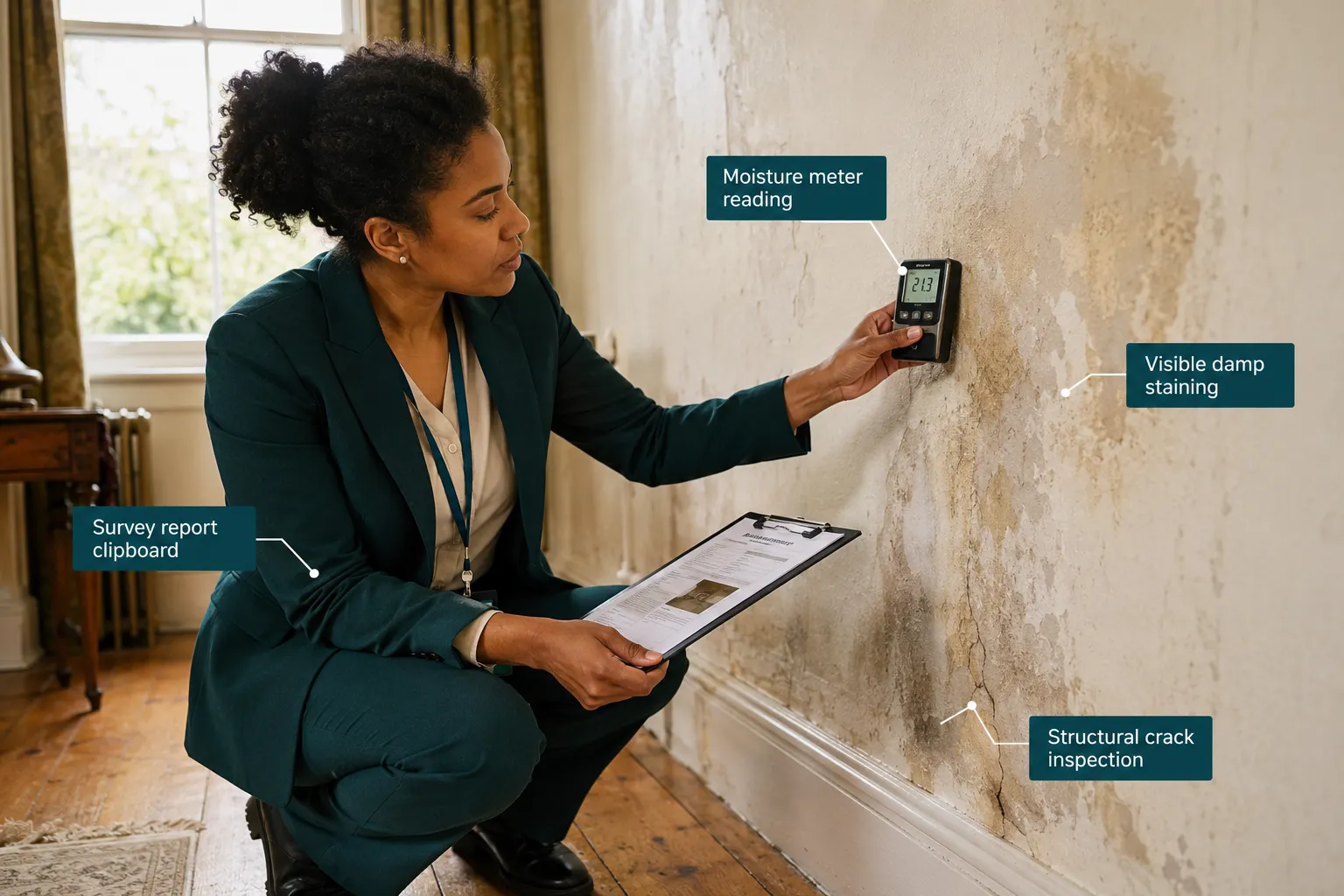
It is worth distinguishing a chartered surveyor from a mortgage valuer. When a lender sends a valuer to the property you want to buy, that professional is working for the bank or building society, not for you. Their report is designed to confirm whether the property provides adequate security for the loan. It is typically brief, may not involve an internal inspection at all, and will not tell you about the damp patch behind the kitchen units or the cracked lintel above the bay window. A chartered surveyor commissioned directly by you works exclusively in your interest.
Key regulated roles within the profession include:
- Residential building surveyor – inspects and reports on property condition
- Valuation surveyor – produces formal market valuations for purchase, lending, or dispute purposes
- Party wall surveyor – manages the legal process when building work affects shared walls or boundaries
- Dilapidations surveyor – assesses repair obligations at the end of commercial leases
For a detailed look at how the cost of a party wall surveyor is calculated, including what drives fees up or down, that dedicated guide covers the subject in full.
The Three RICS Survey Levels Explained
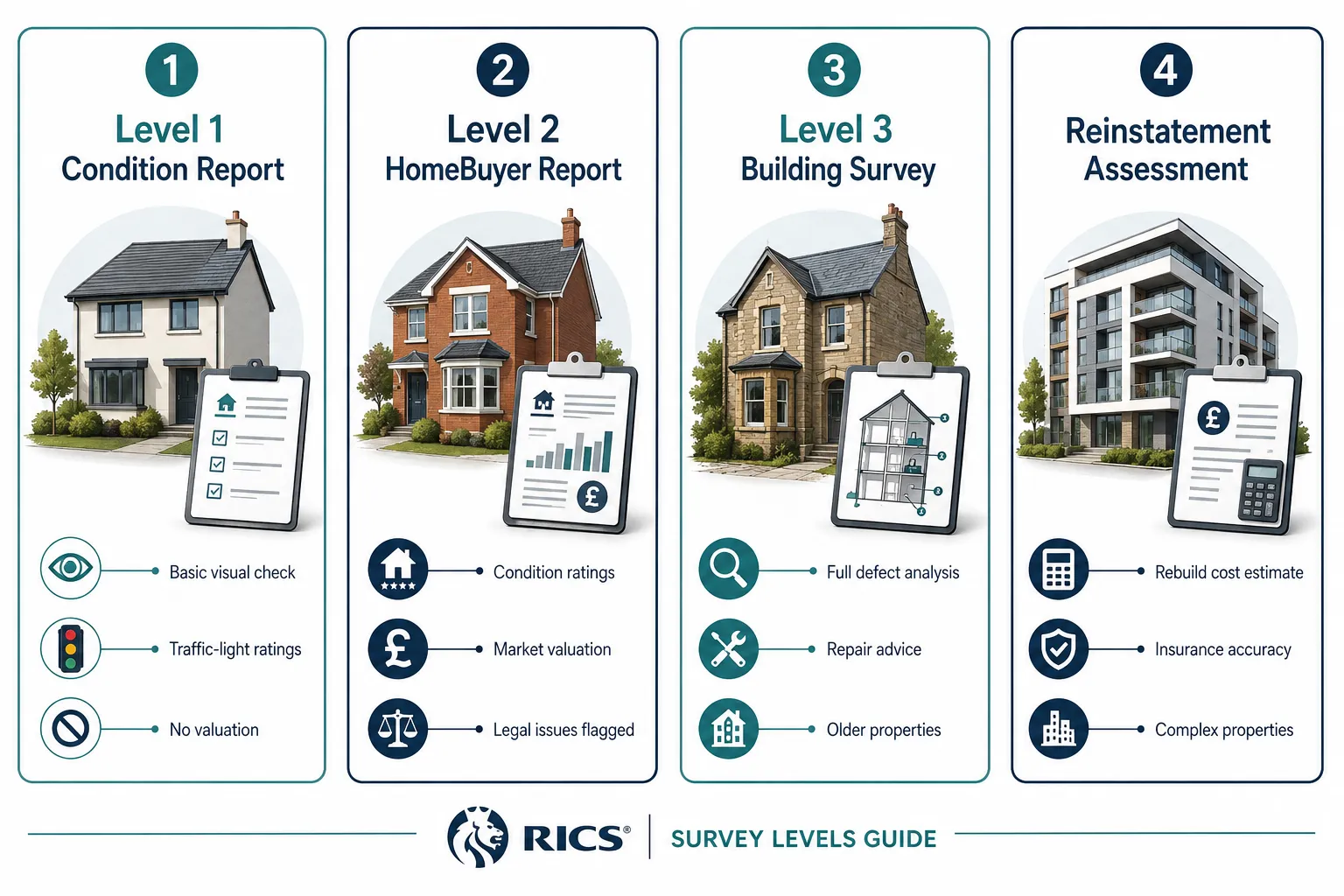
The most common reason UK homebuyers engage a chartered surveyor is to obtain a formal home survey before exchanging contracts. RICS structures these surveys into three levels, each offering increasing depth of inspection and reporting [6][15].
Level 1: Condition Report
The entry-level product, a Level 1 Condition Report, uses a traffic-light rating system to flag the condition of different elements of the property. It does not include a valuation or detailed advice on defects, and it is best suited to new-build properties or conventionally built homes in good condition where the buyer simply wants a basic independent check [8]. Typical fees in 2026 range from around £250 to £600 depending on property size and location [8][14].
Level 2: HomeBuyer Report
The Level 2 HomeBuyer Report is the most popular choice for standard residential purchases in the UK [8][14]. It covers:
- Condition ratings for all accessible parts of the property
- Identification of significant defects and urgent repairs
- A market valuation
- A reinstatement cost estimate for buildings insurance purposes
- Legal issues the buyer should raise with their solicitor
Fees for a Level 2 report typically run from £400 to £1,000 in 2026, varying with property size, age, and regional market [8][14]. The report balances cost against the depth of inspection, making it the default recommendation for buyers purchasing a reasonably standard property built after approximately 1900 in broadly acceptable condition.
Level 3: Building Survey
A Level 3 Building Survey is the most comprehensive product in the RICS framework and is strongly recommended for older, unusual, listed, or significantly altered properties [8][14][15]. Victorian terraces, Edwardian semis, converted barns, and any property where the buyer has concerns about structure, drainage, or historic alterations all fall into this category.
The Level 3 report provides:
- A thorough analysis of all visible defects, including those in roof spaces and under floors where accessible
- Detailed repair and maintenance recommendations
- Commentary on construction methods and materials
- An optional valuation where agreed in advance
Fees for a Level 3 survey typically start at £600 and can exceed £1,500 for large, complex, or high-value properties [8][14]. For a deeper understanding of what this level of inspection covers, the guide to what a Level 3 building survey includes is an essential read before commissioning one.
If you are buying an older property and want to understand the specific risks involved, the article on what to look out for when buying an old house covers the most common structural and material concerns surveyors flag in period homes.
"A survey is not legally required when buying a home in England, Wales or Northern Ireland, but RICS strongly recommends one because the mortgage lender's valuation is designed to protect the lender, not the buyer." [1][6]
Valuation Work: More Than Putting a Number on a House
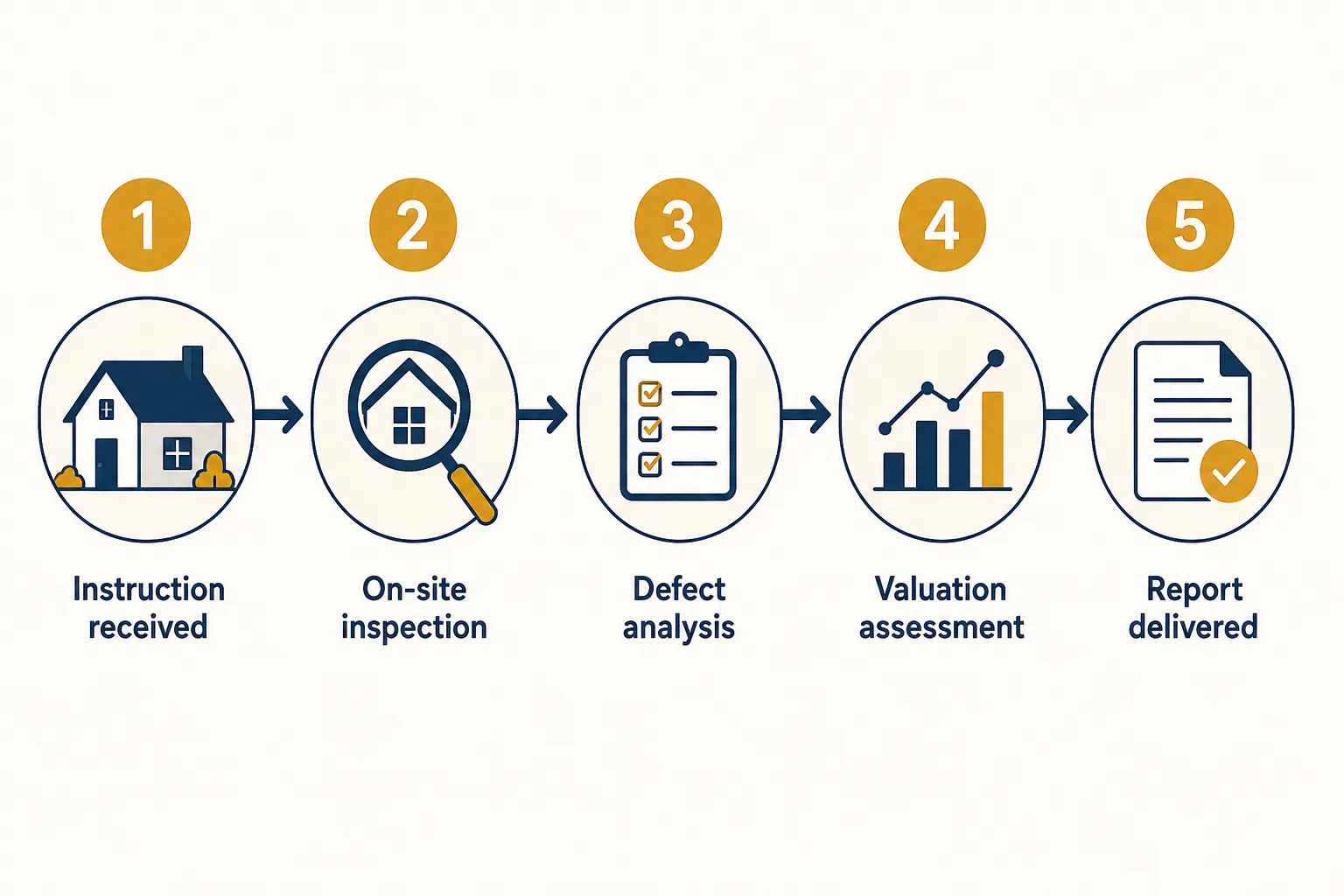
Beyond condition reporting, a core part of what a professional chartered surveyor actually does is formal valuation work. This is a technically demanding discipline that requires the surveyor to analyse comparable sales evidence, adjust for property-specific factors, and reflect current market conditions in a written, defensible report.
In 2026, the UK residential market has presented surveyors with a genuinely complex valuation environment. RICS UK Residential Market Surveys for early 2026 described subdued buyer demand and sluggish sales momentum, with buyer enquiries at a net balance of approximately -26% and agreed sales at -12% according to February 2026 data [7][12]. Surveyors responding to these conditions have been advised to place greater weight on the most recent 90 days of comparable evidence and to include explicit time adjustments in their reports where market conditions have shifted materially [7].
This matters for homebuyers because a formal valuation is not simply an automated estimate. A chartered surveyor must document local demand conditions, explain why comparable sales from six months ago may overstate or understate current achievable prices, and recommend updated valuations where previous assessments are more than 90 days old in volatile markets [7]. For buyers navigating a market where asking prices and achieved prices can diverge significantly, that professional judgement is genuinely valuable.
The valuation challenges posed by AI tools in 2026 and how chartered surveyors handle buyer-seller disputes is a topic worth exploring for buyers who have encountered automated valuation estimates that conflict with a surveyor's opinion.
Reinstatement Cost Assessments
One valuation task that often surprises homebuyers is the reinstatement cost assessment, sometimes called a rebuild cost assessment. This is not the same as the market value of the property. It is an estimate of how much it would cost to demolish and rebuild the property from scratch using current construction costs, materials, and labour rates [10].
This figure is used to set the sum insured on a buildings insurance policy. An inaccurate reinstatement cost can leave a homeowner either dangerously under-insured (meaning a claim following fire or flood would not cover the full rebuild) or over-insured (meaning unnecessarily high premiums). Chartered surveyors use detailed knowledge of construction methods, materials, and current cost indices to produce these assessments, and they are frequently included within Level 2 and Level 3 reports or commissioned separately for higher-value properties [10][15].
The Wider Role: Beyond the Standard Home Survey
A plain-English guide to what a professional chartered surveyor actually does for UK homebuyers would be incomplete without addressing the full breadth of the role. Condition surveys and valuations are the most visible services, but chartered surveyors also:
Advise on renovation and extension feasibility. Before committing to a purchase with ambitious improvement plans, a surveyor can assess whether the structure supports the intended works. The guide to home extension cost considerations illustrates why professional input at the planning stage saves money later.
Manage party wall matters. Where building work affects a shared wall, boundary, or excavation near a neighbour's property, the Party Wall etc. Act 1996 requires a formal process. A party wall surveyor administers that process, produces an agreed schedule of condition, and helps resolve disputes if they arise.
Produce dilapidations reports. At the end of a commercial lease, landlords and tenants often dispute the cost of repairs. A dilapidations survey provides an independent, evidenced assessment of repair obligations that can form the basis of negotiation or legal proceedings.
Act as expert witnesses. In boundary disputes, negligence claims, or other property-related litigation, chartered surveyors can provide court-admissible expert testimony grounded in professional standards and documented evidence.
Support investment decisions. For buyers considering buy-to-let or portfolio acquisitions, a surveyor's assessment of condition, yield potential, and compliance risks is a critical input. The guide to property investment covers how professional advice fits into that decision-making process.
Emerging Responsibilities in 2026
The role of a chartered surveyor is not static. In 2026, several developments are expanding the scope of professional responsibilities:
Upfront sales packs. Government proposals for sellers to provide key property information at the point of listing are gaining momentum. Industry bodies including the Residential Property Surveyors Association (RPSA) suggest that chartered surveyors are likely to play a bigger role in assembling or validating these packs, potentially shifting more of their work to earlier in the transaction to reduce fall-throughs and buyer surprises [13]. The RICS homebuying reforms in 2026 and how mandatory upfront surveys will reshape chartered surveyor workflows explores this shift in detail.
Digital fraud vigilance. In July 2026, the RPSA reported a sophisticated phishing campaign targeting residential surveyors using fake property portal branding and credential-stealing pages [3]. Professional bodies are now urging surveyors to scrutinise instructions, verify client identities, and use secure systems, adding digital risk management to the traditional on-site inspection role [3].
Collaboration with conveyancers. Complaints data highlighted by the RPSA in July 2026 showed a 36% rise in accepted complaints over 12 months, with over a third relating to residential conveyancing [5]. While surveyors are not the primary target of these complaints, the trend is driving closer working relationships between surveyors and solicitors, with surveyors being more explicit about the legal issues they identify and the recommended checks they pass on to conveyancers [5][15].
How to Choose and Work With a Chartered Surveyor
Selecting the right professional is as important as selecting the right survey level. The following steps will help UK homebuyers make a confident choice:
- Verify RICS membership. Check the RICS Find a Surveyor directory to confirm that the professional holds current membership. Only RICS members can produce official RICS Home Survey reports [1][6].
- Match the survey level to the property. Use the three-level framework as a starting point, but ask the surveyor directly whether the property's age, construction type, and condition warrant a higher level of inspection.
- Clarify what is included. Confirm whether a market valuation and reinstatement cost assessment are included in the fee, or whether they are optional extras.
- Ask about local knowledge. A surveyor with direct experience of the local market and common construction types in the area will produce a more useful report than a generalist operating outside their core geography.
- Read the report carefully. Condition ratings, recommended actions, and legal issues flagged by the surveyor should all feed into your negotiation with the seller and your instructions to your solicitor.
| Survey Level | Best For | Typical 2026 Fee |
|---|---|---|
| Level 1 Condition Report | New builds, modern homes in good condition | £250 – £600 |
| Level 2 HomeBuyer Report | Standard properties, post-1900 construction | £400 – £1,000 |
| Level 3 Building Survey | Older, unusual, listed, or significantly altered properties | £600 – £1,500+ |
Fee ranges vary by property size, complexity, and regional location. Source: [8][14]
Conclusion
A professional chartered surveyor is far more than a person with a clipboard who checks for damp. They are a regulated, independently qualified professional whose work spans formal condition reporting, market valuation, reinstatement cost assessment, party wall management, and increasingly, a role in the upfront information that shapes the entire homebuying transaction.
For UK homebuyers in 2026, the practical next steps are clear:
- Do not rely on the mortgage lender's valuation as a substitute for an independent survey. It protects the lender, not you.
- Choose the survey level that matches the property, not the one that costs the least. A Level 2 report on a Victorian terrace is rarely adequate; a Level 3 survey on the same property could save tens of thousands in unexpected repair costs.
- Commission a RICS-registered surveyor and verify their membership before signing any instruction letter.
- Read the full report before exchange of contracts, and use the surveyor's findings to inform both your negotiation and your solicitor's due diligence.
- Ask questions. A good chartered surveyor will explain their findings in plain English and help you understand the difference between a cosmetic issue and a structural risk.
The modest cost of a professional survey, typically a fraction of one percent of the purchase price, is one of the most cost-effective investments a homebuyer can make. The alternative, discovering a significant defect after completion, is invariably far more expensive.
References
[1] House Surveys UK The Costs Types And Benefits Of An RICS Home Survey – rics.org
[2] Home Survey Standards – rics.org
[3] News – rpsa.org.uk
[5] rpsa.org.uk – rpsa.org.uk
[6] Home Surveys – rics.org
[7] Valuation Resilience Under February 2026 RICS Survey Adjusting For 26 Buyer Enquiry Slump – Valuation resilience under february 2026 rics survey adjusting for 26 buyer enquiry slump
[8] Survey Types UK Buyers Guide – propertypassport.uk
[10] Building Surveying Standards – rics.org