

Last updated: July 24, 2026
Quick Answer: Party wall works can reduce a property's market value when they cause structural damage, introduce latent defects, or leave unresolved liability. Chartered surveyors quantify this impact by comparing pre- and post-works condition records, costing remediation, and applying a diminution-in-value framework. The adjustment can range from negligible to several percentage points of open-market value, depending on the severity of damage, the strength of the owner's legal recovery rights, and how thoroughly the works were documented under the Party Wall etc. Act 1996.
Key Takeaways
- A formal schedule of condition, prepared before works begin, is the single most important document for any post-works valuation adjustment claim.
- Surveyors assess structural impact by comparing pre- and post-works condition records, commissioning specialist reports, and costing like-for-like repairs.
- Diminution in value is not always equal to repair cost, a willing purchaser's perception of residual risk also factors into the adjustment.
- The Party Wall etc. Act 1996 gives adjoining owners a statutory right to compensation for damage caused by notifiable works.
- Compensation claims and valuation adjustments are separate processes; both may run concurrently.
- Engaging a chartered surveyor (MRICS or FRICS) early protects evidential integrity and strengthens any subsequent claim.
- Insurance reinstatement value and open-market value are different figures, surveyors must be clear which basis applies in each scenario.
- Works on a neighbour's side can still affect your property's value if structural connection, drainage, or ground conditions are disturbed.
What Is a Party Wall Survey and How Does It Affect Property Value
A party wall survey is a formal inspection and award process carried out under the Party Wall etc. Act 1996 before notifiable works begin. It protects both the building owner (the person doing the works) and the adjoining owner (the neighbour) by recording existing conditions and setting out how works must be carried out.
The survey affects property value in two ways. First, a well-executed survey with a thorough party wall schedule of condition creates a clear evidential baseline, making it straightforward to prove whether damage occurred and to quantify it. Second, if the survey is absent or inadequate, any structural damage becomes harder to attribute, which can suppress value because buyers and lenders treat unresolved uncertainty as a risk premium.
Key point: Properties where party wall works were completed without a formal award, or where no schedule of condition was prepared, routinely attract more cautious valuations because the liability trail is unclear.
For a broader overview of when a survey is legally required, see do you need a party wall surveyor?
How Surveyors Assess Damage After Party Wall Works
Surveyors assess post-party wall damage by systematically comparing the pre-works schedule of condition against the current state of the property, then categorising defects by cause, severity, and repairability.
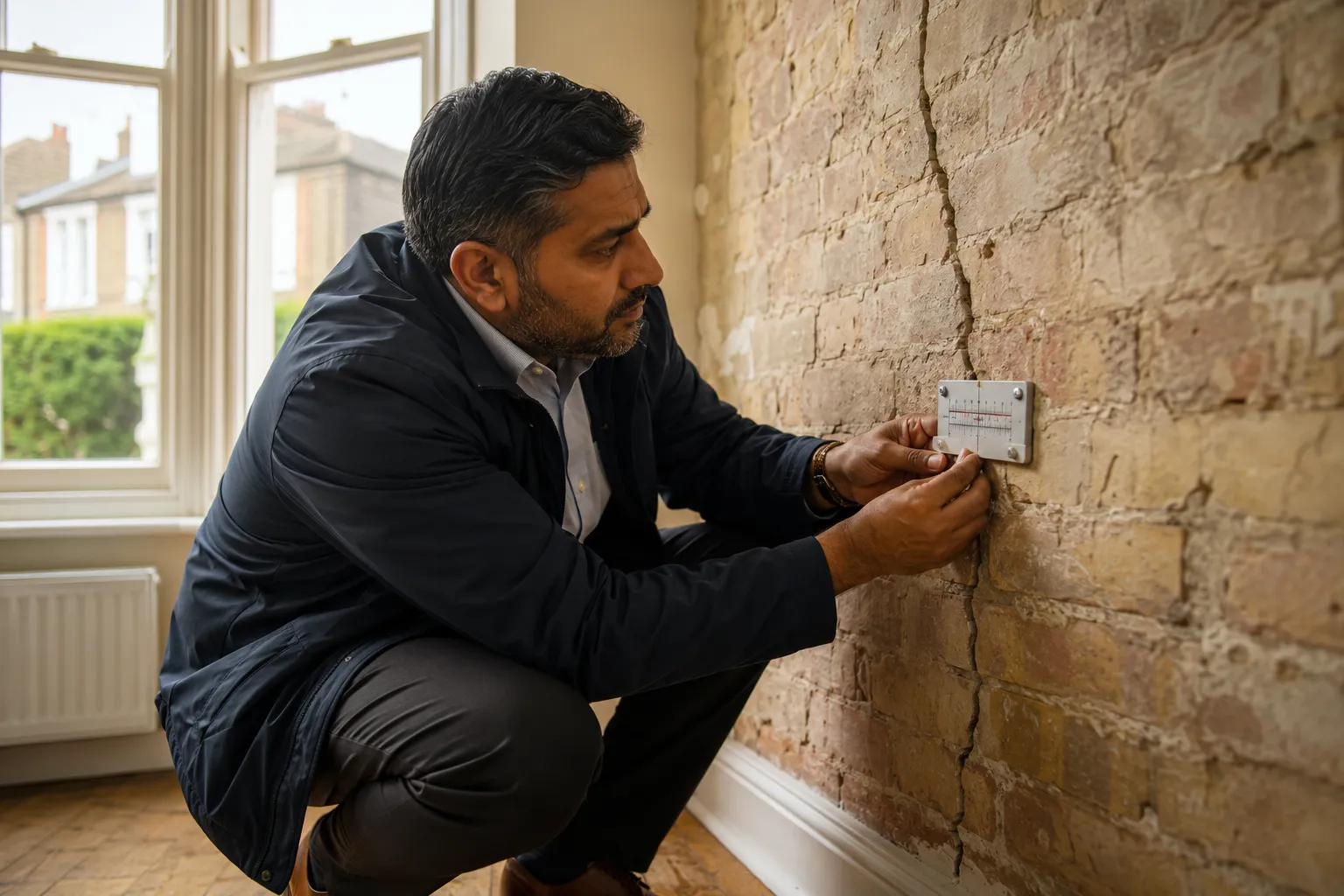
The standard process follows these steps:
- Retrieve the pre-works schedule of condition and the party wall award. If none exists, the surveyor must establish a baseline from any available evidence, photographs, previous surveys, or mortgage valuation reports.
- Carry out a detailed post-works inspection, recording all cracks, movement, settlement, drainage changes, and finishes damage using photographic and written records.
- Map new defects against the works to establish causation. Not every crack that appears after works is caused by those works, surveyors must distinguish pre-existing defects from new damage.
- Commission specialist input where needed. Structural engineers are called in for foundation movement, beam deflection, or where invasive investigation is required. See when to involve a structural engineer for guidance on that distinction.
- Cost the remediation on a like-for-like basis, using current market rates for labour and materials.
- Assess residual risk, whether repair will fully restore structural integrity or whether a stigma element remains.
Common mistake: Surveyors sometimes limit their inspection to visible finishes and miss sub-floor or roof-space damage caused by vibration or ground movement. A thorough post-works assessment must include all accessible areas, not just the rooms adjacent to the works.
Can Party Wall Works Decrease Your Home's Value
Yes, party wall works can decrease a property's value, but whether they actually do depends on the type and severity of damage, whether it has been repaired, and the quality of documentation available to buyers and their advisers.
Three scenarios where value is most likely to fall:
- Structural damage that has not been repaired, cracks in load-bearing walls, settlement of foundations, or deflection of lintels reduce value directly and may make the property unmortgageable until remediated.
- Repaired damage with no supporting documentation, buyers and lenders cannot verify the quality of repairs without a surveyor's sign-off, so they discount for residual uncertainty.
- Ongoing disputes or unresolved liability, if a compensation claim is live or the building owner is disputing responsibility, the property carries a contingent liability that suppresses value.
Conversely, where works were properly notified, a schedule of condition was prepared, any damage was repaired to a professional standard, and a surveyor has confirmed the property is structurally sound, the impact on open-market value is typically negligible.
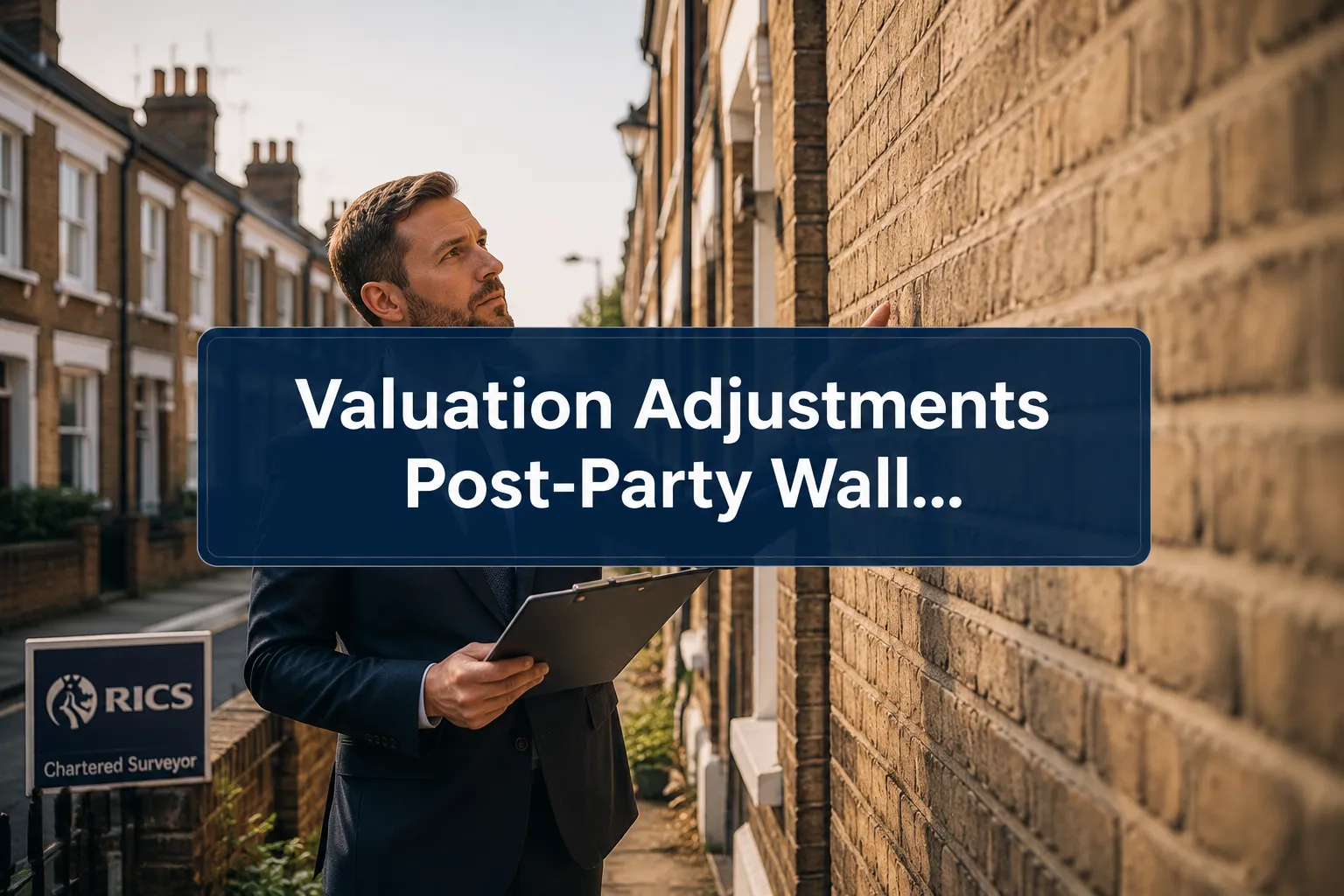
Valuation Adjustments Post-Party Wall Works: The Party Wall Act Process Explained
The Party Wall etc. Act 1996 creates a statutory framework that directly underpins valuation adjustments post-party wall works. Under the Act, the building owner must serve notice, and if the adjoining owner dissents, each party appoints a surveyor (or they agree on a single agreed surveyor) to draw up a party wall award.
The award sets out:
- The permitted scope of works
- Working hours and access conditions
- The schedule of condition for the adjoining property
- The process for making good any damage
When damage occurs, the adjoining owner's surveyor raises the matter formally. The surveyors then agree on the extent of damage, the cost of making good, and whether any additional compensation is due. This agreed position feeds directly into valuation adjustments because it establishes:
- Liability, who is responsible for the cost
- Quantum, how much the repair costs
- Residual risk, whether the repair fully restores value
"The party wall award is not just a procedural document, it is the primary evidence set a valuer relies on when quantifying diminution in value or confirming that risks have been properly managed."
For a detailed breakdown of what awards cover, see party wall awards explained.
What Structural Issues Reduce Property Value After Party Wall Work
Not all structural issues carry the same weight in a valuation. Surveyors and valuers apply different adjustments depending on the nature and location of the defect.
| Defect Type | Typical Valuation Impact | Key Consideration |
|---|---|---|
| Hairline cracks in plaster (cosmetic) | Minimal to none | Easily repaired; low buyer concern |
| Stepped cracks in brickwork | Low to moderate | Indicates movement; needs monitoring |
| Foundation settlement or heave | High | May require underpinning; lender concern |
| Damaged or deflected lintel | Moderate to high | Structural risk to openings above |
| Drainage disruption | Moderate | Can cause ongoing subsidence risk |
| Roof structure disturbance | Moderate to high | Particularly relevant in loft conversions |
Edge case: Basement excavations adjacent to a party wall carry the highest risk profile because they alter ground conditions for both properties. Surveyors dealing with basements and party wall works must apply particularly rigorous pre- and post-works monitoring.
How Much Can a Property Value Drop After Party Wall Works
There is no fixed percentage reduction that applies universally. The adjustment depends on repair cost, residual risk, and market conditions in the specific location.
As a general framework, surveyors and valuers consider:
- Repair cost as a floor, the minimum adjustment is the cost of making good, because a buyer will deduct this from any offer.
- Stigma uplift, where structural damage has occurred, even after repair, some buyers and lenders apply an additional discount for perceived residual risk. This is particularly common with foundation-related issues.
- Recovery rights, if the adjoining owner has a clear, accepted liability claim against the building owner (or their insurer), the effective adjustment is lower because the cost of repair is recoverable.
The HMRC Valuation Office Agency framework for damaged or defective property instructs valuers to consider two figures: the value with the benefit of any insurance or right of action, and the value in its damaged state. The gap between these two figures is the practical range within which the valuation adjustment sits.
For properties where the damage is severe and recovery is uncertain, the adjustment can be material, in some cases several percentage points of open-market value. For cosmetic damage with clear liability and prompt repair, the adjustment may be zero once works are complete.
Party Wall Surveyor vs Structural Engineer for Valuation
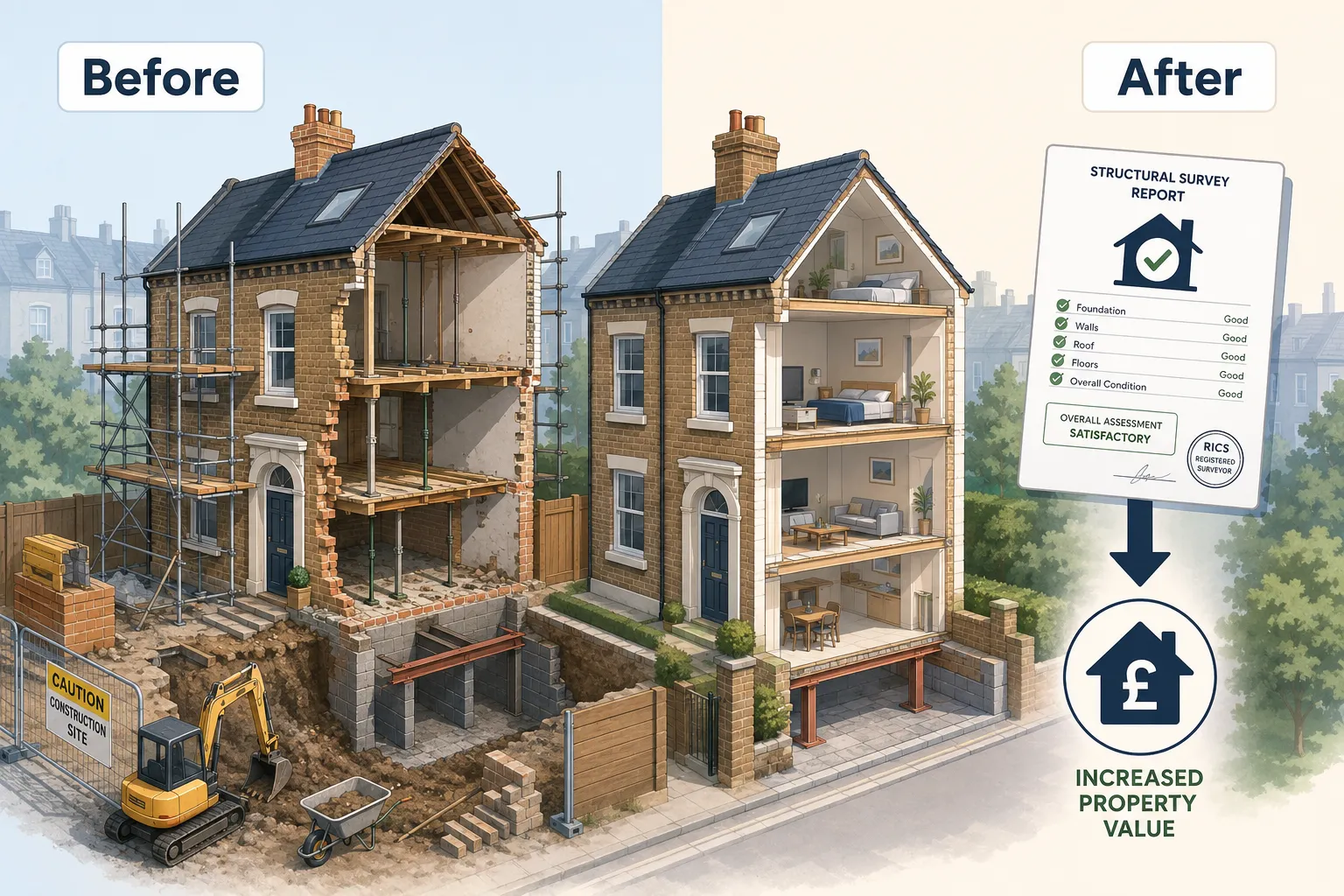
A party wall surveyor and a structural engineer serve different but complementary roles in assessing post-works structural impacts.
Party wall surveyor (typically MRICS or FRICS):
- Manages the legal process under the 1996 Act
- Prepares and holds the schedule of condition
- Awards compensation and agrees the scope of making good
- Provides the evidential framework for valuation adjustments
Structural engineer (typically MIStructE or CEng):
- Investigates the technical cause and extent of structural damage
- Recommends remediation methods
- Signs off that repairs restore structural integrity
- Required where invasive investigation or specialist analysis is needed
For valuation purposes, both reports are needed when structural damage is significant. The party wall surveyor's award establishes liability and quantum; the structural engineer's report confirms that the agreed repairs are technically adequate. A valuer relying on only one without the other is working with incomplete evidence.
Choose a structural engineer if: the damage involves foundations, load-bearing elements, or requires invasive investigation. Choose a party wall surveyor if: the primary need is to establish liability, agree compensation, or produce documentation for a valuation or sale.
Can You Claim Compensation for Property Damage from Party Wall Works
Yes. The Party Wall etc. Act 1996 gives adjoining owners a statutory right to compensation for damage caused by notifiable works. This right exists independently of any negligence claim and does not require the building owner to have acted improperly, it is a strict liability provision.
The compensation process works as follows:
- The adjoining owner's surveyor documents the damage and its cause.
- The surveyors agree (or a third surveyor determines) the scope and cost of making good.
- The building owner is required to carry out or fund the repairs.
- If the building owner fails to act, the adjoining owner can carry out the works and recover the cost.
Important distinction: Compensation under the Act covers the cost of making good physical damage. It does not automatically cover diminution in value where the property is worth less even after repair, that requires a separate claim, typically in nuisance or negligence, and is harder to establish.
For situations where a neighbour refuses to engage with the process, see what happens when a neighbour refuses party wall works.
Valuation Adjustments Post-Party Wall Works: What to Do When Your Property Value Is Lower
If party wall works have been completed and a subsequent valuation or survey suggests the property is worth less than expected, the following steps apply.
Immediate actions:
- Obtain a copy of the party wall award and the pre-works schedule of condition.
- Commission a post-works building survey from a chartered surveyor to document current condition.
- Identify all defects and establish whether they are attributable to the works.
Next steps:
- Engage the building owner (or their surveyor) formally, in writing, setting out the damage and requesting making good.
- If the building owner disputes liability, refer the matter to the third surveyor named in the award.
- Where damage has been repaired, obtain a surveyor's certificate confirming the repair standard, this is essential for any future sale or remortgage.
If selling:
- Disclose the history of works and any damage to prospective buyers and their solicitors.
- Provide the full documentation pack (award, schedule of condition, repair certificates) to support the asking price.
- A property valuation from a chartered surveyor that specifically addresses the post-works condition gives buyers and lenders confidence and can prevent unnecessary price chipping.
How Long After Party Wall Works Should You Get a Revaluation
A revaluation should be obtained as soon as any damage has been repaired and signed off by a structural engineer or chartered surveyor, and no later than three to six months after works complete. This window matters because:
- Some settlement and movement takes time to manifest, a revaluation too soon may miss latent defects.
- Mortgage offers typically have validity periods of three to six months, so timing the revaluation to coincide with a remortgage or sale avoids gaps.
- Limitation periods for damage claims run from the date of damage (or when it was reasonably discoverable), so early documentation protects the owner's legal position.
If no damage occurred, a brief confirmation from the party wall surveyor that the post-works inspection found no new defects is usually sufficient for lender purposes, without the need for a full revaluation.
What Documentation Do Surveyors Need for Post-Party Wall Valuation
A surveyor carrying out a post-party wall valuation adjustment assessment needs the following documentation as a minimum:
- Pre-works schedule of condition, the baseline record of the property's condition before works began
- Party wall award, sets out the permitted scope of works and the making-good obligations
- Post-works inspection report, the surveyor's own assessment of current condition
- Structural engineer's report (where applicable), confirms cause, extent, and remediation of structural damage
- Repair invoices and contractor sign-off, evidence that making good has been completed to a professional standard
- Correspondence between surveyors, establishes the agreed position on liability and quantum
- Any relevant insurance documentation, confirms whether a claim has been accepted and the basis of settlement
Where any of these documents are missing, the surveyor must note the evidential gap and explain how it affects the reliability of the valuation adjustment. Missing pre-works records are the most common gap and the hardest to fill retrospectively.
Party Wall Works on a Neighbour's Side Affecting Your Property Value
Works carried out entirely on a neighbour's side of the boundary can still affect the adjoining property's value if they disturb shared structural elements, alter ground conditions, or damage connected drainage or services.
The most common scenarios:
- Loft conversions that involve steel beams bearing on the party wall can cause differential settlement or cracking in the adjoining property.
- Basement excavations that lower the ground adjacent to shared foundations can cause subsidence in the adjoining property.
- Extensions that alter drainage runs can cause ground movement or damp penetration.
In all these cases, the adjoining owner has the same statutory rights under the 1996 Act as if the damage had been caused by works directly on the boundary. The key is that the works must have been notifiable, if the neighbour carried out works without serving notice, the adjoining owner's remedies lie in nuisance or negligence rather than under the Act, which is a more complex and costly route.
When Is Party Wall Work Not Covered by Insurance for Valuation Claims
Party wall damage claims fall outside standard buildings insurance coverage in several common scenarios, which directly affects how surveyors frame valuation adjustments.
- Deliberate or foreseeable damage, insurers routinely exclude damage that was a predictable consequence of notifiable works, on the basis that the building owner should have managed the risk through the party wall process.
- Works carried out without notice, if the building owner did not serve a valid party wall notice, their insurer may decline to cover damage on the grounds of non-disclosure or breach of policy conditions.
- Pre-existing defects, damage that existed before works began is not covered, which is why the pre-works schedule of condition is so important in separating new from pre-existing damage.
- Consequential loss, most buildings policies do not cover diminution in value beyond the cost of physical repair, meaning the stigma element of any valuation adjustment is typically uninsured.
Where insurance does not respond, the building owner remains personally liable under the Act. Surveyors should therefore present valuation adjustments in terms of both the insured and uninsured elements, so that the adjoining owner understands the full picture of their recovery position.
Common Mistakes Surveyors Make Assessing Party Wall Damage
Even experienced practitioners make errors in post-party wall assessments that undermine the reliability of valuation adjustments.
- Relying solely on visual inspection without recommending specialist investigation where foundation or drainage issues are suspected.
- Failing to distinguish new from pre-existing damage, particularly in older properties where some cracking and movement is normal.
- Undercosting remediation by using schedule rates rather than current market rates for specialist contractors.
- Ignoring the stigma element, assuming that repair cost equals the full valuation adjustment, when buyer perception of residual risk may justify an additional discount.
- Inadequate photographic records, photographs without scale references, timestamps, or location context are difficult to rely on in dispute resolution.
- Not cross-referencing the party wall award, surveyors who assess damage without reading the award may miss obligations or permitted deviations that affect liability.
Avoiding these errors requires a structured, document-led approach from the outset of any post-works assessment.
FAQ
Does a party wall agreement guarantee my property value won't fall?
No. A party wall agreement (award) manages the process and creates liability for making good damage, but it does not prevent damage from occurring. It does, however, ensure that if damage occurs, there is a clear legal mechanism to recover the cost of repair.
Who pays for a post-works valuation if damage has occurred?
The cost of establishing and quantifying damage, including surveyor and structural engineer fees, is generally recoverable from the building owner as part of the making-good process under the Act.
Can I refuse to sell my property until the building owner repairs the damage?
Yes. There is no legal obligation to sell at any particular time. However, if a sale is time-sensitive, it may be more practical to agree a retention with the buyer's solicitors, reflecting the unrepaired damage, and pursue the building owner separately.
How does a party wall valuation adjustment differ from an insurance reinstatement valuation?
An open-market valuation adjustment reflects what a willing buyer would pay given the damage and its repair status. An insurance reinstatement cost valuation reflects the cost of rebuilding the property to its pre-damage specification. These figures can differ significantly and serve different purposes.
Is a RICS-registered surveyor required for post-party wall valuation work?
While not legally mandated for all purposes, RICS membership (MRICS or FRICS) is the recognised professional standard. Lenders, courts, and HMRC's Valuation Office Agency all place greater weight on valuations and condition reports prepared by RICS-registered practitioners.
What if the building owner has sold their property before the damage is repaired?
The liability under the Party Wall etc. Act 1996 attaches to the building owner at the time of the works. If they have sold, the adjoining owner may need to pursue a claim in nuisance or negligence against the original owner, which is more complex. This is another reason to document and raise damage claims promptly.
Conclusion
Valuation adjustments post-party wall works require a methodical, evidence-led approach. The quality of documentation prepared before works begin, particularly the schedule of condition and the party wall award, determines how straightforward or contested any subsequent adjustment will be.
Actionable next steps for property owners and professionals:
- Before any notifiable works begin, ensure a thorough schedule of condition is prepared by a chartered surveyor.
- After works complete, commission a post-works inspection promptly, do not wait for visible damage to appear.
- If damage is found, engage the building owner's surveyor formally and in writing without delay.
- Where structural issues are suspected, instruct a structural engineer alongside the party wall surveyor.
- Assemble a complete documentation pack before any sale or remortgage, award, schedule, repair certificates, and surveyor sign-off.
- If the valuation impact is material, obtain a formal diminution-in-value report from a chartered surveyor experienced in party wall matters.
For professional guidance on party wall matters, valuations, or post-works assessments, contact a chartered surveyor who specialises in this area. Acting early protects both the evidential record and the financial position of everyone involved.
.pwv-wrap{font-family:Arial,sans-serif;max-width:540px;margin:2em auto;background:#f7f9fc;border:1px solid #d0d8e4;border-radius:8px;padding:24px}
.pwv-wrap h3{margin:0 0 4px;font-size:1.1em;color:#1a2e4a}
.pwv-wrap p.pwv-sub{margin:0 0 18px;font-size:.85em;color:#555}
.pwv-row{margin-bottom:14px}
.pwv-row label{display:block;font-size:.88em;font-weight:bold;color:#1a2e4a;margin-bottom:4px}
.pwv-row select,.pwv-row input{width:100%;padding:7px 10px;border:1px solid #b0bec5;border-radius:5px;font-size:.9em;box-sizing:border-box}
.pwv-btn{background:#1a2e4a;color:#fff;border:none;padding:10px 22px;border-radius:5px;font-size:.95em;cursor:pointer;width:100%}
.pwv-btn:hover{background:#2c4a72}
.pwv-result{margin-top:16px;background:#fff;border:1px solid #b0d4f1;border-radius:6px;padding:14px;display:none}
.pwv-result .pwv-range{font-size:1.25em;font-weight:bold;color:#1a2e4a}
.pwv-result .pwv-note{font-size:.8em;color:#666;margin-top:6px}
Post-Party Wall Valuation Impact Estimator
Answer 3 questions to estimate the likely valuation adjustment range for your property.
function pwvCalc(){
var s=document.getElementById(‘pwv-sev’).value,
d=document.getElementById(‘pwv-doc’).value,
r=document.getElementById(‘pwv-rep’).value;
if(s===”||d===”||r===”){alert(‘Please answer all 3 questions.’);return;}
var score=parseInt(s)+parseInt(d)+parseInt(r);
var range,note;
if(score<=1){range='Negligible (0-0.5%)';note='Well-documented, repaired cosmetic damage rarely affects open-market value materially.';}
else if(score<=3){range='Low (0.5-2%)';note='Minor gaps in documentation or repair sign-off introduce buyer uncertainty. A surveyor certificate resolves most of this.';}
else if(score<=5){range='Moderate (2-5%)';note='Partial repairs or missing records create measurable buyer discount. Professional remediation and documentation are recommended before sale.';}
else{range='Significant (5%+)';note='Unrepaired structural damage or absent documentation can materially suppress value and affect mortgageability. Seek chartered surveyor advice promptly.';}
document.getElementById('pwv-range').textContent='Estimated adjustment: '+range;
document.getElementById('pwv-note').textContent=note;
document.getElementById('pwv-result').style.display='block';
}
Tags: party wall works, valuation adjustments, party wall surveyor, structural damage assessment, Party Wall Act 1996, diminution in value, chartered surveyor, property valuation, schedule of condition, party wall award, post-works survey, structural impact