

The Party Wall Act: Your Complete Guide to Understanding Your Rights and Responsibilities
Imagine planning your dream home extension, only to discover that your neighbour can legally halt your project. Or worse, finding unexpected construction happening next door that threatens your property’s structural integrity. These scenarios play out daily across England and Wales, and understanding the party wall act could be the difference between a smooth renovation and a costly legal nightmare.
The Party Wall etc. Act 1996 is one of the most misunderstood pieces of legislation affecting homeowners, yet it impacts millions of properties across the country. Whether you’re planning building work, receiving a notice from your neighbour, or simply want to understand your property rights, this comprehensive guide will equip you with everything you need to navigate the party wall process confidently.
Key Takeaways
- The party wall act is a legal framework that governs building work on or near shared walls, boundaries, and excavations affecting neighbouring properties in England and Wales
- Property owners must serve formal party wall notices 2 months before structural work or 1 month before excavations, giving neighbours time to consent or dissent
- Appointing qualified party wall surveyors protects both building owners and adjoining owners by ensuring fair, professional assessment of proposed works
- Non-compliance with the party wall act can result in court injunctions, project delays, and significant financial penalties
- Understanding your rights under the legislation helps prevent disputes and maintains positive neighbour relations during construction projects
What Is the Party Wall Act? 📋
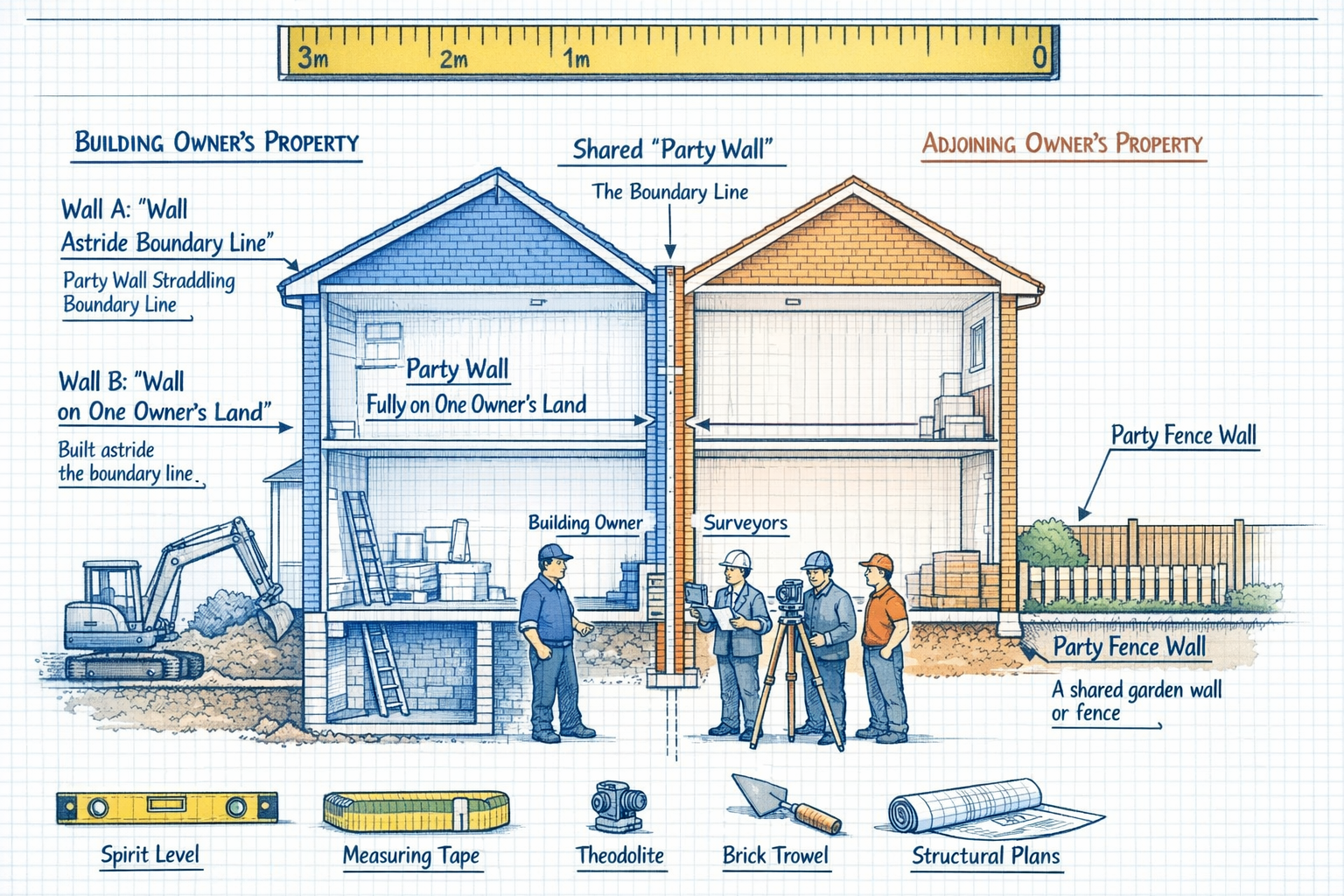
The Party Wall etc. Act 1996 is a piece of legislation that provides a framework for preventing and resolving disputes in relation to party walls, boundary walls, and excavations near neighbouring buildings. Enacted on July 1, 1997, this Act applies to England and Wales, providing legal protection for both property owners undertaking building work and their neighbours who may be affected.
At its core, the party wall act exists to balance the rights of property owners who wish to improve or develop their properties with the rights of neighbours to protect their own properties from potential damage. The legislation recognizes that in densely populated areas, particularly in cities like London, building work on one property can significantly impact adjacent properties.
The Purpose Behind the Legislation
The Act serves several critical purposes:
- Prevents disputes before they escalate into costly legal battles
- Establishes clear procedures for notifying neighbours about planned work
- Provides a dispute resolution mechanism through appointed surveyors
- Protects property rights for both building and adjoining owners
- Creates a record of property conditions before work begins
Understanding common misconceptions about party wall agreements can help property owners avoid costly mistakes and unnecessary conflicts.
Types of Work Covered Under the Party Wall Act
The party wall act doesn’t apply to all building work—only specific types of construction activities that could affect shared structures or neighbouring properties. Understanding which projects require party wall procedures is essential for compliance.
Work on Existing Party Walls (Section 2)
Section 2 of the Act covers work directly to existing party structures:
| Type of Work | Description | Notice Required |
|---|---|---|
| Cutting into a party wall | Installing beams, damp-proof courses | 2 months |
| Removing chimney breasts | Taking out part of a shared chimney | 2 months |
| Raising party walls | Increasing wall height | 2 months |
| Underpinning | Strengthening foundations of party wall | 2 months |
| Demolishing and rebuilding | Complete reconstruction of party wall | 2 months |
Building on the Line of Junction (Section 1)
Section 1 addresses new construction on or at the boundary line between properties:
- Building a new wall astride the boundary (requires neighbour’s consent)
- Constructing a wall entirely on your land but up to the boundary line
- Erecting a party fence wall (non-structural boundary wall)
Excavation Work (Section 6)
Section 6 covers excavations within certain distances of neighbouring buildings:
✓ Within 3 metres of a neighbour’s structure and going deeper than their foundations
✓ Within 6 metres of a neighbour’s structure and cutting a line at 45 degrees from the bottom of their foundations
This section is particularly relevant for basement conversions, extensions with deep foundations, and new builds on tight urban plots. When planning home extensions, understanding these excavation rules is crucial.
Work NOT Covered by the Act
It’s equally important to know what doesn’t require party wall procedures:
- ❌ Drilling to put up shelves or cabinets
- ❌ Cutting chases for electrical cables or pipes (normal maintenance)
- ❌ Replastering or redecorating
- ❌ Minor repairs that don’t affect the structure
- ❌ Work entirely within your property that doesn’t involve shared walls or excavations
Understanding Party Wall Notices: Your Legal Obligations
Serving the correct party wall notice is a legal requirement, not an optional courtesy. The type of notice depends on the work being undertaken, and getting this wrong can delay your project significantly.
Types of Party Wall Notices
Party Structure Notice (Section 2 Notice)
This notice is required for work directly affecting an existing party wall or structure. You must serve this notice at least 2 months before the intended start date of work.
The notice must include:
- Your name and address
- Details of the proposed work with drawings
- The intended start date
- Whether you’re appointing a surveyor
Line of Junction Notice (Section 1 Notice)
Required when building a new wall on or at the boundary line, this notice must be served at least 1 month before starting work.
Notice of Adjacent Excavation (Section 6 Notice)
For excavations within 3 or 6 metres of a neighbouring building, serve this notice at least 1 month before beginning excavation work.
How to Serve a Party Wall Notice Properly
Proper service of notices is crucial for compliance:
- Identify all affected neighbours – Include anyone sharing a wall or within excavation distances
- Use the correct notice template – Standard forms are available, though not legally required
- Include all necessary information – Detailed descriptions and drawings prevent disputes
- Deliver via appropriate method – Hand delivery, registered post, or through a letterbox
- Keep proof of service – Maintain records of when and how notices were delivered
When buying a house, checking whether previous owners complied with party wall requirements can reveal important information about the property’s history.
What Happens After Serving Notice?
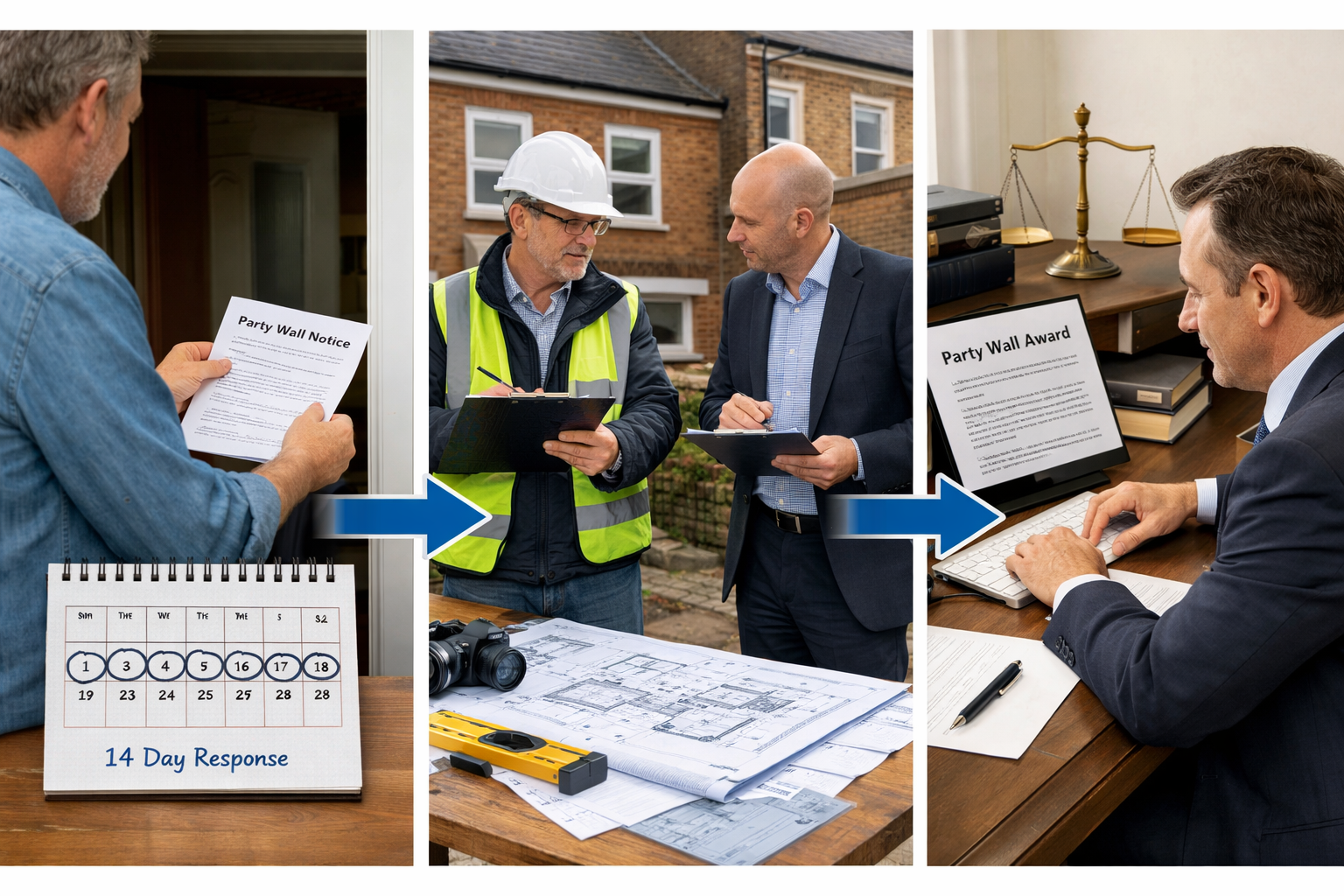
Your neighbour (the adjoining owner) has 14 days to respond to your notice. They have three options:
Option 1: Consent ✅
If your neighbour consents in writing, you can proceed with the work as described. However, this doesn’t prevent them from making claims for damage later, so many experts still recommend having a party wall agreement in place.
Option 2: Dissent 📝
If your neighbour dissents or doesn’t respond within 14 days, a dispute is deemed to have arisen. This isn’t necessarily negative—it simply triggers the surveyor appointment process.
Option 3: Counter-Notice 🔄
For Section 1 notices, neighbours can serve a counter-notice requiring you to build the wall astride the boundary line (at your expense) or build it to a specific height or specification.
The Party Wall Surveyor: Roles and Responsibilities
When a dispute arises (or is deemed to have arisen), the party wall act requires the appointment of surveyors to resolve the matter impartially. Understanding the surveyor’s role is essential for both building and adjoining owners.
Types of Surveyor Appointments
Two Surveyors (Most Common)
Each party appoints their own surveyor:
- The building owner (person doing the work) appoints one surveyor
- The adjoining owner (neighbour) appoints another surveyor
- These two surveyors then select a third surveyor to act as arbitrator if they disagree
Agreed Surveyor (More Economical)
Both parties can agree to appoint a single surveyor to act impartially for both sides. This approach:
- Reduces costs (fees split between parties)
- Speeds up the process
- Works well when the relationship is amicable
Learn more about the agreed surveyor’s role and benefits to determine if this approach suits your situation.
What Does a Party Wall Surveyor Do?
Party wall surveyors have specific duties under the Act:
🔍 Inspect both properties – Document existing conditions before work begins
📋 Review proposed works – Assess plans and specifications
⚖️ Determine reasonableness – Ensure work is appropriate and necessary
📸 Prepare schedules of condition – Photographic and written records
📄 Draft the Party Wall Award – Legal document setting out rights and responsibilities
🛡️ Protect both parties’ interests – Act impartially and professionally
The Party Wall Award Explained
The Party Wall Award is the legally binding document produced by the surveyor(s). It typically includes:
- Detailed description of the works permitted
- How and when work will be carried out
- Access arrangements for inspections
- Working hours and restrictions
- Schedule of condition of the adjoining property
- Provisions for making good any damage
- Allocation of costs (usually building owner pays)
The Award must be served on both parties within 10 days of being issued. Either party can appeal to the County Court within 14 days of receiving the Award if they believe the surveyor acted improperly.
Costs Associated with the Party Wall Act 💷
One of the most common questions about the party wall act concerns costs. Understanding the financial implications helps property owners budget appropriately for their projects.
Who Pays for What?
General Principle: The building owner (person carrying out the work) typically pays all reasonable costs associated with the party wall process.
This includes:
- Both surveyors’ fees (even the adjoining owner’s surveyor)
- Third surveyor fees if appointed
- Cost of preparing the Award
- Reasonable costs of the adjoining owner seeking advice
Typical Party Wall Surveyor Fees
Costs vary depending on project complexity and location:
| Project Type | Estimated Surveyor Costs |
|---|---|
| Simple loft conversion | £700 – £1,200 |
| Single-storey extension | £1,000 – £1,800 |
| Two-storey extension | £1,500 – £2,500 |
| Basement excavation | £2,000 – £4,000+ |
| Complex commercial projects | £5,000+ |
For detailed information, review the cost of party wall surveyor services and cost of party wall agreement guides.
Factors Affecting Costs
Several factors influence the total cost:
- Number of adjoining owners – More neighbours means more notices and potentially more surveyors
- Complexity of work – Structural alterations cost more to assess than simple work
- Property condition – Older properties may require more detailed condition surveys
- Disputes – Contentious situations requiring extensive negotiation increase costs
- Location – London and Southeast England typically have higher fees
Cost-Saving Strategies
While you cannot avoid legitimate party wall costs, you can minimize them:
✓ Appoint an agreed surveyor – Single surveyor serving both parties reduces fees
✓ Provide complete information – Detailed plans and specifications prevent delays
✓ Communicate proactively – Discuss plans with neighbours before formal notices
✓ Choose experienced surveyors – Efficient professionals complete work faster
✓ Respond promptly – Delays extend the process and increase costs
Common Party Wall Disputes and How to Avoid Them
Despite the Act’s intention to prevent disputes, conflicts still arise. Understanding common issues helps property owners navigate the process smoothly.
Frequent Sources of Dispute
1. Lack of Communication 🗣️
The most common problem is poor communication between neighbours. Many disputes could be avoided by:
- Discussing plans informally before serving formal notices
- Explaining the benefits and necessity of the work
- Addressing concerns proactively
- Maintaining respectful, professional dialogue
2. Inadequate Notices
Serving incomplete or incorrect notices creates confusion and delays:
- Missing technical details or drawings
- Wrong notice type for the work planned
- Insufficient notice period
- Failure to identify all affected neighbours
3. Access Disputes
Surveyors and contractors need access to neighbouring properties for:
- Condition surveys before work begins
- Inspections during construction
- Making good any damage afterward
Refusing reasonable access can lead to legal complications.
4. Damage Claims
Disputes often arise when:
- Pre-existing damage wasn’t properly documented
- New damage occurs during construction
- Disagreement exists about causation
- Making good is inadequate or delayed
5. Cost Arguments
Adjoining owners sometimes dispute:
- Reasonableness of surveyor fees
- Necessity of certain procedures
- Allocation of costs between parties
Preventing Party Wall Disputes
Before Starting Work:
📝 Educate yourself – Understand your obligations under the Act
🤝 Talk to neighbours early – Build goodwill before formal processes
👷 Hire qualified professionals – Use experienced surveyors and contractors
📸 Document everything – Photos and written records protect all parties
⏰ Allow adequate time – Don’t rush the party wall process
During Construction:
🏗️ Follow the Award – Comply with all conditions and restrictions
🔍 Allow inspections – Cooperate with surveyor visits
🧹 Minimize disruption – Respect working hours and access agreements
💬 Maintain communication – Keep neighbours informed of progress
🛠️ Address issues promptly – Fix problems before they escalate
Understanding the consequences of ignoring the party wall act demonstrates why compliance is essential.
Special Considerations for Specific Projects
Different types of building work present unique party wall challenges. Here’s what to consider for common projects.
Loft Conversions 🏠
Loft conversions frequently trigger party wall requirements, particularly in terraced or semi-detached properties.
Party wall issues include:
- Raising party walls to create headroom
- Installing steel beams that rest on or penetrate party walls
- Removing chimney breasts on party walls
- New windows affecting neighbours’ privacy
Many homeowners wonder: do you require party wall agreements for lofts? The answer is usually yes if the work involves shared structures.
Basement Excavations ⛏️
Basement conversions are among the most complex party wall situations, particularly in urban areas.
Key considerations:
- Section 6 notices for excavations within 3-6 metres
- Underpinning of party walls
- Temporary support during excavation
- Waterproofing affecting neighbouring foundations
- Monitoring for ground movement
For specialized guidance, consult resources on basements and party wall surveyors.
Extensions and New Builds 🏗️
Both single and multi-storey extensions commonly require party wall procedures.
Typical requirements:
- Foundations within 3-6 metres of neighbours
- New walls at or near boundary lines
- Raising existing party walls
- Installing beams into party walls
When planning extensions, factor in party wall requirements alongside other home extension cost considerations.
Chimney Breast Removal 🧱
Removing chimney breasts is deceptively complex from a party wall perspective.
Important points:
- Chimney breasts are usually party structures in terraced houses
- Removal requires Section 2 notice
- Structural support must be provided for remaining sections
- Neighbour’s chimney breast may need support
- Professional structural engineering advice is essential
Consider consulting a structural engineer before removing chimney breasts.
Your Rights as an Adjoining Owner
If you’re on the receiving end of a party wall notice, understanding your rights protects your property and interests.
What You’re Entitled To
1. Proper Notice 📬
You have the right to receive:
- Adequate notice periods (1-2 months depending on work type)
- Complete information about proposed works
- Clear drawings and specifications
- Contact details for the building owner
2. Professional Surveyor Representation 👨💼
You can appoint your own surveyor at the building owner’s expense to:
- Review the proposed works independently
- Protect your interests during negotiations
- Ensure proper schedules of condition are prepared
- Monitor work during construction
3. Schedule of Condition 📋
Before work begins, you’re entitled to:
- Photographic record of your property’s current state
- Written descriptions of existing conditions
- Documentation of any pre-existing defects
- Baseline for assessing any damage claims
4. Protection from Damage 🛡️
The party wall act provides:
- Right to have damage made good at building owner’s expense
- Ability to claim compensation for inconvenience
- Protection of your property’s structural integrity
- Recourse if work causes problems
5. Access for Inspections 🔍
You can require:
- Surveyor access to inspect work in progress
- Verification that work complies with the Award
- Documentation of any deviations from agreed plans
What You Cannot Do
Understanding limitations prevents unreasonable expectations:
❌ Prevent reasonable work – You cannot stop work that complies with the Act
❌ Demand unreasonable conditions – Requests must be proportionate
❌ Refuse all access – Reasonable access must be granted
❌ Ignore the process – Non-response creates a deemed dispute
❌ Delay indefinitely – Response deadlines must be respected
Should You Consent or Dissent?
When receiving a party wall notice, carefully consider your response:
Reasons to Consent:
- Work appears straightforward and low-risk
- You trust your neighbour completely
- You want to maintain a friendly relationship
- The notice provides adequate detail
Reasons to Dissent (Trigger Surveyor Appointment):
- Complex or extensive work is proposed
- You want professional protection
- Pre-existing property issues need documenting
- You’re concerned about potential damage
- You want formal records and procedures
Important: Dissenting doesn’t mean you oppose the work—it simply means you want professional surveyor involvement to protect both parties.
The Party Wall Act and Property Transactions
The party wall act has important implications when buying or selling property. Both buyers and sellers should understand these considerations.
For Property Sellers 🏡
Disclosure Obligations:
When selling, you should disclose:
- Any party wall awards affecting the property
- Ongoing party wall disputes
- Recent work that required party wall procedures
- Outstanding party wall matters
Pre-Sale Considerations:
✓ Complete outstanding work – Finish projects before listing
✓ Obtain necessary awards – Don’t leave disputes unresolved
✓ Gather documentation – Compile party wall paperwork
✓ Address damage claims – Resolve issues with neighbours
For Property Buyers 🔑
Due Diligence Questions:
When buying, investigate:
- Has the seller carried out work requiring party wall procedures?
- Were proper notices served and awards obtained?
- Are there any ongoing party wall disputes?
- Has neighbouring work affected the property?
- Are party wall awards registered with the property?
Survey Recommendations:
Buyers should:
- Request a comprehensive building survey
- Ask surveyors to check for party wall compliance
- Review any party wall awards carefully
- Investigate signs of structural work on party walls
Understanding common defects in older homes helps identify potential party wall issues during property viewings.
Legal Implications
Retrospective Compliance:
If previous owners failed to comply with the party wall act:
- The obligation transfers to new owners
- Neighbours can still serve notice of dispute
- Retrospective awards may be required
- Potential liability exists for undocumented damage
Indemnity Insurance:
Some buyers purchase party wall indemnity insurance to protect against:
- Historical non-compliance
- Undiscovered party wall breaches
- Neighbour claims for past work
- Cost of retrospective procedures
However, this insurance doesn’t permit future non-compliance and may not cover all scenarios.
Regional Variations and Exceptions
While the party wall act applies across England and Wales, some regional considerations exist.
Scotland and Northern Ireland 🏴
Important: The Party Wall etc. Act 1996 does not apply in Scotland or Northern Ireland.
Scotland has different legislation:
- Common law principles govern party walls
- No statutory notice requirements
- Disputes handled through different legal mechanisms
- Professional advice still recommended
Northern Ireland similarly:
- Relies on common law and property law
- No equivalent statutory framework
- Different dispute resolution procedures
Inner London Peculiarities
Before the 1996 Act, London had its own party wall legislation:
- London Building Acts (Amendment) Act 1939
- Some provisions still apply in Inner London
- Additional requirements for certain work
- Professional surveyors understand these nuances
Conservation Areas and Listed Buildings
Additional considerations apply in protected areas:
🏛️ Listed Building Consent may be required alongside party wall procedures
🌳 Conservation Area Approval might be necessary
📋 Additional restrictions on materials and methods
⏰ Extended timelines for approvals and work
Enforcement and Legal Remedies
Understanding enforcement mechanisms helps property owners appreciate the importance of compliance with the party wall act.
What Happens If You Don’t Comply?
Immediate Consequences:
If you proceed with notifiable work without serving notices:
- Neighbours can apply for a court injunction
- Work may be stopped immediately
- You may be required to undo completed work
- Costs escalate dramatically
Legal Remedies Available to Neighbours:
Adjoining owners can:
- Seek injunctions – Court orders stopping work
- Claim damages – Compensation for losses
- Require compliance – Force retrospective procedures
- Recover costs – Legal fees and surveyor costs
Criminal Penalties:
While the party wall act itself doesn’t create criminal offenses, related violations might:
- Building regulation breaches
- Planning permission violations
- Trespass and property damage
- Nuisance claims
Appealing Party Wall Awards
If you disagree with a party wall award, limited appeal options exist:
Grounds for Appeal:
You can appeal to the County Court within 14 days if:
- The surveyor acted outside their authority
- Procedural irregularities occurred
- The surveyor showed bias or impropriety
- The award contains fundamental errors
What You Cannot Appeal:
Courts generally won’t overturn awards based on:
- Disagreement with surveyor’s judgment
- Preference for different solutions
- Cost concerns (if costs are reasonable)
- General dissatisfaction with outcomes
Appeal Process:
- File appeal within 14 days of receiving Award
- Provide grounds for appeal
- Attend court hearing
- Court reviews surveyor’s conduct and procedures
- Decision is final (further appeals rare)
Dispute Resolution Alternatives
Before resorting to court action, consider:
Mediation 🤝
- Neutral third party facilitates discussion
- Less adversarial than court proceedings
- Can preserve neighbour relationships
- Often faster and cheaper
Negotiation 💬
- Direct discussions between parties
- Compromise on disputed points
- Amend proposals to address concerns
- Maintain control over outcomes
Expert Determination 📊
- Independent expert reviews technical issues
- Binding decision on specific questions
- Faster than court proceedings
- Appropriate for technical disputes
Best Practices for Building Owners
Following best practices ensures smooth party wall procedures and maintains positive neighbour relations.
Planning Stage Checklist ✅
3-6 Months Before Work:
- Review proposed work against party wall act requirements
- Identify all potentially affected neighbours
- Engage qualified party wall surveyor for advice
- Prepare detailed plans and specifications
- Budget for party wall costs
- Consider timing and neighbour circumstances
2-3 Months Before Work:
- Discuss plans informally with neighbours
- Address concerns and questions
- Prepare and serve formal party wall notices
- Provide complete information and drawings
- Keep proof of service
- Wait for neighbour responses
1-2 Months Before Work:
- Appoint surveyors (if dispute arises)
- Cooperate with surveyor inspections
- Review and accept party wall award
- Ensure contractors understand award conditions
- Arrange access for pre-work condition surveys
- Finalize start date
During Construction Best Practices
Communication:
- Keep neighbours informed of progress
- Provide advance notice of noisy or disruptive work
- Respond promptly to concerns
- Maintain professional, courteous dialogue
Compliance:
- Follow all award conditions strictly
- Respect working hours and restrictions
- Allow surveyor inspections as required
- Document work progress photographically
Problem Management:
- Address issues immediately
- Report damage or concerns to surveyors
- Don’t attempt to hide problems
- Cooperate with remedial requirements
After Completion
Final Steps:
✓ Notify completion to surveyors and neighbours
✓ Allow final inspections of both properties
✓ Make good any damage as required by award
✓ Obtain sign-off from surveyors
✓ Retain all documentation for property records
✓ Settle outstanding fees promptly
The Future of the Party Wall Act
As construction practices and property ownership evolve, the party wall act continues to adapt. Understanding emerging trends helps property owners prepare for future developments.
Proposed Reforms and Discussions
Current Debates:
Several aspects of the Act face ongoing discussion:
🔄 Standardization of fees – Calls for greater transparency in surveyor charging
📱 Digital notices – Electronic service and documentation
⚖️ Dispute resolution – Alternative mechanisms to reduce costs
📋 Notice templates – Standardized forms to reduce errors
🎓 Surveyor qualifications – Enhanced training and accreditation requirements
Technology and the Party Wall Process
Modern technology is transforming party wall procedures:
Digital Tools:
- Online notice serving platforms
- Virtual property inspections
- 3D modeling and visualization
- Digital schedules of condition
- Electronic award distribution
Benefits:
- Faster processing times
- Reduced paperwork
- Better documentation
- Improved accessibility
- Cost efficiencies
Emerging Challenges
Modern Construction Methods:
New building techniques create party wall considerations:
- Modular construction and prefabrication
- Innovative foundation systems
- Sustainable building materials
- Smart home technology integration
Urban Densification:
Increasing density in cities leads to:
- More complex party wall situations
- Multiple adjoining owners
- Cumulative impact of successive projects
- Greater need for professional expertise
Climate Considerations:
Environmental concerns affect party wall work:
- Retrofit insulation projects
- Energy efficiency improvements
- Flood resilience measures
- Sustainable drainage systems
Frequently Asked Questions About the Party Wall Act
Do I need a party wall agreement for permitted development?
Yes, in most cases. Planning permission and party wall requirements are separate legal obligations. Even if your work qualifies as permitted development (not requiring planning permission), you must still comply with the party wall act if the work involves party structures or excavations near boundaries.
How long does the party wall process take?
Typically 2-4 months from serving notice to receiving the award, though complex cases may take longer. The statutory notice periods are 1-2 months, and surveyor appointments and award preparation add additional time. Plan accordingly and don’t assume you can start work immediately after serving notice.
Can my neighbour stop my building work?
Not if you comply with the Act. Your neighbour cannot prevent reasonable work that follows proper party wall procedures. However, they can:
- Require professional surveyor involvement
- Ensure proper protection measures
- Demand schedules of condition
- Seek court injunctions if you fail to comply with the Act
What if I’ve already started work without serving notice?
Stop immediately and seek professional advice. You should:
- Halt all notifiable work
- Engage a party wall surveyor urgently
- Serve retrospective notices
- Follow the proper procedures
- Be prepared for potential claims
Continuing without compliance risks court injunctions and significant costs.
Do I need the party wall act for a garden wall?
It depends. A purely decorative garden wall entirely on your land doesn’t require party wall procedures. However, you need to comply if:
- The wall is on or astride the boundary
- It’s a party fence wall (shared boundary wall)
- Excavations for foundations come within 3-6 metres of your neighbour’s building
- The wall will be over a certain height near the boundary
Can I do party wall procedures myself without a surveyor?
Technically yes, but not recommended. The Act allows building owners to act as their own surveyor, but this approach:
- Requires detailed legal and technical knowledge
- May not be accepted by adjoining owners
- Increases risk of errors and disputes
- Could cost more in the long run if problems arise
Professional surveyors provide expertise, impartiality, and protection for all parties.
Conclusion: Navigating the Party Wall Act with Confidence
The Party Wall etc. Act 1996 represents a crucial piece of legislation that protects property owners while enabling necessary building work in our densely populated communities. While the requirements may initially seem daunting, understanding the Act’s purpose and procedures transforms it from an obstacle into a valuable framework for fair, professional construction practices.
Key principles to remember:
🏠 The Act balances rights – Protecting both building owners and neighbours
⏰ Early planning is essential – Allow adequate time for proper procedures
👥 Professional help pays dividends – Qualified surveyors prevent costly mistakes
💬 Communication prevents disputes – Talk to neighbours before formal processes
📋 Documentation protects everyone – Proper records safeguard all parties
Your Next Steps
If you’re planning building work:
- Assess your project against party wall requirements early in planning
- Engage a qualified party wall surveyor for professional guidance
- Budget appropriately for party wall costs and timelines
- Communicate with neighbours before serving formal notices
- Serve proper notices with complete information and adequate notice periods
- Follow the award strictly once issued
If you’ve received a party wall notice:
- Don’t panic – The notice doesn’t mean your neighbour is doing anything wrong
- Read carefully – Understand what work is proposed
- Seek advice – Consult a party wall surveyor at your neighbour’s expense
- Respond within 14 days – Don’t let the deadline pass
- Consider appointing a surveyor – Professional representation protects your interests
- Cooperate with procedures – Allow access for inspections and surveys
Professional Resources
For expert guidance on party wall matters and comprehensive surveying services, visit Prince Surveyors for professional support tailored to your specific situation. Whether you’re a building owner planning work or an adjoining owner protecting your property, qualified professionals make the party wall process smoother, faster, and more cost-effective.
The party wall act exists to facilitate good neighbour relations during construction work. By understanding your rights and responsibilities, planning thoroughly, and engaging qualified professionals when needed, you can navigate party wall procedures confidently while maintaining positive relationships with those who share your boundaries.
Remember: compliance with the party wall act isn’t just a legal obligation—it’s an investment in protecting your property, your project, and your peace of mind. The time and cost invested in proper procedures pale in comparison to the expense, stress, and delays of disputes, litigation, and remedial work.
Start your next building project on the right foundation by making party wall compliance a priority from day one. Your neighbours, your project timeline, and your budget will all benefit from this professional, proactive approach.