

Last updated: July 24, 2026
Quick Answer: A Single Joint Expert (SJE) is an independent chartered surveyor jointly instructed by all parties in a property dispute to provide impartial evidence on a specific issue. Under Civil Procedure Rules Part 35, courts actively encourage SJE appointments to reduce costs and speed up resolution. RICS sets the professional standards governing how these experts must be appointed, how they must behave, and what happens when their findings are challenged.
Key Takeaways
- An SJE owes their primary duty to the court or tribunal, not to either disputing party.
- CPR Part 35 gives courts the power to direct that expert evidence comes from a single joint expert rather than two separately instructed experts.
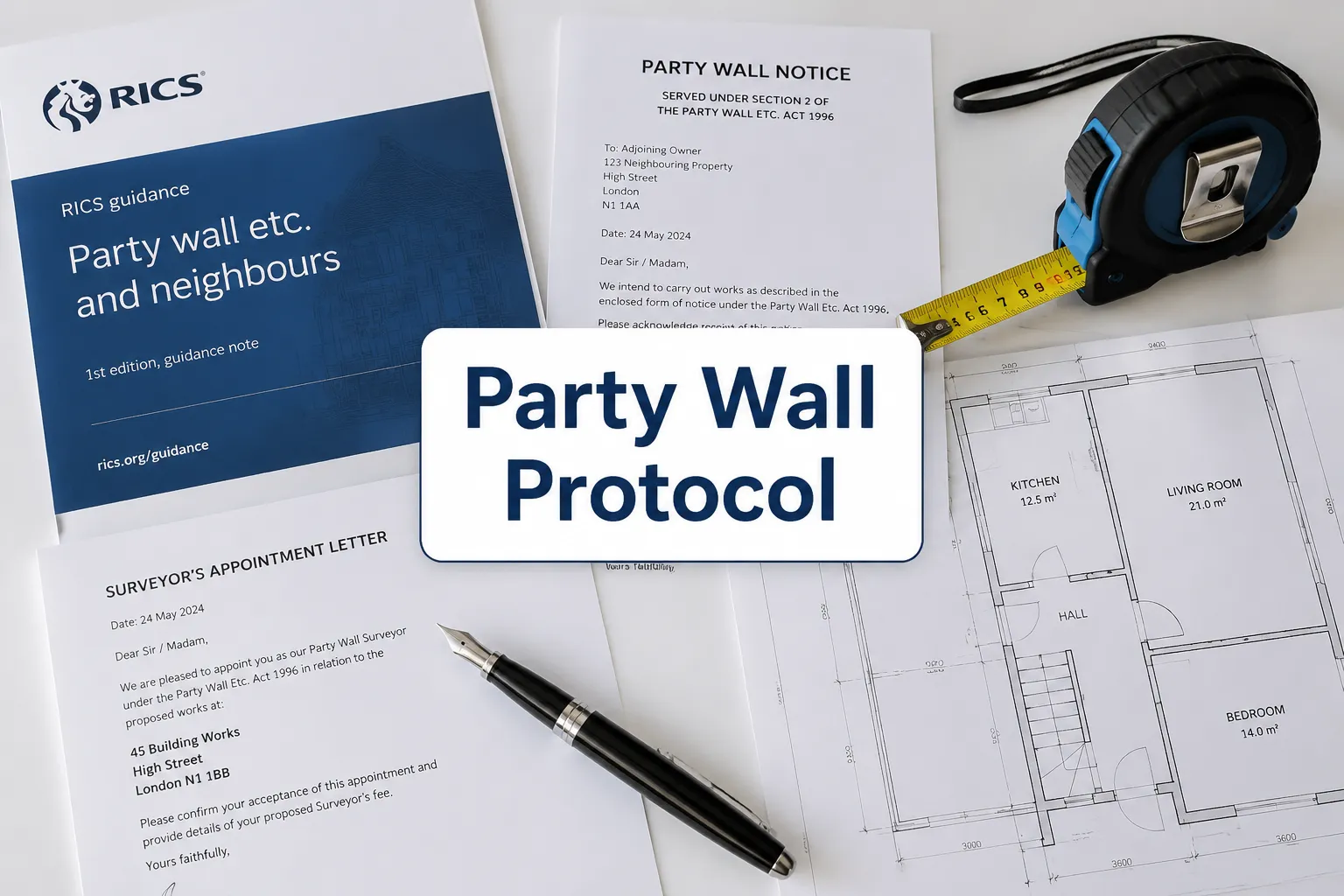
- RICS guidance requires that party wall surveyor appointments be made in writing, directly to the individual surveyor, not their firm.
- SJE appointments typically cost less overall than two separate expert instructions, though the single fee is shared between parties.
- Both parties can object to a proposed SJE before appointment, but once confirmed, removal requires court permission.
- In party wall cases, the "agreed surveyor" concept under the Party Wall etc. Act 1996 functions similarly to an SJE but has its own distinct statutory framework.
- Valuation SJEs and party wall SJEs operate under different procedural rules, even when the same surveyor could theoretically handle both.
- A joint expert's report can be challenged, but courts give it significant weight, overturning it requires strong contrary evidence.
What Is a Single Joint Expert Appointment in Property Disputes
A Single Joint Expert is an independent professional appointed by mutual agreement of all parties, or by court direction, to provide a single expert opinion on a disputed technical issue. In property disputes, this typically means a chartered surveyor instructed to assess party wall matters, property valuations, building defects, or boundary questions.
The SJE's duty runs to the court or tribunal, not to the party who suggested them or who pays them. This is the defining feature that separates an SJE from a party-appointed expert witness. The SJE must provide an objective, balanced report even if their findings favour one side over the other.
Why this matters in practice: When two parties each appoint their own expert, those experts often produce conflicting reports, which drives up legal costs and extends timelines. An SJE sidesteps that dynamic by producing one authoritative report that both sides must engage with.
How RICS Defines a Single Joint Expert vs Separate Experts
RICS distinguishes clearly between three roles: the single joint expert, the party-appointed expert witness, and the independent expert. Each carries different duties and procedural implications.
| Role | Instructed by | Primary duty | Typical use |
|---|---|---|---|
| Single Joint Expert | All parties jointly | The court | Low-to-mid complexity disputes |
| Party Expert Witness | One party only | That party (within overriding duty to court) | Complex, high-value litigation |
| Independent Expert | Parties by agreement | Agreed terms of reference | ADR, arbitration |
RICS professional standards require that any surveyor acting as an SJE must comply with CPR Part 35 and its accompanying Practice Direction. They must also follow RICS guidance on conflicts of interest, meaning they cannot have any prior relationship with either party that could compromise objectivity.
Common mistake: Some property owners assume that because they suggested the expert, that expert will lean in their favour. An SJE is explicitly prohibited from doing so. If a surveyor agrees to act partially, they are in breach of RICS standards and CPR Part 35.
When Should You Use a Single Joint Expert for Party Wall Cases
An SJE is most appropriate for party wall cases when the dispute is factual rather than legal, the sums involved are proportionate to a shared expert fee, and both parties are willing to accept a neutral finding.
Under the Party Wall etc. Act 1996, the default mechanism is actually the appointment of an "agreed surveyor", a single surveyor jointly selected by the building owner and the adjoining owner. This is functionally similar to an SJE but operates under statute rather than CPR Part 35. For a full breakdown of how this works, see this complete guide to the agreed surveyor role under the Party Wall Act.
Choose an SJE (or agreed surveyor) for party wall cases when:
- The dispute concerns a schedule of condition, crack assessment, or method of works.
- Both neighbours want to avoid the cost of two separate surveyors producing conflicting awards.
- The works are relatively straightforward, for example, a standard loft conversion or rear extension.
- There is no pre-existing breakdown of trust between the parties.
Opt for separate experts when:
- One party suspects the other of bad faith or concealment of information.
- The dispute involves significant financial claims, such as structural damage exceeding tens of thousands of pounds.
- Legal proceedings are already underway and the court has not yet directed a joint appointment.
For more context on when party wall disputes escalate, see common party wall disputes and how they arise.
What Are the RICS Protocols for Appointing a Single Joint Expert
The RICS protocols for single joint expert appointments in property disputes require a written instruction letter signed by all parties, a clearly defined scope of instruction, and confirmation that the expert has no conflict of interest.
Step-by-step appointment process:
- Agree on the expert: Both parties must agree on the individual. RICS recommends checking the surveyor's RICS membership status and relevant specialism before confirming.
- Issue a joint letter of instruction: The instruction must come from all parties together. It should specify the issues to be addressed, the property details, the relevant documents to be provided, and the deadline for the report.
- Confirm in writing to the individual, not the firm: RICS guidance is explicit, appointment letters must name the individual surveyor, not just their practice. This applies equally to party wall appointments under the 1996 Act.
- Define the expert's access rights: The letter should confirm whether the expert can inspect the property, speak to contractors, and request additional documents.
- Agree on fee allocation: Typically, the SJE fee is shared equally between parties unless the court orders otherwise.
- File the appointment with the court (if litigation is active): In court proceedings, the parties must notify the court of the SJE appointment and obtain permission if required under the case management directions.
RICS's 7th edition Party Wall Legislation and Procedure guidance (effective from December 2019) contains detailed requirements on written appointments. A consultation draft for the 8th edition reinforces these requirements and further clarifies the distinction between acting as a surveyor and acting as an agent for a party.
How Much Does a Single Joint Expert Cost Compared to Two Experts
An SJE appointment almost always costs less in total than instructing two separate experts, though the individual fee may be higher than a single party-appointed expert because the SJE must serve both parties' informational needs.
Rough cost comparison (estimates based on typical UK chartered surveyor rates in 2026):
- A party-appointed expert for a mid-complexity party wall dispute: approximately £800,£1,500 per side, meaning £1,600,£3,000 combined.
- An SJE for the same dispute: approximately £1,000,£2,000 total, shared equally between parties.
The saving is real, but the bigger financial benefit comes from avoiding contested expert evidence in court. When two experts disagree, the court may order a joint statement or "hot-tubbing" session, which adds further cost. An SJE eliminates that risk.
For a detailed breakdown of party wall surveyor fees, see how much a party wall agreement costs and party wall surveyor cost guide.
Key point: The cost saving from an SJE is not just the fee itself, it is the reduction in legal time spent managing competing expert positions.
Can Both Parties Reject a Single Joint Expert Appointment
Yes, either party can object to a proposed SJE before the appointment is confirmed. Once the appointment is made and accepted, removal requires either mutual agreement or a court order.
Before appointment: Any party can raise a reasonable objection, for example, if the proposed expert has a prior professional relationship with the other side, has previously advised on the same property, or lacks the specific expertise required. RICS guidance on conflicts of interest supports this right to object.
After appointment: If a party believes the appointed SJE has a conflict of interest that was not disclosed at the outset, they can apply to the court to have the expert replaced. The bar for removal post-appointment is high, courts are reluctant to disrupt proceedings without strong cause.
Edge case: If the parties cannot agree on who to appoint, either party can apply to the court for a direction. The court may select from a shortlist or ask a professional body such as RICS to nominate a suitable expert.
What Happens If the Joint Expert Is Biased Toward One Party
If an SJE's report appears to favour one party without adequate justification, the disadvantaged party can submit written questions to the expert under CPR Part 35.6, commission their own expert to review the methodology, or apply to the court to challenge the report's weight.
RICS standards require all experts to maintain impartiality throughout the instruction. A surveyor who allows their opinion to be shaped by the preferences of one party is in breach of both CPR Part 35 and RICS professional conduct rules. This can result in disciplinary action by RICS and the court disregarding the report entirely.
Practical safeguard: When drafting the joint letter of instruction, both parties should ensure questions are framed neutrally and that all relevant documents are disclosed to the expert simultaneously. Asymmetric disclosure is one of the most common causes of apparent bias in SJE reports.
What's the Difference Between Joint Experts in Party Wall vs Valuation Disputes
Party wall joint experts operate primarily under the Party Wall etc. Act 1996 and RICS party wall guidance, while valuation joint experts operate under CPR Part 35 and RICS Valuation, Global Standards (the Red Book).
Party wall SJEs (agreed surveyors):
- Appointed under Section 10 of the Party Wall etc. Act 1996.
- Their output is a Party Wall Award, a legally binding document.
- They must remain impartial between the building owner and adjoining owner.
- The appointment must be in writing to the individual surveyor.
- See what a party wall award involves for more detail.
Valuation SJEs:
- Appointed under CPR Part 35 in the context of litigation or pre-litigation dispute resolution.
- Their output is an expert report, not a statutory award.
- They must comply with Red Book valuation standards and CPR Part 35 simultaneously.
- Common in matrimonial proceedings, probate disputes, and commercial lease renewals.
- For valuation disputes specifically, see independent property valuation guidance.
The key practical difference: a party wall award issued by an agreed surveyor has immediate statutory force. A valuation SJE report is evidence, persuasive, but subject to the court's assessment of its weight.
How Long Does a Single Joint Expert Appointment Typically Take
From instruction to final report, an SJE appointment in a typical UK property dispute takes between four and twelve weeks, depending on the complexity of the issues, the availability of the expert, and how quickly both parties provide the necessary documents.
Indicative timeline:
- Agreeing on the expert and issuing the joint instruction letter: 1-2 weeks.
- Site inspection (where required): scheduled within 2-4 weeks of instruction.
- Report preparation: 2-6 weeks after inspection, depending on complexity.
- Written questions and responses (CPR Part 35.6): up to a further 4 weeks if questions are raised.
Party wall cases under the 1996 Act have a statutory timetable that runs in parallel. An adjoining owner has 14 days to respond to a party wall notice, and if a dispute is deemed to have arisen, the surveyor appointment process must begin promptly. Delays in appointing an agreed surveyor can stall construction projects significantly.
What Qualifications Must a RICS Joint Expert Have
A joint expert in a UK property dispute must hold current RICS membership (MRICS or FRICS) and must have demonstrable expertise in the specific area of dispute, party wall matters, residential valuation, commercial valuation, or building defects, as appropriate.
Minimum requirements:
- Current RICS membership in good standing.
- Relevant specialism, a valuation SJE should hold RICS Registered Valuer status for valuation disputes.
- No conflict of interest with either party.
- Familiarity with CPR Part 35 and the duty of an expert witness to the court.
- Professional indemnity insurance covering the scope of the instruction.
For party wall cases, the expert should also have direct experience preparing party wall awards and schedules of condition. See what a party wall schedule of condition involves for context on the technical scope required.
RICS also publishes guidance specifically for professionals acting as expert witnesses, which sets out the standards for report writing, disclosure, and conduct during cross-examination.
Can You Appeal a Single Joint Expert's Decision in Property Disputes
A party wall award issued by an agreed surveyor can be appealed to the county court within 14 days of service, under Section 10(17) of the Party Wall etc. Act 1996. An SJE's expert report in civil litigation cannot be "appealed" as such, it is evidence, and its weight is a matter for the court.
For party wall awards: The 14-day appeal window is strict. Courts have occasionally allowed late appeals in exceptional circumstances, but this is not guaranteed. The appeal must identify a specific legal or procedural error in the award, not simply a disagreement with the surveyor's judgment.
For valuation SJE reports in litigation: The opposing party can challenge the report by submitting written questions, introducing contrary evidence, or, with the court's permission, instructing their own expert to respond. The court will then weigh the competing evidence.
Common mistake: Parties sometimes assume that an SJE report is final and unchallengeable. It is not. But challenging it effectively requires more than expressing dissatisfaction, it requires identifying a specific methodological flaw or factual error.
For expert witness services in property disputes, see expert witness reports from chartered surveyors.
What Mistakes Do Parties Make When Appointing Joint Experts
The most frequent errors in single joint expert appointments involve vague instructions, late disclosure of documents, and failing to agree the scope before the expert begins work.
Top mistakes to avoid:
- Vague letter of instruction: If the questions put to the expert are ambiguous, the report will be too. Both parties should agree precise, numbered questions before sending the instruction.
- Asymmetric document disclosure: Sending the expert documents that the other side has not seen undermines the process and can invalidate the report.
- Appointing a firm rather than an individual: RICS guidance is clear, the appointment must name the individual surveyor. Appointing "ABC Surveyors Ltd" without naming the person creates ambiguity about who bears the duty.
- Ignoring the conflict of interest check: Failing to ask the proposed expert about prior involvement with either party or the property is a common oversight that causes problems later.
- Assuming the report ends the dispute: An SJE report is a significant step, but parties still need to agree on implementation, especially in party wall cases where the award must be served and works must be supervised.
- Missing the 14-day appeal window: For party wall awards, missing this deadline can leave a party with no legal recourse even if the award contains errors.
Interactive Tool: SJE or Separate Experts, Which Route Fits Your Dispute?
.cg-sje-wrap{font-family:Arial,sans-serif;max-width:520px;margin:0 auto;background:#f4f7fb;border:1px solid #d0dbe8;border-radius:8px;padding:20px}
.cg-sje-wrap h3{margin:0 0 12px;font-size:1rem;color:#1a2e4a}
.cg-sje-q{margin-bottom:12px}
.cg-sje-q p{margin:0 0 6px;font-size:.9rem;color:#2c3e50;font-weight:600}
.cg-sje-q label{display:block;font-size:.85rem;color:#3d5166;margin-bottom:4px;cursor:pointer}
.cg-sje-q input{margin-right:6px}
.cg-sje-btn{background:#1a2e4a;color:#fff;border:none;padding:10px 22px;border-radius:5px;cursor:pointer;font-size:.9rem;margin-top:6px}
.cg-sje-btn:hover{background:#2a4a72}
.cg-sje-result{margin-top:14px;padding:12px;border-radius:6px;font-size:.88rem;display:none}
.cg-sje-yes{background:#e6f4ea;border:1px solid #7ec89a;color:#1a4a2e}
.cg-sje-no{background:#fdf0e6;border:1px solid #e8a87c;color:#5a2a00}
Is a Single Joint Expert Right for Your Dispute?
1. Is the dispute primarily factual (e.g. crack assessment, valuation)?
2. Are both parties willing to accept a neutral finding?
3. Is the financial value of the dispute under £50,000?
4. Have legal proceedings already started?
function cg_sje_check(){
var q=[“q1″,”q2″,”q3″,”q4”],a=[],i;
for(i=0;i-1){alert(“Please answer all four questions.”);return;}
var score=0;
if(a[0]===”y”)score++;if(a[1]===”y”)score++;if(a[2]===”y”)score++;if(a[3]===”n”)score++;
var out=document.getElementById(“cg-sje-out”);
out.style.display=”block”;
if(score>=3){out.className=”cg-sje-result cg-sje-yes”;out.innerHTML=”SJE likely suitable. Your dispute profile fits the criteria for a single joint expert appointment. A shared instruction should reduce cost and timeline.”;}
else{out.className=”cg-sje-result cg-sje-no”;out.innerHTML=”Consider separate experts. Given the complexity, value, or trust issues involved, separately instructed experts with a joint statement process may better protect your position.”;}
}
Frequently Asked Questions
What is the legal basis for appointing a Single Joint Expert in a UK property dispute?
The primary legal basis is CPR Part 35, which governs expert evidence in civil proceedings in England and Wales. Courts can direct that expert evidence on a particular issue be provided by one jointly instructed expert. In party wall cases, Section 10 of the Party Wall etc. Act 1996 provides a parallel statutory mechanism through the "agreed surveyor" route.
Does an SJE appointment require a court order?
Not always. Parties can agree to appoint an SJE voluntarily before or during litigation without a court order. However, if the case is already before a court, the parties should notify the court and ensure the appointment is consistent with any case management directions already in place.
Who pays the Single Joint Expert's fee?
Typically, the fee is split equally between the parties unless the court orders otherwise. In party wall cases, the building owner (the party carrying out the works) generally bears the surveyor's reasonable costs, though this can be adjusted in the award.
Can an SJE be appointed for both party wall and valuation issues in the same dispute?
In theory, yes, if one qualified individual has expertise in both areas. In practice, it is uncommon because party wall and valuation expertise are distinct specialisms. Most practitioners recommend appointing separate experts for each distinct technical issue to ensure the depth of expertise required.
What happens if one party refuses to sign the joint letter of instruction?
If one party refuses to cooperate with an SJE appointment, the other party can apply to the court for a direction under CPR Part 35. The court can order the appointment and specify the terms of instruction. Refusing to engage with a court-directed SJE process can result in adverse costs consequences.
How is an SJE different from an arbitrator or mediator?
An SJE provides expert evidence, a technical opinion on a factual issue. They do not make binding decisions (except in the specific case of a party wall agreed surveyor issuing an award). An arbitrator makes a binding decision on the dispute as a whole. A mediator facilitates negotiation but has no decision-making power. These are three distinct roles.
Conclusion
Single joint expert appointments in property disputes, governed by RICS protocols for party wall and valuation cases, offer a practical path to faster, cheaper, and more proportionate resolution of technical disagreements. The framework is well-established: CPR Part 35 sets the procedural rules for litigation, the Party Wall etc. Act 1996 provides the statutory mechanism for neighbour disputes, and RICS standards govern how experts must behave throughout.
Actionable next steps for property owners and professionals in 2026:
- Before any dispute escalates, check whether the issue is factual enough to suit a single expert, most party wall and valuation disagreements are.
- Draft a precise, jointly agreed letter of instruction that names the individual surveyor, defines the questions clearly, and sets a disclosure deadline.
- Verify the proposed expert's RICS membership, relevant specialism, and absence of conflicts before confirming the appointment.
- If the dispute involves a party wall matter, review your obligations under the 1996 Act, the agreed surveyor route may resolve the matter without court involvement at all.
- If proceedings are already underway, seek legal advice on whether a court direction for an SJE is appropriate given the case management timetable.
For professional guidance on party wall matters, see party wall services from RICS-qualified surveyors, or explore party wall agreement essentials every property owner should know.
Tags: single joint expert, party wall disputes, RICS protocols, expert witness property, party wall act 1996, property valuation disputes, CPR Part 35, agreed surveyor, chartered surveyor appointment, property dispute resolution, party wall surveyor, joint expert instruction