

Last updated: July 24, 2026
Quick Answer: Selecting Party Wall Act listed expert witnesses in 2026 means verifying RICS chartered status, formal expert witness accreditation (such as an RICS Expert Witness Certificate or MAE membership), and active listing on a specialist register like the UK Register of Expert Witnesses. The right expert must demonstrate current knowledge of the RICS Party Wall Legislation and Procedure standard, CPR Part 35 compliance, and a track record of impartial, court-ready reporting. Credentials alone are not enough, you also need to confirm the expert is actively practising under the latest guidance, not relying on experience from a decade ago.
Key Takeaways
- Registered expert-witness status and specialist party wall listing are now baseline selection criteria, not optional extras.
- RICS chartered status (MRICS or FRICS) combined with a formal expert witness qualification is the strongest credential combination in 2026.
- The RICS Party Wall Legislation and Procedure standard (seventh edition, 2023) is the current professional benchmark; an eighth edition consultation launched in April 2026.
- A single Agreed Surveyor can act for both parties in straightforward cases, but disputes requiring litigation demand separate, independently appointed experts.
- Expert witnesses must comply with CPR Part 35 in civil proceedings; failure to do so can invalidate evidence and expose the appointing party to cost penalties.
- The UK Register of Expert Witnesses maintains a dedicated Party Wall Act specialism category, always cross-reference a candidate's listing there.
- Costs for party wall expert witnesses vary significantly; understanding the fee structure upfront prevents disputes later.
- Common mistakes include appointing generalist building surveyors without litigation experience and failing to check whether an expert's listing is current.
What Is the Party Wall Act and Why Do You Need an Expert Witness?
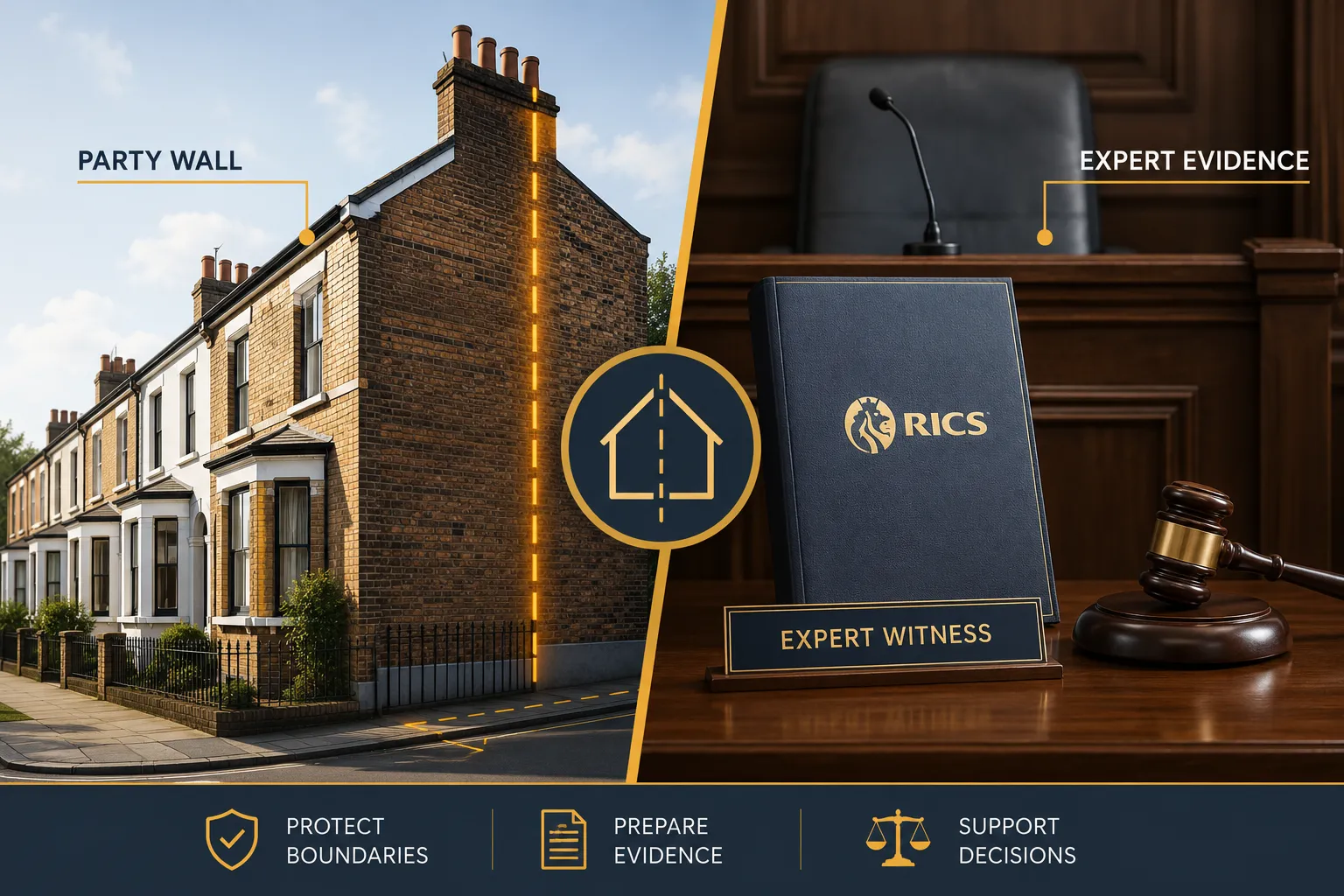
The Party Wall etc. Act 1996 is the UK legislation governing construction work on or near shared boundaries between neighbouring properties. It requires building owners to serve formal notices before starting certain works, and it provides a dispute resolution mechanism when neighbours cannot agree.
An expert witness becomes necessary when a party wall dispute escalates beyond the surveyor stage and enters formal legal proceedings. At that point, the court requires evidence from someone who can give an independent, technically qualified opinion, not just a professional opinion in the ordinary surveying sense, but one that meets the strict standards of CPR Part 35.
Key scenarios where an expert witness is needed include:
- County Court or High Court proceedings arising from disputed party wall awards
- Claims for damage allegedly caused by notifiable works
- Injunction applications to stop or compel works
- Professional negligence claims against surveyors
For a grounding in how party wall disputes typically develop before reaching this stage, see this detailed guide to party wall disputes.
How Do You Find a Qualified Party Wall Act Expert Witness?
Start with the UK Register of Expert Witnesses, which maintains a specific category for experts who expressly claim Party Wall Act expertise. This matters because searching a generic "construction" category will surface hundreds of professionals with no meaningful party wall litigation experience.
Steps to find a qualified expert:
- Search the UK Register of Expert Witnesses using "Party Wall Act" as the specialism filter.
- Cross-reference candidates against the RICS Find a Surveyor directory to confirm chartered status.
- Ask your solicitor whether the candidate has appeared in proceedings relevant to your type of dispute.
- Check the profile's last update date, entries refreshed in 2024 or 2025 signal active practice.
- Request a CV and confirm formal expert witness training (see credentials section below).
Profiles on specialist registers typically include discipline, region, fee structure, court experience, and last update date. An expert whose profile has not been updated in several years may not be actively accepting litigation instructions.
What Credentials Should a Party Wall Act Expert Witness Have?
The strongest credential profile in 2026 combines chartered surveyor status, specialist party wall experience, and formal expert witness qualification. No single credential is sufficient on its own.
Core credentials to look for:
| Credential | Issuing Body | Why It Matters |
|---|---|---|
| MRICS or FRICS | RICS | Confirms professional competence and regulatory oversight |
| RICS Expert Witness Certificate | RICS | Demonstrates training in CPR Part 35 and court procedure |
| MAE (Member of the Academy of Experts) | The Academy of Experts | Specialist expert witness accreditation, widely recognised by courts |
| RICS Registered Expert Witness status | RICS | Signals active commitment to expert witness practice standards |
| Party Wall Act specialism listing | UK Register of Expert Witnesses | Confirms express expertise in the 1996 Act, not just general construction |
The RICS Party Wall Legislation and Procedure standard (seventh edition, reissued May 2023) is the current professional benchmark. In April 2026, RICS launched a consultation on a draft eighth edition, aimed at strengthening conduct expectations and updating standard letters. Selecting an expert who is engaged with this forthcoming framework, rather than working from outdated practice, is increasingly treated as a due diligence requirement by instructing solicitors.
Leading party wall specialists also hold specialist expert witness training and act as Single Joint Experts where courts require a neutral appointment agreed by both parties.
What Is the Difference Between a Surveyor and a Party Wall Expert Witness?
A party wall surveyor manages the procedural aspects of the Party Wall etc. Act 1996, serving notices, preparing schedules of condition, and drawing up party wall awards. An expert witness provides independent technical evidence to a court or tribunal and is bound by CPR Part 35 duties that override any duty to the appointing party.
The distinction is critical. A surveyor acts in a quasi-judicial role during the award process. An expert witness acts as an officer of the court once litigation begins. The same person can perform both roles at different stages of a matter, but they cannot act as both simultaneously in the same dispute.
For more on the surveyor's role in the award process, the party wall awards guide explains how awards are structured and what they cover.
Can You Use the Same Expert Witness for Both Parties?
In some circumstances, yes, but only in the surveyor stage, not in contested litigation. Under the Party Wall etc. Act 1996, both parties can agree to appoint a single Agreed Surveyor to act for them jointly. This is a legitimate and cost-effective route for straightforward cases.
However, once a dispute enters court proceedings, each party must have their own independently appointed expert witness. A Single Joint Expert (SJE) can be appointed by the court itself, but this is distinct from a party-appointed expert and is subject to specific court directions.
Choose an Agreed Surveyor if:
- The dispute is procedural rather than substantive
- Both parties trust the same professional to act impartially
- Cost efficiency is a priority and the works are relatively low-risk
Appoint separate experts if:
- The matter is in, or heading toward, formal litigation
- There is a significant financial claim at stake
- The parties' positions are fundamentally opposed
For a complete breakdown of the Agreed Surveyor route, see this guide to agreed surveyor roles, appointment, and benefits.
How Much Does a Party Wall Act Expert Witness Cost?
Party wall expert witness fees are not regulated and vary considerably depending on the expert's seniority, the complexity of the case, and the volume of court attendance required. As a general guide (estimates based on typical market rates, not a guaranteed benchmark):
- Initial instructions and report preparation: Typically ranges from £1,500 to £5,000 or more for a substantive expert report, depending on complexity.
- Court attendance: Charged at an hourly or daily rate; senior RICS experts commonly charge £200,£500 per hour.
- Single Joint Expert appointments: Often slightly lower overall because the cost is shared between parties.
Always request a detailed fee schedule before instructing. Confirm whether the fee covers amendments to the report following disclosure, attendance at pre-trial review hearings, and travel time.
For context on how party wall surveyor costs are structured more broadly, see this overview of party wall agreement costs.
What Happens If Your Expert Witness Is Not Listed or Accredited?
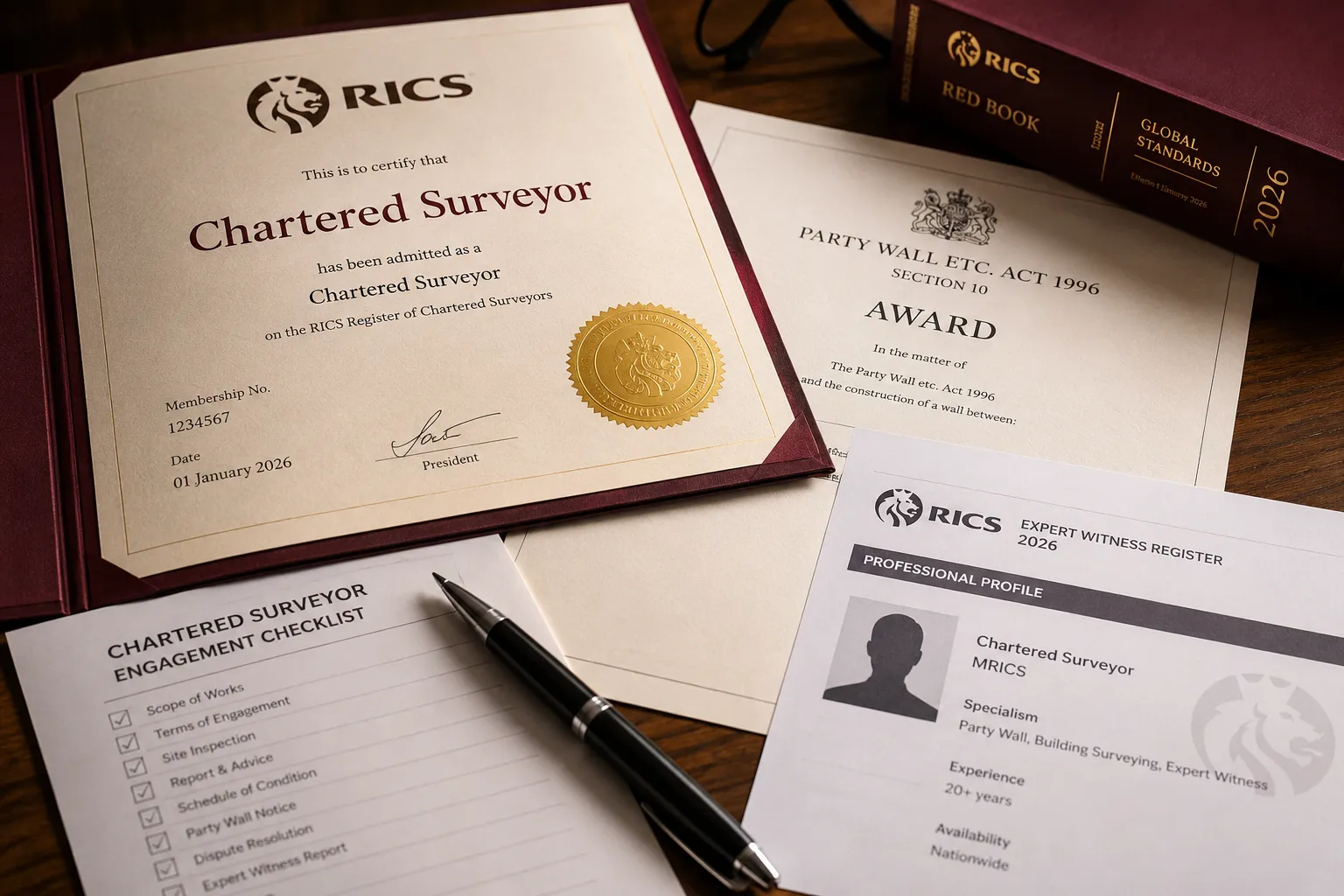
An unlisted or unaccredited expert can still give evidence in court, but the absence of formal credentials significantly weakens the weight a judge will give to that evidence. Courts scrutinise expert qualifications carefully, particularly in technical property disputes.
Practical risks of using an unaccredited expert include:
- The opposing party's legal team challenging the expert's standing before the report is even considered
- Cost sanctions if the court finds the expert's evidence did not meet CPR Part 35 standards
- The expert's opinion being given less weight than a formally accredited counterpart's
- Potential professional negligence exposure if the appointing solicitor failed to conduct adequate due diligence on credentials
Use of specialist registers is increasingly treated by law firms as a risk-control step, both to evidence due diligence and to demonstrate that the expert's expertise is expressly anchored in the Party Wall etc. Act 1996 rather than general construction practice.
How Do You Verify That an Expert Witness Is on the Official List?
The UK Register of Expert Witnesses allows direct searching by specialism, region, and discipline. Always verify the listing yourself rather than relying solely on the expert's own CV.
Verification checklist:
- Search the UK Register of Expert Witnesses directly and confirm the Party Wall Act specialism is listed
- Check the RICS Find a Surveyor tool to confirm current MRICS or FRICS membership
- Ask the expert to provide their RICS Registered Expert Witness reference number if applicable
- Confirm membership of the Academy of Experts (MAE or FAE) via the Academy's own directory
- Ask for two or three anonymised case references involving party wall litigation
One common mistake: accepting a CV that lists "party wall experience" without distinguishing between acting as a surveyor under the Act and acting as a court-appointed expert witness. These are different roles with different competency requirements.
What Are the Most Common Mistakes When Choosing a Party Wall Expert Witness?
The most frequent errors fall into three categories: credential gaps, process errors, and conflict-of-interest oversights.
Credential gaps:
- Appointing a generalist building surveyor without litigation experience
- Overlooking whether the expert's training is current (pre-2023 training may predate the current RICS standard)
- Confusing RICS membership with RICS Expert Witness accreditation, these are separate
Process errors:
- Failing to check the expert's listing is active and recently updated
- Not confirming the expert can meet court deadlines before instructing
- Neglecting to agree a fee cap or budget estimate in writing
Conflict-of-interest oversights:
- Appointing an expert who has previously advised the opposing party on the same site
- Using an expert who has a professional or personal relationship with the appointing solicitor's firm
For broader context on the consequences of procedural errors under the Act, see this article on the consequences of ignoring the Party Wall Act.
What Should You Ask a Party Wall Expert Witness Before Hiring Them?
Before instructing any expert, a direct conversation covering the following questions will reveal whether they are genuinely suitable or simply credentialled on paper.
Ten questions worth asking:
- Are you currently listed on the UK Register of Expert Witnesses under the Party Wall Act specialism?
- Do you hold an RICS Expert Witness Certificate or equivalent formal accreditation?
- How many party wall-related expert reports have you produced in the last three years?
- Have you given oral evidence in court in a party wall matter? If so, at what level?
- Are you familiar with the RICS seventh edition Party Wall standard and the April 2026 eighth edition consultation?
- Can you confirm you have no conflict of interest in this matter?
- What is your current availability and can you meet the court's likely timetable?
- How do you structure your fees and what is included in your initial report fee?
- Have you acted as a Single Joint Expert? If so, how recently?
- Can you provide anonymised references from solicitors who have instructed you in party wall litigation?
How Are Party Wall Expert Witnesses Evaluated and What Makes One Successful in 2026?
Courts evaluate party wall expert witnesses on the quality, impartiality, and procedural compliance of their reports, not on the strength of the case they are supporting. An expert who advocates for their appointing party rather than giving a genuinely independent opinion will be identified quickly and their evidence discounted.
2026 success metrics for party wall expert witnesses:
- CPR Part 35 compliance: The expert's report must contain the mandatory declarations and follow the prescribed format. Courts treat non-compliance as a serious failing.
- Currency of knowledge: Active engagement with the RICS seventh edition standard and awareness of the forthcoming eighth edition signals that the expert is practising at the current professional frontier.
- Impartiality record: Experts who have given evidence for both building owners and adjoining owners across their career demonstrate genuine independence.
- Report clarity: Judges and opposing counsel value concise, well-structured reports over lengthy technical narratives. The ability to explain complex party wall issues in plain language is a measurable differentiator.
- Court attendance track record: An expert who has given oral evidence and been cross-examined successfully carries more weight than one whose experience is limited to written reports.
For an overview of the full scope of party wall services that feed into expert witness instructions, the party wall services page provides useful context.
Are There Alternatives to Hiring a Listed Expert Witness?
For disputes that have not yet reached formal litigation, there are several alternatives that may resolve the matter without the cost and complexity of court proceedings.
- Third surveyor determination: Under the Party Wall etc. Act 1996, if the two appointed surveyors cannot agree, a third surveyor (selected at the outset) makes a binding determination. This is faster and cheaper than court.
- Mediation: An increasing number of party wall disputes are resolved through mediation, which does not require a formal expert witness. A mediator with party wall expertise can guide both parties to a settlement.
- Agreed Surveyor: As noted above, a single neutral surveyor acting for both parties can resolve procedural disputes without litigation.
- Early legal advice: Sometimes a solicitor's letter citing the correct provisions of the Act resolves a dispute before any expert is needed.
If a neighbour is refusing to engage with the process at all, this guide on what happens when a neighbour refuses party wall works explains the available options.
What Happens When Expert Witnesses for Each Party Disagree?
When two party-appointed experts reach different conclusions, the court does not simply split the difference. The judge weighs the quality of each expert's reasoning, their adherence to CPR Part 35, and the strength of the underlying evidence.
How courts manage expert disagreement:
- Experts are typically directed to produce a Joint Statement identifying areas of agreement and the precise points of disagreement, before trial.
- The Joint Statement process often narrows the issues significantly, reducing trial time and cost.
- Where experts remain in disagreement, oral evidence and cross-examination at trial determines which opinion the court prefers.
- An expert who cannot defend their methodology under cross-examination will lose credibility quickly, regardless of their credentials.
The practical implication: selecting an expert who is experienced in the Joint Statement process and comfortable under cross-examination is as important as their technical knowledge. A strong report that collapses under questioning is worse than a modest report that holds up.
For professional expert witness report services, see Prince Surveyors' expert witness reports.
Party Wall Expert Witness Credential Checker
.cg-checker{font-family:Arial,sans-serif;max-width:540px;margin:24px auto;border:2px solid #1a3a5c;border-radius:8px;padding:20px;background:#f9f9f9}
.cg-checker h3{color:#1a3a5c;margin:0 0 4px;font-size:1.05rem}
.cg-checker p.cg-sub{color:#555;font-size:0.85rem;margin:0 0 16px}
.cg-item{display:flex;align-items:flex-start;margin-bottom:10px;gap:10px}
.cg-item input[type=checkbox]{margin-top:3px;accent-color:#1a3a5c;width:16px;height:16px;flex-shrink:0}
.cg-item label{font-size:0.88rem;color:#222;line-height:1.4}
.cg-result{margin-top:16px;padding:12px;border-radius:6px;font-size:0.9rem;font-weight:bold;text-align:center;display:none}
.cg-btn{display:block;width:100%;padding:10px;background:#1a3a5c;color:#fff;border:none;border-radius:6px;font-size:0.95rem;cursor:pointer;margin-top:14px}
.cg-btn:hover{background:#2a5080}
.cg-score{font-size:0.82rem;font-weight:normal;display:block;margin-top:4px}
Party Wall Expert Witness Credential Checker
Tick each criterion your candidate meets, then check their suitability score.
function cgCheck(){
var boxes=document.querySelectorAll(‘.cg-checker input[type=checkbox]’);
var score=0;
boxes.forEach(function(b){if(b.checked)score++;});
var el=document.getElementById(‘cg-result’);
el.style.display=’block’;
if(score>=6){el.style.background=’#d4edda’;el.style.color=’#155724′;el.innerHTML=’Strong candidate (‘+score+’/7)Meets 2026 baseline criteria. Proceed with final checks.‘;}
else if(score>=4){el.style.background=’#fff3cd’;el.style.color=’#856404′;el.innerHTML=’Partial match (‘+score+’/7)Address gaps before instructing, especially credentials and conflicts.‘;}
else{el.style.background=’#f8d7da’;el.style.color=’#721c24′;el.innerHTML=’Insufficient credentials (‘+score+’/7)Seek an alternative candidate with stronger accreditation.‘;}
}
Frequently Asked Questions
What is the minimum qualification for a party wall expert witness in 2026?
There is no statutory minimum, but courts and instructing solicitors now treat RICS chartered status (MRICS or FRICS), formal expert witness training, and CPR Part 35 familiarity as the practical baseline. An expert without these credentials will face serious credibility challenges.
Does a party wall expert witness have to be local to the property?
No. While local knowledge can be useful for context, courts are more concerned with technical competence and impartiality than geography. Many leading party wall expert witnesses practise nationally.
Can a party wall surveyor who prepared the award later act as an expert witness in a dispute about it?
This creates a significant conflict of interest and is generally inadvisable. The expert's prior involvement as a surveyor in the same matter undermines the independence that CPR Part 35 requires.
How long does it take to get an expert witness report prepared?
For a substantive party wall expert report, allow four to eight weeks from instruction, depending on site access requirements, document review, and the expert's current caseload. Always confirm availability before instructing.
What is a Single Joint Expert and when is one used in party wall cases?
A Single Joint Expert (SJE) is appointed by both parties jointly, often at the court's direction, to provide a single independent opinion. SJEs are common in lower-value party wall claims where the cost of two separate experts would be disproportionate.
Is it possible to challenge an expert witness's report after it has been filed?
Yes. The opposing party's legal team can serve written questions on the expert under CPR Part 35.6, and the expert can be cross-examined at trial. A well-prepared expert should be able to defend every conclusion in their report.
Conclusion
Selecting Party Wall Act listed expert witnesses in 2026 is a process that rewards careful due diligence. The combination of RICS chartered status, formal expert witness accreditation, active listing on a specialist register, and current knowledge of the RICS Party Wall standard is the strongest credential profile available. With the eighth edition of the RICS guidance in consultation as of April 2026, the professional landscape is actively evolving, and experts who are engaged with that process will carry greater authority in proceedings.
Actionable next steps:
- Use the UK Register of Expert Witnesses to search specifically under the Party Wall Act specialism, not generic construction categories.
- Verify RICS membership and expert witness accreditation independently before instructing.
- Ask the ten pre-instruction questions listed in this article and require written answers on fees and availability.
- Confirm the expert has no conflict of interest in writing before any documents are shared.
- If the dispute has not yet reached litigation, explore the third surveyor or mediation routes first, they are faster and cheaper.
For a broader view of party wall procedure and professional services, explore the complete party wall services overview or read more on party wall rights and obligations.
Tags: party wall act, expert witness, RICS chartered surveyor, party wall disputes, expert witness credentials, CPR Part 35, party wall award, party wall surveyor, expert witness accreditation, property disputes UK, party wall legislation, 2026 surveying standards