

Last updated: May 21, 2026
Quick Answer: The Renters' Rights Act 2025 came into force on 1 May 2026, abolishing Section 21 evictions and converting most assured shorthold tenancies into periodic assured tenancies. Private landlords in England must provide existing tenants with the new Renters' Rights Act Information Sheet by 31 May 2026. Missing this deadline can result in a financial penalty of up to £7,000. New tenancies created on or after 1 May 2026 require the sheet to be provided at the outset.
Key Takeaways
- 🗓️ Deadline: 31 May 2026 — existing tenants must receive the Renters' Rights Act Information Sheet by this date.
- ⚠️ Penalty: up to £7,000 for landlords who fail to distribute the sheet.
- 🏠 Section 21 'no-fault' evictions are abolished — landlords must now rely on Section 8 grounds to regain possession.
- 🔄 Most assured shorthold tenancies (ASTs) converted to periodic assured tenancies automatically on 1 May 2026.
- 📈 Rent increases capped at once per year, and tenants have the right to challenge increases through a First-tier Tribunal.
- 📋 Government-produced template sheets are available; landlords do not need to create their own from scratch.
- 🔍 Property condition matters more than ever — without Section 21, landlords cannot easily remove tenants who raise disrepair complaints.
- 🏛️ A landlord register and new ombudsman are expected to follow later in 2026.
- 📐 Pre-letting surveys and condition reports now serve as critical evidence of habitability and compliance.
- ℹ️ This article provides factual information only — always seek qualified legal advice for your specific circumstances.
Table of Contents
- What Exactly Is the Renters' Rights Act Information Sheet?
- When Do Landlords Have to Distribute the New Rights Sheet?
- Penalties If You Don't Give Tenants the Rights Information Sheet
- How Is This Different from Previous Tenant Rights Documentation?
- Do These Rights Apply to All Rental Types?
- Are There Template Versions of the Rights Information Sheet Available?
- Who Is Exempt from Providing the Renters' Rights Information Sheet?
- What Key Protections Are Included in the New Rights Document?
- Why Property Surveys Are Now a Landlord's Best Defence
- Common Mistakes Landlords Make When Preparing Rights Information Sheets
- FAQ
What Exactly Is the Renters' Rights Act Information Sheet? {#what-is-it}
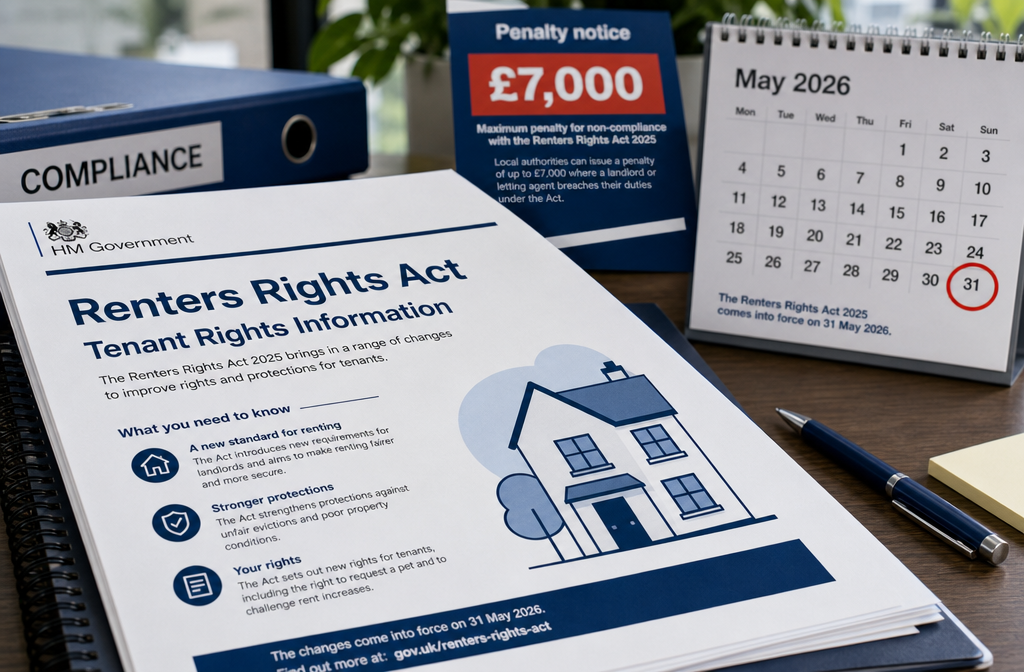
The Renters' Rights Act Information Sheet is an official document that landlords in England must provide to tenants, summarising the key rights and protections introduced by the Renters' Rights Act 2025. It is a mandatory disclosure requirement, not optional guidance.
The sheet covers the abolition of Section 21 evictions, the new periodic tenancy structure, rent increase rules, the right to challenge rent increases, and forthcoming protections such as the landlord register and ombudsman scheme. Its purpose is to ensure tenants understand their legal position under the new regime from the outset of, or transition into, the new framework.
The government produces the official version of this document. Landlords are required to use the prescribed form rather than drafting their own summary. Think of it as a statutory equivalent to the "How to Rent" guide that landlords have been required to provide under the previous regime — but updated to reflect the most significant overhaul of English tenancy law in approximately 40 years.
Key point: The information sheet is distinct from the tenancy agreement itself. It must be provided as a standalone document, and landlords should retain proof of delivery (for example, a signed acknowledgement or tracked email).
When Do Landlords Have to Distribute the New Rights Sheet? {#deadline}
The core Renters Rights Act information sheet deadline for landlords in 2026 is 31 May 2026 for existing tenants. For new tenancies created on or after 1 May 2026, the sheet must be provided at the point the tenancy begins.
Here is a clear breakdown:
| Tenancy Type | When Sheet Must Be Provided |
|---|---|
| Existing tenants (converted tenancies) | By 31 May 2026 |
| New tenancies from 1 May 2026 onwards | At the start of the tenancy |
| Tenancies granted before 1 May 2026 (still running) | By 31 May 2026 |
The 31 May 2026 deadline is firm. There is no grace period announced beyond this date, and the clock is already running. Landlords with large portfolios should prioritise distribution immediately, particularly where tenants are difficult to contact.
Practical tip: Deliver via a method that creates a paper trail — tracked post, email with read receipt, or a signed copy retained by both parties. For more on what landlords are expected to provide at the outset of a tenancy, see this guide on what a landlord should provide in an unfurnished apartment.
Penalties If You Don't Give Tenants the Rights Information Sheet {#penalties}
Failure to provide the Renters' Rights Act Information Sheet by the required deadline can result in a civil penalty of up to £7,000, enforced by the local housing authority.
This is not a theoretical risk. Local authorities have been given enforcement powers under the Act, and the penalty regime is designed to incentivise compliance rather than simply punish after the fact. Repeat offenders or landlords who also breach other provisions of the Act may face additional consequences, including being listed on the forthcoming landlord register in a way that affects their ability to let property.
What happens if a landlord misses the 2026 distribution deadline:
- The local housing authority may issue a notice of intent to impose a financial penalty.
- Landlords have the right to make representations before a final penalty notice is issued.
- The penalty can be up to £7,000 per breach.
- Failure to comply may also weaken a landlord's position in any subsequent Section 8 possession proceedings.
There is currently no published guidance suggesting that a landlord who misses the deadline but rectifies it promptly will automatically avoid a penalty — so the safest course is to meet the 31 May 2026 deadline. Seek legal advice promptly if you are at risk of missing it.
How Is This Different from Previous Tenant Rights Documentation? {#differences}
Previously, landlords were required to provide the government's "How to Rent" checklist at the start of each new AST. The Renters' Rights Act Information Sheet is a different document with a different legal basis and a broader scope.
Key differences:
- Scope: The old "How to Rent" guide covered general renting advice. The new information sheet is specifically tied to the statutory rights created by the Renters' Rights Act 2025.
- Trigger: The old guide was required only at the start of a new tenancy. The new sheet must be given to existing tenants by 31 May 2026, regardless of when their tenancy started.
- Content: The new sheet addresses the abolition of Section 21, the new periodic tenancy structure, rent challenge rights, and forthcoming protections — none of which existed under the previous regime.
- Penalty: The penalty for failing to provide the new sheet (up to £7,000) is separate from any penalty for failing to provide the "How to Rent" guide.
Landlords should not assume that having previously provided the "How to Rent" guide satisfies the new obligation. It does not.
Do These Rights Apply to All Rental Types? {#scope}
The Renters' Rights Act 2025 applies to assured and assured shorthold tenancies in the private rented sector in England. This covers the vast majority of private residential lettings.
The Act does NOT apply to:
- Social housing tenancies (these are governed by separate legislation).
- Licences to occupy (lodgers, for example, where the landlord also lives in the property).
- Holiday lets and short-term accommodation not structured as assured tenancies.
- Most commercial tenancies.
- Tenancies where the annual rent exceeds £100,000 (which fall outside the assured tenancy framework).
Note on "state by state" differences: The Renters' Rights Act is England-specific legislation. Scotland, Wales, and Northern Ireland have their own separate tenancy law frameworks and are not covered by this Act. Landlords with properties across UK nations must check the applicable rules for each jurisdiction separately.
For landlords operating across multiple properties or in leasehold blocks, the block management obligations and service charge structures may also interact with the new Act — professional advice is recommended.
Are There Template Versions of the Rights Information Sheet Available? {#templates}
Yes. The government publishes the prescribed Renters' Rights Act Information Sheet, and landlords are expected to use this official version rather than creating their own. It is available via GOV.UK.
Cost to landlords: Distributing the information sheet itself has no direct cost beyond the administrative time to print, email, or post it. For a single-property landlord, this is minimal. For larger portfolio landlords or letting agents managing hundreds of tenancies, the administrative burden is more significant but still manageable.
Letting agents acting on behalf of landlords should clarify in their management agreements who is responsible for distributing the sheet. If the agent holds a full management mandate, they will typically handle this — but the legal obligation ultimately rests with the landlord.
Who Is Exempt from Providing the Renters' Rights Information Sheet? {#exemptions}
There are no broad exemptions for private landlords with assured or assured shorthold tenancies in England. The obligation applies regardless of portfolio size, whether the landlord is a company or an individual, and whether the property is furnished or unfurnished.
Potential edge cases where the obligation may not apply:
- Excluded occupiers (lodgers sharing facilities with a resident landlord) — these are licences, not assured tenancies.
- Tenancies outside the assured tenancy framework (very high-rent properties, commercial lets, holiday lets).
- Social landlords — registered providers of social housing are not private landlords under this Act.
Common mistake: Some landlords assume that because their tenant is on a fixed-term agreement that hasn't yet expired, they don't need to act. This is incorrect. Fixed-term ASTs were converted to periodic assured tenancies on 1 May 2026, and the information sheet obligation applies from that date.
What Key Protections Are Included in the New Rights Document? {#protections}
The Renters' Rights Act Information Sheet summarises the following core protections for tenants:
- Abolition of Section 21: Landlords can no longer serve a 'no-fault' eviction notice. All possession claims must be based on specific Section 8 grounds (for example, rent arrears, anti-social behaviour, or the landlord genuinely wishing to sell or move in).
- Periodic tenancy structure: Tenants no longer have fixed-term agreements. Tenancies roll on a periodic basis, giving tenants greater security of tenure.
- Rent increase rules: Landlords may only increase rent once in any 12-month period and must use the correct statutory notice procedure.
- Right to challenge rent increases: Tenants can refer a proposed rent increase to the First-tier Tribunal (Property Chamber) if they believe it is above market rate.
- Awaab's Law-style hazard obligations: Landlords must address certain hazards (including damp and mould) within prescribed timeframes. Failure to do so strengthens a tenant's ability to bring a complaint or legal claim.
- Forthcoming protections: The sheet should also reference the planned landlord register and new ombudsman scheme, both expected later in 2026.
Why Property Surveys Are Now a Landlord's Best Defence {#surveys}

Without Section 21, landlords cannot simply serve a no-fault notice to end a tenancy when a dispute arises. This fundamentally changes the risk calculus around property condition. A tenant who raises a disrepair complaint now has considerably more security of tenure while that complaint is live — and a landlord who cannot evidence the property's condition at the outset is in a weaker position.
Pre-letting condition surveys serve three practical purposes under the new regime:
- Evidence of habitability at the point of letting — demonstrating the property met the Decent Homes Standard and was free from Category 1 hazards under the Housing Health and Safety Rating System (HHSRS) at the start of the tenancy.
- A baseline for dilapidations claims — if a tenant causes damage, a dated condition report is the most reliable evidence of the property's prior state.
- Awaab's Law compliance — where damp, mould, or structural defects are identified, a surveyor's report supports a documented remediation plan, which is now a legal expectation.
A construction and condition survey or a Level 3 full building survey carried out before a tenancy begins creates a defensible record. For older properties, where defects such as common defects in older homes like damp penetration, roof deterioration, or timber decay are more likely, this is especially important.
Landlords should also consider how often rental units should be inspected during the tenancy to maintain an ongoing record of condition. Mid-tenancy inspections, documented by a professional, provide continuity of evidence that is difficult to challenge.
For landlords uncertain about which level of survey is appropriate, the guide to choosing between a Level 2 and Level 3 survey sets out the decision criteria clearly.
The consequences of failing to act on known defects are now more serious than ever — a tenant with a disrepair complaint and security of tenure is a very different situation from the pre-2026 regime.
Common Mistakes Landlords Make When Preparing Rights Information Sheets {#mistakes}
The Renters Rights Act information sheet deadline for landlords in 2026 is creating compliance pressure, and several predictable errors are already emerging:
- Using an outdated version of the sheet. Always download the current version from GOV.UK. Earlier drafts or pre-commencement versions may not satisfy the legal requirement.
- Failing to keep proof of delivery. Handing over a sheet verbally or leaving it on a kitchen table without a signed acknowledgement is not sufficient evidence of compliance.
- Assuming the letting agent has handled it. Landlords must confirm with their agent in writing that the sheet has been distributed and that evidence has been retained.
- Overlooking existing tenants. Some landlords are focused on new lettings and have not acted on the obligation to provide the sheet to tenants already in situ by 31 May 2026.
- Conflating the information sheet with the tenancy agreement update. The sheet is a separate document. Updating the tenancy agreement (or acknowledging the periodic conversion) is a different step.
- Ignoring the property condition implications. The information sheet is the visible compliance task, but the underlying change — the end of Section 21 — means property condition documentation is now equally critical.
For landlords managing multiple properties, a simple spreadsheet tracking each tenancy, the date the sheet was provided, and the method of delivery is a low-cost way to demonstrate systemic compliance.
FAQ {#faq}
Q: Can tenants sue their landlord for not receiving the Renters' Rights Act Information Sheet?
A: The primary enforcement mechanism is a civil penalty imposed by the local housing authority, not a direct tenant claim. However, failure to comply may be relevant evidence in any broader dispute about the landlord's conduct, and it may affect the landlord's ability to rely on certain possession grounds. Tenants should contact their local council or seek advice from Shelter or Citizens Advice.
Q: Does the 31 May 2026 deadline apply if my tenant's fixed term hasn't ended yet?
A: Yes. Fixed-term ASTs were converted to periodic assured tenancies on 1 May 2026 regardless of the original end date. The obligation to provide the information sheet applies from that conversion date, and the deadline for existing tenants is 31 May 2026.
Q: Is the Renters' Rights Act Information Sheet the same as the "How to Rent" guide?
A: No. They are separate documents with separate legal bases. The "How to Rent" guide requirement may still apply in certain contexts, but the Renters' Rights Act Information Sheet is a new, additional obligation introduced by the 2025 Act.
Q: What Section 8 grounds can landlords now use to regain possession?
A: The Renters' Rights Act expanded and modified the Schedule 2 grounds under the Housing Act 1988. Key grounds include significant rent arrears, anti-social behaviour, the landlord wishing to sell the property, and the landlord or a close family member wishing to move in. The specific evidential requirements for each ground are detailed — legal advice is strongly recommended before serving any Section 8 notice.
Q: How often can a landlord increase rent under the new rules?
A: Once in any 12-month period, using the correct statutory notice. Tenants can challenge the proposed increase at the First-tier Tribunal (Property Chamber) if they believe it exceeds the open market rent.
Q: When will the landlord register and ombudsman scheme launch?
A: Both are expected later in 2026, but no confirmed launch dates have been announced at the time of writing. Landlords should monitor GOV.UK and sector bodies such as the NRLA for updates.
Conclusion: Act Now, Document Everything
The Renters Rights Act information sheet deadline for landlords in 2026 is 31 May — and with penalties of up to £7,000, this is not a compliance task to defer. The immediate priority is straightforward: download the current prescribed information sheet from GOV.UK, distribute it to every existing tenant, and retain proof of delivery.
But the information sheet is only the most visible part of a much larger shift. The abolition of Section 21 means that landlords who cannot evidence their property's condition, who have unresolved disrepair issues, or who lack a documented maintenance history are now carrying significantly more risk than they were before 1 May 2026.
Actionable next steps for landlords and letting agents:
- Distribute the information sheet to all existing tenants before 31 May 2026 and retain signed acknowledgements or tracked delivery evidence.
- Commission a pre-letting or mid-tenancy condition survey for any property without a recent professional inspection — particularly older stock where hazards are more likely.
- Review your Section 8 grounds with a solicitor or licensed conveyancer, and ensure your tenancy documentation is up to date.
- Establish a routine inspection schedule and document each visit formally.
- Monitor GOV.UK for updates on the landlord register and ombudsman scheme, and prepare to register when the system opens.
- Seek qualified legal advice for any tenancy where a dispute, disrepair complaint, or possession action is already in progress.
The new framework is demanding, but landlords who act promptly, maintain well-evidenced properties, and engage professional advisers are well-placed to manage it successfully.
References
- Renters' Rights Act 2025 (UK Parliament). legislation.gov.uk
- Housing Act 1988 (as amended). legislation.gov.uk
- Ministry of Housing, Communities and Local Government. How to Rent Guide. GOV.UK. gov.uk
- Housing Health and Safety Rating System (HHSRS) Operating Guidance. ODPM, 2006.
- Awaab's Law provisions — Social Housing (Regulation) Act 2023. legislation.gov.uk
This article provides factual information only and does not constitute legal advice. Landlords and letting agents should seek qualified legal and professional guidance for their specific circumstances.