

Nearly one in three neighbour disputes in England and Wales involves construction work on or near a shared boundary, and the majority of those conflicts could have been avoided entirely with early professional intervention. Professional party wall surveying: how chartered surveyors prevent neighbour disputes before they start is not merely a procedural formality. It is a structured, legally grounded service that protects both building owners and their neighbours from costly, relationship-damaging confrontations before a single brick is laid.
In 2026, with urban renewal projects, loft conversions, and basement digs accelerating across England, the demand for qualified party wall surveyors has never been greater. Yet many homeowners still treat the Party Wall etc. Act 1996 as a bureaucratic hurdle rather than a powerful dispute-prevention tool. This guide explains how chartered surveyors use the Act's framework proactively, and why instructing one early is almost always the most cost-effective decision a building owner can make.
Key Takeaways
- The Party Wall etc. Act 1996 requires formal notice before most extension, loft conversion, and basement work begins, failing to serve notice can expose building owners to injunctions and compensation claims.
- A chartered surveyor's most valuable work happens before disputes arise: serving compliant notices, preparing schedules of condition, and drafting party wall awards that set clear rules for the works.
- Appointing a surveyor early, ideally two to three months before work starts, dramatically reduces the likelihood of a formal dispute reaching the courts.
- The RICS is currently consulting on the 8th edition of its Party Wall Legislation and Procedure guidance (April 2026), signalling ongoing professional evolution in this field.
- The cost of proactive party wall surveying is typically a fraction of the legal fees incurred when disputes escalate to court proceedings.
Understanding the Legal Framework Behind Party Wall Surveying
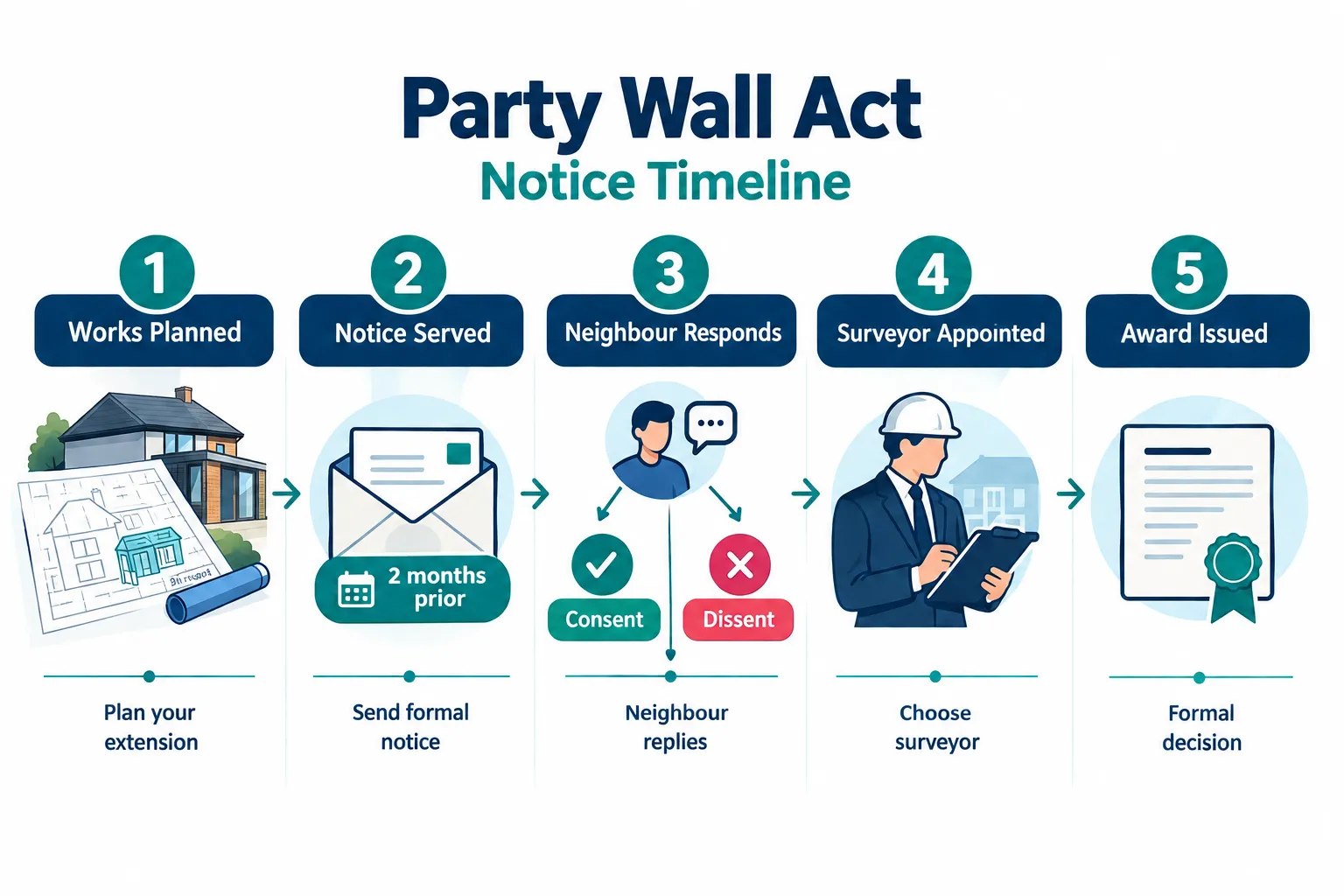
The Party Wall etc. Act 1996 governs three distinct categories of work in England and Wales: works directly on a shared party wall or party fence wall, new buildings at or astride the boundary line, and excavations within three to six metres of an adjoining owner's structure [1]. Any building owner proposing such works must serve written notice on all affected adjoining owners before works commence.
The notice periods are fixed:
| Type of Work | Minimum Notice Period |
|---|---|
| Party wall or party structure works | 2 months |
| New building at or near boundary | 1 month |
| Excavations near foundations | 1 month |
Once notice is served, the adjoining owner has 14 days to respond. If they consent in writing, works may proceed without a formal award. If they dissent, or simply fail to respond, a dispute is deemed to have arisen under the Act, and one or more surveyors must be appointed to resolve it [1].
This is where professional party wall surveying: how chartered surveyors prevent neighbour disputes before they start becomes most relevant. A qualified surveyor does not wait for a dissent to arrive. They manage the process from the outset, ensuring notices are correctly drafted, served on the right parties, and followed up in a way that encourages early consent.
What the Act Covers, and What It Does Not
The Act applies to shared walls between properties (such as the wall between two terraced houses), party fence walls (walls straddling the boundary that are not part of a building), and floors or ceilings between flats. It does not cover garden fences, boundary hedges, or purely internal works that have no structural effect on a shared structure [6].
For homeowners planning loft conversions, rear extensions, or basement digs in terraced or semi-detached properties, the Act almost certainly applies. The party wall risks in terraced and semi-detached homes guide provides detailed practical guidance on the specific risk profiles of these common project types.
How Chartered Surveyors Prevent Disputes Before They Start
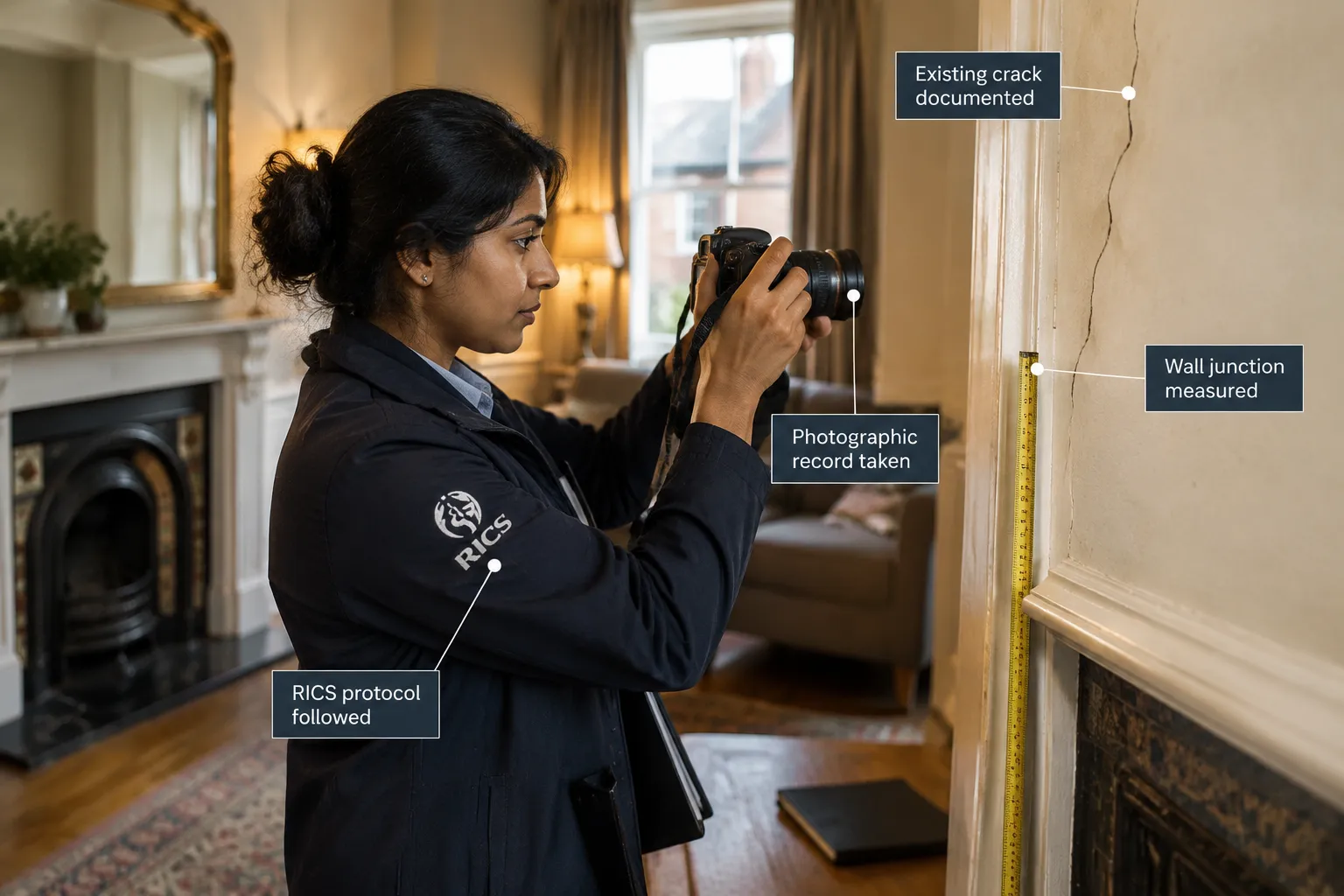
The dispute-prevention role of a chartered party wall surveyor operates across three interconnected stages: pre-notice preparation, the notice and consent process, and the drafting of a party wall award. Each stage offers specific opportunities to reduce friction and protect all parties.
Stage 1: Pre-Notice Preparation and Early Engagement
The single most effective thing a building owner can do is instruct a chartered surveyor before any design is finalised. At this stage, the surveyor can:
- Review proposed plans against the Act's trigger conditions
- Identify all adjoining owners who must receive notice (including freeholders, leaseholders, and mortgagees in some cases)
- Advise on whether the design can be modified to reduce the impact on neighbouring structures
- Initiate informal communication with neighbours to prepare them for the formal notice
"Early engagement between surveyors and adjoining owners is consistently the most effective way to prevent disputes from escalating into formal proceedings.", RICS Consumer Guide on Party Walls [6]
This pre-notice dialogue is not legally required, but it is strongly recommended by the RICS and widely adopted by specialist firms [7]. A neighbour who receives a formal legal notice without any prior warning is far more likely to dissent, and to do so out of anxiety rather than genuine objection. A brief, professional conversation before the notice arrives changes the dynamic entirely.
Stage 2: Serving Compliant Notices
A notice that is incorrectly drafted, served on the wrong party, or delivered outside the required timeframe is legally invalid. Invalid notices can delay projects by weeks or months and, in some cases, expose building owners to injunctions that halt works entirely [2].
Chartered surveyors ensure that notices:
- Identify the building owner and the adjoining owner correctly
- Describe the proposed works with sufficient precision
- State the planned start date and comply with minimum notice periods
- Are served by an appropriate method (personal delivery, recorded post, or, where the owner cannot be found, affixed to the property)
The evergreen guide to Party Wall Act notices, RICS templates and common pitfalls sets out the most frequent errors surveyors encounter and how to avoid them. Common mistakes include failing to identify leaseholders as separate adjoining owners, omitting reference to excavation works when they fall within the Act's trigger distances, and serving notice too late to meet the statutory minimum period.
Stage 3: The Schedule of Condition
Before any notifiable works begin, a professionally prepared schedule of condition documents the existing state of the adjoining owner's property. This typically includes:
- Photographs of all rooms and external elevations adjacent to the works
- Written descriptions of existing cracks, defects, and structural features
- Measurements of any pre-existing movement or settlement
The schedule of condition is the single most important document in preventing post-works disputes. Without it, there is no agreed baseline from which to assess whether any damage was caused by the works. With it, both parties have an objective record that a chartered surveyor can refer to if a claim arises [8].
For basement conversions, among the highest-risk project types, the Party Wall Act compliance protocols for basement conversions explains how surveyors manage the heightened structural risks involved in deep excavation work.
Stage 4: Drafting the Party Wall Award
Where an adjoining owner dissents, or where the works are sufficiently complex to warrant one, the surveyor(s) prepare a party wall award, a legally binding document that sets out:
- The precise works permitted
- The hours during which works may be carried out
- Security arrangements (including security for expenses where appropriate)
- Access rights for inspection
- The procedure for making good any damage
The award is enforceable in the County Court and provides both parties with certainty [1]. A well-drafted award effectively removes the main sources of dispute: ambiguity about what is permitted, when it can happen, and who is responsible for any resulting damage.
The Economic Case for Professional Party Wall Surveying
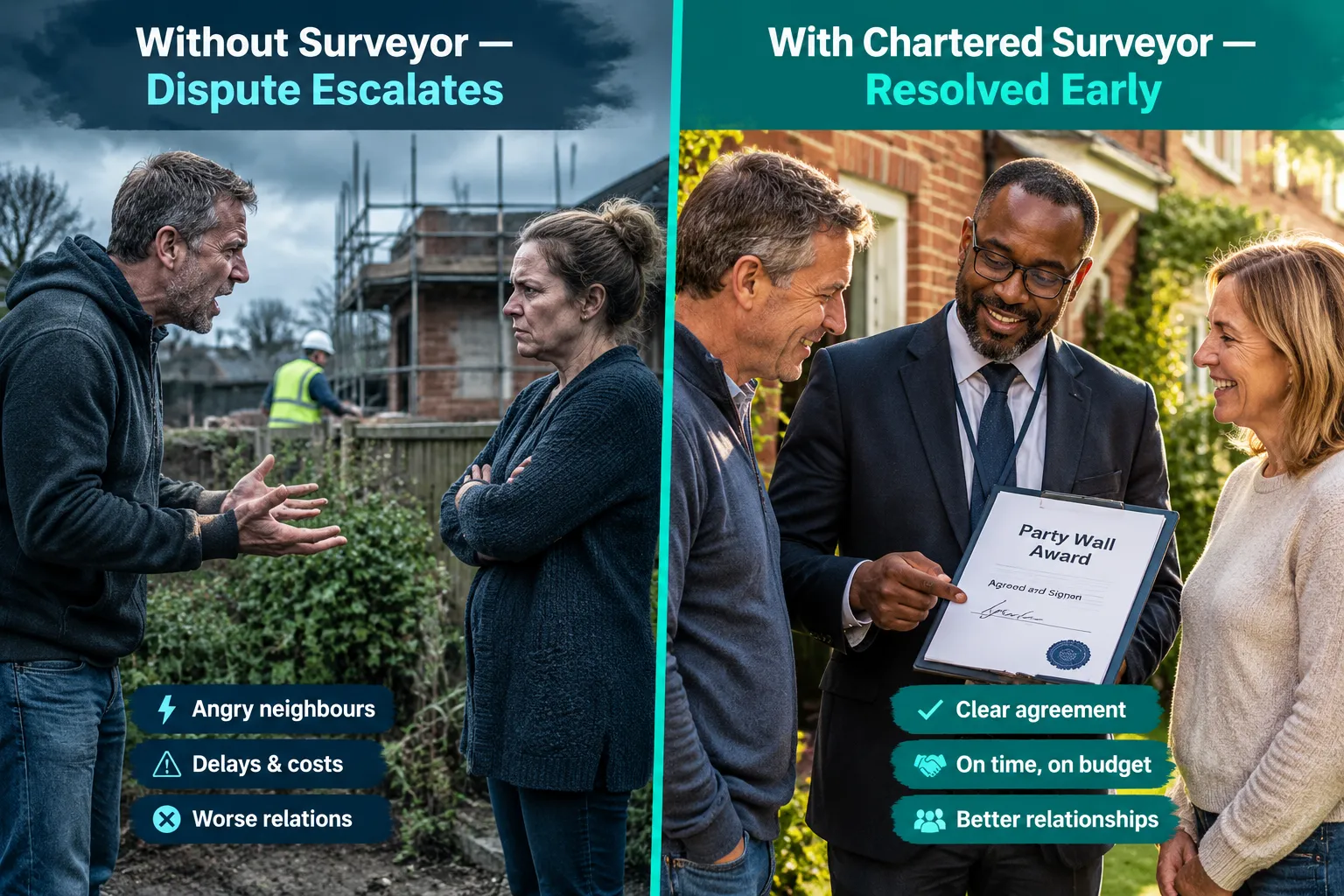
The financial argument for instructing a chartered surveyor early is compelling. In 2026, a standard party wall surveyor's fee for a residential extension typically ranges from £700 to £1,500 for straightforward cases. Contested disputes that reach the County Court can cost each party £5,000 to £20,000 or more in legal and surveyor fees, plus the delay costs of halted construction [5].
The cost comparison is stark:
- Proactive surveyor instruction: typically £700,£1,500
- Formal dispute resolution with two surveyors: £2,000,£5,000
- Court proceedings: £5,000,£20,000+
- Injunction to halt works: potential project delay of 3-6 months
Beyond direct costs, there are less visible economic consequences. Damage to a neighbouring property that is not covered by a schedule of condition can result in compensation claims that drag on for years. Recent case law reinforces this point: in Taylor v Jones (2024), the court examined the extent of a building owner's liability for damage caused during party wall works, finding that the absence of a properly constituted award significantly complicated the assessment of responsibility [3]. The case underlines why professional documentation, not just goodwill, is essential.
The RICS is currently consulting on the 8th edition of its Party Wall Legislation and Procedure guidance, with the April 2026 consultation reflecting the profession's ongoing effort to sharpen standards and address emerging challenges in complex urban projects [9]. This evolution signals that the bar for professional practice is rising, making it even more important for building owners to instruct RICS-qualified surveyors rather than unregulated practitioners.
When One Surveyor or Three?
The Act allows for three surveyor configurations:
- Agreed surveyor, a single surveyor appointed by both parties jointly. This is the most cost-effective option and works well when both parties trust the process.
- Two surveyors, each party appoints their own surveyor. The two surveyors then select a third surveyor to act as arbitrator if they cannot agree.
- Three surveyors, the full panel, used in complex or high-value disputes.
For most residential projects, an agreed surveyor is the preferred approach. The RICS consumer guide recommends that building owners propose an agreed surveyor in their initial communication with the adjoining owner, as this reduces costs and speeds up the process [7]. For answers to the most common questions about how surveyor appointments work in practice, the top 9 questions about party wall surveys is a useful starting point.
Specialist Applications: Complex Projects and Emerging Challenges
Professional party wall surveying: how chartered surveyors prevent neighbour disputes before they start becomes especially critical in complex or high-stakes project types where the risk of structural interference is elevated.
Loft Conversions and Roof Works
Loft conversions frequently involve cutting into party walls to install steel beams, raising the roof line, or inserting new structural elements. Each of these triggers the Act. The surveyor must ensure that the award specifies the exact structural works, the method of temporary support, and the reinstatement obligations [4].
Basement Excavations
Deep excavations within three to six metres of an adjoining foundation trigger the Act's excavation provisions. These projects carry the highest risk of subsidence and structural damage, and the schedule of condition must be especially thorough, including photographic evidence of foundations where accessible. The schedules of condition for party wall works under the Renters Rights Act explores how these documents protect adjoining owners in 2026's evolving regulatory environment.
Commercial and Mixed-Use Developments
Large-scale commercial projects, including the data centre and urban renewal projects currently reshaping Northern England and the Midlands, present party wall challenges at a different scale entirely. The party wall challenges in Northern England data centres and party wall surveying for Manchester's 2026 urban renewal projects both illustrate how the Act's principles scale to infrastructure-level projects, where the financial and reputational stakes are substantially higher.
Office-to-Residential Conversions
The ongoing wave of permitted development conversions from office to residential use raises specific party wall considerations, particularly in multi-occupancy buildings where the structural relationship between units is complex. The party wall surveys for office-to-residential PDR expansions sets out the RICS protocols that apply to these conversions in 2026.
Ethical Obligations and the Surveyor's Duty of Impartiality
A frequently misunderstood aspect of party wall surveying is the surveyor's duty of impartiality. Unlike a solicitor, a party wall surveyor, even one appointed by the building owner, owes a duty to act impartially and in accordance with the Act. This is not a conflict of interest; it is a statutory obligation [4].
This duty of impartiality is what gives the party wall award its legal authority. Both parties can trust that the award reflects a professional, objective assessment rather than advocacy for one side. The scholarly analysis of party wall surveyors' duties published in 2024 reinforces that this impartiality is not merely aspirational, it is enforceable, and surveyors who fail to act impartially risk having their awards challenged in court [4].
For building owners, this means that appointing a reputable, RICS-qualified surveyor is not just about compliance. It is about ensuring that the award will withstand scrutiny if challenged, and that the process will be accepted as fair by the adjoining owner.
Conclusion: Act Early, Appoint Professionally
The evidence is clear: professional party wall surveying, how chartered surveyors prevent neighbour disputes before they start, delivers its greatest value not in resolving disputes, but in preventing them from arising in the first place. The combination of compliant notices, thorough schedules of condition, and carefully drafted party wall awards creates a framework within which both building owners and neighbours can have confidence in the process.
Actionable next steps for building owners in 2026:
- Instruct a chartered surveyor at design stage, before plans are finalised, so that the surveyor can identify Act triggers and advise on risk-reducing design choices.
- Allow adequate time for notice periods, serve notice at least two months before works are due to start for party wall works, and plan the project timeline around statutory minimum periods.
- Propose an agreed surveyor to your neighbour, this reduces costs, speeds up the process, and signals good faith.
- Insist on a schedule of condition, even if your neighbour consents without a formal award, a schedule of condition protects both parties from post-works disputes.
- Use RICS-qualified practitioners, with the 8th edition consultation underway in 2026, RICS standards are evolving. Ensure the surveyor appointed is up to date with current guidance.
The cost of professional party wall surveying is modest. The cost of not doing it, in legal fees, project delays, and damaged neighbourly relations, can be enormous. In a year when construction activity across England is at a high, the proactive appointment of a chartered surveyor is one of the most rational investments a building owner can make.
References
[1] If You Can't Agree – gov.uk
[2] Party Wall Dispute – permitted-development.com
[3] Navigating Liability Insights From Taylor V Jones And The Party Wall Act 1996 – clarionsolicitors.com
[4] Volume 2 Party Walls 2024 – falcon-chambers.com
[5] Disputes – westvilleassociates.com
[6] Party Walls – rics.org
[7] RICS Consumer Guide Party Walls – ricsfirms.com
[8] RICS Consumer Guide Party Walls (CHPK) – chpk.co.uk
[9] Party Wall Legislation and Procedure – rics.org
[10] Party Wall Surveyor – permitted-development.com