

Roughly 4.98 million leasehold flats exist in England alone, yet the majority of their owners have never seen the calculation behind the premium they are asked to pay to extend a lease or buy a freehold. That gap between legal obligation and practical understanding costs flat owners thousands of pounds every year. Professional Leasehold Valuation: How Chartered Surveyors Calculate Premiums for UK Flat Owners sits at the intersection of statute, mathematics and market evidence, and getting it right can mean the difference between a fair deal and a costly one.
Key Takeaways
- The Leasehold and Freehold Reform Act 2024 introduced a mandatory standard valuation method that all chartered surveyors must now follow when calculating lease extension and enfranchisement premiums.
- Every premium has two core components: the market value of the interest being acquired (built from term value and reversion value) and "other compensation" for additional freeholder losses.
- Marriage value, previously a significant premium uplift on leases below 80 years, has been abolished under the 2024 Act, reducing costs for many flat owners.
- A RICS-accredited surveyor provides not just a number but a defensible evidence base that supports negotiations with freeholders and, where necessary, arguments before the First-tier Tribunal.
- Deferment rates and capitalisation rates are the two most contested inputs in any leasehold valuation; small changes in either can shift a premium by tens of thousands of pounds.
The Legal Framework Behind Leasehold Premium Calculations
The Leasehold and Freehold Reform Act 2024 fundamentally reshaped how premiums are determined in England and Wales. Before the Act, valuers worked within a patchwork of case law, Lands Tribunal decisions and negotiated practice. The Act replaced much of that discretion with a statutory standard valuation method, set out in Schedule 4, which applies to lease extensions for flats and collective freehold acquisitions alike [10][11].
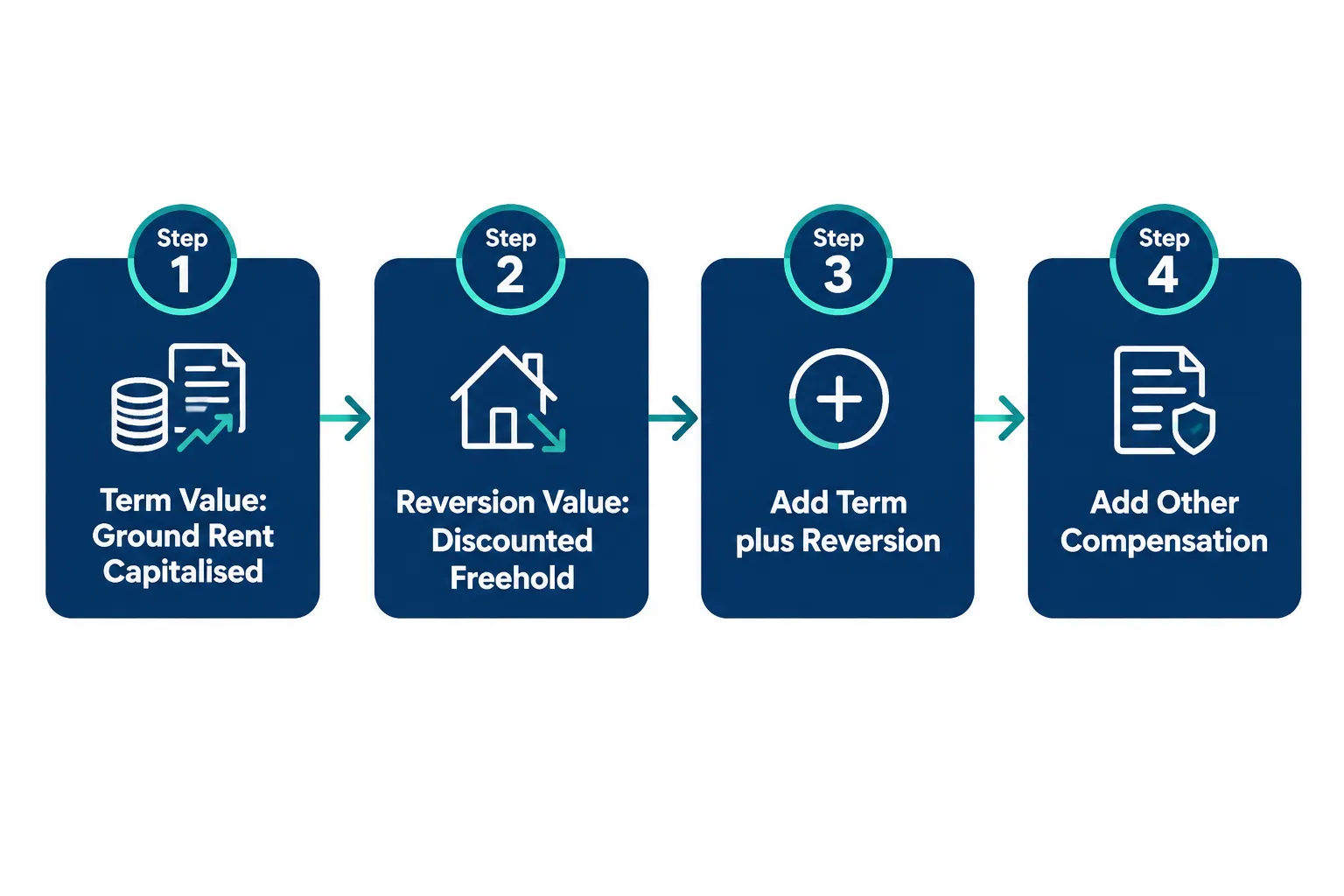
The legislation confirms that the premium payable is the sum of two distinct elements: first, the market value of the interest being acquired, calculated strictly under the standard method; and second, "other compensation" covering losses such as development value or the loss of rights that fall outside the main calculation [3][4]. Parliamentary debates on clause 11 of the Bill in January 2024 made this two-part structure explicit for all four enfranchisement rights, including both individual lease extensions and collective freehold purchases [3].
One of the most significant changes introduced by the Act was the abolition of marriage value. Previously, when a lease had fewer than 80 years remaining, the premium included a share of the uplift in value created by merging the leasehold and freehold interests. The 2024 Act removed this element entirely, and a subsequent human rights challenge to the 0.1% ground rent cap and the abolition of marriage value was upheld by the court [6]. This single reform reduces premiums substantially for flat owners with shorter leases.
The government's own plain English explainer confirms that the reforms are designed to make extending a lease or buying a freehold cheaper and more straightforward [9]. For chartered surveyors, however, the statutory method introduces new technical obligations. RICS guidance on leasehold reform in England and Wales sets out how members should apply the statutory framework in practice, aligning professional standards with the legislative requirements [2].
For a broader understanding of how tenure affects property value, the article on leasehold vs freehold valuations and how tenure, ground rent and short leases affect property value provides useful context alongside the statutory framework.
How Chartered Surveyors Build the Market Value Calculation
Under Schedule 4 of the 2024 Act, the market value of the interest being acquired is assembled from two building blocks: term value and reversion value [10][14]. Understanding how each is calculated is essential for any flat owner entering a lease extension or enfranchisement process.
Step 1: Calculating Term Value
Term value is the capitalised worth of the ground rent that the freeholder is entitled to receive over the remaining years of the existing lease. In practice, the ground rent is treated as an income stream, and the surveyor capitalises it using an appropriate yield, known as the capitalisation rate, that reflects the risk and duration of that income [10].
Where the ground rent is a fixed peppercorn or a nominal sum, the term value will be negligible. Where ground rents are higher, as is common in leases granted before the Leasehold Reform (Ground Rent) Act 2022, the term value can be a meaningful component of the total premium. The capitalisation rate applied is one of the most contested inputs in any professional leasehold valuation, and surveyors must be able to justify their choice with reference to market evidence [1][2].
Step 2: Calculating Reversion Value
Reversion value represents what the freeholder would receive at the end of the existing lease, discounted back to today. The Schedule 4 formula reduces the market value (v) of the reversion using a prescribed deferment rate (d) and the number of years (n) remaining on the current lease [10].
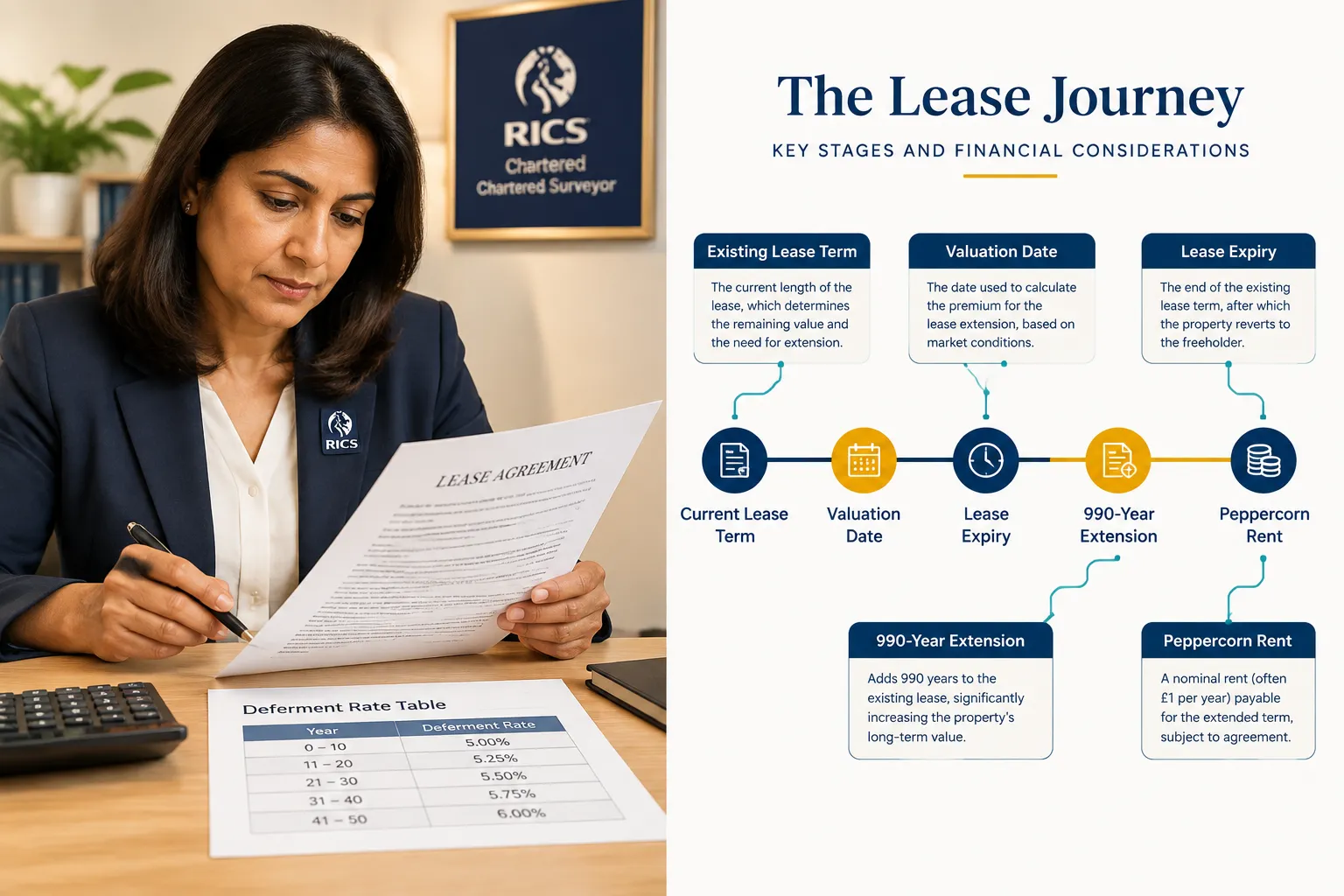
For lease extensions, the reversion is the market value of a new 990-year lease at a peppercorn ground rent, starting when the current lease expires, discounted at the statutory deferment rate [3][10]. For freehold acquisitions, it is the market value of the freehold itself at lease expiry, similarly discounted.
The deferment rate is the single most influential variable in most leasehold valuations. A lower deferment rate produces a higher reversion value and therefore a higher premium. The government's consultation on leasehold enfranchisement valuation rates sought views on the appropriate rates to be prescribed in secondary legislation [1]. Until those rates are formally set, surveyors rely on the rates established in the landmark Sportelli case and subsequent tribunal decisions, alongside emerging guidance from RICS [2].
Step 3: Adding Term and Reversion
Once both components are calculated, Step 3 of the Schedule 4 process simply adds them together to produce the market value of the interest under the standard method [10][14][15]. This combined figure then forms the foundation of the premium before any "other compensation" is added.
The table below summarises the three-step structure:
| Step | Component | What It Represents |
|---|---|---|
| 1 | Term Value | Capitalised ground rent over remaining lease |
| 2 | Reversion Value | Discounted value of the interest at lease expiry |
| 3 | Market Value | Sum of Steps 1 and 2 |
| + | Other Compensation | Development value, loss of rights, etc. |
The Professional Surveyor's Role in Evidence, Negotiation and Dispute Resolution
A leasehold valuation is not simply a mathematical exercise. Professional Leasehold Valuation: How Chartered Surveyors Calculate Premiums for UK Flat Owners involves assembling and defending a body of evidence that can withstand scrutiny from a freeholder's surveyor, a lender's valuer, or a tribunal panel.
Gathering and Interpreting Market Evidence
The market value inputs, particularly the "vacant possession value" of the flat used to calculate the reversion, must be grounded in comparable sales evidence. Chartered surveyors analyse recent transactions of similar flats in the same locality, adjusting for differences in floor area, condition, floor level, outlook and lease length [5]. RICS guidance on the valuation of residential leasehold properties for secured lending purposes sets out the standards that apply when these valuations are also used by mortgage lenders [5].
In 2026, market conditions vary significantly by region. Surveyors working in areas experiencing strong price growth must be especially careful to use the most current comparable evidence, as stale data can understate the reversion value and expose a flat owner to challenge. The article on valuation accuracy in uncertain markets and how chartered surveyors navigate affordability pressures explores how professionals maintain accuracy when market conditions shift rapidly.
Supporting Freeholder Negotiations
Most lease extensions and enfranchisement claims are resolved by negotiation rather than tribunal. A professionally prepared valuation report gives the flat owner a credible opening position and a clear basis for counter-arguing the freeholder's surveyor's figures. The report should set out all assumptions transparently, the deferment rate applied, the capitalisation rate used, the comparable evidence relied upon and any adjustments made, so that the freeholder's advisers can engage with the substance rather than the conclusion.
"A well-evidenced leasehold valuation report does not just state a number, it anticipates every challenge the freeholder's surveyor is likely to raise and answers it in advance."
Where negotiations stall, either party can apply to the First-tier Tribunal (Property Chamber) for a determination. Tribunal proceedings are formal, and the quality of the surveyor's evidence, including the written report and oral testimony, directly affects the outcome. The article on expert witness preparation for valuation disputes and navigating disagreements in markets with conflicting price signals provides further detail on how surveyors prepare for contested hearings.
Valuations for Secured Lending
Flat owners who need mortgage finance to fund a lease extension or purchase their freehold require a separate valuation for their lender. RICS guidance specifically addresses the valuation of residential leasehold properties for secured lending, noting that short leases, typically those with fewer than 70 to 85 years remaining depending on the lender, can affect mortgageability and therefore the achievable market value [5]. A chartered surveyor instructed jointly by the borrower and lender must navigate these competing interests carefully, ensuring the valuation reflects both the current market and the post-extension value that justifies the lending.
Key Inputs, Common Disputes and How Surveyors Resolve Them
Professional Leasehold Valuation: How Chartered Surveyors Calculate Premiums for UK Flat Owners depends heavily on a small number of critical inputs. Disputes between the parties almost always centre on one or more of the following:

Deferment Rate
The deferment rate reflects the rate of return a freeholder would require to defer receipt of the freehold. A higher rate reduces the present value of the reversion and lowers the premium. The government's consultation on enfranchisement valuation rates is examining whether the rates established in Sportelli remain appropriate under the new statutory framework [1]. Until secondary legislation fixes the rates, this remains the most frequently disputed variable.
Capitalisation Rate
The capitalisation rate converts the ground rent income stream into a capital value. It reflects the security, duration and quantum of the income. Higher-risk or shorter income streams attract higher yields and therefore lower term values. Surveyors must justify their chosen rate with reference to comparable investment transactions [2].
Vacant Possession Value
The underlying value of the flat, typically assessed on the basis of a long leasehold interest with a peppercorn ground rent, underpins the reversion calculation. Disputes arise when the parties use different comparable sales, apply different adjustments, or disagree on the appropriate lease length assumption.
Other Compensation
The second element of the premium, "other compensation", covers items such as development value (where the freeholder had realistic plans to develop the property) or the loss of specific rights. This element is calculated under a separate schedule and is often the subject of negotiation where the freeholder has demonstrable development intentions [3][4].
The following list summarises the most common points of dispute and the surveyor's approach to each:
- Deferment rate: Surveyors cite Sportelli, subsequent tribunal decisions and the government's consultation evidence to defend their chosen rate.
- Comparable evidence: Surveyors select the most recent, most similar transactions and document every adjustment made.
- Development value: Surveyors assess whether any development potential is genuine, viable and attributable to the freeholder's interest.
- Lease length assumption: Surveyors confirm the unexpired term from the lease document and verify it against Land Registry records.
For flat owners in areas where property values are moving quickly, regional context matters. The article on valuation strategies for Northern Powerhouse properties and surveyor insights on growth outpacing London illustrates how regional price dynamics feed into the comparable evidence base.
Surveyors advising on buy-to-let flats face an additional layer of complexity, as lender requirements and rental yield expectations intersect with the leasehold valuation. The article on chartered surveyor opportunities in the institutional buy-to-let surge and valuation due diligence essentials addresses how professionals manage these overlapping demands.
Where interest rate movements affect the discount rates used in leasehold calculations, surveyors must stay current with macroeconomic conditions. The article on chartered valuations at 3.75% base rates and adjusting for house price growth and buyer confidence provides relevant context for how base rate changes filter through to property valuations in 2026.
Conclusion
Professional Leasehold Valuation: How Chartered Surveyors Calculate Premiums for UK Flat Owners is a discipline that combines statutory precision with professional judgment. The Leasehold and Freehold Reform Act 2024 has standardised the core methodology, term value plus reversion value, with marriage value abolished, but the inputs that drive those calculations remain contested and evidence-dependent.
Actionable next steps for flat owners in 2026:
- Check your lease length now. Once a lease falls below 80 years, the premium rises sharply even without marriage value. Acting before that threshold is crossed saves money.
- Instruct a RICS-accredited surveyor early. A professional valuation before serving a Section 42 notice (lease extension) or Section 13 notice (collective enfranchisement) establishes a defensible opening position.
- Request a fully documented report. Ensure the surveyor sets out every assumption, deferment rate, capitalisation rate, comparables and adjustments, so the freeholder's surveyor cannot simply dismiss the figures.
- Understand the two-part premium structure. Know what "other compensation" could add to the market value component, particularly if the freeholder has development ambitions.
- Prepare for negotiation, not just calculation. The statutory method produces a framework, not a fixed answer. Professional evidence and skilled negotiation determine the final premium paid.
Flat owners who engage a qualified chartered surveyor at the outset, rather than after receiving the freeholder's counter-notice, consistently achieve better outcomes. The cost of professional advice is almost always recovered many times over in the reduction of the premium paid.
References
[1] Leasehold Enfranchisement Valuation Rates – gov.uk
[2] Leasehold Reform In England And Wales – rics.org
[3] Leasehold And Freehold Reform Bill (Sixth Sitting) – hansard.parliament.uk
[4] bills.parliament.uk – bills.parliament.uk
[5] Valuation Of Residential Leasehold Properties For Secured Lending Purposes England And Wales 1st Edition Guidance Note – rics.org
[6] Leasehold And Freehold Reform Act 2024 Human Rights Challenge – cms.law
[9] Plain English Explainer: Extending Your Lease Or Buying Your Freehold – gov.uk
[10] Schedule 4 Part 5 – Leasehold and Freehold Reform Act 2024 – legislation.gov.uk