

Fewer than one in ten property disputes that reach the courts are resolved without some form of expert surveyor evidence, yet the standards governing how that evidence is built, presented, and defended have never been more demanding. In 2026, the role of professional expert witness surveyors sits at the intersection of technical rigour, legal compliance, and professional accountability. This article unpacks how UK chartered surveyors construct credible evidence in valuation and building defect disputes, what courts and lawyers actually expect, and why the bar set by the Royal Institution of Chartered Surveyors (RICS) continues to rise.
Key Takeaways
- RICS has published a new 5th edition Expert Witness Professional Standard (effective 30 November 2026), introducing stricter duties around independence, AI use, and conflict-of-interest disclosure [1].
- Chartered surveyors acting as expert witnesses owe their primary duty to the court or tribunal, not to the instructing party, a principle that underpins every aspect of evidence-building.
- Expert reports in valuation and defect disputes must comply with the Civil Procedure Rules (CPR) and include a signed statement of truth.
- The RICS Expert Witness Accreditation Service provides a formal, peer-validated credential for surveyors handling complex disputes [7].
- Lawyers consistently prefer RICS-accredited chartered surveyors because their methodology is transparent, peer-reviewed, and defensible under cross-examination.
What Makes a Surveyor an Expert Witness
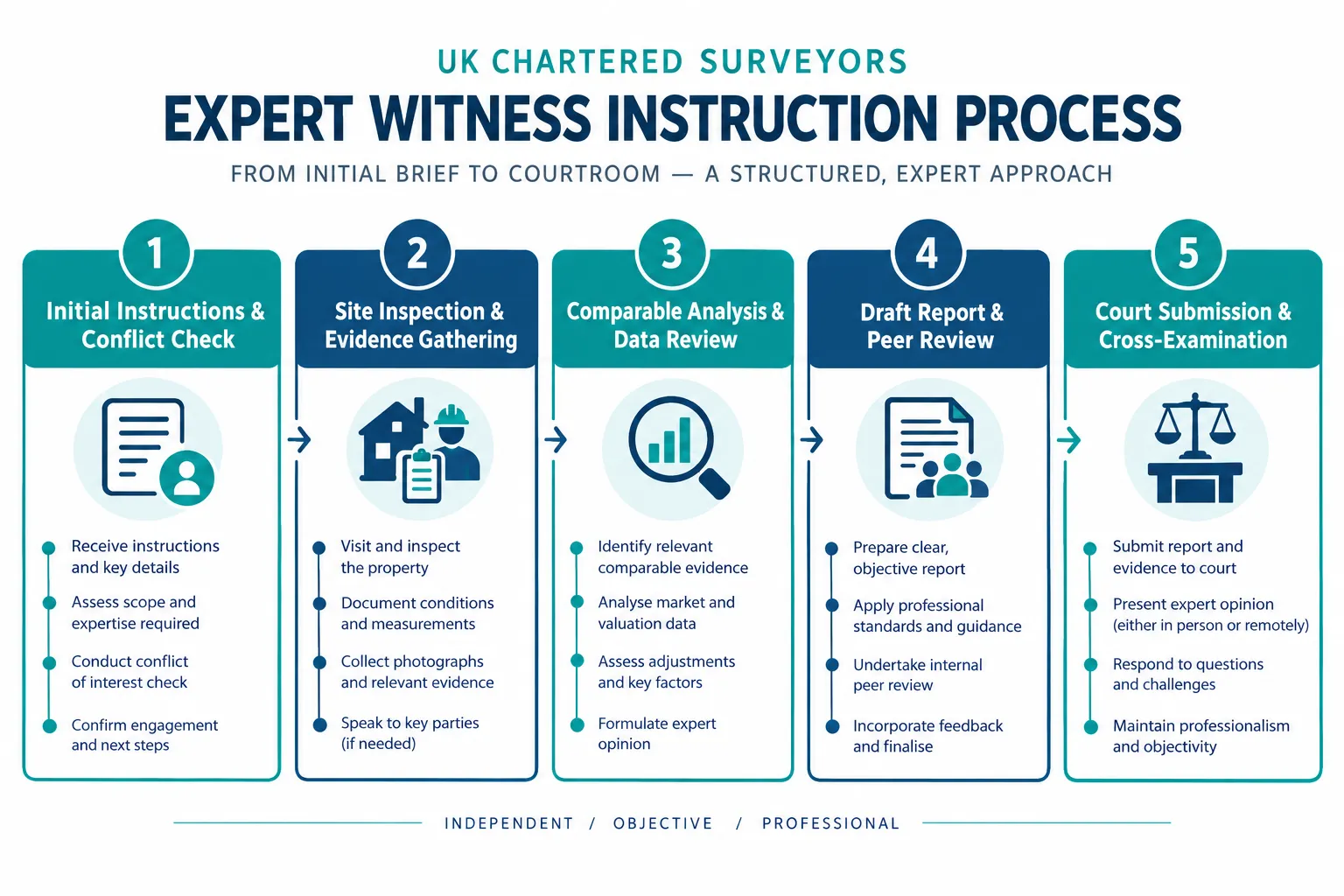
Not every chartered surveyor who inspects a property qualifies as an expert witness in the legal sense. The distinction matters enormously. An expert witness is appointed specifically to provide independent, impartial opinion evidence on matters that fall outside the ordinary knowledge of the court. In property disputes, that typically means valuation methodology, construction defects, or both.
The RICS Professional Standard "Surveyors Acting as Expert Witnesses" sets the framework for this role. The 4th edition has governed practice since 2014, and the forthcoming 5th edition, published July 2026 and effective 30 November 2026, introduces significant updates to reflect the realities of modern litigation, including the growing use of artificial intelligence in evidence preparation [1][5].
Three core characteristics define a qualified expert witness surveyor:
- Relevant technical expertise, demonstrable knowledge in the specific area of dispute, whether residential valuation, commercial property, or structural defects.
- Independence, no material interest in the outcome; the duty is to the court, not the client.
- Compliance with procedural rules, full adherence to CPR Part 35 in England and Wales, or equivalent rules in Scotland and Northern Ireland.
A surveyor who cannot satisfy all three criteria should decline the instruction. The RICS Practice Alert issued in February 2024 reinforced this point, reminding members that accepting instructions outside their competence or where a conflict of interest exists exposes both the expert and their client to serious procedural risk [4].
Understanding why property owners hire surveyors in the first place helps contextualise how disputes arise, and why the quality of expert evidence is so consequential when they do.
The Legal Framework: CPR, Duties, and the Statement of Truth
Every expert report produced by a UK chartered surveyor for court proceedings must satisfy the Civil Procedure Rules. CPR Part 35 governs expert evidence in England and Wales, and its requirements are non-negotiable. The report must:
- State the substance of all material instructions received.
- Set out the facts and assumptions upon which opinions are based.
- Contain a declaration that the expert understands their duty to the court and has complied with it.
- Be verified by a signed statement of truth.
The statement of truth is not a formality. Deliberately making a false statement in an expert report is contempt of court. This single requirement focuses the mind of every surveyor who takes on an expert witness role.
"The expert's overriding duty is to the court, not to the party who instructs or pays them. This principle is foundational and non-negotiable under RICS standards."
Scotland operates under different procedural rules, and RICS has produced specific guidance for Scottish practitioners to address the distinct requirements of the Court of Session and Sheriff Court [1]. Surveyors instructed in Scottish proceedings should consult this guidance before accepting any appointment.
The RICS client-facing guide makes clear that parties to a dispute should not expect their appointed surveyor to advocate for their position [2]. An expert who crosses the line from impartial opinion into partisan advocacy risks having their evidence excluded, a catastrophic outcome for the instructing party.
How Professional Expert Witness Surveyors Build Evidence in Valuation Disputes
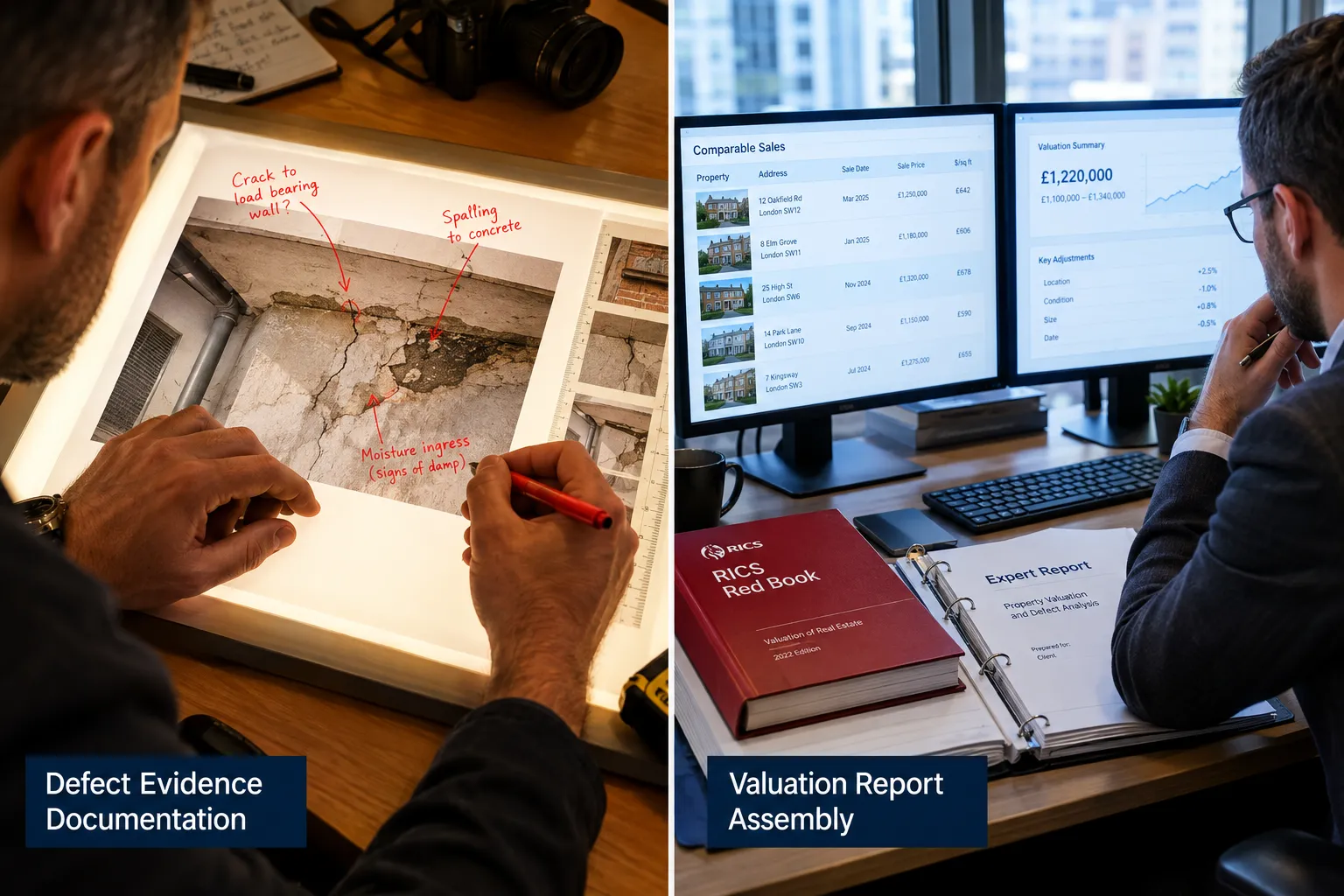
Valuation disputes are among the most technically demanding cases in UK property litigation. They arise in contexts ranging from matrimonial asset division and inheritance tax assessments to negligence claims against mortgage valuers and landlord-tenant rent review arbitrations. Professional expert witness surveyors building evidence in valuation disputes follow a structured methodology that must withstand forensic scrutiny.
Establishing the Valuation Date and Basis
The first task is to identify the correct valuation date and the appropriate basis of value. These are not interchangeable concepts. Market value, fair value, and investment value each carry distinct definitions under the RICS Red Book (RICS Valuation, Global Standards). Getting this wrong at the outset can invalidate an entire report.
For guidance on how chartered surveyors navigate valuation in shifting market conditions, the article on valuation accuracy in uncertain markets provides useful context on the methodological pressures surveyors face.
Comparable Evidence
Comparable transactions form the backbone of most valuation reports. The expert must:
| Step | Action | Key Consideration |
|---|---|---|
| 1 | Identify comparable sales or lettings | Proximity, timing, property type |
| 2 | Adjust for material differences | Size, condition, tenure, location |
| 3 | Reconcile to a concluded opinion | Weighting of each comparable |
| 4 | Document the reasoning | Transparency for cross-examination |
Each comparable must be verified against primary sources. Reliance on unverified secondary data, particularly automated valuation model outputs, is a known weakness that opposing counsel will exploit. The 5th edition RICS standard specifically addresses the use of AI-generated data in expert reports, requiring explicit disclosure of any AI tools used in evidence preparation [5].
Regional divergence in UK property markets adds another layer of complexity. Surveyors instructed in disputes involving properties in Scotland, Northern Ireland, or the North of England must account for market dynamics that differ materially from the South East. The analysis of expert witness valuations in regional price divergence illustrates how these differences affect the defensibility of assessments.
Defending the Opinion Under Cross-Examination
A valuation opinion is only as strong as the reasoning that supports it. Experienced barristers will probe the choice of comparables, the adjustments applied, and the weight given to market sentiment. The expert must be able to explain every decision in plain language without retreating into jargon. The RICS guidance on expert witness valuations amid market sentiment shifts outlines how RICS protocols help surveyors defend assessments when market conditions were volatile at the valuation date.
Building Defect Disputes: Evidence Standards for Structural and Construction Claims
Building defect disputes present a different but equally demanding evidence challenge. The expert surveyor must establish not just that a defect exists, but its cause, its severity, the standard of workmanship or design expected, and the cost of remediation. These four elements must all be addressed in the report.
Inspection and Documentation
The physical inspection is the foundation of all defect evidence. A thorough inspection for expert witness purposes goes well beyond a standard Level 3 building survey. It involves:
- Photographic evidence, systematic, dated, and referenced to a floor plan or schedule.
- Intrusive investigation, where necessary and agreed with the parties, opening up concealed elements.
- Specialist sub-contractor reports, structural engineers, damp specialists, or mechanical and electrical engineers where the defect falls outside the surveyor's direct expertise.
- Material sampling, where the composition of a material is in dispute.
Common defect categories in litigation:
- Damp ingress and rising damp
- Structural movement and subsidence
- Roof failures and rainwater management
- Thermal bridging and condensation
- Fire safety and cladding defects
- Workmanship failures in new build properties
For a detailed overview of the most frequently litigated issues, the article on 11 common defects in older homes provides a practical reference point.
Causation Analysis
Establishing causation is often the most contested element of a defect dispute. The expert must distinguish between defects caused by poor design, defective workmanship, inadequate maintenance, or inherent material failure. This distinction directly affects liability.
The report must set out the expert's reasoning in a logical sequence: observed condition, probable cause, alternative causes considered and rejected, and the basis for the conclusion. Courts expect this reasoning to be explicit, not implied.
Remediation Costs
Quantifying the cost of remediation requires the expert to specify the scope of works in sufficient detail for a contractor to price them. Vague descriptions such as "repair as necessary" will not satisfy the court. The expert should reference appropriate industry standards, such as those published by the Building Research Establishment or relevant British Standards, to justify the specified remediation approach.
RICS Accreditation and the Professional Standards Governing Expert Witnesses
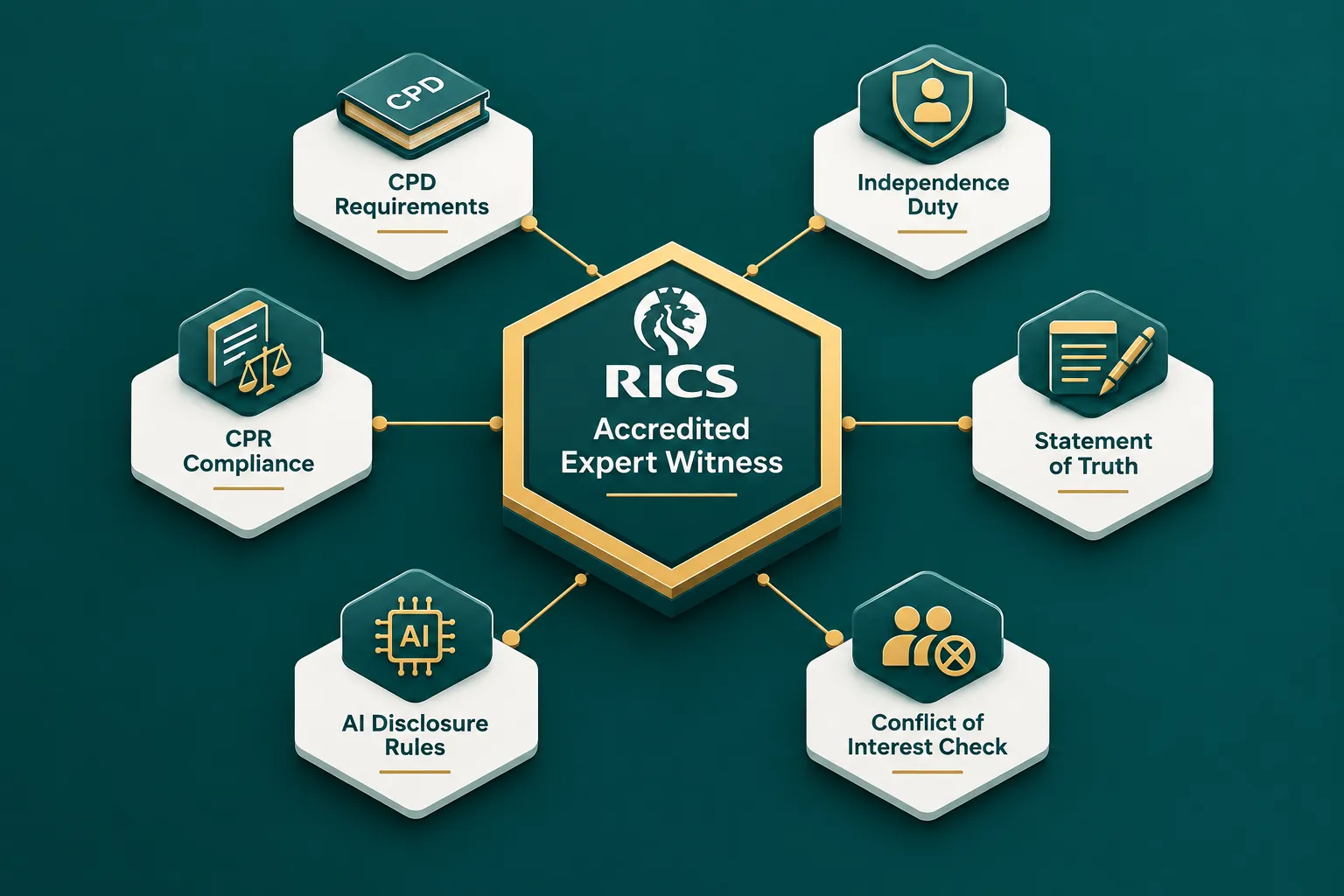
The RICS Expert Witness Accreditation Service (EWAS) represents the highest formal recognition available to UK surveyors undertaking expert witness work [7]. Accreditation is not mandatory, but it carries significant weight with solicitors, barristers, and judges who regularly encounter expert evidence.
What Accreditation Involves
The accreditation process assesses candidates against a demanding set of criteria:
- Written examination on expert witness law, procedure, and RICS standards.
- Portfolio submission demonstrating experience in preparing and defending expert reports.
- Peer review of a sample report by an accreditation panel.
- Continuing professional development, accredited experts must maintain their knowledge through structured CPD.
The 5th edition standard, effective November 2026, introduces enhanced requirements around conflict-of-interest management and the disclosure of AI tools used in evidence preparation [5][8]. These changes reflect broader concerns about the integrity of expert evidence in an era when large language models and automated valuation tools are increasingly accessible.
Why Lawyers Prefer Accredited Chartered Surveyors
Solicitors and barristers instructing expert witnesses face their own professional obligations. Appointing an expert whose methodology is opaque or whose credentials are unclear creates risk for the legal team as well as the client. RICS-accredited surveyors offer:
- A documented, peer-validated methodology.
- Familiarity with CPR obligations and court procedure.
- A clear professional disciplinary framework if conduct is called into question.
- Specialist registers covering valuation and construction defect disciplines [7].
The RICS launched a global consultation on the updated expert witness standard in 2025, gathering input from practitioners, lawyers, and judiciary across multiple jurisdictions [9]. The resulting 5th edition reflects this broad engagement and is designed to remain relevant as litigation practice evolves.
The Expert Report: Structure and Content Requirements
A well-structured expert report is the product that courts actually evaluate. The following structure reflects both CPR requirements and RICS best practice [2][3]:
- Introduction, identity of the expert, instructions received, scope of the report.
- Qualifications and experience, relevant credentials, including RICS membership and any specialist accreditation.
- Documents and materials considered, a complete list of everything reviewed.
- Inspection details, dates, access arrangements, and any limitations on the inspection.
- Factual background, an objective account of the property and the dispute context.
- Analysis and opinion, the core technical content, structured by issue.
- Summary of conclusions, a concise statement of the expert's opinions.
- Statement of truth, signed declaration per CPR Part 35.
- Appendices, photographs, plans, comparables, and supporting documents.
Clarity is paramount. Judges are not surveyors. Technical concepts must be explained in accessible language without sacrificing accuracy. Reports that rely on unexplained jargon or assume specialist knowledge in the reader are consistently criticised in judicial decisions.
Emerging Issues in 2026: AI, Conflicts of Interest, and Enhanced Transparency
The 5th edition RICS standard addresses three emerging challenges that have become pressing in 2026.
Artificial intelligence is now used by many surveyors in evidence preparation, for comparable searches, report drafting, and data analysis. The new standard requires explicit disclosure of any AI tools used, the extent of their contribution, and the steps taken to verify AI-generated outputs [5]. An expert cannot delegate their professional judgment to an algorithm.
Conflict of interest rules have been tightened. The standard now requires a more rigorous initial conflict check and ongoing monitoring throughout the instruction. A conflict that emerges after appointment must be disclosed immediately to both parties and the court [1][8].
Transparency in methodology has been elevated as a core requirement. The 5th edition makes clear that experts must be able to explain and justify every methodological choice, including the selection and weighting of comparables, the choice of inspection techniques, and the basis for any cost estimates [5].
Conclusion
Professional expert witness surveyors occupy a unique and demanding position in the UK legal system. Their evidence can determine the outcome of disputes worth millions of pounds, and the standards to which they are held reflect that responsibility. The 2026 RICS 5th edition Professional Standard raises the bar further, demanding greater transparency, more rigorous conflict management, and explicit accountability for the use of AI tools.
Actionable next steps for surveyors and those instructing them:
- Surveyors considering expert witness work should review the 5th edition standard before it takes effect on 30 November 2026 and assess whether their current practice meets the enhanced requirements.
- Those seeking accreditation should engage with the RICS Expert Witness Accreditation Service early, as the portfolio and examination requirements demand significant preparation.
- Solicitors and legal teams should verify that any chartered surveyor they instruct is familiar with the current RICS standard, holds relevant accreditation where available, and can demonstrate independence from the instructing party.
- Parties to disputes should understand that an expert witness surveyor's duty runs to the court, not to them, and that a well-prepared, independent report is ultimately more valuable than a partisan one.
The integrity of expert evidence in property disputes depends on chartered surveyors who treat their court duty as paramount. In a market where valuation complexity and construction litigation are both increasing, that professional commitment is more important than ever.
References
[1] Surveyors Acting As Expert Witnesses – rics.org
[2] Surveyors Acting As Expert Witnesses Client Guide – rics.org
[3] Surveyors acting as expert witnesses Feb2023amend – rics.org
[4] Practice Alert Expert Witnesses February 2024 – rics.org
[5] RICS 2026 Expert Witness Guidance Key Changes For Surveyors – rimkus.com
[7] Expert Witness Accreditation Service – rics.org
[8] New Expert Witness Guidance For RICS Members – nmrk.com
[9] RICS Launches Global Consultation On Updated Expert Witness Standard – rics.org