

Last updated: July 24, 2026
Quick Answer: Party wall surveyors for garden boundary excavations are legally required under the Party Wall etc. Act 1996 whenever excavation work falls within 3 metres of a neighbouring structure at a depth greater than that structure's foundations, or within 6 metres under a 45-degree angle rule. Outbuildings, garden rooms, and sheds near boundaries can all trigger these requirements. Failing to serve the correct notice before work begins can expose building owners to injunctions, compensation claims, and costly delays.
Key Takeaways
- The Party Wall etc. Act 1996 covers excavations within 3 metres or 6 metres of a neighbouring building, depending on depth and angle.
- A formal party wall notice must be served at least one month before excavation begins near a boundary.
- Outbuildings, garden rooms, and large sheds near the boundary line can qualify as "structures" under the Act.
- A party wall award is a legally binding document that sets out how work must be carried out and who bears the costs.
- Award clauses for outbuildings typically cover method of excavation, hours of work, protection measures, and dispute resolution.
- Ignoring party wall requirements can result in injunctions that halt work entirely.
- The building owner (the person doing the work) normally pays the adjoining owner's surveyor fees.
- An agreed surveyor appointed by both parties can reduce overall costs and speed up the process.
- Costs for a party wall surveyor for garden excavation typically range from £700 to £2,000 or more, depending on complexity.
- A schedule of condition survey of the neighbouring property should always precede excavation work.
What Is a Party Wall Surveyor and What Do They Do?
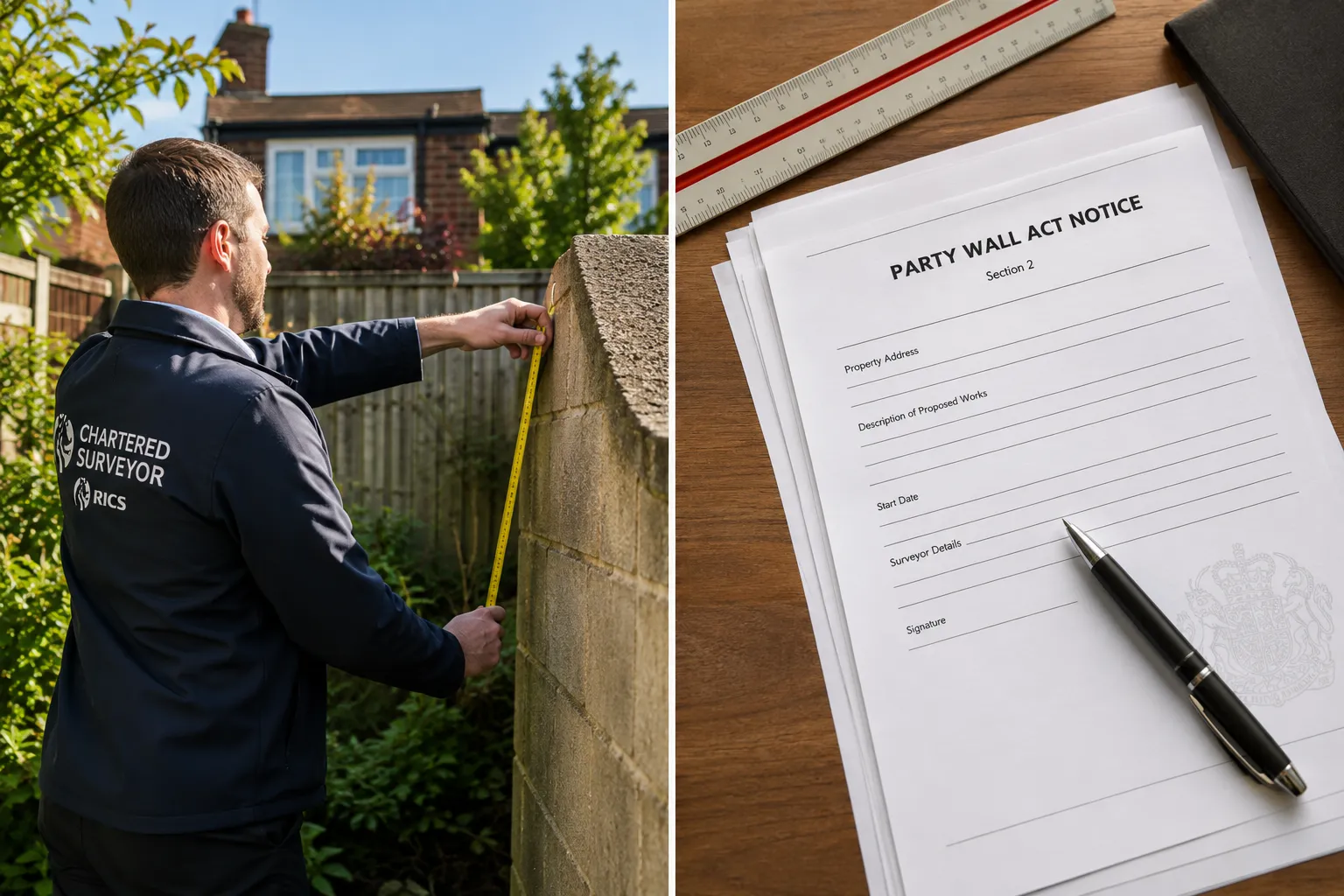
A party wall surveyor is a specialist who administers the Party Wall etc. Act 1996 on behalf of building owners and adjoining owners during construction or excavation work near shared boundaries. They are not planning officers or structural engineers, though they often work alongside both.
Their core duties include:
- Assessing whether proposed works fall within the Act's scope
- Drafting and serving party wall notices
- Preparing a party wall award that legally governs how work proceeds
- Conducting or reviewing a schedule of condition to document the neighbouring property's state before work starts
- Resolving disputes between neighbours without court involvement
Any person can technically act as a party wall surveyor, but appointing a chartered surveyor (MRICS or FRICS) with specific party wall experience is strongly advisable. For a detailed overview of the role, see this complete guide to party wall surveyor roles and appointment.
When Do You Need a Party Wall Surveyor for Garden Work?
You need a party wall surveyor for garden work when the proposed excavation or construction falls within the thresholds set by the Party Wall etc. Act 1996. The Act applies to three categories of work: work on a party wall or party fence wall, new building at or astride the boundary line, and excavations near neighbouring structures.
For garden boundary excavations specifically, the Act is triggered when:
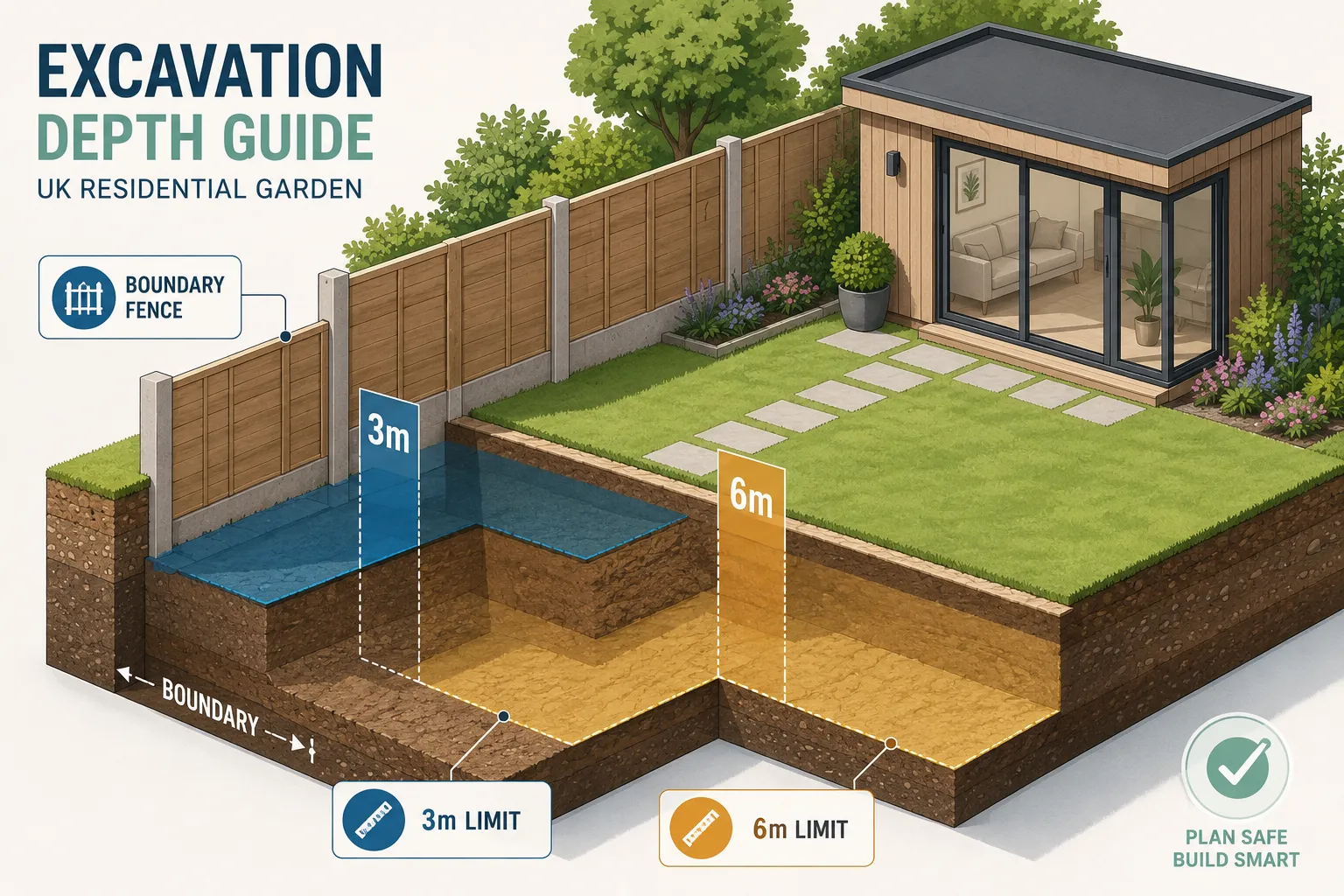
- Excavation is proposed within 3 metres of a neighbouring building or structure, and the new foundations will go deeper than the neighbour's existing foundations.
- Excavation is proposed within 6 metres of a neighbouring building or structure, and the new foundations will cut a 45-degree line drawn downward from the bottom of the neighbour's foundations.
This applies to permanent outbuildings, garden rooms, and any structure with foundations, not just the main house. If you're unsure whether your project falls within scope, read do you need a party wall surveyor? for a practical checklist.
What Are the Notice Thresholds for Party Wall Work Near Boundaries?
The notice thresholds under the Party Wall etc. Act 1996 are fixed distances from neighbouring structures, not from the boundary line itself. This is a common source of confusion.
Key thresholds at a glance:
| Threshold | Condition | Notice Period |
|---|---|---|
| 3 metres from neighbour's structure | New foundations deeper than neighbour's | 1 month minimum |
| 6 metres from neighbour's structure | New foundations cut 45-degree angle from neighbour's foundations | 1 month minimum |
| Party wall or fence wall | Any notifiable work on shared wall | 2 months minimum |
The notice must be served in writing, identify the work, and give the adjoining owner enough time to respond. If the neighbour consents in writing within 14 days, no surveyor is needed. If they dissent or fail to respond, a surveyor must be appointed. For a broader look at what the Act covers, the party wall agreement essentials guide is a useful reference.
How Deep Does Excavation Need to Be Before the Party Wall Act Applies?
The Party Wall Act does not set a fixed depth figure. Instead, depth is measured relative to the neighbouring structure's foundations, not from ground level.
For the 3-metre rule: the Act applies if your new foundations will be deeper than the bottom of the neighbour's foundations at any point within that 3-metre zone.
For the 6-metre rule: the Act applies if a straight line drawn at 45 degrees downward from the bottom of the neighbour's foundations would intersect your proposed excavation.
Practical example: If a neighbour's garden room has strip foundations at 600mm depth, and your proposed outbuilding foundations are 750mm deep and located 2.5 metres away, the 3-metre rule is triggered because your foundations are deeper than the neighbour's within that zone.
A structural engineer can calculate whether the 45-degree line is breached, but the party wall surveyor makes the legal determination. For projects involving deeper excavation such as basements, the process becomes more involved, as explained in this guide to party wall surveyors for basement projects.
What Is the Difference Between a Party Wall Surveyor and a Structural Engineer?
A party wall surveyor administers the legal process under the 1996 Act; a structural engineer designs and calculates the physical structure. They serve different functions and are often both needed on the same project.
- A structural engineer calculates loads, foundation depths, soil bearing capacity, and structural risk. They produce drawings and specifications.
- A party wall surveyor uses those drawings to assess whether the Act applies, serves notices, prepares the award, and resolves disputes.
For garden boundary excavations, the structural engineer's drawings are often submitted as part of the party wall award process. The surveyor then uses them to set conditions on how work must proceed. See checking engineers and party wall requirements for more on how these roles interact.
Do You Need a Party Wall Surveyor for a Shed or Garden Room Near a Boundary?
Yes, in some cases. A standard timber shed on a concrete pad is unlikely to trigger the Act because it has no deep foundations. But a garden room, studio, or outbuilding with concrete strip or pad foundations could trigger the 3-metre or 6-metre rules if it is close to the boundary and the neighbour has an existing structure nearby.
The key questions to ask:
- Does the outbuilding require foundations deeper than 300mm?
- Is any part of the structure within 3 metres of a neighbouring building or structure?
- If within 6 metres, does the 45-degree angle rule apply?
If the answer to any of these is yes, a party wall notice is likely required. Lightweight garden rooms on screw piles or surface pads at shallow depth are less likely to trigger the Act, but this should be confirmed by a qualified surveyor rather than assumed.
What Are Award Clauses in Party Wall Agreements for Outbuildings?
A party wall award is a legally binding document produced by the appointed surveyor(s) that sets out the rights and obligations of both the building owner and the adjoining owner. Award clauses for outbuildings and garden excavations typically cover the following areas:
- Permitted working hours (for example, Monday to Friday, 8am to 6pm)
- Method of excavation (hand dig versus mechanical, vibration limits)
- Protection measures for the neighbouring structure during works
- Notification requirements before work starts each day or phase
- Access rights for the adjoining owner's surveyor to inspect
- Reinstatement obligations if damage occurs
- Dispute resolution mechanism if a disagreement arises mid-project
Award clauses can also include specific conditions for outbuildings, such as requiring temporary shoring of a neighbour's garden wall or specifying the type of concrete to be used in foundations to reduce lateral pressure. For more detail on what a party wall award contains, see the party wall awards service page.
What Is Included in a Party Wall Award for Excavation Disputes?
When a dispute arises, the party wall award becomes the primary instrument for resolution. In excavation disputes, the award typically includes:
- A description of the notifiable works and their location relative to the boundary
- Reference drawings showing excavation depth and proximity to neighbouring structures
- A schedule of condition report documenting the neighbour's property before works begin
- Specific clauses addressing the risk of subsidence, vibration, or groundwater interference
- Provisions for independent monitoring (for example, crack monitors on the neighbouring structure)
- A mechanism for the adjoining owner to claim compensation if damage occurs
The award is enforceable in the County Court. Neither party can simply ignore it. If the building owner proceeds without complying with award conditions, the adjoining owner can apply for an injunction to stop the works. For a full explanation of what can go wrong when the Act is ignored, see consequences of ignoring the Party Wall Act.
How Much Does a Party Wall Surveyor Cost for Garden Excavation?
Party wall surveyor costs for garden excavation vary based on the complexity of the works, the number of adjoining owners affected, and whether one agreed surveyor or two separate surveyors are appointed.
Typical cost ranges (2026 estimates):
- Simple notice and consent (no award needed): £300 to £600
- Single award for one adjoining owner: £700 to £1,500
- Complex excavation with multiple neighbours: £1,500 to £3,000 or more
- Dispute resolution with two separate surveyors: £2,000 to £4,000+
The building owner (the person doing the work) is normally responsible for paying both their own surveyor and the adjoining owner's reasonable surveyor fees. Appointing an agreed surveyor who acts for both parties can reduce total costs significantly. For a detailed breakdown, see cost of a party wall surveyor.
Can Party Wall Surveyor Costs Be Split Between Neighbours?
In most cases, no. The Party Wall etc. Act 1996 places the cost burden on the building owner, not the adjoining owner. The adjoining owner is entitled to appoint their own surveyor at the building owner's expense, provided those fees are reasonable.
However, costs can be shared or reduced in specific circumstances:
- If both parties agree to appoint a single agreed surveyor, the total fee is split or absorbed by the building owner at a lower overall cost.
- If the adjoining owner requests additional work or conditions that go beyond what is strictly necessary, a surveyor may apportion some costs to them.
- If both parties are carrying out works simultaneously, costs may be shared by agreement.
The key point: adjoining owners should never feel they cannot appoint a surveyor because of cost concerns. The building owner pays.
What Happens If You Don't Notify a Party Wall Surveyor When Required?
Proceeding without serving the required party wall notice is a civil wrong under the Act. It does not automatically result in a fine, but the consequences can be severe.
Potential outcomes of non-compliance:
- The adjoining owner can apply to the County Court for an injunction to halt works immediately.
- The court may order the building owner to demolish completed work and reinstate the site.
- The building owner becomes liable for any damage caused, with no protection from the award process.
- Without a schedule of condition, it becomes very difficult to dispute claims of pre-existing damage.
- Disputes become far more expensive to resolve once work has already started.
The consequences of ignoring the Party Wall Act are well-documented and the courts have consistently sided with adjoining owners in these cases.
How Long Does the Party Wall Surveyor Process Take for Outbuildings?
The minimum statutory timeline is one month from the date the notice is served to when work can begin. In practice, the full process often takes six to ten weeks when a formal award is required.
Typical timeline:
- Week 1: Notice served on adjoining owner(s)
- Weeks 1-2: Adjoining owner responds (consent or dissent)
- Weeks 2-4: Surveyors appointed, schedule of condition carried out
- Weeks 4-8: Award drafted, reviewed, and agreed
- Week 8 onwards: Work can begin under the award
Delays occur when adjoining owners are slow to respond, when drawings are incomplete, or when the proposed works are complex. Serving a well-prepared notice with full drawings from the outset is the single most effective way to keep the process on track.
Common Mistakes People Make With Party Wall Requirements for Garden Work
Many homeowners and builders underestimate how often garden projects trigger the Act. These are the most frequent errors:
- Assuming the boundary line is the trigger. The Act measures distance from neighbouring structures, not from the boundary itself.
- Overlooking outbuildings as "structures." A neighbour's garden room, garage, or greenhouse with foundations counts as a structure under the Act.
- Serving notice too late. The one-month notice period is a minimum, not a suggestion. Starting work before it expires is a breach.
- Using informal agreements. A verbal agreement with a neighbour has no legal standing under the Act. Written consent is required.
- Not commissioning a schedule of condition. Without a documented record of the neighbour's property before works begin, any damage claim is very difficult to defend.
- Appointing an unqualified surveyor. Anyone can legally act as a party wall surveyor, but an unqualified appointment can produce a flawed award that does not hold up.
For more on avoiding these pitfalls, see 5 common misconceptions about party wall agreements.
FAQ: Party Wall Surveyors for Garden Boundary Excavations
Q: Does the Party Wall Act apply to all garden excavations?
No. It only applies when excavation is within 3 metres of a neighbouring structure (and deeper than its foundations) or within 6 metres under the 45-degree angle rule. Shallow surface-level landscaping does not trigger the Act.
Q: Can my neighbour stop my garden outbuilding project through the party wall process?
No. The Act does not give neighbours a veto over lawful building work. It gives them the right to have the works carried out safely and to be compensated for any damage. An award regulates how work proceeds, it does not prevent it.
Q: What if my neighbour ignores the party wall notice?
If an adjoining owner fails to respond within 14 days of receiving a notice, a dispute is deemed to have arisen under the Act. Both parties must then appoint surveyors to resolve the matter and produce an award.
Q: Is a party wall award the same as planning permission?
No. They are entirely separate processes. A party wall award governs the relationship between neighbours under the 1996 Act. Planning permission is granted by the local planning authority. Both may be required for the same project.
Q: How long is a party wall award valid?
A party wall award remains valid for the duration of the notified works. If works are paused for an extended period or the scope changes significantly, a new or supplementary award may be needed.
Q: Can I use the same surveyor as my neighbour?
Yes. Both parties can appoint a single agreed surveyor, which is often faster and less expensive than each party appointing their own. The agreed surveyor acts impartially for both. See the agreed surveyor guide for full details.
Q: Do I need a party wall surveyor if I'm just digging a soakaway?
Possibly. If the soakaway is within 3 metres of a neighbouring structure and requires excavation deeper than that structure's foundations, the Act may apply. A brief consultation with a party wall surveyor before digging is the safest approach.
Conclusion
Party wall surveyors for garden boundary excavations play a critical role in protecting both building owners and their neighbours from costly disputes and structural damage. The notice thresholds under the Party Wall etc. Act 1996 are precise and non-negotiable, and award clauses for outbuildings provide a legally enforceable framework that governs everything from excavation method to damage compensation.
Actionable next steps for homeowners and property professionals in 2026:
- Before any garden excavation or outbuilding project, measure the distance from the proposed works to all neighbouring structures, including outbuildings, garages, and garden rooms.
- Establish the depth of your proposed foundations and compare them to the neighbouring structure's likely foundation depth.
- If the 3-metre or 6-metre thresholds are met, instruct a chartered party wall surveyor to serve the correct notice at least one month before work starts.
- Commission a schedule of condition on the neighbouring property before any excavation begins.
- Ensure all award clauses are reviewed carefully before signing off, paying particular attention to protection measures and reinstatement obligations.
Taking these steps early avoids injunctions, protects against unfounded damage claims, and keeps garden projects on schedule.
.pwc-wrap{font-family:Arial,sans-serif;max-width:480px;margin:24px auto;border:2px solid #2c5f8a;border-radius:8px;padding:20px;background:#f9fbfd;color:#222}
.pwc-wrap h3{margin:0 0 14px;font-size:1.1rem;color:#2c5f8a}
.pwc-label{display:block;font-size:.88rem;font-weight:700;margin:10px 0 4px}
.pwc-input{width:100%;box-sizing:border-box;padding:7px 10px;border:1px solid #b0c4d8;border-radius:4px;font-size:.95rem}
.pwc-btn{margin-top:14px;width:100%;padding:10px;background:#2c5f8a;color:#fff;border:none;border-radius:5px;font-size:1rem;cursor:pointer;font-weight:700}
.pwc-btn:hover{background:#1a4266}
.pwc-result{margin-top:14px;padding:12px;border-radius:5px;font-size:.92rem;line-height:1.5;display:none}
.pwc-yes{background:#fff3cd;border:1px solid #e6a817;color:#7a4f00}
.pwc-no{background:#d4edda;border:1px solid #28a745;color:#155724}
.pwc-note{font-size:.78rem;color:#555;margin-top:10px}
Party Wall Excavation Notice Checker
This tool gives indicative guidance only. Always consult a qualified party wall surveyor before starting work.
function pwcCheck(){
var d=parseFloat(document.getElementById(‘pwc-dist’).value);
var depth=parseFloat(document.getElementById(‘pwc-depth’).value);
var nd=parseFloat(document.getElementById(‘pwc-ndepth’).value);
var r=document.getElementById(‘pwc-result’);
r.style.display=’block’;
if(isNaN(d)||isNaN(depth)||isNaN(nd)){r.className=’pwc-result pwc-yes’;r.innerHTML=’Please enter all three values to check.’;return;}
var rule3=(dnd);
var angle=nd+(d*1000);
var rule6=(dangle);
if(rule3){r.className=’pwc-result pwc-yes’;r.innerHTML=’Notice likely required (3m rule). Your foundations are deeper than your neighbour’s within 3 metres. Serve a party wall notice at least 1 month before work begins.’;}
else if(rule6){r.className=’pwc-result pwc-yes’;r.innerHTML=’Notice may be required (6m/45° rule). Your excavation may intersect the 45-degree line from your neighbour’s foundations. Consult a party wall surveyor to confirm.’;}
else{r.className=’pwc-result pwc-no’;r.innerHTML=’Notice may not be required based on these inputs. However, always verify with a qualified party wall surveyor before proceeding.’;}
}
Tags: party wall surveyor, party wall act, garden boundary excavation, outbuilding party wall, party wall notice, party wall award, excavation notice thresholds, garden room planning, boundary wall surveyor, party wall costs, award clauses, party wall disputes