

Last updated: July 24, 2026
Quick Answer: A party wall surveyor is a legally appointed professional who administers the Party Wall etc. Act 1996 when your works affect a shared wall, boundary, or nearby excavation. A building surveyor assesses the physical condition, structure, and compliance of a property. For most extensions, basement digs, and structural alterations, you will need both, but their roles do not overlap. Knowing which to appoint first, and when, saves time, money, and neighbour disputes.
Key Takeaways
- The Party Wall etc. Act 1996 legally requires you to serve notice on neighbours before carrying out certain works, and a party wall surveyor manages that process.
- A building surveyor focuses on condition, structure, design compliance, and building regulations, not the statutory party wall procedure.
- For basement digs, rear extensions, and loft conversions that touch or come close to a shared wall, you almost certainly need both professionals.
- The Act does not require party wall surveyors to hold formal qualifications, but RICS strongly recommends appointing a chartered surveyor (MRICS or FRICS) for complex works.
- RICS's 8th Edition party wall guidance was in consultation as of June 2026, with the final document expected later in 2026, choose a surveyor who stays current with this guidance.
- Costs differ: party wall surveyor fees are typically charged per award, while building surveyor fees vary by scope and property size.
- Ignoring the Act can result in injunctions, legal costs, and project delays far exceeding the original surveyor fee.
What Is the Difference Between a Party Wall Surveyor and a Building Surveyor?
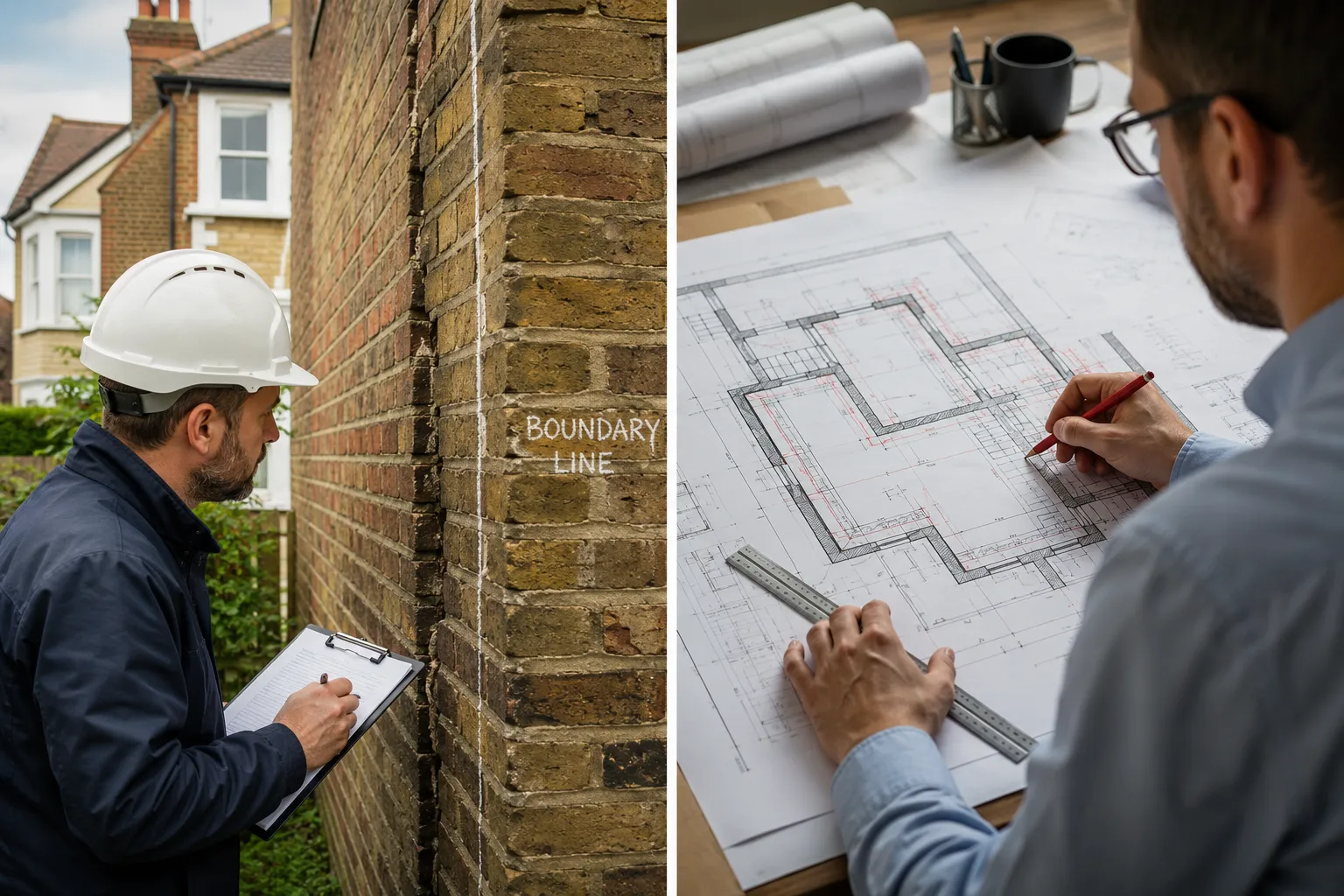
A party wall surveyor administers a specific piece of legislation, the Party Wall etc. Act 1996, and their primary role is to protect the legal rights of both the building owner and the adjoining owner during notifiable works. A building surveyor, by contrast, assesses the physical condition, structural integrity, and regulatory compliance of a building, and may also advise on design, defects, and maintenance.
The two roles are legally and practically distinct:
| Role | Core Function | Legal Basis | Qualification Required? |
|---|---|---|---|
| Party Wall Surveyor | Serve notices, draft awards, resolve disputes | Party Wall etc. Act 1996 | No statutory requirement, but RICS recommends MRICS/FRICS |
| Building Surveyor | Condition reports, structural advice, building regs | Building Act 1984, RICS standards | RICS membership strongly advised |
A measured building surveyor adds a third specialism: producing precise drawings of the existing structure, including the position of party walls, which the party wall surveyor then uses when drafting notices and awards. For more on what a full building survey covers, see this guide to Level 3 building surveys.
When Is a Party Wall Surveyor Required by Law?
A party wall surveyor is legally required whenever works fall within the scope of the Party Wall etc. Act 1996 and the adjoining owner does not give written consent. The Act covers three main categories of work:
- Works to an existing party wall or party structure, for example, cutting into a wall to insert a beam, raising a party wall, or underpinning it.
- New buildings at or astride the boundary line, including new walls built up to or on the boundary.
- Excavations within 3 metres of an adjoining building (or 6 metres if the excavation goes deeper than the neighbour's foundations).
If your neighbour consents in writing within 14 days of receiving notice, no surveyor is needed. If they dissent, or simply do not respond, a dispute is deemed to have arisen and surveyors must be appointed. To understand your full rights under the Act, see what are my party wall rights.
Common mistake: Many homeowners assume verbal agreement from a neighbour is sufficient. It is not. Only written consent avoids the formal surveyor appointment process.
Do I Need a Party Wall Surveyor or Building Surveyor for a Basement Extension?
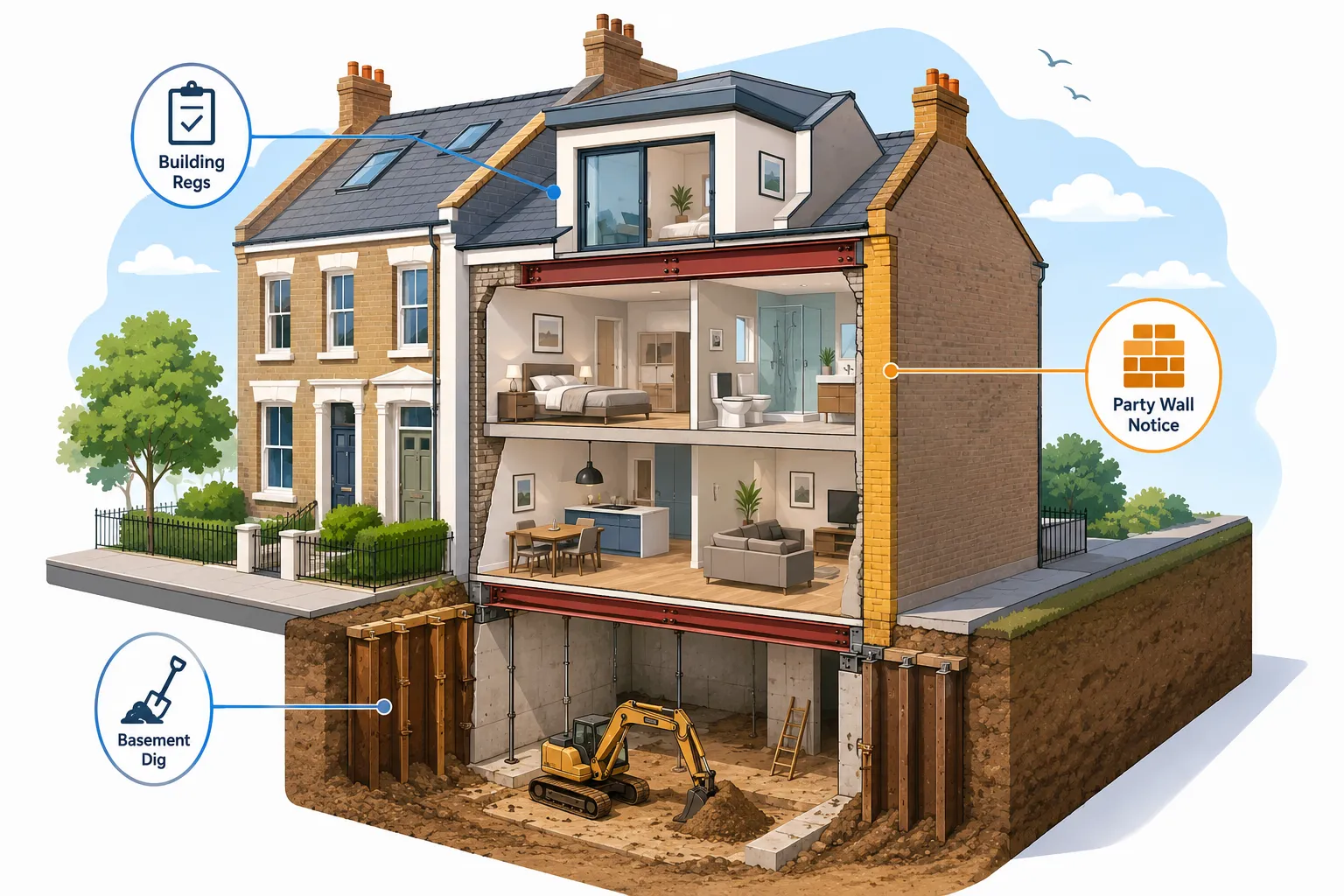
For a basement extension, you almost certainly need both. A basement dig typically involves excavation close to or beneath the foundations of a neighbouring property, which triggers the Act's 3-metre (or 6-metre) excavation provisions. A party wall surveyor must be appointed to serve the relevant notice and, if required, produce a party wall award.
Separately, a building surveyor (or structural engineer working alongside one) is needed to assess the existing structure, advise on underpinning or retention methods, check compliance with building regulations, and produce or review drawings. These are two entirely different scopes of work.
For a detailed breakdown of the party wall process specific to basement projects, see basements and party wall surveyor guidance for Surrey and London projects.
Decision rule: If your basement excavation comes within 3 metres of any part of a neighbouring structure, serve party wall notice. If you are also altering the existing building fabric, commission a building survey or structural assessment alongside it.
Can a Building Surveyor Do Party Wall Work?
A building surveyor can act as a party wall surveyor, but only if they have specific experience and knowledge of the Party Wall etc. Act 1996. The Act defines a "surveyor" broadly as any person who is not a party to the matter, there is no statutory qualification requirement.
However, RICS guidance is clear: the Act's broad definition does not mean any professional is suitable. For complex works such as basement digs, underpinning, or major structural alterations, appointing a chartered surveyor (MRICS or FRICS) with demonstrable party wall experience is strongly advisable. Many chartered building surveyors do hold this expertise, but it should be confirmed before appointment.
Edge case: Some firms offer a combined service where the same chartered surveyor handles both the party wall procedure and the building condition report. This can be cost-effective for straightforward projects, but for high-risk works, particularly basement digs adjacent to older properties, separate specialists often provide better protection for both parties.
What Qualifications Should a Party Wall Surveyor Have?
The Act sets no minimum qualification, but RICS recommends choosing a chartered surveyor with MRICS or FRICS status for any work of meaningful complexity. Chartered surveyors are bound by ongoing continuing professional development (CPD) requirements, must hold professional indemnity insurance, and are subject to RICS disciplinary procedures.
Key things to check when appointing a party wall surveyor:
- MRICS or FRICS membership (verify on the RICS Find a Surveyor register)
- Specific experience with the type of work involved (basement, loft, extension)
- Professional indemnity insurance in place
- Familiarity with the RICS guidance notes on party wall legislation, and awareness of the forthcoming 8th Edition, expected to take effect in late 2026
Note on 2026 developments: RICS's 8th Edition party wall guidance was in consultation with a closing date of 5 June 2026. The final document is expected to refine standards around appointments, impartiality, and documentation. Choosing a surveyor who actively follows RICS guidance will better align your project with current and emerging best practice.
How Much Does a Party Wall Surveyor Cost Versus a Building Surveyor?
Party wall surveyor fees are typically charged per party wall award, with costs varying based on the complexity of the works, the number of adjoining owners, and whether an agreed surveyor or two separate surveyors are appointed. For a detailed breakdown, see this guide to party wall surveyor costs.
Building surveyor fees depend on the type of report commissioned, the size of the property, and the scope of work. A Level 3 full building survey on a standard London terraced house will cost more than a condition report on a small flat.
As a general guide (estimates based on typical 2026 market rates for London and South East England):
- Party wall surveyor (agreed surveyor, simple rear extension): approximately £700 to £1,200 per award
- Party wall surveyor (two surveyors appointed, complex basement): £1,500 to £3,000+ per award
- Level 3 building survey (standard terraced house): approximately £600 to £1,500 depending on size and location
These are indicative ranges only. Always obtain written fee proposals from at least two firms before appointing.
Party Wall Surveyor for a Loft Conversion or Side Extension: What Should You Expect?
For a loft conversion, the party wall process is often triggered when raising or cutting into a party wall, for example, inserting steel beams or raising the ridge. For a side extension built up to the boundary, the Act may apply if the new wall is built astride or immediately adjacent to the boundary line.
What to expect from the party wall process for these project types:
- Notice served on adjoining owners, typically 1 to 2 months before work begins (2 months for party structure works, 1 month for line of junction works).
- Consent or dissent from the neighbour within 14 days. If no response, a dispute is deemed to have arisen.
- Surveyors appointed, either an agreed surveyor acting for both parties, or one surveyor each.
- Schedule of condition prepared, recording the existing state of the neighbour's property before works begin.
- Party wall award issued, setting out how and when works may proceed.
For a full explanation of the agreed surveyor option, which can reduce costs significantly, see agreed surveyor party wall: complete guide to roles and appointment.
How Long Does a Party Wall Survey Take Compared to a Building Survey?
A party wall survey timeline is largely driven by statutory notice periods and neighbour responses, not the surveyor's workload alone. From serving notice to having an award in place typically takes 6 to 10 weeks for a straightforward project, longer if neighbours dissent late or if the works are complex.
A building survey (Level 2 or Level 3) is quicker to commission and complete. The physical inspection usually takes a few hours, with the written report delivered within 5 to 10 working days in most cases. For more on building survey timeframes, see building survey timeframes explained.
Practical implication: Start the party wall notice process as early as possible, ideally when planning permission is submitted or even before. Waiting until the last minute before construction is one of the most common and costly mistakes homeowners make.
Do I Need Both a Party Wall Surveyor and a Building Surveyor?
For most extensions, basement digs, and structural alterations, yes, but the answer depends on the specific works. The table below summarises the most common scenarios:
| Project Type | Party Wall Surveyor Needed? | Building Surveyor Needed? |
|---|---|---|
| Rear extension (close to boundary) | Likely yes | Yes (building regs, condition) |
| Basement dig within 3m of neighbour | Yes | Yes (structural, regs) |
| Loft conversion with party wall works | Likely yes | Yes |
| Internal structural alteration only | Possibly not | Yes |
| New side extension on boundary | Yes (line of junction) | Yes |
If you are unsure whether your project triggers the Act, the do you need a party wall surveyor guide provides a clear checklist.
What Happens If You Don't Hire a Party Wall Surveyor When You Need One?
Failing to serve notice or appoint a surveyor when the Act requires it does not make the works illegal, but it removes your legal protection and exposes you to significant risk. An adjoining owner can apply to court for an injunction to stop the works, which can halt a project mid-build and generate legal costs far exceeding the original surveyor fee.
Beyond injunctions, proceeding without a schedule of condition means there is no agreed baseline if the neighbour later claims your works caused damage. Without a party wall award, you have no documented authority to carry out the works, and any resulting dispute is resolved through the courts rather than the faster, cheaper statutory process.
For a full account of what can go wrong, see consequences of ignoring the Party Wall Act.
Common Mistakes When Choosing Between a Party Wall and Building Surveyor
1. Assuming one professional covers both roles automatically.
Unless explicitly confirmed, a party wall surveyor is not conducting a building survey, and a building surveyor is not serving party wall notices.
2. Appointing the cheapest option without checking qualifications.
The Act's open definition of "surveyor" means unqualified individuals can legally act. For complex or high-value works, this is a serious risk.
3. Leaving party wall notices too late.
Notice periods are statutory. Starting the process after planning permission is granted, rather than alongside it, is the single most common cause of project delays.
4. Not obtaining a schedule of condition.
Even when a party wall award is in place, some surveyors skip or rush the schedule of condition. This document is your primary protection against spurious damage claims.
5. Confusing a measured building survey with a building survey.
A measured building survey produces accurate drawings of the existing structure. It is not a condition report. Both may be needed for a major extension project.
FAQ
Q: Can my architect act as my party wall surveyor?
A: An architect can act as a party wall surveyor if they are not a party to the matter and have relevant experience. However, RICS recommends a chartered surveyor with specific party wall expertise, particularly for complex works. Confirm qualifications and professional indemnity insurance before appointing.
Q: Does a party wall surveyor need to visit the property?
A: Yes. A schedule of condition requires a physical inspection of the adjoining owner's property before works begin. Remote or paper-only party wall services are not adequate for notifiable works.
Q: Who pays the party wall surveyor's fees?
A: In most cases, the building owner (the person carrying out the works) pays the fees for both surveyors, including the adjoining owner's surveyor. The party wall award will set out the fee arrangements.
Q: Is a party wall agreement the same as a party wall award?
A: No. A party wall agreement is the informal term sometimes used when a neighbour consents in writing and no surveyor is needed. A party wall award is the formal document produced by surveyors when a dispute has arisen (or been deemed to arise). The award is legally binding.
Q: Do I need a party wall surveyor for internal structural work?
A: Only if the internal work involves cutting into, raising, or otherwise affecting a party wall or party structure. Purely internal works that do not touch a shared wall or come within the Act's excavation distances do not trigger the notice requirement.
Q: How do I find a qualified party wall surveyor in 2026?
A: Use the RICS Find a Surveyor register and filter for party wall experience. Look for MRICS or FRICS membership, check that professional indemnity insurance is in place, and ask specifically about experience with your type of project.
Conclusion
Choosing between a party wall surveyor and a building surveyor is not an either/or decision for most significant building projects. The two roles serve different legal and technical functions, and attempting to substitute one for the other, or skipping either, creates real risk.
Actionable next steps:
- Identify whether your works fall within the scope of the Party Wall etc. Act 1996 using the three categories: party structure works, line of junction works, and excavations within 3 or 6 metres of a neighbouring structure.
- If the Act applies, appoint a chartered party wall surveyor (MRICS or FRICS) and serve notice before works begin, ideally at the planning stage.
- Commission a building survey or structural assessment separately to cover condition, compliance, and building regulations.
- For basement projects specifically, treat both appointments as essential from day one rather than reactive additions.
- Verify qualifications, professional indemnity insurance, and familiarity with the RICS 8th Edition guidance (expected to take effect in late 2026) before signing any appointment letter.
Getting the right professionals in place early is not a bureaucratic exercise, it is the most reliable way to protect your investment, your timeline, and your relationship with your neighbours.
.cg-tool{font-family:Arial,sans-serif;max-width:560px;margin:2em auto;border:2px solid #1a3a5c;border-radius:8px;overflow:hidden}
.cg-tool-header{background:#1a3a5c;color:#fff;padding:14px 18px;font-size:1.05em;font-weight:700}
.cg-tool-body{padding:18px}
.cg-q{font-weight:600;margin-bottom:8px;color:#1a3a5c;font-size:.95em}
.cg-opts label{display:block;margin:5px 0;cursor:pointer;font-size:.9em}
.cg-opts input{margin-right:7px}
.cg-btn{margin-top:14px;background:#1a3a5c;color:#fff;border:none;padding:10px 22px;border-radius:5px;cursor:pointer;font-size:.95em;font-weight:600}
.cg-btn:hover{background:#2a5a8c}
.cg-result{margin-top:14px;padding:12px;border-radius:6px;font-size:.9em;display:none}
.cg-need-both{background:#e8f4e8;border-left:4px solid #2e7d32;color:#1b5e20}
.cg-pw-only{background:#fff8e1;border-left:4px solid #f9a825;color:#5d4037}
.cg-bs-only{background:#e3f2fd;border-left:4px solid #1565c0;color:#0d3c6e}
.cg-neither{background:#f5f5f5;border-left:4px solid #9e9e9e;color:#333}
function cgCheck(){
var q1=document.querySelector(‘input[name=”q1″]:checked’);
var q2=document.querySelector(‘input[name=”q2″]:checked’);
var q3=document.querySelector(‘input[name=”q3″]:checked’);
if(!q1||!q2||!q3){alert(“Please answer all three questions.”);return;}
var ids=[“r-both”,”r-pw”,”r-bs”,”r-neither”];
ids.forEach(function(id){var el=document.getElementById(id);el.style.display=”none”;});
var pw=(q1.value===”yes”||q2.value===”yes”);
var bs=(q3.value===”yes”);
var show=pw&&bs?”r-both”:pw?”r-pw”:bs?”r-bs”:”r-neither”;
var el=document.getElementById(show);el.style.display=”block”;
}
Tags: party wall surveyor, building surveyor, party wall act, basement extension, structural alteration, loft conversion, RICS chartered surveyor, party wall notice, building regulations, extension surveyor, party wall award, property surveyor UK
How Prince Surveyors can help: explore our party wall surveyors or learn about our party wall surveyor costs.