

{"cover":"Professional landscape format (1536×1024) hero image featuring bold text overlay 'Party Wall Notices in 2026 Housing Recovery: Timing Strategies for First-Time Buyer Extensions' in extra large 70pt white sans-serif font with dark shadow effect, positioned in upper third. Background shows modern UK terraced houses with visible shared walls, construction scaffolding on home extension, young couple reviewing documents with surveyor, architectural plans visible. Color scheme: navy blue, white, bright orange accents. High contrast, magazine cover quality, editorial style with professional depth of field. Include subtle calendar elements showing 2026 timeline markers and legal document imagery.","content":["Detailed landscape format (1536×1024) image showing professional party wall surveyor conducting property inspection at shared wall between two UK terraced houses. Close-up view of surveyor using measuring equipment and tablet, with visible brick party wall structure, foundation excavation area marked with safety barriers, architectural drawings spread on table in foreground. Include calendar showing 2-month notice period timeline, legal document checklist overlay with ticked boxes. Warm natural lighting, professional construction site aesthetic, safety equipment visible, first-time buyer couple observing in background. Color palette: construction orange, professional grey, document white.","Detailed landscape format (1536×1024) infographic-style image displaying timeline flowchart for party wall notice process in 2026. Visual shows sequential stages: initial notice serving, 14-day neighbour response period, surveyor appointment, 2-4 month total process duration. Include calendar pages, clock elements, document icons, cost breakdown boxes showing £750-£1,800 fee ranges, traffic light system indicating critical deadlines. Modern flat design aesthetic with icons representing homeowners, neighbours, surveyors, and legal documents. Professional blue and green color scheme with clear typography, arrows showing process flow, warning symbols for potential delays.","Detailed landscape format (1536×1024) image showing modern UK home extension project specifically for first-time buyers. Split-screen composition: left side shows completed loft conversion with exposed party wall work, right side shows rear ground floor extension with foundation work near boundary. Include young homeowners reviewing party wall award document with surveyor, cost breakdown spreadsheet visible on laptop showing £1,295-£1,795 architectural package fees. Construction materials, building regulations approval stamps, 2026 housing recovery statistics overlay with upward trend arrows. Bright, optimistic lighting suggesting housing market recovery, professional architectural photography style with blueprint elements."]

The UK housing market in 2026 is experiencing a remarkable recovery, with first-time buyers leading a surge in home extension projects. Yet many new homeowners are discovering a critical legal requirement that can make or break their renovation timeline: party wall notices. Understanding Party Wall Notices in 2026 Housing Recovery: Timing Strategies for First-Time Buyer Extensions has become essential for anyone planning to extend their property this year.
With extension costs rising 3-4% year-on-year and surveyor demand at an all-time high, getting the timing right on party wall procedures can save thousands of pounds and months of delays. This comprehensive guide reveals exactly how first-time buyers can navigate the party wall process efficiently during the current housing recovery.
Key Takeaways
- 🏗️ Start early: Serve party wall notices 2-12 months before planned work begins to avoid costly delays in the competitive 2026 construction market
- 💷 Budget appropriately: Party wall surveyor fees range from £750-£1,800 per neighbour in 2026, with the full process typically costing around £1,000-£2,000 total
- ⏱️ Plan for 2-4 months: The complete party wall agreement process takes 2-4 months from initial notice to final award
- 📋 Mandatory compliance: Loft conversions, rear extensions, and basement projects affecting shared walls legally require party wall notices under the Party Wall etc. Act 1996
- ⚖️ Legal consequences: Failing to serve proper notice can result in injunctions, work stoppages, and liability for repairs you didn't cause
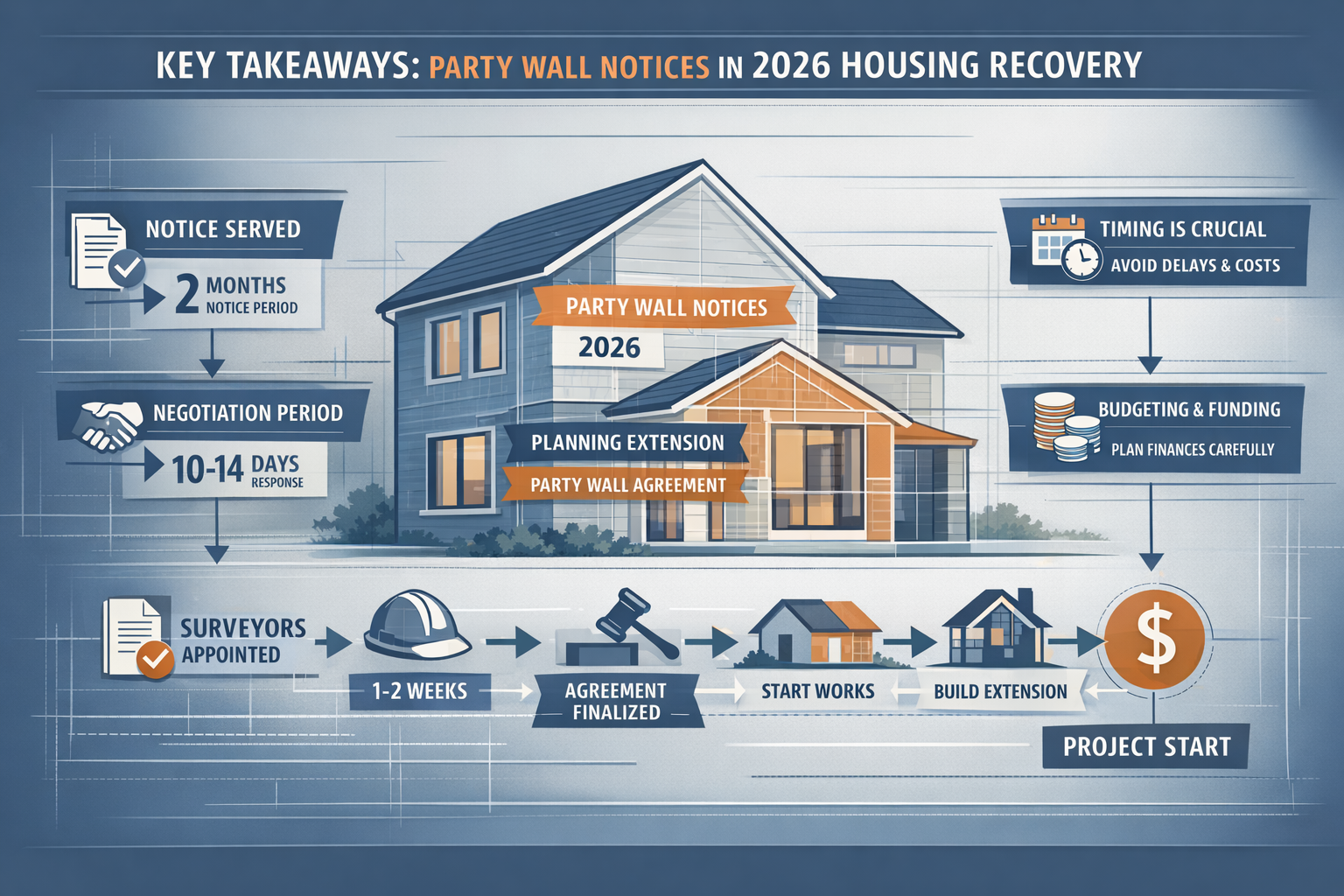
Understanding Party Wall Notices in 2026 Housing Recovery: Legal Framework and Requirements
The Party Wall etc. Act 1996 remains the governing legislation for all building work affecting shared walls, boundaries, and excavations near neighbouring properties in England and Wales[1]. Despite the changing housing market conditions in 2026, these legal requirements have not diminished—in fact, compliance has become more critical than ever.
What Triggers a Party Wall Notice Requirement?
Party wall notices are mandatory when your extension project involves:
- Building on or at a party wall (the shared wall between semi-detached or terraced properties)
- Cutting into a party wall for structural beams or supports
- Removing chimney breasts that form part of the party wall
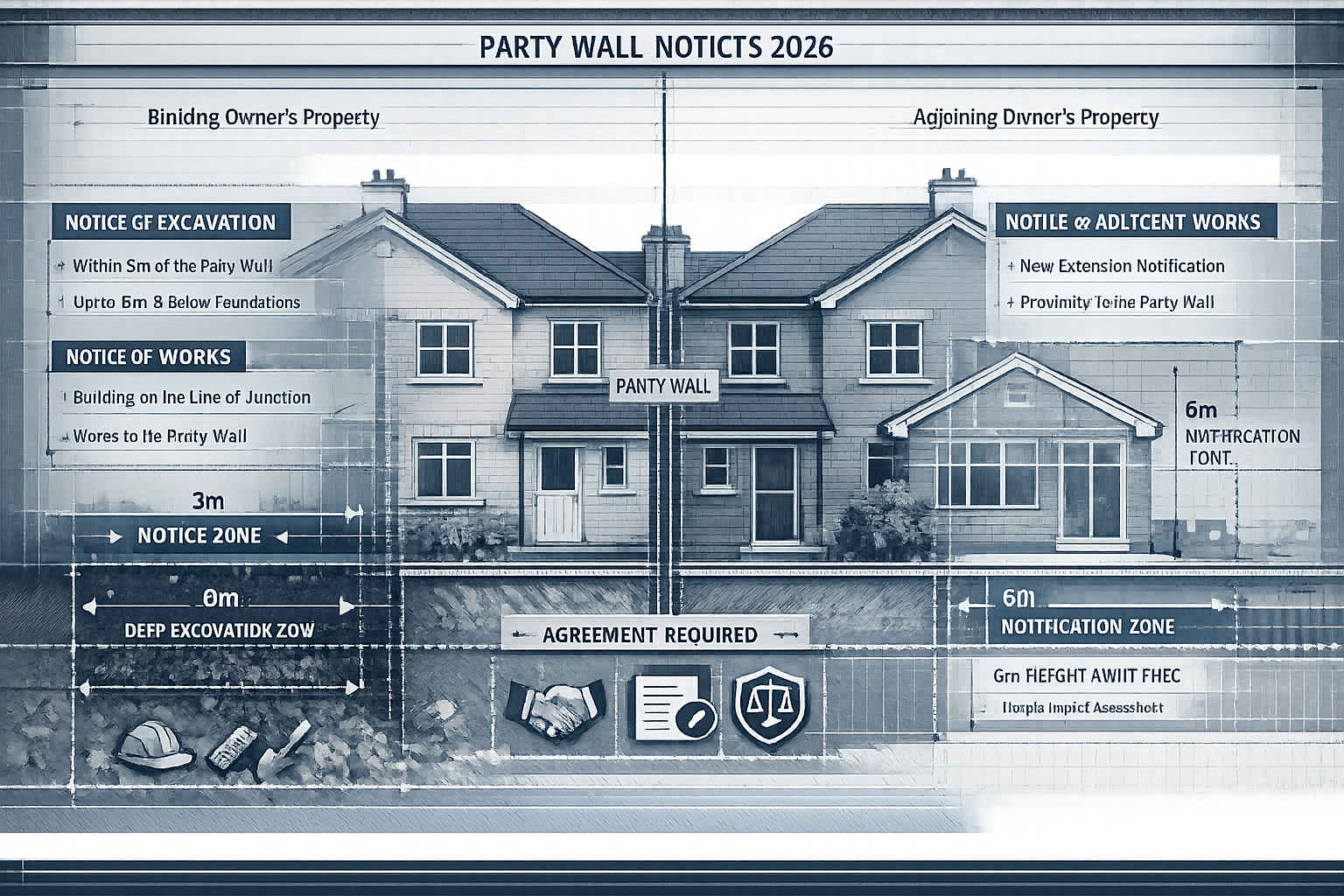
- Excavating within 3 metres of a neighbour's structure if going deeper than their foundations
- Excavating within 6 metres if the work will cut a line at 45 degrees to their foundations
- Raising party walls or constructing new walls at boundaries
For first-time buyers planning popular extension types like loft conversions, these requirements are almost always triggered. Loft conversions require mandatory party wall compliance when work affects shared walls or structures between adjoining properties[3].
The Three Types of Party Wall Notices
Understanding which notice you need is crucial for proper timing:
| Notice Type | When Required | Advance Notice Period |
|---|---|---|
| Party Structure Notice | Work directly to the party wall itself | 2 months minimum |
| Line of Junction Notice | Building a new wall at the boundary | 1 month minimum |
| Adjacent Excavation Notice | Digging near neighbour's foundations | 1 month minimum |
"The courts take a poor view of failure to serve party wall notices; homeowners may be ordered to pay for repairs they're not responsible for, and neighbours can seek civil action or injunctions to stop work."[2]
Essential Information Your Notice Must Include
Written notice must contain specific details to be legally valid[2]:
- Your full contact information (name, address, phone, email)
- Comprehensive details of planned work (type, scope, methods)
- Proposed start date for construction
- Access requirements over the neighbour's property
- Drawings or plans showing the extent of work
Many first-time buyers benefit from professional assistance in preparing these notices. Understanding the cost of party wall surveyor services can help budget appropriately for expert guidance.
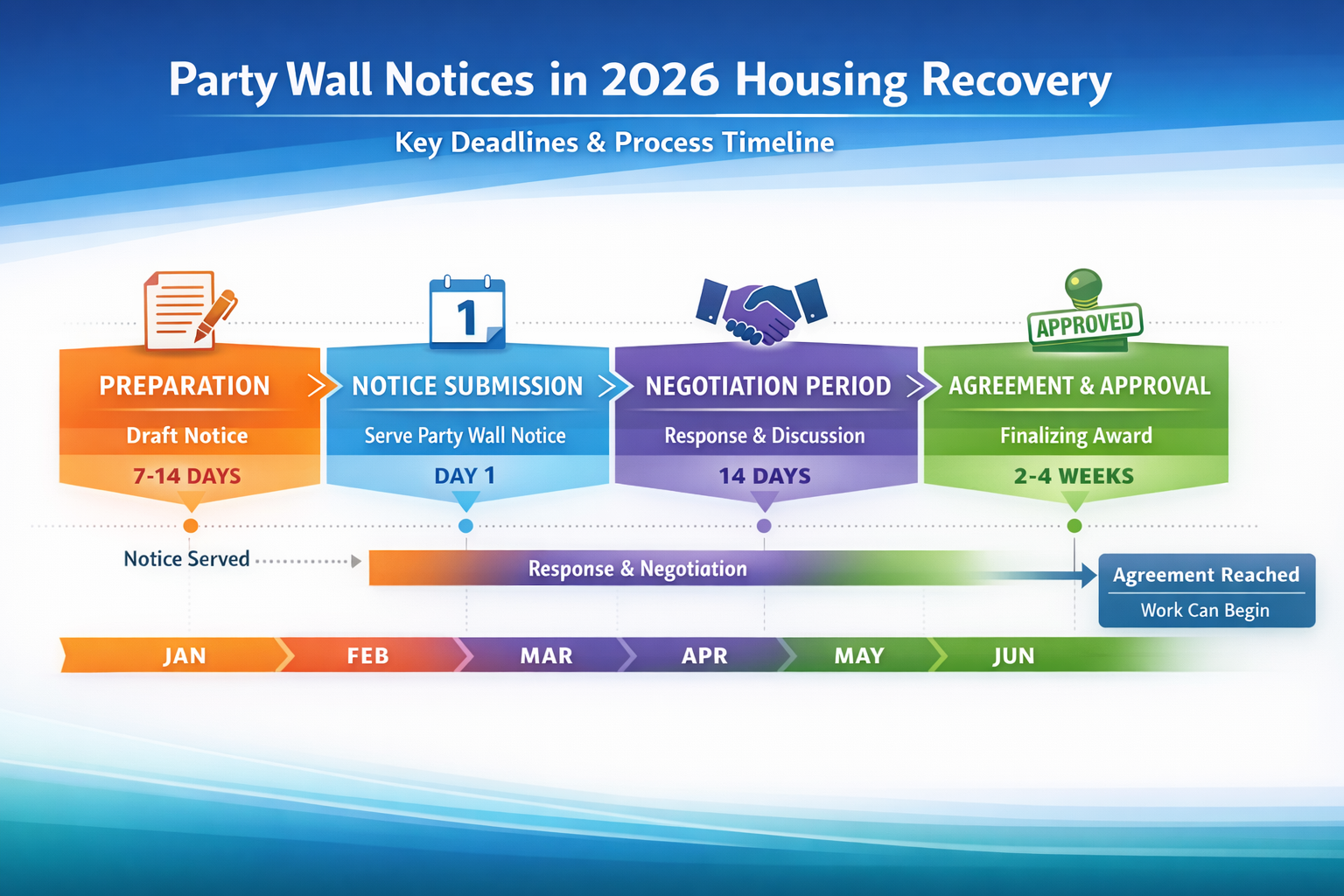
Strategic Timing for Party Wall Notices in 2026 Housing Recovery: Critical Deadlines and Process Duration
The timing of party wall notices has become particularly crucial in 2026's competitive construction environment. With demand for builders and surveyors at unprecedented levels, understanding the complete timeline is essential for first-time buyers planning extensions.
The Complete Party Wall Timeline
According to 2026 London-specific guidance, homeowners should budget 2-4 months for the full party wall agreement process[3]. Here's how that breaks down:
Phase 1: Notice Serving (Day 0)
- Prepare and serve formal written notice to all affected neighbours
- Must be served 2 months (Party Structure Notice) or 1 month (other notices) before work begins
- No planning permission required at this stage[2]
Phase 2: Neighbour Response (Days 1-14)
- Neighbours have 14 days to respond in writing[2]
- Three possible outcomes: consent, dissent, or no response
- If no response within 14 days, automatically treated as dissent
Phase 3: Surveyor Appointment (Days 15-30)
- If neighbour dissents or doesn't respond, surveyors must be appointed
- Building owner appoints their surveyor
- Neighbour appoints their own surveyor OR agrees to use the same surveyor
- Using an agreed surveyor can streamline the process
Phase 4: Property Inspection and Award (Days 31-120)
- Surveyors inspect both properties to document pre-work condition
- Draft party wall award prepared with terms and conditions
- Award finalized and served to both parties
- This phase typically takes 1-3 months depending on surveyor availability
2026 Timing Challenges for First-Time Buyers
The housing recovery has created specific timing pressures:
Surveyor Availability Crisis 📊
With loft conversion demand surging in 2026, qualified party wall surveyors are experiencing unprecedented booking levels[4]. First-time buyers should expect:
- 2-4 week wait times for initial surveyor appointments
- Extended inspection scheduling due to high caseloads
- Premium rates for expedited services
Construction Slot Competition 🏗️
Quality builders are booking 3-6 months in advance. Coordinating party wall completion with builder availability requires careful planning:
- Serve notices immediately after architect plans are finalized
- Book your preferred builder provisionally before party wall award is complete
- Build in 2-week buffer between award completion and construction start
Seasonal Considerations
- Spring 2026 (March-May): Peak demand for extension starts; serve notices in January-February
- Summer 2026 (June-August): Holiday periods can extend surveyor response times by 1-2 weeks
- Autumn 2026 (September-November): Optimal period with better surveyor availability
- Winter 2026 (December-February): Fewer extensions start; faster party wall processing
Early Timing Strategies That Save Money
Strategy 1: Serve Notice Before Final Plans
While notice must include work details, serving as soon as outline plans are ready (even before final planning permission) starts the clock ticking. Minor amendments can be communicated later.
Strategy 2: Proactive Neighbour Communication
Informal discussion with neighbours 1-2 weeks before formal notice can:
- Identify potential concerns early
- Increase likelihood of consent (avoiding surveyor fees)
- Build goodwill for the construction period
Strategy 3: Bundle Multiple Projects
If planning multiple works (loft conversion AND rear extension), serve all notices simultaneously rather than sequentially to avoid multiple 2-month waiting periods.
Understanding the complete party wall awards process helps first-time buyers anticipate each stage and plan accordingly.
Cost Management and Budgeting for Party Wall Notices in 2026 Housing Recovery: First-Time Buyer Financial Strategies
For first-time buyers already stretching their budgets to fund extensions, party wall costs represent a significant additional expense that must be carefully managed. In 2026's housing recovery, these costs have increased alongside general professional service inflation.
2026 Party Wall Cost Breakdown
Surveyor Fees 💷
Party wall surveyor fees in 2026 range from £750-£1,800 per neighbour[2], with variation based on:
- Property location (London typically 20-30% higher)
- Project complexity (loft conversions cost more than simple rear extensions)
- Number of affected neighbours
- Surveyor experience and demand
A typical Party Wall Award costs around £1,000 in total[2] for straightforward cases with one neighbour who agrees to an agreed surveyor.
Who Pays What?
- Building owner (you) pays for YOUR surveyor
- Building owner (you) pays for NEIGHBOUR'S surveyor fees
- Building owner (you) pays for any agreed surveyor
Yes, you read that correctly—as the person initiating the work, you're responsible for all surveyor costs, even your neighbour's choice of surveyor. This can be a shock for first-time buyers.
Complete 2026 Extension Budget for First-Time Buyers
Based on analysis of 5,000+ UK projects in Q1 2026, professional extension fees have increased 3-4% year-on-year[3]. Here's a realistic budget breakdown:
Loft Conversion (Typical Semi-Detached)
- Architectural package: £1,795[3]
- Party wall surveyor (both neighbours): £2,000-£3,600
- Planning fees (if required): £206
- Building regulations: £800-£1,200
- Construction: £35,000-£55,000
- Total: £39,801-£61,801
Rear Ground Floor Extension
- Architectural package: £1,295[3]
- Party wall surveyor (both neighbours): £1,500-£3,600
- Planning fees: £206
- Building regulations: £600-£900
- Construction: £25,000-£45,000
- Total: £28,601-£50,901
Single Storey Side Extension
- Architectural package: £1,495[3]
- Party wall surveyor (one neighbour): £750-£1,800
- Planning fees: £206
- Building regulations: £500-£800
- Construction: £20,000-£35,000
- Total: £22,951-£39,301
Money-Saving Strategies for Party Wall Costs
1. Propose an Agreed Surveyor ✅
Instead of each party appointing separate surveyors, propose using one agreed surveyor. This can reduce total costs by 30-50% since you're only paying one professional instead of two.
2. Obtain Neighbour Consent
If your neighbour fully consents in writing within 14 days, no surveyors are needed at all. Strategies to encourage consent:
- Provide detailed, professional plans showing minimal impact
- Offer to upgrade their side of the shared wall (better insulation, soundproofing)
- Present a clear construction schedule with defined working hours
- Commit to regular updates throughout the project
3. Compare Surveyor Quotes
While you can't control your neighbour's surveyor choice, you can shop around for your own. The cost of party wall agreement varies significantly between firms—obtain at least three quotes.
4. Bundle Services
Many architectural firms offer fixed-price packages that include party wall review. First-time buyers should budget £1,295-£1,795 for architectural packages covering extensions, including survey, drawings, planning application, and party wall review[3].
5. Time Your Project Strategically
Surveyor demand (and prices) peak in spring. Starting your party wall process in autumn or winter may yield better rates and faster service.
Hidden Costs to Budget For
Beyond surveyor fees, first-time buyers should anticipate:
- Schedule of Condition photography: £150-£300 (professional documentation of pre-work property state)
- Additional surveys if disputes arise: £500-£1,500
- Legal fees if disputes escalate: £2,000-£10,000+ (rare but possible)
- Construction delays: £100-£300 per day if party wall delays push back builder start date
Understanding whether you need a party wall surveyor for your specific project helps avoid unnecessary expenses.
Common First-Time Buyer Mistakes with Party Wall Notices in 2026 Housing Recovery
The surge in first-time buyer extensions during 2026's housing recovery has revealed several recurring mistakes that can prove costly. Learning from others' errors helps avoid expensive delays and legal complications.
Mistake #1: Starting Work Without Serving Notice
The Problem: Some first-time buyers assume that obtaining planning permission covers party wall requirements, or that small projects don't need formal notices.
The Reality: Planning permission and party wall notices are completely separate legal processes. Even minor works affecting a party wall require proper notice[1].
The Consequences:
- Neighbours can obtain court injunctions to stop work immediately
- You may be ordered to pay for repairs you didn't cause
- Retrospective party wall agreements are more expensive and contentious
- Builder delays cost £100-£300 per day
The Solution: Always check if your project triggers party wall requirements before any construction begins. When in doubt, consult a qualified surveyor.
Mistake #2: Serving Notice Too Late
The Problem: First-time buyers serve notice just weeks before their builder is scheduled to start, not realizing the 2-4 month process duration.
The Reality: Even with neighbour consent, documentation and condition surveys take time. Without consent, the full surveyor appointment and award process can take 3-4 months[3].
The Consequences:
- Builder cancellation fees (typically 10-20% of contract value)
- Loss of preferred builder to other projects
- Extended mortgage interest payments on empty property
- Increased material costs due to delays (prices rising 3-4% annually[3])
The Solution: Serve party wall notices immediately after architectural plans are finalized, ideally 4-6 months before intended construction start.
Mistake #3: Poor Neighbour Communication
The Problem: Serving formal legal notice without any prior informal discussion can seem aggressive and adversarial.
The Reality: How you approach neighbours significantly impacts whether they consent or dissent. Dissent triggers the expensive surveyor process.
The Consequences:
- Neighbour dissent requiring dual surveyors (£1,500-£3,600 vs. £0 with consent)
- Strained relationships during months of construction
- Potential for disputes over noise, access, or construction methods
- Neighbour may scrutinize every aspect of work, causing delays
The Solution:
- Speak with neighbours informally 2-3 weeks before formal notice
- Show them professional plans and explain benefits
- Address their concerns proactively
- Follow up formal notice with friendly conversation
- Provide direct contact information for questions
Mistake #4: Choosing the Wrong Surveyor
The Problem: Selecting the cheapest quote without considering experience, availability, or specialization.
The Reality: Party wall surveying requires specific expertise. General building surveyors may lack the nuanced understanding of the Party Wall Act[1].
The Consequences:
- Inadequate awards that don't protect your interests
- Extended timelines due to surveyor inexperience
- Disputes requiring expensive resolution
- Awards that impose unnecessary restrictions on your work
The Solution: When checking engineers and party wall surveyors, verify:
- RICS (Royal Institution of Chartered Surveyors) membership
- Specific party wall experience (ask for number of awards completed)
- Local knowledge of your area
- Availability to complete within your timeline
- References from recent clients
Mistake #5: Incomplete Notice Documentation
The Problem: Serving notice without sufficient detail about planned work, drawings, or specifications.
The Reality: Vague notices can be rejected or challenged, restarting the 2-month clock[2].
The Consequences:
- Notice deemed invalid, requiring re-serving
- Additional 2-month delay
- Neighbour suspicion and reduced likelihood of consent
- Surveyor fees increase due to ambiguity
The Solution: Include in your notice:
- Detailed written description of all work
- Architectural drawings showing party wall impact
- Structural engineer calculations if relevant
- Proposed construction methods
- Expected duration and working hours
- Your contact details and builder information
Mistake #6: Ignoring Basement and Foundation Work
The Problem: First-time buyers focus on visible extensions but forget that excavation near boundaries triggers party wall requirements.
The Reality: The 3-metre and 6-metre rules for excavation are strictly enforced. Even if your extension doesn't touch the party wall, digging foundations nearby requires notice[1].
The Consequences:
- Work stoppage mid-excavation
- Expensive underpinning requirements imposed retrospectively
- Foundation redesign costs (£5,000-£15,000)
- Extended project timeline (additional 2-3 months)
The Solution: If your project involves any excavation, consult a party wall surveyor for basement work early in the design phase to understand requirements.
Optimizing Your Extension Timeline: Integrating Party Wall Notices in 2026 Housing Recovery Planning
Successfully managing party wall notices requires integrating them into your overall extension project timeline. For first-time buyers in 2026's competitive market, this coordination is critical for avoiding delays and cost overruns.
The Optimal Extension Timeline for First-Time Buyers
Months 1-2: Design and Planning
- Consult architect for initial designs
- Determine party wall requirements
- Obtain preliminary builder quotes
- Budget for all costs including party wall fees
Month 3: Finalize Plans and Serve Notice
- Complete architectural drawings
- Submit planning application (if required)
- Serve party wall notices immediately
- Begin formal surveyor selection process
Months 4-5: Party Wall Process
- Await neighbour response (14 days)
- Appoint surveyors if needed
- Complete property condition surveys
- Negotiate and finalize party wall award
Month 6: Pre-Construction Preparation
- Receive planning permission (if required)
- Finalize party wall award
- Confirm builder availability
- Order long-lead-time materials
- Arrange building control approval
Months 7-10: Construction
- Begin work according to party wall award terms
- Maintain communication with neighbours
- Address any issues promptly
- Complete inspections as required
Month 11: Completion
- Final building control sign-off
- Post-construction condition survey (if required by award)
- Address any neighbour concerns
- Celebrate your new space! 🎉
Parallel Processing Strategies
Smart first-time buyers run multiple processes simultaneously rather than sequentially:
Strategy 1: Planning Permission + Party Wall Notice
These are independent processes—submit both at the same time. Planning takes 8 weeks; party wall takes 8-16 weeks. Running parallel saves 2 months.
Strategy 2: Surveyor Selection During Notice Period
Don't wait for neighbour response to research surveyors. Have your shortlist ready so you can appoint immediately if needed.
Strategy 3: Builder Booking with Contingency
Book your preferred builder provisionally for 4 months out, with a defined start window rather than fixed date. This accommodates party wall timeline variations.
Managing Multiple Neighbours
Terraced properties often affect neighbours on both sides. Special considerations:
Serve All Notices Simultaneously
Don't serve notices sequentially—this extends your timeline unnecessarily. Serve both neighbours on the same day.
Propose Single Agreed Surveyor
Suggest all three parties (you and both neighbours) use one agreed surveyor. This:
- Reduces costs by 60-70%
- Speeds up the process significantly
- Simplifies coordination and communication
Stagger Construction Impact
If possible, design your project to minimize simultaneous impact on both neighbours:
- Start work on one side first
- Complete noisy phases before moving to the other side
- Provide advance notice of particularly disruptive activities
Technology Tools for 2026 Party Wall Management
Modern first-time buyers can leverage technology to streamline the process:
Project Management Apps
- Track notice deadlines and surveyor appointments
- Share documents with all parties securely
- Maintain communication logs for legal protection
Digital Notice Serving
- Email notice (with proof of delivery) is legally acceptable
- Follow up with registered post for paper trail
- Keep screenshots and email receipts
Condition Documentation
- Use smartphone apps to photograph and timestamp property conditions
- Create shared albums with neighbours showing pre-work state
- Reduces disputes over damage claims
Builder Coordination Platforms
- Share party wall award with builder digitally
- Flag restrictions or special requirements
- Track compliance with award terms
When to Seek Professional Help
While some first-time buyers attempt to manage party wall notices themselves, professional assistance is valuable when:
- Multiple neighbours are affected (3+ properties)
- Complex structural work is involved (steel beams, underpinning)
- Neighbour relationships are already strained
- Property has unusual features (listed building, conservation area)
- Previous party wall disputes exist
- Your project budget exceeds £50,000
The top 5 party wall agreement considerations for renovation can help determine when expert guidance is essential.
Legal Protections and Rights: What First-Time Buyers Need to Know About Party Wall Notices in 2026 Housing Recovery
Understanding your legal rights and protections under the Party Wall etc. Act 1996 empowers first-time buyers to navigate the process confidently while avoiding costly mistakes.
Your Rights as the Building Owner
Right to Undertake Necessary Work
The Act gives you the legal right to carry out work on your property that affects party walls, provided you follow proper procedures[1]. Your neighbour cannot unreasonably prevent necessary structural work.
Right to Access Neighbour's Property
If your work requires access to your neighbour's property (for scaffolding, work to their side of the wall, etc.), the party wall award can grant this access with reasonable notice[2].
Right to Appoint Your Own Surveyor
You have absolute discretion to choose your surveyor. Your neighbour cannot veto your choice (though they select their own surveyor independently).
Right to Appeal
If you disagree with the party wall award terms, you can appeal to the County Court within 14 days of the award being served[1].
Your Neighbour's Rights
Understanding what neighbours can (and cannot) do helps set realistic expectations:
What Neighbours CAN Do:
- Request detailed information about your planned work
- Appoint their own surveyor (at your expense)
- Require a schedule of condition documenting their property before work
- Request specific working hours or methods to minimize disruption
- Seek compensation for actual damage caused by your work
- Refuse access to their property (but surveyors can override this in the award)
What Neighbours CANNOT Do:
- Unreasonably withhold consent to necessary work
- Demand payment simply for agreeing to your work
- Require you to upgrade their property beyond addressing your work's impact
- Impose unreasonable conditions that make your work impossible
- Delay the process indefinitely (surveyors impose reasonable timelines)
Dispute Resolution Mechanisms
When disagreements arise, the Act provides structured resolution:
Level 1: Direct Negotiation
Most issues resolve through direct communication. Before escalating, attempt to:
- Understand your neighbour's specific concerns
- Offer reasonable compromises
- Provide additional information or reassurance
- Involve your surveyor to explain technical aspects
Level 2: Surveyor Mediation
Surveyors act as neutral professionals to resolve disputes. They can:
- Propose compromise solutions
- Explain legal requirements to both parties
- Draft award terms that balance interests
- Set reasonable timelines and conditions
Level 3: Third Surveyor
If the two appointed surveyors cannot agree, they select a third surveyor whose decision is binding[1]. This adds cost (£1,500-£3,000) but resolves deadlock.
Level 4: County Court Appeal
Either party can appeal an award to the County Court within 14 days. This is expensive (£5,000-£20,000+ in legal fees) and rare, reserved for serious disputes.
Liability and Insurance Considerations
Your Liability as Building Owner
You're responsible for:
- Damage directly caused by your work
- Structural issues arising from your construction
- Compensation for loss of amenity during work
You're NOT liable for:
- Pre-existing defects discovered during work
- Damage caused by your builder's negligence (though you may need to pursue your builder)
- Wear and tear unrelated to your project
Insurance Coverage 🛡️
Ensure your insurance arrangements include:
Buildings Insurance: Notify your insurer before starting work. Extensions usually require policy updates.
Public Liability Insurance: Your builder should carry £5-10 million coverage. Request proof before work starts.
Party Wall Insurance: Specialist policies (£150-£300) cover party wall award costs and dispute resolution if neighbours dissent.
Enforcement and Penalties
For Building Owners Who Fail to Serve Notice:
- Neighbours can obtain injunctions stopping work immediately
- Courts may order removal of completed work
- You pay for repairs to neighbour's property (even pre-existing issues)
- Criminal penalties are rare but possible for willful violations
For Neighbours Who Obstruct Lawful Work:
- Surveyors can grant access rights in the award
- Courts can enforce access if unreasonably denied
- Neighbours may be liable for your delay costs if obstruction is unreasonable
Documentation Best Practices
Protect yourself legally by maintaining comprehensive records:
Before Work:
- Copies of all notices served (with proof of delivery)
- Photographs of both properties (timestamped)
- Written correspondence with neighbours
- Party wall award (keep multiple copies)
During Work:
- Daily site diary noting activities
- Photographs of work progress
- Records of any incidents or concerns
- Communication logs with neighbours
After Work:
- Final photographs of completed work
- Building control completion certificate
- Any post-work condition surveys
- Written confirmation from neighbours (if possible)
These records prove invaluable if disputes arise months or years later.
Conclusion: Mastering Party Wall Notices in 2026 Housing Recovery for First-Time Buyer Success
Navigating Party Wall Notices in 2026 Housing Recovery: Timing Strategies for First-Time Buyer Extensions requires careful planning, realistic budgeting, and proactive communication. As the UK housing market continues its recovery trajectory, first-time buyers who master these timing strategies position themselves for successful, stress-free extension projects.
The key to success lies in early action. Serving party wall notices 4-6 months before your intended construction start date provides the buffer needed to accommodate the 2-4 month process duration, surveyor availability challenges, and potential neighbour concerns. This proactive approach prevents the costly delays and builder cancellations that plague rushed projects.
Budget realistically for party wall costs—£1,000-£3,600 depending on your project complexity and number of affected neighbours. These expenses are non-negotiable legal requirements, not optional extras. Factor them into your total extension budget from day one to avoid unpleasant surprises.
Prioritize neighbour relationships throughout the process. A friendly conversation before formal notice can transform a potential dissent (requiring expensive surveyors) into willing consent (costing nothing). The goodwill you build now pays dividends during months of construction activity.
Seek professional guidance when needed. While party wall notices can be served personally, complex projects benefit from experienced surveyor involvement. Understanding when to invest in professional help versus managing the process yourself is a critical judgment call.
Your Action Plan for Party Wall Success
Immediate Next Steps (This Week):
- Review your extension plans to identify all party wall triggers
- Research and shortlist 3-5 qualified party wall surveyors in your area
- Draft an informal letter to neighbours outlining your plans
- Calculate your complete project budget including party wall costs
Short-Term Actions (Next 2-4 Weeks):
- Speak with neighbours informally about your extension plans
- Finalize architectural drawings with party wall details
- Prepare formal party wall notices with all required information
- Serve notices to all affected neighbours (registered post + email)
Medium-Term Actions (Next 2-4 Months):
- Appoint surveyors if neighbours dissent or don't respond
- Cooperate fully with property condition surveys
- Review draft party wall award carefully before acceptance
- Coordinate party wall completion with builder availability
The 2026 housing recovery presents unprecedented opportunities for first-time buyers to add value through extensions. Those who approach party wall requirements strategically—viewing them not as obstacles but as structured processes to be managed—will complete their projects on time, on budget, and with positive neighbour relationships intact.
Your dream extension is achievable. With proper planning, realistic timelines, and the insights shared in this guide, you can navigate party wall notices confidently and focus on the exciting transformation of your home.
Ready to start your extension journey? Begin by consulting with experienced professionals who understand both the legal requirements and the practical realities of 2026's housing market. Your future extended home awaits! 🏡✨
References
[1] Party Wall Surveying For Uk Home Extensions A Practical 2026 Guide For Loft Rear And Basement Projects – https://nottinghillsurveyors.com/blog/party-wall-surveying-for-uk-home-extensions-a-practical-2026-guide-for-loft-rear-and-basement-projects
[2] Party Wall Agreements What You Need To Know – https://www.fmb.org.uk/find-a-builder/ultimate-guides-to-home-renovation/party-wall-agreements-what-you-need-to-know.html
[3] Party Wall Agreement London 2026 – https://www.mayfairstudio.co.uk/blog/party-wall-agreement-london-2026
[4] Party Wall Surveying Surge In 2026 Loft Conversions Navigating High Demand Compliance During Housing Uptick – https://nottinghillsurveyors.com/blog/party-wall-surveying-surge-in-2026-loft-conversions-navigating-high-demand-compliance-during-housing-uptick