

Last updated: July 24, 2026
Quick Answer: If you plan a loft extension on a Victorian terrace that involves underpinning, cutting into the party wall, or excavating near a neighbour's foundations, you must serve a formal Party Wall Notice under the Party Wall etc. Act 1996 before work begins. A RICS-qualified surveyor should also assess the existing foundation condition, as Victorian strip footings are often shallow and vulnerable to disturbance. Skipping either step can halt your project and expose you to legal liability.
Key Takeaways
- The Party Wall etc. Act 1996 legally requires written notice to adjoining owners before underpinning, cutting into a party wall, or excavating within 3 to 6 metres of a neighbour's structure.
- Victorian terraces typically have shallow brick strip foundations, making a RICS structural engineer's assessment essential before any underpinning work begins.
- A Section 2 Notice covers works to an existing party wall (such as inserting steel beams); a Section 6 Notice covers excavations near neighbouring foundations.
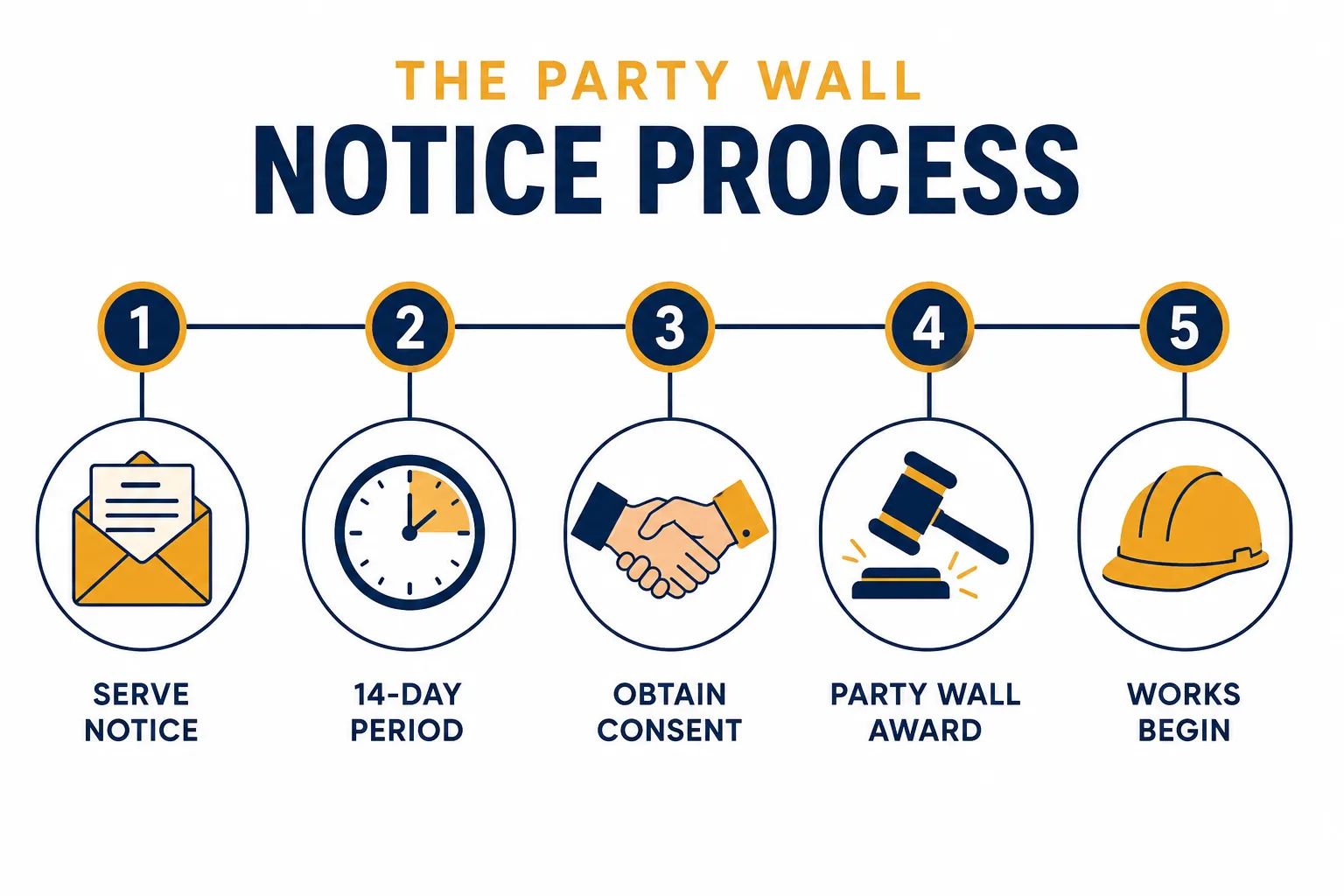
- Neighbours have 14 days to respond; if they dissent or ignore the notice, a Party Wall Award must be prepared before work can start.
- Party wall surveyor fees for underpinning projects typically range from around £800 to £2,000 per surveyor, depending on complexity and location.
- Proceeding without a valid notice is not a criminal offence, but it gives your neighbour grounds to seek an injunction and claim damages.
- A schedule of condition should be prepared before work starts to document the neighbour's property and protect both parties.
- Pre-existing foundation damage must be recorded and disclosed; it does not prevent you from proceeding but affects how the Award is drafted.
What Is a Party Wall Notice and Why Do You Need One for Loft Extension Underpinning
A Party Wall Notice is a formal written document served on an adjoining owner to inform them of proposed building works that affect a shared wall, boundary, or nearby foundations. Under the Party Wall etc. Act 1996, serving this notice is a legal requirement, not a courtesy, before specific categories of work begin.
For a loft extension on a Victorian terrace, underpinning is frequently necessary because the original foundations may not be deep enough to carry the increased load. That underpinning work almost always triggers the Act in one or more ways:
- Cutting into the party wall to insert steel beams (Section 2 Notice)
- Underpinning the party wall itself (Section 2 Notice)
- Excavating within 3 metres of a neighbour's structure to a depth below their foundations (Section 6 Notice)
- Excavating within 6 metres where the excavation depth would cut a line drawn at 45 degrees from the base of the neighbour's foundations (also Section 6 Notice)
Without a valid notice, your neighbour can apply to the courts to stop the work entirely. For a fuller overview of when the Act applies to loft projects, see this guide on whether loft conversions require party wall agreements.
Party Wall Act Requirements for Victorian Terrace Loft Extensions
The Party Wall etc. Act 1996 applies in England and Wales to any works that fall within its defined categories, regardless of the age of the property. Victorian terraces present a specific set of challenges that make compliance especially important.
Why Victorian properties need extra attention:
- Most Victorian terraces were built between roughly 1837 and 1901 with shallow brick strip foundations, often only 450mm to 600mm deep.
- The party walls themselves are frequently single or one-and-a-half brick construction, meaning any cutting or loading must be carefully engineered.
- Decades of settlement, tree root activity, and drainage issues mean the foundations may already be compromised before any new work begins.
Which notices apply:
| Notice Type | Trigger | Minimum Notice Period |
|---|---|---|
| Section 1 | New wall on or at the boundary | 1 month |
| Section 2 | Works to existing party wall | 2 months |
| Section 6 | Excavation near neighbour's foundations | 1 month |
For many loft extension underpinning projects, both a Section 2 and a Section 6 Notice will be required simultaneously. Learn more about the full scope of party wall services available to homeowners.
What Does a RICS Structural Engineer Check When Underpinning Victorian Foundations
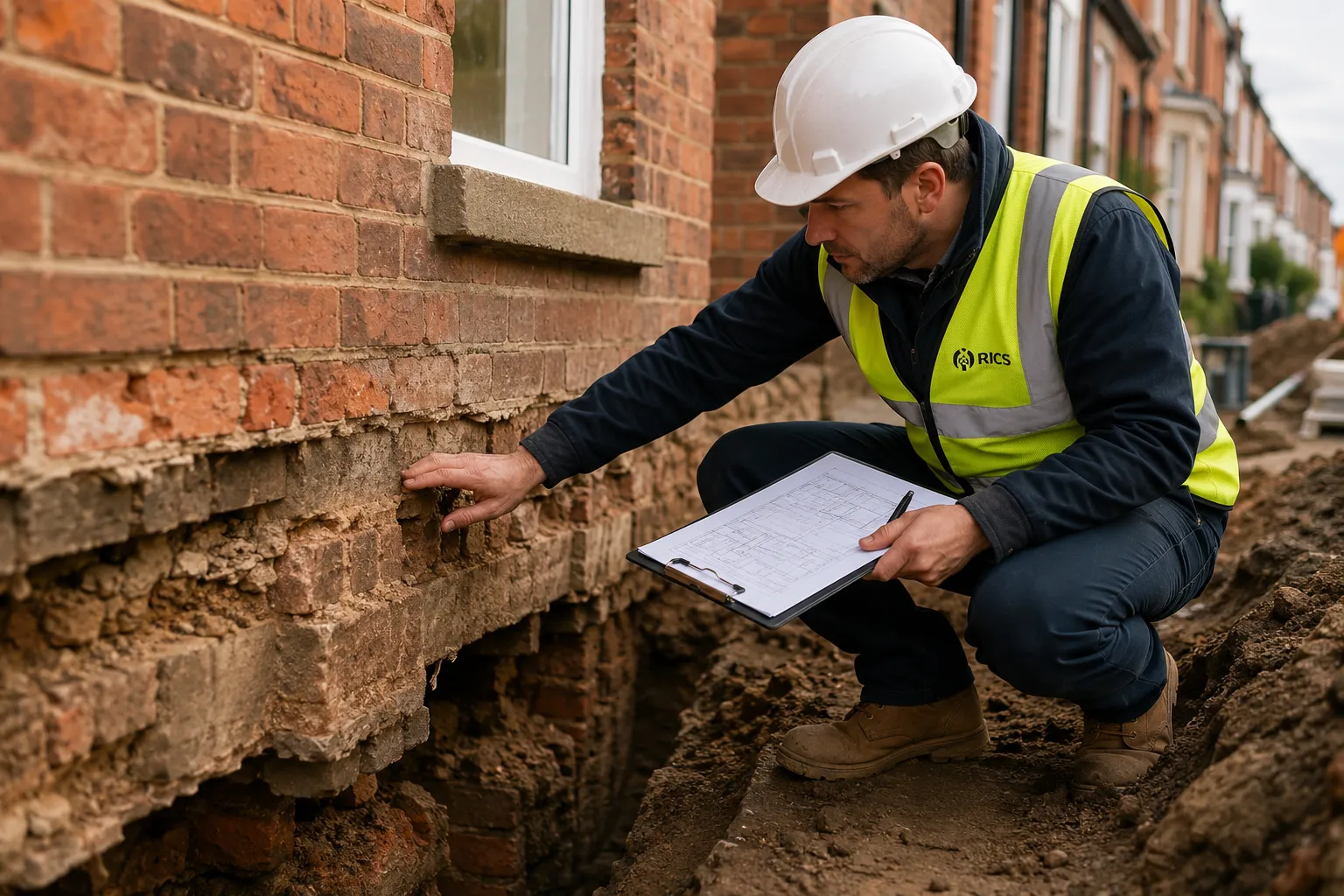
A RICS-qualified structural engineer carries out a detailed assessment of the existing foundation condition before underpinning work is designed or priced. This is separate from the party wall process but closely linked to it.
Key checks a RICS engineer performs:
- Foundation depth and type: Trial pits or non-invasive ground investigation to establish how deep the existing footings run and whether they are brick, mass concrete, or a combination.
- Load-bearing capacity: Calculation of whether the current foundations can carry the additional dead and live loads from a loft conversion.
- Ground conditions: Assessment of soil type (clay, sand, gravel) and any evidence of shrinkage, heave, or contamination.
- Existing cracking and movement: Mapping of cracks in the party wall and external walls to distinguish historic settlement from active movement.
- Drainage and tree proximity: Identification of drains that may have been undermined and trees whose roots could affect the new underpinning.
The findings feed directly into the party wall process. If the engineer identifies that the neighbour's foundations are also at risk during the works, this must be addressed in the Party Wall Award. For related guidance on what a structural engineer review involves in a party wall context, see checking engineers and party wall matters.
How Long Does the Party Wall Notice Process Take Before Work Can Start
The minimum statutory notice periods are fixed by the Act, but the total timeline depends on how quickly neighbours respond and whether disputes arise.
Typical timeline for underpinning works:
- Section 2 Notice: 2-month notice period before work can begin
- Section 6 Notice: 1-month notice period
- Neighbour's response window: 14 days from service of notice
- If no response or dissent: A Party Wall Award must be prepared, which typically takes 4 to 8 weeks after the 14-day window closes
- Agreed surveyor appointment: Can reduce overall time compared to each party appointing their own surveyor
In practice, allow a minimum of 2 to 3 months from serving notice to starting work if the neighbour consents promptly. If a dispute arises, 4 to 6 months is more realistic. Starting the notice process early, ideally before finalising your contractor, is the most effective way to avoid delays.
How Much Does a Party Wall Surveyor Cost for Underpinning Work
Party wall surveyor fees for underpinning projects are typically higher than for straightforward loft conversions because the works are more complex and the risk to adjoining properties is greater.
Typical fee ranges (estimates for 2026, London and South East):
- Building owner's surveyor: £800 to £1,500 for a standard underpinning project
- Adjoining owner's surveyor: £700 to £1,400 (usually paid by the building owner)
- Agreed surveyor (single surveyor for both parties): £1,000 to £1,800 total, often the most cost-effective route
- Schedule of condition: £300 to £600 as a standalone item, though often included in the overall fee
The building owner is responsible for the reasonable costs of the adjoining owner's surveyor. For a detailed breakdown of what drives costs up or down, see this guide to party wall agreement costs.
"The building owner bears the reasonable surveying costs of their neighbour, choosing an agreed surveyor where possible is the most straightforward way to keep fees proportionate."
Can You Do Loft Extension Underpinning Without a Party Wall Notice
No. If the works fall within the scope of the Party Wall etc. Act 1996, proceeding without a valid notice is unlawful. It does not constitute a criminal offence, but the consequences are serious and practical.
What can happen if you skip the notice:
- Your neighbour can apply to the courts for an injunction to stop the work immediately, even mid-project.
- You may be liable for any damage caused to the adjoining property, with no agreed baseline (schedule of condition) to dispute claims.
- Your buildings insurance may not cover damage arising from works that breached the Act.
- Retrospective party wall awards are possible but complicated and expensive to arrange.
The only scenario where no notice is needed is if the loft conversion is entirely internal, involves no cutting into the party wall, and requires no excavation near the boundary. For most Victorian terraces, at least one of those conditions will not be met. See the consequences of ignoring the Party Wall Act for a fuller account of the risks.
Party Wall Notice vs Structural Engineer Report: Understanding the Difference
These are two distinct professional services that serve different purposes, though both are needed for underpinning works on a Victorian terrace.
Party Wall Notice and Award:
- A legal process under statute
- Managed by party wall surveyors (who may or may not be structural engineers)
- Protects the rights of both the building owner and the adjoining owner
- Results in a Party Wall Award that sets out how the works must be carried out
RICS Structural Engineer Report:
- A technical assessment of the building's structure and foundations
- Informs the design of the underpinning scheme
- Provides the technical evidence that the party wall surveyor needs to draft a robust Award
- May also be required by the local authority for building regulations approval
The two processes run in parallel. The structural engineer's drawings and specifications are typically appended to the Party Wall Award as the agreed method of working.
What Happens If Your Neighbour Objects to the Party Wall Notice for Underpinning
If a neighbour dissents from the notice or fails to respond within 14 days, a dispute is deemed to have arisen under the Act. This does not mean the project stops permanently, it triggers the formal dispute resolution process.
Steps after a dissent or non-response:
- Both parties appoint their own party wall surveyors (or agree on a single agreed surveyor).
- The surveyors prepare a Party Wall Award, which sets out the scope of works, working hours, protective measures, and compensation provisions.
- A schedule of condition of the neighbour's property is prepared and appended to the Award.
- Work can begin once the Award is signed by both surveyors.
An Award can be appealed to the County Court within 14 days of service, but appeals are relatively rare. For detailed guidance on what to do when a neighbour refuses party wall works, the process is well established and manageable with the right surveyor.
What Is a Party Wall Award and What Does It Cover for Loft Extension Underpinning
A Party Wall Award is the legally binding document produced by the appointed surveyors that governs how the notifiable works are carried out. For underpinning projects, it is more detailed than for simpler loft conversions.
Typical contents of a Party Wall Award for underpinning:
- Description and drawings of the proposed underpinning works
- Schedule of condition of the adjoining property (photographs and written record)
- Permitted working hours and noise restrictions
- Method statement for excavation and underpinning sequences
- Requirements for temporary support and propping
- Insurance requirements
- Provisions for making good any damage caused
- Access rights for the surveyor to inspect during works
The Award is enforceable in the same way as a court order. For more on what party wall awards contain and how they work, see the party wall awards service page.
Common Mistakes People Make with Party Wall Notices on Victorian Terraces
Several avoidable errors consistently cause delays, disputes, and additional costs on Victorian terrace underpinning projects.
The most frequent mistakes:
- Serving notice too late: Leaving notice to the last minute means the statutory periods push back the start date, often disrupting contractor schedules.
- Serving the wrong notice type: Using a Section 2 Notice when a Section 6 Notice is also needed (or vice versa) invalidates the process for those works.
- Incorrect service: Notice must be served on every adjoining owner, including freeholders and long leaseholders. Missing one party leaves the process defective.
- No schedule of condition: Without a pre-works record of the neighbour's property, any damage claim becomes a dispute about what existed before.
- Assuming consent means no surveyor is needed: Even where a neighbour consents in writing, a schedule of condition is still strongly advisable for underpinning works given the risk of settlement damage.
- Not disclosing pre-existing damage: If the neighbour's foundations are already cracked or damaged, this must be recorded. Concealing it creates liability.
For a broader look at what can go wrong, the top party wall agreement renovation mistakes guide covers the most common pitfalls.
Do You Need a Party Wall Notice for an Internal Loft Conversion or Just for Underpinning
An internal loft conversion that involves no structural work to the party wall and no excavation does not trigger the Party Wall etc. Act 1996. However, most loft conversions on Victorian terraces do involve at least one notifiable element.
Works that do NOT require a notice:
- Installing insulation, boarding, or lighting within the existing roof space
- Fitting a dormer that sits entirely within your own roof structure and does not touch the party wall
- Internal stud partitioning that does not connect to the party wall
Works that DO require a notice:
- Inserting steel beams into or through the party wall
- Raising the party wall to accommodate a new roof line
- Any underpinning of the party wall or foundations
- Cutting chases or pockets into the party wall for structural connections
When in doubt, a brief consultation with a party wall surveyor before work is designed will confirm which notices are needed. This is far cheaper than correcting an invalid process mid-project.
How to Serve a Party Wall Notice Correctly for Underpinning Work
Serving a valid notice requires attention to specific legal requirements. An incorrectly served notice can be challenged and may need to be re-served, restarting the notice period.
Step-by-step process:
- Identify all adjoining owners: This includes freeholders, long leaseholders (leases over 12 months), and any mortgagees with a right to be notified.
- Select the correct notice type: Section 2 for party wall works, Section 6 for excavations, or both where applicable.
- Prepare the notice document: It must include your name and address, the address of the property, a description of the proposed works, and the proposed start date.
- Attach plans and drawings: For underpinning, structural drawings should accompany the notice to give the adjoining owner a clear picture of what is proposed.
- Serve the notice: By hand, first-class post, or recorded delivery. Email is not currently accepted as valid service under the Act.
- Record service: Keep proof of delivery and the date served.
- Await response: The neighbour has 14 days to consent in writing, dissent, or be deemed to have dissented.
A party wall surveyor can draft and serve the notice on your behalf, which reduces the risk of technical errors.
What If Your Victorian Terrace Foundation Is Already Damaged Before Underpinning
Pre-existing foundation damage does not prevent you from proceeding with underpinning, but it must be properly recorded and addressed in the Party Wall Award.
How to handle pre-existing damage:
- Commission a RICS structural engineer to assess and document the existing condition of both your foundations and the party wall before any notice is served.
- Ensure the schedule of condition records all existing cracks, movement, and damage in the adjoining property with photographs and written descriptions.
- Disclose the findings to the party wall surveyors so the Award can include appropriate protective measures.
- The structural engineer's underpinning design should address the pre-existing condition, not just the new loading requirements.
Pre-existing damage that is not recorded creates a significant risk: if the neighbour later claims that the underpinning caused damage that was actually there before, there is no baseline to defend against that claim. A thorough party wall schedule of condition is the most effective protection for both parties.
Interactive Tool: Party Wall Notice Checker for Loft Underpinning
.pw-checker{font-family:Arial,sans-serif;max-width:540px;margin:0 auto;background:#f7f9fc;border:1px solid #d0d8e4;border-radius:8px;padding:20px}
.pw-checker h3{margin:0 0 14px;font-size:1.1rem;color:#1a2e4a}
.pw-q{margin-bottom:12px}
.pw-q label{display:block;font-size:.9rem;color:#333;margin-bottom:5px;font-weight:600}
.pw-q select{width:100%;padding:7px 10px;border:1px solid #b0bec5;border-radius:5px;font-size:.9rem;background:#fff}
.pw-btn{background:#1a2e4a;color:#fff;border:none;padding:10px 22px;border-radius:5px;font-size:.95rem;cursor:pointer;margin-top:6px}
.pw-btn:hover{background:#2c4a72}
.pw-result{margin-top:14px;padding:12px;border-radius:6px;font-size:.88rem;line-height:1.5;display:none}
.pw-result.show{display:block}
.pw-result.warn{background:#fff3cd;border:1px solid #f0c040;color:#7a5000}
.pw-result.ok{background:#e8f5e9;border:1px solid #81c784;color:#1b5e20}
.pw-result.alert{background:#fdecea;border:1px solid #e57373;color:#7f0000}
Party Wall Notice Checker
function pwCheck(){
var q1=document.getElementById(‘q1’).value,q2=document.getElementById(‘q2’).value,q3=document.getElementById(‘q3’).value;
var r=document.getElementById(‘pwResult’);
if(!q1||!q2||!q3){r.className=’pw-result show warn’;r.innerHTML=’Please answer all three questions.’;return;}
var notices=[];
if(q1===’yes’||q3===’yes’) notices.push(‘Section 2 Notice (2-month notice period)’);
if(q2===’yes’) notices.push(‘Section 6 Notice (1-month notice period)’);
if(notices.length===0){r.className=’pw-result show ok’;r.innerHTML=’No party wall notice appears required for these works. Confirm with a party wall surveyor if you are unsure.’;}
else{r.className=’pw-result show alert’;r.innerHTML=’Notice(s) required:
‘+notices.join(‘
‘)+’
Serve notice before work begins. Consult a RICS party wall surveyor to draft and serve the correct documentation.’;}
}
Frequently Asked Questions
Do I need a party wall notice for every loft conversion on a Victorian terrace?
Not automatically. The notice is required only if the works involve cutting into or raising the party wall, underpinning, or excavating near the neighbour's foundations. A purely internal loft conversion with no structural work to the party wall does not trigger the Act, though this is rare on Victorian terraces.
Who pays for the neighbour's party wall surveyor?
The building owner (the person carrying out the works) is responsible for the reasonable costs of the adjoining owner's surveyor. This applies whether the neighbour appoints their own surveyor or both parties use an agreed surveyor.
Can my neighbour stop my loft extension underpinning permanently?
No. The Act does not give neighbours a right of veto. If they dissent, a Party Wall Award is prepared by the surveyors, which allows the works to proceed subject to agreed conditions. A neighbour can appeal an Award to the County Court within 14 days, but the courts rarely overturn a properly prepared Award.
What is the difference between a party wall surveyor and a structural engineer?
A party wall surveyor manages the legal process under the Act, prepares the Award, and protects both parties' rights. A structural engineer designs the underpinning scheme and assesses foundation safety. For underpinning projects, both professionals are typically required and their work feeds into each other.
How far in advance should I serve the party wall notice before starting my loft extension?
For underpinning works requiring a Section 2 Notice, the minimum is 2 months before the proposed start date. In practice, serve notice as soon as the structural drawings are ready, ideally 3 to 4 months before you plan to start, to allow time for any dissent and Award preparation.
What happens to the party wall process if my neighbour is abroad or uncontactable?
If an adjoining owner cannot be found after reasonable attempts, the Act allows for the appointment of a surveyor on their behalf. Document all attempts to contact them. A party wall surveyor can advise on the correct procedure to ensure the process remains valid.
Is a schedule of condition compulsory for underpinning works?
It is not legally compulsory, but it is strongly advisable and most party wall surveyors will insist on it for underpinning projects. Without a pre-works record, any damage claim after the works is much harder to resolve fairly for either party.
Conclusion
Party Wall Notices for Loft Extension Underpinning: RICS Checks for Victorian Terrace Foundations sit at the intersection of property law and structural engineering, and getting both right is essential for any Victorian terrace loft project. The legal process and the technical assessment are not optional extras, they are the framework that allows the works to proceed safely and without costly disputes.
Actionable next steps:
- Appoint a RICS structural engineer early to assess your existing foundations and confirm whether underpinning is needed and what type.
- Once structural drawings are underway, instruct a party wall surveyor to identify which notices are required and serve them at least 2 to 3 months before your planned start date.
- Ensure a schedule of condition is prepared for all adjoining properties before work begins.
- Keep records of all notice service, responses, and correspondence throughout the process.
- If your neighbour dissents, do not panic, work with your surveyor to progress the Award efficiently.
For professional guidance on party wall matters and RICS surveys across London and the South East, contact a chartered surveyor to discuss your specific project before committing to a contractor or start date.
Tags: party wall notice, loft extension underpinning, Victorian terrace foundations, RICS structural engineer, Party Wall Act 1996, party wall surveyor cost, party wall award, underpinning foundations, loft conversion party wall, schedule of condition, building owner rights, party wall dispute