

Roughly one in three party wall awards issued under the Party Wall etc. Act 1996 now faces some form of challenge, ranging from informal objections to full county court appeals. For homeowners and developers caught in that escalating minority, a standard party wall surveyor is no longer sufficient. Party Wall Disputes: When to Hire an Expert Witness Surveyor and What Evidence They Need is a question that sits at the intersection of property law, structural engineering, and civil procedure, and getting the answer wrong can cost tens of thousands of pounds in legal fees, remediation costs, and delayed construction programmes.
This article explains precisely when a dispute moves beyond the scope of a party wall surveyor's ordinary role, how an expert witness surveyor operates under court rules, and what documentary and physical evidence must be assembled before litigation begins.
Key Takeaways
- A standard party wall surveyor resolves disputes through the award process; an expert witness surveyor provides independent, court-admissible opinion evidence when that process fails or is challenged.
- Expert witness involvement is triggered by county court appeals, disputed structural damage, or challenges to surveyor conduct or jurisdiction under the 1996 Act.
- All expert evidence in civil proceedings is governed by CPR Part 35 and Practice Direction 35, non-compliance renders reports inadmissible.
- The expert's overriding duty is to the court, not to the instructing party; this independence is what gives the evidence its legal weight.
- Homeowners should begin assembling evidence, schedules of condition, photographs, structural assessments, and correspondence, long before any formal dispute is declared.
When a Standard Party Wall Survey Is Not Enough
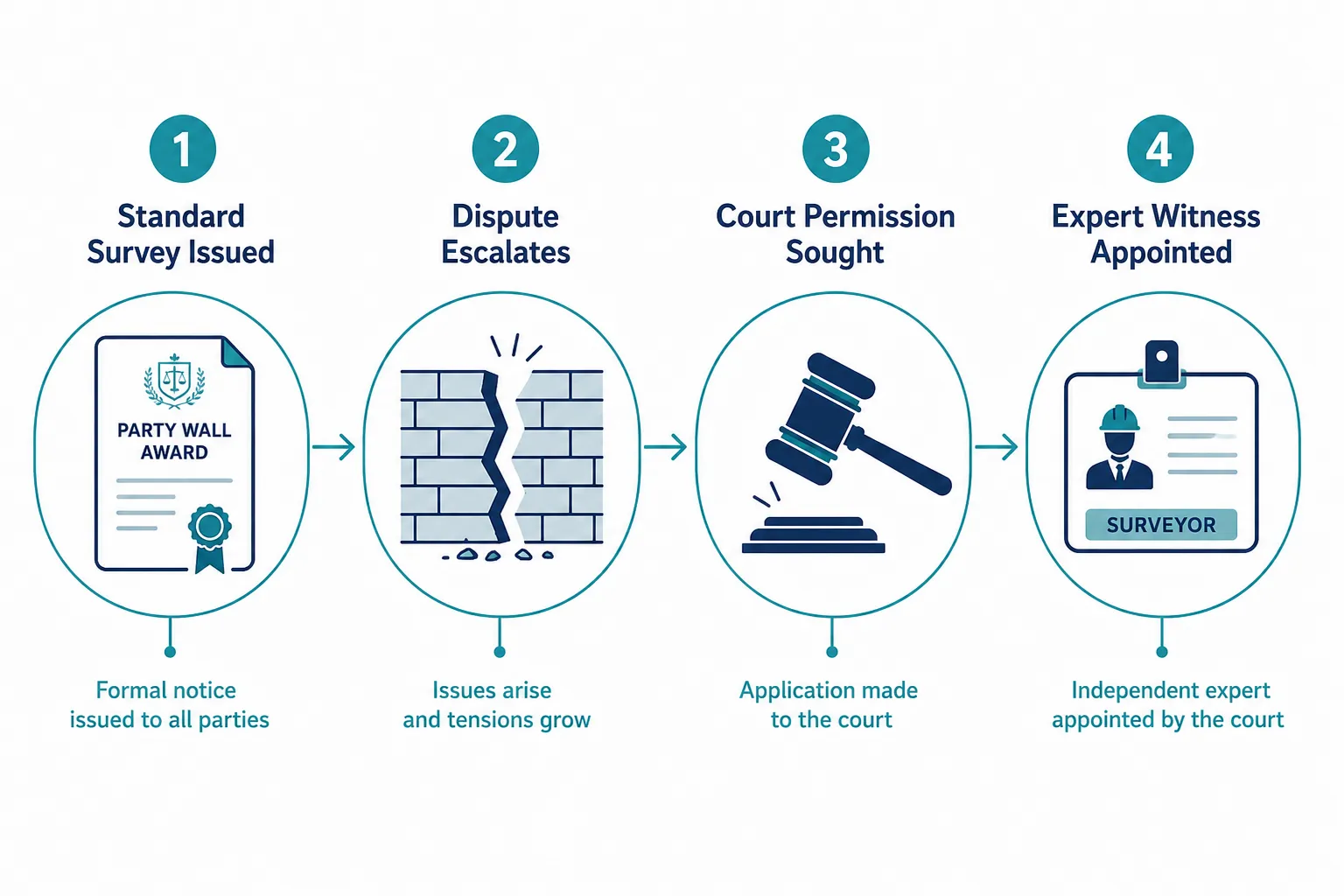
The Party Wall etc. Act 1996 creates a statutory framework for resolving disagreements between building owners and adjoining owners before and during construction works. A party wall surveyor appointed under that framework produces an award, a binding document that sets out the rights and obligations of each party, the manner in which works must be carried out, and any compensation due [1].
In straightforward cases, this process works well. The dispute is contained within the statutory mechanism, costs are proportionate, and construction can proceed. However, certain circumstances expose the limits of the ordinary award process and demand a higher level of expert input.
The ordinary award process breaks down when:
- The award itself is appealed in the county court within 14 days of service
- Structural damage such as cracking, movement, or subsidence is alleged and causation is genuinely disputed
- The adequacy or reasoning of the original award is questioned by either party
- Surveyor conduct, impartiality, or jurisdiction under the 1996 Act is challenged [4]
At this point, the parties move from a statutory dispute resolution mechanism into civil litigation territory. The rules change entirely. Evidence must meet court standards. Opinion evidence from a surveyor is only admissible if that surveyor has been properly instructed as an expert witness and their report complies with CPR Part 35 [2].
For a broader understanding of how party wall surveys are managed in active development markets, the article on party wall surveys in recovery markets managing notices and disputes provides useful context on how escalating construction activity increases the frequency of contested awards.
It is also worth noting that the RICS launched a consultation on updated party wall practice guidance in 2026, signalling growing scrutiny of how awards are reasoned and documented [5]. Surveyors who have not kept pace with those updated standards face greater exposure when their awards are challenged.
The Distinction Between a Party Wall Surveyor and an Expert Witness Surveyor
These are not the same role, and conflating them is a common and costly mistake.
| Role | Appointed by | Duty owed to | Output |
|---|---|---|---|
| Party wall surveyor | Building owner, adjoining owner, or jointly | The statutory process | Party wall award |
| Expert witness surveyor | One party (or jointly by court direction) | The court (overriding duty) | CPR Part 35-compliant report |
A party wall surveyor acts as a quasi-arbitrator within the 1996 Act framework. An expert witness surveyor provides independent opinion evidence to assist the court in resolving a technical question that is beyond the knowledge of a judge or lay tribunal [2]. The expert's overriding duty is to the court, not to the client who pays the fee, a principle that is non-negotiable under CPR Part 35 [6].
Understanding the Legal Framework: CPR Part 35 and Expert Evidence in Party Wall Disputes
The Civil Procedure Rules govern all civil litigation in England and Wales, and Part 35 specifically controls the use of expert evidence. For anyone navigating Party Wall Disputes: When to Hire an Expert Witness Surveyor and What Evidence They Need, understanding CPR Part 35 is not optional, it is the foundation on which all court-admissible surveying evidence rests.
Three core principles apply [6]:
- No party may call an expert or rely on an expert report without the court's permission. This means the court controls whether expert evidence is even allowed, and on what issues.
- Expert evidence must be restricted to what is reasonably required to resolve the proceedings. Courts actively limit the scope of expert reports to prevent disproportionate costs.
- Expert evidence is normally given in a written report, with oral evidence only if the court directs. The written report is the primary vehicle; cross-examination at trial is the exception, not the rule.
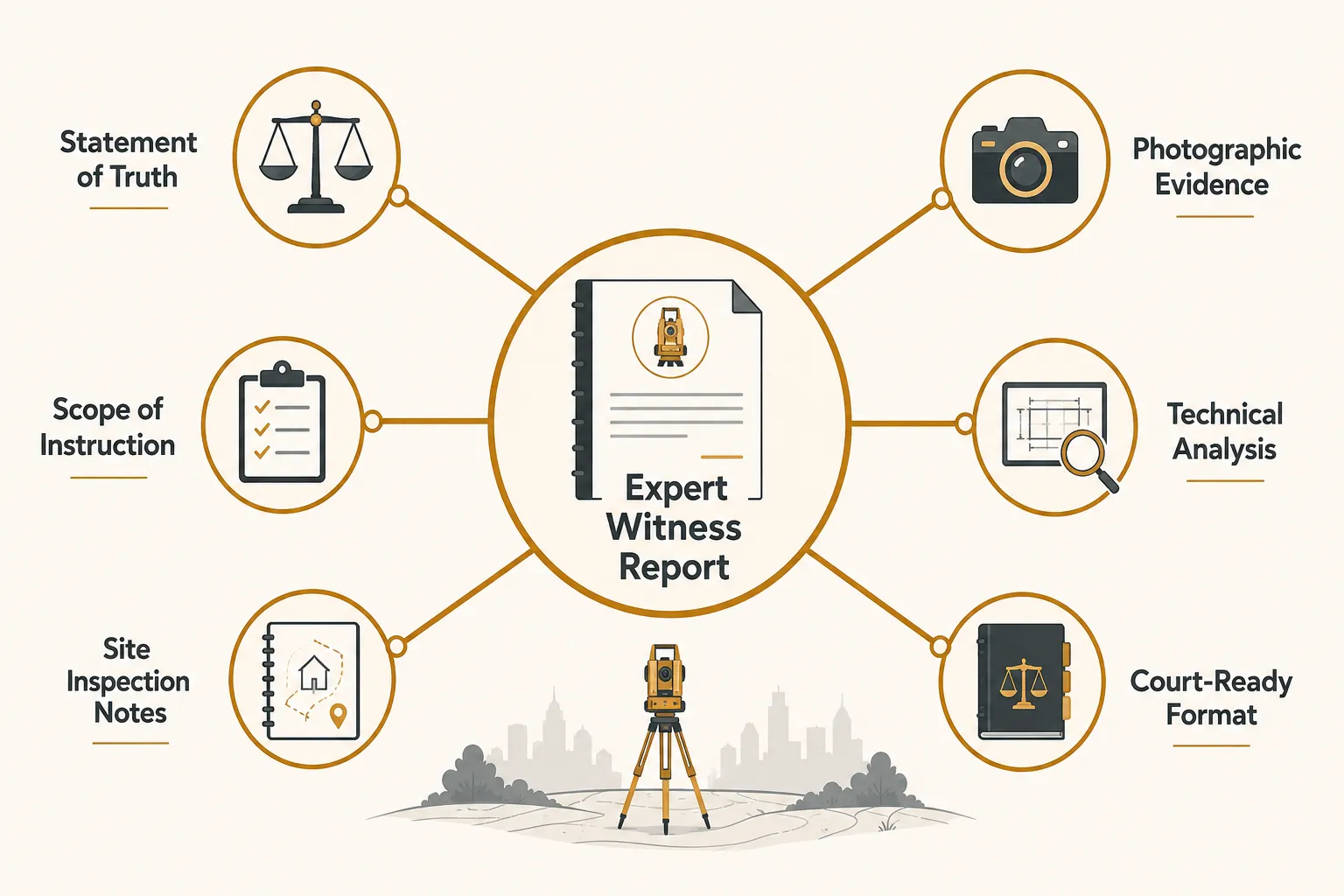
Practice Direction 35 sets out the mandatory contents of any expert report. A report that omits required elements will not be accepted by the court [3].
Mandatory contents of a CPR Part 35-compliant expert report include:
- Details of the expert's qualifications and relevant experience
- A statement of the substance of all instructions received (whether written or oral)
- A statement that the expert understands their duty to the court and has complied with it
- Where there is a range of opinion on a matter, a summary of that range and the expert's reasons for their own view
- A summary of the conclusions reached
- A statement of truth in the prescribed form [3]
"The expert's report must contain a statement that the expert understands their duty to the court and has complied with that duty. Without this, the report is defective on its face."
For surveyors seeking to understand how these protocols apply across different dispute types in 2026, the expert witness roles in 2026 UK property disputes RICS protocols article provides a useful comparative framework.
RICS Professional Standards for Expert Witness Surveyors
The RICS publishes a professional standard titled "Surveyors Acting as Expert Witnesses," which sets out the competence and conduct requirements for RICS members accepting expert witness instructions [2]. The August 2026 update to this standard introduced tighter requirements around:
- Conflict of interest checks before accepting instructions
- Scope of instruction letters that clearly define the issues the expert is asked to address
- Continuous professional development in expert witness practice as a condition of ongoing competence
A surveyor who accepts expert witness instructions without meeting these standards exposes both themselves and their instructing party to significant risk. Courts have struck out expert reports where the expert lacked relevant specialism or failed to disclose a conflict [2].
For a detailed examination of how expert witness testimony is constructed using modern survey technology, the article on expert witness testimony in boundary disputes leveraging latest survey technology is directly relevant, particularly where structural surveys and measured data form part of the evidence.
What Evidence an Expert Witness Surveyor Needs: A Practical Guide
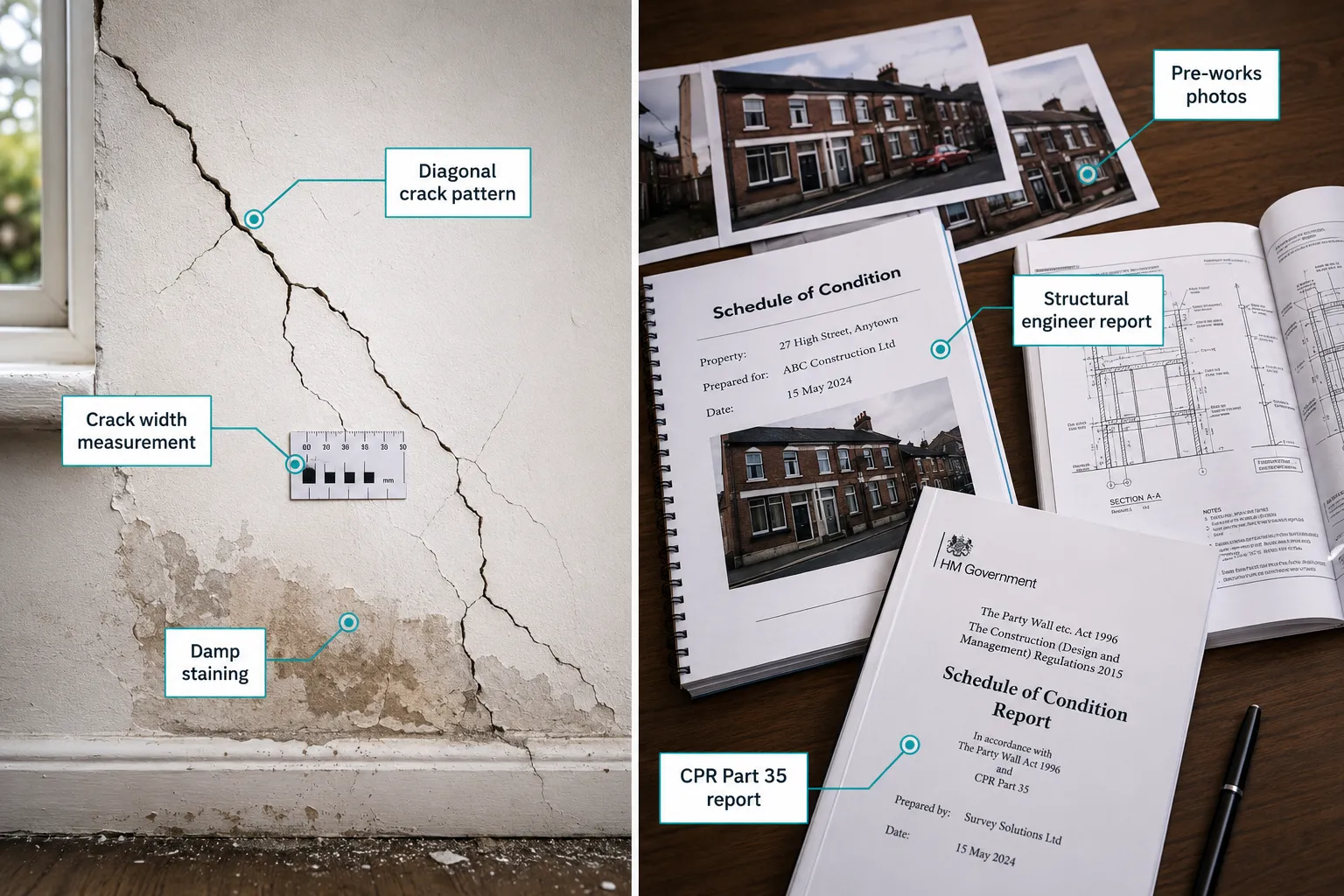
Assembling the right evidence is where many party wall disputes are won or lost before a single court hearing takes place. Party Wall Disputes: When to Hire an Expert Witness Surveyor and What Evidence They Need ultimately comes down to the quality and completeness of the evidence base the expert can draw upon.
The expert witness surveyor does not simply inspect the property and write an opinion. They must construct a technically rigorous, court-admissible analysis that traces causation, quantifies damage, and addresses the specific legal questions the court has permitted them to answer [4].
Pre-Works Evidence
The single most important category of evidence in any structural damage dispute is the Schedule of Condition prepared before works began. This is a detailed photographic and written record of the existing state of the adjoining owner's property at the time the party wall notice was served.
A robust Schedule of Condition should include:
- High-resolution photographs of all internal and external walls, floors, and ceilings adjacent to the works
- Written descriptions of any pre-existing cracks, defects, or movement, with crack width measurements recorded
- Date-stamped metadata on all photographs
- A signed acknowledgement by both parties (or their surveyors) confirming the schedule is agreed
Where no Schedule of Condition was prepared, or where it was inadequate, the expert witness surveyor faces a significantly harder task in establishing whether damage was caused by the notifiable works or pre-existed them [10].
Post-Works Structural Evidence
Once damage is alleged, the expert must gather:
- Crack mapping surveys showing the location, orientation, width, and depth of all cracking
- Movement monitoring data where available (tell-tales, crack gauges, or digital monitoring records)
- Structural engineering reports addressing the mechanism of damage and likely cause
- Ground investigation data where subsidence or soil movement is alleged
The expert is expected to consider alternative causes, including pre-existing defects, thermal movement, or independent structural issues, and to explain why those alternatives are or are not consistent with the observed damage pattern [4].
Documentary Evidence
Beyond physical inspection, the expert witness surveyor will require access to a comprehensive documentary record:
- The original party wall notice and any counter-notices
- The party wall award, including any schedules or appendices
- All correspondence between the parties and their surveyors
- The building owner's construction drawings, specifications, and method statements
- Any contractor's records, including daily logs, monitoring records, and incident reports
- Planning permissions and building regulations approvals
This documentary record allows the expert to assess whether the works were carried out in accordance with the award and whether any departures from the agreed method of working contributed to the alleged damage [9].
Expert-to-Expert Discussions
In cases where both parties instruct their own expert witness surveyors, the court will typically direct the experts to meet, discuss the issues, and produce a Joint Statement setting out the areas of agreement and disagreement. This process, sometimes called a "without prejudice" experts' meeting, is a critical stage in litigation and often narrows the issues significantly before trial [3].
The Joint Statement must accurately reflect the experts' genuine views. It is not a negotiating document, and any attempt to use it as one risks a finding of professional misconduct [2].
For those involved in disputes arising from the current infrastructure and retrofit construction surge, the party wall surveys for 2026 UK retrofit projects RICS checklists and cost escalation protections article addresses the specific evidence challenges that arise in those project types.
How Homeowners Should Prepare Before Litigation
Most homeowners involved in a party wall dispute do not anticipate that it will escalate to court. By the time litigation becomes likely, the window for gathering the best evidence has often passed. The following steps should be taken as early as possible, ideally before works begin.
Step 1: Instruct a Competent Party Wall Surveyor from the Outset
The quality of the original party wall award directly affects the strength of any subsequent expert witness case. An award that is poorly reasoned, inadequately documented, or procedurally defective is far more vulnerable to appeal [5]. Instructing a surveyor with demonstrable experience in contested matters, not just routine awards, reduces this risk considerably.
For answers to common questions about the party wall survey process, the top 9 questions about party wall surveys resource covers the fundamentals that every property owner should understand before serving or receiving a notice.
Step 2: Insist on a Thorough Schedule of Condition
As noted above, the Schedule of Condition is the foundation of any damage claim. Adjoining owners should not accept a cursory schedule. If the building owner's surveyor produces an inadequate schedule, the adjoining owner's surveyor should prepare a supplementary one independently.
Step 3: Document Everything in Writing
All communications with the building owner, their contractor, and their surveyor should be in writing. Verbal agreements, informal assurances, and undocumented site visits are of limited evidential value in court proceedings. A contemporaneous written record, including emails, letters, and dated site notes, is far more persuasive [9].
Step 4: Seek Legal Advice Early
Solicitors specialising in property litigation can advise on whether a dispute is likely to require expert evidence, what directions the court is likely to make, and how to manage costs proportionately. Early legal advice also helps avoid procedural errors, such as missing the 14-day appeal window, that can extinguish rights entirely.
Step 5: Instruct an Expert Witness Surveyor with the Right Specialism
Not every surveyor is qualified to act as an expert witness. The instructing party should verify that the proposed expert:
- Holds RICS membership and has completed relevant CPD in expert witness practice [2]
- Has specific experience in party wall disputes, structural damage assessment, or construction defects as relevant to the case
- Has no conflict of interest with any party, their solicitors, or their other advisers
- Is available to meet court timetables, including experts' meetings and trial dates
The expert witness preparation for 2026 valuation disputes navigating disagreements article, while focused on valuation disputes, contains directly transferable guidance on how experts should structure their preparation and manage conflicting technical evidence.
Common Pitfalls in Party Wall Expert Witness Cases
Even well-prepared cases can be undermined by avoidable errors. The following are the most frequently encountered problems in party wall expert witness proceedings:
Pitfall 1: Using the party wall surveyor as the expert witness
The party wall surveyor who produced the original award has an inherent conflict of interest if asked to act as expert witness in a challenge to that award. Courts have refused to accept such evidence [4].
Pitfall 2: Inadequate photographic evidence
Photographs without metadata, scale references, or clear location identifiers are of limited evidential value. The expert must be able to demonstrate precisely where each photograph was taken and when.
Pitfall 3: Failure to address alternative causation
An expert report that simply asserts the works caused the damage, without engaging with alternative explanations, will be vulnerable to challenge. Courts expect experts to demonstrate that they have genuinely considered and excluded other causes [6].
Pitfall 4: Exceeding the permitted scope of the report
If the court has given permission for expert evidence on structural causation, the expert must not stray into quantum of loss, negligence, or other issues outside the permitted scope. Doing so risks the report being disallowed in part or in full [3].
Pitfall 5: Late instruction of the expert
Instructing an expert witness after key evidence has been lost, altered, or disputed significantly weakens the case. Early instruction, even in an advisory capacity before formal proceedings, is strongly recommended.
Conclusion
Party wall disputes that escalate beyond the statutory award process enter a more demanding evidential and procedural environment. The transition from party wall surveyor to expert witness surveyor is not merely a change of title, it represents a fundamental shift in duty, methodology, and the standards to which all evidence will be held.
Actionable next steps for homeowners and developers facing a contested party wall dispute:
- Audit your existing evidence, review the Schedule of Condition, correspondence file, and award documentation for gaps before instructing an expert.
- Instruct an RICS-accredited expert witness surveyor with specific party wall and structural damage experience at the earliest opportunity.
- Seek specialist property litigation advice to understand court timetables, cost budgeting obligations, and the likely scope of permitted expert evidence.
- Preserve all physical evidence, do not carry out remedial works to alleged damage until it has been inspected, photographed, and documented by the expert.
- Engage constructively in the experts' meeting process, the Joint Statement stage frequently resolves disputes that appeared irreconcilable at the outset.
The cost of getting this process right is modest compared to the cost of contested litigation without adequate expert support. Early, well-evidenced expert witness involvement remains the most reliable route to a proportionate and defensible outcome.
References
[1] Party Wall Surveyor – partneresi.com
[2] Surveyors Acting As Expert Witnesses – rics.org
[3] CPR 35 Compliant Reports Court Appearance – redmondassociates.co.uk
[4] Expert Witness Roles In Party Wall Award Challenges 2026 Case Law And RICS Best Practices – Expert witness roles in party wall award challenges 2026 case law and rics best practices
[5] RICS Launches Consultation On Updated Party Wall Practice Guidance – rics.org
[6] CPR Part 35 Expert Witness Report – surveymerchant.com
[9] Construction Dispute Resolution 101 – oseimc.com
[10] Party Walls – jspubs.com