

Last updated: July 24, 2026
Quick Answer: When a party wall award is challenged in court, an expert witness provides independent technical evidence on construction methods, structural impact, and surveyor conduct. In 2026, RICS guidance and recent case law have tightened the standards for who qualifies, what they must prepare, and how courts weigh their testimony. Getting the right expert early can determine whether a challenge succeeds or fails.
Key Takeaways
- A party wall award can be challenged in the county court within 14 days of service, but courts retain discretion in exceptional circumstances.
- Expert witnesses in party wall cases must be independent, impartial, and comply with Civil Procedure Rules (CPR) Part 35.
- RICS 7th edition guidance (updated 2026) sets the professional conduct framework for surveyors acting as expert witnesses.
- Recent cases including Power v Shah (Court of Appeal, 2023) and Taylor v Jones (Court of Appeal, 2024) have shaped how courts treat expert evidence on jurisdiction and quantum.
- The expert witness role is distinct from the party wall surveyor role; conflating them is one of the most common and costly mistakes.
- Costs for an expert witness surveyor typically range from £2,000 to £10,000 or more depending on complexity and court level.
- Strong expert evidence requires a thorough schedule of condition, technical drawings, and a clear methodology.
- Hiring an expert too late, or choosing one without court experience, significantly weakens a party wall challenge.

What Is a Party Wall Award and When Do You Need to Challenge It
A party wall award is a legally binding document produced by appointed surveyors under the Party Wall etc. Act 1996. It sets out the rights and obligations of both the building owner and the adjoining owner before, during, and after notifiable construction works.
You may need to challenge an award if:
- The award was made without proper jurisdiction (for example, no valid notice was served)
- The works described go beyond what the Act permits
- The award imposes unreasonable or unlawful conditions
- There are errors in the schedule of condition that could affect compensation claims
- The surveyor acted outside their authority or with apparent bias
Under Section 10(17) of the Act, either party may appeal to the county court. The standard timeframe is 14 days from service of the award. Courts have historically treated this as a strict deadline, though recent commentary from early 2026 confirms that judges retain limited discretion where there is a compelling reason for delay. For a broader overview of how awards work in practice, see this guide to party wall awards.
What Does an Expert Witness Actually Do in a Party Wall Dispute
An expert witness provides the court with independent, objective technical opinion that falls outside the knowledge of a judge or lay person. In party wall cases, this typically means giving evidence on structural engineering, construction methodology, surveyor conduct, or the adequacy of the award itself.
Key tasks include:
- Reviewing the award and supporting documents for technical accuracy
- Inspecting the property and preparing or reviewing a schedule of condition
- Producing a CPR Part 35-compliant expert report setting out findings and opinions
- Attending court to give oral evidence and be cross-examined
- Preparing a joint statement if the court directs a meeting of experts from both sides
The expert's duty is to the court, not to the party who instructed them. This is a fundamental principle under CPR Part 35 and one that courts scrutinise closely. An expert who appears to advocate for their client rather than assist the court will lose credibility quickly. For professional expert witness report services, see expert witness reports.
What Is the Difference Between a Party Wall Surveyor and an Expert Witness
These are two distinct roles, and confusing them is a common and expensive mistake. A party wall surveyor acts during the statutory process under the 1996 Act to produce the award. An expert witness acts after a dispute reaches litigation, providing independent technical opinion to the court.
| Feature | Party Wall Surveyor | Expert Witness Surveyor |
|---|---|---|
| When appointed | Before or during works | After dispute reaches court |
| Duty owed to | Both parties (quasi-judicial) | The court |
| Output | Party wall award | CPR Part 35 expert report |
| Regulated by | Party Wall Act 1996 | CPR Part 35, RICS guidance |
| Can be same person? | Rarely advisable | Usually a separate appointment |
A party wall surveyor who produced the original award should not then act as expert witness in a challenge to that same award. The conflict of interest is obvious and courts will not accept it. Learn more about how the agreed surveyor role works under the Act.
What Qualifications Does an Expert Witness Need for Party Wall Matters
An expert witness in party wall cases should hold chartered status with RICS (MRICS or FRICS) and have direct, demonstrable experience in party wall matters and litigation support. There is no single mandatory licence, but courts expect a high standard.
Minimum qualifications and attributes to look for:
- RICS membership (MRICS or FRICS) with a specialism in building surveying or structural engineering
- Practical party wall experience including award production and dispute resolution
- Familiarity with CPR Part 35 and the duties of an expert witness
- Experience of giving evidence in county court or higher
- No conflict of interest with either party or the original surveyor
The RICS 7th edition guidance on expert witnesses, updated in 2026, reinforces that members acting as experts must maintain independence, declare conflicts, and not accept instructions on a contingency fee basis. Membership of the Academy of Experts or the Expert Witness Institute is a positive indicator of litigation experience but is not a formal requirement.
What Does RICS Say About Expert Witness Conduct in Party Wall Disputes
RICS guidance updated in 2026 sets a clear professional conduct framework for surveyors acting as expert witnesses. The core principle is that the expert's overriding duty is to the court, not to the instructing party.
RICS expects expert witnesses to:
- Provide opinions that are genuinely independent and based on their own expertise
- Declare any conflicts of interest before accepting instructions
- Ensure their report complies with CPR Part 35 and the relevant Practice Direction
- Attend a without-prejudice meeting with the opposing expert if directed, and produce a joint statement identifying agreed and disputed matters
- Avoid advocacy or partisan language in written reports or oral evidence
"The expert witness who presents as an advocate undermines not only their own credibility but the credibility of the party who instructed them."
RICS also notes that surveyors must not take on expert witness work if they lack the specific technical knowledge required for the issues in dispute. A residential building surveyor, for example, may not be the right expert for a case involving deep basement construction. For context on how party wall disputes typically arise, see this overview of party wall disputes.
What Are Common Reasons Party Wall Awards Get Challenged
Most challenges fall into a small number of categories. Understanding them helps both building owners and adjoining owners assess whether a challenge has merit before incurring expert witness costs.
Jurisdictional challenges are the most technically complex. If the building owner failed to serve a valid notice, the surveyors had no jurisdiction to make an award. Power v Shah (Court of Appeal, 2023) confirmed that an award made without jurisdiction is a nullity, not merely voidable. Courts in early 2026 have continued to apply this principle, though judges are taking a pragmatic approach to minor procedural defects that caused no prejudice.
Quantum and costs disputes are the most common in practice. Taylor v Jones (Court of Appeal, 2024) addressed the expert's role in appeals concerning the cost of making good damage and the allocation of surveyor fees. The court emphasised that expert evidence on market rates and remediation costs must be grounded in comparable evidence, not bare assertion.
Other common grounds include:
- Awards that permit works beyond the scope of Section 2 of the Act
- Failure to carry out an adequate schedule of condition before works began
- Procedural errors in the appointment of surveyors
- Awards that are internally inconsistent or impossible to comply with
For more on what can go wrong when the Act is not followed properly, see the consequences of ignoring the Party Wall Act.
Can You Challenge a Party Wall Award After It Has Been Issued
Yes, but the 14-day window under Section 10(17) is strict. The challenge must be made to the county court by way of appeal, not judicial review or Part 8 claim in most cases.
Where the award is alleged to be a nullity (for example, because no valid notice was served), a separate claim to set aside the award may be available outside the 14-day window. Judge Parfitt's June 2025 county court decision confirmed that nullity challenges can be brought as standalone claims, but the court will still scrutinise delay and prejudice carefully.
Practical checklist before filing a challenge:
- Confirm the date of service of the award
- Identify the specific ground of challenge (jurisdictional, quantum, procedural)
- Instruct a qualified expert witness to review the award and advise on merits
- File the appellant's notice at the county court within 14 days if possible
- Prepare supporting evidence including the schedule of condition and any photographs
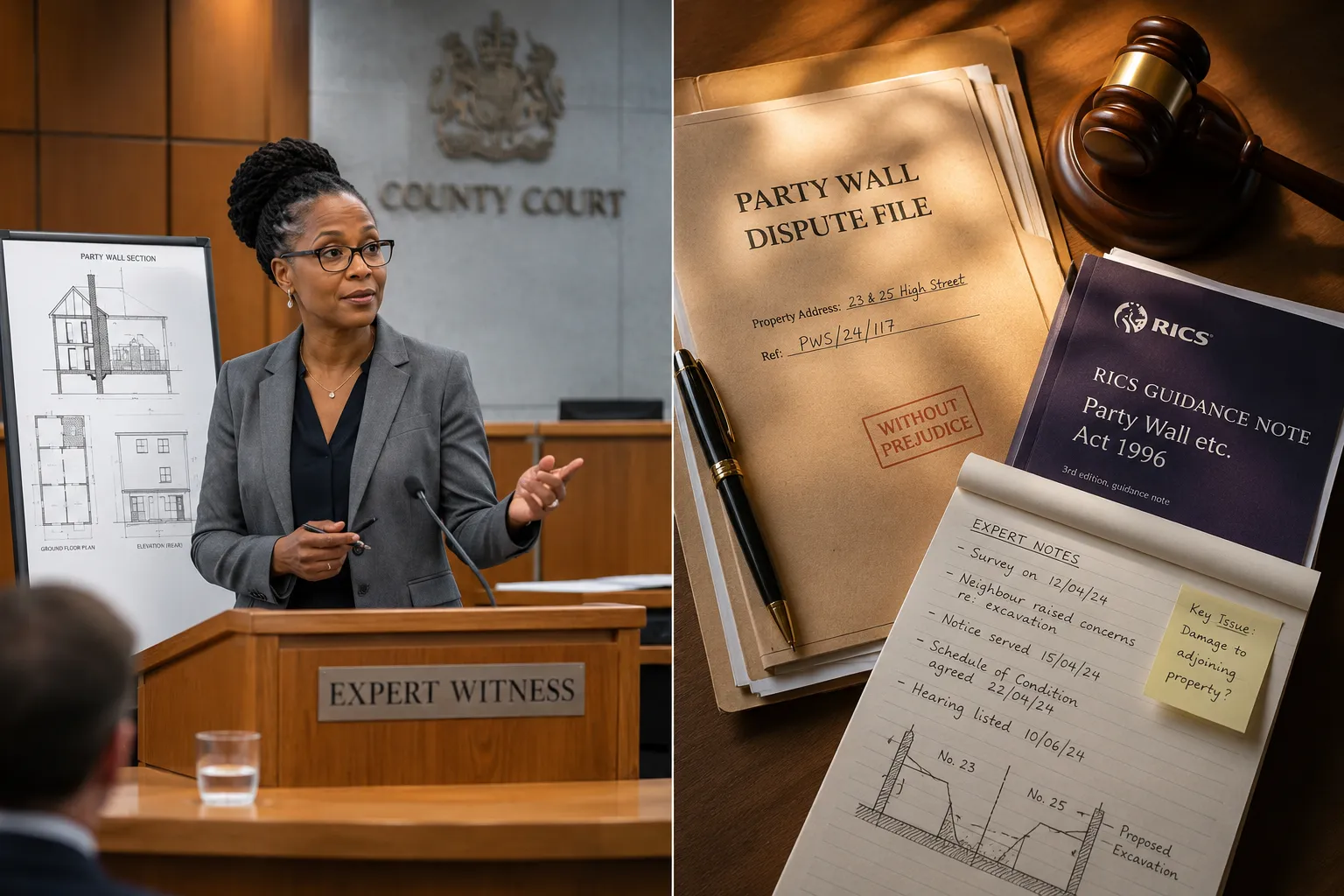
What Evidence Do Expert Witnesses Need to Prepare for Party Wall Cases
A strong expert report in a party wall challenge is built on documented, verifiable evidence. Opinions without evidential foundation carry little weight.
Core evidence typically includes:
- The original party wall notices and acknowledgements
- The party wall award and any supplementary awards
- A schedule of condition prepared before works commenced
- Photographs and measurements taken at inspection
- Structural or engineering calculations where relevant
- Comparable costs or market evidence for quantum disputes
- Correspondence between surveyors and parties
The expert must explain their methodology clearly in the report. Courts in 2026 have been particularly critical of reports that reach conclusions without showing the reasoning. A well-structured report sets out the facts, the expert's instructions, the documents reviewed, the inspection findings, and the opinions separately and clearly.
How Much Does an Expert Witness Cost for a Party Wall Case
Expert witness costs in party wall cases vary considerably based on the complexity of the dispute, the seniority of the expert, and whether the matter proceeds to a full hearing.
Typical cost ranges (estimates based on current market rates in 2026):
- Initial review and advice: £500 to £1,500
- Full CPR Part 35 expert report: £2,000 to £5,000 for straightforward cases
- Complex cases involving structural issues or multiple properties: £5,000 to £10,000+
- Court attendance (per day): £1,500 to £3,500
The losing party in a party wall appeal is generally ordered to pay costs, so the financial risk of a weak challenge is significant. Courts have the power to disallow expert costs where the evidence was unnecessary or disproportionate. For a broader picture of party wall surveying costs, see this guide to the cost of a party wall surveyor.
How Long Does a Party Wall Award Challenge Typically Take
Most county court appeals against party wall awards are resolved within three to nine months from the date of filing, though complex cases can take longer.
Factors that affect the timeline:
- Court availability in the relevant county court
- Whether expert evidence is directed by the court (adds preparation time)
- Whether a joint expert meeting is required before the hearing
- Whether the parties reach a settlement before the hearing date
Nullity claims, which are treated as standalone Part 7 or Part 8 claims rather than appeals, can take longer because they follow the full civil litigation timetable. Early legal and expert advice is therefore important to manage both costs and expectations.
What Mistakes Do People Make When Hiring an Expert Witness for Party Wall Issues
The most damaging mistakes are instructing an expert too late, choosing someone without court experience, or selecting a surveyor who is not genuinely independent.
Common mistakes to avoid:
- Waiting until after the 14-day appeal window before seeking expert advice
- Instructing the original party wall surveyor as expert witness in a challenge to their own award
- Choosing an expert based on price alone rather than relevant experience
- Failing to check for conflicts of interest, particularly in smaller local markets where surveyors know each other
- Providing the expert with a desired conclusion rather than letting them form an independent view
- Ignoring CPR Part 35 requirements, which can result in the expert's report being excluded
A good expert witness will tell you honestly if the challenge lacks merit. That candour saves money and avoids the reputational damage of a failed court action. For guidance on finding the right surveyor, see this overview of party wall services.
How Do Recent 2026 Court Rulings Affect Party Wall Expert Witness Testimony
The direction of travel in 2026 is towards greater scrutiny of expert evidence and a more pragmatic judicial approach to procedural defects. Courts are less willing to entertain challenges based on technical irregularities that caused no real prejudice, but they are equally firm that expert reports must meet the CPR Part 35 standard.
Key developments shaping expert witness practice in 2026:
- Nullity vs voidable distinction: Following Power v Shah (2023), courts continue to distinguish between awards that are void for want of jurisdiction and those that are merely irregular. Expert witnesses must be precise about which category applies.
- Quantum evidence standards: Building on Taylor v Jones (2024), courts expect expert evidence on remediation costs to be supported by market comparables, not just professional opinion.
- RICS 7th edition compliance: Courts are now more likely to question whether an expert's report complies with the updated RICS guidance, and non-compliance can affect the weight given to the evidence.
- Joint statements: Courts are directing joint expert meetings more routinely, which means experts must be prepared to engage constructively with opposing experts before the hearing.
Conclusion
Expert witness roles in party wall award challenges have become more demanding and more consequential in 2026. The combination of tightened RICS guidance, evolving case law from Power v Shah and Taylor v Jones, and county court decisions on nullity and jurisdiction means that the quality of expert evidence can determine the outcome of a challenge.
Actionable next steps:
- If you have received a party wall award you wish to challenge, seek legal and expert advice immediately, well within the 14-day appeal window.
- Instruct a RICS-chartered surveyor with specific party wall and litigation experience, not simply the nearest available surveyor.
- Ensure the expert is genuinely independent and has no prior involvement with the award being challenged.
- Ask the expert to assess the merits honestly before committing to court proceedings.
- Prepare a complete evidence file including the original notices, the award, and the schedule of condition.
For professional guidance on party wall matters and expert witness services, contact a qualified chartered surveyor who can assess your specific situation and advise on the strongest course of action.
Frequently Asked Questions
Can a party wall surveyor who made the award also act as an expert witness in a challenge to it?
No. A surveyor who produced the original award has an obvious conflict of interest and cannot provide independent expert evidence in a challenge to that same award. Courts will not accept such evidence, and RICS guidance prohibits it.
Is expert witness evidence always required in a party wall appeal?
Not always. Simple procedural appeals may be resolved on the documents alone. However, where the challenge involves technical questions about construction, structural impact, or the adequacy of the schedule of condition, expert evidence is usually essential.
What happens if the expert witnesses on both sides disagree?
Courts will direct a joint meeting of experts to produce a statement identifying agreed and disputed matters. The judge then weighs the competing opinions at the hearing, taking into account each expert's qualifications, methodology, and impartiality.
Can an expert witness be penalised for giving poor evidence?
Yes. Courts can disallow an expert's costs, make adverse cost orders, and refer serious cases of misleading evidence to RICS for disciplinary action. Experts who act as advocates rather than independent advisers risk significant professional consequences.
Does the 14-day appeal deadline apply to nullity challenges?
The 14-day rule applies to standard Section 10(17) appeals. Where the ground is that the award is a nullity because no valid notice was served, a separate claim may be possible outside that window, but courts will scrutinise delay and any prejudice caused. Early advice is essential.
How do I find a qualified expert witness for a party wall case?
Look for a RICS-chartered building surveyor (MRICS or FRICS) with demonstrable party wall experience and a track record of producing CPR Part 35-compliant reports. Membership of the Academy of Experts or Expert Witness Institute is a useful indicator. Always check for conflicts of interest before instructing.
Tags: party wall expert witness, party wall award challenge, RICS best practices 2026, party wall dispute, expert witness surveyor, party wall appeal, CPR Part 35, party wall act 1996, chartered surveyor expert witness, party wall case law, party wall jurisdiction, party wall costs