

Last updated: July 24, 2026
Quick Answer: A party wall award is a legally binding document prepared under the Party Wall etc. Act 1996 that governs how notifiable construction works, including commercial extensions, must proceed. For leasehold commercial properties, the process is more complex because notices must be served on every qualifying interest holder, including freeholders and long leaseholders. Getting this right from the start prevents injunctions, delays, and costly disputes.
Key Takeaways
- A party wall award is legally required before starting most commercial extension works that affect a shared wall or boundary.
- In leasehold commercial properties, notices must be served on both the freeholder and any leaseholder holding a lease exceeding one year.
- The Leasehold and Freehold Reform Act 2024 has strengthened leaseholders' rights, making correct notice-serving more important than ever.
- Multi-owner scenarios require a coordinated approach: phased notice-serving, ownership audits, and sometimes a lead surveyor model.
- Failure to serve valid notices before starting work can result in injunctions that halt construction entirely.
- A party wall award is separate from building regulations approval and planning permission, all three may be needed.
- Costs for a party wall surveyor on commercial projects typically range from around £700 to £2,500 or more per award, depending on complexity.
- An agreed surveyor (one impartial professional appointed by both parties) can reduce costs and speed up the process for straightforward cases.
- Schedules of condition should always be completed before work begins to protect all parties from spurious damage claims.
- Early engagement with adjoining owners is the single most effective way to avoid disputes and keep projects on schedule.

What Is a Party Wall Award and Why Do You Need One for a Commercial Extension
A party wall award is a legally binding document prepared by one or more appointed surveyors under the Party Wall etc. Act 1996. It sets out how notifiable works must be carried out, what protections are in place for adjoining owners, how access will be managed, and how any damage will be resolved.
For commercial extensions, a party wall award is required whenever the proposed works involve:
- Cutting into or building onto a shared (party) wall
- Excavating within three to six metres of an adjoining building's foundations, depending on depth
- Building a new wall at or astride the boundary line
Why it matters for commercial projects specifically: Commercial extensions often involve deeper foundations, heavier structural loads, and longer build programmes than domestic works. The risks to adjoining properties are correspondingly higher, so surveyors and adjoining owners tend to scrutinise awards more carefully. Skipping this step is not just a legal risk, it can trigger an injunction that stops the entire project mid-build.
For a detailed overview of how party wall awards work in practice, see this guide to party wall awards.
How Do Party Wall Notices Work for Leasehold Commercial Properties
In leasehold commercial properties, party wall notices must be served on every qualifying adjoining owner, not just the person who happens to occupy the premises. A qualifying owner is anyone with a freehold interest or a leasehold interest with more than one year remaining on the term.
This means that in a typical commercial leasehold arrangement, the building owner (the party carrying out the works) must serve separate notices on:
- The freeholder of the adjoining property
- Any head lessee
- Any long leaseholder (lease exceeding one year) with an interest in the affected part of the building
Common mistake: Many building owners serve notice only on the occupying tenant, assuming that covers the requirement. It does not. If the freehold is held separately, a notice to the tenant alone is invalid and the entire process may need to restart.
The Leasehold and Freehold Reform Act 2024 has further strengthened leaseholders' rights, making it even more critical to identify and notify all qualifying interests before any work begins. Conducting a title register search at HM Land Registry for every adjoining property is the correct starting point.
Notices must be served at the correct statutory periods before work starts: two months for party structure notices and line of junction notices, and one month for three/six-metre excavation notices.
What Is the Difference Between a Party Wall Award and Building Regulations Approval
A party wall award and building regulations approval are entirely separate legal requirements that serve different purposes. Building regulations approval confirms that the proposed works meet structural, fire, and energy efficiency standards. A party wall award governs the rights and obligations between neighbouring property owners during construction.
| Requirement | Who Grants It | What It Covers |
|---|---|---|
| Party Wall Award | Appointed surveyor(s) | Neighbour rights, access, damage, working hours |
| Building Regulations | Local authority or approved inspector | Structural safety, fire, energy, accessibility |
| Planning Permission | Local planning authority | Land use, design, impact on surroundings |
A commercial extension will often require all three. Obtaining building regulations approval does not mean party wall obligations have been satisfied, and vice versa. Surveyors sometimes see projects stall because one of the three has been overlooked, most often the party wall award.
How Much Does a Party Wall Surveyor Cost for Commercial Extensions
Party wall surveyor fees for commercial extensions are generally higher than for domestic projects because of the increased complexity, longer award documents, and the greater likelihood of disputes. As a general guide (based on current market rates in 2026):
- Agreed surveyor (both parties use one surveyor): approximately £700 to £1,500 per award for straightforward cases
- Two-surveyor model (each party appoints their own): approximately £1,200 to £2,500 or more per award, with each party typically paying their own surveyor
- Three-surveyor model (a third surveyor is appointed to resolve disagreements): additional fees apply, often £1,500 to £3,000 or more for the third surveyor's involvement
For multi-owner commercial scenarios involving several adjoining properties, total costs can scale significantly. The building owner usually bears the cost of the adjoining owner's surveyor fees where the works are solely for the building owner's benefit.
For a fuller breakdown of what drives party wall costs, see this article on the cost of a party wall surveyor and the related guide on the cost of a party wall agreement.
What Happens If You Don't Get a Party Wall Award Before Starting Work
Starting notifiable works without a valid party wall award in place is a serious legal error. The adjoining owner can apply to the courts for an injunction to stop the works immediately, and courts have consistently granted such injunctions even when construction is already underway.
Beyond injunctions, the consequences include:
- Personal liability for damage: Without a schedule of condition completed before works began, proving the pre-existing state of the adjoining property becomes very difficult. The building owner may face claims for damage they did not cause.
- Retrospective awards: While surveyors can prepare retrospective awards, these are not guaranteed to be accepted by courts and do not provide the same legal protection as a properly served and agreed award.
- Project delays: An injunction can halt a commercial project for weeks or months while the legal process is resolved, with significant financial consequences.
The consequences of ignoring the Party Wall Act are well-documented and consistently severe. There is no commercial justification for bypassing the process.
How Long Does the Party Wall Awards Process Take for Commercial Buildings
The party wall awards process for a commercial extension typically takes between two and four months from the point of serving notices to having a signed award in place, though this varies considerably.
The statutory minimum notice periods alone account for one to two months. After that, the time required depends on:
- Whether the adjoining owner consents or disputes the works
- How many adjoining owners are involved
- The complexity of the proposed works and the award document
- Whether a schedule of condition needs to be prepared (it almost always does)
For multi-owner commercial projects, a phased approach to notice-serving, aligned with the construction programme, is strongly recommended. This means serving notices in coordinated batches so that awards are in place ahead of each phase of work, rather than trying to manage all notices simultaneously. This prevents bottlenecks and keeps the project moving.
Allow at least three months of lead time before the planned construction start date. On complex commercial schemes, six months is a safer planning assumption.
Do All Leaseholders Need to Agree to a Party Wall Award, or Just the Freeholder
Every qualifying adjoining owner must be served with a notice and given the opportunity to consent or dissent. This includes all leaseholders with a lease exceeding one year, not just the freeholder.
However, "agreeing" to a party wall award is not quite the right framing. The process works as follows:
- The building owner serves notice on each qualifying adjoining owner.
- Each adjoining owner has 14 days to consent in writing. If they consent, no award is needed for that owner.
- If they do not respond within 14 days, or if they dissent, a dispute is deemed to have arisen and surveyors must be appointed.
- The appointed surveyor(s) then prepare an award, which is binding on all parties regardless of whether the adjoining owner "agrees" with its contents.
So an adjoining leaseholder cannot simply veto the works by refusing to engage. What they can do is appoint a surveyor to represent their interests and ensure the award properly protects them. This is an important distinction that building owners and their advisors sometimes misunderstand.
For a deeper look at what happens when a neighbour refuses to engage, see this article on what to do when a neighbour refuses party wall works.
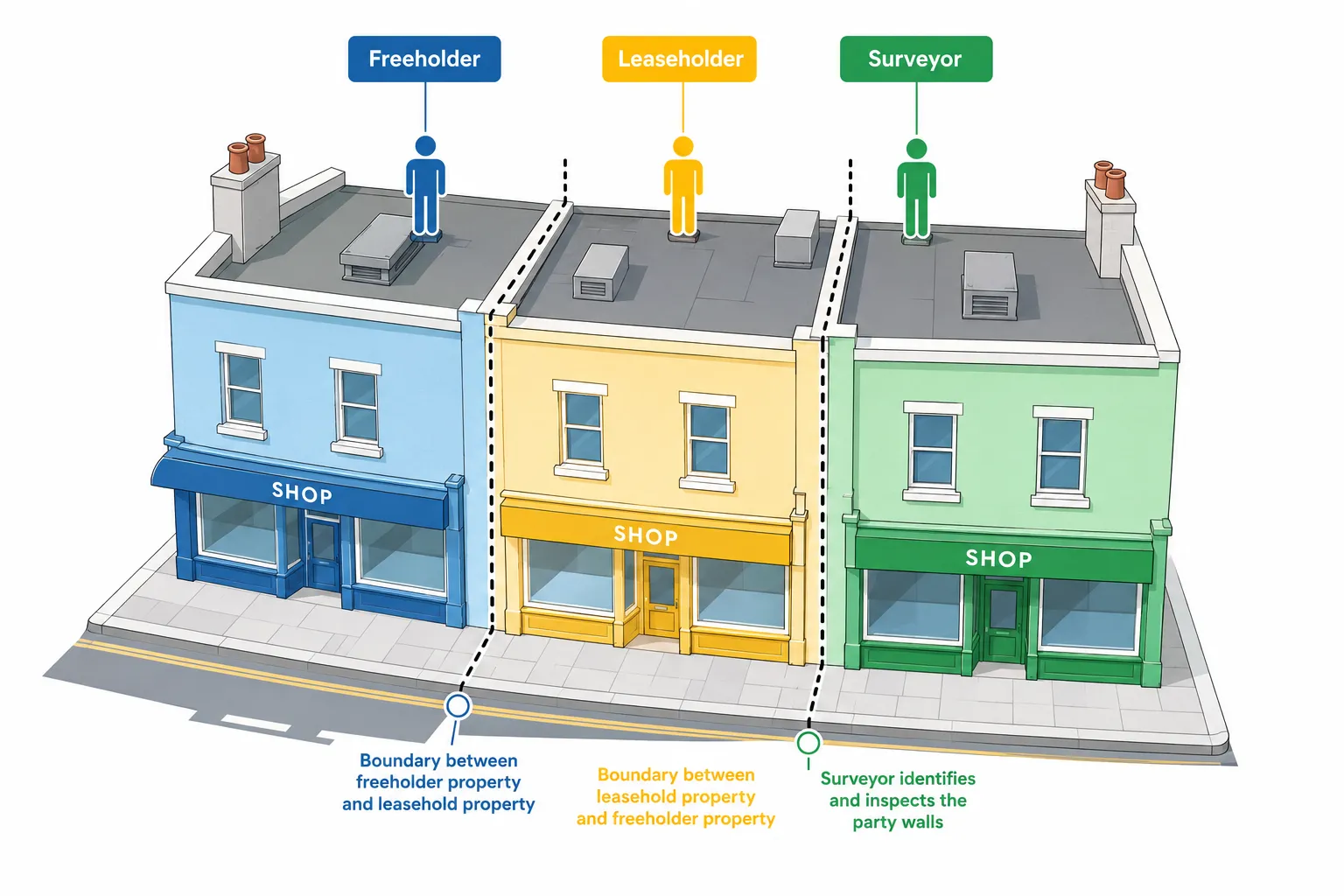
What Should Be Included in a Multi-Owner Agreement for Party Wall Work
In multi-owner commercial scenarios, the party wall award (or series of awards) needs to address a broader range of issues than a standard domestic award. A well-drafted multi-owner award should include:
- Scope of works: A precise description of all notifiable works, cross-referenced to approved drawings
- Working hours and noise controls: Specific restrictions, particularly where adjoining properties include residential or hospitality uses
- Vibration and dust limits: Measurable thresholds, especially for excavation and demolition phases
- Access arrangements: How and when surveyors and contractors may access adjoining properties
- Schedule of condition: A photographic and written record of the pre-works condition of every affected property
- Damage resolution process: Clear steps for reporting, assessing, and compensating any damage
- Security for expenses: Where there is a real risk of damage, the award may require the building owner to provide a bond or other security
For projects involving mixed-use buildings, awards should also address reciprocal easement agreements (REAs), shared corridors, service areas, or access rights that already exist between properties. A party wall award must not inadvertently conflict with these established rights.
A party wall schedule of condition is a particularly important component. Without it, resolving damage claims after the fact becomes a matter of dispute rather than documented fact.
How Do You Handle Party Wall Disputes Between Commercial Tenants and Landlords
Party wall disputes in commercial leasehold situations often arise from a mismatch between who has the legal obligation to serve notices (the building owner carrying out the works) and who has the practical interest in the outcome (the tenant occupying the space).
The key principles are:
- The building owner is responsible for serving valid notices and paying for the process. In a commercial leasehold context, this is usually the leaseholder carrying out the extension, not the freeholder, unless the freeholder is doing the works.
- The adjoining owner's surveyor represents the interests of whoever appointed them, whether that is a freeholder, head lessee, or occupying tenant with a qualifying lease.
- Disputes between a commercial tenant and their own landlord about whether works should proceed at all are a separate matter governed by the lease terms, not the Party Wall Act.
Where a commercial tenant wants to carry out an extension but the lease requires landlord consent, that consent must be obtained separately from the party wall process. The two are legally distinct. Failing to get landlord consent under the lease while proceeding with party wall notices is a common and costly mistake.
For guidance on resolving party wall disputes more broadly, see this resource on party wall disputes.
Can You Start a Commercial Extension Without Waiting for the Party Wall Award
No. Work that triggers the Party Wall etc. Act 1996 cannot lawfully begin until either the adjoining owner has consented in writing, or a party wall award has been signed and served on all parties.
There is one narrow exception: if all adjoining owners consent in writing within the 14-day response period, no award is needed and work can proceed after the statutory notice period expires. But this requires genuine written consent, verbal agreement is not sufficient.
Choose this approach if: The adjoining owner is cooperative, the works are relatively straightforward, and you have a good working relationship. Even with consent, a schedule of condition is strongly recommended.
Do not attempt to start early if: Any adjoining owner has not responded, has dissented, or if the ownership picture is unclear. The risk of an injunction is real and the financial consequences of a stopped commercial project are severe.
What Are Common Mistakes with Party Wall Notices on Leasehold Properties
The most frequent errors on leasehold commercial projects include:
- Serving notice on the wrong party: Notifying only the occupying tenant when the freehold is held separately, or missing a head lessee in a multi-tier leasehold structure.
- Using incorrect notice forms or periods: Line of junction notices, party structure notices, and excavation notices each have different requirements. Using the wrong form or serving too late invalidates the notice.
- Failing to conduct an ownership audit: Before serving any notice, a thorough check of HM Land Registry title registers for all adjoining properties is essential. This typically takes one to two weeks but prevents much larger delays later.
- Assuming planning permission covers party wall obligations: These are entirely separate legal requirements.
- Not preparing a schedule of condition: This is not a legal requirement under the Act, but its absence makes damage claims almost impossible to resolve fairly.
- Ignoring non-responses: If an adjoining owner does not respond within 14 days, a dispute is automatically deemed to have arisen. Building owners sometimes assume silence means consent, it does not.
For more on common misconceptions, see this article on 5 common misconceptions about party wall agreements.
Who Pays for the Party Wall Surveyor in a Commercial Leasehold Situation
The general rule under the Party Wall etc. Act 1996 is that the building owner (the party carrying out the works) pays the reasonable costs of the process, including the adjoining owner's surveyor fees, where the works are for the building owner's sole benefit.
In commercial leasehold situations, this means:
- The leaseholder carrying out the extension typically pays both their own surveyor's fees and the adjoining owner's surveyor's fees.
- If the adjoining owner appoints an unnecessarily expensive surveyor, the building owner's surveyor can challenge the fees as unreasonable, the appointed surveyors determine what is reasonable, not the parties themselves.
- Where works benefit both parties (for example, repairs to a shared wall), costs may be apportioned between them.
- In multi-owner scenarios, the building owner's total surveyor costs can be substantial. Using an agreed surveyor model, where both parties appoint a single impartial surveyor, can reduce this significantly.
The agreed surveyor model is particularly worth considering for commercial projects where multiple adjoining owners are involved and relationships are cooperative.
What Is the Role of a Party Wall Surveyor vs a Building Surveyor for Extensions
These two roles are often confused, but they serve distinct functions on a commercial extension project.
A party wall surveyor:
- Acts under the statutory framework of the Party Wall etc. Act 1996
- Prepares and serves party wall awards
- Conducts schedules of condition
- Resolves disputes between building owners and adjoining owners
- Can be appointed as an agreed surveyor (acting for both parties) or as one of two separate surveyors
A building surveyor:
- Advises on the design, specification, and condition of the building
- May prepare drawings and specifications for the extension works
- Monitors construction quality and progress
- Advises on building regulations compliance
- Can also act as a party wall surveyor if they hold the relevant expertise
On a commercial extension, both roles are typically needed. The building surveyor drives the technical design and construction oversight; the party wall surveyor manages the legal relationship with adjoining owners. Sometimes one qualified professional covers both roles, but on complex commercial projects they are often separate appointments.
For more on when and why to appoint a surveyor, see this guide on why property owners hire surveyors.
Frequently Asked Questions
Q: Does the Party Wall Act apply to commercial properties in the same way as residential ones?
Yes. The Party Wall etc. Act 1996 applies to all properties in England and Wales, regardless of whether they are residential or commercial. The same notice requirements, timescales, and award procedures apply.
Q: Can a party wall award be appealed?
Yes. Any party to a party wall award can appeal to the County Court within 14 days of receiving the award. Appeals are relatively rare and courts generally uphold awards unless there is a clear procedural error or the award is manifestly unreasonable.
Q: What is a "deemed dispute" and how does it arise?
A deemed dispute arises automatically when an adjoining owner fails to respond to a party wall notice within 14 days. It does not require any active objection, silence is treated as a dispute under the Act, triggering the surveyor appointment process.
Q: Do I need a party wall award for internal commercial works that don't touch the party wall?
Not necessarily. Works that are entirely internal and do not affect the party wall structure, foundations, or boundary line do not trigger the Act. However, if there is any doubt, it is worth getting a professional opinion before starting.
Q: Can the same surveyor act for both parties in a commercial dispute?
Yes, if both parties agree. This is called the agreed surveyor model. The agreed surveyor acts impartially for both the building owner and the adjoining owner. It is faster and cheaper than the two-surveyor model, but requires the cooperation and trust of both parties.
Q: What happens to the party wall award if the commercial property is sold mid-project?
A party wall award runs with the land, not the individual. If the building owner or the adjoining owner sells their property during the works, the award remains binding on the new owner. The new owner should be made aware of the award as part of the conveyancing process.
Conclusion
Party wall awards for commercial extensions involving leasehold notices, multi-owner agreements, and surveyor coordination are among the most technically demanding aspects of commercial property development in England and Wales. The stakes are high: an invalid notice, a missed leaseholder, or a failure to obtain an award before starting work can result in injunctions, legal costs, and project delays that far outweigh the cost of getting the process right from the outset.
Actionable next steps for building owners and their advisors:
- Commission an ownership audit of all adjoining properties using HM Land Registry title registers before drafting any notices.
- Identify every qualifying interest holder, freeholders, head lessees, and long leaseholders, and serve notices on each one individually.
- Allow at least three months of lead time before the planned construction start date; six months for complex multi-owner schemes.
- Consider the agreed surveyor model where relationships with adjoining owners are cooperative, it reduces cost and speeds up the process.
- Always commission a schedule of condition before any work begins, regardless of whether the adjoining owner requests one.
- Keep party wall obligations, building regulations approval, and planning permission as three separate workstreams managed in parallel, not sequentially.
Working with an experienced chartered surveyor who understands both the statutory framework and the practical realities of commercial construction is the most reliable way to keep a project on track. For professional guidance tailored to your specific project, explore the full range of party wall services available from qualified chartered surveyors.
.pw-checker{font-family:Arial,sans-serif;max-width:560px;margin:24px auto;border:2px solid #1a3a5c;border-radius:8px;overflow:hidden}
.pw-checker__header{background:#1a3a5c;color:#fff;padding:14px 18px;font-size:1rem;font-weight:700}
.pw-checker__body{padding:18px;background:#f7f9fc}
.pw-checker__q{font-size:.92rem;font-weight:600;color:#1a3a5c;margin-bottom:8px}
.pw-checker__btns{display:flex;gap:10px;margin-bottom:14px}
.pw-checker__btn{flex:1;padding:9px 0;border:2px solid #1a3a5c;border-radius:5px;background:#fff;color:#1a3a5c;font-size:.88rem;font-weight:600;cursor:pointer;transition:background .2s,color .2s}
.pw-checker__btn:hover,.pw-checker__btn.active{background:#1a3a5c;color:#fff}
.pw-checker__result{background:#e8f0fb;border-left:4px solid #1a3a5c;padding:11px 14px;border-radius:4px;font-size:.88rem;color:#1a3a5c;display:none}
.pw-checker__result.show{display:block}
.pw-checker__reset{margin-top:12px;background:none;border:none;color:#1a3a5c;text-decoration:underline;cursor:pointer;font-size:.82rem}
var pw_state={};
var pw_results={
q1_no:”Works that do not affect a party wall or boundary are unlikely to trigger the Party Wall Act. Confirm with a chartered surveyor if excavation is planned near adjoining foundations.”,
q2_no:”Residential works affecting a party wall still require notices under the Party Wall etc. Act 1996. Serve notice at least 2 months before starting structural works.”,
q2_yes_q3_no:”A party wall award is very likely required. Serve a party structure notice at least 2 months before work starts and commission a schedule of condition.”,
q2_yes_q3_yes:”A party wall award is required, and this is a complex multi-owner scenario. Conduct an ownership audit, serve notices on every qualifying interest holder (freeholders and leaseholders with 1+ year remaining), and consider appointing a lead or agreed surveyor to coordinate the process.”
};
function pw_next(q,ans){
pw_state[q]=ans;
if(q===’q1’&&ans===’no’){pw_show(pw_results.q1_no);return;}
if(q===’q1’&&ans===’yes’){document.getElementById(‘pw-step1′).style.display=’none’;document.getElementById(‘pw-step2′).style.display=’block’;return;}
if(q===’q2’&&ans===’no’){pw_show(pw_results.q2_no);return;}
if(q===’q2’&&ans===’yes’){document.getElementById(‘pw-step2′).style.display=’none’;document.getElementById(‘pw-step3′).style.display=’block’;return;}
if(q===’q3’&&ans===’no’){pw_show(pw_results.q2_yes_q3_no);return;}
if(q===’q3’&&ans===’yes’){pw_show(pw_results.q2_yes_q3_yes);return;}
}
function pw_show(msg){
var r=document.getElementById(‘pw-result’);
r.textContent=msg;r.classList.add(‘show’);
document.getElementById(‘pw-reset’).style.display=’inline’;
}
function pw_reset(){
pw_state={};
[‘pw-step1′,’pw-step2′,’pw-step3′].forEach(function(id){document.getElementById(id).style.display=’none’;});
document.getElementById(‘pw-step1′).style.display=’block’;
var r=document.getElementById(‘pw-result’);r.classList.remove(‘show’);r.textContent=”;
document.getElementById(‘pw-reset’).style.display=’none’;
}