

Party wall disputes in the UK surged by approximately 40% in 2026, with the vast majority of cases concentrated in terraced streets and semi-detached housing where shared structures leave little margin for misunderstanding [11]. Whether spelled "neighbours" or "neighbors," the frustration is the same: a home improvement project stalls, legal notices go wrong, and two households that once got along find themselves locked in a costly standoff. Understanding the role of chartered surveyors in preventing and resolving these conflicts is essential for any homeowner planning works in close proximity to a shared wall. This article explains the legal framework of neighbours and party walls, how surveyors prevent "neighbors" disputes in UK terraced and semi-detached homes, and what the latest professional standards mean for both building owners and adjoining owners in 2026.
Key Takeaways
- The Party Wall etc. Act 1996 remains the governing legislation for shared structures in England and Wales, with no outstanding statutory amendments as of 2026.
- Disputes have risen sharply in 2026, driven by loft conversions, rear extensions, and structural alterations in high-density housing.
- RICS launched a major consultation in 2026 on a draft 8th edition of its Party Wall Legislation and Procedure guidance, signalling imminent changes to professional standards.
- Chartered surveyors act in a quasi-judicial, independent capacity, they are not agents of the owners who appoint them, and a 2026 High Court ruling confirmed they carry no liability for construction collapses.
- Early engagement, properly served notices, detailed schedules of condition, and transparent awards remain the most effective tools for preventing neighbour conflict.
The Legal Foundation: Party Wall etc. Act 1996
The Party Wall etc. Act 1996 is the cornerstone of neighbour rights in England and Wales when it comes to shared structures. It applies to three categories of work: work directly on a party wall or party fence wall, excavations within three or six metres of a neighbouring building, and the construction of new walls at or astride a boundary. For the owners of terraced and semi-detached homes, this covers a wide range of common projects, including loft conversions, rear extensions, chimney-breast removals, and underpinning.
A 2026 review of the legislation confirms that no outstanding amendments have been made to the Act, meaning its core provisions, notices, surveyor appointments, and party wall awards, continue to govern how neighbours manage shared-structure disputes [14]. What has changed is the environment in which the Act operates. Legal scrutiny of surveyor conduct has intensified, documentation standards have risen, and adjoining owners are far more aware of their statutory rights than they were a decade ago [1].
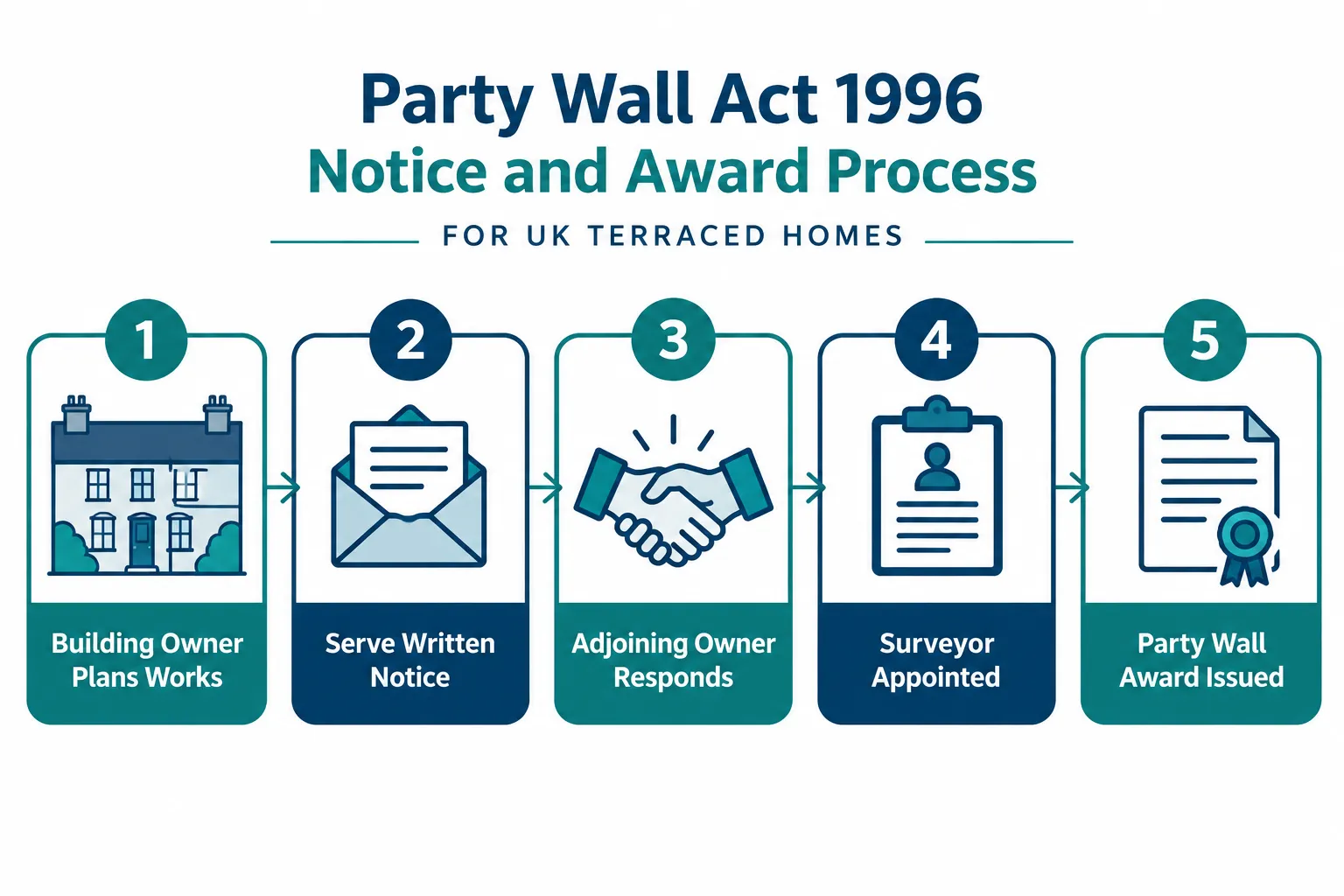
The standard process under the Act works as follows:
- The building owner (the person carrying out the works) serves a written notice on the adjoining owner.
- The adjoining owner has 14 days to respond, they can consent in writing or dissent.
- If the adjoining owner dissents, or fails to respond within 14 days, a dispute is deemed to have arisen.
- Each owner appoints a surveyor, or both agree to share a single "agreed surveyor."
- The surveyor or surveyors produce a party wall award, a legally binding document setting out how and when the works may proceed.
The Act also provides for a Third Surveyor, selected by the two appointed surveyors at the outset, who can be called upon if the appointed surveyors cannot agree. For a detailed breakdown of what these agreements must contain, see this guide to party wall agreement essentials.
"Carefully drafted awards, clear schedules of condition, and transparent fee structures are now critical tools for preventing neighbour disagreements in terraced and semi-detached home projects." [1]
One practical point worth noting: the Act applies in England and Wales only. Scotland and Northern Ireland operate under different legal frameworks for boundary and shared-structure disputes.
Why Disputes Are Rising in Terraced and Semi-Detached Housing
The terraced house and semi-detached home are the dominant housing types across much of England and Wales. In cities such as Manchester, Liverpool, Birmingham, and across inner London, Victorian and Edwardian terraces sit cheek-by-jowl, sharing not just walls but chimney stacks, roof structures, and foundations. Any significant alteration to one property can directly affect its neighbour.
The 40% spike in party wall disputes recorded in 2026 reflects a convergence of factors [11]:
- Ambitious home improvement projects: Loft conversions, rear extensions, and basement excavations are all at record levels as homeowners seek to add space rather than move.
- Greater awareness of rights: Adjoining owners are increasingly informed about the Act's provisions and more willing to contest inadequate or improperly served notices.
- Inadequate professional oversight: Some building owners attempt to manage the process without specialist help, resulting in defective notices and disputed awards.
- Multi-party complexity: In a long terrace, a single loft conversion may require notices to be served on two adjoining owners simultaneously, creating coordination challenges.
The consequences of getting it wrong are significant. An invalid notice can delay a project by weeks or months. A poorly drafted award can be challenged in court. And in the worst cases, works that proceed without a valid award expose the building owner to injunctions and compensation claims.
For homeowners in the north of England, where terraced housing is particularly dense, resources such as party wall agreements for Liverpool property investments provide region-specific context for managing these pressures.
Common Triggers for Neighbour Disputes
| Type of Work | Party Wall Act Relevance | Typical Dispute Trigger |
|---|---|---|
| Loft conversion | Works to party wall / roof structure | Noise, structural disturbance, inadequate notice |
| Rear extension | Excavations near boundary, new wall on boundary | Foundation works, overshadowing, access disputes |
| Chimney-breast removal | Direct work on party wall | Structural stability concerns, inadequate schedule of condition |
| Basement excavation | Excavations within 3-6 metres of neighbour's foundations | Settlement risk, inadequate engineering detail in award |
| Garden wall rebuild | Party fence wall provisions | Boundary line disagreements |
The Surveyor's Role: Independent, Quasi-Judicial, and Non-Negotiable
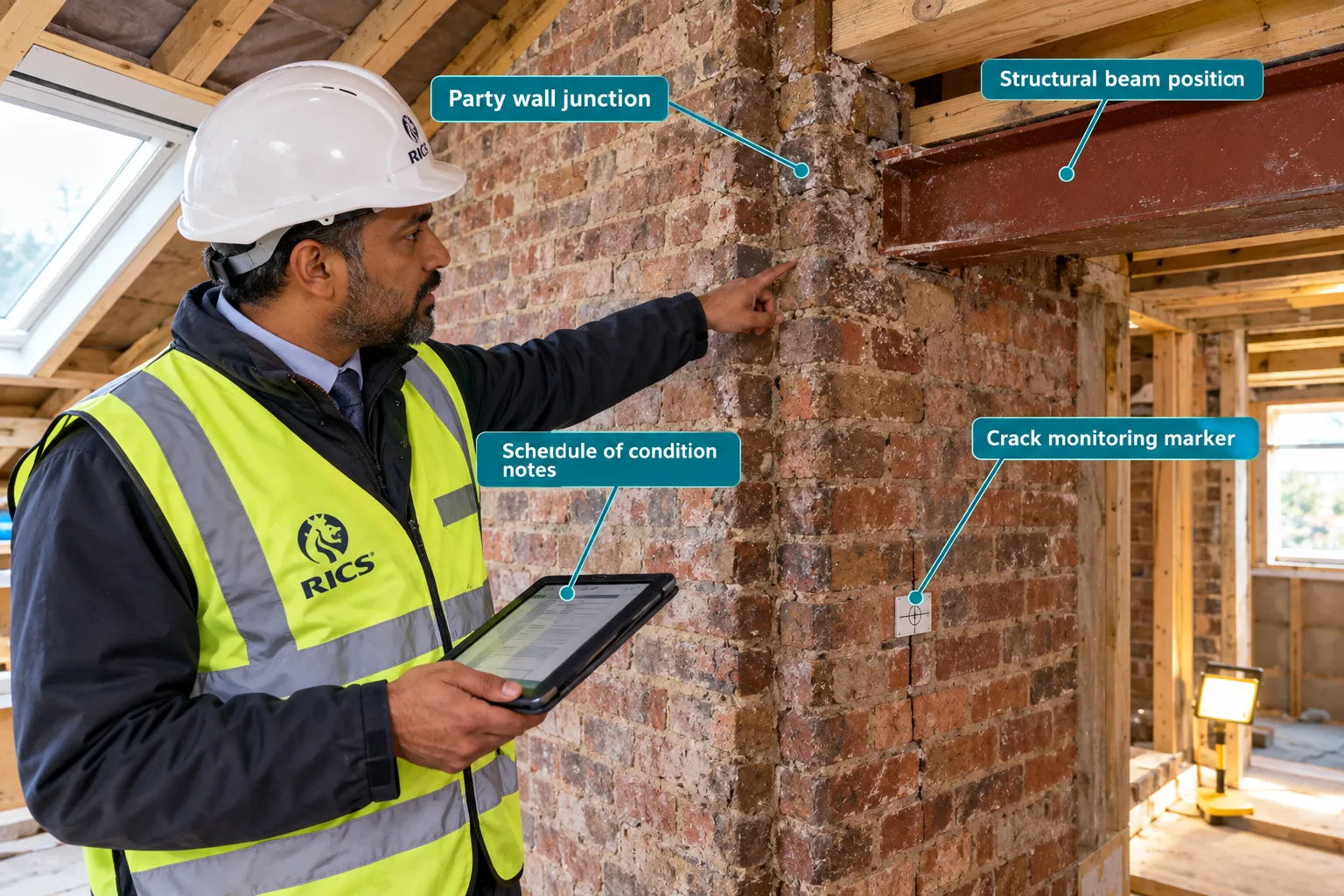
A common misconception among homeowners is that a party wall surveyor works for the person who appoints them. This is incorrect, and the distinction matters enormously in preventing and resolving neighbour disputes.
Under the Party Wall etc. Act 1996, a surveyor's appointment is personal and statutory, not an agency relationship [6]. The surveyor's duty is to the Act itself, not to the owner who pays their fee. This means a surveyor appointed by the building owner must still produce an award that fairly protects the adjoining owner's interests. Equally, a surveyor appointed by the adjoining owner cannot obstruct reasonable works simply because their appointing owner objects.
A significant High Court decision reported in August 2026 reinforced this principle by confirming that party wall surveyors are not liable for a construction collapse [3]. The judgment, which drew on precedents including Gyle-Thompson v Wall Street (Properties) Ltd and Gray v Elite Town Management, stressed that surveyors occupy a quasi-judicial role: they do not manage site safety, cannot suspend works, and routinely disclaim structural responsibility under the Construction (Design and Management) Regulations 2015 [3]. This ruling clarifies expectations for both owners: a party wall surveyor is a dispute-prevention and documentation professional, not a site manager or structural engineer.
RICS recommends that only chartered surveyors holding MRICS or FRICS status be appointed under the Act [4][8]. This professional standard ensures that the surveyor has the competence to:
- Assess whether proposed works fall within the Act's scope
- Advise on notice validity and timing
- Prepare or review schedules of condition (a photographic and written record of the adjoining property's pre-works state)
- Draft or scrutinise party wall awards
- Liaise with a Third Surveyor if the appointed surveyors disagree
For those wondering about the financial side of engaging professional help, the cost of a party wall surveyor guide provides a clear breakdown of typical fee structures and what influences them.
Agreed Surveyor vs. Two Surveyors: Which Is Better?
When an adjoining owner dissents, both parties have the option of appointing a single agreed surveyor rather than each appointing their own [4][8]. This approach:
- Reduces costs significantly
- Speeds up the award process
- Reduces the potential for adversarial positioning between two surveyors
However, the agreed surveyor option only works where both parties trust the same professional. In cases where the relationship between neighbours is already strained, each owner appointing their own surveyor may provide greater reassurance, even if it costs more.
How Surveyors Prevent "Neighbors" Disputes: Best Practice in 2026
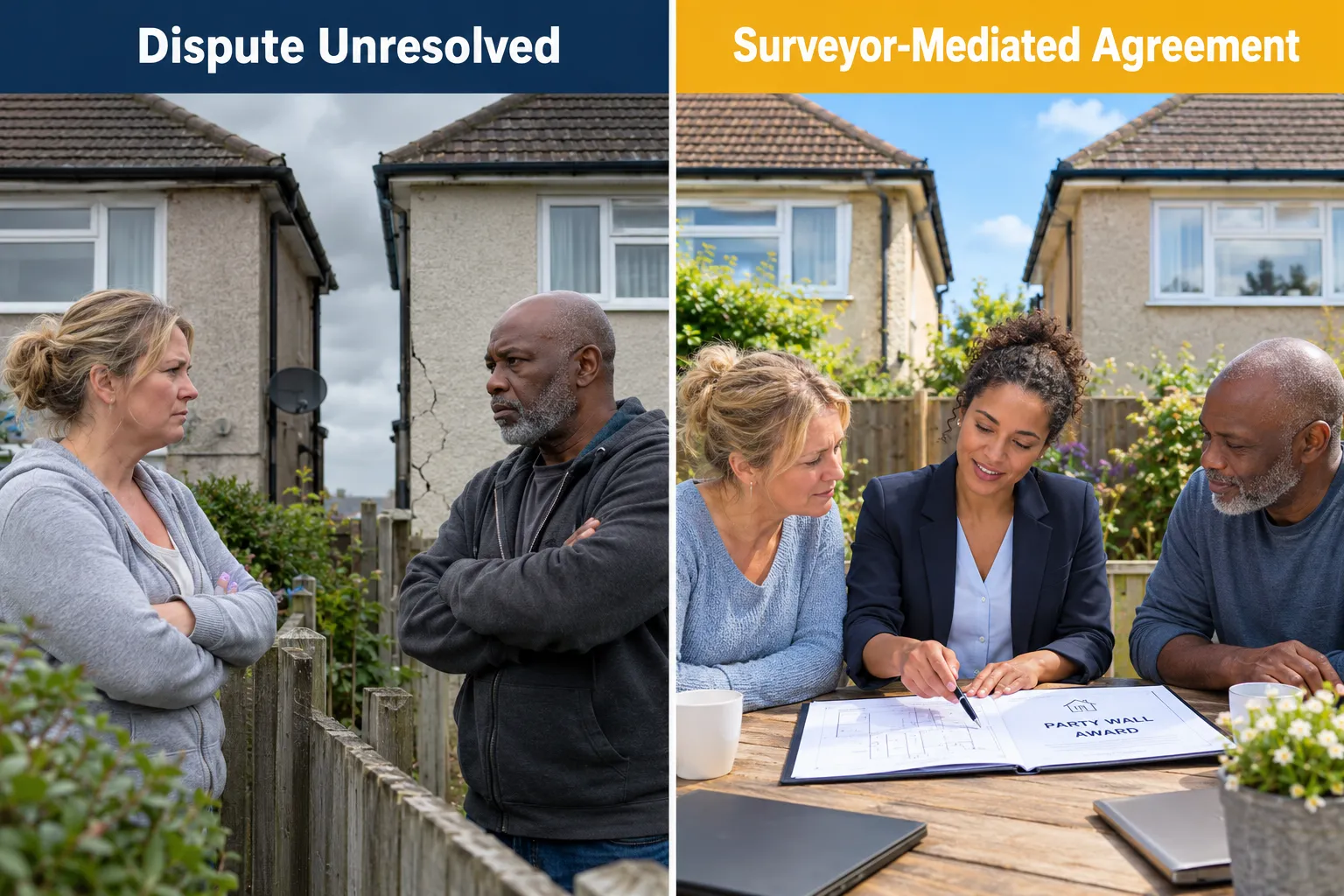
The most effective dispute prevention happens before a notice is served. Experienced chartered surveyors consistently identify early engagement as the single most powerful tool available to building owners [2][5]. When a neighbour understands what is planned, why it is safe, and how their interests are protected, the likelihood of a formal dispute drops dramatically.
Early Engagement and Communication
Best practice in 2026 involves the building owner (or their surveyor) approaching the adjoining owner informally before any formal notice is served [2][5]. This typically includes:
- Sharing drawings and a plain-English explanation of the proposed works
- Explaining the Party Wall Act process and the adjoining owner's rights
- Offering to fund the adjoining owner's surveyor fees (as required by the Act in most cases)
- Answering questions about timescales, noise, access, and structural impact
This approach builds goodwill and reduces the chance that the adjoining owner will appoint an obstructive surveyor or challenge the notice on technical grounds.
Serving Valid Notices
A notice that fails to meet the Act's requirements is invalid, and an invalid notice provides no legal protection to the building owner. Common errors include:
- Incorrect description of works: The notice must accurately describe what is planned.
- Wrong notice type: The Act provides for Line of Junction notices, Party Structure notices, and Adjacent Excavation notices, each with different timescales and triggers.
- Insufficient notice period: Party Structure notices require at least two months' notice; Adjacent Excavation notices require at least one month.
- Failure to identify the correct party wall: In a terrace, the wall between properties is the party wall; the wall at the end of a terrace may be an external wall, not a party wall.
Practitioners in 2026 warn that building owners who ignore these details risk invalid notices, disputed awards, and costly delays, particularly in dense terraced streets where multiple neighbours can challenge defective paperwork simultaneously [6][12].
Schedules of Condition: The Evidence That Prevents Damage Claims
A schedule of condition is a detailed record, typically photographic and written, of the adjoining property's state before works begin. It is one of the most practical tools a surveyor uses to prevent post-works disputes.
Without a schedule of condition, any crack, settlement, or damage that appears in the adjoining property after works are complete can be attributed to those works, even if it pre-existed them. With a thorough schedule in place, the surveyor can compare the pre- and post-works condition and determine whether any damage is genuinely attributable to the building owner's project.
For older terraced and semi-detached housing stock, which often has pre-existing defects, this documentation is particularly important. A guide to common defects in older homes provides useful context on the types of pre-existing issues surveyors typically record.
Drafting a Robust Party Wall Award
The party wall award is the legally binding document that governs how the works proceed. In 2026, surveyors are expected to produce awards that address:
- Working hours and noise restrictions
- Access arrangements for the surveyor and contractor
- Structural method statements and engineering details
- Compensation provisions if damage occurs
- Health and safety obligations, including those arising from the CDM Regulations 2015
Recent commentary notes that the extension of Awaab's Law in 2026 to encompass structural collapse hazards, not just damp and mould, is influencing what a "robust" party wall award must cover in high-density housing [15]. Surveyors are increasingly expected to consider wider structural risk issues when agreeing works affecting party walls, especially in older terraced housing stock.
For multi-generational extensions and complex residential projects, the party wall surveys for multi-generational extensions guide covers RICS best practices in detail.
The RICS 8th Edition Consultation: What Is Changing in 2026
The Royal Institution of Chartered Surveyors launched a major consultation in April 2026 on a draft 8th edition of Party Wall Legislation and Procedure [7][9]. The consultation ran for approximately eight weeks, closing on 5 June 2026, with responses scheduled for publication in November 2026 [7].
The draft 8th edition is expected to strengthen guidance in several key areas [6][9]:
- Notice validity: Clearer standards for what constitutes a valid notice, reducing the scope for technical challenges.
- Award drafting: More detailed requirements for what awards must contain, improving consistency across practitioners.
- Fee transparency: Explicit guidance on how surveyor fees should be calculated and communicated to owners.
- Third Surveyor procedures: Streamlined processes for resolving disagreements between appointed surveyors.
- Surveyor independence: Reinforced framing of surveyor appointments as personal and statutory, not as agency relationships.
While the 7th edition (reissued in May 2023) remains the formal benchmark, surveyors handling terraced and semi-detached disputes in 2026 must follow its provisions while anticipating the 8th edition's changes [9]. This transitional phase creates a practical challenge: practitioners need to be meticulous about current standards while preparing to adapt their procedures when the new edition is finalised.
For building owners and adjoining owners alike, the practical implication is clear: the bar for professional competence in party wall work is rising. Appointing a chartered surveyor who is actively engaged with RICS guidance is no longer optional, it is the foundation of a defensible, dispute-resistant process [4][8].
For those involved in larger or more complex projects, such as office-to-residential conversions, the party wall surveying for office-to-resi conversions guide covers how these professional standards apply in more demanding contexts.
When disputes do escalate beyond the party wall process into formal legal proceedings, the role of the chartered surveyor can extend further. The guide to when a RICS chartered surveyor becomes an expert witness explains how surveyors support boundary, valuation, and defect disputes in court.
Conclusion
The relationship between neighbours and party walls in UK terraced and semi-detached homes is governed by a well-established legal framework, but the human and professional dimensions of managing that framework are becoming more demanding by the year. Party wall disputes have risen sharply in 2026, driven by ambitious home improvement projects and increasingly informed adjoining owners. The Party Wall etc. Act 1996 provides the structure; chartered surveyors provide the expertise that makes it work in practice.
Actionable next steps for building owners and adjoining owners in 2026:
- Engage early. Speak to your neighbour before serving any formal notice. Share your plans, answer their questions, and build goodwill before the legal process begins.
- Appoint a RICS-accredited surveyor. Only MRICS or FRICS-qualified professionals should be appointed under the Act. Verify credentials before instructing anyone.
- Serve valid, accurate notices. Use the correct notice type, include a precise description of works, and observe the required notice periods. If in doubt, instruct a surveyor to serve the notice on your behalf.
- Commission a thorough schedule of condition. This single document can prevent months of post-works dispute over alleged damage.
- Stay informed about RICS standards. With the 8th edition of Party Wall Legislation and Procedure expected to be finalised in late 2026, practitioners and owners alike should monitor RICS guidance for updates.
- Consider an agreed surveyor. Where the neighbour relationship is cordial, sharing a single surveyor reduces cost and speeds up the process without compromising either party's legal protection.
The cost of getting party wall matters wrong, in time, money, and neighbourly goodwill, far exceeds the cost of professional advice. In 2026, with dispute rates at record levels and professional standards under active review, there has never been a stronger case for engaging a chartered surveyor at the earliest stage of any project affecting a shared wall.
References
[1] News – eastonbevins.co.uk
[2] Blog – peterbarry.co.uk
[3] News – whmatthews.com
[4] Party Walls – rics.org
[5] Party Walls – peterbarry.co.uk
[6] Party Wall Act Updates Post Rics 8th Edition Essential Changes Building Owners Must Know For 2026 Works – partywallsurveyorlondon.uk
[7] Rics Launches Consultation Updated Party Wall Practice Guidance – todaysconveyancer.co.uk
[8] Rics Consumer Guide Party Walls – ricsfirms.com
[9] Party Wall Legislation And Procedure – rics.org
[10] Party Wall Matters – shw.co.uk