

The UK housing landscape is transforming in 2026, driven by an unprecedented surge in multi-generational living arrangements. As ageing parents move in with adult children and extended families consolidate under one roof, suburban properties across the country are undergoing significant extensions. This shift has created a critical need for professional Party Wall Surveys for Multi-Generational Extensions in Suburban UK: 2026 RICS Best Practices Amid Family Housing Trends to ensure legal compliance and neighbourly harmony. 🏘️
With construction activity expected to increase substantially throughout 2026[4], understanding the intricacies of the Party Wall etc. Act 1996 has never been more important for homeowners, surveyors, and builders alike. This comprehensive guide explores the essential protocols, legal requirements, and best practices that govern party wall procedures for suburban extension projects designed to accommodate multiple generations.
Key Takeaways
- Early planning is essential: Party wall considerations should begin during site selection and design phases, not after construction contracts are signed[3]
- Proper notification prevents disputes: Serving correct Party Wall Act notices to all affected neighbours 2+ months before work starts is legally required and prevents costly delays
- RICS standards ensure quality: Updated 2026 professional standards provide clear frameworks for surveyors managing multi-generational extension projects[1]
- Schedules of condition protect all parties: Detailed pre-construction property assessments safeguard both building owners and adjoining owners from unfounded damage claims
- Professional surveyors reduce conflict: Appointing qualified RICS surveyors early in the process significantly decreases the likelihood of neighbour disputes and legal complications
Understanding the Party Wall Act for Multi-Generational Extensions
The Party Wall etc. Act 1996 governs building work that affects shared walls, boundaries, and excavations near neighbouring properties throughout England and Wales. For families planning multi-generational extensions in suburban areas, this legislation is particularly relevant because typical extension projects often involve work directly on or near party walls shared with semi-detached or terraced neighbours.
What Triggers Party Wall Requirements?
Several common scenarios in multi-generational extension projects trigger Party Wall Act obligations:
- Building on or at the boundary line between properties
- Excavating within 3 metres of a neighbour's structure if going deeper than their foundations
- Excavating within 6 metres if the work will cut a line at 45 degrees down from the neighbour's foundations
- Working directly on an existing party wall, such as cutting into it for steel beams or inserting a damp-proof course
- Raising party walls or adding new floors that increase loading
Understanding what party wall rights you have is crucial before beginning any extension work. Many homeowners mistakenly believe that because they own their property, they can build freely without consulting neighbours—this is one of the common misconceptions about party wall agreements that can lead to expensive legal disputes.
The Three Types of Party Wall Notices
Depending on the scope of your multi-generational extension, you may need to serve one or more of these notices:
| Notice Type | Purpose | Notice Period |
|---|---|---|
| Party Structure Notice | Work directly on or to an existing party wall | 2 months |
| Line of Junction Notice | Building a new wall on the boundary | 1 month |
| 3/6 Metre Notice | Excavations near neighbouring foundations | 1 month |
For comprehensive guidance on the notification process, homeowners should review detailed information about party wall agreements and what you must know before proceeding.
Party Wall Surveys for Multi-Generational Extensions in Suburban UK: Planning and Preparation
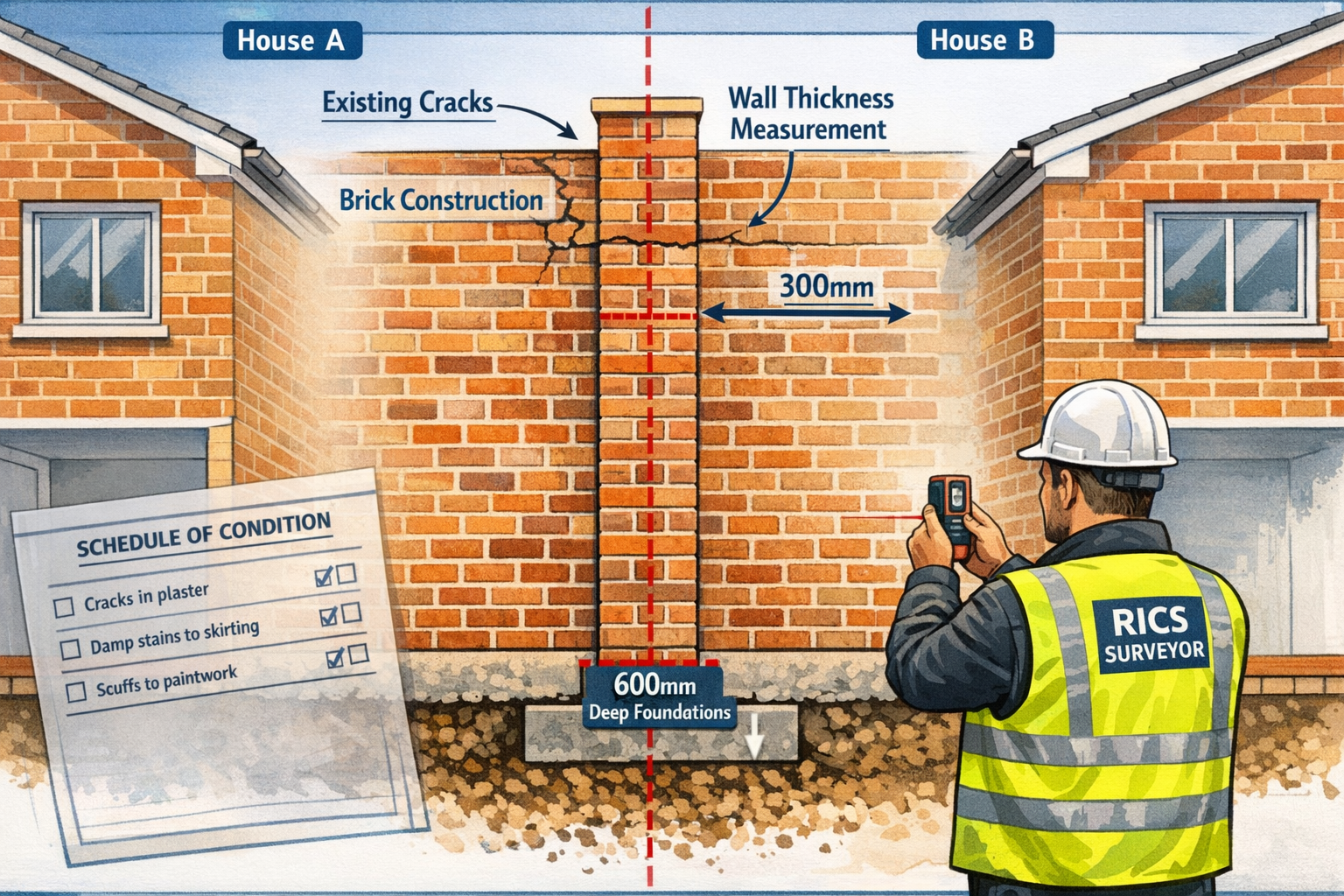
Identifying affected neighbours is a critical first step in any party wall process, requiring careful assessment of all potentially affected properties during the planning phase[3]. This is particularly important in suburban developments where properties are closely spaced and foundations may extend further than visible property boundaries suggest.
Early Planning: The Foundation of Success
According to RICS protocols, party wall planning should begin early in the development process, starting during site selection and design rather than after contracts are signed[3]. For multi-generational extensions, this means:
- Engaging a qualified surveyor during the design phase to assess party wall implications
- Mapping all neighbouring properties that might be affected by the proposed work
- Reviewing ground conditions and existing foundation depths
- Designing construction methods that minimize neighbour disruption
- Building party wall timelines into the overall project schedule
This proactive approach prevents the common scenario where families discover party wall requirements weeks before their planned construction start date, forcing expensive delays while proper notices are served and responses obtained.
The Role of Schedules of Condition
A schedule of condition is a detailed photographic and written record of a neighbouring property's condition before construction begins. This document serves as crucial evidence if disputes arise about construction damage.
For multi-generational extensions, schedules of condition should document:
- ✅ Internal walls adjacent to the party wall
- ✅ Ceilings and floors in rooms adjoining the construction
- ✅ External facades and any existing cracks or defects
- ✅ Drainage systems and ground conditions
- ✅ Decorative finishes and fixtures
Professional surveyors typically photograph every room, measuring and documenting pre-existing damage with precision. This protects both the building owner (who won't be blamed for pre-existing issues) and the adjoining owner (who has evidence if genuine damage occurs).
Understanding home extension cost considerations should include budgeting for professional party wall services, as attempting to navigate the process without expert guidance often results in greater expenses through delays and disputes.
Navigating the 2026 RICS Framework for Suburban Extensions
The Royal Institution of Chartered Surveyors (RICS) released updated professional standards in early 2026 aimed at raising transparency and improving practice for property-related matters[1]. These enhanced standards provide clearer guidance for surveyors managing the increasing volume of multi-generational extension projects across suburban UK.
Key 2026 RICS Best Practices
The updated framework emphasizes several critical areas for party wall surveyors:
1. Enhanced Communication Protocols 📋
Surveyors must now maintain more detailed records of all communications between building owners and adjoining owners. This includes:
- Timestamped records of notice serving
- Documentation of verbal discussions
- Clear explanation of technical terms in plain language
- Regular progress updates throughout the construction phase
2. Improved Dispute Resolution Mechanisms
With construction activity expected to increase throughout 2026, creating potential for neighbour disputes[4], the RICS compliance framework now provides structured approaches for early conflict resolution before formal disputes escalate.
3. Standardized Award Documentation
Party wall awards must now follow more consistent templates, ensuring all parties clearly understand their rights, obligations, and the scope of permitted works.
Appointing the Right Surveyor
For multi-generational extension projects, homeowners have several options:
Agreed Surveyor Approach (Recommended)
Both parties jointly appoint a single surveyor who acts impartially. This is typically:
- More cost-effective (one fee split between parties)
- Faster (no need for surveyor coordination)
- Less adversarial (promotes cooperation)
Two Surveyor Approach
Each party appoints their own surveyor, who then work together to produce the award. This approach:
- Provides independent representation for each party
- May be necessary when relationships are already strained
- Costs more (two surveyor fees)
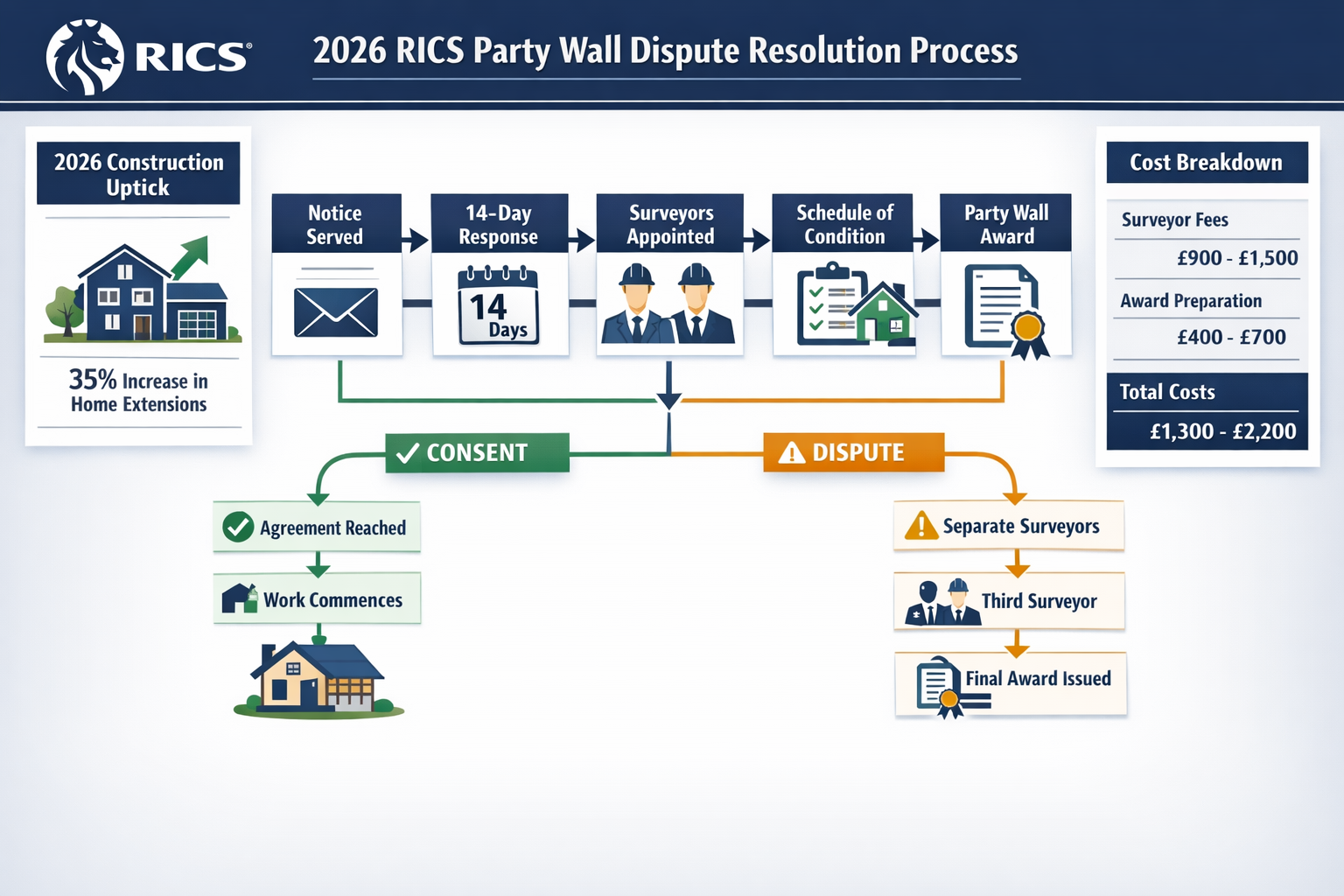
- Includes provision for a "Third Surveyor" if the two cannot agree
When selecting a surveyor, verify they are RICS-qualified and experienced specifically with residential extensions. The cost of party wall agreements varies based on project complexity, but investing in quality surveying services prevents far more expensive problems later.
Party Wall Surveys for Multi-Generational Extensions in Suburban UK: The Process Step-by-Step
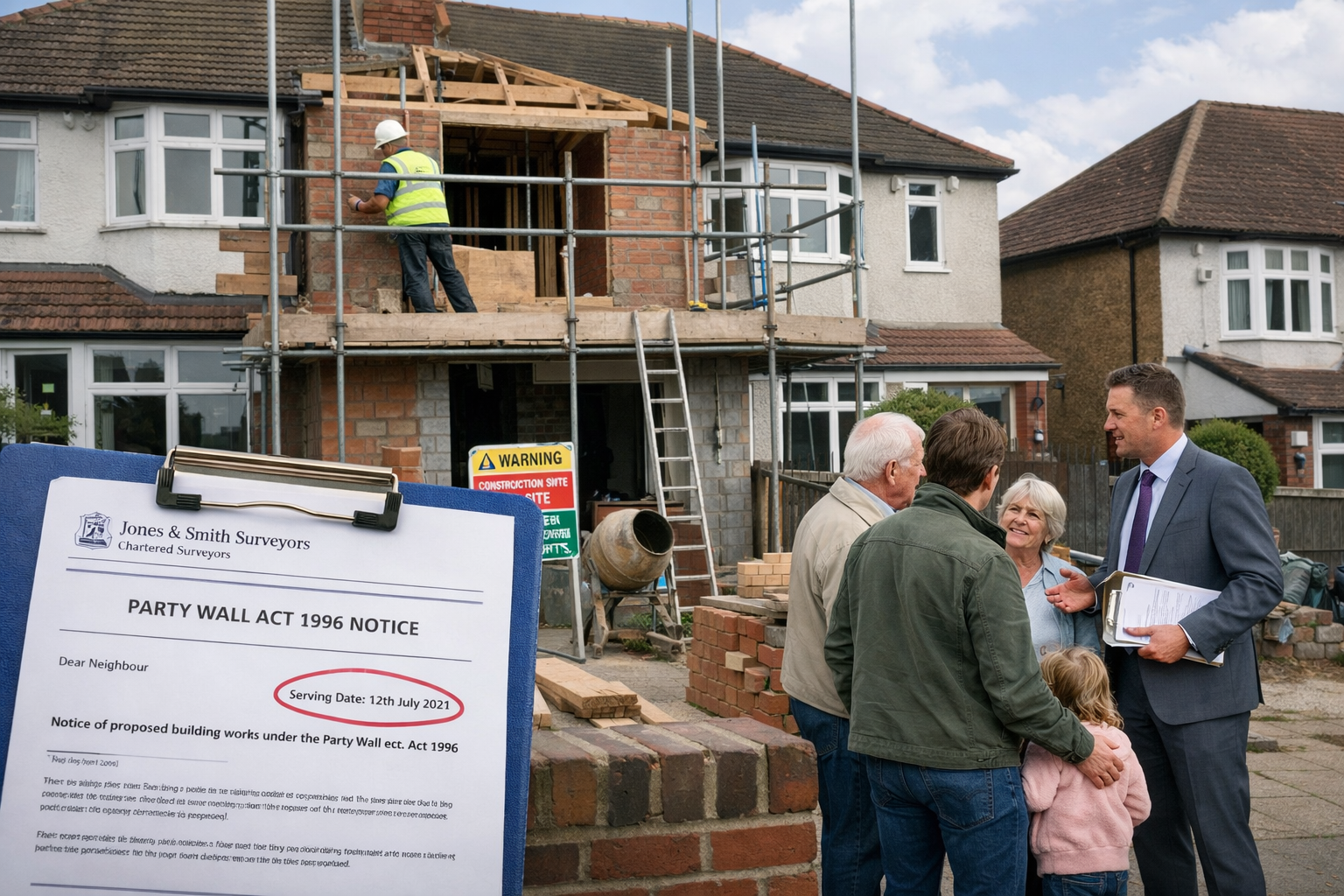
Understanding the complete process helps families plan their multi-generational extension projects with realistic timelines and expectations. Here's how the party wall survey process typically unfolds:
Phase 1: Pre-Notice Preparation (2-4 weeks)
Week 1-2: Design and Assessment
- Architect finalizes extension plans
- Surveyor reviews designs for party wall implications
- Identification of all affected neighbours
- Preliminary discussions with adjoining owners (optional but recommended)
Week 3-4: Notice Preparation
- Surveyor prepares appropriate notices with technical drawings
- Building owner reviews and approves notice content
- Notices are formally served via recorded delivery or hand delivery
💡 Pro Tip: Informal conversations with neighbours before formal notices arrive can significantly improve relationships and reduce anxiety about the upcoming work.
Phase 2: Notice Period and Response (1-2 months)
Once notices are served, adjoining owners have 14 days to respond in writing. They can either:
- Consent to the works (simplest outcome—no award needed, though still advisable)
- Dissent or not respond (triggers the formal surveyor appointment process)
- Request modifications to the proposed works
If dissent occurs or no response is received within 14 days, a "dispute" is deemed to exist under the Act. This isn't necessarily adversarial—it simply means the formal surveyor process must be followed.
Phase 3: Survey and Award Preparation (4-8 weeks)
Surveyor Appointment
- Building owner appoints their surveyor (or proposes agreed surveyor)
- Adjoining owner appoints their surveyor or agrees to the agreed surveyor
- Surveyors exchange contact details and documentation
Site Inspections
- Surveyors inspect both properties
- Schedule of condition prepared for adjoining property
- Assessment of proposed construction methods
- Evaluation of potential risks and mitigation measures
Award Drafting
The party wall award is a legally binding document that specifies:
- Exactly what work is permitted
- When work can occur (including hours of operation)
- How the work must be carried out
- Who pays for what (typically building owner pays all costs)
- Rights of access for inspections
- Procedures if damage occurs
Phase 4: Construction and Monitoring (Duration varies)
Once the award is in place:
- Construction can legally commence
- Surveyors may conduct periodic inspections
- Any variations to planned works require surveyor approval
- Adjoining owners can request inspections if concerned about damage
- Final inspection confirms completion and any remedial work needed
For properties requiring more extensive assessment beyond party wall matters, families might also consider whether they need a Level 2 or Level 3 survey to evaluate the overall structural integrity before major extension work.
Common Challenges in Multi-Generational Extension Projects
The unique nature of multi-generational extensions—typically larger, more complex, and involving significant structural changes—presents specific challenges that differ from standard home improvements.
Challenge 1: Foundation Depth Uncertainties
Older suburban properties often lack accurate records of foundation depths. Multi-generational extensions frequently require deeper foundations to support additional floors or larger footprints, triggering the 3-metre or 6-metre excavation rules.
Solution: Early ground investigation surveys can identify foundation depths before designs are finalized, allowing architects to plan accordingly and avoid surprises during the party wall process.
Challenge 2: Multiple Affected Neighbours
Corner properties or extensions affecting rear and side boundaries may require serving notices to three or more neighbours, each with different concerns and response timelines.
Solution: Stagger the design and notice process to allow adequate time for all responses. Consider holding a joint meeting with all affected neighbours to address concerns collectively.
Challenge 3: Emotional Resistance from Neighbours
Multi-generational extensions are often substantial projects that change the character of a street. Neighbours may resist not due to legal concerns but emotional reactions to change.
Solution: Early, empathetic communication explaining the family circumstances (ageing parents needing care, avoiding nursing home costs) often generates understanding and support. Addressing practical concerns (construction noise, parking, dust) with concrete mitigation plans demonstrates respect.
Challenge 4: Extended Timelines Affecting Family Needs
When extensions are being built to accommodate elderly parents with urgent care needs, party wall delays can create genuine hardship.
Solution: Begin the party wall process 4-6 months before the intended construction start date. This buffer accommodates unexpected delays while ensuring the project proceeds when needed.
Cost Considerations for Party Wall Surveys in 2026
Understanding the financial implications of party wall procedures helps families budget appropriately for their multi-generational extensions.
Typical Cost Breakdown
| Service | Estimated Cost Range (2026) |
|---|---|
| Agreed Surveyor Fee | £700-£1,500 |
| Building Owner's Surveyor | £800-£1,800 |
| Adjoining Owner's Surveyor | £600-£1,400 |
| Schedule of Condition | £300-£600 per property |
| Third Surveyor (if needed) | £1,000-£2,500 |
Important: Under the Party Wall Act, the building owner pays all reasonable surveyor fees—both their own and the adjoining owner's. This is a legal obligation, not negotiable.
For comprehensive information about costs, homeowners should review detailed guidance on the cost of party wall agreements which breaks down various scenarios and fee structures.
Factors Affecting Costs
Several variables influence party wall surveying costs:
- Project complexity: Larger extensions with multiple affected walls cost more to survey
- Number of neighbours: Each additional neighbour requires separate notices and potentially separate schedules of condition
- Property access: Difficult-to-access areas requiring specialized equipment increase costs
- Dispute complexity: Contentious situations requiring extensive negotiation and documentation increase fees
- Geographic location: London and South East England typically have higher surveyor fees than other regions
Dispute Avoidance Strategies for Suburban Extensions
With construction activity increasing in 2026, proactive dispute avoidance becomes essential for maintaining neighbourhood relationships while completing necessary home adaptations.
Strategy 1: Transparent Communication from Day One
Before formal notices:
- Knock on neighbours' doors personally to discuss plans
- Bring visual materials (architect drawings, 3D renderings)
- Explain the family circumstances driving the extension
- Ask about their concerns and genuinely listen
- Provide your contact information for questions
After notices are served:
- Follow up to ensure they received and understood the notice
- Offer to arrange a meeting with your surveyor to explain the process
- Keep them informed of timeline changes
- Address concerns promptly and respectfully
Strategy 2: Minimize Construction Disruption
Even with legal rights established through a party wall award, being a considerate neighbour reduces conflict:
- 🔨 Limit noisy work to reasonable hours (typically 8am-6pm weekdays, 8am-1pm Saturdays)
- 🚗 Arrange contractor parking to avoid blocking neighbours' access
- 🧹 Maintain site cleanliness to prevent dust and debris affecting adjacent properties
- 📢 Warn neighbours before particularly disruptive activities (concrete pours, demolition)
- 🔧 Respond quickly to any damage claims with professional assessment
Strategy 3: Professional Project Management
Hiring experienced contractors familiar with party wall requirements ensures compliance and reduces neighbour complaints:
- Contractors should understand party wall award conditions
- Site managers should have copies of the award on-site
- Workers should be briefed on access restrictions and protected areas
- Regular monitoring ensures work stays within permitted scope
For properties in specific areas, working with local specialists familiar with regional building patterns can be advantageous. Homeowners might consider chartered surveyors in South West London or other location-specific professionals who understand local property types and common party wall scenarios.
The Future of Multi-Generational Housing and Party Wall Practice
The trend toward multi-generational living shows no signs of slowing in 2026 and beyond. Several factors are driving this shift:
Demographic and Economic Drivers
- Ageing population: The UK's over-65 population continues growing, with many preferring family care to institutional settings
- Housing affordability crisis: Young families unable to purchase homes are increasingly living with parents while saving deposits
- Care cost escalation: Nursing home fees often exceed £50,000 annually, making home adaptations financially sensible
- Cultural shifts: Changing attitudes toward extended family living, particularly in diverse communities
Implications for Surveyors and Homeowners
This sustained demand for multi-generational extensions means:
- Increased surveyor specialization: More RICS professionals are developing expertise specifically in residential extension party wall work
- Standardized processes: As volume increases, procedures become more streamlined and predictable
- Technology integration: Digital schedules of condition, electronic notice serving, and online dispute resolution platforms are emerging
- Regulatory evolution: Future updates to the Party Wall Act may address specific multi-generational extension scenarios
Preparing for Your Multi-Generational Extension
Families planning extensions to accommodate multiple generations should:
6-9 Months Before Construction:
- ✅ Consult with architect about multi-generational design requirements
- ✅ Engage RICS surveyor for preliminary party wall assessment
- ✅ Research buying a house considerations including party wall implications if purchasing specifically to extend
- ✅ Review local planning permission requirements (separate from party wall)
3-6 Months Before Construction:
- ✅ Finalize architectural plans
- ✅ Identify all affected neighbours
- ✅ Begin informal neighbour discussions
- ✅ Prepare and serve formal party wall notices
- ✅ Appoint surveyors if dissent occurs
1-3 Months Before Construction:
- ✅ Complete schedules of condition
- ✅ Receive party wall award
- ✅ Brief contractors on award requirements
- ✅ Establish communication protocols with neighbours
During Construction:
- ✅ Maintain regular neighbour communication
- ✅ Ensure contractor compliance with award
- ✅ Address any damage claims immediately
- ✅ Document completion and final inspections
Conclusion: Building Stronger Families and Neighbourhoods
Party Wall Surveys for Multi-Generational Extensions in Suburban UK: 2026 RICS Best Practices Amid Family Housing Trends represent more than just legal compliance—they embody the principle that we can adapt our homes to meet changing family needs while respecting our neighbours' rights and maintaining community harmony.
The 2026 RICS framework provides clearer guidance than ever before, helping surveyors, homeowners, and builders navigate these increasingly common projects with professionalism and efficiency. By understanding the Party Wall Act requirements, engaging qualified surveyors early in the planning process, and prioritizing transparent communication with neighbours, families can successfully create the multi-generational living spaces they need.
Your Next Steps
If you're planning a multi-generational extension in suburban UK:
- Start early: Begin party wall considerations during the design phase, not after construction is scheduled
- Engage professionals: Appoint a qualified RICS surveyor with specific experience in residential extensions
- Communicate proactively: Talk to neighbours before formal notices arrive to build understanding and cooperation
- Budget appropriately: Include party wall surveying costs (£2,000-£4,000 typically) in your extension budget
- Document everything: Maintain detailed records of all communications, notices, and agreements
- Stay compliant: Ensure your contractors understand and follow party wall award conditions throughout construction
The rise in multi-generational living reflects a return to traditional family structures adapted for modern times. With proper planning, professional guidance, and neighbourly consideration, these extensions can be completed smoothly, creating homes that serve families for generations while maintaining the fabric of suburban communities across the UK. 🏡
References
[1] Uk Influence And Advocacy Update January 2026 – rics.org
[2] Building Surveying Standards – rics.org
[3] Party Wall Surveys For Ai Data Centre Developments Rics Protocols Amid 2026 Infrastructure Demand – nottinghillsurveyors.com
[4] Party Wall Surveys And Neighbour Disputes During 2026s Construction Uptick Rics Compliance Framework – nottinghillsurveyors.com