

Nearly one in five UK homes has a damp or mould problem serious enough to affect the health of its occupants [2]. Yet thousands of homeowners and landlords each year pay for mould eradication treatments without first establishing why the mould appeared in the first place. The result is predictable: the mould returns, the costs mount, and the underlying defect remains untouched. Understanding what a building surveyor examines before any treatment is commissioned is the most effective way to avoid that cycle. This guide to mold eradication in UK homes covers exactly what a surveyor looks for before you commit to treatment costs, why that diagnostic step is non-negotiable, and how the findings shape every decision that follows.
Key Takeaways
- Mould is a symptom, not the problem. A building surveyor's role is to identify the root cause before any remediation spend is approved.
- The three main causes of mould in UK homes are condensation, penetrating damp, and rising damp. Each demands a different fix.
- Awaab's Law now imposes strict legal timescales on social housing providers to investigate and remedy damp and mould hazards.
- Government guidance is clear: eradicating visible mould without addressing the source is ineffective and potentially harmful.
- A Level 3 building survey provides the most thorough assessment of moisture-related defects and is strongly recommended before committing to specialist treatment costs.
Why Mould Keeps Coming Back Without a Proper Survey
Mould growth in UK homes has reached what some commentators are calling epidemic proportions. A 2025 industry report found that over 4.6 million UK households reported damp or mould problems, with the issue disproportionately affecting older housing stock and properties with poor energy performance [5]. Cold snaps in early 2025 drove a measurable spike in mould complaints, as lower outdoor temperatures increased condensation risk on poorly insulated surfaces [7].
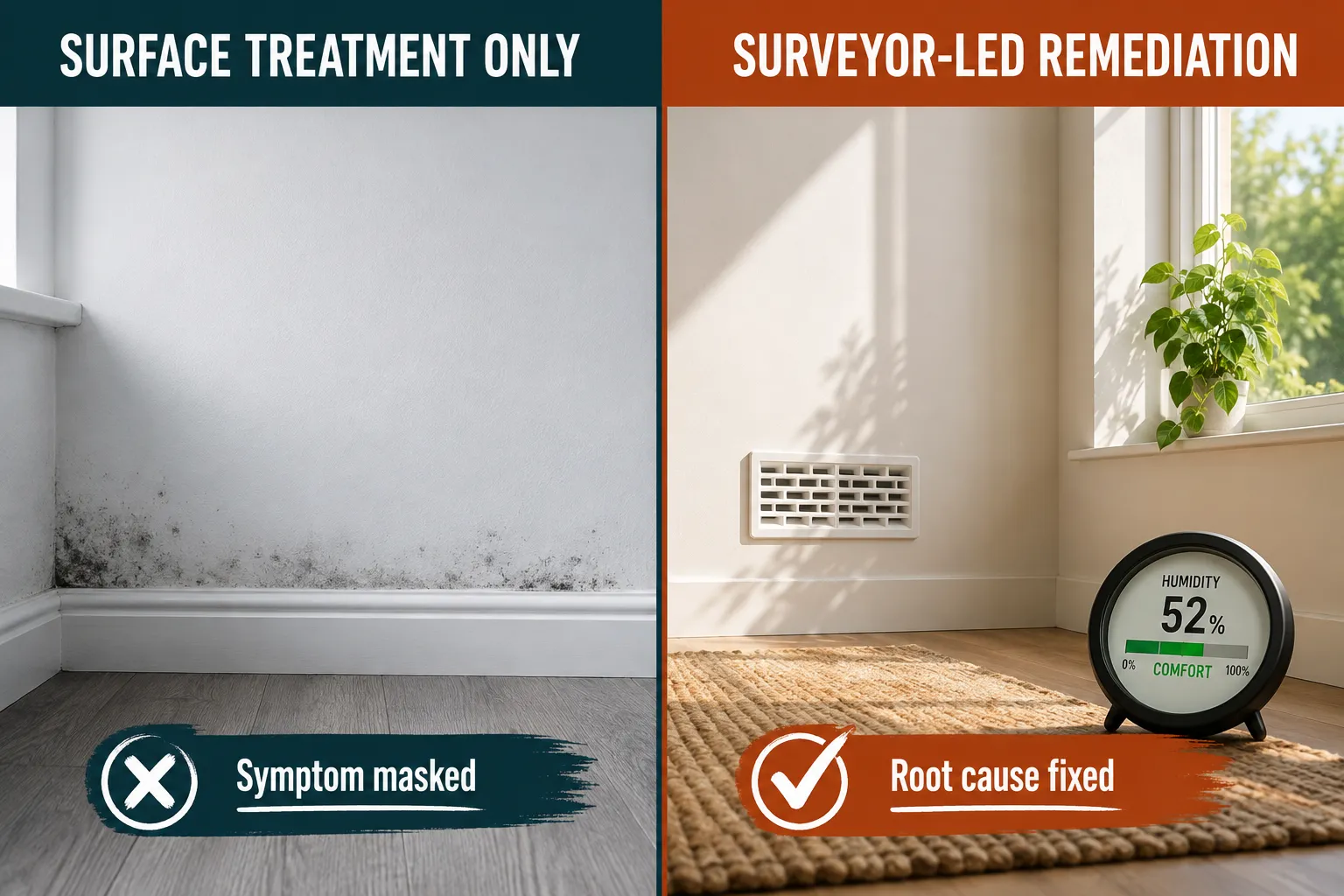
The core problem is that most mould eradication products and services treat what is visible. A biocidal wash, a fungicidal paint, or a surface scrub will kill active spores and temporarily improve appearances. But if the moisture source driving spore growth is still present, regrowth is almost inevitable within weeks or months. Government health guidance from the UK Health Security Agency and the Department for Levelling Up, Housing and Communities is unambiguous on this point: the cause must be eradicated, not merely the visible mould [4].
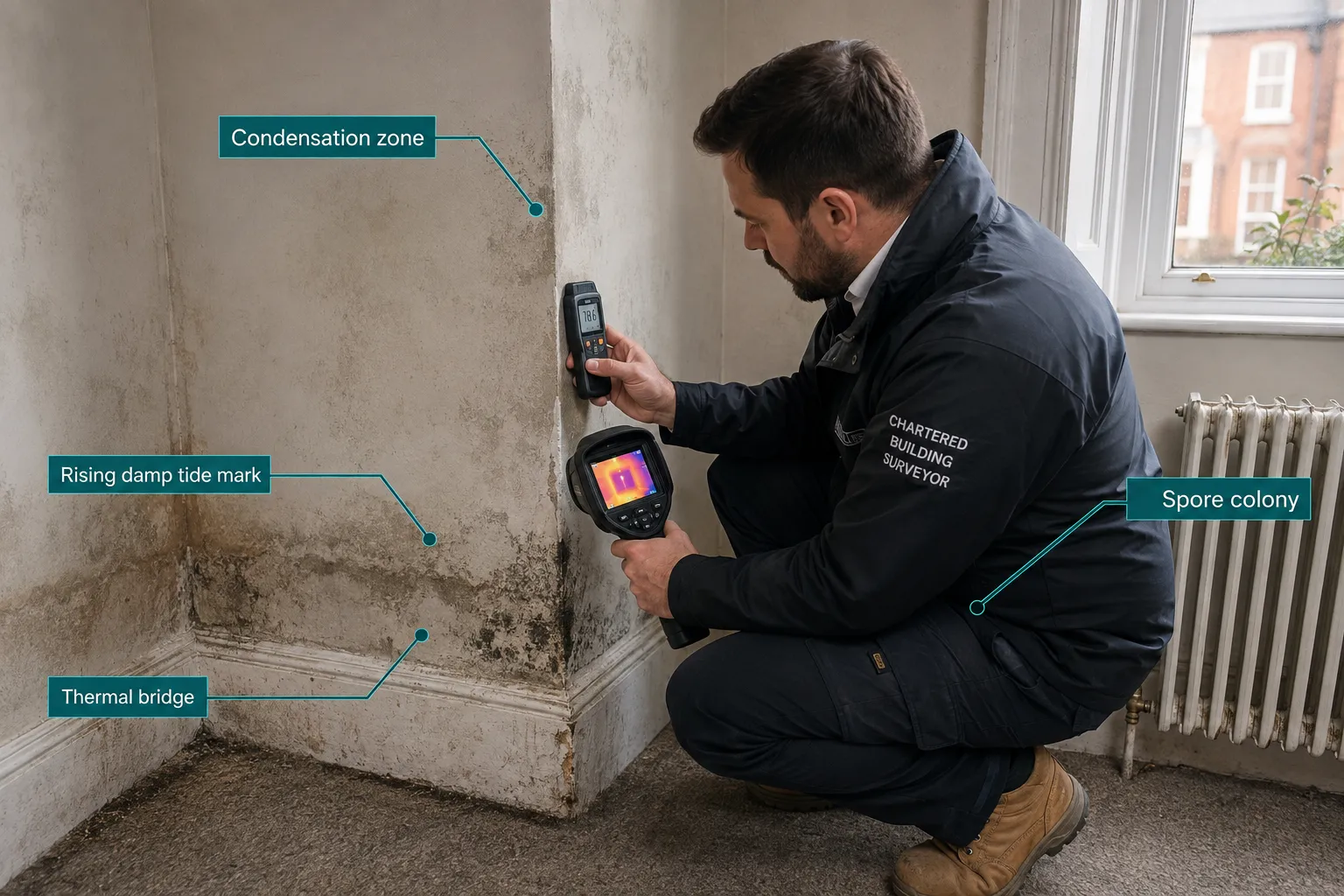
This is precisely where a qualified building surveyor adds irreplaceable value. Rather than arriving with a spray bottle, a surveyor arrives with instruments, expertise, and a framework for understanding why moisture is present in a specific location. That diagnosis is the foundation of every cost-effective remediation plan.
The Surveyor's Diagnostic Framework: What Gets Examined
Identifying the Type of Damp
Not all damp is the same, and the treatment for each type is entirely different. A surveyor will work to categorise the moisture problem before recommending any action. The three principal categories are:
Condensation occurs when warm, moist air meets a cold surface. It is the most common cause of black mould (Cladosporium and Aspergillus species) in UK homes and is strongly associated with inadequate ventilation, thermal bridging, and fuel poverty. Condensation mould typically appears on north-facing walls, in corners, behind furniture, and around window reveals.
Penetrating damp enters the building fabric from outside, usually through defective masonry, failed pointing, leaking gutters, cracked render, or faulty flashings. It tends to produce horizontal or irregular damp patches that worsen after rainfall.
Rising damp travels upward through masonry via capillary action when a damp-proof course is absent, bridged, or failed. It typically presents as a tide mark at low level, often with salt crystallisation (efflorescence) on the wall surface.
A surveyor will also consider plumbing leaks, roof defects, and interstitial condensation within wall or roof constructions, all of which can mimic or compound the above categories.
Instruments and Methods Used On-Site
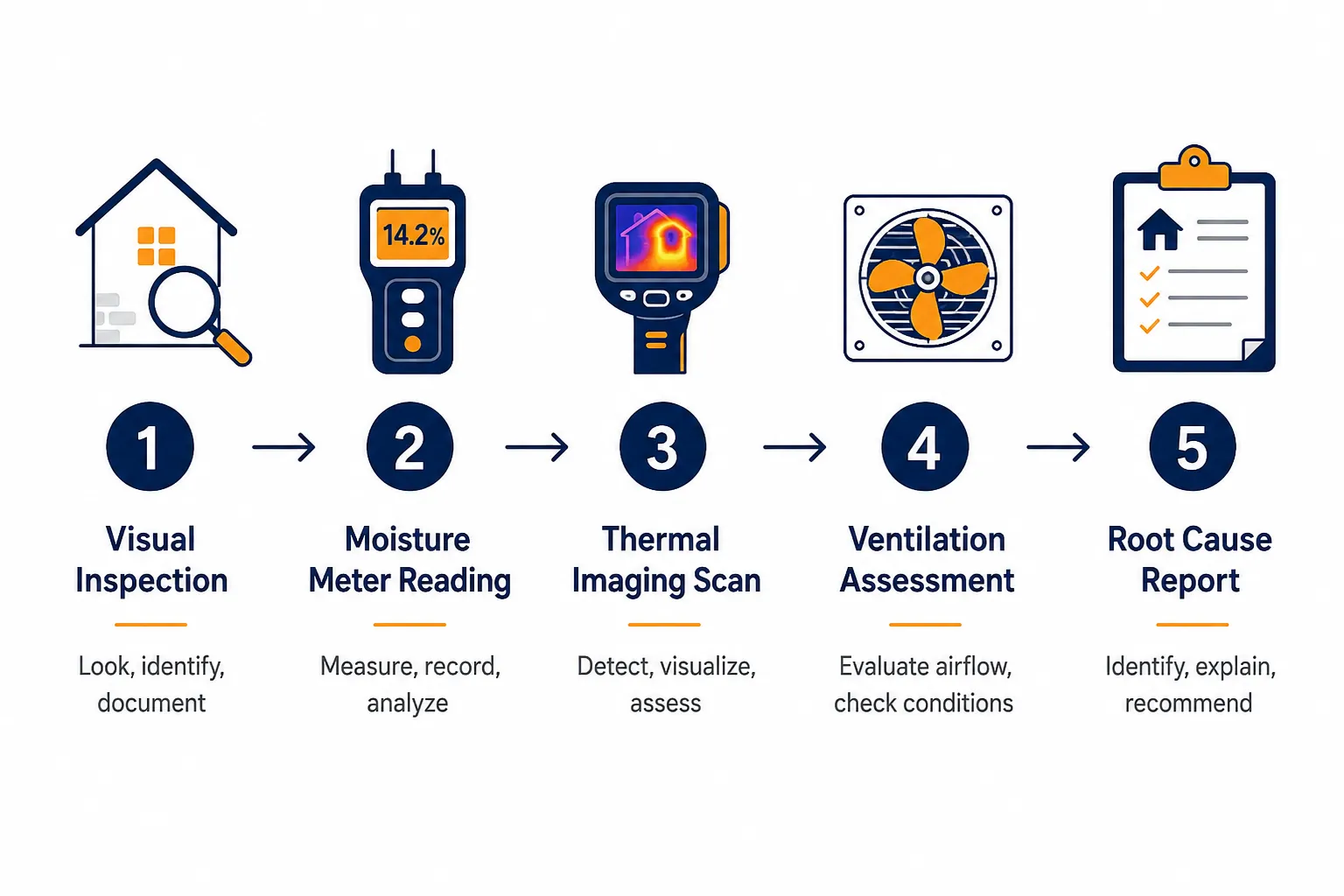
A professional building survey for mould and damp will typically involve:
| Tool | What It Measures |
|---|---|
| Moisture meter (pin-type) | Electrical resistance indicating moisture content in timber and masonry |
| Moisture meter (capacitance) | Surface moisture without penetrating the material |
| Thermal imaging camera | Cold spots and thermal bridges that create condensation risk |
| Hygrometer | Relative humidity and temperature inside rooms |
| Visual inspection | Staining patterns, tide marks, salt deposits, spore colonies |
The combination of these methods allows a surveyor to map moisture distribution across the building fabric, distinguish between surface condensation and structural damp ingress, and identify hidden defects not visible to the naked eye. For older properties with complex construction histories, a Level 3 building survey provides the most comprehensive assessment framework available.
Ventilation and Building Performance Assessment
Since condensation is the dominant cause of mould in UK homes, ventilation assessment is now central to any competent survey. A surveyor will check:
- Whether trickle vents are present and open in window frames
- The condition and operation of extractor fans in kitchens and bathrooms
- Whether passive stack ventilation is blocked or absent
- Signs of air bricks being blocked at ground level
- Whether recent draught-proofing or double glazing installation has reduced background ventilation without compensating measures
The relationship between energy efficiency retrofits and mould risk is increasingly recognised. Tightening a building's envelope without improving ventilation can dramatically increase condensation. This intersection of energy performance and moisture risk is explored further in our article on how building surveys guide homebuyers through long-term cost planning.
What a Surveyor Will and Will Not Advise About Mould Eradication
The Scope of a Building Survey Report
A building surveyor's report will document the location, extent, and probable cause of mould and damp. It will typically include:
- A description of observed defects with photographic evidence
- An assessment of severity, often using the Housing Health and Safety Rating System (HHSRS) risk categories
- Recommended remedial actions, ranked by urgency
- Guidance on whether specialist investigation (e.g., an independent damp surveyor, a structural engineer, or a ventilation specialist) is required before works commence
What a building surveyor will generally not do is specify a particular mould eradication product, endorse a specific contractor, or guarantee that a proposed treatment will be permanent. That distinction matters enormously when interpreting a survey report.
"The surveyor's job is to diagnose, not to prescribe a brand. A report that says 'treat with biocidal wash and repaint' without identifying the moisture source is incomplete."
The HHSRS and Risk-Based Decision Making
The Housing Health and Safety Rating System is the statutory framework used to assess health and safety hazards in residential properties in England and Wales. Damp and mould growth is one of 29 defined hazard categories, and HHSRS assessments are used by local authority environmental health officers to enforce action against landlords and by surveyors to communicate risk to buyers and owners.
A surveyor familiar with HHSRS will rate a mould hazard based on:
- The likelihood of harm occurring
- The range of outcomes if harm does occur (from minor respiratory irritation to serious illness or death)
- The vulnerability of likely occupants (children, elderly people, and those with respiratory conditions face higher risk)
This risk-based approach means that a small patch of mould in a well-ventilated hallway will be treated very differently from extensive black mould in a bedroom occupied by a child with asthma. Understanding what questions to ask during a building survey can help buyers extract the most useful information from this process.
When a Surveyor Recommends Specialist Input
In some cases, a building surveyor will flag that the mould problem requires input from a specialist before any treatment is commissioned. Common triggers for specialist referral include:
- Suspected structural defects driving penetrating damp (e.g., failed cavity wall insulation, cracked lintels)
- Uncertainty about the presence or condition of a damp-proof course
- Evidence of interstitial condensation within insulated wall or roof constructions
- Mould in locations suggesting a concealed plumbing leak
- Properties with unusual or historic construction methods
Commissioning a specialist report before agreeing a remediation contract is not a delay tactic. It is the most direct route to a permanent fix and, in most cases, the most cost-effective one.
Awaab's Law, Legal Duties, and What They Mean for Mold Eradication in UK Homes
The Legal Landscape in 2026
The death of two-year-old Awaab Ishak in 2020 from a respiratory condition caused by prolonged mould exposure in a social housing flat in Rochdale became a catalyst for significant legislative change [6]. Awaab's Law, introduced through the Social Housing (Regulation) Act 2023 and now in force for social housing providers in England, sets mandatory timescales for investigating and remedying damp and mould hazards [3] [8].
Under the current framework, social landlords must:
- Acknowledge a damp or mould complaint within a defined period
- Investigate the hazard within 14 days
- Begin emergency repairs within 24 hours where there is an immediate risk to health
- Complete all remediation works within a specified timeframe
These duties apply to social housing. Private landlords currently operate under the existing framework of the Landlord and Tenant Act 1985 and the Homes (Fitness for Human Habitation) Act 2018, which requires properties to be free from hazards that make them unsuitable for occupation. The Housing Ombudsman has also published detailed guidance and case studies reinforcing the expectation that landlords investigate root causes rather than apply cosmetic fixes [10].
Implications for Buyers and Landlords
For anyone purchasing a property with visible mould, the legal landscape reinforces the surveyor's diagnostic approach. A buyer who commissions a building survey for a first-time purchase and receives a report identifying significant mould has both a negotiating tool and a roadmap for remediation. Knowing whether the mould stems from a structural defect (seller's responsibility to disclose) or from occupant lifestyle factors (condensation management) changes the conversation entirely.
For landlords, the direction of travel is clear even in the private rented sector. The Housing Ombudsman's 2025 report on damp and mould found persistent patterns of landlords treating symptoms rather than causes, and called for systemic change in how complaints are investigated and resolved [10]. Proactive commissioning of a building survey before a mould eradication contractor is engaged is fast becoming best practice, not just in social housing but across the wider rental market.
Practical Implications: Getting the Most From a Pre-Treatment Survey
Before You Accept Any Remediation Quote
The mould eradication industry in the UK is largely unregulated. Any contractor can offer a damp survey and a treatment package. Some provide genuine diagnostic value; others focus primarily on selling products. Before accepting any quote for mould treatment, the following checklist is worth working through:
- Has the surveyor identified the specific moisture source, not just the visible mould?
- Does the report distinguish between condensation, penetrating damp, and rising damp?
- Are recommended repairs clearly separated from cosmetic treatments?
- Has ventilation been assessed as part of the inspection?
- Is the surveyor RICS-qualified or affiliated with a recognised professional body?
- Does the report reference HHSRS risk categories where relevant?
The RICS consumer guidance on damp and mould specifically advises homeowners to seek independent professional advice before committing to specialist treatment, precisely because the market contains a wide range of service quality [9].
Common Defects That Drive Mould Growth
Mould rarely appears in isolation. It is almost always connected to one or more building defects that a competent survey will identify. These include:
- Failed or missing cavity wall insulation creating cold spots and condensation risk
- Blocked or inadequate guttering causing water to track down external walls
- Failed window or door seals allowing water ingress at reveals
- Cracked or spalled render on external walls permitting moisture penetration
- Poorly detailed flat roofs with inadequate falls or failed upstands
- Absent or bridged damp-proof courses at ground level
Many of these defects are common in older UK housing stock. Our guide to 11 common defects in older homes provides a broader overview of the structural issues that frequently underpin moisture problems.
The Energy Performance Connection
There is a growing body of evidence linking poor energy performance with elevated mould risk. Properties with low EPC ratings tend to have colder internal surfaces, higher heating costs (contributing to fuel poverty and under-heating), and less effective ventilation. The relationship between EPC ratings, Minimum Energy Efficiency Standards (MEES), and building condition is explored in detail in our article on EPC, MEES, and building surveys.
In 2026, energy performance is no longer a secondary consideration in mould assessments. A surveyor who does not consider the thermal performance of the building envelope alongside moisture readings is working with an incomplete picture.
Conclusion
Mold eradication in UK homes is not a product. It is a process that begins with accurate diagnosis. A building surveyor's assessment before any treatment is commissioned is the single most important step a homeowner, buyer, or landlord can take to ensure that remediation money is spent on the right problem, in the right place, with a realistic prospect of lasting success.
The key actions to take in 2026 are straightforward:
- Commission a RICS-qualified building survey before accepting any mould treatment quote. For older or complex properties, a Level 3 survey is the appropriate level of investigation.
- Insist on root-cause identification in the survey report. If a report only describes visible mould without identifying the moisture source, request clarification before proceeding.
- Address building defects first. Structural repairs, ventilation improvements, and damp-proof course work must precede any cosmetic treatment.
- Understand your legal position. Whether you are a buyer, a private landlord, or a social housing provider, the legal framework in 2026 increasingly requires evidence-based remediation, not surface-level fixes.
- Consider energy performance. If the property has a low EPC rating, thermal improvement works may be the most effective long-term solution to condensation-driven mould.
The cost of a thorough building survey is a fraction of the cost of repeated mould treatments that fail to address the underlying cause. Investing in diagnosis first is not caution, it is the most direct route to a dry, healthy home.
References
[1] Deadly Mould Crisis Uk Homes – lbc.co.uk
[2] Uk Damp Mould Statistics – mouldpros.co.uk
[3] Awaabs Law – housing-ombudsman.org.uk
[4] Understanding And Addressing The Health Risks Of Damp And Mould In The Home 2 – gov.uk
[5] Mouldy Nation Report 2025 Damp And Mould Plague Uk Homes – newsontheblock.com
[6] Cpwvzxzzxrxo – bbc.com
[7] 2025 Cold Snap Data Reveals Uk Mould Rise – marlowe-es.com
[8] Awaabs Law In The Social Rented Sector – gov.uk
[9] Damp And Mould – rics.org
[10] Latest Housing Ombudsman Damp And Mould Report – housing-ombudsman.org.uk