

Nearly two-thirds of UK homebuyers admit they do not fully understand how a surveyor arrives at a property valuation figure, yet that single number can determine whether a mortgage is approved, a sale falls through, or a buyer overpays by tens of thousands of pounds. This guide cuts through the jargon. It explains, in practical terms, exactly how RICS chartered surveyors assess market value, rebuild cost, and long-term risk for UK homes, drawing on current professional standards and 2026 market data. Whether buying, selling, or remortgaging, understanding how UK property "worth" is really calculated gives every party a sharper negotiating position.
Key Takeaways
- "Worth" is not a single figure: chartered surveyors distinguish between market value, mortgage lending value, and rebuild cost, and each serves a different purpose.
- RICS Red Book standards and the updated UK residential supplement govern how every professional valuation must be conducted.
- Comparable sales evidence is the cornerstone of residential valuation, but condition, location, and energy performance all adjust the final figure.
- Mid-2026 market data shows modest price growth slowing, with asking-price drops running well above seasonal norms, context that directly affects comparable evidence.
- Buyers and sellers who understand the valuation process are better placed to challenge, accept, or act on a surveyor's opinion of value.
What "Worth" Actually Means: Three Distinct Figures
Most people use the word "worth" to mean one thing. In practice, a chartered surveyor works with at least three separate concepts, and confusing them is one of the most common, and costly, mistakes in UK property transactions.
1. Market Value
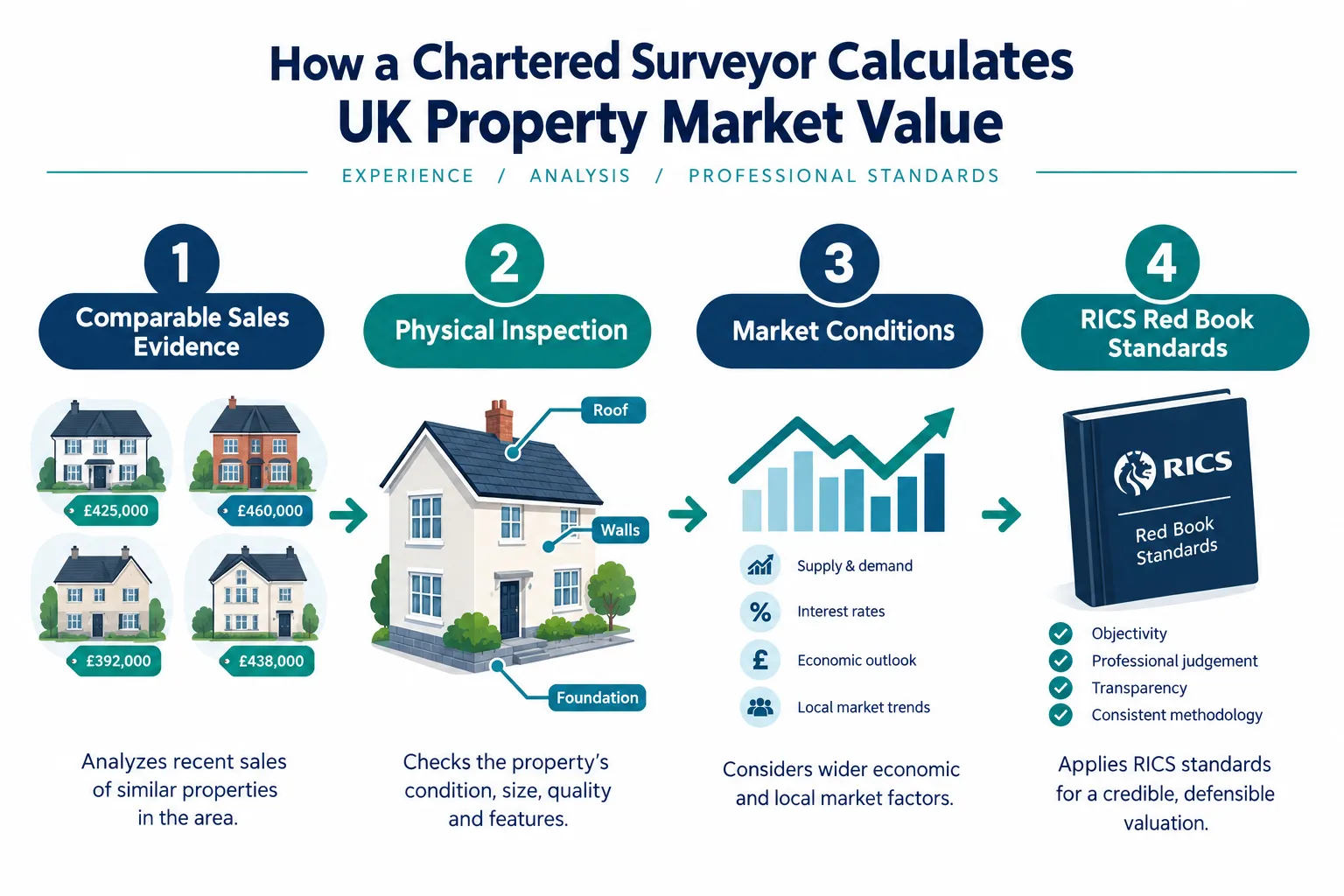
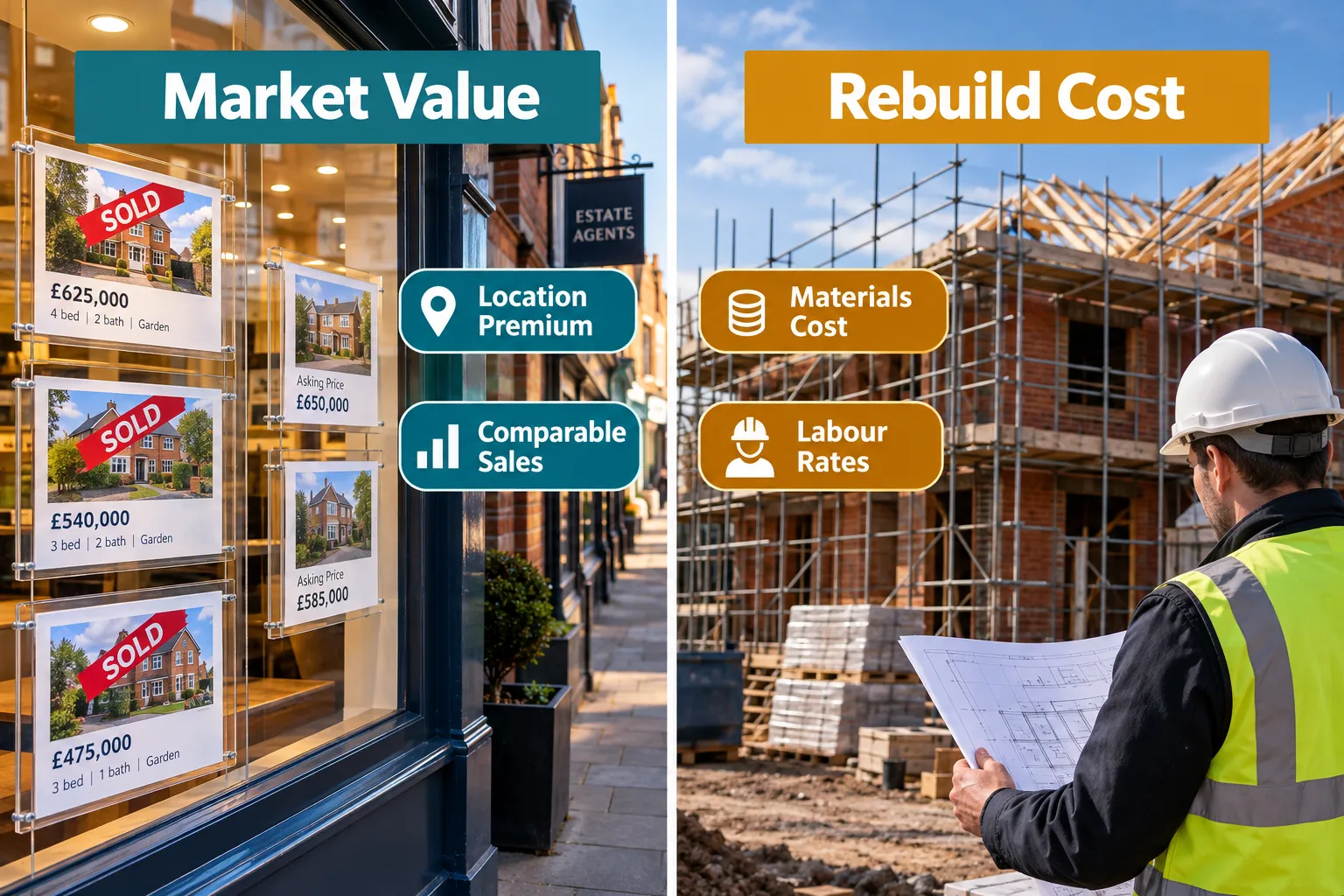
This is the estimated amount a property would sell for between a willing buyer and a willing seller, neither under compulsion, both acting with full information, on the date of valuation. It is the figure most buyers and sellers care about. The RICS Red Book Global Standards define market value precisely, and the UK national supplement, effective from 1 May 2024, sets out additional consistency requirements for residential work in England, Wales, Scotland, and Northern Ireland [2].
2. Mortgage Lending Value (MLV)
Lenders often instruct their own valuers to assess a property not just at today's price but at a sustainable long-term value that strips out short-term market peaks. This figure can be lower than market value, which is why a lender's valuation sometimes disappoints a buyer who has agreed a higher price.
3. Rebuild Cost (Reinstatement Value)
This is the cost of demolishing and rebuilding the property from scratch to its current specification, including professional fees and VAT. It has nothing to do with what the house would sell for. A Victorian terraced house in a regional city might have a market value of £280,000 but a rebuild cost of £420,000, because labour, materials, and specialist brickwork are expensive regardless of location. Underinsuring against rebuild cost is a serious and widespread risk.
"Market value tells you what the market will pay. Rebuild cost tells you what it would cost to put things right if the worst happened. They are rarely the same number."
The Comparable Sales Method: The Engine of Residential Valuation
For the vast majority of UK homes, the comparable sales method, often called "comps", is the primary valuation tool. This is how UK property "worth" is really calculated in practice, and understanding it demystifies the process entirely.
How Comparables Work
A chartered surveyor searches for recent sales of similar properties in the same locality. "Similar" means comparable in:
- Type (terraced, semi-detached, detached, flat)
- Size (gross internal area in square metres)
- Age and construction (Victorian brick, 1970s cavity wall, modern timber frame)
- Condition (broadly similar state of repair)
- Location (same street, same postcode sector, or comparable micro-market)
The surveyor then adjusts for differences. A comparable property that sold three months ago for £350,000 but had a new kitchen and bathroom might support a value of £335,000 for a subject property with original fittings, the surveyor applies a reasoned adjustment rather than a mechanical formula.
The 2026 Market Context
This process is only as reliable as the evidence available. The UK House Price Index, published by the ONS, provides the authoritative baseline for national and regional price movements [1]. As of mid-2026, the ONS private rent and house prices bulletin shows overall price growth continuing but at a softening pace [6][7]. Separately, Rightmove's asking-price data for July 2026 recorded a drop roughly five times larger than the typical seasonal fall for that month [8], a signal that sellers are adjusting expectations faster than the headline indices suggest.
For surveyors, this creates a challenge: agreed sales from three to six months ago may overstate current market value if sentiment has shifted. The RICS UK Residential Market Survey for mid-2026 reported weak buyer demand and subdued agreed sales volumes, reinforcing the need for careful, up-to-date comparable selection. Readers interested in how surveyors navigate thin evidence in these conditions will find practical detail in this guide to valuation evidence in subdued markets.
When Comparables Are Scarce
In rural areas, unusual property types, or flat markets, finding reliable comparables is genuinely difficult. Surveyors may widen the search radius, extend the time window, or apply greater adjustments, all of which introduce more professional judgment and, potentially, more uncertainty. The valuation methodology for flat markets explores the specific techniques used when regional prices plateau.
What Adjusts the Final Figure: Condition, Location, and Energy Performance
Comparable sales give a starting range. What moves the figure within, or outside, that range is a structured assessment of the subject property itself.
Physical Condition
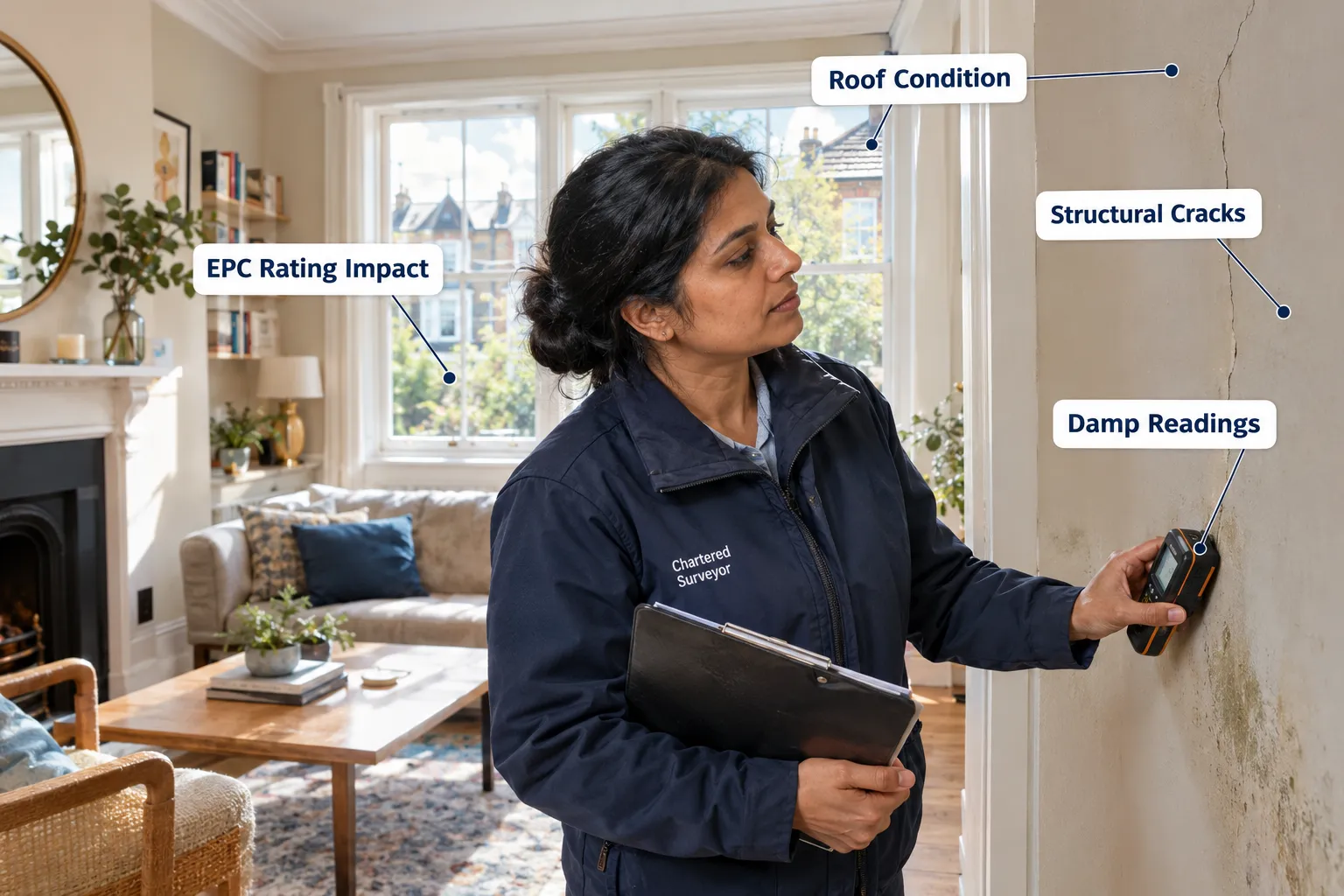
A chartered surveyor conducting a valuation will note defects that affect value. These are not the same as the detailed findings in a Level 3 building survey, but significant issues, structural movement, roof failure, damp penetration, or obsolete electrics, will be reflected in a downward adjustment. For buyers wanting the full picture, a Level 3 building survey provides the comprehensive structural assessment that a valuation alone does not.
Location Factors
Location is not just a postcode. Surveyors consider:
| Factor | Positive Effect | Negative Effect |
|---|---|---|
| School catchment | Strong demand, price premium | Outside catchment, reduced demand |
| Transport links | Proximity to station adds value | Poor connectivity suppresses price |
| Flood risk | Low-risk zone, no adjustment | Flood zone 3, material discount |
| Noise and amenity | Quiet residential street | Adjacent to busy road or industrial use |
| Future development | Regeneration area, uplift potential | Planned infrastructure nearby |
Energy Performance and ESG Factors
This is the area of fastest change in 2026. Mandatory ESG and energy performance considerations are now formally built into the RICS valuation framework [9]. A property with an Energy Performance Certificate (EPC) rating of A or B commands a measurable premium in many markets. Conversely, a property rated F or G, below the Minimum Energy Efficiency Standard (MEES) threshold, faces a discount that reflects both the cost of required works and the risk of unlettability for landlords. The interaction between EPC ratings, retrofit costs, and valuation is explored in detail in the guide to EPC ratings and MEES in building surveys.
With a forthcoming dedicated UK Residential Property Valuation standard expected in mid-2026, surveyors are already aligning their practice to ensure energy performance is reported consistently and transparently [9].
The Surveyor's Inspection: What Actually Happens on the Day
A valuation inspection for mortgage purposes typically takes 20 to 45 minutes for a standard residential property. A more detailed homebuyer report or building survey takes considerably longer. Either way, the surveyor follows a structured process.
The Inspection Checklist
A chartered surveyor will typically assess:
- External fabric, roof covering, chimneys, gutters, walls, windows, and drainage
- Internal structure, ceilings, floors, walls, and any signs of movement or damp
- Services, age and condition of heating, electrics, and plumbing (visual only unless tested)
- Site and grounds, boundary features, outbuildings, access, and any visible environmental risks
- Legal and planning flags, extensions, conversions, or alterations that may require documentation
The surveyor records findings against a standardised condition rating system. Under RICS Home Survey Standards, condition ratings run from 1 (no repair currently needed) to 3 (defects that are serious or need to be repaired urgently). This system, subject to ongoing updates through the RICS Home Survey Standards updates for 2026, makes reports more consistent and comparable across firms.
High-Volume Residential Valuation in Practice
Large residential valuation firms handle thousands of mortgage valuations monthly. Consistency is enforced through peer review, automated desktop valuation cross-checks, and quality auditing. The RICS Red Book UK supplement, updated with effect from 1 May 2024, strengthened requirements around consistency and documentation specifically for this high-volume residential context [2].
Regional Divergence: Why the Same House Is Worth Different Amounts Across the UK
One of the most misunderstood aspects of UK property valuation is regional divergence. A four-bedroom detached house in County Durham and an equivalent property in Surrey are not comparable in any meaningful sense. In 2026, this divergence has widened further.
The ONS UK House Price Index confirms that price growth in northern English cities, Scotland, and parts of Wales has outpaced London and the South East over the past 18 months [1]. For surveyors, this means that national indices, useful for context, cannot substitute for local comparable evidence. A surveyor valuing in Sheffield cannot rely on London-derived price trends, and vice versa.
For buyers considering investment in northern markets, the guide to building surveys for buy-to-let investment decisions addresses how regional migration patterns are affecting both property quality assessments and valuations.
Common Misconceptions About Property "Worth"
"The asking price reflects the value."
It does not. Asking prices are set by sellers and agents, often aspirationally. The Rightmove July 2026 data showing an unusually large asking-price drop is a reminder that asking prices and achieved prices diverge, sometimes significantly [8].
"Online valuation tools are accurate enough."
Automated valuation models (AVMs) use algorithmic analysis of Land Registry data and property characteristics. They are useful for a quick estimate but cannot account for condition, recent improvements, or hyperlocal factors. They carry wide confidence intervals and are not a substitute for a professional opinion.
"A higher valuation is always better."
For sellers, yes. For buyers, an inflated valuation means overpaying. For remortgagors, an accurate valuation, not an optimistic one, is what matters for loan-to-value calculations.
"Surveyors always agree with the agreed price."
They do not. A surveyor who believes the agreed price exceeds market value will report a "down valuation." This can cause a mortgage offer to be reduced or withdrawn. In a softening market, down valuations become more common as agreed prices lag behind shifting sentiment.
How to Use This Knowledge as a Buyer or Seller
Understanding how UK property "worth" is really calculated is not just academic. It translates directly into practical action.
As a buyer:
- Commission an independent survey rather than relying solely on the lender's valuation, which is instructed to protect the lender, not you.
- Review the comparable evidence the surveyor cites. If you believe the comparables are weak or outdated, you have grounds to discuss the figure.
- Factor EPC rating and retrofit costs into your offer price, not just the headline asking price.
As a seller:
- Obtain a pre-sale valuation from a RICS-registered surveyor, not just an estate agent's appraisal (which carries no professional liability).
- Address visible defects before marketing. Condition ratings directly affect value.
- Understand that in a softening market, pricing to the top of comparable evidence risks a down valuation that delays or collapses a sale.
Conclusion
This plain-English guide to how UK property "worth" is really calculated reveals that valuation is neither guesswork nor a simple formula. It is a structured professional process governed by RICS Red Book standards, grounded in comparable sales evidence, and adjusted for condition, location, and increasingly, energy performance. In mid-2026, with asking prices falling faster than seasonal norms and buyer demand remaining subdued, the quality of that comparable evidence, and the surveyor's judgment in applying it, matters more than ever.
Actionable next steps:
- Before any transaction, instruct a RICS-registered chartered surveyor for an independent opinion of value.
- Ask the surveyor to explain the comparable evidence used and any adjustments made, a good surveyor will welcome the question.
- Check the property's EPC rating and model the cost of any required energy improvements before finalising an offer price.
- For complex or unusual properties, consider a full Level 3 building survey alongside the valuation to ensure condition issues are fully captured.
- Monitor the ONS UK House Price Index and RICS Residential Market Survey for the most current and reliable market data in your region.
References
[1] UK House Price Index Monthly Price Statistics – ons.gov.uk
[2] Red Book UK Supplement Updated Guidance – ww3.rics.org
[6] Private Rent and House Prices UK July 2026 – ons.gov.uk
[7] Private Rent and House Prices UK July 2026 Release – ons.gov.uk
[8] UK House Price Index July 2026: Why This Summer's Price Drop Is Five Times Bigger Than Normal – chbl.uk
[9] Residential Valuations – RICS Standards and Guidance – rics.org