

When property markets enter periods of stagnation, the challenge for chartered surveyors intensifies dramatically. With more than a third of new build flats selling below their original purchase prices in 2025[3], and regional house price growth diverging significantly across the UK, traditional valuation approaches require careful refinement. The current landscape of 2026 demands that property professionals adapt their methodologies to accurately assess properties in markets where headline prices remain broadly flat, even as regional variations create pockets of growth and decline.

Understanding Valuation Methodology for Flat Markets: Chartered Surveyor Techniques When Regional House Prices Plateau Amid Macroeconomic Uncertainty has become essential for property professionals navigating today's complex economic environment. This comprehensive guide explores the specialized techniques surveyors employ when conventional market indicators provide limited guidance.
Key Takeaways
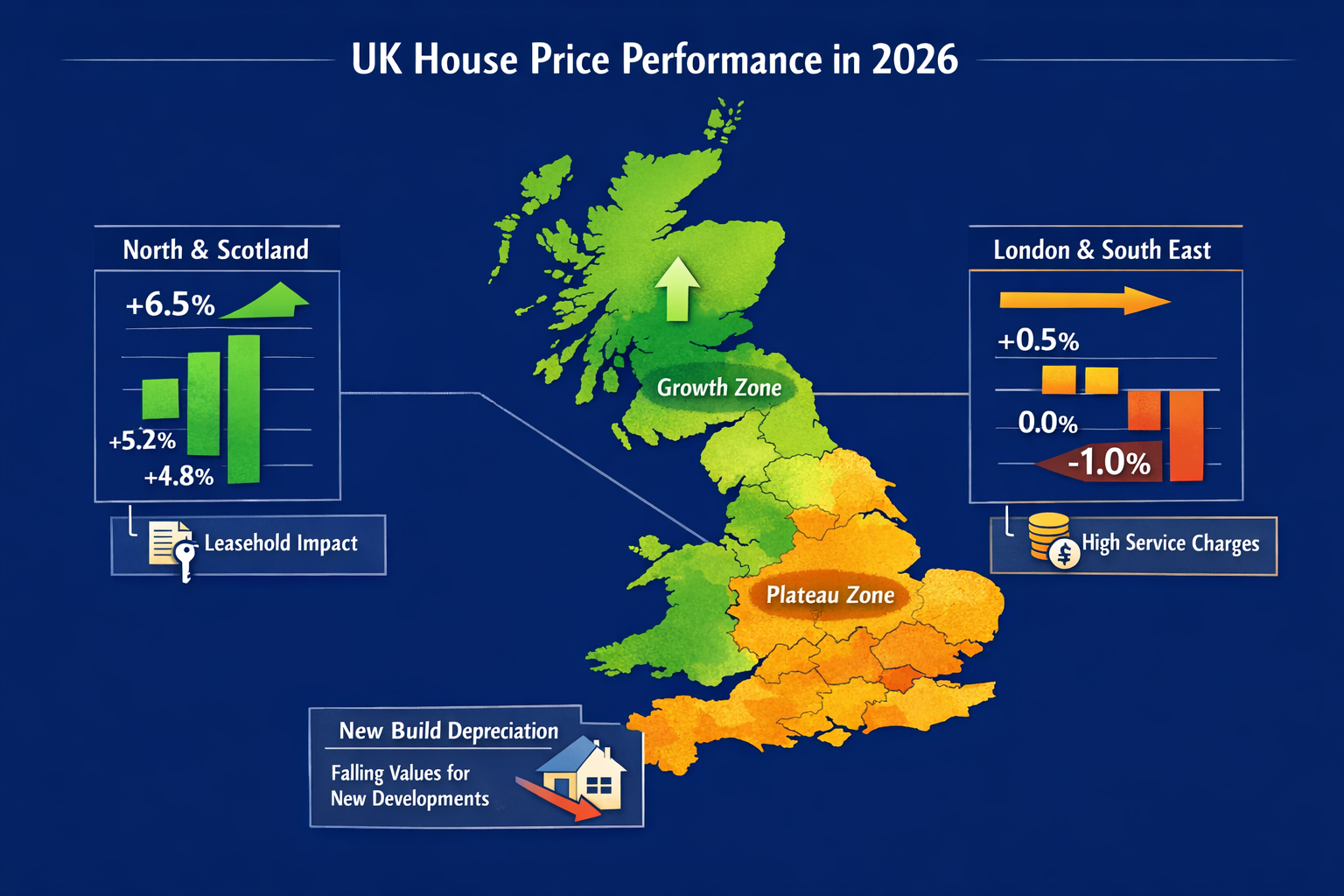
- Regional divergence requires surveyors to apply location-specific valuation adjustments, with Scotland, Wales, and northern England showing stronger growth than London and the southeast[4]
- Leasehold considerations have become critical valuation factors, particularly for flats where declining lease terms significantly impact buyer appetite and lender willingness
- Service charge analysis now forms an integral component of flat valuations, directly affecting borrowing capacity and achievable sale prices
- Comparable evidence must be carefully weighted to account for market timing, with recent transactions given greater emphasis in plateau conditions
- Risk assessment frameworks help surveyors communicate uncertainty to clients while maintaining professional valuation standards
Understanding Market Plateau Conditions in 2026
The UK property market in 2026 presents a unique challenge for valuation professionals. Unlike periods of consistent growth or clear decline, flat markets create ambiguity that complicates traditional comparable sales analysis. House prices are expected to rise modestly, with predictions ranging from 1% to 4% growth nationally[2], but this headline figure masks significant regional variation.
Defining a Flat Market Environment
A flat market doesn't necessarily mean zero price movement. Instead, it describes conditions where:
- Price volatility remains minimal over extended periods (6-12 months)
- Transaction volumes may decrease as buyers and sellers adopt wait-and-see approaches
- Regional performance diverges significantly from national averages
- Property types experience different trajectories (flats underperforming houses)
- Macroeconomic factors create uncertainty about future price direction
Chartered surveyors must recognize that flat markets often contain micro-trends invisible in aggregate data. A street-by-street analysis may reveal pockets of strength or weakness that national statistics obscure.
The 2026 Market Context
Current market conditions reflect several converging factors:
📊 Interest Rate Environment: Mortgage rates remain elevated compared to pre-2022 levels, constraining buyer purchasing power and dampening price growth expectations.
🏢 New Build Depreciation: The significant proportion of new build flats selling below original prices[3] signals structural issues in this segment that surveyors must account for in their valuations.
📍 Geographic Disparity: Scotland, Wales, and northern England are expected to outperform London and the southeast[4], requiring location-specific valuation approaches.
💷 Affordability Improvements: Modest improvements in affordability may support price stability rather than growth, creating the plateau conditions that challenge traditional valuation methods.
When conducting professional property valuations, surveyors must synthesize these factors into coherent assessments that reflect genuine market value.
Core Valuation Methodology for Flat Markets: Chartered Surveyor Techniques When Regional House Prices Plateau Amid Macroeconomic Uncertainty
Chartered surveyors employ several refined techniques when assessing properties in stagnant market conditions. These methodologies build upon traditional approaches while incorporating adjustments specific to plateau environments.
Comparative Method Refinements
The comparative method remains the foundation of residential property valuation, but flat markets require enhanced scrutiny:
Time-Weighted Comparables: In stable markets, the recency of comparable sales becomes paramount. Surveyors typically prioritize:
- Sales within the previous 3 months as primary evidence
- Sales from 3-6 months ago with cautious adjustment
- Older sales used only for trend analysis or where recent evidence is scarce
Quality of Evidence Assessment: Not all comparable sales carry equal weight. Surveyors evaluate:
| Evidence Quality | Characteristics | Weighting |
|---|---|---|
| Excellent | Same street, similar size/condition, arms-length transaction | 100% |
| Good | Adjacent streets, comparable features, normal sale | 80-90% |
| Moderate | Wider area, some differences, standard transaction | 60-80% |
| Limited | Different submarket, significant adjustments needed | 40-60% |
| Poor | Distressed sale, unusual circumstances | <40% |
Adjustment Precision: Flat markets demand more granular adjustments for property differences. Surveyors must account for:
- 🏠 Property condition (decorative order vs. requiring modernization)
- 📐 Size variations (price per square foot analysis)
- 🌳 Position factors (corner plots, main road locations, outlook)
- 🚗 Parking provision (especially critical in urban areas)
- 🏗️ Building quality (construction standards, materials, age)
Leasehold Valuation Considerations
For flats operating under leasehold structures—the predominant tenure in England and Wales—lease length has become a critical valuation determinant. The impact of declining lease terms cannot be overstated[3].
Lease Length Impact Matrix:
- 80+ years: Minimal impact on value; mortgageable by most lenders
- 70-80 years: 5-10% value reduction; some lender restrictions
- 60-70 years: 10-20% value reduction; significant lender limitations
- Below 60 years: 20-40% value reduction; very limited mortgage availability
Surveyors conducting leasehold extension and enfranchisement valuations must factor these considerations into their assessments, particularly in flat markets where buyers have greater negotiating power.
Ground Rent Capitalization: Modern valuation approaches must also consider:
- Ground rent amounts and review patterns
- Onerous lease terms that may deter buyers
- Freeholder identity and reputation
- Service charge levels and escalation clauses
Service Charge Analysis
Rising service charges directly constrain buyer borrowing capacity[3], making this analysis essential for accurate flat valuations in 2026.
Service Charge Impact Assessment:
Surveyors should:
- Obtain detailed service charge breakdowns for the previous 3-5 years
- Identify trend patterns (stable, gradually increasing, or spiking)
- Compare against local benchmarks for similar developments
- Assess reserve fund adequacy (insufficient reserves signal future increases)
- Review major works schedules (planned expenditure affecting future charges)
"In flat markets, service charges become a differentiating factor between properties. Two identical flats with £1,000 vs. £3,000 annual service charges may see a 10-15% valuation difference, as buyers factor ongoing costs into their affordability calculations."
The Residual Method for Development Potential
Where properties possess development potential, the residual method provides valuable insight, particularly in areas showing growth potential despite broader market stagnation.
Residual Valuation Formula:
Site Value = Gross Development Value - (Construction Costs + Professional Fees + Finance Costs + Profit Margin)
In flat markets, surveyors must apply conservative assumptions:
- GDV estimates based on current market conditions, not projected growth
- Profit margins increased to reflect development risk (20-25% vs. 15-20% in growth markets)
- Exit timing extended to account for slower sales rates
- Finance costs calculated over longer development periods
This approach proves particularly relevant for commercial valuations where development or refurbishment potential affects value.
Regional Variation and Location-Specific Techniques

The divergence between regional markets in 2026 requires surveyors to adopt location-specific approaches within the broader framework of Valuation Methodology for Flat Markets: Chartered Surveyor Techniques When Regional House Prices Plateau Amid Macroeconomic Uncertainty.
Growth vs. Plateau Region Strategies
Northern England, Scotland, and Wales Approach:
These regions are expected to see stronger growth[4], requiring surveyors to:
- ✅ Weight recent sales more heavily to capture emerging growth trends
- ✅ Consider forward-looking indicators (employment growth, infrastructure investment)
- ✅ Apply modest upward adjustments where momentum is evident
- ✅ Recognize that "flat" national conditions may mask local growth
London and Southeast Approach:
Markets experiencing genuine stagnation or decline demand different techniques:
- ⚠️ Scrutinize comparable evidence for signs of price softening
- ⚠️ Apply conservative adjustments between properties
- ⚠️ Weight seller motivation factors more heavily
- ⚠️ Consider extended marketing periods in valuation assumptions
Surveyors operating across multiple regions, such as those providing services in Barnes, Richmond, Bromley, Ealing, and Oxfordshire, must maintain distinct valuation frameworks for each location.
Micromarket Analysis
Flat markets amplify the importance of micromarket analysis—understanding conditions at the neighborhood or even street level.
Key Micromarket Indicators:
- Days on Market Trends: Properties selling quickly suggest localized demand strength
- Sale Price to Asking Price Ratios: Consistent achievement of asking prices indicates market resilience
- Inventory Levels: Low stock levels may support prices despite broader stagnation
- Demographic Shifts: Areas attracting new residents may outperform
- Infrastructure Development: Crossrail, HS2, and other projects create localized growth
Surveyors should maintain detailed databases of these indicators for their operating areas, enabling nuanced valuations that reflect genuine market conditions rather than relying solely on regional or national trends.
New Build vs. Established Property Differentiation
The significant depreciation affecting new build flats[3] requires distinct valuation approaches:
New Build Flat Considerations:
- 📉 Apply depreciation factors based on local new build performance data
- 📉 Account for "new build premium" erosion (typically 10-20% over 2-3 years)
- 📉 Consider building warranty status and remaining coverage
- 📉 Assess developer reputation and building quality issues
- 📉 Factor in service charge trajectories (often increase post-developer control)
Established Property Advantages:
- ✨ Known service charge histories
- ✨ Established building performance and maintenance records
- ✨ Proven neighborhood integration
- ✨ Often superior construction quality in period properties
- ✨ No "new build premium" to depreciate
This differentiation becomes particularly important when advising clients on what to do if a home valuation is less than an offer, as new build properties may face additional downward pressure.
Specialized Valuation Scenarios in Flat Markets
Insurance Reinstatement Valuations
Flat markets don't affect reinstatement costs, which reflect building costs rather than market values. However, surveyors must ensure clients understand this distinction.
Insurance reinstatement cost valuations serve a different purpose than market valuations, focusing on:
- 🏗️ Current construction costs (which may rise despite flat property prices)
- 🏗️ Professional fees for rebuilding
- 🏗️ Demolition and site clearance costs
- 🏗️ Local authority fees and compliance costs
In 2026, construction cost inflation continues despite property price stagnation, creating a widening gap between market values and reinstatement costs that surveyors must communicate clearly to clients.
Pension and SIPP Valuations
Properties held within Self-Invested Personal Pensions require annual valuations that reflect genuine market value, making flat market conditions particularly challenging.
SIPP pension valuations in plateau conditions require:
- 📊 Conservative approach to avoid overstating pension fund values
- 📊 Clear documentation of market conditions affecting valuation
- 📊 Consideration of liquidity factors (extended sale periods)
- 📊 Compliance with HMRC requirements for realistic valuations
Capital Gains Tax Valuations
Capital gains tax valuations benefit from flat market conditions, as minimal appreciation between acquisition and disposal dates may reduce tax liabilities.
Surveyors must:
- 🔍 Establish baseline values at acquisition dates
- 🔍 Document market conditions at both acquisition and disposal
- 🔍 Apply appropriate indexation allowances where applicable
- 🔍 Provide robust evidence to support valuations for HMRC scrutiny
Risk Assessment and Uncertainty Communication
Professional surveyors operating under RICS standards must communicate valuation uncertainty appropriately, particularly in flat markets where future price direction remains unclear.
Material Uncertainty Clauses
While not always required in flat markets (unlike pandemic conditions), surveyors should consider including material uncertainty declarations when:
- Comparable evidence is sparse or conflicting
- Market conditions are rapidly changing
- Significant macroeconomic uncertainty exists
- Property type has experienced unusual volatility
Valuation Ranges vs. Point Estimates
Some surveyors adopt valuation ranges in flat markets:
- Point estimate: £450,000
- Range approach: £440,000-£460,000
The range approach acknowledges inherent uncertainty while providing clients with realistic expectations for achievable sale prices.
Scenario Analysis
For complex valuations, particularly commercial properties, scenario analysis provides valuable insight:
| Scenario | Assumptions | Valuation |
|---|---|---|
| Optimistic | Market recovery, 3% growth | £463,500 |
| Base Case | Continued plateau, 0% growth | £450,000 |
| Pessimistic | Market softening, -3% decline | £436,500 |
This approach helps clients understand the range of potential outcomes and make informed decisions about pricing strategies.
Practical Application: Case Study Approach
Case Study 1: London Two-Bedroom Flat
Property: Two-bedroom flat, 750 sq ft, 65-year lease, £2,800 annual service charge
Valuation Challenges:
- Lease length below optimal 80-year threshold
- Service charges above local average (£2,200)
- New build comparable sold 15% below purchase price
- London market showing stagnation
Surveyor Approach:
- Identified comparable with 85-year lease at £425,000
- Applied 12% reduction for shorter lease (£51,000)
- Applied 5% reduction for higher service charges (£18,700)
- Final valuation: £355,000
This demonstrates how multiple factors compound in flat markets, requiring careful analysis of each element.
Case Study 2: Manchester Three-Bedroom House
Property: Victorian terrace, 1,200 sq ft, good condition, growing neighborhood
Valuation Challenges:
- National headlines suggest flat market
- Local area showing 4% growth
- Mix of comparable evidence
Surveyor Approach:
- Prioritized recent local sales over older transactions
- Identified neighborhood improvement factors (new school, transport links)
- Applied modest upward adjustment reflecting local growth
- Final valuation: £285,000 (3% above 6-month-old comparables)
This illustrates the importance of micromarket analysis over reliance on national trends.
Technology and Data in Flat Market Valuations
Modern surveyors leverage technology to enhance valuation accuracy:
Automated Valuation Models (AVMs)
AVMs provide useful cross-checks but require careful interpretation in flat markets:
- ✅ Useful for identifying comparable properties
- ✅ Provide rapid initial estimates
- ⚠️ May lag current market conditions
- ⚠️ Cannot assess property-specific factors (condition, lease terms)
- ⚠️ Require professional judgment overlay
Data Analytics Platforms
Professional-grade platforms offer:
- 📈 Real-time transaction data
- 📈 Days-on-market trending
- 📈 Heat mapping of price movements
- 📈 Demographic and economic indicators
These tools enhance but don't replace the professional judgment central to Valuation Methodology for Flat Markets: Chartered Surveyor Techniques When Regional House Prices Plateau Amid Macroeconomic Uncertainty.
Geographic Information Systems (GIS)
GIS technology enables sophisticated spatial analysis:
- 🗺️ Mapping price gradients across areas
- 🗺️ Identifying micromarket boundaries
- 🗺️ Analyzing proximity to amenities and transport
- 🗺️ Visualizing planning and development impacts
Professional Standards and Regulatory Compliance
Chartered surveyors must maintain compliance with RICS standards throughout the valuation process:
RICS Red Book Requirements
The RICS Valuation – Global Standards (Red Book) mandates:
- Clear identification of valuation purpose
- Appropriate basis of value (Market Value, Market Rent, etc.)
- Transparent assumptions and special assumptions
- Adequate inspection and investigation
- Proper comparable evidence analysis
- Professional indemnity insurance coverage
Basis of Value Selection
In flat markets, the chosen basis of value significantly impacts outcomes:
- Market Value: Price achieved in competitive market with reasonable marketing period
- Forced Sale Value: Reduced price reflecting compressed marketing timeframe
- Fair Value: Accounting standard requiring specific assumptions
Surveyors must select the appropriate basis for the valuation purpose and apply it consistently.
Documentation Standards
Comprehensive documentation becomes particularly important in flat markets where valuations may face greater scrutiny:
- 📝 Detailed comparable analysis with adjustment justifications
- 📝 Market condition assessment and trend analysis
- 📝 Photographs and property description
- 📝 Lease documentation review (for leasehold properties)
- 📝 Service charge and ground rent analysis
- 📝 Limitations and assumptions clearly stated
Client Communication and Expectation Management
Effective communication forms an essential component of professional valuation services in uncertain markets.
Managing Seller Expectations
Sellers often harbor unrealistic price expectations, particularly if they purchased during a growth period. Surveyors should:
- 🗣️ Present clear comparable evidence
- 🗣️ Explain market condition impacts
- 🗣️ Discuss realistic marketing periods
- 🗣️ Provide strategic pricing recommendations
Understanding how to negotiate house price down after a survey helps surveyors advise sellers on likely buyer behavior.
Advising Buyers
Buyers in flat markets gain negotiating power but require guidance on:
- 💡 Distinguishing between realistic and unrealistic asking prices
- 💡 Understanding factors affecting value (lease length, service charges)
- 💡 Timing considerations (is now the right time to buy?)
- 💡 Future value prospects based on location and property type
Lender Communication
Mortgage lenders require valuations that protect their security interest. In flat markets, surveyors must:
- 🏦 Clearly communicate any downward pressure factors
- 🏦 Highlight risks (lease length, service charges, market conditions)
- 🏦 Provide robust comparable evidence
- 🏦 Ensure valuations reflect genuine market value, not aspirational pricing
Future-Proofing Valuation Approaches
As markets evolve, surveyors must adapt their methodologies to maintain accuracy and relevance.
Emerging Considerations for 2026 and Beyond
Several factors will increasingly influence valuations:
Energy Performance: With growing emphasis on sustainability, EPC ratings increasingly affect values:
- Properties rated A-C command premiums
- Properties rated F-G face discounts and regulatory risks
- Improvement costs factor into valuation calculations
Climate Risk: Flood risk, coastal erosion, and extreme weather vulnerability increasingly impact values, particularly as insurance costs rise.
Working Patterns: Post-pandemic working patterns continue to influence location preferences, with implications for regional price divergence.
Planning Reform: Potential planning system changes could affect development potential valuations significantly.
Continuous Professional Development
Surveyors must maintain current knowledge through:
- 📚 Regular RICS CPD compliance
- 📚 Market research and analysis
- 📚 Technology adoption and training
- 📚 Peer discussion and knowledge sharing
Conclusion
Valuation Methodology for Flat Markets: Chartered Surveyor Techniques When Regional House Prices Plateau Amid Macroeconomic Uncertainty requires a sophisticated blend of traditional principles and adaptive refinement. As the UK property market in 2026 demonstrates significant regional divergence—with northern regions and Scotland outperforming London and the southeast[4]—surveyors must move beyond headline national statistics to understand genuine local market conditions.
The challenges are substantial: new build flats selling below original prices[3], leasehold structures creating additional complexity, and rising service charges constraining buyer capacity. Yet these challenges also present opportunities for professional surveyors to demonstrate their value through rigorous analysis, appropriate methodology selection, and clear client communication.
Key Principles for Success
Effective valuation in flat markets rests on several foundations:
- Prioritize recent, high-quality comparable evidence over older or less relevant transactions
- Conduct thorough micromarket analysis rather than relying on regional or national trends
- Factor leasehold considerations prominently in flat valuations, including lease length and service charges
- Differentiate between property types, particularly new build vs. established properties
- Communicate uncertainty appropriately while maintaining professional standards
- Leverage technology as a tool to enhance, not replace, professional judgment
Actionable Next Steps
For property professionals seeking to refine their approach:
✅ Review your comparable database to ensure sufficient recent evidence for your operating areas
✅ Develop location-specific knowledge of micromarket conditions affecting your valuations
✅ Enhance your leasehold analysis capabilities, including lease extension valuation techniques
✅ Invest in data analytics tools that provide real-time market intelligence
✅ Strengthen client communication protocols to manage expectations effectively in uncertain markets
✅ Maintain RICS compliance and pursue relevant CPD to stay current with evolving standards
The flat market conditions of 2026 test the skill and judgment of chartered surveyors, but those who adapt their methodologies appropriately will provide invaluable guidance to clients navigating this complex landscape. By combining rigorous analytical techniques with clear communication and professional integrity, surveyors can deliver valuations that accurately reflect market realities while maintaining the confidence of clients, lenders, and other stakeholders.
For professional valuation services that account for current market complexities, consider consulting experienced chartered surveyors who understand the nuances of regional variation and specialized property types in today's challenging environment.
References
[1] House Price Forecast – hoa.org.uk
[2] Uk House Prices Expected To Rise Modestly In 2026 Amid Improving Affordability 4584495 – investing.com
[3] Watch – youtube.com
[4] 2026 Uk House Price Predictions – rightmove.co.uk