

Nearly one in five UK property transactions that fall through do so because a survey reveals defects the buyer was not prepared for, yet research consistently shows that a significant proportion of buyers still choose a surveyor based on price alone. Knowing how UK homebuyers can find a truly professional building survey, and which questions to ask before you instruct, can mean the difference between a sound investment and a costly mistake.
This guide is not a general introduction to survey types. It is a practical interviewing framework: a set of targeted questions and evaluation criteria that allow buyers to compare surveyors rigorously, understand what a professional building survey must include in 2026, and avoid instructing someone who is technically qualified on paper but operationally inadequate for the property in question.
Key Takeaways
- RICS membership and current professional indemnity insurance are non-negotiable minimum requirements before instructing any surveyor.
- The RICS Home Survey Standard is under active revision in 2026; asking your surveyor which edition they are working to is a meaningful quality signal.
- Survey level must be matched to property type and age, a Level 2 HomeBuyer Report is frequently unsuitable for older or non-standard properties.
- A professional surveyor will welcome pre-instruction questions about scope, limitations, report format, and follow-up communication.
- Price should be the last criterion evaluated, not the first.
Why the 2026 Regulatory Landscape Makes This Question More Urgent
The standards governing UK residential surveys are in a period of active change. The RICS Home Survey Standard, first published in 2019, sets out the minimum requirements for all RICS-regulated home surveys [1]. A second edition is currently in development following a formal RICS consultation, and an April 2026 update confirmed that work on the revised standard is progressing, with new report formats being introduced [2][3]. A further progress update has outlined the expected timeline for the second edition to come into force [4].
What this means practically is that the market currently contains surveyors operating at different stages of adoption. Some are already working to updated report formats; others are still using legacy templates. Asking a prospective surveyor which version of the RICS Home Survey Standard their reports comply with, and whether they are already using the new report formats ahead of any mandatory date, is a simple but revealing question [2].
This matters because the building survey demand surge capitalizing on market recovery as transaction volumes accelerate through 2026 has placed significant pressure on surveying firms. Higher transaction volumes create the risk that less experienced or less diligent practitioners fill capacity gaps. A buyer who knows what questions to ask is far better placed to filter out those risks.
Additionally, the RICS has been developing a proposed regulatory scheme for home surveys, which would introduce formal oversight and complaints mechanisms [3]. Asking a surveyor what their complaints process is, and whether they are registered with any oversight scheme, signals to them that you are an informed client, and gives you useful information about their professionalism.
Matching Survey Level to Your Property: The First Critical Question
Before asking anything else, a buyer must understand whether the survey level being proposed is genuinely appropriate for the property. This is where many buyers go wrong: they accept a Level 2 HomeBuyer Report on a 1920s semi-detached because it is cheaper, when the property's age, construction type, and condition clearly warrant a Level 3 Building Survey [6].
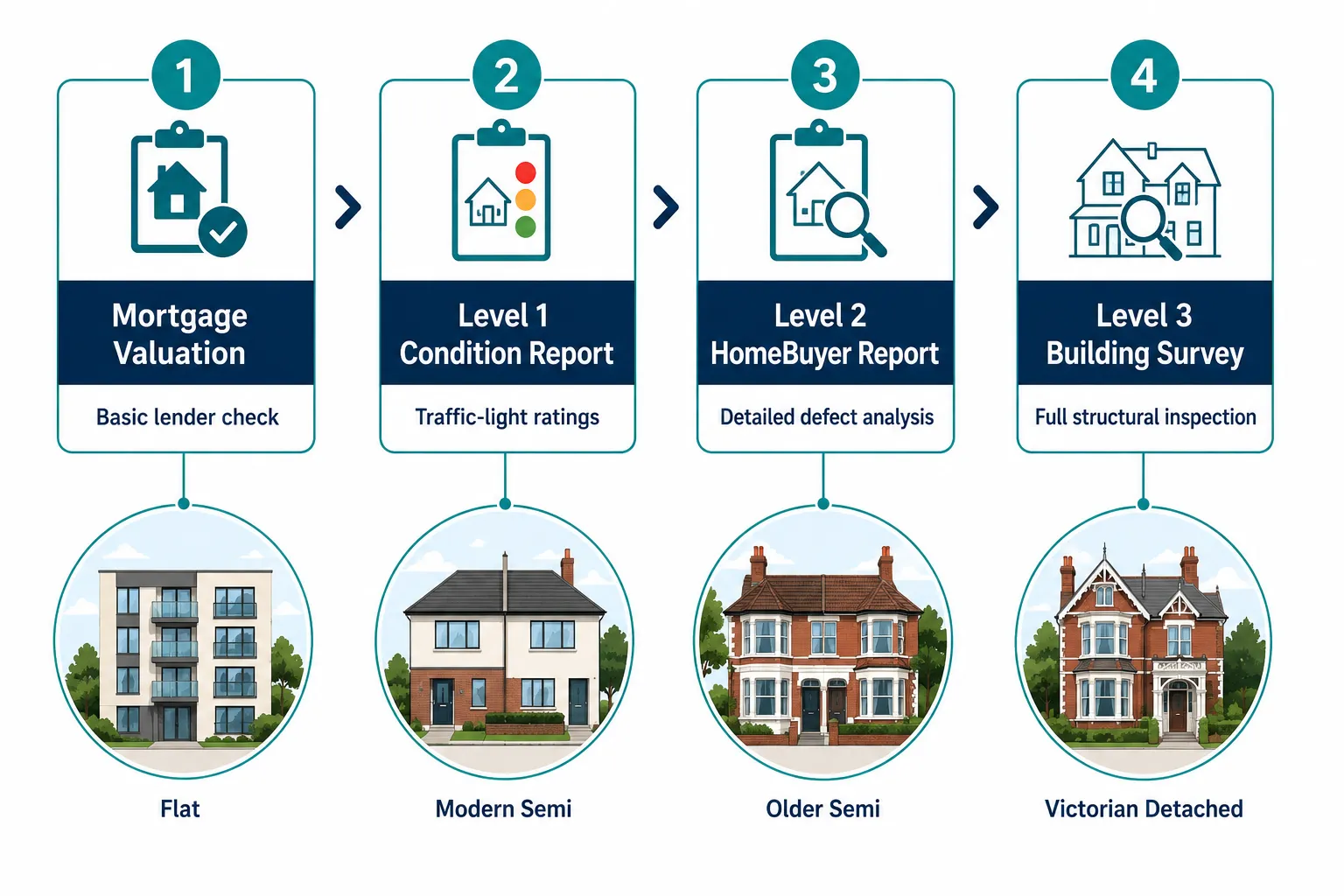
The RICS framework currently recognises three main residential survey products:
| Survey Level | Product Name | Typical Use Case |
|---|---|---|
| Level 1 | Condition Report | Modern, conventionally built properties in good condition |
| Level 2 | HomeBuyer Report | Properties built after approximately 1900, in reasonable condition, no major concerns |
| Level 3 | Building Survey | Older, larger, altered, or non-standard properties; any property where significant works are planned |
A professional surveyor should proactively recommend the appropriate level, not simply quote for whatever level the buyer requests. If a surveyor is happy to carry out a Level 2 on a Victorian terrace with visible damp and a recently extended rear without questioning whether that level is sufficient, treat that as a warning sign [5].
The questions to ask at this stage include:
- Based on what you know about this property, which survey level do you recommend and why?
- Are there any features of this property, age, construction type, extensions, non-standard materials, that would limit what a Level 2 can cover?
- Would you recommend any specialist reports (structural engineer, damp specialist, drainage survey) alongside the building survey?
For buyers considering properties with unusual construction or recent permitted development work, the building survey quality standards post-RICS Retrofit Summit, what surveyors need to know in 2026 provides useful context on how standards are evolving.
Verifying Professional Credentials: Questions That Go Beyond the RICS Logo
Displaying the RICS logo on a website is not, by itself, sufficient verification of current membership. Professional indemnity insurance can lapse; membership can be suspended. A truly professional surveyor will not be offended by verification requests, they will expect them [7].
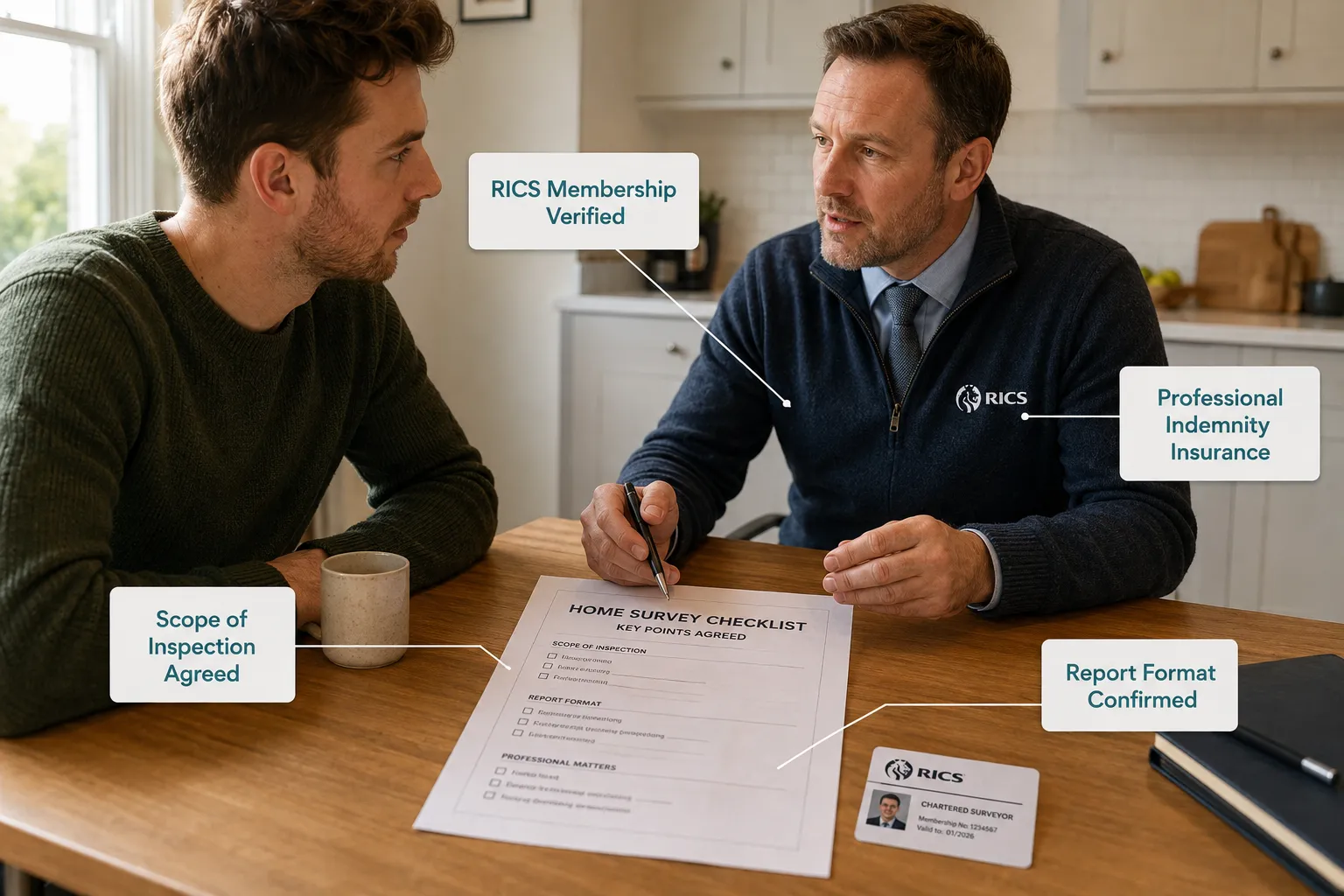
Credential verification checklist:
- RICS membership status: Ask for the surveyor's RICS membership number and verify it directly on the RICS Find a Surveyor register. Confirm whether they hold AssocRICS, MRICS, or FRICS status, for a Level 3 Building Survey, MRICS or FRICS is the expected minimum.
- Professional indemnity insurance: Ask for confirmation that their PI insurance is current and covers the value of the property being surveyed. A surveyor who hesitates on this question is a concern.
- Relevant experience: Ask how many surveys of this specific property type and age they have carried out in the last 12 months. A surveyor who primarily handles new-build valuations may not be the right choice for a 1900s end-of-terrace.
- Local knowledge: Ask whether they have surveyed properties in the same area recently. Local knowledge of common defects, coal mining subsidence, particular brick types, local flood risk, is genuinely valuable.
- Complaints history: Ask what their complaints process is and whether they have had any RICS disciplinary findings against them. This is a standard due-diligence question [7].
The RICS building surveying standards framework provides the professional backdrop against which all of this should be evaluated [10].
Understanding Scope and Limitations Before You Sign
One of the most common sources of post-survey disappointment is a mismatch between what the buyer expected to be inspected and what the surveyor was contractually obligated to inspect. A professional building survey has defined limitations, it is a visual inspection, not an intrusive investigation, but those limitations should be clearly explained before instruction, not discovered when reading the report [8][9].
Questions to ask about scope:
- Will you inspect the roof covering, and if not, will you note that it was not inspected and recommend a specialist?
- Will you access the loft space? If not, why not, and what will you do instead?
- Will you inspect under floor coverings or behind fitted furniture?
- Will you test services (gas, electrics, plumbing)? If not, will you recommend specialist tests?
- Will you comment on energy efficiency, EPC-related issues, or retrofit requirements?
That last question is increasingly important in 2026. With minimum energy efficiency standards continuing to evolve, a surveyor who does not flag potential EPC compliance issues is providing an incomplete picture of the property's total cost of ownership. The essential building survey checklists for 2026 EPC retrofit mandates and fire safety compliance sets out what a thorough 2026 survey should address in this area.
Specific concerns you should raise before instruction:
Always tell the surveyor about any specific concerns you have identified. A professional surveyor will note these and either address them directly or recommend specialist follow-up [8]. If you have noticed:
- Cracks in external brickwork
- Evidence of damp on internal walls
- A recently built extension or loft conversion
- Suspected Japanese knotweed in the garden
- Any visible signs of subsidence
…raise these explicitly before instructing. Ask the surveyor how they will address each concern in the report. If they dismiss your concerns without explanation, that is a red flag.
Report Quality, Condition Ratings, and Communication
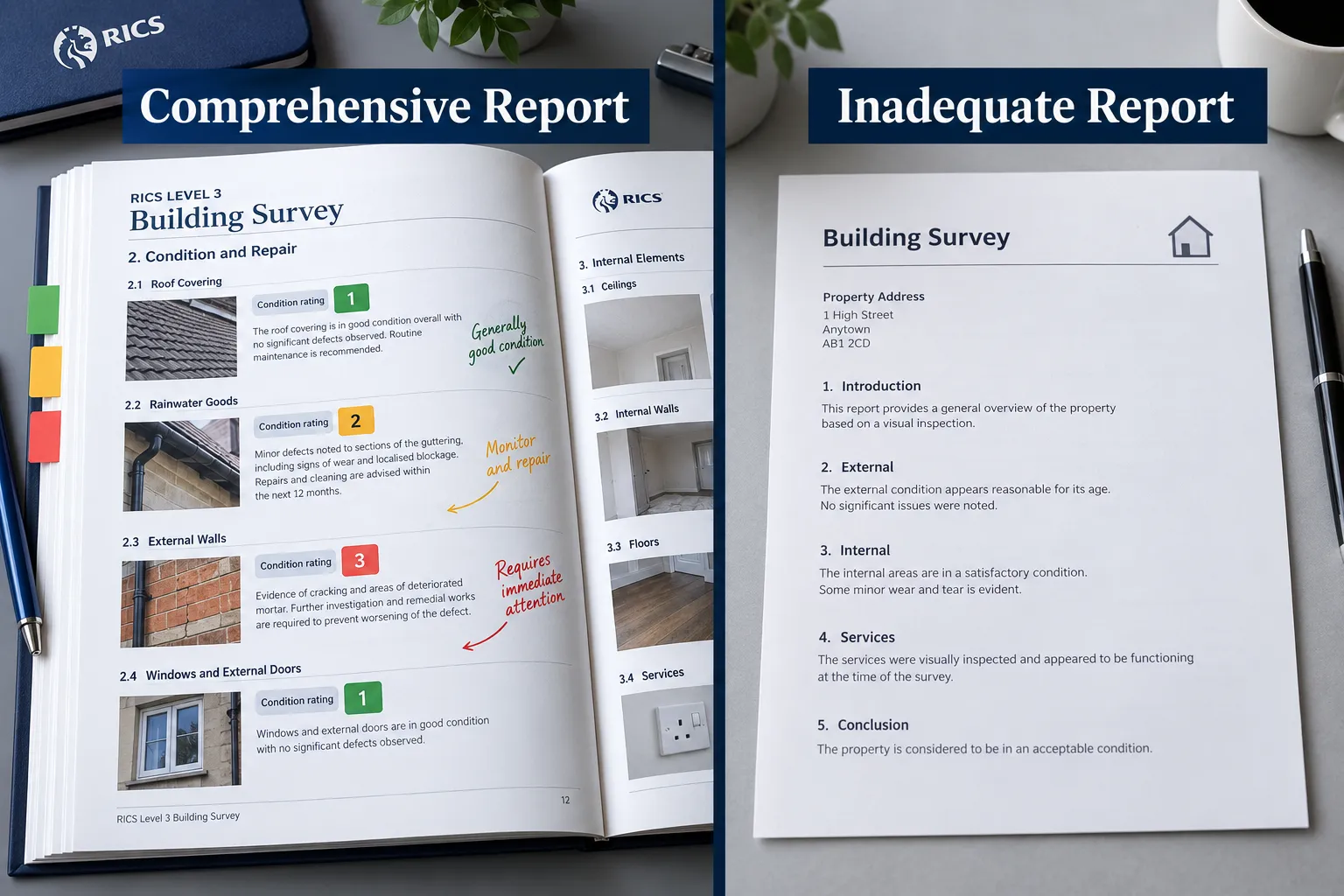
The format and content of the report itself is a legitimate pre-instruction topic. A professional surveyor should be able to describe exactly what their report will contain, how defects will be rated, and what happens after you receive it [5][9].
Questions to ask about the report:
- What condition rating system do you use, and what does each rating mean?
- Will the report include photographs of defects?
- Will it include a prioritised list of recommended actions?
- How long will the report take to produce after the inspection?
- Will you be available to discuss the report with me after I receive it, and is that included in the fee?
- Will the report be compliant with the current RICS Home Survey Standard? [1]
The RICS Home Survey Standard requires that reports use a three-tier condition rating system (Condition Ratings 1, 2, and 3), where Condition Rating 3 indicates defects that are serious and/or require urgent attention [1]. A report that uses vague language like "some deterioration noted" without a clear rating is not meeting the standard.
Timing matters. Ask specifically: how long after the inspection will the report be delivered? In a competitive market, a delay of more than five to seven working days can create real problems. Some firms quote fast turnaround times during the sales process and then fail to deliver, ask for a written commitment on timing.
Post-report communication is often overlooked. A surveyor who delivers a report and then becomes unreachable has not provided a complete professional service. Confirm before instruction whether a follow-up call is included, and whether the surveyor will speak directly with your solicitor if required.
For buyers considering properties where technology-driven assessment tools are being used, the technology-driven early property insight, reducing building survey delays through better data interpretation in complex properties explores how modern surveyors are using data to improve both speed and accuracy.
Costs, Quotes, and What to Watch For
In 2026, a Level 3 Building Survey on a typical UK residential property typically ranges from approximately £600 to £1,500 or more, depending on property size, location, age, and complexity. London and the South East tend to sit at the higher end of this range. A Level 2 HomeBuyer Report typically falls between £400 and £900 [9].
When comparing quotes, ask:
- Is VAT included in the quoted fee?
- Does the fee include the post-report discussion, or is that charged separately?
- Are there any additional charges if the property is larger than a certain square footage, or if access is more complex than expected?
- What is your cancellation policy if the sale falls through before the survey is carried out?
A quote that is significantly lower than others should prompt questions, not celebration. Unusually low fees often reflect a surveyor who is cutting time on site, using junior staff, or producing template-heavy reports with minimal property-specific analysis.
The land survey costs in 2026, complete guide to pricing factors and regional variations provides a useful broader reference point for understanding how surveying fees are structured across different property and survey types.
A Pre-Instruction Checklist: Questions to Ask Every Surveyor
The following checklist consolidates the key questions from this guide into a format that can be used when contacting multiple surveyors for quotes.
Professional credentials:
- What is your RICS membership number and grade?
- Is your professional indemnity insurance current and does it cover this property value?
- How many Level 3 Building Surveys have you carried out on properties of this type and age in the last year?
Survey scope:
- Which survey level do you recommend for this property, and why?
- What will not be inspected, and how will that be noted in the report?
- Will you address the specific concerns I have raised (list them)?
Report and communication:
- What condition rating system does your report use?
- How long after inspection will the report be delivered?
- Is a post-report discussion included in the fee?
- Which edition of the RICS Home Survey Standard does your report comply with? [1][2]
Fees and process:
- Is the quoted fee inclusive of VAT?
- Are there any circumstances in which additional charges would apply?
- What is your complaints process?
For buyers purchasing properties where fire safety compliance is a relevant concern, particularly flats or converted buildings, the building safety reforms in the living sector, surveyor roles in 2026 post-Grenfell compliance provides important context on what a thorough survey should address.
Similarly, buyers of new-build properties should be aware that a survey is still strongly advisable, the do I need a survey on a new build guide addresses the specific considerations that apply.
Conclusion
Knowing how UK homebuyers can find a truly professional building survey is not about being difficult or distrustful, it is about being an informed client in a transaction where the stakes are high and the consequences of a poor survey can run to tens of thousands of pounds.
Actionable next steps:
- Before requesting any quotes, research the RICS Find a Surveyor register and identify three to five MRICS or FRICS-qualified surveyors with demonstrable experience in your property type and location.
- Use the pre-instruction checklist above when contacting each surveyor. Note how they respond, a professional will welcome the questions; an unprofessional one will deflect them.
- Ask specifically about RICS Home Survey Standard compliance and which report format they are currently using, given the 2026 updates.
- Raise every specific concern you have about the property before instruction, in writing if possible, and confirm how each will be addressed.
- Evaluate quotes last, after professional credentials, scope, and communication quality have been assessed.
- Once the report is received, use the included post-report discussion, do not simply read the report and move on without speaking to the surveyor directly.
A building survey is not a commodity. The difference between a professional who spends three hours on site, produces a detailed condition-rated report, and follows up with a clear conversation, and one who spends ninety minutes and delivers a template document, can be the difference between a confident purchase and an expensive regret.
References
[1] Home Survey Standards – rics.org
[2] Home Survey Standard 2nd Edition April 2026 Update – rics.org
[3] Rics Launches Consultation Updated Home Survey Standard – rics.org
[4] Home Survey Standard 2nd Edition A Progress Update – rics.org
[5] Home Survey Checklist Questions Before And After – amssurveys.co.uk
[6] Home Surveys – rics.org
[7] Ask A Surveyor – trustedsurveyors.org.uk
[8] Seven Things A Surveyor May Ask You – novellosurveyors.co.uk
[9] Homebuyer Survey Checklist – lmsurveyors.co.uk
[10] Building Surveying Standards – rics.org