

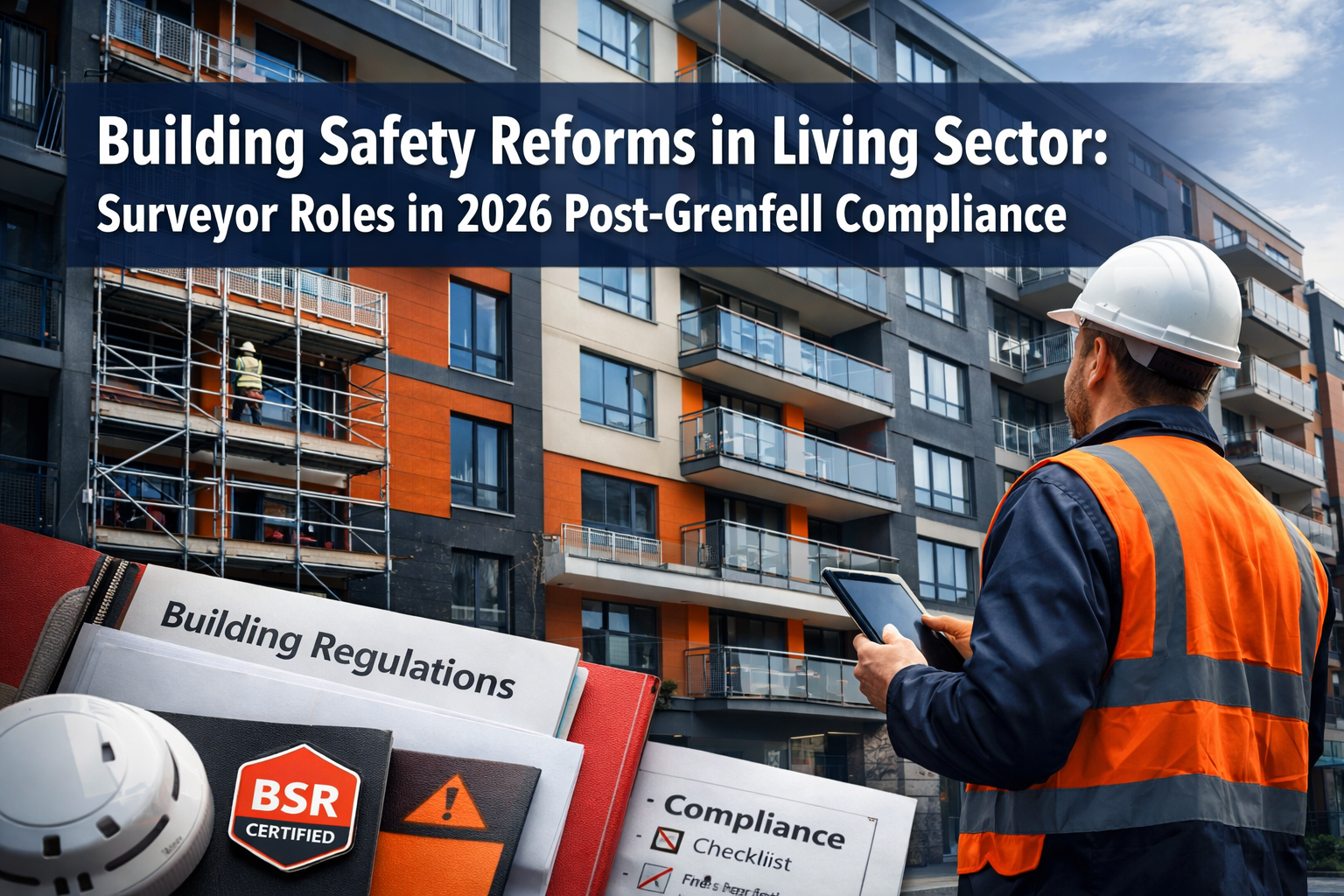
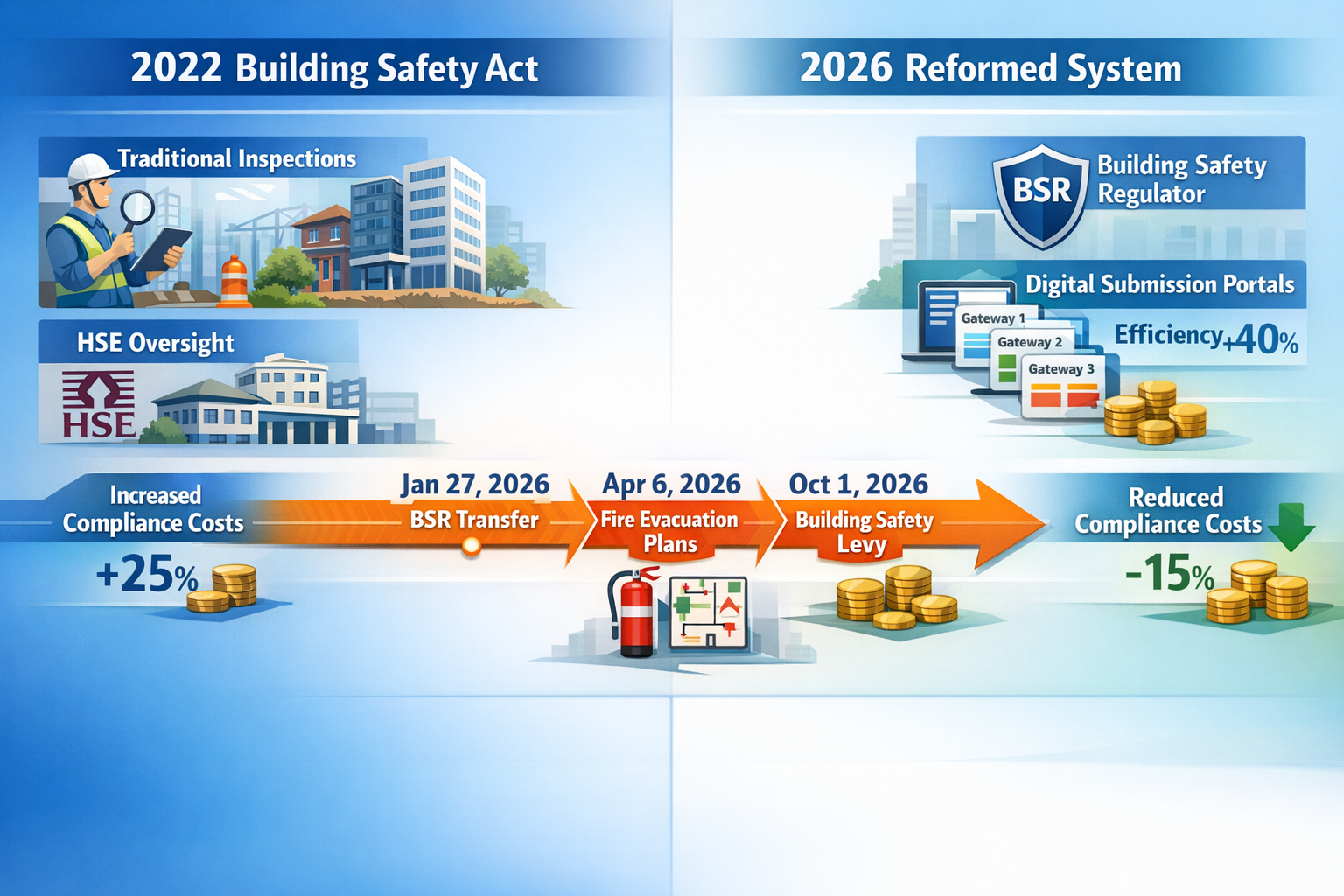
On January 27, 2026, the Building Safety Regulator officially transferred from the Health and Safety Executive to become an independent executive body—a watershed moment that fundamentally reshaped how surveyors approach multi-occupancy residential buildings. This transformation, combined with new fire safety evacuation requirements taking effect April 6 and the Building Safety Levy launching October 1, has created the most significant regulatory shift in the living sector since the tragic Grenfell Tower fire in 2017. Understanding Building Safety Reforms in Living Sector: Surveyor Roles in 2026 Post-Grenfell Compliance is no longer optional for property professionals—it's essential for practice survival and legal protection.
The reforms have elevated surveyors from advisory consultants to critical gatekeepers in building safety compliance, particularly for buildings exceeding 18 meters or seven stories. With heightened accountability standards, expanded inspection protocols, and potential expert witness responsibilities in remediation disputes, chartered surveyors must navigate a complex regulatory landscape that demands technical precision and comprehensive documentation.
Key Takeaways
- Independent BSR Authority: The Building Safety Regulator became a standalone body on January 27, 2026, creating direct accountability to the Secretary of State and specialized focus on residential building safety [1][4][6]
- Mandatory Fire Safety Plans: New regulations effective April 6, 2026 require Personal Emergency Evacuation Plans (PEEPs) for vulnerable residents in buildings 11-18 meters, adding surveyor assessment obligations [1][3][5]
- Building Safety Levy Impact: The October 1, 2026 levy implementation affects major residential developments with 10+ dwellings, driving accelerated building control applications and increased compliance costs [1][2]
- Enhanced Gateway 2 Processing: BSR Innovation Unit improvements now meet 12-week processing targets, though heightened due diligence requirements substantially increase project costs and timelines [1][2]
- Expert Witness Demand Surge: Surveyors face growing requirements for remediation dispute preparation and litigation support as building safety claims escalate across the living sector [2]
Understanding the 2026 Building Safety Regulatory Framework
The regulatory architecture governing Building Safety Reforms in Living Sector: Surveyor Roles in 2026 Post-Grenfell Compliance represents a fundamental restructuring of accountability and oversight mechanisms. The Building Safety Act 2022 established the foundation, but 2026 marks the year when operational reality catches up with legislative intent.
The Independent Building Safety Regulator
The BSR's transition to independence on January 27, 2026 eliminated the fragmentation that occurred when building safety oversight sat within HSE's broader workplace safety mandate [4][6]. This structural change creates several critical implications for surveyors:
Direct Ministerial Accountability 🏛️
The BSR now reports directly to the Secretary of State for the Ministry for Housing, Communities and Local Government (MHCLG), ensuring building safety receives dedicated political attention and resource allocation separate from general workplace health and safety concerns [6].
Expanded Regulatory Scope
Government proposals include BSR absorption of construction product testing and certification roles, accreditation and licensing for fire risk assessors and principal contractors on higher-risk buildings, and maintenance of a publicly available library of test data and serious fire reports [4]. For surveyors, this means interfacing with a more comprehensive regulatory authority that touches every aspect of building safety compliance.
Enhanced Enforcement Powers
The independent BSR possesses strengthened enforcement capabilities, including the authority to issue compliance notices, stop notices, and substantial financial penalties for non-compliance. Surveyors conducting building regulation compliance testing must document findings with heightened precision to support or defend against potential enforcement actions.
Gateway System Requirements
The three-gateway regime continues to govern higher-risk buildings (18+ meters or 7+ stories):
| Gateway Stage | Timing | Surveyor Role | Key Requirements |
|---|---|---|---|
| Gateway 1 | Planning Permission | Advisory | Design compliance review |
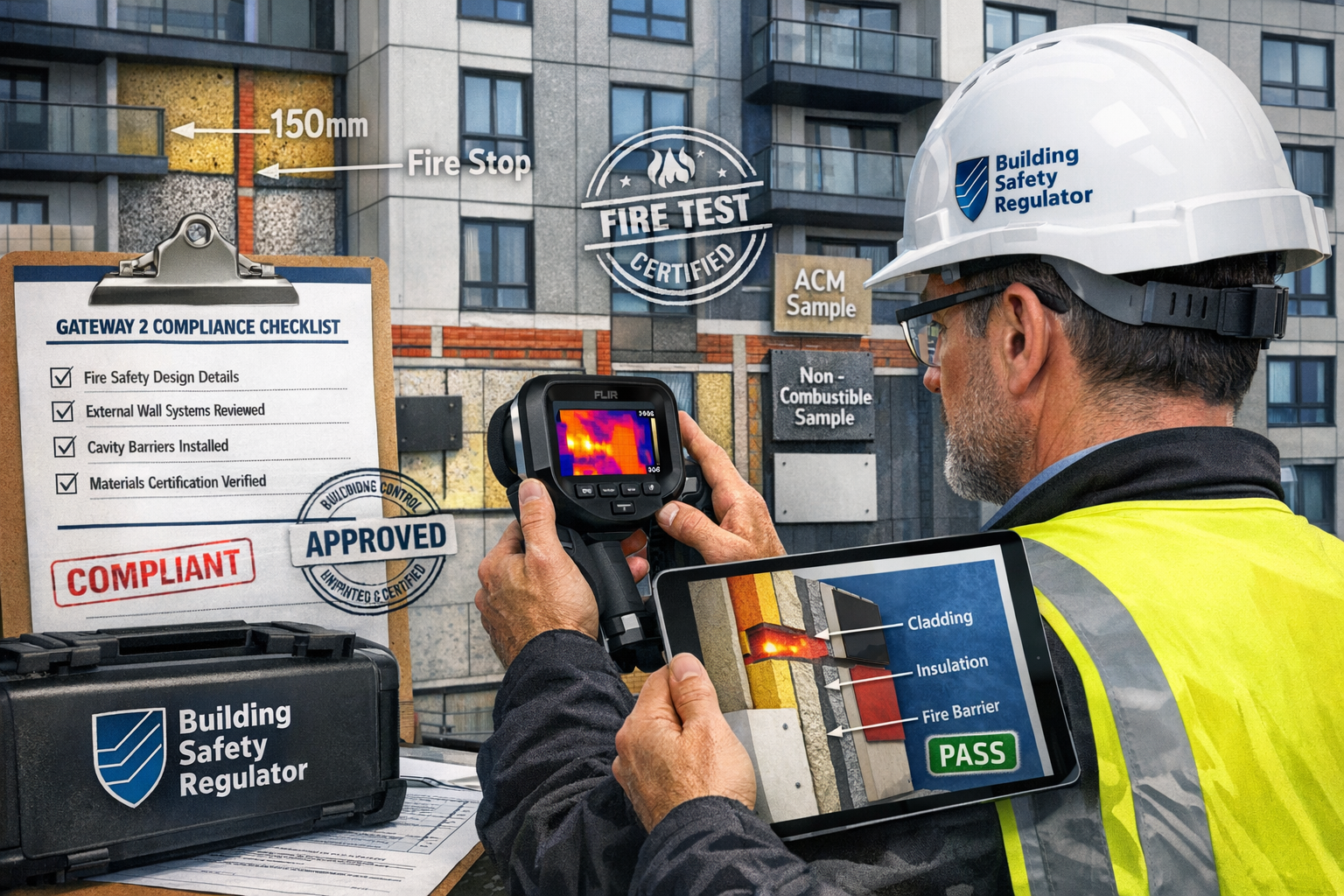
| Gateway 2 | Pre-Construction | Critical Assessment | Detailed design verification, fire safety strategy validation |
| Gateway 3 | Pre-Occupation | Final Certification | Completion inspection, safety case file verification |
Gateway 2 processing improvements announced in 2026 represent significant progress, with the BSR Innovation Unit now meeting 12-week targets for new-build applications [1]. However, these improvements come with substantially increased due diligence requirements that have elevated compliance costs and extended project timelines, particularly impacting time-sensitive developments like Purpose-Built Student Accommodation (PBSA) where occupancy must align with academic schedules [2].
Critical 2026 Compliance Milestones for Surveyors
Three major regulatory changes in 2026 directly impact surveyor responsibilities and create new service opportunities within the living sector.
Fire Safety Evacuation Plans (April 6, 2026)
The Fire Safety (Residential Evacuation Plans) (England) Regulations 2025 took effect on April 6, 2026, introducing mandatory Personal Emergency Evacuation Plans (PEEPs) for buildings between 11-18 meters [1][3][5]. This regulation fills a critical gap in fire safety provision for mid-rise residential buildings that previously fell outside the highest-risk category.
Surveyor Assessment Obligations 🔥
The Responsible Person (building owner or manager) must conduct person-centered fire risk assessments for residents whose evacuation ability is compromised by physical or cognitive impairment [5]. Surveyors supporting these assessments must evaluate:
- Evacuation route accessibility and adequacy
- Fire door integrity and self-closing mechanisms
- Emergency lighting and wayfinding systems
- Refuge area provision and communication systems
- Building-specific evacuation strategies (stay-put vs. simultaneous evacuation)
This requirement significantly expands the scope of health and safety inspections that surveyors conduct for residential property managers and freeholders. Documentation standards have become paramount, as inadequate PEEPs could result in regulatory enforcement action or civil liability in the event of fire incidents.
Building Safety Levy Implementation (October 1, 2026)
The Building Safety Levy launches on October 1, 2026, applying to major residential developments in England comprising 10 or more dwellings or 30 or more bedspaces for purpose-built student accommodation [1][2]. Certain exemptions apply, including a 50% discount for developments meeting previously developed land conditions.
Pre-Levy Application Surge
Industry sources anticipate a significant spike in building control applications and initial notices before the October 1 deadline as developers accelerate submissions to potentially avoid or minimize levy costs [1][2]. This creates immediate capacity challenges for surveyors providing:
- Pre-application design reviews
- Gateway submission preparation
- Building materials assessments
- Fire safety strategy validation
Viability Impact Analysis
The levy adds to already substantial Gateway 2 compliance costs that have impacted development viability across the living sector [2]. Surveyors advising developers must integrate levy calculations into financial feasibility assessments and provide realistic cost projections that account for the layered regulatory burden.
Cost Recovery Consultation
The government has initiated consultation on reforming charges regulations to enable local authority building control services and the BSR to recover costs more fully than currently permitted [1]. This signals potential additional building control charges ahead, further impacting development economics and creating demand for surveyor expertise in cost management and compliance optimization.
For property buyers, understanding these cost implications is crucial when considering whether you need a survey on a new build, as developers may pass through increased compliance costs through higher purchase prices or service charges.
Surveyor Roles in Building Safety Reforms: Enhanced Responsibilities
The transformation of Building Safety Reforms in Living Sector: Surveyor Roles in 2026 Post-Grenfell Compliance has fundamentally expanded surveyor responsibilities across multiple practice areas.
Level 3 Building Survey Integration
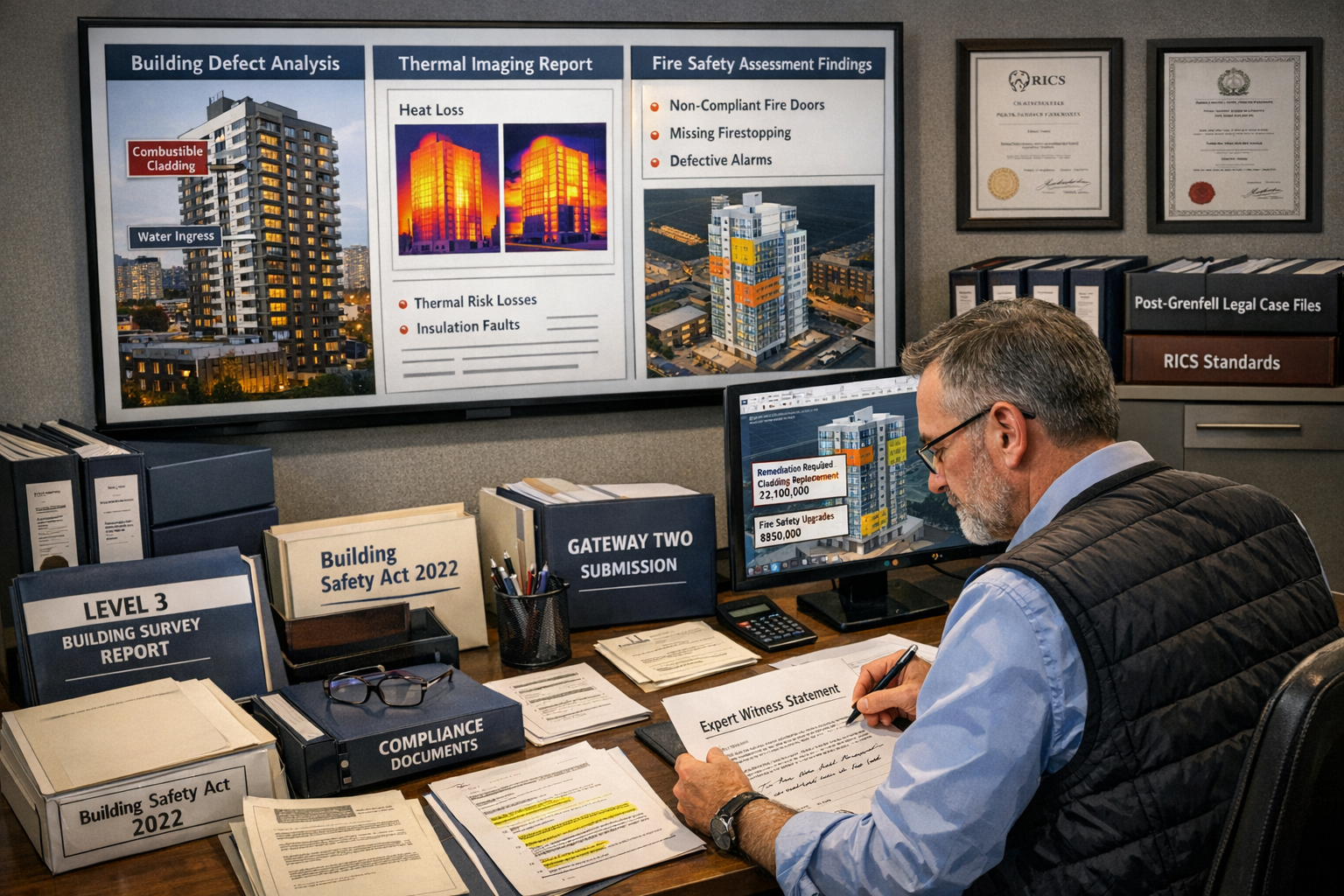
Modern Level 3 full building surveys for multi-occupancy residential properties must now incorporate comprehensive building safety assessments that extend beyond traditional structural and condition evaluation. Key additions include:
External Wall System Assessment 🏗️
Detailed inspection of cladding materials, fire barriers, cavity barriers, and external wall construction to identify potential combustibility risks or non-compliant materials. This requires understanding of approved construction details, fire testing standards, and material specifications that comply with post-Grenfell guidance.
Fire Safety Infrastructure Evaluation
Assessment of fire doors, compartmentation integrity, fire-stopping quality, smoke ventilation systems, and fire detection/alarm systems. Surveyors must identify deficiencies that could compromise evacuation strategies or fire spread containment.
Building Safety Documentation Review
Verification that appropriate safety case files, fire risk assessments, and building information exist and are accessible. For buildings requiring BSR registration, confirmation of registration status and compliance with ongoing information duties.
Remediation Cost Estimation
Where deficiencies are identified, surveyors must provide realistic cost estimates for remediation work, including temporary safety measures, full cladding replacement, or fire safety system upgrades. These estimates frequently become critical in purchase negotiations or areas requiring further investigation.
Expert Witness Preparation and Remediation Disputes
The surge in building safety remediation work has created corresponding increases in disputes over responsibility, cost allocation, and work scope. Surveyors increasingly find themselves providing expert witness services in:
Leaseholder vs. Freeholder Disputes
Determining responsibility for remediation costs under the Building Safety Act's protections for qualifying leaseholders, assessing whether buildings meet the statutory definition of defects, and evaluating the reasonableness of proposed remediation approaches.
Developer Liability Claims
Assessing whether original construction complied with building regulations in force at the time, evaluating design and construction defects, and determining causation between alleged defects and required remediation work.
Insurance Claims
Providing technical evidence on the nature and extent of building safety defects, validating remediation cost estimates, and assessing whether defects constitute insurable events under professional indemnity or construction defects policies.
Expert Witness Standards ⚖️
Surveyors providing expert witness reports must adhere to Civil Procedure Rules Part 35, maintaining independence from the instructing party and providing objective technical opinions based on thorough investigation and industry standards. Documentation quality and technical precision become paramount, as reports face rigorous cross-examination and judicial scrutiny.
New Build Snagging and Compliance Verification
The heightened regulatory environment has elevated the importance of comprehensive snagging inspections for new residential developments. Understanding what is house snagging and when is a snagging survey necessary has become critical for buyers in multi-occupancy buildings.
Gateway 3 Verification Support
Surveyors assist developers in preparing for Gateway 3 submissions by conducting pre-completion inspections that identify deficiencies requiring rectification before occupation certificates can be issued. This includes verification that construction matches approved Gateway 2 designs and that all fire safety systems function as specified.
Purchaser Protection
Buyers of new-build apartments benefit from independent snagging surveys that verify building safety compliance, identify construction defects, and confirm that developers have fulfilled their Building Safety Act obligations, including provision of required safety information and completion certificates.
Practical Compliance Strategies for Property Stakeholders
Successfully navigating Building Safety Reforms in Living Sector: Surveyor Roles in 2026 Post-Grenfell Compliance requires coordinated action across multiple stakeholder groups.
For Building Owners and Responsible Persons
Immediate Action Items ✅
- Verify BSR Registration Status: Ensure all buildings meeting height thresholds are properly registered with the BSR and that registration information remains current
- Implement PEEP Requirements: For buildings 11-18 meters, establish systems for identifying residents requiring PEEPs and conducting person-centered fire risk assessments by the April 6, 2026 deadline
- Update Fire Risk Assessments: Review and update fire risk assessments to incorporate new regulatory requirements and ensure alignment with current BSR guidance
- Establish Safety Case Files: Compile and maintain comprehensive building safety documentation, including design information, construction records, and ongoing maintenance documentation
- Engage Competent Surveyors: Retain qualified chartered surveyors with demonstrated expertise in building safety compliance for periodic inspections and compliance verification
Ongoing Compliance Management
Building owners must establish robust compliance management systems that include regular fire risk assessments, periodic building safety inspections, resident communication protocols, and documentation maintenance procedures. The shift to proactive compliance management represents a fundamental change from reactive maintenance approaches that previously dominated the living sector.
For Developers and Construction Professionals
Pre-October 2026 Considerations 🏗️
Developers with projects approaching commencement should carefully evaluate the timing implications of the October 1, 2026 Building Safety Levy implementation. Strategic decisions include:
- Accelerated Gateway Submissions: Submitting building control applications before the levy effective date to potentially minimize costs, while ensuring adequate time for thorough design development and compliance verification
- Levy Cost Integration: Incorporating levy costs into development appraisals and sales pricing for projects commencing after October 1, 2026
- Enhanced Due Diligence: Allocating additional time and resources for Gateway 2 processing, recognizing that improved BSR performance still involves substantially increased compliance requirements compared to pre-reform standards
Design Stage Integration
Early engagement with chartered surveyors during design development enables identification and resolution of compliance issues before formal Gateway submissions, reducing costly design changes during regulatory review. This includes fire safety strategy development, external wall system design verification, and means of escape optimization.
For Property Buyers and Investors
Enhanced Due Diligence Requirements 🔍
Purchasers of flats in multi-occupancy buildings should commission comprehensive RICS building surveys that specifically address building safety compliance. Critical investigation areas include:
- BSR Registration Verification: Confirming appropriate registration for buildings meeting height thresholds
- Remediation Status: Identifying any outstanding building safety defects and associated remediation plans or ongoing works
- Service Charge Implications: Understanding potential future service charge increases related to building safety compliance, remediation work, or enhanced management requirements
- EWS1 Form Status: For buildings requiring External Wall System certification, verifying current EWS1 form status and any restrictions on mortgageability
- Building Safety Act Protections: Understanding leaseholder protections under the Building Safety Act and potential liability limitations for qualifying leaseholders
When comparing full building survey vs homebuyer survey options, buyers of flats in buildings potentially affected by building safety reforms should strongly consider Level 3 surveys given the technical complexity and financial implications of compliance issues.
Regional Compliance Variations and Scottish Divergence
While this article focuses primarily on English regulations, property professionals must recognize important jurisdictional variations affecting Building Safety Reforms in Living Sector: Surveyor Roles in 2026 Post-Grenfell Compliance.
Scottish Building Safety Levy (April 1, 2027)
The Scottish Government is introducing a separate Scottish Building Safety Levy from April 1, 2027, creating a distinct compliance framework north of the border [1]. Surveyors practicing across England and Scotland must maintain expertise in both regulatory regimes and understand the timing differences that affect cross-border developers and investors.
Regional BSR Implementation
Chartered surveyors operating across different regions should recognize that local authority building control services may implement BSR requirements with varying interpretations and processing approaches. Maintaining relationships with building control teams in key operational areas—whether chartered surveyors in Central London, chartered surveyors in Sussex, or chartered surveyors in Oxfordshire—enables more efficient navigation of local compliance processes.
Technology and Innovation in Building Safety Compliance
Advanced technology increasingly supports surveyor compliance work in the post-Grenfell regulatory environment.
Digital Inspection Tools
Thermal Imaging and Moisture Detection 📱
Advanced thermal imaging cameras enable non-invasive assessment of external wall system performance, identification of thermal bridging and insulation deficiencies, and detection of moisture penetration that may indicate failed fire barriers or weather protection.
Drone Survey Technology
Premium drone surveys provide detailed high-resolution imagery of building facades, roofs, and other difficult-to-access areas without expensive scaffolding or access equipment. This technology proves particularly valuable for initial building safety assessments and ongoing monitoring of high-rise residential buildings.
Building Information Modeling (BIM)
Digital building models enable comprehensive documentation of building safety information, integration of inspection findings with design documentation, and efficient updating as buildings undergo modification or remediation work.
Documentation and Compliance Management Systems
Specialized software platforms now support building safety compliance management, including:
- Safety case file compilation and maintenance
- Fire risk assessment tracking and updating
- Resident PEEP management and communication
- Regulatory submission preparation and tracking
- Compliance deadline monitoring and reporting
Surveyors who integrate these technologies into practice workflows deliver more efficient, comprehensive, and defensible building safety services.
Future Outlook: Anticipated Developments Beyond 2026
The regulatory landscape continues to evolve, with several anticipated developments likely to further impact Building Safety Reforms in Living Sector: Surveyor Roles in 2026 Post-Grenfell Compliance.
Second Staircase Requirements
Ongoing discussions regarding mandatory second staircases for residential buildings above certain heights may result in additional regulatory requirements affecting new construction design and potentially triggering remediation obligations for existing buildings [7].
Remediation Funding Mechanisms
Government initiatives to address building safety remediation costs continue to develop, including potential expansion of developer contribution schemes, government funding programs, and industry levy mechanisms. Surveyors must stay informed about funding availability and application requirements to advise clients effectively.
Enhanced Product Testing and Certification
The BSR's expanded role in construction product testing and certification will likely result in more rigorous product approval processes and enhanced traceability requirements for building materials, particularly those affecting fire safety performance [4].
Professional Competence Requirements
Anticipated introduction of mandatory competence frameworks and licensing requirements for building safety professionals, including surveyors, fire risk assessors, and principal contractors working on higher-risk buildings [4]. This may require additional training, assessment, and ongoing professional development to maintain authorization to practice in building safety compliance.
Conclusion
The transformation of Building Safety Reforms in Living Sector: Surveyor Roles in 2026 Post-Grenfell Compliance represents the most significant regulatory shift in residential building safety since the tragic events of June 2017. The January 27, 2026 transfer of the Building Safety Regulator to independent status, combined with April 6 Fire Safety Evacuation Plan requirements and the October 1 Building Safety Levy implementation, creates a fundamentally new operating environment for property professionals.
Chartered surveyors have evolved from advisory consultants to critical compliance gatekeepers, with expanded responsibilities spanning Gateway system navigation, fire safety assessment, remediation dispute resolution, and expert witness services. The heightened accountability standards and complex layered regulatory requirements demand technical precision, comprehensive documentation, and ongoing professional development.
Actionable Next Steps
For Building Owners and Managers:
- Conduct immediate compliance audits to verify BSR registration status and PEEP implementation
- Engage qualified chartered surveyors for comprehensive building safety assessments
- Establish robust compliance management systems and documentation protocols
For Developers:
- Evaluate project timing relative to October 1, 2026 levy implementation
- Integrate enhanced Gateway 2 due diligence requirements into project schedules and budgets
- Engage surveyors early in design development to optimize compliance outcomes
For Property Buyers:
- Commission comprehensive Level 3 building surveys that specifically address building safety compliance
- Investigate remediation status, service charge implications, and Building Safety Act protections
- Verify BSR registration and EWS1 form status before purchase completion
For Surveyors:
- Invest in specialized training on Building Safety Act requirements and BSR processes
- Develop expertise in fire safety assessment, external wall system evaluation, and expert witness services
- Implement technology solutions that enhance inspection efficiency and documentation quality
The government's target of delivering 1.5 million homes depends on successful navigation of these building safety reforms [1]. Surveyors who embrace enhanced responsibilities, invest in specialized expertise, and deliver comprehensive building safety services will find themselves indispensable to a living sector that prioritizes resident safety above all else.
The post-Grenfell era has fundamentally redefined what it means to deliver safe residential accommodation. Through rigorous compliance, technical excellence, and unwavering commitment to resident protection, surveyors play a pivotal role in ensuring that the tragedy of Grenfell Tower never occurs again.
References
[1] Building Safety Lookahead 2026 Will See The Reform Of The Bsr Introduction Of The Building Safety Levy And More – charlesrussellspeechlys.com
[2] The Uk Living Sector What Might We Expect In 2026 – gtlaw.com
[3] Building Safety Developments Expected In 2026 – shoosmiths.com
[4] Biz Const Building Safety Act 2026 Key Developments And What To Expect – rwkgoodman.com
[5] Building Safety Update New Rules Regulations And Guidance – dacbeachcroft.com
[6] Building Safety Regulator Key Changes From January 2026 – connections.nortonrosefulbright.com
[7] Building Safety Act 2022 What To Expect In 2026 Levy Bsr Reform Second Staircases And Remediation Bill – thelawyer.com