


Last updated: July 24, 2026
Quick Answer: Spring 2026 has brought five critical shifts that every building surveyor, homeowner, and property professional must act on: updated RICS cladding valuation standards, revised party wall cost expectations, stronger impartiality rules for party wall surveyors, mandatory schedule of condition reporting, and the growing use of technology in property assessments. Understanding these changes protects your investment, keeps your project legal, and prevents costly disputes.
Key Takeaways
- RICS's updated cladding valuation standard takes effect November 1, 2026, changing how EWS1 forms are requested during secured lending valuations.
- Party wall agreement costs in 2026 range from approximately £100 (with neighbour consent) to over £4,000 per neighbour if disputes arise.
- A Schedule of Condition report is now considered essential before any notifiable party wall works begin.
- Party wall surveyors must remain strictly impartial regardless of who appointed them, a legal principle reinforced by case law.
- Failing to serve correct party wall notices can expose building owners to injunctions, compensation claims, and project delays.
- Three distinct notice types apply depending on the work: Section 1 (boundary), Section 3 (existing party wall), and Section 6 (excavation near foundations).
- Technology including 3D laser scanning and digital condition-mapping tools is now standard practice in high-quality valuations and surveys.
- RICS membership (MRICS or FRICS) remains the benchmark qualification for party wall and valuation work in the UK.
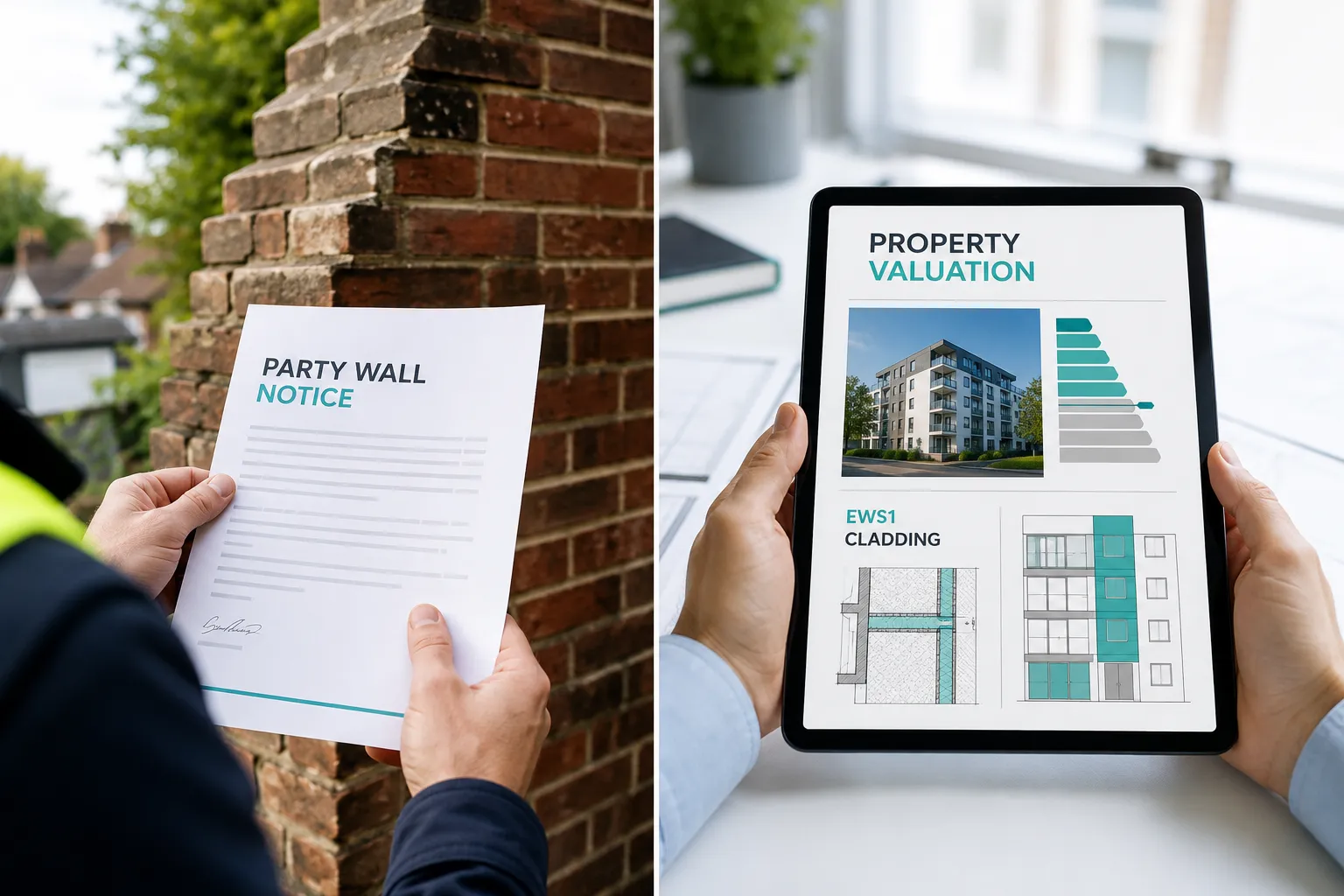
What Are the Main Changes to Party Wall Legislation and Valuation in Spring 2026?
Spring 2026 has not introduced a wholesale rewrite of the Party Wall etc. Act 1996, but it has brought significant procedural and professional standard updates that change how surveyors and property owners must act. The most consequential shift on the valuation side is RICS's second edition of its cladding valuation standard, effective November 1, 2026.
The five hot topics for building surveyors spring 2026, actionable protocols for valuation and party walls, can be summarised as:
- Updated RICS cladding valuation guidance for multi-storey residential buildings
- Revised party wall cost structures reflecting rising surveyor fees and dispute complexity
- Strengthened impartiality obligations for appointed party wall surveyors
- Mandatory Schedule of Condition reporting as standard pre-work practice
- Technology integration in both valuation and party wall inspection workflows
Each topic carries direct practical consequences. Ignoring any one of them risks financial loss, legal liability, or a stalled project.
How Do Building Surveyors Value Properties After the New Spring 2026 Protocols?
The updated RICS standard for secured lending valuations of multi-storey, multi-occupancy residential buildings with cladding is the most significant valuation protocol change of 2026. Effective from November 1, 2026, it provides clearer guidance on when valuers must request an EWS1 (External Wall System) form before completing a mortgage valuation.
What changes in practice:
- Valuers must now apply a more structured decision framework before deciding whether an EWS1 form is needed, reducing inconsistent assessments across lenders.
- Properties with certain cladding types that were previously assessed case-by-case now fall into defined categories with prescribed valuation responses.
- Lenders relying on valuations for secured lending must ensure their appointed valuers are working to this updated standard from November 2026 onwards.
For residential buyers purchasing flats in blocks built or clad between approximately 1980 and 2015, this standard is particularly relevant. A valuation prepared without reference to it may not satisfy lender requirements, potentially delaying or blocking a mortgage offer. For specialist valuation needs including SIPP pension valuations or commercial property valuations, the cladding standard applies where the property type falls within scope.
What Is the Difference Between Old and New Valuation Methods for Surveyors?
Traditional property valuation relied heavily on comparable sales data, physical inspection notes, and surveyor judgement. The spring 2026 protocols add structured compliance layers that make the process more systematic and defensible.
| Aspect | Pre-2026 Approach | Spring 2026 Protocol |
|---|---|---|
| Cladding assessment | Case-by-case discretion | Defined decision framework, EWS1 trigger criteria |
| Party wall cost accounting | Often omitted from valuations | Systematic deduction of known/estimated party wall costs |
| Condition reporting | Recommended but inconsistent | Considered essential pre-work standard |
| Technology use | Optional enhancement | Increasingly expected by RICS standards |
| Impartiality documentation | Assumed | Must be demonstrable and recordable |
The practical effect: valuers who do not update their methodology risk producing reports that lenders, courts, or RICS disciplinary panels consider inadequate. For buyers, a Level 3 full building survey remains the most thorough way to understand a property's condition alongside any formal valuation.
What Are Party Wall Survey Costs in 2026 and What Should You Expect to Pay?
Party wall agreement costs in 2026 vary considerably depending on whether neighbours consent or dissent. If a neighbour agrees in writing (known as giving consent), the building owner can proceed without appointing a surveyor, and costs can be as low as £100 for basic notice preparation.
If a neighbour dissents, the costs rise sharply:
- Single agreed surveyor (appointed by both parties): typically £800 to £1,500 for straightforward works.
- Two separate surveyors (one per party): costs can exceed £4,000 per neighbour, and in prolonged disputes, significantly more.
- Three-surveyor tribunal (where two appointed surveyors cannot agree): adds a third surveyor's fees on top.
In high-demand urban markets, particularly London and the South East, fees at the upper end of these ranges are common. For a detailed breakdown of what drives these costs, the cost of a party wall surveyor guide covers the variables clearly.
Common mistake: Building owners often underestimate party wall costs when budgeting a project. Professional valuers are now advised to deduct known or estimated party wall costs from a property's assessed market value, so buyers and lenders are not caught out by liabilities that emerge after purchase.
What Is the Party Wall Act and How Does It Apply to Your Project?
The Party Wall etc. Act 1996 is the UK legislation that governs work on shared walls, boundaries, and excavations near neighbouring properties. It applies in England and Wales. It does not apply in Scotland, where common law and separate building regulations govern equivalent situations.
The Act requires building owners to serve formal written notice on adjoining owners before carrying out certain types of work. Three notice types apply:
- Section 1 Notice: For new building on or at the boundary line.
- Section 3 Notice: For work on an existing party wall or party structure (including loft conversions, extensions cutting into a shared wall, and underpinning).
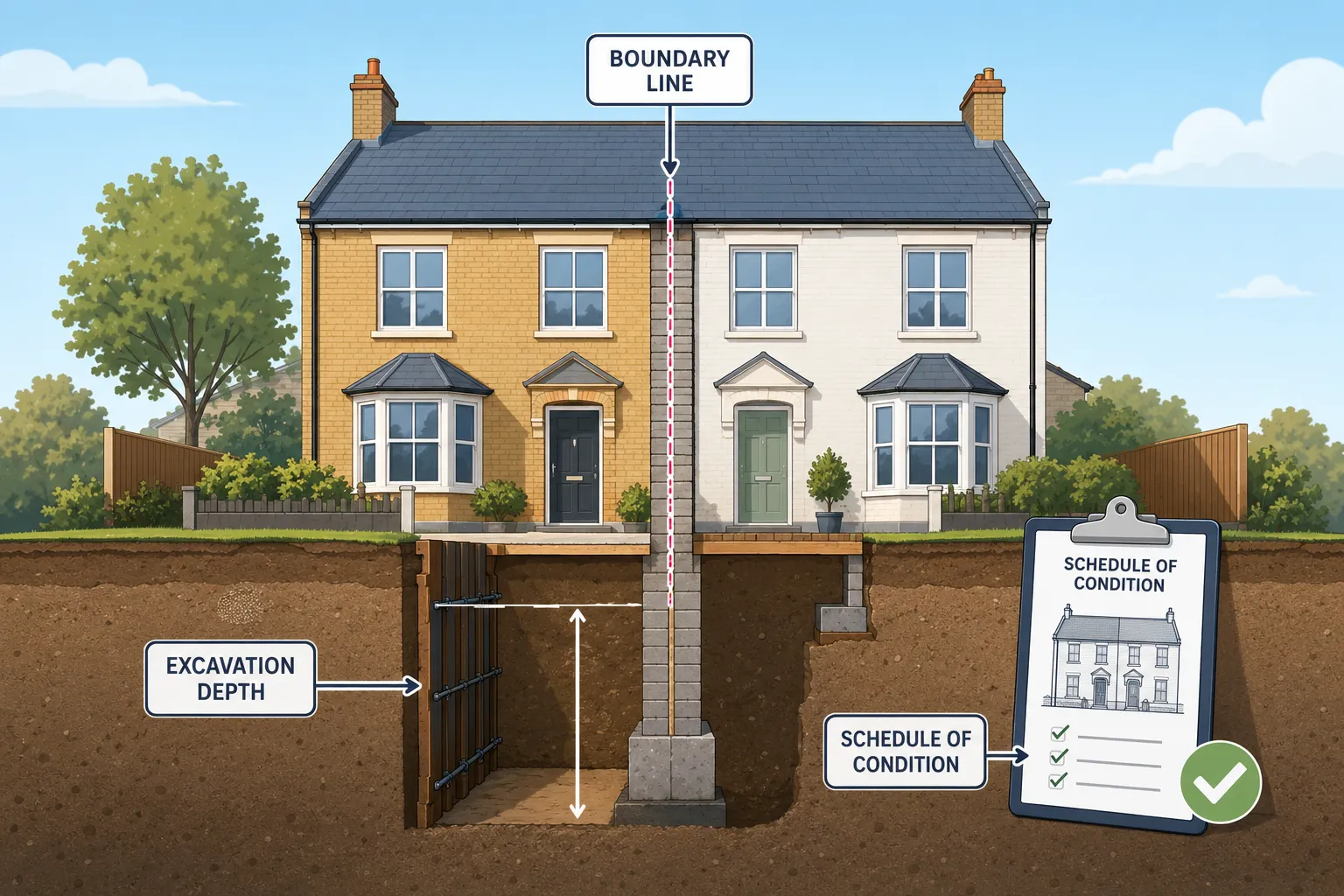
- Section 6 Notice: For excavation within 3 metres of a neighbouring building and below the level of their foundations, or within 6 metres under certain depth conditions.
If you are buying a house and the property has been recently extended or altered, checking whether the correct notices were served is an important due diligence step. The Party Wall Act guide for homebuyers explains what to look for.
Do You Need a Surveyor for Party Wall Work, or Can You Do It Yourself?
You can serve party wall notices yourself without a surveyor, provided you use the correct notice format and serve it within the correct timeframe. However, once a neighbour dissents, the Act requires that a surveyor (or surveyors) be appointed, at that point, professional involvement becomes a legal requirement, not a choice.
When to use a surveyor from the start:
- The works are complex (deep excavations, structural alterations to a shared wall).
- You have a difficult relationship with a neighbour.
- The property is in a high-density urban area where disputes are more common.
- You need a Schedule of Condition report to protect against future damage claims.
When self-service notice may be sufficient:
- The works are straightforward and the neighbour is cooperative.
- You are confident in completing the correct notice type and serving it correctly.
- You have confirmed the neighbour will consent in writing.
Even where consent is given, a Schedule of Condition report is strongly recommended. Without it, any pre-existing cracks or damage at the neighbouring property could later be attributed to your works, leaving you exposed to compensation claims.
Common Mistakes Building Surveyors and Building Owners Make With Party Wall Procedures
The most frequent errors in party wall procedures are procedural rather than technical, and they are largely avoidable.
Top mistakes:
- Serving the wrong notice type. Using a Section 3 notice when a Section 6 notice is required (or vice versa) can invalidate the process entirely.
- Serving notice too late. Section 3 notices require at least two months' notice; Section 6 notices require one month. Starting work before the notice period expires is a breach of the Act.
- Assuming verbal consent is sufficient. Only written consent counts. A neighbour who verbally agrees but later dissents leaves the building owner unprotected.
- Appointing a non-impartial surveyor. The 2018 case of Welter v McKeeve confirmed that party wall surveyors must act independently of the party who appointed them. A surveyor who acts as an advocate rather than an impartial professional risks having their award challenged in court.
- Skipping the Schedule of Condition. Without a documented baseline, disputes about damage become very difficult to resolve. For more on what can go wrong, see consequences of ignoring the Party Wall Act.
What Happens If You Don't Follow Party Wall Protocols Correctly?
Failing to comply with the Party Wall etc. Act 1996 does not make the works automatically illegal, but it removes the legal protections the Act provides and exposes the building owner to serious risk.
Potential consequences include:
- An injunction from a court ordering works to stop until proper notices are served and an award is made.
- Compensation claims from neighbours for damage, disturbance, or loss.
- Difficulty selling the property later, as conveyancers will ask for party wall documentation.
- Personal liability for the building owner if their contractor causes damage without an award in place.
There is no criminal penalty for non-compliance, but the civil and financial exposure can be severe. Courts have shown willingness to grant injunctions even mid-project, which can be extremely costly.
Are There Exemptions to Party Wall Act Requirements?
Some works are exempt from the Act's formal notice requirements. Internal works that do not affect the party wall structure, decorating, and minor repairs that do not cut into or weaken the shared wall generally fall outside the Act's scope.
Key exemptions and edge cases:
- Plastering or painting a party wall does not require notice.
- Inserting a damp-proof course that does not cut into the wall is generally exempt.
- Works entirely within your own property that do not affect the party structure are not notifiable.
However, the line between notifiable and non-notifiable work is not always obvious. A loft conversion, for example, almost always requires a Section 3 notice if it involves cutting into or placing a beam on a party wall. If in doubt, a brief consultation with a qualified party wall surveyor is far less expensive than dealing with a dispute after the fact. For loft-specific guidance, see party wall agreements for loft conversions.
How Long Does a Party Wall Survey Take in 2026?
A party wall survey, from serving notice to receiving a signed Party Wall Award, typically takes between two and three months for straightforward cases. Complex projects involving deep excavations, structural alterations, or disputed works can take considerably longer.
Typical timeline:
- Notice served: Day 1
- Neighbour response period: 14 days (to consent or dissent)
- If dissent: surveyor(s) appointed within 10 days
- Award preparation and agreement: typically 4 to 8 weeks after appointment
- Total (straightforward): approximately 8 to 12 weeks
Delays are most common when neighbours do not respond to notices (which triggers a deemed dissent after 14 days), when surveyors have difficulty agreeing on the award terms, or when a third surveyor must be appointed. Planning your project timeline to accommodate this process from the outset avoids costly delays.
Which Building Surveyor Qualifications Matter Most for Party Wall Work?
MRICS (Member of the Royal Institution of Chartered Surveyors) or FRICS (Fellow) is the benchmark qualification for party wall surveyors in the UK. The RICS 7th edition guidance on party wall legislation and procedure, effective from December 2019, sets out the professional and ethical standards that RICS members must meet, going beyond mere compliance with the 1996 Act.
What to look for when appointing a party wall surveyor:
- MRICS or FRICS designation confirmed on the RICS Find a Surveyor register.
- Demonstrable experience with the specific type of work (excavation, structural alteration, loft conversion).
- Clear commitment to impartiality, a surveyor who promises to "fight your corner" is a red flag.
- Membership of the Faculty of Party Wall Surveyors (FPWS) is an additional indicator of specialist expertise.
For complex projects such as basement excavations, specialist experience matters greatly. The basement and party wall surveyor guidance explains what to expect from a surveyor working on below-ground projects.
What Tools and Technology Are Surveyors Using for Valuations in Spring 2026?
Technology adoption in surveying has accelerated significantly. In spring 2026, the following tools are increasingly standard in high-quality valuation and party wall inspection workflows:
- 3D laser scanning (LiDAR): Produces precise dimensional records of existing structures, particularly useful for Schedule of Condition reports and pre-excavation baseline surveys.
- Digital condition-mapping software: Allows surveyors to annotate photographs and floor plans in real time, producing cleaner, more defensible reports.
- Drone inspection: Used for roof and high-level external wall assessments, reducing the need for access equipment and improving safety.
- Automated valuation model (AVM) cross-checking: Valuers increasingly use AVM outputs as a cross-reference against their own comparable analysis, particularly for lender-instructed valuations.
- EWS1 assessment tools: Structured digital frameworks aligned with the updated RICS cladding standard help valuers apply the new decision criteria consistently.
Technology does not replace professional judgement, but it does make reports more accurate, more consistent, and more defensible in dispute scenarios.
Party Wall Dispute Resolution: What Are Your Options If Neighbours Disagree?
If neighbours cannot agree on party wall matters, the Act provides a structured resolution process. The appointed surveyor(s) make a Party Wall Award, a legally binding document that sets out how and when works may be carried out, what protections are in place for the adjoining owner, and how any damage will be assessed and compensated.
Resolution options in order of escalation:
- Agreed surveyor: Both parties appoint a single impartial surveyor, which is faster and less expensive.
- Two surveyors: Each party appoints their own surveyor, who together produce the award.
- Three-surveyor tribunal: If the two appointed surveyors cannot agree, a third surveyor (agreed in advance or appointed by the local authority) makes the final determination.
- Court appeal: Either party can appeal a Party Wall Award to the County Court within 14 days of the award being served. Courts will generally uphold awards unless there is a clear procedural or legal error.
Expert witness surveyors are increasingly being called upon to support judicial reviews, particularly in cases involving deep excavations and structural damage claims, a trend that reflects the growing financial stakes in urban development disputes. For a full overview of the dispute process, see party wall disputes explained.
How Do the New 2026 Valuation Protocols Affect Residential vs Commercial Properties?
The updated RICS cladding valuation standard applies specifically to multi-storey, multi-occupancy residential buildings, so its direct impact falls on flats and apartments rather than houses or commercial properties. However, the broader principle of systematic cost accounting (including party wall costs) applies across both residential and commercial valuations.
Residential properties:
- Flats in blocks with cladding systems are most directly affected by the EWS1 decision framework changes.
- Party wall costs must now be factored into valuations where notifiable works are planned or ongoing.
- Buyers of terraced or semi-detached houses should confirm party wall compliance as part of pre-purchase due diligence.
Commercial properties:
- The cladding standard does not directly apply, but commercial surveyors are expected to apply equivalent diligence under general RICS valuation standards (Red Book).
- Party wall obligations apply equally to commercial development projects where boundaries or shared structures are affected.
- Commercial property valuations must account for any outstanding party wall liabilities as part of a complete market value assessment.
Frequently Asked Questions
Q: Do I need a party wall agreement for a single-storey extension?
A: Yes, if the extension involves cutting into or building on a party wall, or if excavation comes within 3 metres of a neighbour's foundations. A Section 3 or Section 6 notice (or both) will likely be required. Serve notice at least two months before work begins.
Q: Can a neighbour stop my building works under the Party Wall Act?
A: A neighbour cannot permanently block works that are lawful under planning and building regulations, but they can trigger the formal surveyor appointment process, which may delay your start date. An injunction is possible if you begin work without serving correct notices.
Q: What is an EWS1 form and when do I need one in 2026?
A: An EWS1 (External Wall System) form is a document completed by a qualified professional confirming the fire safety status of a building's external wall system. From November 1, 2026, the updated RICS standard provides clearer criteria for when valuers must request one during a secured lending valuation of a multi-storey residential block.
Q: Who pays for the party wall surveyor?
A: In most cases, the building owner who initiates the works pays for both their own surveyor and the adjoining owner's surveyor. Where works benefit both parties (for example, repairs to a shared wall), costs may be apportioned. The Party Wall Award will specify the cost allocation.
Q: Is a Schedule of Condition report legally required?
A: It is not a statutory requirement under the 1996 Act, but it is strongly recommended as standard practice and is increasingly treated as essential by professional surveyors. Without it, resolving damage disputes becomes very difficult, and the building owner is likely to bear the cost of any claimed damage.
Q: What happens if my neighbour ignores the party wall notice?
A: If a neighbour does not respond within 14 days of a valid notice being served, they are deemed to have dissented. The building owner must then appoint a surveyor on the neighbour's behalf (if the neighbour fails to do so within 10 days), and the formal award process proceeds. For more detail, see what happens when a neighbour refuses party wall works.
Conclusion: Actionable Next Steps for Spring 2026
The five hot topics for building surveyors spring 2026, actionable protocols for valuation and party walls, are not abstract regulatory changes. Each one has direct, practical consequences for homeowners planning works, buyers conducting due diligence, landlords managing portfolios, and surveyors advising clients.
Act on these steps now:
- If you are planning any extension, loft conversion, or excavation near a shared boundary, identify which party wall notice type applies and serve it with the correct notice period.
- Commission a Schedule of Condition report before any notifiable works begin, it is the single most effective way to protect against future damage claims.
- If you are buying a flat in a multi-storey block, ask your surveyor to confirm whether the updated EWS1 assessment criteria apply and whether the valuation reflects the November 2026 RICS standard.
- When appointing a party wall surveyor, verify MRICS or FRICS status and confirm their commitment to impartiality, not advocacy.
- Build party wall costs into your project budget from day one. Assuming consent and then facing dissent can add thousands of pounds to your costs and weeks to your timeline.
For any project where the stakes are high, working with a qualified chartered surveyor from the outset is the most cost-effective decision you can make.
.pw-tool{font-family:Arial,sans-serif;max-width:520px;margin:2em auto;border:2px solid #1a3a5c;border-radius:8px;padding:20px;background:#f8fafc;color:#1a3a5c}
.pw-tool h3{margin:0 0 12px;font-size:1.1em;color:#1a3a5c}
.pw-tool label{display:block;margin:10px 0 4px;font-weight:bold;font-size:.9em}
.pw-tool select{width:100%;padding:8px;border:1px solid #1a3a5c;border-radius:4px;font-size:.9em;background:#fff}
.pw-btn{margin-top:14px;background:#1a3a5c;color:#fff;border:none;padding:10px 20px;border-radius:4px;cursor:pointer;font-size:.95em;width:100%}
.pw-btn:hover{background:#2a5a8c}
.pw-result{margin-top:14px;padding:12px;border-radius:4px;font-size:.9em;display:none}
.pw-result.show{display:block}
.pw-notice{background:#e8f4e8;border-left:4px solid #2e7d32}
.pw-warn{background:#fff3e0;border-left:4px solid #e65100}
Party Wall Notice Checker, Spring 2026
Answer two questions to find out which notice type applies to your project.
function checkNotice(){
var w=document.getElementById(‘pw-work’).value;
var c=document.getElementById(‘pw-consent’).value;
var r=document.getElementById(‘pw-result’);
if(!w||!c){r.className=’pw-result pw-warn show’;r.innerHTML=’Please answer both questions.’;return;}
var msg=”;var cls=’pw-notice’;
if(w===’none’){msg=’No notice required. Internal works not affecting the party wall structure are generally exempt from the Party Wall etc. Act 1996. If in doubt, consult a chartered surveyor.’;}
else if(c===’yes’){msg=’Notice still required, but consent means no surveyor appointment is needed. Keep the written consent on file. A Schedule of Condition report is still recommended before works begin.’;}
else{
if(w===’s3′)msg=’Section 3 Notice required. Serve at least 2 months before work starts. If neighbour dissents, appoint a party wall surveyor.’;
else if(w===’s1′)msg=’Section 1 Notice required. Serve at least 1 month before work starts. Covers new walls on or at the boundary line.’;
else if(w===’s6′)msg=’Section 6 Notice required. Serve at least 1 month before excavation begins. Applies to excavation within 3m of neighbour’s foundations and below their foundation depth.’;
cls=’pw-warn’;
}
r.className=’pw-result ‘+cls+’ show’;r.innerHTML=msg;
}
Tags: building surveyors 2026, party wall act, party wall surveyor, RICS valuation standards, EWS1 cladding, party wall notice, schedule of condition, property valuation, party wall disputes, chartered surveyor, party wall costs, building survey