

Last updated: July 24, 2026
Quick Answer: Expert witness challenges in boundary-adjacent party wall claims are governed primarily by CPR Part 35, which requires experts to act as independent advisers to the court rather than advocates for the party who instructed them. In 2026, courts continue to scrutinise expert qualifications, methodology, and impartiality closely. A well-prepared, CPR-compliant expert report is often the single most decisive factor in whether a boundary or party wall dispute resolves quickly or escalates into costly litigation.
Key Takeaways
- CPR Part 35 and Practice Direction 35 set the binding rules for expert evidence in party wall and boundary disputes heard in civil courts.
- Courts can refuse permission for expert evidence, limit it to a single joint expert (SJE), or exclude a report that fails the independence test.
- An expert witness in a party wall boundary case must hold relevant professional qualifications, typically MRICS or FRICS, and demonstrate direct experience with the Party Wall etc. Act 1996.
- Challenging an opponent's expert is legitimate and effective when their report contains methodological errors, conflicts of interest, or falls outside their stated area of expertise.
- The cost of a party wall expert witness in 2026 ranges broadly depending on case complexity, but instructing parties should budget for both report preparation and potential cross-examination time.
- When two experts disagree, courts often order a without-prejudice meeting and a joint statement identifying areas of agreement and disagreement.
- Thorough document preparation before an expert inspection is one of the most overlooked ways to strengthen a party wall boundary claim.
- Using one expert for both structural and boundary issues is possible but carries risks if the court finds the scope too broad for a single practitioner.
What Makes an Expert Witness Challenge Valid in Party Wall Disputes
A valid challenge to an expert witness in a party wall dispute must be grounded in one or more of three areas: lack of relevant qualifications, a demonstrable conflict of interest, or methodological failures in the report itself. Courts will not entertain challenges based purely on disagreement with the expert's conclusions.
Under CPR Part 35, every expert owes a primary duty to the court, not to the instructing party. This means a challenge gains traction when it shows the expert has departed from that duty, for example by adopting an advocacy role, selectively presenting evidence, or failing to acknowledge contrary findings. In boundary-adjacent cases specifically, challenges often succeed when the expert has not personally inspected the locus or has relied on outdated title plans without cross-referencing physical features.
Common grounds for a valid challenge include:
- The expert lacks direct experience with the Party Wall etc. Act 1996 or boundary law principles.
- The report does not contain the CPR Part 35 declaration of independence.
- Measurements or survey data in the report are inconsistent with Land Registry title plans or OS mapping.
- The expert previously advised the same party on the same dispute in a non-expert capacity (blurring the line between advocate and adviser).
- Conclusions are stated without adequate reasoning, making the report impossible to test.
For a broader view of how disputes escalate when these issues go unaddressed, the party wall disputes guide sets out the typical progression from notice to award to litigation.
How CPR Rules Affect Expert Evidence in Boundary Claims
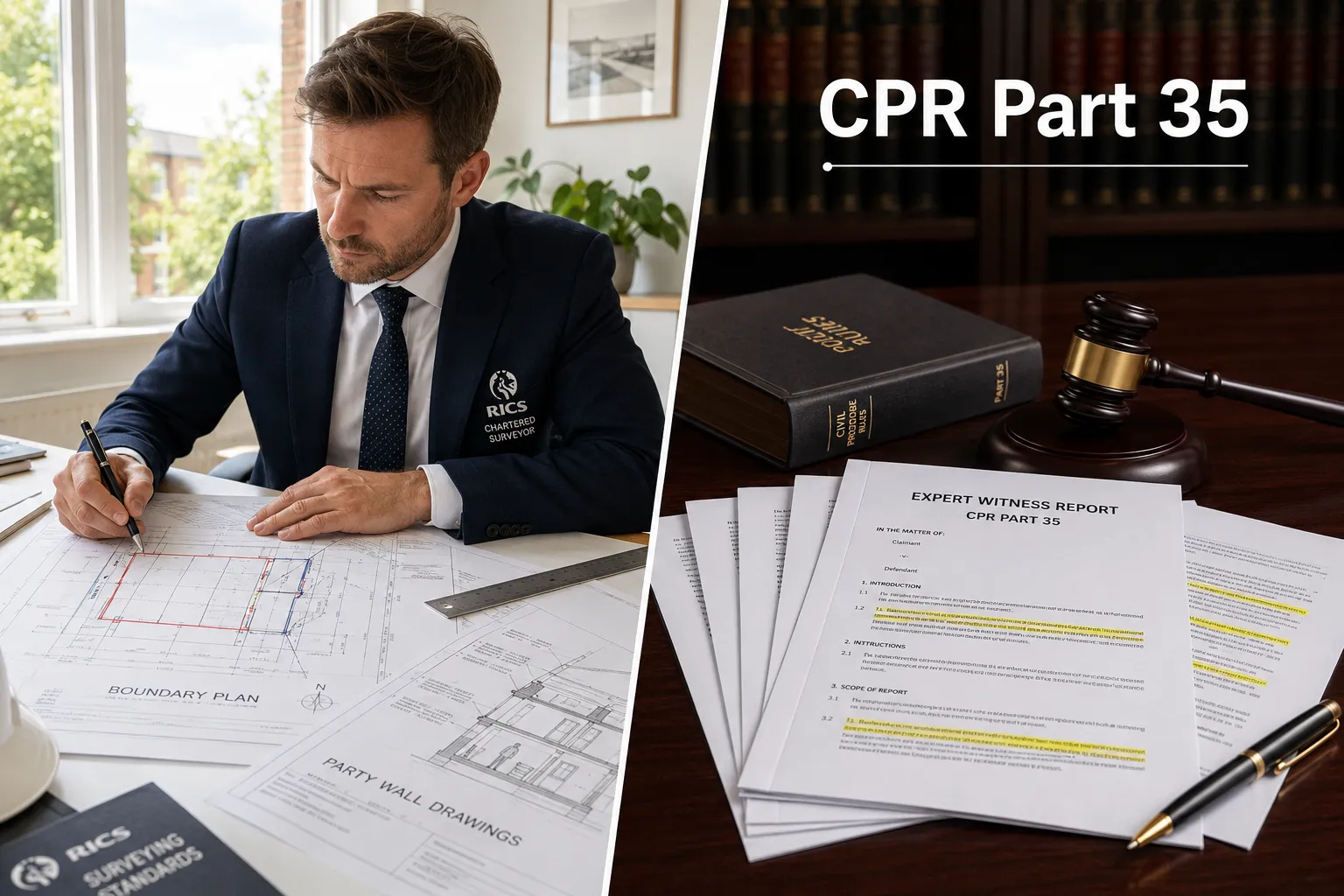
CPR Part 35, supported by Practice Direction 35, is the controlling framework for all expert evidence in civil proceedings in England and Wales, including boundary and party wall claims. The rules do not simply regulate how reports are written; they determine whether expert evidence is permitted at all.
Courts must give permission before a party can rely on expert evidence. In boundary-adjacent party wall cases, a judge will weigh whether the expert evidence is genuinely necessary or whether the factual evidence alone is sufficient. Permission is not automatic, and where it is granted, the court may impose restrictions on the expert's scope.
Key CPR obligations for experts in party wall boundary cases:
- The report must state the substance of all material instructions, whether written or oral.
- The expert must confirm they understand their duty to the court and that the report has been prepared in accordance with that duty.
- If the expert changes their opinion after the report is filed, they must communicate that change promptly.
- Experts may be required to hold a without-prejudice discussion with the opposing expert and produce a joint statement before the hearing.
Practice Direction 35 also sets out the required format for expert reports, including a statement of the expert's qualifications and a summary of the range of opinion on the issues where opinion differs. Omitting these elements gives the opposing party a procedural ground for challenge before the substantive arguments are even reached.
Single Joint Expert vs Separate Experts in Party Wall Cases
In many boundary-adjacent party wall cases heard in the County Court, judges prefer to appoint a single joint expert (SJE) rather than allow each side to instruct their own. This reduces cost, shortens proceedings, and avoids the spectacle of two surveyors giving diametrically opposed evidence.
A single joint expert is instructed by both parties jointly and owes duties to both. Neither party can communicate with the SJE without copying in the other. The SJE's report carries significant weight precisely because it cannot be dismissed as partisan. However, either party retains the right to put written questions to the SJE after the report is served.
Choose a single joint expert if:
- The case involves a relatively straightforward boundary measurement or condition assessment.
- Both parties want to minimise costs and reach a faster resolution.
- The court has indicated a preference for a SJE at a case management conference.
Separate experts may be justified if:
- The technical issues are genuinely complex and require competing methodologies to be tested.
- There is a significant factual dispute about the physical condition of the wall or boundary feature at a specific historical date.
- One party has reason to believe the proposed SJE lacks sufficient specialist knowledge of party wall law.
The expert witness reports service provides further detail on how these appointments work in practice and what each format involves.
Can You Challenge an Expert Witness on a Boundary-Adjacent Property Claim
Yes, challenging an expert witness on a boundary-adjacent party wall claim is entirely legitimate and, in some cases, strategically essential. The challenge can be made at the permission stage, during the exchange of reports, or through cross-examination at trial.
The most effective pre-trial challenge is a written CPR Part 35 question submitted to the opposing expert after their report is served. These questions must be for the purpose of clarification only, but a well-framed clarification question can expose gaps in methodology, force the expert to qualify overstated conclusions, or reveal that the expert's opinion rests on an incorrect factual assumption.
Practical challenge strategies:
- Submit targeted Part 35 questions within 28 days of receiving the report, focusing on the factual basis of each key conclusion.
- Request disclosure of the expert's instructions and any prior correspondence with the instructing party that may reveal a lack of independence.
- At trial, cross-examine on the expert's qualifications in the specific sub-discipline (boundary surveying versus structural assessment, for example).
- Refer the court to any inconsistency between the expert's report and the joint statement produced after the experts' without-prejudice meeting.
What Qualifications Does an Expert Need for Party Wall Boundary Claims
An expert witness in a party wall boundary claim should hold MRICS or FRICS status from the Royal Institution of Chartered Surveyors and have demonstrable, recent experience in party wall matters under the 1996 Act. Membership of the Pyramus & Thisbe Club, a specialist body for party wall surveyors, is a strong indicator of focused expertise.
For boundary-specific elements of a claim, the expert should also have experience in measured surveys, title plan interpretation, and the application of boundary presumptions in English property law. A structural engineer may be appropriate where the dispute centres on load-bearing elements, but they should not be asked to opine on boundary location unless they hold additional qualifications in land surveying.
Qualification checklist for a party wall boundary expert:
- MRICS or FRICS with a surveying specialism (not just valuation).
- Verifiable experience preparing or defending party wall awards under the 1996 Act.
- Familiarity with OS mapping, Land Registry title plans, and historical conveyancing documents.
- No prior commercial relationship with either party that could compromise independence.
- Willingness to sign the CPR Part 35 declaration and attend court for cross-examination if required.
For context on what a party wall surveyor does day-to-day, the complete guide to party wall surveyor roles is a useful reference point.
Common Mistakes Experts Make in Party Wall Adjacent Property Cases
The most frequent expert witness failures in party wall boundary cases are not dramatic ethical breaches; they are procedural and presentational errors that undermine an otherwise sound opinion.
The most common mistakes, and how to avoid them:
| Mistake | Why It Matters | How to Avoid It |
|---|---|---|
| Missing the CPR Part 35 declaration | Report is inadmissible without it | Use a standard template that includes the declaration as a final section |
| Overstating certainty | Invites effective cross-examination | Acknowledge the range of opinion and explain why one view is preferred |
| Failing to inspect in person | Weakens factual foundation | Always attend the site and document the visit with photographs and notes |
| Conflating the role of party wall surveyor with expert witness | Creates apparent conflict of interest | Maintain clear role separation from the outset of the dispute |
| Relying solely on current title plans | Boundary positions may have shifted historically | Cross-reference with historical OS maps, conveyancing deeds, and physical features |
| Ignoring the joint statement process | Leaves the court without a clear picture of what is actually in dispute | Engage constructively in the experts' meeting and produce a clear joint statement |
Experts who previously acted as the appointed party wall surveyor in the same dispute face a particular challenge. Courts are alert to the risk that such an expert has already formed and communicated views in an advisory capacity, making true independence harder to demonstrate.
How Much Does an Expert Witness Cost for a Party Wall Dispute in 2026
Expert witness fees for party wall boundary disputes in 2026 vary considerably based on case complexity, the expert's seniority, and whether the matter proceeds to a full hearing. As a general guide (based on typical market rates for RICS-qualified surveyors in England), parties should anticipate the following cost ranges:
- Initial report preparation: Approximately £1,500 to £4,000 for a straightforward case; £4,000 to £10,000 or more for complex multi-issue disputes.
- Attendance at experts' meeting and joint statement: Typically 3 to 6 hours of professional time.
- Court attendance and cross-examination: Charged at the expert's hourly rate, which for senior RICS fellows commonly falls between £200 and £450 per hour.
The average cost of a boundary dispute article provides a broader breakdown of total litigation costs, which can help parties assess whether settlement is more cost-effective than proceeding to a hearing.
Courts have the power to limit the recoverable costs of expert evidence, particularly where a SJE was available but the parties chose separate experts without good reason. Instructing parties should factor this into their cost-benefit analysis before committing to a full expert report.
What Happens If Expert Witnesses Disagree on Boundary Party Wall Issues
When experts disagree, the CPR process requires them to hold a without-prejudice meeting, after which they must produce a joint statement setting out the areas of agreement and the precise points of disagreement with reasons. This document is filed with the court and often becomes the central focus of the trial.
Judges do not simply choose between two competing opinions. Instead, they assess which expert's methodology was more rigorous, which opinion was better reasoned, and whether either expert departed from their duty to the court. An expert who concedes appropriate points in the joint statement often gains more credibility than one who refuses to move from their original position.
What the court looks at when experts disagree:
- Whether the disagreement is about facts (which the court will resolve on the evidence) or opinion (where the court assesses methodology and reasoning).
- Whether one expert has greater relevant experience in the specific sub-discipline.
- Whether either expert failed to consider material evidence, such as a historical deed or a physical boundary feature.
- The tone and conduct of the experts' meeting, which can reflect on their independence.
Are There Updated CPR Procedures for Expert Evidence in 2026 Party Wall Claims
CPR Part 35 itself has not been fundamentally restructured for 2026, but courts are applying its provisions with increasing rigour, particularly in cases where parties have attempted to use expert evidence as a litigation tactic rather than a genuine aid to the court. Case management judges are more frequently directing parties to use a single joint expert in lower-value boundary disputes, and are quicker to disallow expert costs where the instruction was disproportionate to the sums at stake.
In 2026, practitioners should also be aware that the courts' general emphasis on proportionality under the overriding objective continues to shape how expert evidence is managed. A party seeking permission for two separate experts in a dispute over a boundary line worth a modest sum will face close scrutiny at the case management conference.
Practical 2026 procedural points:
- File any application for expert permission early, ideally at the first case management conference.
- Be prepared to justify why a SJE is not appropriate if you are seeking permission for your own expert.
- Ensure the expert's letter of instruction is drafted carefully, as it will be disclosed to the court.
- Build in adequate time for the experts' meeting and joint statement before the trial date.
For those dealing with party wall matters that may escalate, understanding the consequences of ignoring the Party Wall Act is an important first step before any expert is instructed.
How to Find a Qualified Expert Witness for Boundary Party Wall Disputes
The most reliable route to a qualified expert witness for a boundary-adjacent party wall dispute is through the RICS Expert Witness Register or via a referral from a solicitor experienced in property litigation. The Pyramus & Thisbe Club also maintains a directory of party wall specialists.
When assessing a potential expert, request a CV that specifically lists party wall and boundary cases they have handled, including whether they have given evidence in court. Ask directly whether they have any prior connection to the other party or their advisers.
Key selection criteria:
- Verifiable court experience, not just report preparation.
- Specific knowledge of the Party Wall etc. Act 1996, not just general building surveying.
- Availability to meet the court's timetable, including the experts' meeting and trial date.
- A clear fee structure with no success-based element, which would compromise independence.
The party wall services page and the party wall awards service can help property owners understand the full range of professional support available before and during a dispute.
What Documents Do Experts Need to Review for Party Wall Boundary Cases
A thorough expert review in a boundary-adjacent party wall case requires access to both legal title documents and physical survey records. Gaps in the document bundle are a leading cause of expert reports that fail to withstand cross-examination.
Core documents an expert should review:
- Land Registry title plans and title registers for both properties.
- Original conveyancing deeds, particularly any that pre-date Land Registry first registration.
- Historical OS maps at the largest available scale for the relevant period.
- Party wall notices, counter-notices, and any existing party wall awards.
- Photographs and schedules of condition prepared before any building works commenced.
- Planning permissions and approved drawings for the works in dispute.
- Any correspondence between the parties or their surveyors that touches on the boundary or wall position.
A party wall schedule of condition prepared before works begin is particularly valuable because it provides a contemporaneous record that an expert can use to assess whether alleged damage pre-existed the disputed works.
Can You Use the Same Expert for Both Structural and Boundary Issues in Party Wall Claims
Using a single expert to address both structural and boundary issues is possible but should be approached carefully. Courts will accept a dual-scope instruction only if the expert holds genuine qualifications and experience in both disciplines. A building surveyor with party wall experience may legitimately address structural condition and boundary position, but only if their CV supports competence in both areas.
The risk of a dual-scope instruction is that the opposing party challenges the expert's qualifications in one of the two areas, potentially undermining the entire report. Where the structural and boundary issues are genuinely distinct and complex, instructing separate specialists is often the more defensible approach, subject to the court's permission for more than one expert.
What Is the Timeline for Expert Reports in CPR Party Wall Proceedings
The timeline for expert evidence in CPR proceedings is set by the court at the case management conference, and parties have limited flexibility to deviate from it. A typical timetable for a boundary-adjacent party wall case proceeding in the County Court might look like this:
- Case management conference: Court grants permission for expert evidence and sets the timetable.
- Expert reports exchanged simultaneously: Usually 10 to 16 weeks after the case management conference.
- Part 35 questions submitted: Within 28 days of receiving the opposing report.
- Answers to Part 35 questions: Within a further 28 days.
- Experts' without-prejudice meeting: Typically 4 to 6 weeks before trial.
- Joint statement filed: Usually 2 to 3 weeks before trial.
- Trial: Expert gives oral evidence and is cross-examined.
Missing any of these deadlines can result in the expert's evidence being excluded, so early instruction and close coordination between the expert and the legal team are essential.
Frequently Asked Questions
Can a party wall surveyor also act as an expert witness in the same dispute?
A party wall surveyor who has already acted as an appointed surveyor in the same dispute faces a significant conflict of interest if asked to act as a CPR expert witness. Courts are likely to treat their evidence with caution because they have already formed and communicated views in an advisory role. It is generally better to instruct a separate expert with no prior involvement.
What happens if an expert fails to include the CPR Part 35 declaration?
A report without the CPR Part 35 declaration of independence is technically non-compliant and can be challenged as inadmissible. In practice, courts may allow the expert to remedy the omission by filing a supplementary statement, but this creates delay and costs, and it damages the expert's credibility.
How long does an expert witness report take to prepare for a party wall boundary case?
A straightforward report typically takes four to eight weeks from initial instruction to delivery, assuming the expert has prompt access to the site and all relevant documents. Complex cases involving multiple title deeds, historical mapping, or significant structural issues may take considerably longer.
Can the court reject an expert's opinion entirely?
Yes. Courts are not bound to accept expert evidence, even where it is uncontested. A judge may reject an expert opinion if the reasoning is inadequate, the methodology is flawed, or the expert has clearly departed from their duty of independence.
What is a Part 35 question and when should it be used?
A CPR Part 35 question is a written question submitted to the opposing party's expert after their report is served. Questions must be for the purpose of clarification only, not to obtain new evidence. They are most useful for exposing factual assumptions the expert has made, pressing for acknowledgment of contrary evidence, or clarifying the basis for a specific conclusion.
Does every party wall dispute need an expert witness?
No. Many party wall disputes are resolved through the statutory award process under the Party Wall etc. Act 1996 without ever reaching court. Expert witness evidence under CPR Part 35 becomes relevant only when a dispute proceeds to civil litigation, for example where a party appeals an award or brings a separate claim for damages.
Conclusion
Expert witness challenges in boundary-adjacent party wall claims require a clear understanding of CPR Part 35, a carefully selected and qualified expert, and disciplined document preparation from the outset. In 2026, courts continue to apply proportionality principles rigorously, meaning poorly prepared or partisan expert evidence is increasingly likely to be excluded or heavily discounted.
Actionable next steps for property owners and professionals facing a boundary-adjacent party wall dispute:
- Instruct a qualified RICS expert with specific party wall and boundary experience before proceedings are issued, not after.
- Review all title documents, historical deeds, and any existing party wall awards before the expert's site inspection.
- If the opposing party has already served an expert report, submit targeted CPR Part 35 questions within the 28-day window.
- Engage constructively in the experts' meeting process; courts view an expert who refuses to concede reasonable points as less credible.
- Assess at each stage whether the cost of expert evidence is proportionate to the value of the dispute and the realistic prospects of recovery.
For professional support with party wall matters, from initial notices through to expert witness appointments, the party wall services and expert witness reports pages provide a starting point for understanding what specialist assistance is available.
.cg-timeline-wrap{font-family:Arial,sans-serif;max-width:680px;margin:2em auto;background:#f7f9fc;border-radius:8px;padding:24px 20px;box-sizing:border-box;}
.cg-timeline-wrap h3{font-size:1.05rem;color:#1a2e4a;margin:0 0 16px;text-align:center;}
.cg-step{display:flex;align-items:flex-start;margin-bottom:14px;}
.cg-step-num{min-width:32px;height:32px;background:#1a2e4a;color:#fff;border-radius:50%;display:flex;align-items:center;justify-content:center;font-weight:700;font-size:.9rem;margin-right:14px;flex-shrink:0;}
.cg-step-body{background:#fff;border-left:3px solid #2e6da4;border-radius:4px;padding:10px 14px;flex:1;}
.cg-step-title{font-weight:700;color:#1a2e4a;font-size:.92rem;margin-bottom:3px;}
.cg-step-detail{color:#444;font-size:.85rem;line-height:1.4;}
.cg-note{font-size:.78rem;color:#666;text-align:center;margin-top:10px;}
CPR Expert Evidence Timeline: Party Wall Boundary Cases
Tags: expert witness party wall, CPR Part 35, boundary dispute, party wall claims, party wall surveyor, expert witness challenges, boundary-adjacent property, single joint expert, party wall act 1996, expert witness qualifications, civil procedure rules, property litigation