

Last updated: July 24, 2026
Quick Answer: The evergreen RICS guidance on shorter transaction times sets out best-practice principles for managing party wall procedures efficiently, with the goal of keeping agreements on track within compressed timescales such as a six-week completion window. Achieving a six-week party wall agreement is possible when notices are served early, both parties cooperate, and a single agreed surveyor is appointed promptly. No statutory shortcut exists, but disciplined process management aligned with RICS guidance consistently delivers faster outcomes.
Key Takeaways
- The Party Wall etc. Act 1996 sets minimum statutory notice periods that cannot be waived, but smart sequencing can keep total timescales within six weeks.
- RICS guidance emphasises early notice service, clear communication, and appointing an agreed surveyor as the fastest route to a party wall award.
- A party wall award typically takes two to four weeks to prepare once surveyors are appointed, making front-loaded preparation critical.
- Costs for a standard residential party wall agreement range from roughly £700 to £2,000 per surveyor, depending on complexity and location.
- Skipping or ignoring statutory requirements does not speed things up; it creates injunctions, disputes, and delays that far exceed the original timescale.
- A schedule of condition, prepared before works begin, protects both the building owner and the adjoining owner and is strongly recommended by RICS.
- Properties with complex shared structures, basement excavations, or multiple adjoining owners are less likely to achieve a six-week completion.
- Disputes are the single biggest cause of delay; early neighbour engagement dramatically reduces the risk of dissent.
What Is the Evergreen RICS Guidance on Party Wall Agreements
The evergreen RICS guidance on party wall agreements is a body of professional best-practice standards published by the Royal Institution of Chartered Surveyors to help surveyors and property owners manage party wall procedures correctly, efficiently, and fairly. It does not replace the Party Wall etc. Act 1996 but interprets and supplements it with practical frameworks for notice service, surveyor appointment, award preparation, and dispute resolution.
RICS updates its guidance periodically through formal consultations. As of 2026, RICS has been consulting on revised party wall practice notes to reflect evolving construction methods and the increasing pressure on transaction timescales in the UK residential market. The core principles, however, remain consistent: serve valid notices, appoint qualified surveyors promptly, and produce a well-drafted award before works begin.
Who this guidance applies to:
- Building owners carrying out notifiable works (extensions, loft conversions, basement digs, structural work near boundaries)
- Adjoining owners whose properties share a wall, floor, or boundary with the proposed works
- RICS-accredited party wall surveyors acting for either party
- Conveyancers and solicitors managing property transactions with party wall obligations
For a broader overview of your rights and responsibilities, see this guide to party wall rights and obligations.
How Can You Complete Party Wall Agreements in Six Weeks
A six-week party wall agreement completion is achievable for straightforward residential projects when all parties act promptly and no disputes arise. The statutory minimum notice period under the Party Wall etc. Act 1996 is one month for party structure notices and two months for line of junction notices, so the clock starts the moment a valid notice is served.
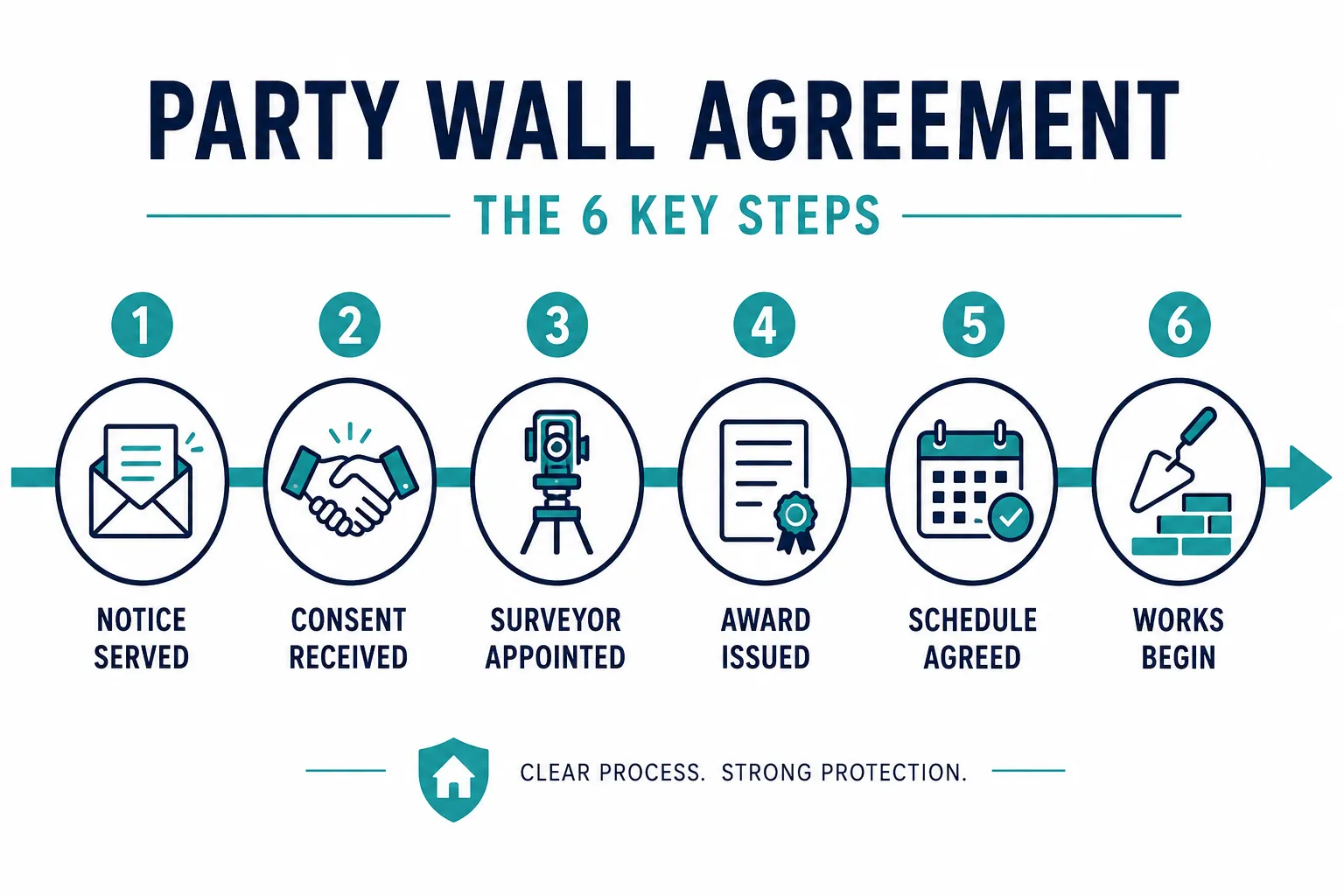
The six-week window works like this in practice:
- Week 1: Serve the party wall notice on day one of the process, not after planning permission is granted.
- Weeks 1-2: Adjoining owner acknowledges receipt and either consents or dissents. Consent ends the formal process immediately.
- Week 2: If the adjoining owner dissents or fails to respond within 14 days, surveyors are appointed without delay.
- Weeks 2-5: Surveyors inspect, prepare the party wall award, and agree its terms.
- Week 6: Award is signed, schedule of condition is completed, and works can begin.
This timeline assumes a single agreed surveyor (appointed jointly by both parties), a simple project scope, and no disagreement over the award's terms. The moment a second surveyor is appointed, or a dispute emerges, the realistic timescale extends to eight to twelve weeks or more.
What Are the Steps to Accelerate a Party Wall Agreement Timeline
Accelerating a party wall agreement timeline comes down to eliminating avoidable delays at each stage. RICS guidance consistently identifies early preparation and proactive communication as the two most effective levers.
Step-by-step checklist for faster completion:
- Identify notifiable works early. Before submitting a planning application, confirm with a party wall surveyor which works trigger the Act. Loft conversions, rear extensions, and basement excavations almost always do. See the guide on party wall agreements for loft conversions for specific triggers.
- Prepare notices in advance. Draft party wall notices while planning permission is being processed, not after it is granted. A valid notice requires the building owner's name and address, a description of the proposed works, and the proposed start date.
- Speak to neighbours before serving notice. An informal conversation explaining the works reduces the likelihood of a reflexive dissent. Neighbours who understand what is happening are far more likely to consent.
- Propose an agreed surveyor immediately. If dissent is likely, have a named RICS-accredited surveyor ready to propose. Delays in appointing surveyors account for a significant share of extended timescales.
- Provide complete drawings upfront. Surveyors cannot draft a thorough award without adequate structural drawings. Incomplete information is one of the most common causes of back-and-forth delays.
- Commission a schedule of condition promptly. A party wall schedule of condition documents the adjoining property's pre-works state and should be completed before the award is finalised, not after.
- Respond to surveyor queries without delay. Every unanswered email or missed call adds days to the process.
Party Wall Agreement Cost and Fees for Faster Completion
Party wall agreement costs vary by project complexity, location, and whether one or two surveyors are appointed. Appointing a single agreed surveyor is both the fastest and most cost-effective route.
| Scenario | Typical Cost Range | Timescale Impact |
|---|---|---|
| Adjoining owner consents | Nil surveyor cost | Fastest: no award needed |
| Single agreed surveyor | £700, £1,200 | Moderate: 2-4 weeks for award |
| Two separate surveyors | £1,500, £2,000+ each | Slower: coordination adds time |
| Third surveyor referral | Additional £1,000+ | Significant delay |
Costs in London and the South East tend to sit at the upper end of these ranges. For a detailed breakdown, see the full guide on party wall agreement costs.
Who pays? As a general rule, the building owner (the person carrying out the works) pays the surveyor's fees. If the adjoining owner appoints their own surveyor, the building owner typically covers those fees too, provided they are reasonable.
"Choosing an agreed surveyor is the single most effective way to reduce both cost and timescale in a straightforward residential party wall case."
Can You Skip Any Party Wall Agreement Requirements to Speed Things Up
No statutory party wall requirement can be skipped or shortened. The notice periods, the right to appoint a surveyor, and the requirement for a party wall award before notifiable works begin are all set by the Party Wall etc. Act 1996 and cannot be waived by either party unilaterally.
What can be avoided is unnecessary procedural delay. The Act does not require:
- Multiple rounds of negotiation before an award is issued
- Lengthy site inspections for simple projects
- Extended correspondence between surveyors
Common shortcuts that backfire:
- Starting works without serving notice leads to injunctions, mandatory cessation of works, and potential legal costs far exceeding the original project budget. See the full consequences in this article on ignoring the Party Wall Act.
- Serving a defective notice restarts the clock entirely and may trigger dissent from a previously cooperative neighbour.
- Pressuring surveyors to rush an award without adequate information produces poorly drafted awards that create disputes during construction.
Who Needs to Follow RICS Party Wall Guidance
RICS party wall guidance applies directly to RICS-accredited surveyors, who are professionally obligated to follow it. For property owners and developers, the guidance is not legally binding in the same way the Act is, but following its principles is the most reliable way to avoid disputes, delays, and professional negligence claims.
You need to engage with party wall procedures if you are:
- Extending a semi-detached or terraced house
- Converting a loft where the structure sits on or near a shared wall
- Excavating within three or six metres of a neighbouring foundation (depending on depth)
- Building a new wall on or at the boundary line
If you are buying a property and the seller has recently carried out works, check whether party wall obligations were properly discharged. Unresolved party wall matters can complicate a purchase. This guide on buying a house and the Party Wall Act covers what to look for.
What Is the Difference Between Standard and Accelerated Party Wall Agreements
There is no formal legal category called an "accelerated" party wall agreement. The distinction in practice is between a process managed efficiently from day one and one that drifts due to poor preparation or communication.
A standard process often looks like this: notice served after planning permission, neighbour dissents, two surveyors appointed, drawings requested, award drafted over several weeks. Total time: ten to sixteen weeks.
An efficiently managed process: notice served during the planning application stage, agreed surveyor proposed on day one of dissent, complete drawings provided upfront, award issued within three to four weeks of appointment. Total time: six to seven weeks.
The difference is process management, not any special legal mechanism. RICS guidance on shorter transaction times explicitly supports this front-loaded approach as best practice.
Common Mistakes That Delay Party Wall Agreements
The most common mistakes that delay party wall agreements are serving notices too late, providing incomplete information to surveyors, and failing to engage neighbours before the formal process begins.
Top delay-causing mistakes:
- Late notice service: Serving notice only after planning permission is granted adds weeks to the overall project timeline unnecessarily.
- Vague or defective notices: A notice that does not clearly describe the works or proposed start date can be challenged and must be reissued.
- No prior neighbour conversation: Neighbours who feel blindsided are more likely to dissent and appoint their own surveyor.
- Incomplete structural drawings: Surveyors cannot finalise an award without knowing the full scope and method of works.
- Ignoring surveyor correspondence: Delays in responding to queries from the appointed surveyor are a frequent and entirely avoidable cause of extended timescales.
- Appointing inexperienced surveyors: A surveyor unfamiliar with the Act's procedural requirements will take longer and may produce an award that is later challenged.
For more on avoiding these pitfalls, see this article on common misconceptions about party wall agreements.
What Happens If You Don't Follow RICS Party Wall Procedures
Failing to follow RICS party wall procedures and the underlying statutory requirements can result in injunctions, forced stoppage of works, and significant financial liability. Courts have consistently upheld the rights of adjoining owners where building owners have proceeded without proper notice or a valid award.
Practical consequences include:
- An injunction stopping all works immediately, potentially leaving a property in a partially demolished or structurally vulnerable state
- Legal costs that routinely exceed the cost of the original party wall process
- Damage claims from the adjoining owner that are harder to defend without a pre-works schedule of condition
- Difficulty selling the property, as unresolved party wall matters appear in conveyancing searches
Party Wall Agreement Disputes and How to Avoid Them
Most party wall disputes arise from poor communication, not genuine legal disagreement. When neighbours understand what works are planned and why, and when surveyors are experienced and professional, the vast majority of cases resolve without conflict.
Dispute prevention strategies:
- Speak to neighbours informally before serving any formal notice
- Share architectural drawings or a simple plan showing what is being built
- Respond to concerns promptly and in writing
- Use an RICS-accredited agreed surveyor who both parties trust
If a dispute does arise, the Act provides a clear mechanism: each party appoints a surveyor, and those two surveyors either agree an award or refer the matter to a third surveyor. This process is designed to resolve disagreements without court proceedings. For detailed guidance, see this resource on party wall disputes.
Do All Properties Qualify for a Six-Week Party Wall Completion
Not all properties or projects are suited to a six-week party wall completion. Simple rear extensions on semi-detached houses with cooperative neighbours are the most likely candidates. More complex scenarios require more time.
Properties and projects less likely to achieve six-week completion:
- Basement excavations, which involve more complex structural assessments and often trigger the three-metre and six-metre excavation notice provisions
- Properties with multiple adjoining owners (mid-terrace houses may have two or more)
- Projects where the adjoining owner is difficult to contact or unresponsive
- Works involving unusual structural methods or materials that require additional engineering input
- Cases where the adjoining owner has already indicated opposition
Properties well-suited to six-week completion:
- End-of-terrace or semi-detached with a single cooperative adjoining owner
- Simple loft conversion or rear extension with standard structural approach
- Both parties willing to use a single agreed surveyor
- Complete drawings available at notice stage
What Documents Do You Need for a Fast Party Wall Agreement
Having the right documents ready before serving notice is the single most effective preparation step for a fast party wall agreement. Surveyors cannot produce a complete, defensible award without adequate information.
Essential documents:
- Completed party wall notice (one for each notifiable work type)
- Architectural drawings showing the proposed works in plan and section
- Structural engineer's drawings or calculations (particularly for loft conversions and extensions)
- Existing property plans showing the shared wall or boundary
- Proposed construction method statement if excavation is involved
Strongly recommended:
- Party wall drawings prepared specifically for the party wall process, distinct from planning drawings
- A draft schedule of condition covering the adjoining property's current state
Having all of these ready before the notice is served means that once a surveyor is appointed, the award can be drafted immediately rather than waiting for information to be gathered.
FAQ
Q: Is there an official RICS document specifically titled "Evergreen RICS Guidance on Shorter Transaction Times"?
A: No single RICS publication carries that exact title. The phrase refers to RICS's ongoing, regularly updated best-practice guidance on party wall procedures and transaction efficiency, which is embedded across RICS practice notes and consumer guides rather than in one standalone document.
Q: Can a party wall notice period be shortened by agreement?
A: The statutory minimum notice periods under the Party Wall etc. Act 1996 cannot be reduced by agreement between the parties. However, if the adjoining owner consents immediately after receiving notice, the process can conclude well within the statutory window.
Q: What is an agreed surveyor and why is it faster?
A: An agreed surveyor is a single RICS-accredited professional appointed jointly by both the building owner and the adjoining owner. Because there is only one surveyor to coordinate, the award is typically produced faster and at lower cost than when each party appoints their own surveyor.
Q: How long does a party wall award take to prepare?
A: For a straightforward residential project with complete drawings and a cooperative adjoining owner, a party wall award typically takes two to four weeks from surveyor appointment. Complex projects or disputes can extend this to eight weeks or more.
Q: Can works begin before the party wall award is signed?
A: No. Notifiable works cannot legally begin until a valid party wall award has been agreed and signed, or until the adjoining owner has given written consent. Starting works beforehand exposes the building owner to injunctions and legal liability.
Q: Does a party wall agreement expire?
A: A party wall award does not have a fixed expiry date, but it is tied to the specific works described in it. If the scope of works changes materially, or if works do not begin within a reasonable period (typically twelve months is used as a practical benchmark), a new notice and award may be required.
Q: What happens if a neighbour refuses to engage with the party wall process?
A: If an adjoining owner fails to respond to a party wall notice within 14 days, this is treated as a deemed dissent under the Act. The building owner can then appoint a surveyor on the adjoining owner's behalf if they continue to refuse to engage. See this guide on what happens when a neighbour refuses party wall works for more detail.
Q: Is RICS accreditation required for a party wall surveyor?
A: RICS accreditation is not a legal requirement under the Act, but appointing an RICS-accredited surveyor provides assurance of professional standards, insurance, and adherence to the evergreen RICS guidance on shorter transaction times and best practice.
.pw-tool{font-family:Arial,sans-serif;max-width:520px;margin:2em auto;background:#f8f9fb;border:1px solid #d0d7e2;border-radius:8px;padding:24px}
.pw-tool h3{margin:0 0 4px;font-size:1.1em;color:#1a2a4a}
.pw-tool p{margin:0 0 16px;font-size:.85em;color:#555}
.pw-tool label{display:block;font-size:.9em;font-weight:600;color:#1a2a4a;margin-bottom:4px}
.pw-tool select{width:100%;padding:8px;border:1px solid #b0bac8;border-radius:5px;font-size:.9em;margin-bottom:14px;background:#fff}
.pw-tool button{background:#1a2a4a;color:#fff;border:none;padding:10px 22px;border-radius:5px;font-size:.95em;cursor:pointer;width:100%}
.pw-tool button:hover{background:#2c4a7a}
.pw-result{margin-top:16px;padding:14px;border-radius:6px;font-size:.9em;display:none}
.pw-result.green{background:#e6f4ea;border:1px solid #7bc99a;color:#1a4a2a}
.pw-result.amber{background:#fff8e1;border:1px solid #f0c040;color:#4a3a00}
.pw-result.red{background:#fdecea;border:1px solid #e57373;color:#4a1a1a}
.pw-result strong{display:block;font-size:1em;margin-bottom:4px}
Party Wall Timeline Estimator
Answer three quick questions to estimate your party wall completion window.
function pwEstimate(){
var p=document.getElementById(‘pw-proj’).value,
n=document.getElementById(‘pw-neigh’).value,
d=document.getElementById(‘pw-docs’).value,
r=document.getElementById(‘pw-result’),
score=0,msg=”,cls=”;
if(!p||!n||!d){r.style.display=’block’;r.className=’pw-result amber’;r.innerHTML=’Please answer all three questions.‘;return;}
if(p===’simple’)score+=0; else if(p===’basement’)score+=2; else score+=3;
if(n===’good’)score+=0; else if(n===’neutral’)score+=1; else score+=3;
if(d===’yes’)score+=0; else if(d===’partial’)score+=1; else score+=2;
if(score<=1){cls='green';msg='Estimated: 4-6 weeksGood conditions for a fast agreement. Serve notice now and propose an agreed surveyor immediately.’;}
else if(score<=4){cls='amber';msg='Estimated: 6-10 weeksAchievable with prompt action. Finalise drawings and contact your neighbour before serving notice.’;}
else{cls=’red’;msg=’Estimated: 10-16 weeks or moreComplex factors present. Engage an RICS-accredited surveyor early and allow extra time in your project programme.’;}
r.style.display=’block’;r.className=’pw-result ‘+cls;r.innerHTML=msg;
}
Conclusion
Achieving a six-week party wall agreement completion is a realistic goal for many straightforward UK residential projects, but it requires deliberate preparation rather than luck. The evergreen RICS guidance on shorter transaction times makes clear that the fastest outcomes come from serving valid notices early, engaging neighbours before the formal process begins, appointing an agreed RICS-accredited surveyor without delay, and providing complete structural drawings upfront.
No statutory shortcut exists. The Party Wall etc. Act 1996 sets minimum notice periods and procedural requirements that protect both building owners and their neighbours, and attempting to bypass them creates far greater delays than following the process correctly from the start.
Actionable next steps:
- Identify whether your planned works are notifiable under the Act before submitting a planning application.
- Speak informally to affected neighbours and share outline plans.
- Engage an RICS-accredited party wall surveyor to draft valid notices and advise on the fastest compliant route for your specific project.
- Ensure structural drawings are complete before the notice period expires, so an award can be issued without delay.
- If your project involves a basement, multiple adjoining owners, or a potentially uncooperative neighbour, build additional time into your programme from the outset.
For professional party wall surveying services across London and the South East, explore the full range of party wall services available from RICS-accredited chartered surveyors.