

Over 40% of party wall disputes in England and Wales stem from procedural errors that could have been avoided with correct notice service and proper surveyor appointment. For professionals navigating dense urban environments in 2026, the stakes are higher than ever. This Evergreen Guide to Party Wall Act 1996: 2026 Updates for Surveyors in High-Density Urban Extensions consolidates the core statutory framework with the most significant professional practice changes of the year, giving surveyors, building owners, and adjoining owners the clarity they need before a single brick is moved.
Key Takeaways
- The Party Wall etc. Act 1996 governs three distinct categories of work: party wall repairs and alterations, new walls on the boundary, and excavation near neighbouring structures.
- In April 2026, RICS launched a consultation on its draft 8th edition guidance, the most comprehensive overhaul of professional practice standards in over a decade.
- High-density urban extensions trigger the Act more frequently than rural builds due to shared boundaries, close excavation distances, and overlapping structural loads.
- Failing to serve correct notices can result in injunctions, project delays, and financial liability for the building owner.
- A properly drafted party wall award protects both parties and remains the most effective tool for resolving disputes before they escalate to court.
What the Party Wall etc. Act 1996 Actually Covers
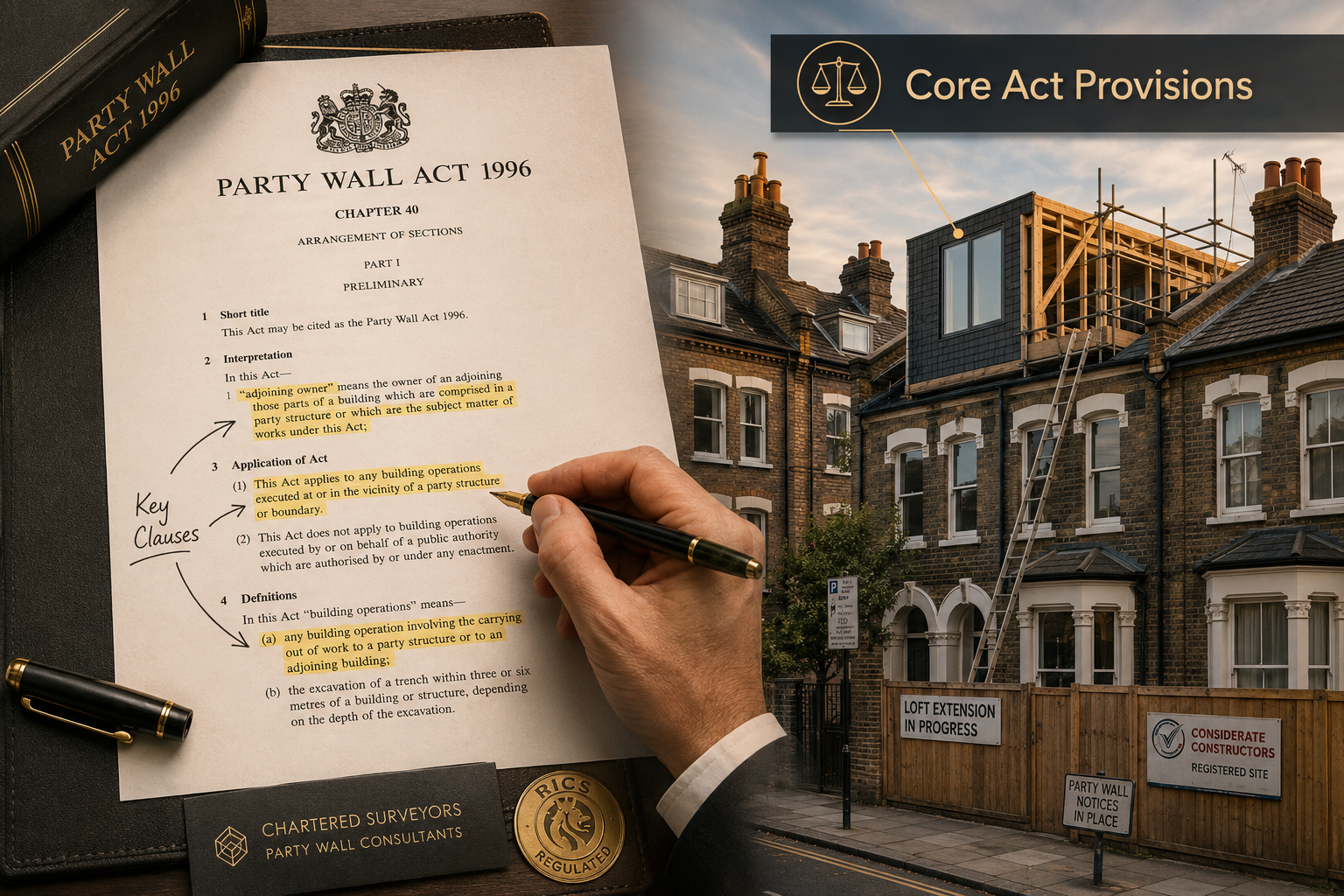
The Party Wall etc. Act 1996 applies in England and Wales and creates a statutory framework for managing construction work that affects shared or boundary structures. It does not prevent building work; it regulates it. Three main categories of work fall under its scope:
1. Works to an existing party wall or party structure (Section 2)
This includes cutting into a wall, raising it, underpinning it, or making good defects. Any structural alteration to a shared wall between two properties triggers this section.
2. New walls built on or at the boundary line (Section 1)
A building owner who wishes to build a new wall astride or immediately adjacent to the boundary must serve notice on the adjoining owner.
3. Excavation near neighbouring buildings (Section 6)
Section 6 of the Act mandates that building owners serve notice before conducting excavation within 3 metres of an adjoining building where the excavation will be deeper than the neighbour's foundations, or within 6 metres where a line drawn at 45 degrees from the bottom of the excavation would intersect the neighbour's foundations [3].
In high-density urban areas — terraced streets, Victorian conversions, and tightly packed new-build developments — all three categories regularly apply simultaneously. A rear extension, for example, may involve Section 2 works to the shared flank wall, Section 6 excavation for new footings, and a Section 1 new wall along the garden boundary. Surveyors working in South West London or North London will rarely encounter a project that triggers only one section.
Notice Requirements and Timelines
The Act sets clear notice periods that building owners must observe before work begins [9]:
| Type of Work | Notice Period Required |
|---|---|
| Section 1 (new boundary wall) | 1 month |
| Section 2 (party wall works) | 2 months |
| Section 6 (excavation) | 1 month |
Once a notice is served, the adjoining owner has 14 days to respond. Consent in writing allows work to proceed. If no response is received within 14 days, or if the adjoining owner dissents, a dispute is deemed to have arisen under the Act [10]. At that point, surveyors must be appointed.
"The notice period is not a formality — it is a statutory right for the adjoining owner to understand and respond to proposed works before they begin."
Common errors include serving notice too late, using incorrect notice forms, or failing to identify all adjoining owners where a property has multiple boundaries. These mistakes can invalidate the entire process and expose the building owner to legal action [4].
RICS 8th Edition Guidance: The 2026 Updates Every Surveyor Must Know
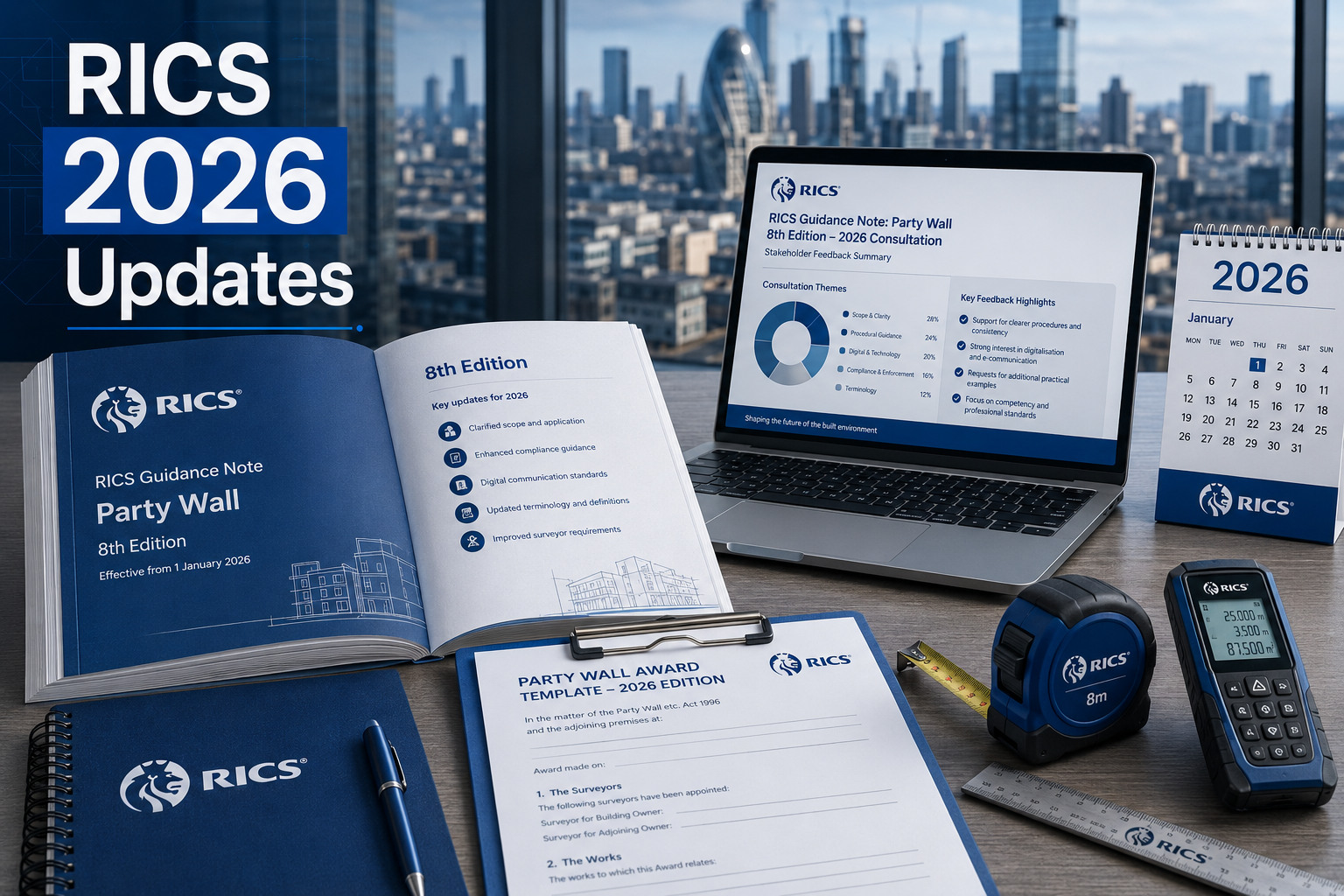
The most significant professional development for party wall practitioners in 2026 is the RICS consultation and subsequent publication of the 8th edition of its Party Wall Legislation and Procedure guidance. In April 2026, RICS opened an eight-week consultation on the draft document, signalling the most comprehensive update to professional practice standards in over a decade [1].
Following the consultation period, the 8th edition was set for immediate implementation in 2026 [2]. Surveyors operating under the Act should treat this as a live requirement, not a future aspiration.
Key Changes in the 8th Edition
The updated guidance introduces several substantive improvements:
- Revised appointment letters: Updated templates clarify the surveyor's role, fee arrangements, and the scope of their authority under the Act.
- Improved draft award template: The new award template reduces ambiguity around the description of works, access rights, and working hours, which are among the most contested elements in urban projects.
- Updated appendices: Practical guidance on notice service, counter-notices, and the role of the Third Surveyor has been expanded.
- Fee practice standards: The 8th edition addresses longstanding concerns about fee transparency, requiring surveyors to provide clear fee estimates before appointment [1].
- Third Surveyor provisions: The guidance clarifies when the Third Surveyor should be called upon and how that process should be initiated, reducing procedural disputes between appointed surveyors [2].
Why the 8th Edition Matters for Urban Extension Projects
High-density urban extensions generate a disproportionate share of party wall disputes. When properties share walls, gardens, and even airspace, the margin for error is narrow. The 8th edition's focus on proper notice service and award drafting directly addresses the procedural failures that most commonly derail urban projects [4].
For surveyors advising clients on party wall disputes, the updated guidance provides a clearer framework for resolution. It also strengthens the position of surveyors who follow correct procedure, making awards less vulnerable to challenge in the County Court.
The 8th edition reinforces a principle that experienced practitioners already know: a party wall surveyor is not an advocate for the party who appoints them. Their duty is to act impartially and resolve matters in accordance with the Act [5]. This distinction is particularly important in contentious urban projects where building owners may expect their surveyor to act as a negotiator rather than a statutory officer.
Applying the Act in High-Density Urban Extensions: Practical Guidance for 2026
The Evergreen Guide to Party Wall Act 1996: 2026 Updates for Surveyors in High-Density Urban Extensions would be incomplete without addressing the specific challenges that dense urban environments create. Extensions in cities such as London, Birmingham, and Manchester involve structural conditions that rarely arise in suburban or rural settings.
Loft Conversions and Roof-Level Works
Loft conversions are among the most common triggers for party wall procedures in urban areas. Raising a party wall, inserting steel beams into a shared chimney breast, or cutting into a shared roof structure all engage Section 2 of the Act. Surveyors should be aware that loft conversions frequently require party wall agreements even when the adjoining owner believes no shared structure is affected.
A party wall schedule of condition is essential before any loft-level work begins. It documents the pre-existing condition of the adjoining property and provides the evidential baseline if a damage claim arises after completion.
Basement and Excavation Works
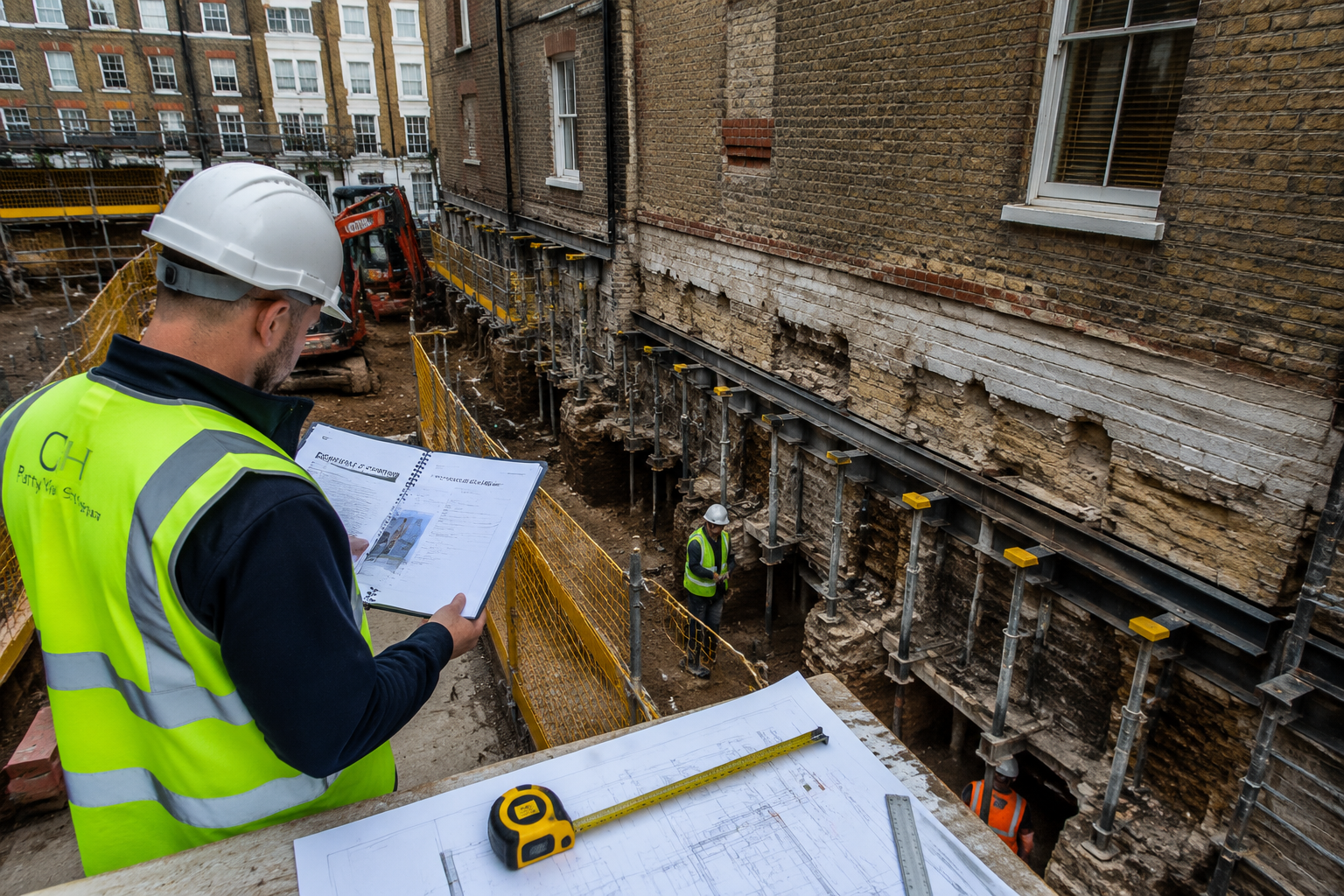
Basement extensions in urban areas are among the most technically complex party wall scenarios. Section 6 excavation notices are required where digging falls within 3 or 6 metres of neighbouring foundations, depending on depth [3]. In terraced streets where properties are separated by less than a metre at garden level, almost any basement project will trigger Section 6.
The cost of a party wall surveyor for basement projects is typically higher than for standard extensions, reflecting the additional technical complexity and the need for structural engineer input. Building owners should budget for this from the outset rather than treating it as an unexpected cost.
Rear Extensions and Side Returns
Single and double-storey rear extensions in terraced or semi-detached properties almost always involve party wall works. The shared flank wall, the foundations, and sometimes the party fence wall at the rear boundary are all potentially affected.
Key practical steps for surveyors handling rear extension projects in 2026:
- Identify all party structures and boundaries before advising on notice requirements.
- Confirm all adjoining owners, including those who share a boundary but not a wall.
- Serve notices with sufficient lead time to avoid project delays.
- Commission party wall drawings that clearly show the relationship between proposed works and existing shared structures.
- Prepare a schedule of condition before work commences.
- Draft the award with precision, addressing access, working hours, and reinstatement obligations.
Dispute Resolution in Urban Contexts
When an adjoining owner dissents or fails to respond within 14 days, the dispute resolution mechanism under the Act is triggered [10]. Both parties appoint surveyors, or agree on a single agreed surveyor. If the two appointed surveyors cannot agree, the matter passes to a Third Surveyor selected in advance.
Understanding what happens when a neighbour refuses party wall works is critical for building owners who face dissent. Refusal does not stop the project — it initiates the formal surveyor appointment process. The resulting award is legally binding and can be enforced.
Non-compliance with the Act carries serious consequences. Building owners who proceed without serving notices or without an award in place risk injunctions halting the work entirely, as well as liability for any damage caused to the adjoining property [7]. In high-density urban areas where properties are structurally interdependent, the potential for damage — and therefore liability — is significantly greater than in detached suburban settings [6].
Cost Apportionment
The Act provides a framework for dividing costs between the building owner and the adjoining owner. As a general principle, the building owner pays for works that benefit them alone. Where works also benefit the adjoining owner — for example, underpinning that strengthens both properties — costs may be shared proportionally.
Surveyors should address cost apportionment explicitly in the award to avoid post-completion disputes. The 8th edition guidance reinforces this expectation, particularly in relation to fee transparency and the proper documentation of cost decisions.
Avoiding the Most Common Procedural Errors
The Party Wall etc. Act 1996 is procedurally unforgiving. Errors that seem minor — a notice served to the wrong address, a surveyor appointed before the dispute period has elapsed, an award that omits working hours — can invalidate the process and expose all parties to delay and cost.
There are several common misconceptions about party wall agreements that contribute to these errors. Among the most persistent:
- "Permitted development means no party wall notice is needed." Planning permission and party wall procedure are entirely separate legal regimes. A project can be permitted development and still require full party wall compliance.
- "The adjoining owner's consent means we don't need a surveyor." Consent in writing avoids the need for an award but does not remove the building owner's obligations under the Act.
- "The Act only applies to houses." The Act applies to all buildings in England and Wales, including commercial properties [7].
- "An email is sufficient notice." Notices must be served in a specific form and by an approved method. Email service is only valid where the adjoining owner has agreed to receive notices electronically.
Conclusion
The Party Wall etc. Act 1996 remains one of the most practically significant pieces of legislation for surveyors working in urban environments. In 2026, the RICS 8th edition guidance update raises the bar for professional practice, addressing the procedural gaps that have historically generated the most disputes and the most avoidable project delays.
For surveyors, the immediate priority is to review the 8th edition guidance in full and update appointment letters, award templates, and notice procedures accordingly. For building owners, the priority is to engage a qualified party wall surveyor early — before designs are finalised — so that notice timelines can be built into the project programme.
Actionable next steps for 2026:
- Review the RICS 8th edition guidance and update all standard documents to align with revised templates.
- Audit current notice service procedures to ensure compliance with statutory form and timing requirements.
- Commission a schedule of condition for every project involving party wall works, without exception.
- Ensure all party wall drawings accurately reflect the relationship between proposed works and existing shared structures.
- Brief building owner clients on cost apportionment principles before appointment to manage expectations.
- Where disputes arise, engage the Third Surveyor mechanism promptly rather than allowing disagreements to delay the project.
The Act is not a barrier to development. Applied correctly, it is a framework that protects all parties and keeps urban construction moving.
References
[1] Rics Opens Consultation On Party Wall Guidance Update – propertywire.com
[2] Rics 8th Edition Party Wall Guidance Post Consultation Changes And Immediate 2026 Implementation For Surveyors – canterburysurveyors.com
[3] Party Wall Act Section 6 – aylingassociates.com
[4] Party Wall Act 1996 – aylingassociates.com
[5] Party Wall Surveyor – en.wikipedia.org
[6] Harrow – chpsurveyors.com
[7] Commercial Property And The Party Wall Etc Act 1996 – bradley-mason.com
[8] Party Wall Agreement – aylingassociates.com
[9] Party Wall Notice Requirements Service And Counter Notices – legalclarity.org
[10] What Happens If A Neighbor Refuses A Party Wall Notice – legalclarity.org