


Last updated: July 24, 2026
Quick Answer: A party wall notice is a formal legal document that building owners in England and Wales must serve on adjoining owners before carrying out certain construction works near or on a shared boundary. Under the Party Wall etc. Act 1996, valid service is mandatory before work begins, and since April 2016, electronic service has been permitted provided the recipient consents. Failure to serve correctly can result in injunctions, legal costs, and significant project delays.
Key Takeaways
- The Party Wall etc. Act 1996 applies to England and Wales and governs works affecting shared walls, boundaries, and nearby excavations.
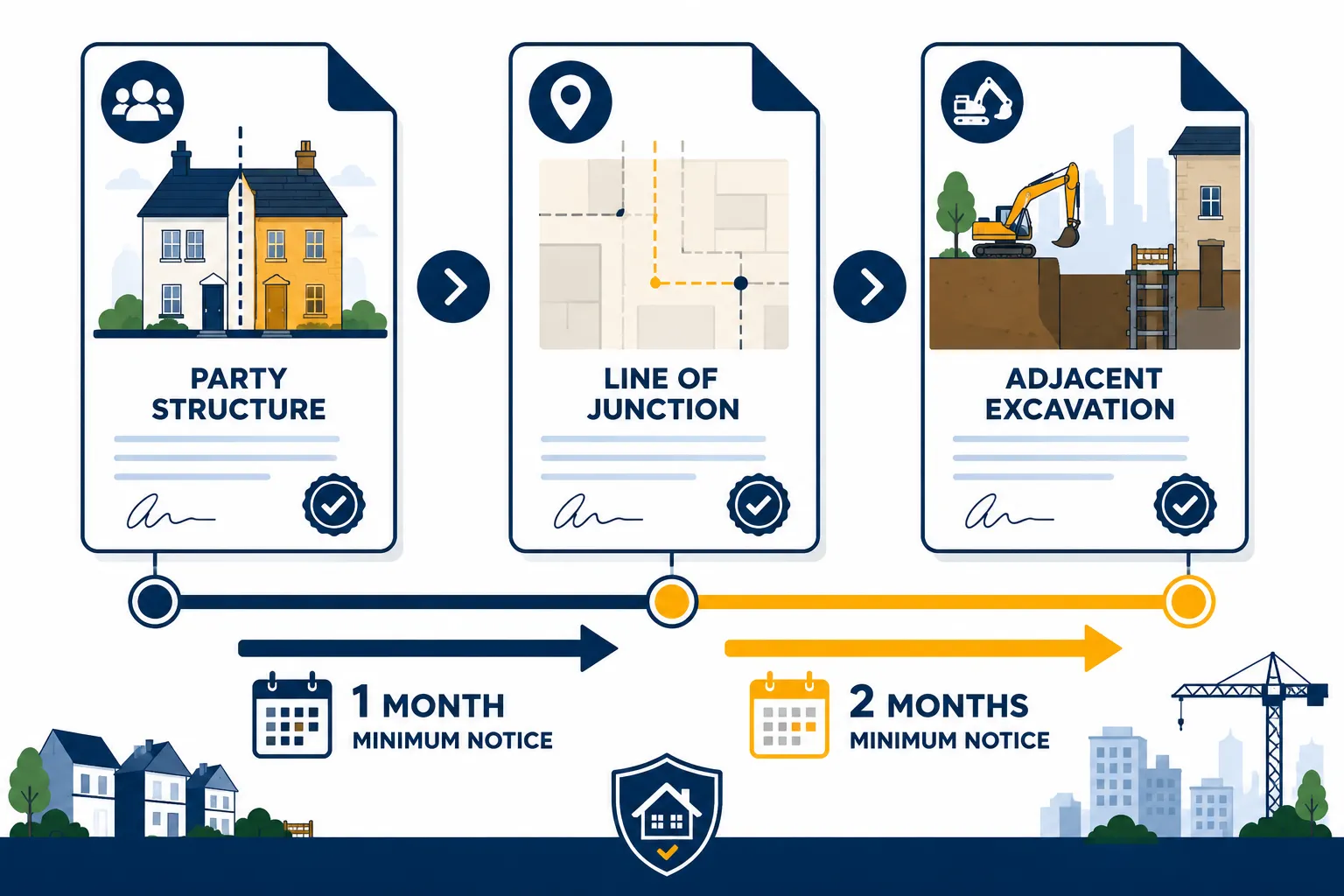
- Three notice types exist: Party Structure Notice (2-month notice), Line of Junction Notice (1-month notice), and Notice of Adjacent Excavation (1-month notice).
- Electronic service of notices has been legally valid since April 6, 2016, but only where the recipient has explicitly consented and provided an electronic address.
- A valid notice must include the building owner's name and address, a description of proposed works, and the intended start date.
- Adjoining owners have 14 days to respond; silence triggers a dispute under the Act.
- You do not legally need a surveyor to serve a notice, but professional involvement significantly reduces risk of errors and disputes.
- Ignoring the Act entirely can lead to injunctions halting your works, legal costs, and claims for damage.
- Digital workflow tools now allow notices, consents, and party wall awards to be managed and tracked electronically, saving time for all parties.
- Listed buildings and conservation areas carry additional considerations that affect the scope and timing of party wall procedures.
- Costs for party wall surveyor services in 2026 typically range from around £700 to £2,000 per surveyor, depending on complexity.
What Is a Party Wall Notice Under the 1996 Act?
A party wall notice is a statutory written document served by a building owner on an adjoining owner before undertaking works covered by the Party Wall etc. Act 1996. The Act applies in England and Wales and covers three categories of work: works to an existing party wall or structure, new building at or astride the boundary line, and excavations within 3 or 6 metres of an adjoining building (depending on depth).
The notice formally informs your neighbour of what you plan to do, when you plan to start, and gives them the opportunity to consent or dissent. It is not a planning permission and does not replace Building Regulations approval. It is a standalone legal process that runs alongside those procedures.
Who must serve a notice? Any building owner who intends to carry out notifiable works. This includes homeowners extending their property, landlords undertaking structural works, and developers building near shared boundaries.
For a broader overview of how the Act works in practice, the complete guide to party wall services covers the full scope of obligations and professional support available.
The Three Types of Party Wall Notices and Their Deadlines
There are three distinct notice types under the Act, each with different triggers and notice periods. Serving the wrong type is one of the most common errors building owners make.
| Notice Type | When It Applies | Minimum Notice Period |
|---|---|---|
| Party Structure Notice | Works to an existing party wall (cutting in, underpinning, raising) | 2 months |
| Line of Junction Notice | New wall built at or astride the boundary | 1 month |
| Notice of Adjacent Excavation | Excavation within 3m or 6m of adjoining structure | 1 month |
Party Structure Notice is the most commonly served notice. It applies whenever you intend to cut into, underpin, raise, or otherwise alter a shared wall. A rear extension that involves opening up a party wall to insert a steel beam, for example, requires this notice at least two months before work starts.
Line of Junction Notice applies when you are building a new wall right on the boundary line or astride it. This is common in infill developments and side-return extensions where a new boundary wall is constructed.
Notice of Adjacent Excavation applies to foundations or other excavations near an adjoining building. The 3-metre rule applies where excavation goes deeper than the adjoining building's foundations; the 6-metre rule applies where excavation would undercut a 45-degree line drawn from the bottom of those foundations.
A notice expires if work does not begin within 12 months of service, so timing matters in both directions.
How Do You Serve Party Wall Notices Digitally in 2026?
Since April 6, 2016, the Party Wall etc. Act 1996 has permitted electronic transmission of notices and documents. This means email service is legally valid, but only under specific conditions.
For electronic service to be valid:
- The recipient (adjoining owner) must have explicitly consented to receiving notices electronically.
- The recipient must have provided a specific electronic address for this purpose.
- The notice must be sent to that agreed address.
In 2026's digital workflow environment, most party wall surveyors use dedicated practice management platforms to track notice service, record consents, store acknowledgements, and manage deadlines. Some firms use document management systems that generate time-stamped delivery records, which are valuable if a dispute arises later about whether or when a notice was served.
Practical steps for digital service:
- Confirm the adjoining owner's consent to electronic service in writing before sending any notice.
- Record the electronic address they have provided.
- Send the notice to that address and retain a delivery or read receipt.
- Keep a timestamped copy of the sent notice in your project file.
Traditional methods remain fully valid. Notices can be delivered in person, sent by post, or, where the owner's name is unknown, addressed to "The Owner" and fixed conspicuously to the premises. Many surveyors use a hybrid approach: email for speed, followed by a posted copy for certainty.
Do You Need a Surveyor to Serve Party Wall Notices?
No, the law does not require you to appoint a surveyor to serve a party wall notice. A building owner can draft and serve a notice themselves. However, there are clear reasons why professional involvement reduces risk.
Reasons to use a surveyor:
- Notices must contain specific mandatory information. An invalid notice has no legal effect and restarts the clock.
- Identifying which notice type applies, and to which adjoining owners, requires knowledge of the Act's scope.
- If the adjoining owner dissents, a surveyor must be appointed anyway to draw up a party wall award.
- A surveyor can prepare a schedule of condition before works begin, protecting both parties from disputed damage claims.
Choose a DIY approach if: the works are straightforward, you have confirmed the correct notice type, the adjoining owner is cooperative, and you are confident completing the mandatory information correctly.
Appoint a surveyor if: the works are complex (underpinning, basement excavation, structural alterations), the adjoining owner is likely to dissent, or the property is listed or in a conservation area.
For guidance on whether professional support is needed in your specific situation, see do you need a party wall surveyor?
Party Wall Notice vs Party Wall Award: What Is the Difference?
A party wall notice and a party wall award are two distinct stages of the same legal process. Confusing them is a common mistake.
A party wall notice is the starting point: it informs the adjoining owner of proposed works. A party wall award (also called a party wall agreement) is the legally binding document produced by appointed surveyors after the adjoining owner dissents to the notice. The award sets out the scope of permitted works, the method of working, hours of operation, and provisions for making good any damage.
If the adjoining owner consents in writing to the notice within 14 days, no award is needed and work can proceed. If they do not respond within 14 days, a dispute is deemed to have arisen under the Act, and surveyors must be appointed.
The party wall award process involves one or two surveyors (or an agreed surveyor appointed by both parties) producing a formal document that is legally enforceable. It protects both the building owner and the adjoining owner.
Can You Email Party Wall Notices, or Does It Have to Be Physical?
Email service is legally valid under the Party Wall etc. Act 1996, but only with prior written consent from the recipient. Without that consent, an emailed notice has no legal standing.
The rule in plain terms:
- With consent and a specified email address: email is valid.
- Without consent: post or personal delivery is required.
This distinction matters in 2026 because many building owners assume that emailing a notice is always acceptable. It is not. If you email a notice without first obtaining the adjoining owner's consent to electronic service, you may find yourself in a position where the notice is challenged as invalid, the clock restarts, and your project is delayed.
One practical approach is to include a short consent request alongside initial project communications: "Do you consent to receiving party wall notices by email? If so, please confirm your preferred email address." Keep that reply on file.
What Happens If You Don't Serve Party Wall Notices Properly?
Failing to serve valid party wall notices, or starting work without serving them at all, carries real legal and financial consequences. The consequences of ignoring the Party Wall Act are well established in case law and are not merely theoretical.
Potential outcomes of non-compliance:
- Injunction: An adjoining owner can apply to the courts to stop works immediately. Courts have granted injunctions even where works are substantially complete.
- Legal costs: You may be ordered to pay the adjoining owner's legal costs.
- Damage claims: Without a pre-works schedule of condition, you have no baseline to dispute claims that your works caused damage.
- Retrospective awards: While surveyors can sometimes produce retrospective awards, this is costly, time-consuming, and not guaranteed to resolve the dispute.
The safest position is always to serve notices before works begin, allow the statutory notice periods to expire, and proceed only once consent is given or a party wall award is in place.

Party Wall Notice Cost and Surveyor Fees in 2026
Serving a party wall notice itself carries no statutory fee. The cost arises when a surveyor is appointed. In 2026, typical costs for party wall surveyor services in England are as follows (these are estimates based on commonly reported market rates and will vary by location and complexity):
- Notice preparation and service by a surveyor: approximately £200 to £500.
- Party wall award (single surveyor): approximately £700 to £1,200.
- Party wall award (two surveyors): approximately £1,500 to £3,000 in total, split between the building owner and adjoining owner.
- Schedule of condition: approximately £300 to £600.
The building owner typically pays the adjoining owner's surveyor's reasonable fees. For a detailed breakdown, see the cost of party wall agreement guide and the party wall surveyor cost overview.
Costs rise significantly for complex works such as basement excavations, underpinning, or where multiple adjoining owners are affected.
Who Needs to Receive Party Wall Notices on My Property?
Every adjoining owner with a legal interest in the affected property must receive a notice. This is broader than many building owners expect.
Who counts as an "adjoining owner":
- The freehold owner of the neighbouring property.
- Any long leaseholder (a lease of more than one year remaining).
- Mortgagees are not required to receive notices, but tenants with long leases are.
If a neighbouring property has both a freeholder and a long leaseholder, both must receive separate notices. Serving only one is not sufficient.
Common mistake: Building owners often serve notice only on the person they know as their neighbour, without checking whether the property is leasehold. A quick Land Registry search before serving notices confirms the correct parties.
Party Wall Notice for Extensions vs Loft Conversions
The type of works determines which notice applies, and extensions and loft conversions often trigger different notice requirements.
Rear or side extensions typically involve:
- A Party Structure Notice where an existing party wall is altered (e.g., a steel beam inserted through a party wall).
- A Line of Junction Notice if a new boundary wall is constructed.
- A Notice of Adjacent Excavation if new foundations are dug within 3 or 6 metres of the neighbour's structure.
Loft conversions may or may not trigger the Act. If the loft conversion involves raising the party wall, inserting beams into the party wall, or cutting into it for any reason, a Party Structure Notice is required. If the loft conversion is entirely within your own roof space and does not affect the party wall at all, no notice may be needed.
For a detailed treatment of this question, see do you require party wall agreements for lofts?
Common Mistakes When Serving Party Wall Notices
Even experienced building owners make procedural errors that invalidate notices or trigger unnecessary disputes.
The most frequent mistakes:
- Wrong notice type: Serving a Line of Junction Notice when a Party Structure Notice is required, or vice versa.
- Insufficient notice period: Starting works before the statutory period expires.
- Missing mandatory information: Omitting the intended start date, the building owner's address, or an adequate description of works.
- Serving only one adjoining owner: Where multiple parties hold a legal interest, all must be served.
- Assuming email is always valid: Sending an electronic notice without prior written consent from the recipient.
- Not keeping proof of service: Failing to retain delivery receipts, signed acknowledgements, or postal proof of postage.
For a broader look at misunderstandings around this process, the article on common misconceptions about party wall agreements is worth reading before you begin.
How Long Does the Party Wall Notice Process Take?
The minimum timeline from serving a notice to starting work depends on the notice type and the adjoining owner's response.
Minimum timelines:
- Party Structure Notice: 2 months from valid service (if consent is given promptly).
- Line of Junction Notice: 1 month from valid service.
- Notice of Adjacent Excavation: 1 month from valid service.
If the adjoining owner dissents, the process extends. Surveyors must be appointed, a schedule of condition prepared, and a party wall award drawn up and served. This typically adds 4 to 8 weeks, though complex cases can take longer.
Total realistic timeline for a straightforward extension with dissent: 3 to 4 months from first serving notice to being able to start notifiable works.
Building owners who factor this into their project programme avoid costly delays. Serving notices at the earliest possible stage, ideally when planning permission is applied for, is the most effective way to keep projects on schedule.
Digital Workflow Tools for Managing Party Wall Notices in 2026
The shift to digital workflows has changed how party wall surveyors manage the notice process. In 2026, several practice management platforms support end-to-end digital handling of party wall matters.
What a good digital workflow covers:
- Automated notice drafting from project data inputs.
- Electronic service with consent tracking and delivery confirmation.
- Deadline management with automated reminders for response periods.
- Secure document storage for notices, consents, awards, and schedules of condition.
- Audit trails that record every action with timestamps.
For building owners and property professionals, the practical benefit is speed and certainty. A notice served electronically with a confirmed delivery receipt and stored in a cloud-based system is far easier to defend in a dispute than a notice served informally with no paper trail.
The evergreen essentials of serving party wall notices under the 1996 Act have not changed, but the tools available to manage that process efficiently have improved considerably. The legal requirements remain constant; the workflow around them has become faster and more transparent.
Party Wall Notice Requirements for Listed Buildings and Conservation Areas
Listed buildings and properties within conservation areas require additional care when planning party wall works. The Act itself does not distinguish between listed and unlisted buildings, so the same notice obligations apply. However, the scope of permitted works is narrower.
Works to a listed building require Listed Building Consent from the local planning authority, which is separate from and in addition to party wall procedures. Where a party wall is part of a listed structure, any alteration, even minor cutting or drilling, may require consent.
In conservation areas, permitted development rights are often restricted, meaning that works which would ordinarily not need planning permission may require a formal application. This affects the timeline and scope of any party wall notice served.
Practical guidance: If either your property or the adjoining property is listed, obtain specialist advice before serving any party wall notice. The intersection of listed building law and party wall law is an area where errors are costly. For background on what these designations mean, see what are listed buildings and conservation areas?
Frequently Asked Questions
Q: Can I serve a party wall notice on a neighbour I have never met?
Yes. The Act requires service on the adjoining owner, not a personal relationship. You can serve by post to the property address, deliver in person, or, if the owner's name is unknown, address the notice to "The Owner" and fix it to the premises. A Land Registry search will confirm the legal owner's name and correspondence address.
Q: What if my neighbour ignores the party wall notice?
If an adjoining owner does not respond within 14 days of receiving a valid notice, a dispute is deemed to have arisen under the Act. Both parties must then appoint surveyors (or agree on a single agreed surveyor) to produce a party wall award. Silence is not consent.
Q: Is a party wall agreement the same as a party wall award?
In everyday usage the terms are often used interchangeably, but technically a party wall award is the formal legal document produced by appointed surveyors. It is sometimes called a party wall agreement in common speech. The notice is the starting document; the award is the binding outcome when consent is not given.
Q: Can I start work before the notice period expires if my neighbour says they are happy verbally?
No. Verbal agreement has no legal standing under the Act. You need written consent from the adjoining owner within the notice period, or a party wall award in place. Starting work early on the basis of a verbal agreement leaves you exposed.
Q: Does the Party Wall Act apply to detached houses?
The Act applies where works affect a party wall, party fence wall, or involve excavations near an adjoining structure. A detached house with no shared walls may still trigger the Act if excavations for new foundations come within 3 or 6 metres of a neighbouring building's foundations.
Q: How do I know if my surveyor is qualified to handle party wall matters?
Look for membership of the Faculty of Party Wall Surveyors (FPWS) or a chartered surveyor (MRICS or FRICS) with demonstrable party wall experience. The top questions about party wall surveys guide covers what to ask when appointing a surveyor.
Conclusion
The evergreen essentials of serving party wall notices under the 1996 Act remain unchanged: serve the correct notice type, include all mandatory information, allow the statutory notice period to expire, and keep proof of service. What has changed in 2026's digital workflow era is the efficiency and transparency with which those steps can be completed. Electronic service, cloud-based document management, and automated deadline tracking have reduced the administrative burden without altering the legal framework.
Actionable next steps:
- Identify whether your proposed works trigger the Act before applying for planning permission, so notice periods can run concurrently.
- Carry out a Land Registry search to confirm all adjoining owners who must receive notices.
- Determine the correct notice type and calculate the minimum notice period for your works.
- Obtain written consent from adjoining owners before serving any notice electronically.
- Appoint a qualified party wall surveyor if works are complex, if the adjoining property is listed, or if dissent is anticipated.
- Retain timestamped proof of every notice served and every response received.
Getting this right at the outset protects your project timeline, your legal position, and your relationship with your neighbours.
.pw-calc{font-family:Arial,sans-serif;max-width:480px;margin:2rem auto;padding:1.5rem;border:2px solid #1a3c6e;border-radius:8px;background:#f8fafd}
.pw-calc h3{margin:0 0 1rem;color:#1a3c6e;font-size:1.1rem}
.pw-calc label{display:block;font-size:.9rem;color:#333;margin-bottom:.3rem;font-weight:600}
.pw-calc select,.pw-calc input{width:100%;padding:.5rem;border:1px solid #ccc;border-radius:4px;font-size:.95rem;box-sizing:border-box;margin-bottom:1rem}
.pw-calc button{width:100%;padding:.65rem;background:#1a3c6e;color:#fff;border:none;border-radius:4px;font-size:1rem;cursor:pointer}
.pw-calc button:hover{background:#2a5298}
.pw-result{margin-top:1rem;padding:1rem;background:#e8f0fe;border-radius:4px;font-size:.95rem;color:#1a3c6e;display:none}
.pw-result strong{display:block;font-size:1.05rem;margin-bottom:.3rem}
Party Wall Notice Deadline Calculator
function calcDeadline(){
var t=document.getElementById(‘pw-type’).value;
var d=document.getElementById(‘pw-date’).value;
if(!d){alert(‘Please select a service date.’);return;}
var base=new Date(d);
var months=(t===’2′)?2:1;
var result=new Date(base);
result.setMonth(result.getMonth()+months);
var opts={day:’numeric’,month:’long’,year:’numeric’};
var label=result.toLocaleDateString(‘en-GB’,opts);
document.getElementById(‘pw-result-date’).textContent=’Earliest start date: ‘+label;
document.getElementById(‘pw-result-note’).textContent=’Works must not begin before this date. If the adjoining owner dissents, a party wall award must also be in place before starting.’;
document.getElementById(‘pw-result’).style.display=’block’;
}
Tags: party wall notice, Party Wall Act 1996, party wall surveyor, party wall award, serving party wall notices, digital party wall service, party wall notice deadlines, party wall costs, adjoining owner, party wall extension, loft conversion party wall, listed buildings party wall