

Last updated: July 24, 2026
Quick Answer: Cross-boundary expert witness roles combine party wall surveying and building valuation expertise into a single, unified service for neighbor disputes. When a qualified chartered surveyor holds both competencies, they can assess structural damage, establish causation under the Party Wall etc. Act 1996, and quantify the resulting property value loss, all within one report. This integrated approach reduces cost, speeds up resolution, and produces more coherent evidence for courts or alternative dispute resolution.
Key Takeaways
- A cross-boundary expert witness handles both physical party wall issues and the financial impact on property value, covering the full scope of a neighbor dispute in one instruction.
- Separate experts for structural damage and valuation are common but can create contradictory evidence, a dual-qualified expert avoids this risk.
- Qualifications to look for include RICS membership, experience under the Party Wall etc. Act 1996, and a demonstrable track record as a single joint expert or court-appointed witness.
- Expert witness costs for neighbor disputes typically range from £1,500 to £5,000 or more depending on complexity, but a single cross-boundary expert is almost always cheaper than instructing two specialists.
- RICS conflict-of-interest rules apply strictly when one expert advises on both valuation and party wall matters for different parties, informed consent and information barriers are mandatory.
- Mediation should be attempted before litigation in most cases, but an expert witness report is often needed to give mediation any real traction.
- Expert reports must be admissible, impartial, and compliant with Civil Procedure Rules Part 35 to be accepted by a court.
- A schedule of condition prepared before works begin is the single most important document in any party wall dispute involving alleged damage.
What Is a Party Wall Expert Witness and What Do They Do?
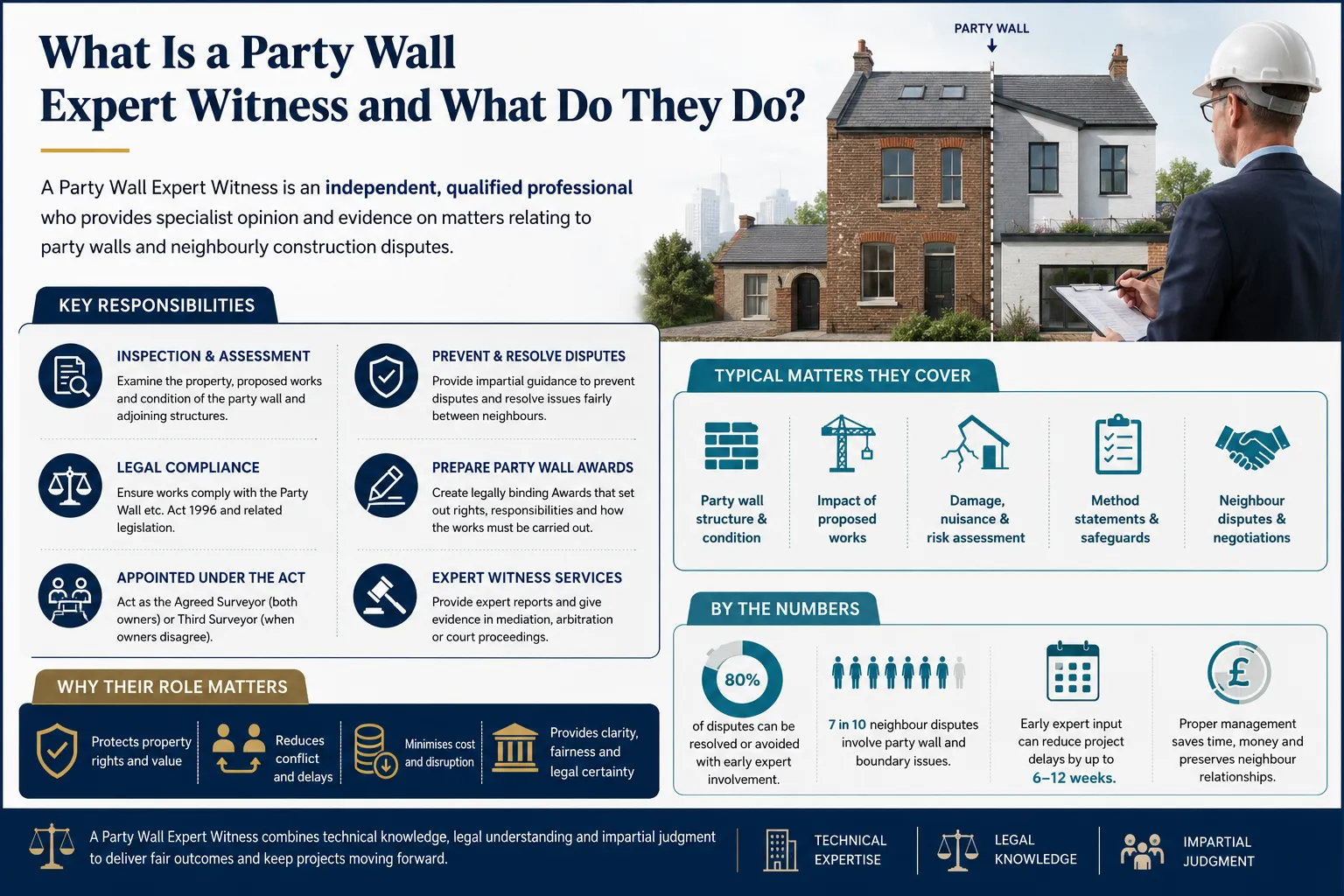
A party wall expert witness is a qualified surveyor instructed to provide independent, impartial evidence on matters arising under the Party Wall etc. Act 1996. Their role is to assess disputed facts, such as whether building works caused structural damage to a neighbor's property, and present findings in a written report that courts and dispute resolution bodies can rely upon.
In practice, their work covers:
- Inspecting the party wall, boundary structure, or excavation site
- Reviewing the party wall award and any pre-works schedule of condition
- Establishing whether alleged damage existed before or after the notifiable works
- Quantifying the cost of reinstatement
- Advising on causation, the critical legal question of whether the works actually caused the damage
A strong expert witness also advises early on whether litigation or alternative dispute resolution (ADR) is the more proportionate route. Experienced practitioners with over two decades in construction and neighbourly matters regularly act as single joint experts, appointed by both parties together, which courts actively encourage to reduce costs and adversarial friction.
For a broader overview of how party wall disputes arise and escalate, see this guide to party wall disputes.
How Does Building Valuation Affect Neighbor Disputes?
Building valuation directly affects neighbor disputes because financial loss, not just physical damage, is often what a claimant is trying to recover. A cracked wall or damaged foundation is a structural problem, but the legal remedy frequently involves money, and that requires a credible valuation of the impact on the property.
Valuation matters in neighbor disputes in three specific ways:
- Diminution in value: If works have permanently reduced a property's market value, the affected owner may claim the difference. This requires a before-and-after valuation from a qualified valuer.
- Cost of reinstatement vs. market value: Courts sometimes need to decide whether it is proportionate to reinstate damage fully or compensate at market value. A valuer helps resolve this.
- Insurance and mortgage implications: Lenders and insurers may require a formal valuation following structural damage, and this can form part of the evidence bundle in a dispute.
Understanding what surveyors look for during a property valuation is useful context for any homeowner entering a dispute where financial loss is claimed.
Can One Expert Witness Handle Both Party Wall and Valuation Issues?
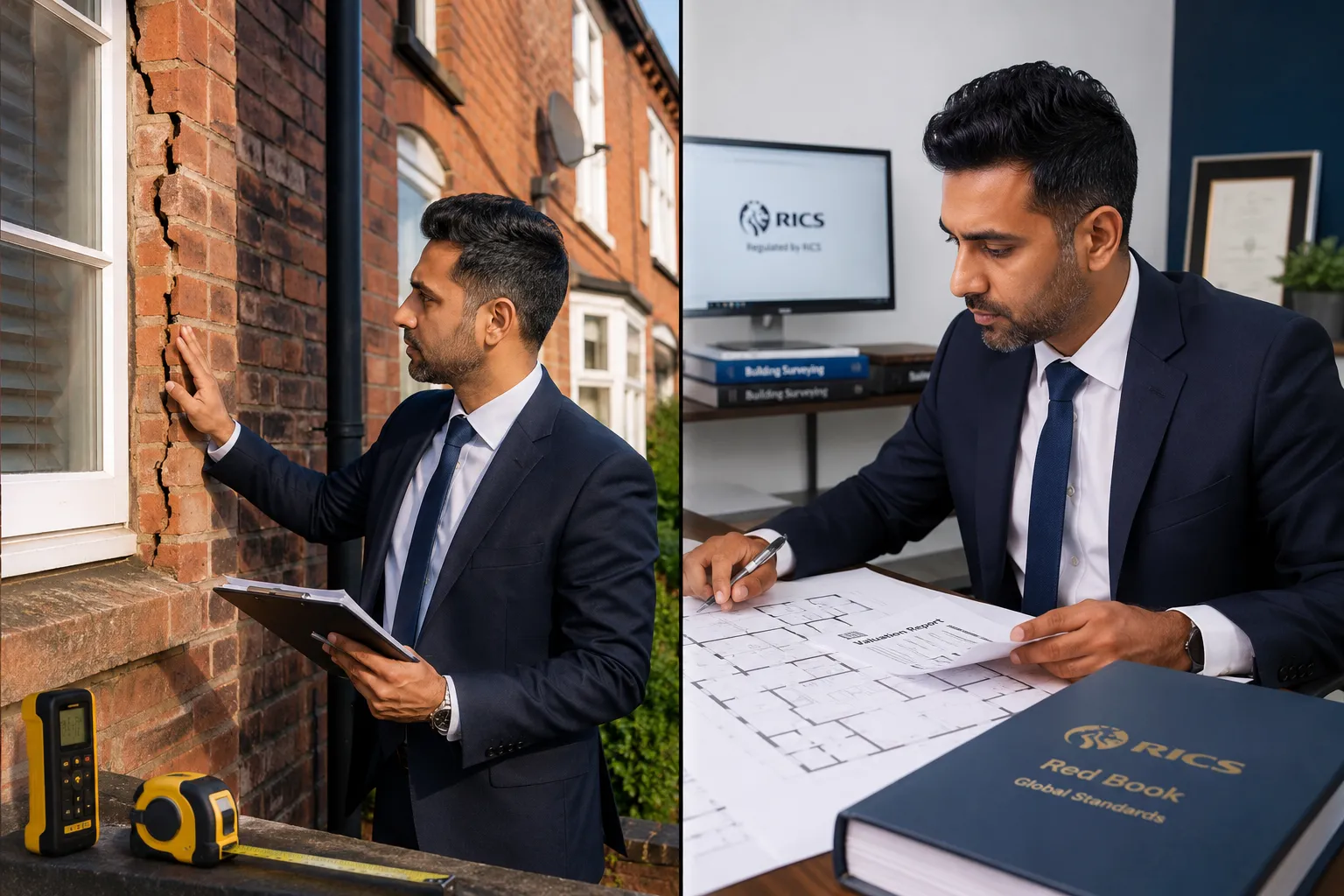
Yes, and in many cases, it produces better outcomes. A chartered surveyor with dual competency in party wall matters and building valuation can assess the physical damage, establish causation, and quantify the financial impact within a single, coherent report. This eliminates the risk of two experts producing conflicting evidence on the same property.
The key requirement is that the expert genuinely holds both competencies. Look for:
- RICS membership (MRICS or FRICS)
- Demonstrable party wall experience, including drafting party wall awards
- Formal valuation qualifications or a track record of valuation work accepted by courts
- Experience acting as a single joint expert or expert witness in litigation
Common mistake: Some instructing solicitors default to appointing a structural engineer for damage and a separate valuer for financial loss. While this can work, it creates a coordination burden and increases the risk of inconsistent conclusions. A cross-boundary expert witness who combines building valuation and party wall expertise in neighbor dispute settlements avoids this entirely.
One well-documented example of this profile in practice is a party wall surveyor who also holds qualifications as a chartered building engineer, adjudicator, and arbitrator, able to advise on both the technical and financial dimensions of a dispute, and to recommend whether litigation or ADR is preferable before costs escalate.
For professional expert witness report services that cover both dimensions, verify the surveyor's full scope of competency before instructing.
What Qualifications Do You Need to Be a Cross-Boundary Expert Witness?
There is no single statutory qualification for expert witnesses in England and Wales, but courts expect a high standard of relevant expertise, impartiality, and procedural compliance. For cross-boundary expert witness roles combining building valuation and party wall expertise in neighbor dispute settlements, the expected profile includes:
| Qualification / Experience | Why It Matters |
|---|---|
| RICS membership (MRICS/FRICS) | Establishes professional credibility and regulatory accountability |
| Party Wall etc. Act 1996 experience | Required to interpret awards, notices, and causation arguments |
| RICS Valuation, Professional Standards compliance | Ensures valuation evidence meets court and lender standards |
| Civil Procedure Rules Part 35 familiarity | Expert reports must comply with CPR 35 to be admissible |
| Single joint expert experience | Courts prefer SJEs; prior experience signals impartiality |
| ADR / adjudication credentials | Enables early, cost-effective resolution before litigation |
Practitioners who also hold adjudicator or arbitrator status, such as membership of the Chartered Institute of Arbitrators, bring additional value because they understand both sides of the dispute resolution process.
How Much Does an Expert Witness Cost for Neighbor Disputes?
Expert witness fees for neighbor disputes in the UK typically range from £1,500 to £5,000 for a written report, with hourly rates for court attendance or further instructions running from £150 to £400 per hour. These are estimates based on market norms, actual fees depend on property complexity, the volume of documentation to review, and whether the expert is instructed as a single joint expert or by one party alone.
A cross-boundary expert who covers both structural and valuation issues will almost always cost less than two separate specialists. The saving comes from:
- A single site inspection covering both physical and financial assessment
- One report rather than two separate documents
- Reduced solicitor time coordinating between experts
For context on typical surveyor costs, the guide to party wall surveyor costs provides useful benchmarks for the party wall element of any instruction.
Who pays? In party wall disputes, the building owner (the party carrying out works) generally bears the surveyor's reasonable costs. In litigation, costs may be awarded by the court.
What Is the Difference Between a Surveyor and a Building Valuator in Party Wall Cases?
In party wall cases, a surveyor's primary role is to administer the statutory process, serving notices, drafting the party wall award, and resolving disputes about the works themselves. A building valuator (or valuation surveyor) focuses specifically on the monetary worth of the property and any financial loss caused by the works.
In practice, many chartered surveyors hold both competencies, but the distinction matters when instructing an expert:
- Party wall surveyor role: Determines whether works comply with the Act, assesses physical damage, and resolves disputes about reinstatement.
- Valuation role: Quantifies diminution in market value, advises on reinstatement cost versus market value, and produces RICS-compliant valuation evidence.
For a dispute where a neighbor claims both structural damage and a drop in their property's sale value, both functions are needed. A single expert covering both is the most efficient solution.
The agreed surveyor approach, where both parties appoint one surveyor, is a related concept that also reduces duplication, though it applies specifically to the party wall award process rather than expert witness work.
How Do You Resolve Neighbor Disputes Involving Shared Walls and Property Damage?
Resolving neighbor disputes involving shared walls and property damage follows a structured process. The Party Wall etc. Act 1996 provides the legal framework, but resolution typically involves several parallel tracks: statutory dispute resolution, negotiation, and, where those fail, litigation or formal ADR.
Step-by-step resolution process:
- Serve or respond to a party wall notice, the building owner must notify affected neighbors before starting notifiable works.
- Commission a schedule of condition, a photographic and written record of the property's condition before works begin. This is the most important protective document in any subsequent dispute.
- Appoint surveyors, both parties appoint surveyors (or agree on one) to draw up a party wall award.
- Document alleged damage, if damage occurs, report it promptly and in writing. Photographs, dates, and descriptions matter.
- Instruct an expert witness, if the dispute cannot be resolved between surveyors, a cross-boundary expert witness who combines building valuation and party wall expertise can provide independent evidence.
- Attempt mediation or ADR, before issuing court proceedings, most courts expect parties to have genuinely tried to resolve the dispute.
- Issue proceedings if necessary, County Court or the First-tier Tribunal (Property Chamber) depending on the nature of the claim.
A party wall schedule of condition completed before works start is the single most effective way to prevent disputes from becoming expensive.
When Should You Hire an Expert Witness vs. Trying Mediation First?
Mediation should generally come before expert witness instruction, but an expert report often makes mediation more effective. Without objective evidence, mediation can stall because both parties simply repeat their own version of events.
Hire an expert witness first if:
- The dispute involves technical questions (causation, structural damage extent) that neither party can resolve without professional evidence
- One party has already issued or threatened court proceedings
- The financial value of the claim exceeds roughly £10,000, making a proportionate investment in expert evidence worthwhile
- There is a significant dispute about whether damage pre-existed the works
Try mediation first if:
- The dispute is primarily about communication breakdown rather than technical facts
- Both parties are willing to negotiate and the financial gap is small
- A schedule of condition already exists and clearly resolves the factual dispute
A practical middle ground: commission a brief preliminary report from a cross-boundary expert, use it to anchor the mediation, and only proceed to full litigation if mediation fails.
What Mistakes Do People Make Hiring Expert Witnesses for Property Disputes?
The most common mistake is hiring an expert who is technically competent but has no experience preparing CPR Part 35-compliant reports for court. A report that does not meet procedural requirements may be inadmissible, wasting both time and money.
Other frequent errors:
- Instructing a partisan expert rather than someone genuinely impartial. Courts treat partisan expert evidence with scepticism, and it can damage a case.
- Waiting too long to instruct an expert. Evidence degrades, cracks get repaired, witnesses forget details, and schedules of condition become less useful over time.
- Failing to check for conflicts of interest. RICS rules require that a valuer or surveyor acting for multiple parties on the same property must secure informed consent and assess whether information barriers are genuinely effective. Where they are not, the expert must decline the instruction.
- Appointing separate structural and valuation experts without coordinating them. Contradictory expert evidence is one of the most avoidable and damaging outcomes in property litigation.
- Ignoring the consequences of ignoring the Party Wall Act, proceeding without proper notices removes many of the statutory protections that make disputes easier to resolve.
Are Expert Witness Reports Admissible in Small Claims Court for Neighbor Disputes?
Expert witness reports can be used in small claims proceedings, but the rules are more restrictive than in multi-track litigation. In the small claims track (claims up to £10,000), the court has discretion to limit or exclude expert evidence to control costs. Permission from the court is required before expert evidence can be relied upon.
In practice:
- For claims under £10,000, a brief, focused report addressing the specific technical question (e.g., whether a crack was caused by the neighbor's works) is more likely to be permitted than a lengthy valuation report.
- For claims above £10,000 allocated to the fast or multi-track, full CPR Part 35-compliant expert evidence is standard.
- A single joint expert report is almost always preferred by courts at all levels, it reduces cost and is treated as more impartial.
What Should Be Included in an Expert Witness Report for Boundary and Party Wall Disputes?
A compliant expert witness report for boundary or party wall disputes must meet Civil Procedure Rules Part 35 requirements and should include:
- Expert's qualifications and experience, establishing authority to give the opinion
- Instructions received, a summary of what the expert was asked to assess
- Documents reviewed, party wall notices, awards, schedules of condition, photographs, correspondence
- Site inspection findings, dated, detailed, with photographic evidence
- Causation analysis, a reasoned conclusion on whether the works caused the alleged damage
- Valuation evidence (where relevant), RICS-compliant assessment of diminution in value or reinstatement cost
- Statement of truth, the expert must confirm the report is their independent, honest opinion
- Declaration of conflicts, any relationship with either party must be disclosed
The report must be addressed to the court, not to the instructing party. An expert's overriding duty is to the court, not to whoever is paying the fee.
How Long Does It Take to Get an Expert Witness Report for a Party Wall Claim?
A standard expert witness report for a party wall claim takes between two and six weeks from instruction to delivery, depending on the complexity of the case and the expert's availability. More complex cases involving both structural damage and valuation, the kind handled by a cross-boundary expert, may take six to ten weeks if multiple site visits or extensive document review are required.
Factors that extend the timeline:
- Large volumes of correspondence and prior survey reports to review
- Disputed access to the property for inspection
- Need for specialist sub-reports (e.g., structural engineering input on foundation damage)
- Court deadlines requiring a concurrent valuation report
Instructing early, before positions harden and evidence degrades, consistently produces faster, more reliable reports.
For related context on building survey timeframes, the principles of scoping and scheduling a complex property assessment apply equally to expert witness work.
What Happens If Expert Witnesses Disagree on Building Valuation?
When two party-appointed experts disagree on building valuation, courts require them to produce a joint statement identifying the areas of agreement and disagreement. This process, known as a "without prejudice" experts' meeting, often narrows the gap significantly before trial.
If disagreement persists:
- The judge will weigh both reports and may prefer one over the other based on methodology, reasoning, and the expert's credibility under cross-examination.
- A court may appoint its own expert in rare cases where both party-appointed reports are found inadequate.
- Where the disagreement is on valuation methodology rather than factual findings, RICS Red Book standards provide a reference framework that judges increasingly apply.
This is one of the strongest arguments for appointing a single joint expert from the outset. When one qualified professional assesses both the structural and valuation dimensions, there is no opposing report to contradict.
.cg-ew-wrap{font-family:Arial,sans-serif;max-width:480px;margin:2em auto;background:#f7f9fc;border:1px solid #d0d8e4;border-radius:8px;padding:24px 28px;box-sizing:border-box}
.cg-ew-wrap h3{margin:0 0 16px;font-size:1.1rem;color:#1a2e4a}
.cg-ew-wrap label{display:block;font-size:.88rem;color:#3a4a5c;margin:12px 0 4px;font-weight:600}
.cg-ew-wrap select,.cg-ew-wrap input[type=range]{width:100%;box-sizing:border-box}
.cg-ew-wrap select{padding:7px 10px;border:1px solid #b0bcc8;border-radius:5px;font-size:.9rem;background:#fff}
.cg-ew-wrap .cg-range-row{display:flex;justify-content:space-between;font-size:.8rem;color:#6a7a8c;margin-top:2px}
.cg-ew-result{margin-top:20px;background:#1a2e4a;color:#fff;border-radius:6px;padding:14px 18px;text-align:center}
.cg-ew-result .cg-cost{font-size:1.5rem;font-weight:700;color:#f0c040}
.cg-ew-result .cg-note{font-size:.78rem;color:#c8d8e8;margin-top:6px}
.cg-ew-btn{display:block;width:100%;margin-top:16px;padding:10px;background:#2a6ebb;color:#fff;border:none;border-radius:5px;font-size:.95rem;cursor:pointer;font-weight:600}
.cg-ew-btn:hover{background:#1a5aa0}
Expert Witness Cost Estimator
function cgCalc(){
var t=document.getElementById(‘cg-type’).value;
var c=document.getElementById(‘cg-complexity’).value;
var r=document.getElementById(‘cg-role’).value;
var base={pw:[1500,2500],val:[1500,2800],both:[2000,3500]};
var mult={low:0.75,med:1,high:1.6};
var role={sje:0.85,party:1.1};
var lo=Math.round(base[t][0]*mult[c]*role[r]/100)*100;
var hi=Math.round(base[t][1]*mult[c]*role[r]/100)*100;
document.getElementById(‘cg-range’).textContent=’£’+lo.toLocaleString()+’, £’+hi.toLocaleString();
document.getElementById(‘cg-result’).style.display=’block’;
}
Frequently Asked Questions
What is the difference between a party wall surveyor and an expert witness?
A party wall surveyor administers the statutory process under the Party Wall etc. Act 1996, serving notices, drafting awards, and resolving procedural disputes. An expert witness provides independent, court-admissible evidence on specific disputed facts, such as causation or financial loss. The same person can hold both roles, but they are distinct functions with different duties.
Do I need a separate expert for structural damage and property value loss?
Not necessarily. A chartered surveyor with dual competency in party wall matters and building valuation can address both in a single report. Separate experts are sometimes instructed but increase cost and risk producing contradictory evidence. A single cross-boundary expert is generally the more efficient and coherent approach.
Can a neighbor refuse access for an expert witness inspection?
A neighbor can refuse access, but this has consequences. Under the Party Wall etc. Act 1996, surveyors have a right of access to inspect works and assess damage. Unreasonable refusal can be noted in the expert's report and may be taken into account by a court or adjudicator.
Is an expert witness report required before mediation?
No, mediation can proceed without one. However, a brief expert report often makes mediation more productive by establishing agreed facts about causation or damage extent. Without objective evidence, parties tend to repeat their own positions rather than negotiate toward a settlement.
What is a single joint expert and why do courts prefer them?
A single joint expert (SJE) is appointed by both parties together rather than by each side separately. Courts prefer SJEs because they reduce cost, avoid contradictory evidence, and are treated as more impartial. In neighbor disputes, an SJE covering both party wall and valuation issues is the most cost-effective and court-friendly option.
How do RICS conflict-of-interest rules affect a cross-boundary expert?
RICS rules require that any surveyor acting for multiple parties on the same property must obtain informed consent from all parties, assess whether an information barrier can genuinely prevent conflicts, and decline the instruction where confidential value-related information cannot be properly managed. This applies directly to experts combining valuation and party wall roles across a dispute, compliance is not optional.
Conclusion
Cross-boundary expert witness roles, combining building valuation and party wall expertise in neighbor dispute settlements, represent the most efficient and coherent approach to resolving the full spectrum of property boundary disputes. Rather than coordinating two separate specialists who may reach conflicting conclusions, a dual-qualified chartered surveyor can assess physical damage, establish causation, and quantify financial loss within a single, court-admissible report.
Actionable next steps for homeowners and property professionals:
- Before any notifiable works begin, commission a party wall schedule of condition, it is the most important protective document you can have.
- If a dispute arises, instruct an expert early, before evidence degrades and positions harden.
- Check that any expert you instruct holds both RICS party wall experience and formal valuation competency, and has a track record of CPR Part 35-compliant reporting.
- Ask whether a single joint expert appointment is appropriate, it saves money and carries more weight with courts.
- Attempt mediation, but use an expert report to anchor it rather than negotiating without objective evidence.
- Verify RICS conflict-of-interest compliance before instructing any expert who will advise on both structural and valuation matters across the same dispute.
For professional guidance on party wall matters, explore the full range of party wall services available from qualified chartered surveyors, or read more about what your party wall rights actually are before entering any dispute process.
Tags: expert witness, party wall, building valuation, neighbor disputes, chartered surveyor, party wall act, property damage claims, single joint expert, RICS, boundary disputes, expert witness report, property dispute resolution