

Nearly one in three UK homebuyers who skip a professional building survey later discover defects that cost more than £5,000 to repair, yet a significant number of those buyers had a report, just not one produced by a chartered surveyor. The distinction between a chartered surveyor vs non‑qualified surveyor is not a matter of professional snobbery; it is a question of legal accountability, insurance protection, and the quality of information on which a buyer stakes hundreds of thousands of pounds.
This article unpacks exactly what RICS accreditation means, how the qualification route differs from unregulated alternatives, and why the April 2026 update to the Home Survey Standard has made the gap between the two even more significant.
Key Takeaways
- Only RICS-accredited professionals are authorised to issue an RICS Home Survey report; non-qualified surveyors cannot produce this regulated document.
- Chartered surveyors complete a degree, structured workplace experience, and a rigorous Assessment of Professional Competence (APC) before earning MRICS or FRICS status.
- The RICS Home Survey Standard (2nd edition, updated April 2026) sets a single benchmark for all condition-based home surveys and strengthens consumer-protection language.
- RICS operates a transparent disciplinary and regulatory framework, including published sanctions, giving consumers a formal complaints route that non-qualified surveyors cannot offer.
- Verifying RICS status, local experience, and professional indemnity (PI) insurance are the three non-negotiable checks before instructing any surveyor in 2026.
What "Chartered Surveyor" Actually Means
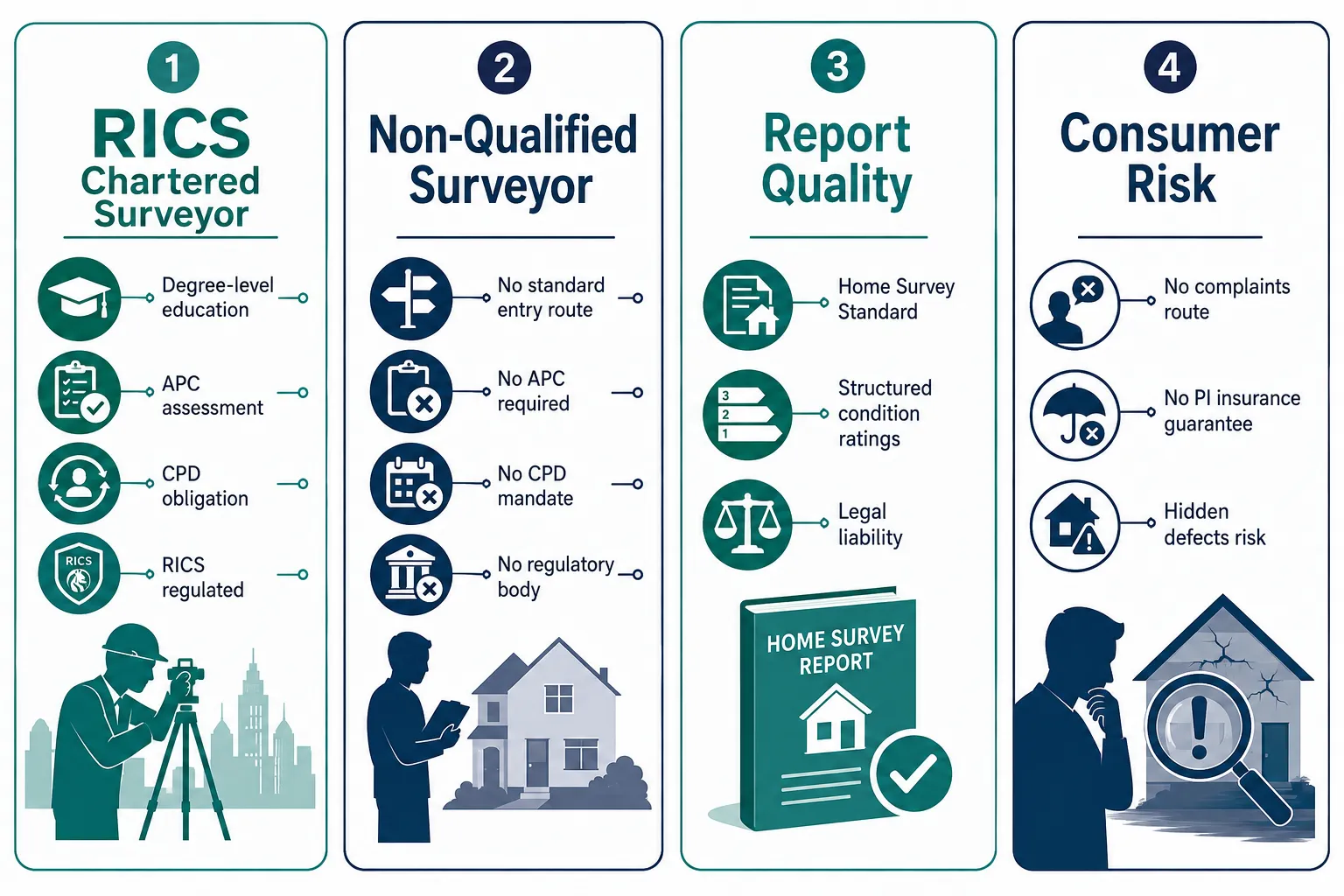
The title "chartered surveyor" is not self-awarded. It is conferred by the Royal Institution of Chartered Surveyors (RICS) only after a candidate satisfies a multi-stage qualification pathway. Understanding that pathway is the clearest way to appreciate what separates a chartered surveyor vs non‑qualified surveyor when it comes to your UK building survey.
The RICS Qualification Pathway
The route to MRICS (Member of RICS) or FRICS (Fellow of RICS) status involves three distinct stages:
- Academic foundation, a RICS-accredited degree or conversion programme covering construction technology, law, valuation, and professional ethics.
- Structured experience, a minimum period of supervised, documented workplace experience across defined competency areas relevant to the chosen pathway (e.g., building surveying).
- Assessment of Professional Competence (APC), a formal submission and final assessment interview in which candidates demonstrate they have met every required competency at the correct level. Failure at APC means the title cannot be used.
Once qualified, chartered surveyors must complete Continuing Professional Development (CPD) each year and comply with RICS Rules of Conduct. Those rules cover honesty, competence, service quality, and the handling of complaints.
Non-qualified surveyors face none of these requirements. There is no standard entry route, no competency assessment, and no mandatory CPD. The word "surveyor" is not a protected title in UK law, meaning anyone can use it regardless of training.
For more on how the profession is evolving, see Chartered Surveyor Training Pathways For 2026 Homebuying Reforms.
Specialist RICS Accreditations
Beyond the core MRICS pathway, RICS also recognises specialist competencies relevant to building surveys. Surveyors working on historic or complex properties may hold additional accreditations that demonstrate deeper expertise in areas such as traditional construction methods, damp diagnosis, or structural assessment. These specialist designations are only available to those who have already achieved MRICS or FRICS status, a non-qualified practitioner cannot hold them.
The RICS Home Survey Standard: One Benchmark, Updated for 2026
The clearest practical expression of why RICS accreditation matters for your UK building survey is the Home Survey Standard itself. RICS published the second edition of this standard, with an April 2026 update that strengthened competence requirements and consumer-protection language [9].
The standard establishes a single framework for all condition-based home surveys, covering:
- Level 1 (formerly the Condition Report), a basic traffic-light condition assessment.
- Level 2 (formerly the HomeBuyer Report), a more detailed assessment including advice on defects and maintenance.
- Level 3 (formerly the Building Survey), the most comprehensive inspection, recommended for older, larger, or non-standard properties.
For a detailed breakdown of what the most thorough inspection covers, the What Is A Level 3 Building Survey guide explains the scope, methodology, and when buyers should commission one.
The standard is unambiguous: only RICS-qualified surveyors are authorised to produce an RICS Home Survey report. A non-qualified practitioner may produce a written property report, but it cannot carry the RICS brand, it is not governed by the standard, and it carries no regulatory weight.
The April 2026 update also reflects the broader context of proposed upfront condition assessments linked to homebuying reforms. The Building Survey Scope Expansion: Preparing For Upfront Condition Assessments article explores how RICS is consulting on these evolving requirements and what they mean for buyers and practitioners alike [9].
What the Standard Requires in Practice
Under the Home Survey Standard, a chartered surveyor conducting a building survey must:
| Requirement | Chartered Surveyor | Non-Qualified Surveyor |
|---|---|---|
| Follow RICS Home Survey Standard | Mandatory | Not applicable |
| Hold professional indemnity insurance | Required by RICS Rules | Not mandated |
| Provide a structured condition rating | Yes (1, 2, 3 system) | No standard format |
| Be subject to RICS complaints procedure | Yes | No |
| Maintain CPD | Annual obligation | No requirement |
| Face disciplinary sanctions | Yes, published publicly | No equivalent |
Regulatory Oversight, Insurance, and Liability: The Critical Differences
When comparing a chartered surveyor vs non‑qualified surveyor for your UK building survey, the regulatory and insurance differences are arguably more consequential than the qualification differences alone.
Professional Indemnity Insurance
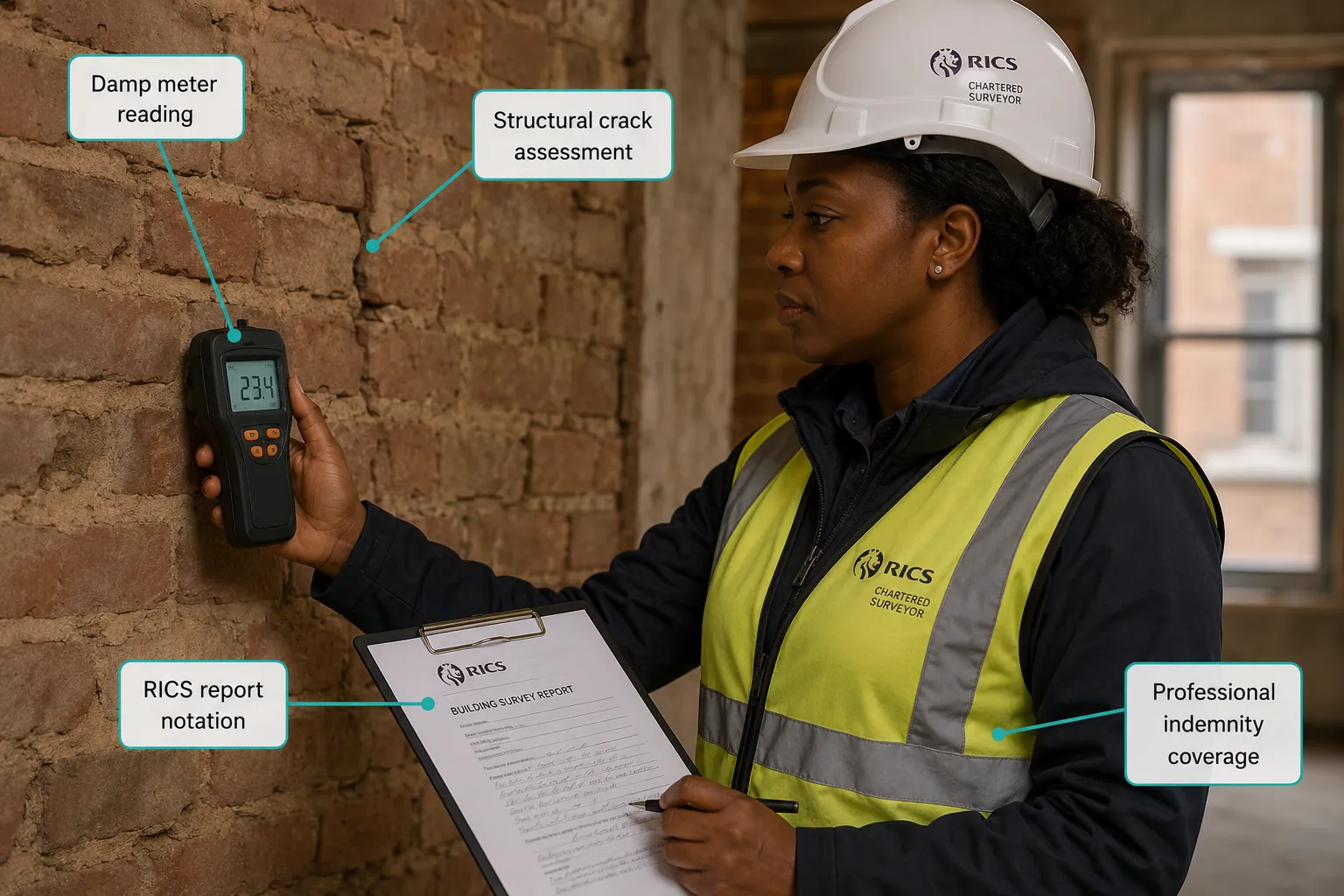
RICS requires all regulated firms and individual members to hold adequate professional indemnity (PI) insurance. This insurance exists to protect clients when a surveyor's negligence causes financial loss, for example, if a significant structural defect is missed and the buyer later faces a large repair bill.
A non-qualified surveyor is under no obligation to hold PI insurance. Some may choose to do so voluntarily, but there is no mechanism to verify this through a regulated register. If a non-qualified surveyor misses a serious defect and carries no PI insurance, the buyer's only recourse is through the civil courts, an expensive and uncertain process.
RICS Disciplinary and Regulatory Framework
RICS operates a transparent disciplinary process. When a complaint is upheld, outcomes, including reprimands, fines, suspensions, and expulsions, are published [5]. This public record serves two purposes: it deters misconduct and it allows consumers to check the disciplinary history of any RICS member.
The published RICS decisions database [8] shows the range of sanctions applied, from formal reprimands for procedural failures to expulsion for serious misconduct. No equivalent mechanism exists for non-qualified surveyors.
RICS also publishes ongoing regulatory activity and market guidance through its news and insight channels [1], [10], keeping practitioners and consumers informed of current standards. The August 2026 RICS newsletter highlighted continued standard-setting activity and market leadership [7], confirming that the institution remains actively engaged in raising the bar for the profession.
What Happens When Things Go Wrong
Consider two scenarios:
Scenario A: A buyer instructs a chartered surveyor who misses significant roof damage. The buyer complains to RICS, which investigates under its disciplinary process [2]. If negligence is found, the PI insurer compensates the buyer. The surveyor faces formal sanctions.
Scenario B: A buyer instructs a non-qualified surveyor who misses the same damage. There is no regulatory body to complain to. If the surveyor has no PI insurance and limited assets, the buyer may recover nothing.
The difference is not hypothetical. It is the structural reason why official consumer guidance consistently recommends using only RICS-qualified surveyors for building surveys.
Practical Guidance: How to Verify and Choose the Right Surveyor in 2026
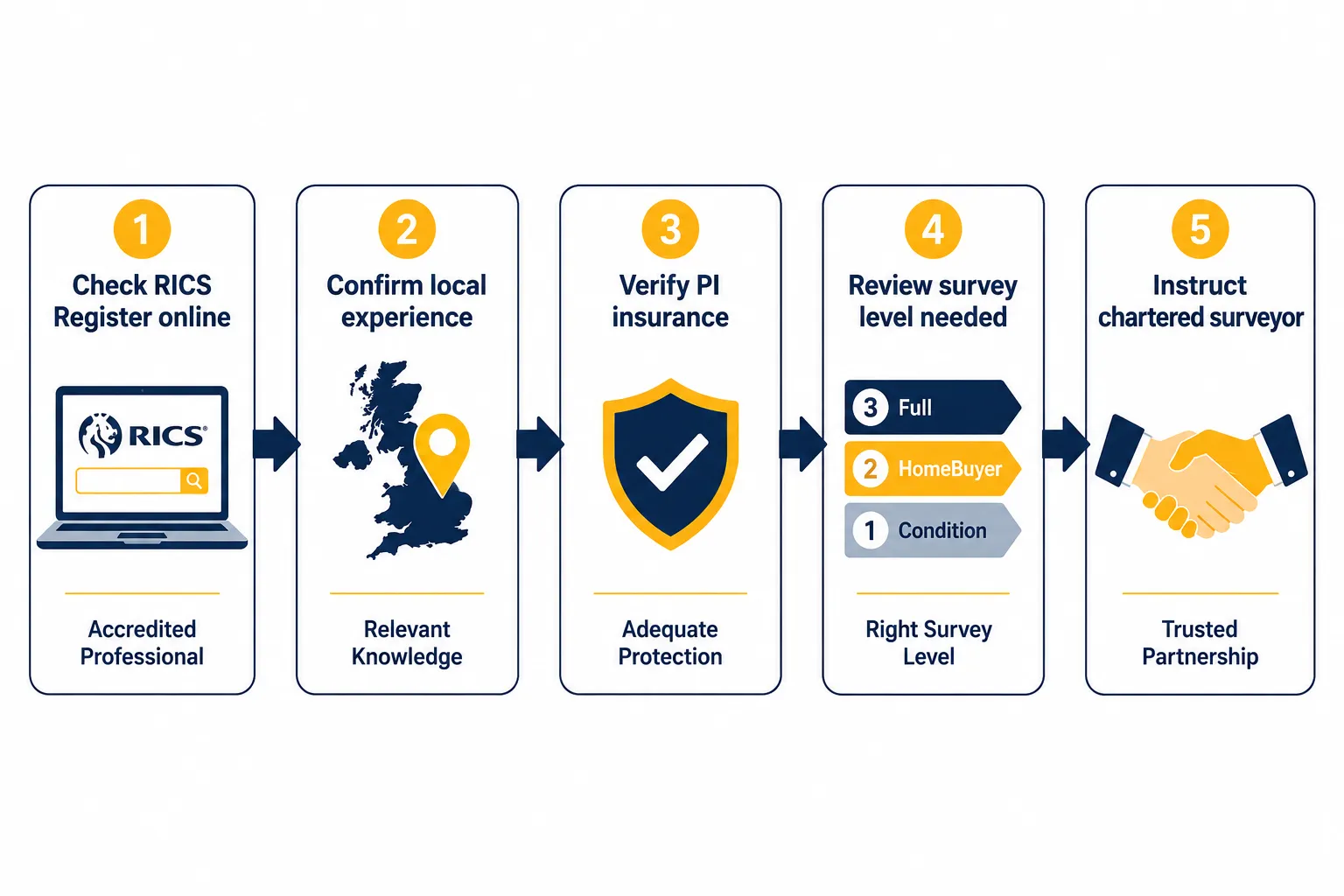
Understanding the chartered surveyor vs non‑qualified surveyor distinction is only useful if buyers know how to act on it. The following steps reflect current industry and consumer advice for 2026.
Step 1: Check the RICS Register
The RICS website hosts a publicly searchable register of all current members and regulated firms. Searching a surveyor's name or firm takes under a minute and confirms whether they hold MRICS or FRICS status. If a surveyor cannot be found on the register, they are not RICS-accredited.
Step 2: Confirm Local Experience
RICS accreditation is a necessary condition, not a sufficient one. A chartered surveyor who specialises in commercial property may not be the best choice for a 1930s semi-detached in a regional market with specific local characteristics. Ask directly about experience with the property type, age, and location.
For buyers navigating regional market variations, Valuation Challenges In Diverging Regional Markets: Chartered Surveyor Techniques For North-South Price Disparities In 2026 provides useful context on how local expertise affects assessment quality.
Step 3: Verify PI Insurance
Ask the surveyor or firm to confirm their PI insurance cover. A reputable RICS firm will provide this information without hesitation. The level of cover should be proportionate to the value of the property being surveyed.
Step 4: Match the Survey Level to the Property
Not every property needs a Level 3 survey, but buyers of older, larger, or non-standard properties should not accept a Level 1 or Level 2 report as sufficient. A chartered surveyor will advise on the appropriate level; a non-qualified practitioner may not have the expertise to make that judgement.
First-time buyers in particular benefit from understanding their options. The Building Survey Protocols For First Time Buyers In 2026 guide covers how survey findings can be used as a negotiation tool, not just a risk-assessment document.
Step 5: Review the Report Format
An RICS Home Survey report follows a standardised structure with condition ratings (1 = no repair needed, 2 = repair or replacement needed, 3 = urgent attention required). This structure makes the report actionable and comparable. A non-qualified surveyor's report may use different terminology, omit key sections, or lack the condition-rating system that makes defects immediately legible to buyers, solicitors, and mortgage lenders.
Common Red Flags When Instructing a Surveyor
- The surveyor cannot be found on the RICS register
- No mention of PI insurance when asked directly
- The fee is substantially below the market rate for the survey level
- The report template does not follow RICS condition ratings
- No complaints procedure is offered or referenced
Why the Gap Is Widening in 2026
Several developments in 2026 have made the chartered surveyor vs non‑qualified surveyor distinction even more consequential for UK building surveys.
Upfront condition assessments linked to proposed homebuying reforms would, if implemented, require condition reports to be produced before a property is listed for sale. These reports would need to meet RICS standards, a requirement that non-qualified surveyors could not satisfy [9].
Rising transaction volumes in 2026 have increased demand for surveys, creating conditions in which unregulated practitioners may seek to fill capacity gaps. The Agreed Sales Recovery And Building Survey Demand article examines how the profession is preparing for this surge.
Energy efficiency requirements are adding complexity to building surveys. Surveyors must now assess EPC ratings, retrofit potential, and MEES compliance alongside traditional structural and condition elements. This expanded scope demands the depth of knowledge that the RICS qualification pathway develops. For context on how energy assessments are being integrated, see EPC MEES Building Survey.
Digital tools and AI are increasingly used by chartered surveyors to enhance report accuracy and efficiency. These tools are being adopted within a regulated framework that ensures their outputs are professionally validated, a safeguard that does not exist in the unregulated sector.
Conclusion
The question of chartered surveyor vs non‑qualified surveyor is not abstract. It determines whether a buyer has regulatory protection, insurance recourse, and a professionally validated report when they commit to one of the largest financial decisions of their life.
RICS accreditation, backed by the April 2026 update to the Home Survey Standard [9], a transparent disciplinary framework [2], [5], and mandatory PI insurance, provides a level of consumer protection that no unregulated alternative can match. The title "surveyor" may be unprotected in UK law, but the consequences of choosing the wrong one are very real.
Actionable next steps for buyers in 2026:
- Search the RICS register before instructing any surveyor, it takes less than two minutes.
- Ask for written confirmation of PI insurance cover before signing any instruction letter.
- Match the survey level to the property: older and non-standard homes warrant a Level 3 building survey.
- Use the survey findings as a negotiation tool, a chartered surveyor's condition ratings carry weight with vendors and solicitors.
- If in doubt about the right survey type, consult a RICS-regulated firm for initial guidance before committing.
The cost of a chartered surveyor's report is a fraction of the cost of an undetected defect. The cost of choosing a non-qualified surveyor, when things go wrong, can be orders of magnitude higher.
References
[1] All News And Insight – rics.org
[2] Disciplinary Process Investigations – rics.org
[5] Disciplinary And Regulatory Decisions – rics.org
[7] Rics Newsletter 06 August 2026 Rics Iczpe – linkedin.com
[8] Published Rics Decisions – rics.org
[9] Home Survey Standard 2nd Edition April 2026 Update – rics.org
[10] Latest News – rics.org