

Last updated: July 24, 2026
Quick Answer: Building survey protocols for fibre optic and 5G installations involving party walls require compliance with the Party Wall etc. Act 1996 before any drilling, cutting, or cable routing through shared walls. Property owners must serve formal notice on adjoining neighbours, obtain a party wall award where consent is withheld, and commission a schedule of condition to protect both parties. Skipping these steps can expose the building owner to injunctions, claims for damage, and costly legal disputes.
Key Takeaways
- The Party Wall etc. Act 1996 applies whenever fibre optic or 5G infrastructure work involves cutting into, drilling through, or fixing to a party wall or party structure.
- A formal party wall notice must be served at least two months before notifiable works begin; neighbours then have 14 days to consent or dissent.
- A party wall award (a legally binding agreement) is required if the adjoining owner dissents or fails to respond.
- A schedule of condition should be prepared before any telecom installation work starts, documenting the existing state of the wall and surrounding structure.
- A building survey is distinct from a party wall survey; both may be needed for complex 5G or fibre rollouts in older urban properties.
- Listed buildings and conservation area properties face additional consent requirements from the local planning authority.
- Telecoms operators benefit from certain permitted development rights under the Electronic Communications Code, but these do not override party wall obligations between private owners.
- Costs for party wall surveying in connection with telecom works typically range from £700 to £1,500 per surveyor, depending on complexity (estimate based on 2026 market rates).
- Neighbours cannot permanently block fibre installation on a shared wall, but they can trigger the formal party wall process, causing delays of weeks or months.
- Engaging a chartered surveyor early reduces risk, cost, and neighbour disputes significantly.
What Is a Party Wall and Why Does It Matter for Fibre Optic Installation
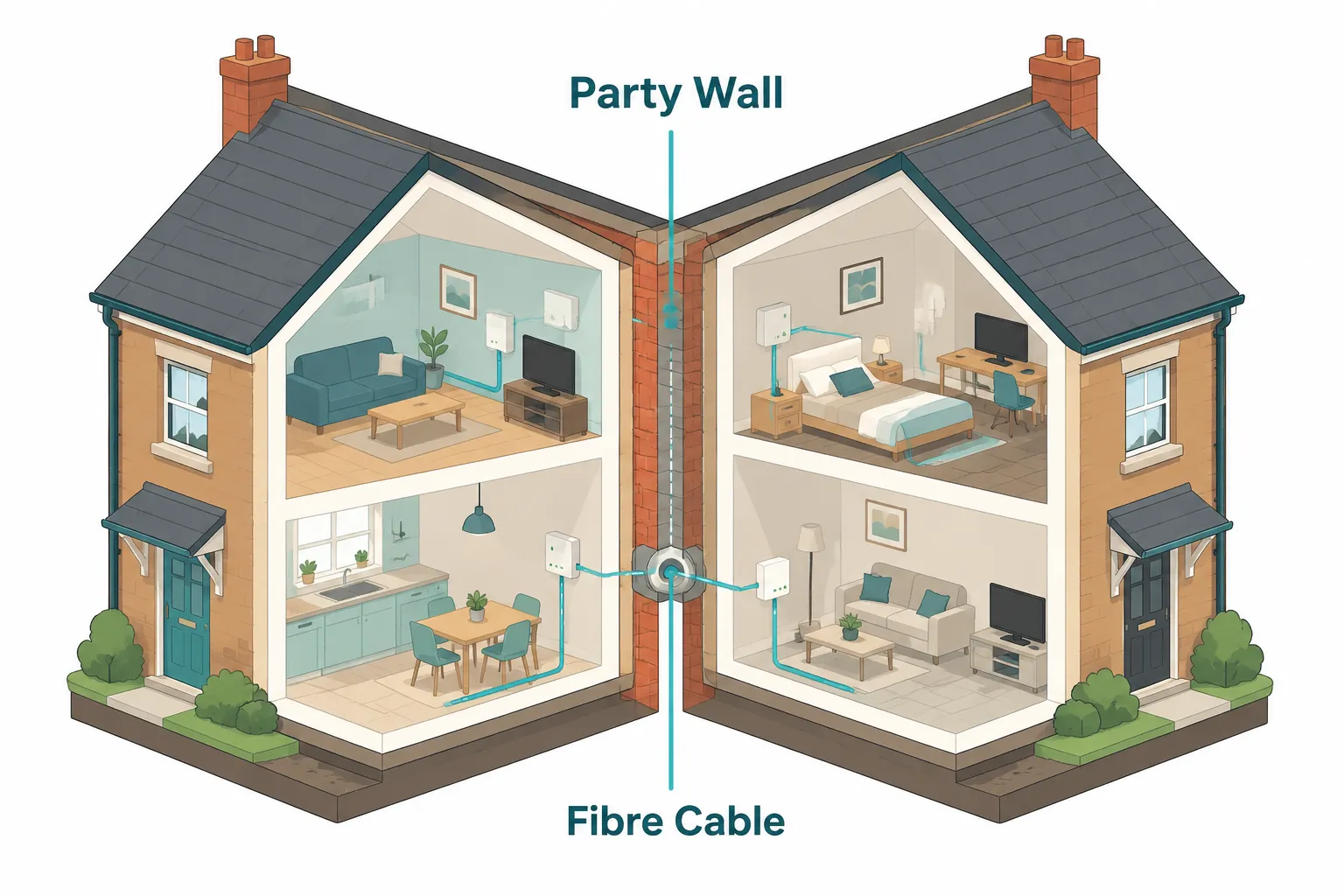
A party wall is a wall that stands on the boundary between two properties and is shared by both owners. Under the Party Wall etc. Act 1996, any work that cuts into, drills through, or structurally affects a party wall requires formal notification to the adjoining owner before work begins.
For fibre optic installation, this matters because:
- Drilling entry points for cables through a shared wall is a notifiable act under Section 2 of the Act.
- Fixing conduit brackets or cable trays to a party wall may also qualify as notifiable work if the fixings penetrate the wall's structure.
- Even minor-looking penetrations can cause cracking, moisture ingress, or vibration damage to the adjoining property.
Who owns the party wall? Both owners share rights in the wall. Neither can carry out notifiable works without following the statutory process. For a fuller explanation of your rights, see this guide on party wall rights for property owners.
Do You Need a Building Survey Before Installing 5G Infrastructure
Yes, in most cases a pre-works building survey or schedule of condition is strongly advisable, and in some circumstances it is effectively mandatory. A building survey establishes the existing condition of the structure before any telecoms work begins, creating a clear baseline if damage claims arise later.
For 5G small cell installations specifically, the survey should cover:
- Structural integrity of the wall or rooftop where equipment will be mounted.
- Presence of asbestos-containing materials in older buildings (pre-2000 construction), which affects how drilling and cutting can be carried out safely. See the asbestos building surveys guidance for more detail.
- Load-bearing capacity for rooftop antenna mounts.
- Proximity of existing services (gas, water, electrical) to proposed cable routes.
A Level 3 full building survey provides the most thorough structural assessment and is the appropriate choice for older or complex urban properties undergoing telecoms upgrades.
What Are Party Wall Act Requirements for Urban Fibre and 5G Upgrades
The Party Wall etc. Act 1996 sets out clear statutory requirements that apply to urban fibre and 5G upgrade works. The building owner (the party carrying out the work) must serve written notice on the adjoining owner before any notifiable work begins.
Key statutory steps:
- Identify notifiable works – Determine whether the proposed cable routing, drilling, or equipment fixing affects a party wall, party fence wall, or excavation within 3 or 6 metres of the adjoining owner's foundations.
- Serve party wall notice – Serve written notice at least two months before work starts (for works under Section 2) or one month before (for new walls on the boundary under Section 1).
- Wait for response – The adjoining owner has 14 days to respond. They can consent in writing, dissent, or fail to respond (which is treated as dissent).
- Appoint surveyors – If the adjoining owner dissents or does not respond, both parties appoint surveyors (or agree on one agreed surveyor).
- Produce a party wall award – The surveyors draw up a legally binding award setting out how and when works will proceed.
- Prepare schedule of condition – Before works start, a party wall schedule of condition documents the existing state of the adjoining property.
Common mistake: Telecoms contractors sometimes assume that permitted development rights under the Electronic Communications Code mean they can bypass party wall obligations. This is incorrect. The Code grants rights against the landowner's own property but does not remove the statutory duty to neighbours under the 1996 Act.
Can You Install Fibre Optic Cables Through Party Walls Without Permission
No. Installing fibre optic cables through a party wall without serving notice and obtaining either written consent or a party wall award is unlawful under the Party Wall etc. Act 1996. The adjoining owner can seek an injunction to halt works and claim compensation for any damage caused.
There is one narrow exception: if the cable route runs entirely within the building owner's own property and does not penetrate the party wall at all (for example, surface-mounted conduit on the owner's side only), the Act does not apply. But any penetration of the shared structure triggers the statutory process.
For a clear overview of what triggers the Act, the Party Wall Act guide for homeowners is a useful starting point.
Party Wall Survey vs Party Wall Award: What Is the Difference
These two terms are often confused. A party wall survey is the process of inspecting and assessing the party wall and adjoining property, typically to produce a schedule of condition. A party wall award is the legally binding document produced by the appointed surveyor(s) that sets out the rights and obligations of both parties during the notifiable works.
| Term | What it is | When it is produced |
|---|---|---|
| Party wall notice | Formal written notification to the neighbour | Before works begin |
| Party wall survey | Physical inspection of the wall and adjoining property | Before and/or after works |
| Schedule of condition | Photographic and written record of existing condition | Before works begin |
| Party wall award | Legally binding document governing the works | After dissent, before works begin |
The award can include conditions specific to telecoms works, such as permitted working hours, cable routing restrictions, and reinstatement requirements. For more on how awards work in practice, see the party wall awards service page.
What Is the Difference Between a Structural Survey and a Party Wall Survey
A structural survey (or building survey) assesses the overall physical condition and structural integrity of a building. A party wall survey is a narrower, legally focused inspection concerned specifically with the shared boundary structure and the impact of proposed works on the adjoining property.
For telecoms installations, both may be needed:
- Structural/building survey: Establishes whether the wall or rooftop can safely support the proposed equipment, and identifies any pre-existing defects that could be worsened by the works.
- Party wall survey: Documents the condition of the party wall and adjoining property to protect both owners if a damage dispute arises later.
Neither replaces the other. A building pathology assessment may also be warranted where the property has a history of structural movement or damp.
How Long Does a Party Wall Survey Take for Telecom Installations
The party wall process for telecoms works typically takes between six and twelve weeks from initial notice to the start of works, assuming the adjoining owner dissents and a formal award is required.
Typical timeline:
- Serving notice: Day 1
- Adjoining owner response period: 14 days
- Surveyor appointment and initial inspection: 1 to 2 weeks after dissent
- Drafting and agreeing the party wall award: 2 to 4 weeks
- Schedule of condition inspection: 1 to 2 days (can run concurrently)
- Total (dissent route): approximately 6 to 10 weeks
If the adjoining owner consents in writing within 14 days, works can begin without an award, and the timeline shortens considerably. For guidance on building survey timeframes more broadly, the linked resource provides useful context.
How Much Does a Party Wall Survey Cost for Fibre Optic Work
Party wall surveyor fees for telecoms-related work typically range from £700 to £1,500 per surveyor in 2026, based on current market rates for urban London and South East England. Where both parties appoint separate surveyors, the building owner (the party carrying out the works) usually pays both sets of fees.
Factors that affect cost include:
- Complexity of the proposed cable route or equipment installation.
- Whether a schedule of condition requires extensive photographic documentation.
- Whether the property is listed or in a conservation area (adds complexity).
- The number of adjoining owners affected (a mid-terrace property has two).
For a detailed breakdown of what drives surveyor fees, the cost of a party wall surveyor guide covers the key variables.
What Happens If You Don't Follow Party Wall Protocols for 5G
Failing to follow party wall protocols before 5G or fibre installation works can result in serious legal and financial consequences. The adjoining owner can apply to the courts for an injunction to stop the works immediately, even if they are already underway.
Potential consequences include:
- Court injunction halting all works until the statutory process is completed.
- Liability for all costs of reinstatement if the wall or adjoining property is damaged.
- Payment of the adjoining owner's legal costs.
- Difficulty selling the property later, as solicitors will identify the breach during conveyancing.
- In extreme cases, the court may order partial demolition of completed works.
The consequences of ignoring the Party Wall Act are well documented and consistently more costly than simply following the process from the start.
Can Neighbours Block Fibre Optic Installation on Shared Walls
A neighbour cannot permanently block a fibre optic installation that falls within the building owner's legal rights, but they can trigger the formal party wall process, which causes delays. Dissenting from a party wall notice does not give the adjoining owner a veto; it simply requires the matter to be resolved through the surveyor and award process.
However, neighbours can legitimately raise concerns that result in conditions being placed on how works are carried out, including:
- Restrictions on working hours.
- Requirements for specific reinstatement materials.
- Limitations on the size or position of wall penetrations.
- Obligations to make good any damage promptly.
If a neighbour refuses to engage at all, the party wall surveyor can proceed to issue the award regardless. For advice on what to do when a neighbour refuses party wall works, the linked article sets out the practical steps.
Who Needs to Be Notified Before Drilling Through Party Walls for Fibre
The adjoining owner (or owners) of every property that shares the party wall must be notified. In a mid-terrace house, this means both immediate neighbours. In a purpose-built flat, this may include the freeholder, the management company, and potentially other leaseholders depending on the lease terms.
Notification checklist:
- Identify all adjoining owners using Land Registry title searches.
- Check lease terms if the property is leasehold (some leases require landlord consent for structural alterations).
- Serve written notice on each adjoining owner separately.
- Keep proof of service (recorded delivery or personal service with a witness).
Telecoms operators working under the Electronic Communications Code must also notify the relevant landowner and, where applicable, the local planning authority.
What Should a Building Survey Protocol Include for 5G Rollout
A building survey protocol for a 5G rollout in an urban environment should cover structural, legal, and safety dimensions. The protocol acts as the framework that guides surveyors, engineers, and contractors through the assessment and approval process before installation begins.
Core elements of a robust survey protocol:
- Pre-works structural assessment: Confirm wall and rooftop load capacity for antenna and equipment weight.
- Materials identification: Check for asbestos, lead paint, or other hazardous materials in the drilling zone.
- Party wall compliance check: Confirm whether any proposed works trigger the Party Wall etc. Act 1996 and serve notices accordingly.
- Schedule of condition: Photographic and written record of the party wall and adjoining structure before works.
- Cable routing plan: Detailed drawings showing the proposed route of all fibre or power cables through the structure. Party wall drawings form a key part of this documentation.
- Post-works inspection: Confirm reinstatement of any penetrations and check for new defects.
- Statutory compliance sign-off: Confirm compliance with building regulations, planning conditions, and the party wall award.

How Do You Handle Party Wall Issues in Listed Buildings or Conservation Areas
Listed buildings and properties in conservation areas face additional layers of consent on top of the standard party wall process. Listed building consent from the local planning authority is required for any works that affect the character of a listed building, and drilling through a historic wall almost always qualifies.
Additional steps for listed or conservation area properties:
- Apply for listed building consent (or conservation area consent) before serving party wall notices, as the planning process may impose conditions that affect how works are designed.
- Engage a heritage consultant or conservation architect if the installation requires significant structural intervention.
- Use reversible fixing methods where possible to minimise impact on historic fabric.
- Confirm that the chosen cable route does not disturb any protected architectural features.
- Check whether the local authority's conservation officer requires a heritage impact statement.
The statutory considerations for building surveys page provides further guidance on navigating consent requirements in sensitive locations.
Common Mistakes People Make With Party Wall Surveys for Broadband
The most frequent errors arise from underestimating the scope of the Party Wall etc. Act 1996 and assuming that small-scale telecoms work falls below the threshold for notification.
Mistakes to avoid:
- Assuming small holes are exempt: Any penetration of a party wall is potentially notifiable, regardless of diameter.
- Serving notice too late: The two-month notice period cannot be shortened by agreement with the contractor; it is a statutory minimum.
- Using the wrong notice form: Section 1, Section 2, and Section 6 notices apply to different types of work; using the wrong one invalidates the notice.
- Failing to identify all adjoining owners: Missing a leaseholder or freeholder can leave the building owner exposed to a separate injunction.
- Not preparing a schedule of condition: Without a pre-works record, any damage claim becomes a credibility dispute rather than a factual one.
- Relying on verbal consent: Written consent from the adjoining owner is required; verbal agreement has no legal standing under the Act.
For a broader overview of the process and common pitfalls, the top questions about party wall surveys article covers the most frequently raised issues.
Interactive Party Wall Compliance Checker
.pw-wrap{font-family:Arial,sans-serif;max-width:520px;margin:0 auto;background:#f4f7fb;border-radius:10px;padding:22px 24px;border:1px solid #d0dce8}
.pw-wrap h3{margin:0 0 14px;font-size:1.05rem;color:#1a2e4a}
.pw-q{margin-bottom:12px}
.pw-q label{display:block;font-size:.9rem;color:#2c3e50;margin-bottom:5px;font-weight:600}
.pw-q select{width:100%;padding:7px 9px;border-radius:6px;border:1px solid #b0bec5;font-size:.88rem;background:#fff}
.pw-btn{margin-top:14px;background:#1a2e4a;color:#fff;border:none;padding:10px 22px;border-radius:6px;font-size:.92rem;cursor:pointer;width:100%}
.pw-btn:hover{background:#2a4a72}
.pw-result{margin-top:14px;padding:12px 14px;border-radius:7px;font-size:.88rem;line-height:1.55;display:none}
.pw-result.warn{background:#fff3cd;border:1px solid #f0c040;color:#7a5800}
.pw-result.ok{background:#e6f4ea;border:1px solid #81c784;color:#1b5e20}
.pw-result.high{background:#fdecea;border:1px solid #e57373;color:#7f1d1d}
Party Wall Compliance Checker, Telecoms Works
function checkPW(){
var q1=document.getElementById(‘q1’).value,
q2=document.getElementById(‘q2’).value,
q3=document.getElementById(‘q3’).value,
q4=document.getElementById(‘q4’).value,
r=document.getElementById(‘pw-result’);
if(!q1||!q2||!q3||!q4){r.className=’pw-result warn’;r.style.display=’block’;r.textContent=’Please answer all questions to get a result.’;return;}
var msg=”,cls=’ok’;
if(q1===’yes’&&q3===’no’){cls=’high’;msg=’High risk: Works affecting a party wall require formal notice under the Party Wall etc. Act 1996. Do not proceed without serving notice and obtaining consent or a party wall award.’;}
else if(q1===’yes’&&q4===’no’){cls=’warn’;msg=’Caution: A schedule of condition should be prepared before works begin to protect both parties from future damage disputes.’;}
else if(q2===’yes’){cls=’warn’;msg=’Additional consent required: Listed building consent or conservation area consent may be needed from your local planning authority before works begin.’;}
else if(q1===’no’&&q3===’na’){cls=’ok’;msg=’Lower risk: If no party wall is affected, the Act may not apply. Confirm with a chartered surveyor that the cable route does not touch any shared structure.’;}
else{cls=’ok’;msg=’Compliance looks reasonable based on your answers. A chartered surveyor should review the full works specification to confirm no further steps are needed.’;}
r.className=’pw-result ‘+cls;r.style.display=’block’;r.textContent=msg;
}
FAQ: Party Wall Surveys and Telecoms Installations
Does the Party Wall etc. Act 1996 apply to fibre optic cable installations?
Yes, if the installation involves drilling through or fixing to a party wall or party structure. The Act applies to the type of work, not the purpose of the work. Telecoms work is not exempt.
Can a telecoms operator serve the party wall notice on behalf of the property owner?
The notice must be served by or on behalf of the building owner (the person with the legal interest in the property). A telecoms contractor can assist with preparation, but the legal obligation rests with the property owner.
What is a party wall award and is it legally binding?
A party wall award is a document produced by the appointed surveyor(s) that sets out the terms under which notifiable works may proceed. It is legally binding on both the building owner and the adjoining owner.
How many surveyors are needed for a party wall dispute about telecoms works?
Each party may appoint their own surveyor, or both parties may agree to appoint a single agreed surveyor. The agreed surveyor route is faster and cheaper and works well where both parties are co-operative.
Does a small cable entry hole through a party wall really need party wall notice?
Yes. The size of the penetration is not the determining factor; the fact that the party wall is being cut or drilled is what triggers the Act. Even a 20mm cable entry hole is notifiable if it passes through the shared structure.
What if works have already started without notice being served?
The adjoining owner can apply for an injunction to stop works immediately. The building owner should seek urgent legal advice and engage a party wall surveyor to regularise the position as quickly as possible.
Are flat owners in a purpose-built block subject to the Party Wall Act?
The Act applies to party structures (including floors and ceilings between flats) as well as party walls. Leaseholders should also check their lease for any restrictions on structural alterations before proceeding.
Conclusion
Building survey protocols for fibre optic and 5G installations involving party walls are not optional extras; they are statutory requirements that protect property owners, neighbours, and the long-term integrity of urban buildings. The Party Wall etc. Act 1996 applies to telecoms work just as it does to extensions or loft conversions, and the consequences of ignoring it are consistently more expensive than following the process correctly from the start.
Actionable next steps for property owners and professionals:
- Before any telecoms installation work is commissioned, confirm whether the proposed cable route or equipment fixing affects a party wall or party structure.
- If it does, engage a chartered party wall surveyor to serve the correct notice with sufficient lead time (at least two months for Section 2 works).
- Commission a schedule of condition before works begin, regardless of whether the neighbour consents or dissents.
- For listed buildings or conservation area properties, apply for the relevant planning consents before the party wall process begins.
- Ensure the telecoms contractor's works specification is reviewed by the surveyor before the party wall award is finalised, so that any conditions can be incorporated.
- Keep all notices, consents, awards, and schedules of condition in the property file, as they will be required during future conveyancing.
A chartered surveyor with experience in both building surveys and party wall matters is the most efficient single point of contact for navigating these requirements. Early engagement saves time, money, and neighbour relationships.
Tags: party wall survey, fibre optic installation, 5G infrastructure, Party Wall Act 1996, building survey protocols, schedule of condition, party wall award, urban telecoms upgrade, chartered surveyor, listed buildings, conservation area, party wall notice