

{"cover":"Professional landscape format (1536×1024) hero image with bold text overlay: 'Building Survey Protocols for Buy-to-Let Institutional Investors: Assessing Yields in 2026' in extra large 72pt white bold sans-serif font with dark semi-transparent overlay box, centered upper-third composition. Background shows aerial view of a row of traditional British terraced rental properties with a suited surveyor holding a clipboard and tablet in foreground, warm golden-hour lighting, deep navy and gold color palette, high contrast, magazine cover editorial quality, financial sector aesthetic.","content":["Wide-angle interior shot of a professional chartered surveyor conducting a Level 3 building condition survey inside a Victorian terraced buy-to-let property, holding a moisture meter against a damp wall, clipboard with RICS checklist visible, natural light from bay window, muted professional color palette of grey and cream, photorealistic editorial quality, 1536×1024 landscape format, institutional property investment context","Regional UK yield comparison infographic-style illustration showing a stylized map of England and Wales with color-coded yield percentages overlaid on key regions — Wales highlighted in deep green at 8.74%, North East in teal at 8.10%, Greater London in amber at 5.74% — with bar chart elements and percentage callouts, clean financial data visualization aesthetic, white background, professional editorial quality, 1536×1024 landscape format","Aerial drone photograph perspective of a portfolio of mixed UK residential properties — terraced houses, HMO conversions, and apartment blocks — with digital overlay graphics showing yield calculations, ICR ratios, and compliance checklist icons, institutional investor portfolio management concept, cool blue and white color scheme, sharp editorial quality, 1536×1024 landscape format, futuristic property tech aesthetic"]
Gross buy-to-let yields in the UK climbed to 6.96% in Q1 2026, up from 6.92% in Q4 2025, while BTL lending surged 21.3% by value year-on-year in Q4 2025 to reach £11.2 billion [4]. For institutional landlords scaling portfolios at speed, that momentum is welcome — but it also raises the stakes for every acquisition decision. A single overlooked structural defect or compliance gap can erode months of rental income. That is precisely why building survey protocols for buy-to-let institutional investors: assessing yields in 2026's bullish landlord sector have become a strategic discipline, not just a due diligence checkbox.

Key Takeaways
- Gross BTL yields reached 6.96% in Q1 2026, with HMOs leading at 8.78% and regional markets like Wales and the North East outperforming London significantly.
- Institutional investors now hold approximately 5% of the UK private rented sector, with that share growing rapidly as smaller landlords exit.
- RICS released a draft code of practice in early 2026 standardising stock condition survey methodologies for large-scale portfolio assessments.
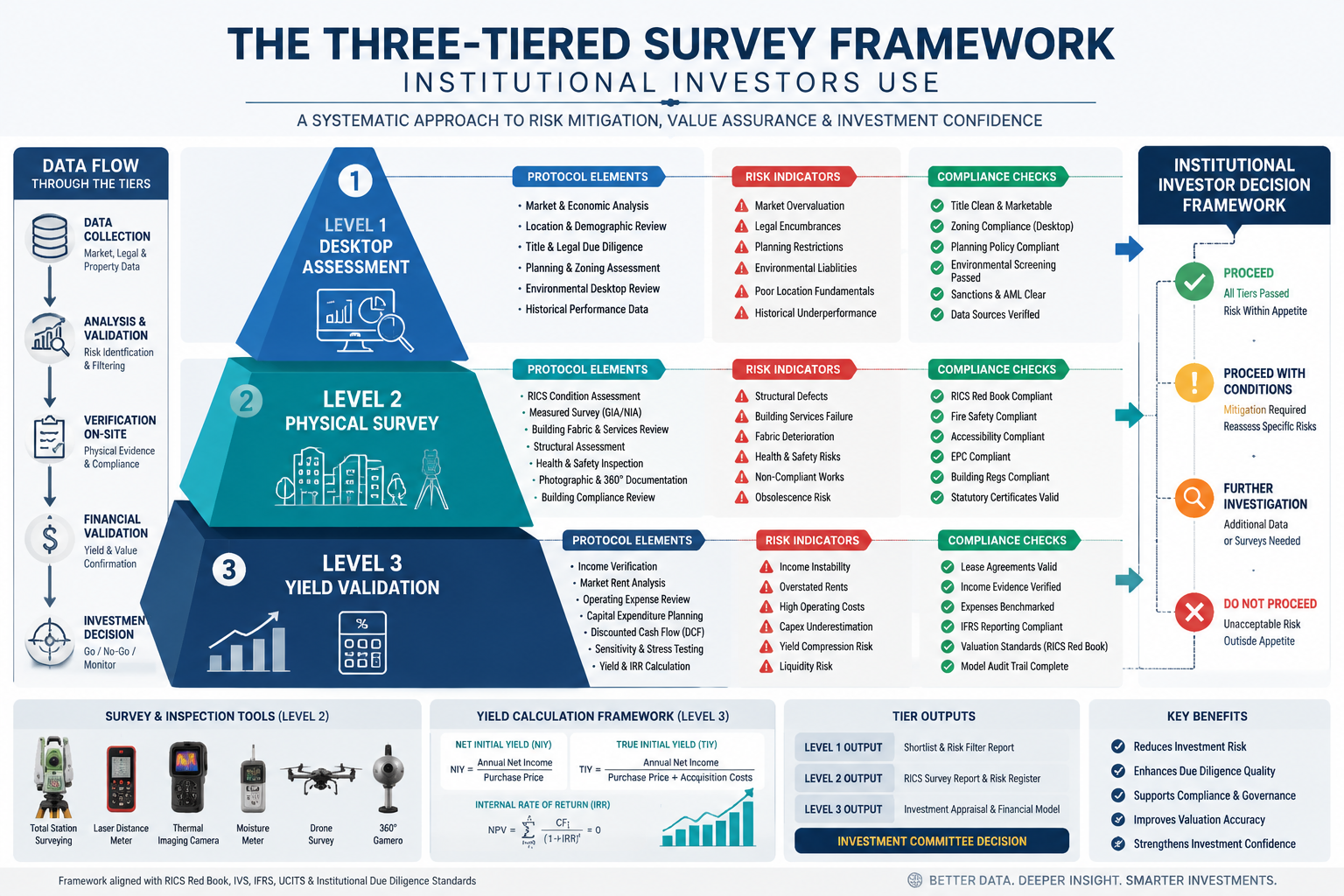
- A three-tiered survey framework — desktop analysis, full building condition survey, and specialist reports — is the institutional standard for risk-adjusted acquisition.
- Survey findings directly influence yield calculations, price renegotiations, and long-term maintenance budgeting across portfolio holdings.
Why 2026 Is a Defining Year for Institutional BTL Expansion
The UK private rented sector is undergoing a structural ownership shift. Institutional investors now control approximately 5% of the market, a share growing steadily as individual landlords exit under the weight of tax reform, regulatory complexity, and rising mortgage costs [2]. That exit creates acquisition opportunity — but also inherited risk. Properties sold by departing small landlords often carry deferred maintenance, outdated EPC ratings, and compliance shortfalls that only a rigorous survey process can surface.
The average BTL interest cover ratio (ICR) improved to 218% in Q4 2025, up from 201% in Q4 2024 [4]. This improved affordability is drawing institutional capital back into the market with greater confidence. However, yield optimisation at scale requires more than favourable financing conditions. It demands a systematic approach to property condition assessment that connects survey findings directly to acquisition pricing and asset management planning.
The regulatory environment is also tightening. The Renters' Rights Act, EPC minimum standards moving toward Band C, and evolving fire safety requirements for HMOs all create compliance obligations that, if undetected before purchase, become costly liabilities post-completion. Institutional buyers cannot afford to absorb those costs silently across a portfolio of dozens or hundreds of units.
Understanding new property management laws and their implications for stock condition is now a prerequisite for any serious institutional acquisition strategy.
The Three-Tiered Survey Framework Institutional Investors Use
The most effective building survey protocols for buy-to-let institutional investors: assessing yields in 2026's bullish landlord sector follow a structured, three-tiered approach. This methodology, increasingly aligned with RICS guidance on residential stock condition surveys [2], allows investors to triage risk efficiently across large property volumes before committing full survey resources.
Tier 1: Desktop Analysis and Pre-Survey Intelligence
Before a surveyor sets foot on site, institutional buyers conduct a thorough desktop review. This includes:
- Planning history — permitted development use, any enforcement notices, or change-of-use applications
- Environmental data — flood risk zones, ground contamination records, radon levels
- Title and lease review — unexpired lease terms, service charge history, and ground rent escalation clauses
- EPC ratings and energy performance data — critical given incoming minimum standards
- Historic building records — structural alterations, party wall agreements, and past insurance claims
This stage filters out properties with fundamental legal or environmental issues before survey costs are committed. For leasehold acquisitions, leasehold extension and enfranchisement valuations can also be commissioned at this stage to model the full cost of ownership.
Tier 2: Full Building Condition Survey
For properties passing Tier 1 screening, a comprehensive Level 3 full building survey is the institutional standard. Unlike a basic mortgage valuation or Level 2 HomeBuyer Report, a Level 3 survey provides a detailed assessment of every accessible element of the building's fabric.
Key elements assessed include:
| Survey Element | Risk Relevance for BTL Investors |
|---|---|
| Roof structure and covering | High — repair costs directly affect net yield |
| Damp and moisture ingress | High — affects habitability and EPC rating |
| Structural movement and cracking | Critical — may affect insurability |
| Electrical and heating systems | High — compliance with EICR and gas safety requirements |
| Windows and external envelope | Medium — energy efficiency and tenant comfort |
| Drainage and plumbing | Medium — hidden defects with high repair costs |
| Fire safety features | Critical for HMOs — regulatory non-compliance risk |
Understanding how long a building survey takes is important for institutional buyers managing tight acquisition timelines, particularly in competitive regional markets.
For larger or more complex properties, premium drone surveys are increasingly used to inspect roofs, chimneys, and high-level external fabric without the cost and delay of scaffolding. This technology is particularly valuable for institutional buyers assessing multi-unit blocks or HMO conversions where roof access is restricted.
Tier 3: Specialist Reports
When Tier 2 identifies specific issues, targeted specialist investigations are commissioned. These may include:
- Structural engineering reports for movement or subsidence concerns
- Asbestos surveys for pre-2000 properties
- Drainage CCTV surveys for older stock
- Electrical Installation Condition Reports (EICRs)
- Fire risk assessments for HMOs and multi-occupancy buildings
Each specialist report feeds directly into the acquisition financial model, either justifying a price reduction, informing a maintenance reserve, or triggering withdrawal from the deal.
Regional Yield Analysis: Where Survey Risk and Return Intersect

Understanding regional yield variation is central to building survey protocols for buy-to-let institutional investors: assessing yields in 2026's bullish landlord sector. Yield data alone does not tell the full story — it must be read alongside the typical condition and age profile of housing stock in each region.
High-Yield Regions: Greater Risk Exposure
Wales led all UK regions with gross yields of 8.74% in Q1 2026, followed by the North East at 8.10% [1]. The North West and East Midlands also performed strongly at 7.87% and 7.58% respectively [1]. These yields are attractive, but they correlate with older housing stock, higher rates of pre-1919 terraced properties, and greater exposure to damp, structural movement, and outdated services.
Institutional buyers targeting these markets must budget for:
- Higher average survey costs due to property age and complexity
- Greater likelihood of Tier 3 specialist investigations being triggered
- Larger maintenance reserves built into yield calculations
- More frequent EPC improvement works to reach Band C compliance
London: Lower Yields, Lower Structural Risk
Greater London reported the lowest gross yields at 5.74% [1]. While this makes London less attractive on a pure income basis, the housing stock in many London boroughs tends to be better maintained, more recently refurbished, and subject to more rigorous regulatory oversight. Survey findings in London are less likely to trigger major structural remediation, though fire safety compliance in converted Victorian properties remains a persistent issue.
Institutional investors with London portfolios benefit from access to specialist chartered surveyors across the capital. Whether acquiring in Clapham, Islington, or North West London, local surveyor knowledge of building typologies and common defect patterns adds significant value to the assessment process.
HMOs: The Highest-Yield, Highest-Complexity Asset Class
Houses in Multiple Occupation delivered the highest yields of any property type in Q1 2026 at 8.78%, compared to 4.60% for detached houses and 5.10% for bungalows [1]. For institutional investors, HMOs represent a compelling income opportunity — but they also carry the most complex survey requirements.
HMO-specific survey considerations include:
- Fire compartmentation — walls, floors, and ceilings must meet fire resistance standards
- Means of escape — stairwells, fire doors, and emergency lighting
- Amenity standards — kitchen and bathroom ratios per occupant
- Licensing compliance — mandatory and additional licensing conditions vary by local authority
- Structural loading — higher occupancy creates greater wear on building fabric
A thorough review of what a landlord should provide in an unfurnished apartment helps institutional buyers benchmark compliance obligations against survey findings before finalising HMO acquisition decisions.
Integrating Survey Findings Into Yield Calculations
A building survey is only as valuable as the financial model it informs. Institutional investors must translate survey findings into hard numbers that affect acquisition pricing, financing terms, and asset management budgets.
The Survey-Adjusted Yield Model
The standard gross yield calculation (annual rent divided by purchase price) does not account for the cost of bringing a property to a lettable, compliant standard. Institutional buyers use a survey-adjusted net yield model:
Survey-Adjusted Net Yield = (Annual Rent – Annual Operating Costs – Annualised Remediation Costs) / (Purchase Price + Acquisition Costs + Immediate Remediation Costs)
Survey findings feed directly into the remediation cost line. A property with a gross yield of 7.5% but requiring £25,000 of immediate structural and compliance work may deliver a survey-adjusted net yield below 5% — making it unviable against alternative acquisitions.
Price Renegotiation Based on Survey Evidence
One of the most immediate financial benefits of rigorous survey protocols is the ability to renegotiate purchase prices based on documented defects. Survey findings provide objective, professional evidence that supports price reduction requests. Understanding average price reductions after a survey helps institutional buyers set realistic expectations and negotiate effectively with vendors.
For portfolio acquisitions involving multiple units, even modest per-unit reductions compound significantly. A £5,000 reduction across 20 units represents £100,000 of capital preserved — capital that can be redeployed into yield-generating improvements.
Building Long-Term Maintenance Reserves
Survey findings also inform the maintenance reserve that institutional investors must hold against future capital expenditure. RICS guidance recommends that stock condition surveys produce a 10-year maintenance cost projection for each asset. This projection feeds into:
- Service charge budgeting for block management structures
- Asset management planning for portfolio-wide capital expenditure programmes
- Lender reporting — particularly relevant as ICR requirements tighten
RICS Standards and Compliance in 2026
RICS released a draft code of practice in early 2026 for residential stock condition surveys, standardising methodologies for large-scale portfolio assessments [2]. This development is significant for institutional investors because it creates a common framework for comparing survey quality across different surveying firms and geographic markets.
Key elements of the draft code include:
- Standardised condition ratings (1 to 3) applied consistently across all building elements
- Mandatory photographic evidence for all condition ratings of 2 or above
- Defined scope of inspection for each property type, including HMOs and purpose-built flats
- Clear reporting requirements for environmental and safety-critical issues
- Integration with EPC and fire safety data
For institutional buyers commissioning surveys across multiple regions, adherence to this standard ensures that survey reports from different firms are directly comparable — enabling portfolio-level risk analysis rather than asset-by-asset assessment.
Choosing between survey levels remains an important decision even within an institutional context. A detailed comparison of Level 2 versus Level 3 survey options helps acquisition teams allocate survey resources appropriately based on property age, type, and value.
Building the Institutional Survey Protocol: A Practical Checklist
The following checklist summarises the core elements of a robust institutional BTL survey protocol for 2026 acquisitions:
Pre-Acquisition (Tier 1)
- Desktop environmental and planning review completed
- EPC rating confirmed and Band C compliance gap assessed
- Lease terms and service charge history reviewed (leasehold)
- Licensing status confirmed for HMOs
Survey Commission (Tier 2)
- Level 3 full building survey instructed from RICS-regulated firm
- Drone survey included for properties with restricted roof access
- Surveyor briefed on specific institutional concerns (compliance, HMO standards, EPC)
- Timeline aligned with acquisition programme
Specialist Investigations (Tier 3 — as triggered)
- Structural engineer instructed for movement or subsidence
- Asbestos survey for pre-2000 properties
- EICR and gas safety inspection
- Fire risk assessment for HMOs
- Drainage CCTV survey for older stock
Financial Integration
- Survey findings translated into remediation cost schedule
- Survey-adjusted net yield calculated
- Price renegotiation initiated where defects warrant
- 10-year maintenance cost projection produced
- Maintenance reserve established in asset management plan
Conclusion
The bullish conditions defining the BTL sector in 2026 — rising yields, improved ICRs, and growing institutional market share — create genuine opportunity for professional landlords willing to deploy capital at scale. But the same market dynamics that make acquisition attractive also raise the cost of getting it wrong. A property acquired without rigorous survey due diligence can quickly become a liability that suppresses portfolio-wide returns.
Building survey protocols for buy-to-let institutional investors: assessing yields in 2026's bullish landlord sector are not a cost centre — they are a yield protection mechanism. Every pound spent on a thorough Level 3 survey, a drone inspection, or a specialist structural report is a pound that prevents a far larger unplanned expenditure post-acquisition.
Actionable next steps for institutional BTL investors in 2026:
- Adopt the three-tiered survey framework as standard acquisition protocol across all markets.
- Align survey briefs with the RICS 2026 draft code of practice for residential stock condition surveys.
- Build survey-adjusted net yield models that incorporate remediation costs before finalising acquisition pricing.
- Prioritise HMO acquisitions with dedicated fire safety and licensing compliance surveys.
- Establish regional surveying partnerships in high-yield markets — Wales, the North East, and the North West — where older stock demands deeper inspection expertise.
- Integrate 10-year maintenance cost projections from survey reports into all asset management and lender reporting frameworks.
The landlords who will dominate the UK's institutional rental market over the next decade are those who treat the building survey not as a formality, but as the foundation of every investment decision.
References
[1] Buy To Let Rental Yields Increase In Q1 As Wales And The North East Lead Regionally – paragonbank.co.uk
[2] Building Surveys For 2026 Institutional Buy To Let Expansion Rics Checklists Beyond Residential Recovery – wimbledonsurveyors.com
[3] Building Survey Protocols For Institutional Buy To Let Acquisitions Risk Mitigation In 2026 Landlord Shifts – manchestersurveyors.com
[4] Buy To Let Lending – ukfinance.org.uk
[8] Valuation Techniques For Buy To Let Surge 2026 Assessing High Yield Rental Opportunities With Rics Insights – canterburysurveyors.com