

Last updated: July 24, 2026
Quick Answer: Boundary disputes and party wall issues are governed by entirely separate legal frameworks and require different surveyor roles. Boundary disputes concern the legal ownership of land and are typically resolved through solicitors and courts, while party wall issues are regulated by the Party Wall etc. Act 1996 and managed primarily by surveyors. Confusing the two, or appointing the wrong professional, can delay resolution and significantly increase costs.
Key Takeaways
- Boundary disputes determine who owns a strip of land; party wall matters regulate construction works on shared structures. These are not the same thing.
- Party wall surveyors under the 1996 Act have no authority to determine legal boundary lines. That power rests with the courts.
- An expert witness surveyor in boundary cases must analyse title plans, historical conveyances, OS mapping, and physical site features to produce court-admissible evidence.
- In party wall disputes, expert witnesses assess the validity of notices and awards, causation of damage, and surveyor conduct.
- A single construction project can trigger both frameworks simultaneously, requiring separate professional appointments.
- Courts in lower-value boundary cases often direct a Single Joint Expert (SJE) to reduce costs and streamline proceedings.
- Resolving a boundary dispute through mediation or an agreed surveyor appointment is almost always cheaper than litigation.
- RICS standards updated in 2026 require surveyors to clearly distinguish between advisory and expert witness roles to maintain professional integrity.
What Is the Difference Between a Boundary Dispute and a Party Wall Issue?
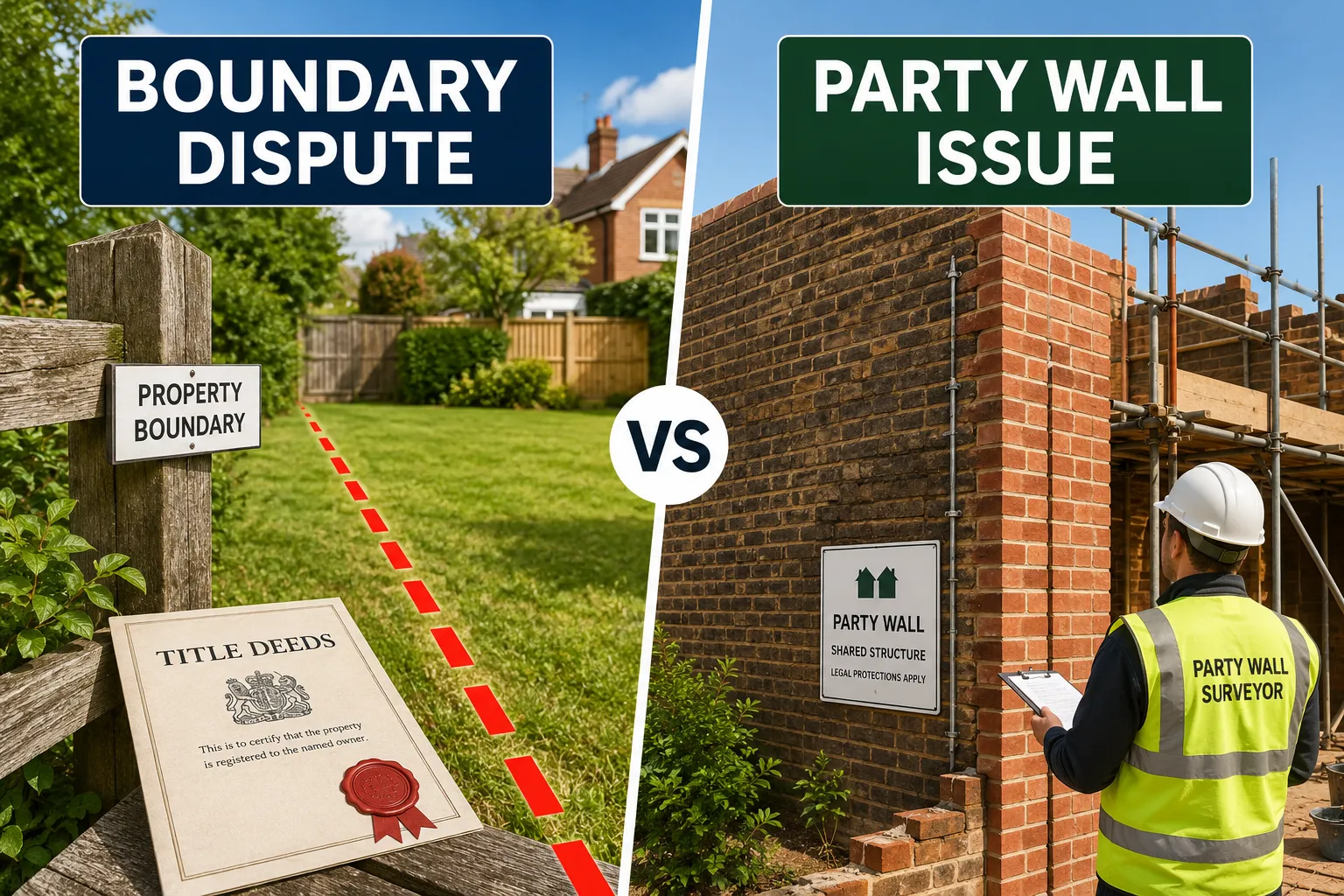
A boundary dispute is a disagreement about where one property ends and another begins, essentially, a question of land ownership. A party wall issue concerns construction works that affect a shared wall, floor, or structure between neighbouring properties.
These two matters are governed by entirely different legal frameworks:
| Feature | Boundary Dispute | Party Wall Issue |
|---|---|---|
| Core question | Who owns the land? | Can this work proceed safely? |
| Governing law | Common law, Land Registration Act 2002 | Party Wall etc. Act 1996 |
| Primary professional | Solicitor + expert witness surveyor | Party wall surveyor |
| Resolution body | County Court / First-tier Tribunal | Surveyor-led award process |
| Surveyor's power | Advisory/evidential only | Statutory authority to make awards |
A key point that surprises many homeowners: party wall surveyors cannot determine legal boundary lines. Their jurisdiction under the 1996 Act is limited to regulating works and resolving disputes about shared structures. If a neighbour's extension crosses a boundary and affects a party wall, both frameworks apply at the same time, requiring separate professional input.
For a detailed look at how party wall matters work in practice, see this complete guide to party wall surveyor services.
When Do You Need an Expert Witness for Boundary Disputes?
An expert witness surveyor is needed when a boundary dispute cannot be resolved by agreement and is heading toward, or already in, legal proceedings. Courts require independent, impartial technical evidence to establish where a legal boundary sits.
Specifically, appoint an expert witness surveyor when:
- Title deeds and Land Registry plans are ambiguous or contradictory
- There is a claim of adverse possession (where a party argues long-term occupation has transferred ownership)
- Physical features on site (fences, walls, hedges) do not match the paper title
- The dispute involves significant land value or development potential
- A neighbour has already instructed their own expert
In lower-value cases, the court may direct both parties to share a Single Joint Expert (SJE) rather than each appointing their own. This reduces costs and avoids the adversarial "battle of experts" that can make proceedings more expensive than the land itself is worth.
"The expert witness's duty is to the court, not to the party who instructed them. Any surveyor who loses sight of that distinction risks their evidence being disregarded entirely."
For professional expert witness reports in property disputes, Prince Surveyors' expert witness service provides court-compliant analysis for both boundary and party wall matters.
How Do Surveyors Determine the True Property Line?
Surveyors establish a legal boundary by combining documentary evidence with physical site analysis. No single source is definitive on its own.
Documentary sources used:
- HM Land Registry title plans (note: these are general boundary plans, not precise legal boundaries)
- Historical conveyances and deeds predating Land Registry
- Ordnance Survey mapping at various scales and dates
- Planning permission drawings and site plans
- Aerial photographs and historical maps
Physical site evidence:
- Age, type, and position of boundary features (fences, walls, hedges, ditches)
- Maintenance patterns (which side has posts, which side has been cut)
- Occupation evidence, paths, planted areas, outbuildings
Common mistake: Many homeowners assume the Land Registry title plan settles the matter. It does not. The red line on a title plan is drawn to a general boundary standard and is not precise enough to determine disputes involving centimetres. A qualified expert witness surveyor must interpret the plan alongside all other evidence.
Adverse possession claims add further complexity. If a neighbour has openly occupied a strip of land for 10 or more years (12 years under the old Land Registration Act rules for unregistered land), they may have a legal claim regardless of what the title plan shows.
What Qualifications Should an Expert Witness Surveyor Have?
An expert witness surveyor in boundary or party wall cases should hold specific qualifications and follow strict professional standards. Appointing an unqualified or insufficiently experienced surveyor can result in evidence being rejected by the court.
Essential qualifications and attributes:
- MRICS or FRICS membership (Royal Institution of Chartered Surveyors)
- Specific experience in boundary dispute or party wall expert witness work
- Familiarity with CPR Part 35 (Civil Procedure Rules governing expert witnesses)
- Ability to produce reports that comply with the RICS Expert Witness Practice Statement
- No conflict of interest with either party
RICS updated its professional standards in 2026 to require surveyors to clearly distinguish between their role as a boundary identification adviser (helping a client understand their position) and their role as a court-appointed expert witness (whose duty is to the court). These two roles must not be conflated.
Membership of specialist bodies such as the Pyramus and Thisbe Club or the Faculty of Party Wall Surveyors, which together represent approximately 900 party wall surveyors, indicates a higher level of specialist commitment for party wall matters specifically.
Boundary Disputes vs Party Wall Issues: How Expert Witnesses Differ Between the Two
The expert witness role differs significantly depending on whether the matter is a boundary dispute or a party wall issue. Understanding this distinction is central to the topic of boundary disputes vs party wall issues: expert witness differentiation and resolution tactics for surveyors.
In boundary disputes, the expert witness:
- Establishes the precise location of the legal boundary
- Analyses title documents, maps, and physical features
- Produces a written report for use in court or tribunal proceedings
- May be appointed as a Single Joint Expert or as a party-appointed expert
In party wall disputes, the expert witness:
- Assesses whether party wall notices and awards were valid and properly served
- Determines causation of alleged damage (was it caused by the notifiable works?)
- Evaluates whether the appointed surveyors acted within their statutory powers
- Provides independent technical analysis to assist the court or an appeal tribunal
A surveyor can, in principle, act as an expert witness in both types of case, but only if they have specific expertise in the relevant area. A party wall surveyor experienced in the 1996 Act process is not automatically qualified to give boundary evidence, and vice versa.
How Do Surveyors Handle Party Wall Agreements?
Under the Party Wall etc. Act 1996, a building owner planning notifiable works must serve written notice on all adjoining owners. If an adjoining owner does not consent within 14 days, a dispute is deemed to have arisen and surveyors must be appointed.
The standard process:
- Building owner serves a party wall notice (at least 1-2 months before works begin, depending on the type of work)
- Adjoining owner either consents in writing or dissents
- If dissent, each party appoints a surveyor, or both agree on a single agreed surveyor
- Surveyors prepare a Party Wall Award setting out how works will proceed
- A schedule of condition is recorded before works begin to document the adjoining property's pre-works state
The building owner typically pays all reasonable surveyor fees. If a neighbour refuses to engage, the process can still proceed, see what happens when a neighbour refuses party wall works for the specific steps surveyors take.
When is a party wall surveyor required vs optional?
A party wall surveyor is legally required whenever works fall under the 1996 Act and the adjoining owner has not given written consent. Works that trigger the Act include: building on or at the boundary line, cutting into or underpinning a party wall, and excavating within 3-6 metres of a neighbour's foundations (depending on depth). Works entirely within your own property that do not affect shared structures do not require a party wall surveyor.
Can the Same Expert Witness Handle Both Boundary and Party Wall Cases?
Yes, but only with appropriate expertise in each area. The same surveyor can act as an expert witness in both boundary and party wall matters, provided they have demonstrable experience and qualifications relevant to each type of case.
Choose the same expert if:
- The dispute involves both a boundary question and a party wall matter arising from the same project
- The surveyor holds RICS accreditation and has a documented track record in both areas
- There is no conflict of interest
Appoint separate experts if:
- The boundary and party wall issues are legally distinct and complex enough to warrant specialist focus
- The court or tribunal directs separate appointments
- One party's surveyor has already been involved in the party wall process (which could compromise their impartiality as an expert witness)
The overlap between boundary and party wall matters is more common than many assume. An extension that encroaches on a neighbour's land by even a few centimetres can simultaneously trigger a boundary dispute and a party wall notice, requiring both a solicitor-led boundary claim and a statutory party wall process.
What Evidence Do Surveyors Use to Resolve Boundary Disputes?
Surveyors use a combination of legal documents, historical maps, physical measurements, and photographic evidence to establish a defensible boundary position. The weight given to each type of evidence depends on its age, accuracy, and consistency with other sources.
Hierarchy of evidence (strongest to weakest):
- Express grant or reservation in the original conveyance (the clearest documentary evidence)
- Attached plans with measurements that can be verified on site
- Historical OS maps showing consistent boundary positions over time
- Physical features that predate the dispute and match the documentary record
- Witness evidence from long-term occupiers or neighbours
- General boundary indications on Land Registry title plans (lowest weight)
Edge case: When all documentary evidence is ambiguous, surveyors may apply the "hedge and ditch" presumption (where a boundary ditch is assumed to belong to the owner on whose side the hedge sits) or other established legal presumptions. These presumptions are rebuttable, so physical evidence matters enormously.
What Happens If Neighbours Disagree on Property Boundaries?
If neighbours cannot agree on where a boundary sits, the dispute typically escalates through several stages before reaching court. Early intervention by a qualified surveyor almost always reduces costs.
Typical escalation path:
- Informal negotiation, neighbours attempt to agree, often without professional input
- Surveyor involvement, one or both parties instruct a surveyor to assess the boundary position
- Mediation, a neutral third party facilitates a negotiated settlement (faster and cheaper than court)
- Boundary determination application, either party applies to HM Land Registry for a determined boundary (a formal, permanently registered boundary line)
- County Court proceedings, if all else fails, a judge decides based on expert witness evidence
Can you resolve a boundary dispute without going to court? Yes, and in most cases, you should try. Mediation and Land Registry determined boundary applications resolve the majority of disputes without litigation. Court proceedings for boundary matters can cost tens of thousands of pounds and take years. For a realistic view of what costs to expect, see this breakdown of the average cost of a boundary dispute.
Common Mistakes People Make With Boundary Disputes and Party Wall Issues
Both types of dispute are frequently made worse by avoidable errors. Knowing these in advance can save significant time and money.
Boundary dispute mistakes:
- Assuming the Land Registry title plan is a precise boundary measurement (it is not)
- Erecting or removing boundary features without legal advice, which can prejudice a later claim
- Delaying action, adverse possession claims strengthen over time
- Instructing a surveyor who lacks expert witness experience for court work
Party wall mistakes:
- Failing to serve notice before starting works (which can make the building owner liable for injunctions and damages), see consequences of ignoring the Party Wall Act
- Assuming verbal agreement with a neighbour is sufficient (it is not, consent must be in writing)
- Conflating a party wall dispute with a boundary dispute and appointing the wrong professional
- Not commissioning a schedule of condition before works begin, leaving no baseline for damage claims
How Much Does It Cost to Hire a Surveyor for Boundary Disputes and Party Wall Matters?
Costs vary considerably based on complexity, location, and whether the matter proceeds to court.
Party wall surveyor fees: A straightforward party wall agreement typically costs between £700 and £2,000 per surveyor, depending on the scope of works. More complex projects, such as basement excavations, attract higher fees. For a detailed breakdown, see how much a party wall surveyor costs.
Boundary dispute costs: These range from a few hundred pounds for an initial desktop review to £5,000,£20,000+ for full expert witness reports and court proceedings. Mediation typically costs £1,000,£3,000 per party and resolves most disputes faster than litigation.
How long does it take to resolve a boundary dispute? A negotiated settlement can be reached in weeks. A Land Registry determined boundary application takes several months. Court proceedings regularly take one to three years. Party wall awards are typically concluded within 4-8 weeks of the notice period ending, assuming cooperation from both parties.
Boundary Disputes vs Party Wall Issues: Resolution Tactics for Surveyors in Practice
The most effective resolution tactics differ depending on whether the matter is a boundary dispute or a party wall issue, and on how far the dispute has already escalated.
For boundary disputes:
- Commission a measured survey and desktop title review early, before positions harden
- Explore a Land Registry determined boundary application as a cost-effective alternative to court
- Where court is unavoidable, propose a Single Joint Expert appointment to reduce adversarial costs
- Ensure all expert witness reports comply with CPR Part 35 and the RICS Expert Witness Practice Statement
For party wall matters:
- Serve notices correctly and on time, defective notices can invalidate the entire award process
- Appoint an agreed surveyor where both parties trust the same professional, reducing fees
- Document the pre-works condition thoroughly with a schedule of condition and photographic record
- If damage is alleged post-works, commission an independent causation report before any admission of liability

Frequently Asked Questions
Q: Can a party wall surveyor also determine where my boundary is?
A: No. Party wall surveyors operating under the Party Wall etc. Act 1996 have no statutory authority to determine legal boundary lines. Boundary determination requires a separate legal process involving solicitors and, where necessary, a court-appointed expert witness surveyor.
Q: What is a Single Joint Expert in a boundary dispute?
A: A Single Joint Expert (SJE) is a surveyor appointed by both parties, or directed by the court, to provide impartial boundary evidence. SJEs are common in lower-value disputes because they reduce costs and avoid the "battle of experts" that can make litigation disproportionately expensive.
Q: Does the Party Wall Act cover garden boundary fences?
A: No. The Party Wall etc. Act 1996 covers party walls, party structures, and excavations near foundations. A garden boundary fence is not a party wall unless it forms part of a building structure shared between properties. Fence disputes are boundary matters governed by common law and title deeds.
Q: What happens if I start building works without serving a party wall notice?
A: The adjoining owner can apply for an injunction to stop the works immediately. The building owner may also face liability for any damage caused. Retrospective notice service is possible but does not remove the risk of legal action. Courts have awarded injunctions requiring partially completed works to be demolished.
Q: How is adverse possession relevant to boundary disputes?
A: Adverse possession allows a person who has openly occupied land for a qualifying period (10 years for registered land under the Land Registration Act 2002, 12 years for unregistered land) to apply to be registered as the legal owner. Expert witness surveyors must consider occupation evidence carefully when advising on boundary positions.
Q: Can I use the same surveyor for both my party wall matter and a boundary dispute with the same neighbour?
A: Only if the surveyor has expertise in both areas and there is no conflict of interest. In practice, where both issues arise from the same project, it is often more efficient to use one experienced chartered surveyor who can advise on both, but their expert witness role in any court proceedings must remain strictly impartial.
Conclusion
The distinction between boundary disputes and party wall issues is not merely technical, it determines which legal framework applies, which professionals to appoint, and what resolution routes are available. Treating one as the other is one of the most common and costly mistakes property owners and their advisers make in 2026.
Actionable next steps:
- Identify which framework applies before instructing anyone. If the question is "where is my boundary?", that is a boundary matter. If the question is "can my neighbour build against our shared wall?", that is a party wall matter. Many projects involve both.
- Appoint the right professional early. A chartered surveyor with RICS accreditation and specific experience in the relevant area will cost less in the long run than correcting a poorly handled dispute later.
- Explore non-court resolution first. Mediation, agreed surveyor appointments, and Land Registry determined boundary applications resolve most disputes faster and at a fraction of litigation costs.
- Document everything. Whether it is a schedule of condition before building works or a photographic record of a boundary feature, contemporaneous evidence is the single most valuable asset in any dispute.
- Seek expert witness advice early if court proceedings look likely. A CPR Part 35-compliant report from a qualified RICS surveyor can clarify the strength of a position before significant legal costs are incurred.
For professional guidance on party wall matters, boundary issues, or expert witness reports across London, Surrey, and the South East, speak to a qualified chartered surveyor who can assess your specific situation and advise on the most proportionate course of action.
.cg-checker{font-family:Arial,sans-serif;max-width:520px;margin:2em auto;border:2px solid #1a3a5c;border-radius:8px;padding:1.5em;background:#f7f9fc}
.cg-checker h3{margin:0 0 .8em;color:#1a3a5c;font-size:1.1em}
.cg-q{margin-bottom:1em}
.cg-q p{font-weight:600;margin:0 0 .4em;color:#222;font-size:.95em}
.cg-q label{display:block;margin:.25em 0;cursor:pointer;font-size:.9em;color:#333}
.cg-btn{background:#1a3a5c;color:#fff;border:none;padding:.6em 1.4em;border-radius:5px;cursor:pointer;font-size:.95em;margin-top:.5em}
.cg-btn:hover{background:#2a5a8c}
.cg-result{margin-top:1em;padding:.9em;border-radius:6px;font-size:.92em;display:none}
.cg-boundary{background:#fff3cd;border:1px solid #e0a800;color:#7a5000}
.cg-partywall{background:#d4edda;border:1px solid #28a745;color:#155724}
.cg-both{background:#d1ecf1;border:1px solid #0c7cd5;color:#0c3a5c}
Boundary or Party Wall? Quick Checker
1. Is the dispute about where your property ends and your neighbour’s begins?
2. Does your planned work affect a shared wall, floor, or structure?
3. Are you excavating within 6m of a neighbour’s foundations?
function cgCheck(){
var q1=document.querySelector(‘input[name=”q1″]:checked’);
var q2=document.querySelector(‘input[name=”q2″]:checked’);
var q3=document.querySelector(‘input[name=”q3″]:checked’);
var r=document.getElementById(‘cg-result’);
if(!q1||!q2||!q3){r.style.display=’block’;r.className=’cg-result cg-boundary’;r.innerHTML=’Please answer all three questions.’;return;}
var a1=q1.value,a2=q2.value,a3=q3.value;
r.style.display=’block’;
if(a1===’yes’&&(a2===’yes’||a3===’yes’)){r.className=’cg-result cg-both’;r.innerHTML=’Both frameworks likely apply. You may need a boundary expert witness surveyor AND a party wall surveyor. Seek RICS-accredited advice promptly.’;}
else if(a1===’yes’){r.className=’cg-result cg-boundary’;r.innerHTML=’Boundary dispute likely. Instruct an RICS-accredited surveyor to review title deeds and site evidence. A solicitor may also be needed.’;}
else if(a2===’yes’||a3===’yes’){r.className=’cg-result cg-partywall’;r.innerHTML=’Party Wall Act likely applies. Serve a party wall notice before works begin and appoint a party wall surveyor if your neighbour dissents.’;}
else{r.className=’cg-result cg-boundary’;r.innerHTML=’Neither framework clearly applies. Seek an initial consultation with a chartered surveyor to confirm your position.’;}
}
Tags: boundary disputes, party wall issues, expert witness surveyor, Party Wall Act 1996, RICS chartered surveyor, boundary determination, party wall agreement, property disputes UK, surveyor expert witness, boundary evidence, party wall notice, property law UK