

Fewer mortgages were approved last month than at any point in nearly three years. That single fact, buried in a Bank of England spreadsheet, is now shaping every negotiation happening across London's property market this week.
The mortgage approvals three-year low London buyers November 2026 story is not abstract economics. It is the reason a seller in Walthamstow is suddenly open to a lower offer, and why a buyer in Richmond is being asked to re-confirm their mortgage offer before exchange. The Bank of England's Money and Credit statistics, published on 29 October 2026, confirm that approvals for house purchase dropped to 53,400 in September, the weakest figure since December 2023.
This article breaks down what the numbers mean, why they matter specifically for London, and what buyers and sellers should do about it this month.
Key Takeaways
- House purchase mortgage approvals fell to 53,400 in September 2026, down from 54,800 in August, and about 9% below the recent six-month average, the lowest level since December 2023.
- Remortgage approvals jumped 25% to 42,600, suggesting existing owners are locking in deals rather than moving house.
- Bank Rate sits at 3.75%, with a rise to 4% widely expected at the 5 November 2026 MPC meeting, the first increase since August 2023.
- Nationwide's October index shows average UK prices essentially flat, with annual growth at just 0.5%, the weakest since January 2024.
- A thinner market gives serious London buyers more negotiating leverage, but also raises the risk of down-valuations and lapsed mortgage offers.
The Numbers Behind the Mortgage Approvals Three-Year Low London Buyers November 2026 Story
According to the Bank of England's Money and Credit release for September 2026, mortgage approvals for house purchase slipped to 53,400 (Reuters reported a near-identical 53,443), down from 54,800 in August. That is roughly 9% below the previous six-month average of around 58,800, and it is the lowest reading since December 2023.
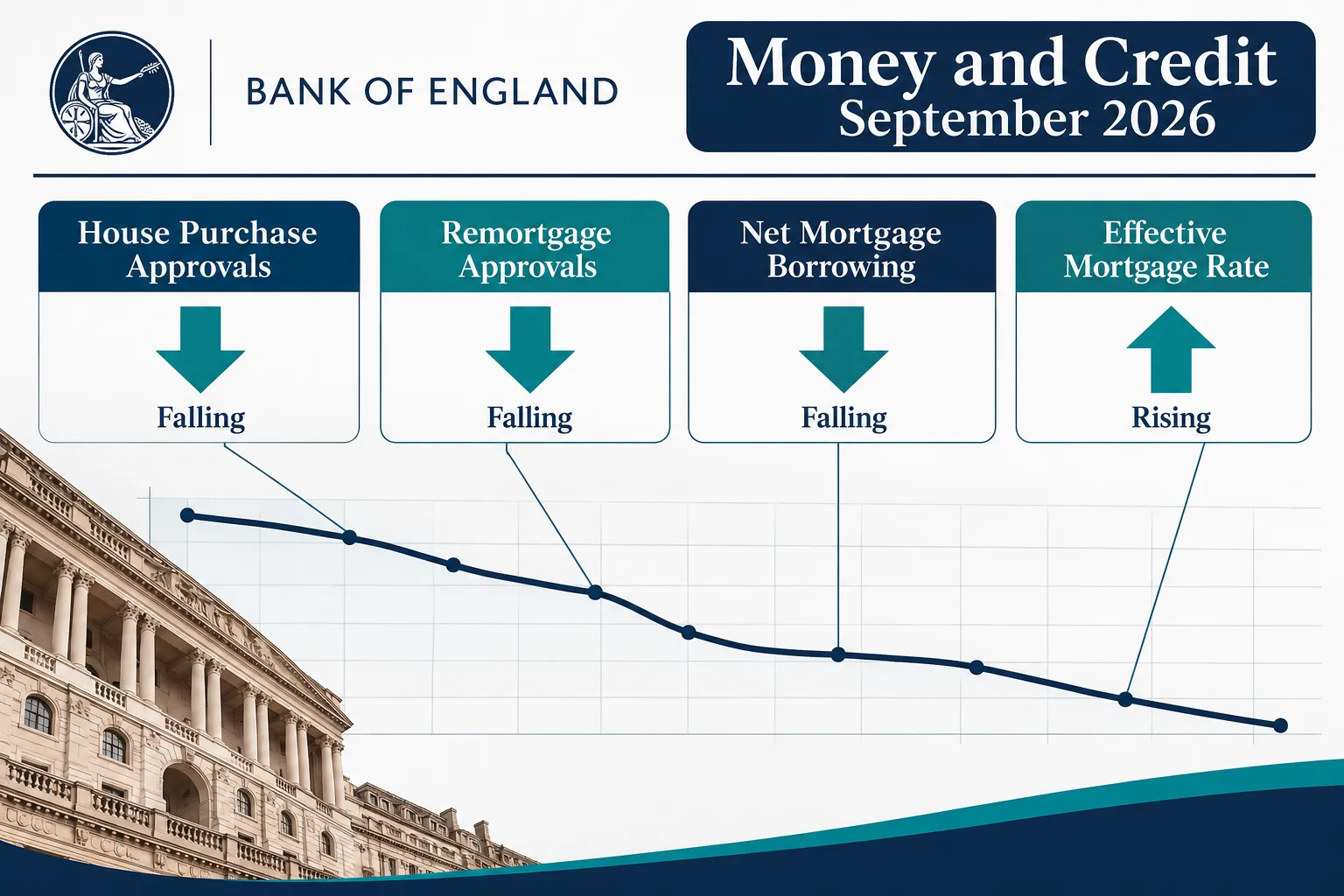
Other figures from the same release paint a picture of caution mixed with refinancing activity:
| Metric | September 2026 | Previous month | Change |
|---|---|---|---|
| House purchase approvals | 53,400 | 54,800 | Down |
| Remortgage approvals | 42,600 | 34,000 | Up 25% |
| Net mortgage borrowing | £3.9bn | £4.2bn | Down |
| Gross secured lending | £24.2bn | , | , |
| Repayments | £21.4bn | , | , |
| New mortgage rate (effective) | 4.63% | 4.60% | Up |
| Outstanding stock rate | 4.03% | , | Up |
| Net consumer credit borrowing | £1.9bn | £2.7bn | Down |
Jeremy Leaf, a north London estate agent and former RICS residential chairman, put it plainly: "Mortgage approvals are arguably the best barometer of future market activity." A decline of this scale tends to show up in completed sales two to three months later, meaning London's winter market could feel noticeably slower than usual.
Tomer Aboody of MT Finance was similarly blunt, saying the decline "reflects low confidence." Richard Pinch of Broadstone went further, describing a housing market "under increasing pressure," pointing to OBR forecasts that mortgage repayments could reach 4.25% of household disposable income by 2031, the highest since 2009, with the average effective mortgage rate expected to climb from 4% to around 5%.
Why Buyers Hit Pause: Budget, Bank Rate and the Autumn Squeeze
Much of September's hesitation traces back to the Autumn Budget, delivered on 28 October 2026 by Chancellor John Healey. Buyers reportedly held off making decisions until they knew what was coming. In the end, stamp duty was left unchanged. The headline new policy was a "Your First Home" equity-loan scheme for new-build first-time buyers, though the first loans will not be issued until April 2027, meaning it offers no immediate relief. A First Time Buyer ISA will eventually replace the Lifetime ISA, but only for new savers from April 2029.
Nathan Emerson, chief executive of Propertymark, called the approvals dip "disappointing, yet understandable" given that backdrop. John Phillips of Just Mortgages and Spicerhaart struck a more hopeful note, saying he expects pent-up demand to be released now the Budget uncertainty has passed.
Layered on top of this is the interest rate picture. Bank Rate currently stands at 3.75%, with a rise to 4% widely expected at the Monetary Policy Committee meeting on Thursday 5 November 2026, which would be the first increase since August 2023. CPI inflation was 3.5% in September, and average fixed mortgage rates are already close to 6%. Tom Bill of Knight Frank notes that approvals are now down by almost a fifth year on year, a sharper fall than the monthly figures alone suggest.
For context on how Bank Rate decisions have been moving through the year, see our earlier coverage of the Bank of England base rate hold in June 2026 and its impact on mortgage rates and UK property, and our analysis of the June 2026 base rate decision at 3.75% and what it meant for homebuyers.
What a Thinner Market Means for London Prices
Nationwide's October 2026 index, published 30 October, shows the average UK house price at £273,566, down 0.3% month on month and up just 0.5% year on year, the weakest annual growth rate since January 2024. London does not move in lockstep with national averages, but the direction of travel matters: a cooling, cautious market with fewer approvals typically means fewer competing bidders per property and longer selling times.

This mirrors trends covered in our pieces on UK house prices falling in June 2026 after Rightmove's biggest drop in 14 years and the subsequent third straight monthly rise in UK house prices in September 2026. London's market has been choppy all year, and this latest approvals dip adds another layer of uncertainty rather than a clean trend in either direction.
Why Surveys and Valuations Matter More in a Cautious Market
When fewer mortgages are being approved and lenders are more risk-averse, two problems become more common for London buyers and sellers: down-valuations and lapsed mortgage offers.
A down-valuation happens when the lender's own valuer assesses a property below the agreed sale price. In a nervous lending environment, valuers are more conservative. If this happens without independent evidence to challenge it, buyers either have to find extra cash, renegotiate the price, or walk away, sometimes collapsing the whole chain.
This is where an independent RICS Level 2 (HomeBuyer) survey, a Level 3 (Building) survey, or a separate RICS Red Book valuation becomes genuinely valuable, not just a box-ticking exercise:
- For buyers: a documented, independent assessment of condition and value gives concrete grounds to renegotiate the price or justify pulling out, rather than relying on gut feeling.
- For sellers: an accurate, realistic valuation before marketing reduces the risk of a late-stage lender down-valuation derailing an agreed sale.
- For both sides: clear written evidence speeds up renegotiation, because neither party is arguing from assumption.
Our previous article on how falling mortgage rates affect lender valuations and the RICS surveyor tools used when buyer enquiries pick up explains this dynamic in more detail, as does our guide to how mortgage lender survey requirements are evolving as lending caution intensifies in 2026.
"A further decline in mortgage approvals reflects low confidence.", Tomer Aboody, MT Finance
Five Things London Buyers Should Do This Month
- Reconfirm your mortgage offer in writing. With fewer approvals going through and rates ticking upward, offers can lapse or be re-priced. Check expiry dates now, not at exchange.
- Commission an independent survey before you commit further funds. A Level 2 or Level 3 RICS survey gives you leverage if the lender's own valuation comes in low.
- Get a separate RICS Red Book valuation if there's any doubt about price. This is distinct from the lender's valuation and can be used in negotiation.
- Watch the 5 November MPC decision closely. A move from 3.75% to 4% could affect fixed-rate pricing within days, particularly for anyone not yet locked in.
- Use the quieter market to negotiate, not just to wait. With approvals at a three-year low, sellers are more open to realistic offers, but only if buyers can show they are mortgage-ready and chain-free where possible.
For sellers wondering how to price sensibly in this environment, our article on chartered surveyor valuation techniques for stabilising London flats in 2026 offers practical guidance, and buyers weighing up affordability pressures may find our piece on surveyor strategies for navigating affordability crises in London and South East markets useful context.
Conclusion: Navigating a Cautious London Market
The mortgage approvals three-year low London buyers November 2026 figures are a clear signal that confidence has dipped, not collapsed. Remortgage activity remains strong, Budget uncertainty has passed, and an interest rate rise, while a headwind, is already largely priced into market expectations. For London buyers and sellers, the sensible response is not panic, but preparation: verify mortgage offers, commission independent surveys and valuations, and use documented evidence to negotiate from a position of fact rather than guesswork.
Prince Surveyors, RICS chartered surveyors based in London, can provide Level 2 HomeBuyer surveys, Level 3 Building surveys and independent Red Book valuations to support buyers and sellers through this cautious market. Contact Prince Surveyors today to book a survey or valuation before your next move.
FAQ
Why did mortgage approvals fall to a three-year low in September 2026?
A combination of buyers waiting for the Autumn Budget outcome, rising effective mortgage rates (now 4.63% on new lending), and anticipation of a Bank Rate rise contributed to the drop to 53,400 approvals, according to Bank of England data published 29 October 2026.
Does a fall in mortgage approvals mean London house prices will drop?
Not necessarily on its own. Nationwide's October 2026 index shows UK prices roughly flat, with annual growth at just 0.5%. Fewer approvals generally signal a slower, more cautious market rather than a guaranteed price fall, though it can increase buyers' negotiating power.
Should I get a survey even if my mortgage lender has already done a valuation?
Yes. A lender's valuation is primarily for the lender's risk assessment, not a full condition report. An independent RICS Level 2 or Level 3 survey, or a separate Red Book valuation, gives you documented evidence to challenge a down-valuation or negotiate price.
Will the Bank Rate rise on 5 November 2026 affect my mortgage immediately?
If you are on a fixed rate, no immediate change applies until your fix ends. If you are on a tracker or variable rate, or are about to lock in a new fixed deal, a rise from 3.75% to 4% could affect your monthly payments or the rate offered almost immediately.