

A net balance reading of -15% on buyer enquiries might sound discouraging at first glance — but within the context of the UK property market in 2026, it represents a measurable improvement from the deeply negative readings recorded throughout much of 2024 and 2025. That shift matters enormously to RICS chartered surveyors, who must translate improving demand signals into defensible, evidence-based property valuations. Understanding the valuation impacts of falling mortgage rates in 2026: RICS surveyor tools for buyer enquiry upticks is now central to accurate property assessment across the UK.
As mortgage rates ease from their recent peaks, surveyors face a dual challenge: capturing genuine affordability improvements in their valuations while guarding against premature price inflation driven by speculative demand. This article examines how RICS professionals are responding, what tools and frameworks they are using, and what buyers and sellers need to understand about property valuations in this shifting environment.
Key Takeaways
- Buyer enquiry net balances have improved to -15% in 2026, signalling a market recovery that directly influences comparable evidence used in RICS valuations.
- Falling mortgage rates improve monthly affordability but can also compress supply by encouraging homeowners to hold existing low-rate deals, creating upward price pressure.
- RICS Red Book valuations must reflect current market evidence, meaning surveyors are actively updating their comparable analysis to account for rate-driven demand shifts.
- AI-powered surveyor platforms and standardised equipment checklists are helping RICS professionals manage increased workloads as buyer activity rises.
- Buyers commissioning surveys in 2026 should understand that a mortgage valuation and a full RICS survey serve very different purposes.
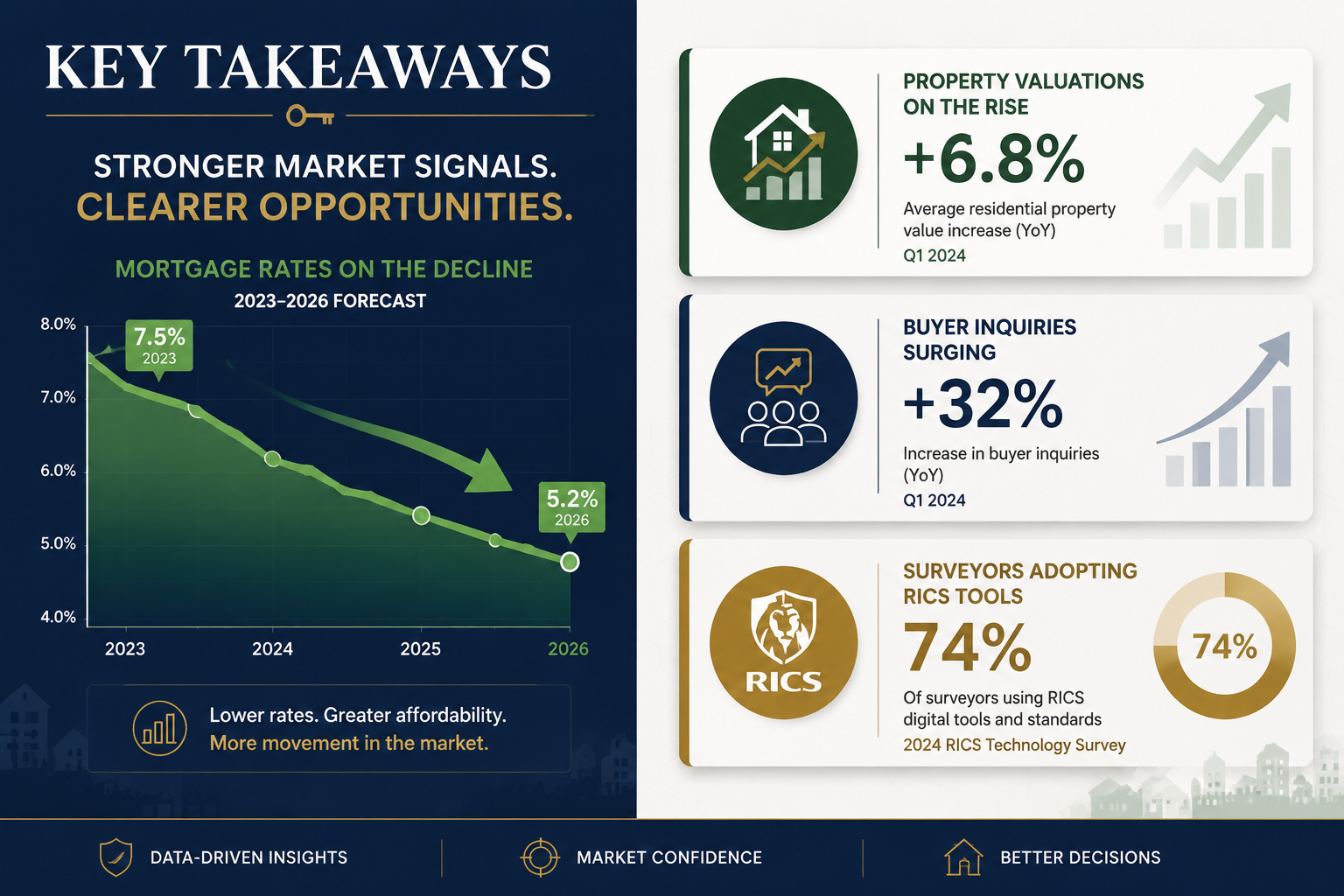
How Falling Mortgage Rates Are Reshaping Property Valuations in 2026
The relationship between mortgage rates and property values is well established, but the mechanics are more nuanced than a simple inverse correlation. When borrowing costs fall, monthly repayments decrease for a given loan size. This improves purchasing power, draws more buyers into the market, and — where housing supply is constrained — places upward pressure on transaction prices.
In 2026, the average 30-year fixed mortgage rate in the US stood at 6.52% in June, down from a peak of 6.91% in 2025 [1]. While UK and US markets operate differently, the global rate environment shapes investor sentiment and institutional lending behaviour on both sides of the Atlantic. In the UK, the Bank of England's rate decisions have similarly moved in a downward direction through 2025 and into 2026, providing relief to prospective buyers who were priced out during the peak tightening cycle.
The median home price in the US reached $403,200 in the first quarter of 2026 — nearly $100,000 higher than in 2020 [1]. UK house prices have followed a comparable trajectory. This means that even with lower rates, affordability remains stretched. RICS surveyors must therefore weigh two competing forces: improved borrowing conditions on one side, and elevated baseline prices on the other.
What the -15% Net Balance Means for Comparable Evidence
The RICS Residential Market Survey uses net balance figures to track directional trends in buyer enquiries, agreed sales, and price expectations. A net balance of -15% means more surveyors are reporting falling enquiries than rising ones — but the figure has improved substantially from the -40% to -50% readings seen during the rate-shock period of 2022-2023.
For valuation purposes, this matters because:
- Comparable sales evidence is becoming more plentiful as transaction volumes recover
- Time-on-market data is shortening in many regions, supporting higher valuations
- Sealed bid situations are re-emerging in high-demand urban areas, creating upward price pressure that surveyors must document carefully
RICS surveyors conducting RICS Red Book valuations are required to base their opinions of value on current market evidence. As buyer activity improves, the pool of relevant comparables expands, but surveyors must also guard against using outlier transactions driven by short-term rate optimism as representative benchmarks.
"A valuation is a snapshot of market value at a specific date. When market conditions are changing rapidly — as they are in 2026 — the currency of comparable evidence becomes critically important."
The Supply Constraint Problem
One factor complicating the valuation picture is the so-called "golden handcuff" effect. Many existing homeowners secured fixed-rate mortgages at sub-2% rates in 2020-2021. Moving home means surrendering those rates and taking on a new deal at today's higher costs. This suppresses the supply of second-hand homes coming to market, meaning that even modest improvements in buyer demand can create disproportionate upward price pressure in certain segments.
RICS surveyors must account for this supply-demand imbalance when assessing factors of valuation for any given property. A house in a catchment area with very few recent sales requires more careful comparable selection and greater reliance on adjusted evidence from neighbouring markets.
RICS Surveyor Tools for Managing Buyer Enquiry Upticks
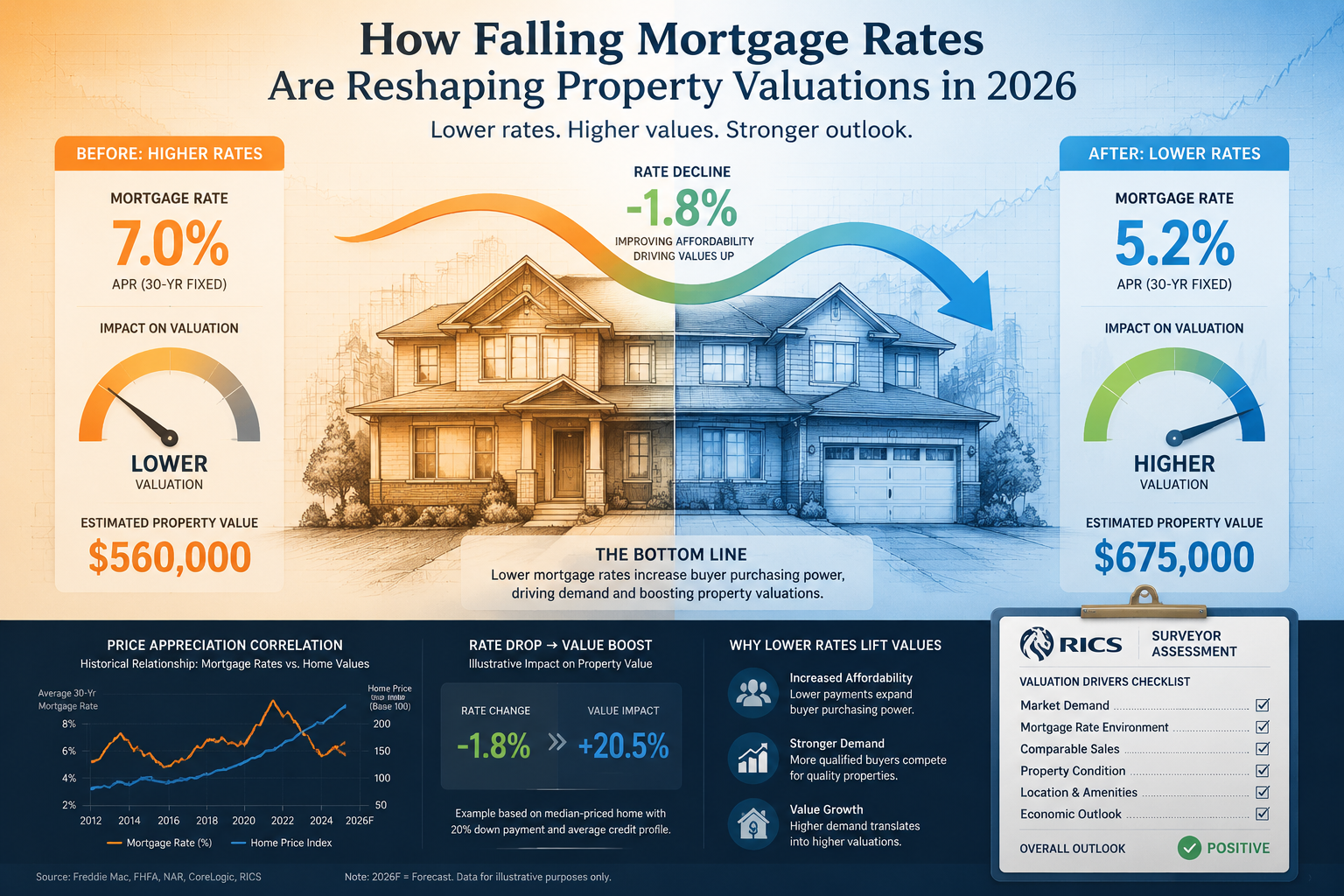
As buyer enquiries recover, RICS chartered surveyors face increased workloads. Instruction volumes for RICS home surveys and valuations are rising, and the profession has responded with both technological innovation and reinforced standards around equipment and methodology.
AI-Powered Report Generation
One of the most significant developments in 2026 is the formal recognition of AI-powered inspection platforms within the RICS ecosystem. Surveyor AI, an AI-powered inspection platform, has been approved as an official RICS Tech Partner, enabling UK property professionals to generate professional survey reports with up to 80% time savings per report [2]. This is not about replacing professional judgement — it is about reducing the administrative burden so that surveyors can focus on the analytical and interpretive work that requires human expertise.
For buyers, this means faster turnaround times on survey reports during periods of high market activity. For surveyors, it means the ability to handle more instructions without compromising the quality of individual assessments.
The RICS Equipment Checklist
Technology alone does not make a good survey. RICS provides a detailed equipment checklist for surveyors, emphasising the importance of reliable physical tools to ensure accurate property assessments [3]. The core toolkit for a residential inspection includes:
| Tool | Purpose |
|---|---|
| Electronic moisture meter | Detecting damp penetration and rising damp |
| Powerful LED torch | Inspecting roof voids, underfloor spaces, and poorly lit areas |
| Spirit level | Checking structural alignment and floor levelness |
| Binoculars | Assessing roof coverings and high-level external elements |
| Probe / bradawl | Testing timber for rot and insect attack |
| Camera with zoom | Documenting defects for the written report |
When buyer enquiry volumes rise sharply, there is a risk that some surveyors — particularly those under commercial pressure to increase throughput — may cut corners on physical inspection. RICS standards are explicit: no amount of digital tooling replaces a thorough on-site assessment using calibrated equipment.
Forecasting Models and Market Adjustment Factors
Beyond the physical inspection, RICS surveyors use structured forecasting models to contextualise their valuations within broader market trends. In 2026, these models must incorporate:
- Rate sensitivity analysis — How much of current buyer demand is rate-driven versus structural?
- Inventory adjustment — What is the local supply pipeline, and how will it affect prices over the next 6-12 months?
- Affordability stress testing — At what rate level would demand materially weaken again?
- Regional divergence — National trends mask significant local variation; Manchester, London, and rural markets are behaving very differently.
The Federal Reserve's policies in the US, and the Bank of England's equivalent decisions in the UK, do not directly set mortgage rates but exert powerful indirect influence over the interest rate environment [1]. RICS surveyors who understand this transmission mechanism can produce more robust forward-looking commentary in their valuation reports.
For those seeking specialist advice, chartered surveyors in London and across the regions are increasingly incorporating rate scenario modelling into their client-facing reports, particularly for commercial clients and portfolio investors who need to understand valuation sensitivity across multiple rate environments.
Practical Implications for Buyers, Sellers, and Investors in 2026
Understanding the valuation impacts of falling mortgage rates in 2026 and the RICS surveyor tools for buyer enquiry upticks is not just an academic exercise. It has direct, practical consequences for anyone transacting in the property market this year.
For Buyers: Survey vs. Valuation
A common and costly misconception is that a mortgage valuation provides sufficient protection for a buyer. It does not. A mortgage valuation is conducted for the lender's benefit — it answers only whether the property is adequate security for the loan. It does not identify structural defects, damp problems, or costly repairs that could affect the buyer's decision or negotiating position.
For a comprehensive assessment, buyers should commission an independent RICS home survey or, for older or more complex properties, a RICS Level 3 Building Survey. RICS offers consumer guides to help homebuyers understand the different survey types and their relative benefits [4]. In a market where buyer competition is increasing, the temptation to skip a survey to speed up a transaction is understandable but risky.
As buyer enquiries rise and transactions accelerate, the risk of purchasing a property with undisclosed defects increases. A thorough survey provides the evidence base for price renegotiation or, in serious cases, withdrawal from a transaction before legal completion.
For Sellers: Accurate Pricing in a Recovering Market
Sellers in 2026 face the challenge of pricing accurately in a market that is improving but not yet fully recovered. Overpricing relative to comparable evidence will result in extended time on market, which itself becomes a negative signal to subsequent buyers. Underpricing in areas of genuine demand compression means leaving money on the table.
A professional RICS Red Book valuation provides an independent, evidence-based opinion of market value that estate agents' appraisals — which are often commercially motivated — cannot replicate. This is particularly important for:
- Probate and estate sales
- Matrimonial and divorce settlements
- Shared ownership transactions
- Properties with unusual characteristics or limited comparable evidence
For shared ownership properties specifically, the valuation methodology must comply with strict RICS protocols. Buyers and housing associations can learn more about the specific requirements through guidance on RICS shared ownership valuations.
For Investors: Rate-Adjusted Yield Analysis
Property investors face a more complex calculus. Falling mortgage rates improve financing costs but also tend to compress yields as capital values rise. In 2026, investors must assess:
- Net initial yield after accounting for higher purchase prices
- Reversionary yield based on rental growth projections
- Void risk in markets where tenant demand may not keep pace with capital value growth
- Exit strategy viability at various future rate scenarios
RICS valuers working on investment properties use discounted cash flow models alongside traditional comparable evidence. For investors holding properties subject to lease extension obligations, a professional lease extension valuation is essential to understanding the true cost of extending and its impact on the overall investment return.
Regional Variations Worth Noting
The national picture conceals significant regional divergence. Northern cities like Manchester have seen stronger relative price growth driven by employment migration and infrastructure investment. London markets remain bifurcated, with prime central areas recovering more slowly than outer boroughs. Buyers and investors in areas such as West London and South West London are operating in micro-markets with distinct supply and demand dynamics that national rate trends alone cannot explain.
RICS surveyors operating in these regions must maintain granular knowledge of local comparable evidence, planning pipelines, and demographic trends to produce valuations that genuinely reflect local market conditions rather than simply applying national rate-adjustment factors.
Right to Buy and Specialist Valuations
For council tenants exercising their Right to Buy in 2026, falling mortgage rates have improved affordability at the margin, making more purchases financially viable. However, the valuation methodology for Right to Buy is strictly prescribed, and the discount calculation must be applied correctly. Specialist guidance on Right to Buy valuations ensures that both the tenant and the local authority receive a fair and compliant assessment.
Conclusion
The valuation impacts of falling mortgage rates in 2026 and the RICS surveyor tools for buyer enquiry upticks represent a defining challenge and opportunity for the UK property profession. As buyer enquiries recover from their deeply negative readings toward a net balance of -15%, surveyors must update their comparable evidence frameworks, deploy modern technology responsibly, and maintain rigorous physical inspection standards to produce valuations that are both accurate and defensible.
Actionable next steps for stakeholders in 2026:
- Buyers should commission an independent RICS survey — not just a mortgage valuation — before exchanging contracts, particularly as market pace increases.
- Sellers should obtain a professional RICS Red Book valuation to set an evidence-based asking price rather than relying solely on estate agent appraisals.
- Investors should stress-test their yield assumptions against multiple rate scenarios and seek specialist RICS valuation advice for complex assets.
- Surveyors should review their equipment checklists, explore RICS-approved AI tools to manage rising workloads, and ensure their comparable databases are updated to reflect the most recent transaction evidence.
- All parties should engage only with RICS-qualified professionals, verifiable through the official RICS firms directory [5], to ensure that valuations and surveys meet the profession's mandatory standards.
The property market in 2026 is in transition. Those who act on accurate, professionally produced valuation evidence will be best positioned to make sound decisions — whether buying, selling, or investing.
References
[1] How The Federal Reserve Affects Mortgage Rates – kiplinger.com
[2] surveyorai – surveyorai.io
[3] Equipment Checklist – rics.org
[4] Consumer Guides – rics.org
[5] ricsfirms – ricsfirms.com
How Prince Surveyors can help: explore our property valuations or learn about our which survey you need.