

A residential property that has been converted to an HMO, office or retail unit does not simply carry its old value forward. The moment its lawful use changes, so does the entire basis on which a RICS-registered valuer must assess it. Getting that assessment wrong, whether at purchase, refinance or dispute, can cost an owner tens of thousands of pounds.
This article explains how UK surveyors approach property value after a change of use, covering the valuation methods, evidence requirements, compliance factors and risk adjustments that determine whether a conversion genuinely adds value or quietly destroys it.
Key Takeaways
- A change of use shifts the valuation method from comparable sales to income capitalisation or commercial comparables, depending on the new use class.
- Planning status and licensing compliance are the first things a surveyor checks, an unlawful use can make a property unmortgageable.
- HMO gross yields exceeded 7% in Q2 2026, making income-based uplift real, but conversion and compliance costs must be deducted before any net gain is confirmed.
- Regional location determines whether the value uplift is material: the North and Midlands show the strongest gains; London and the South East show tighter margins.
- Reinstatement risk, purchaser demand and exit strategy all affect the final valuation figure, not just the income the property currently generates.
Why the Valuation Method Changes After a Change of Use
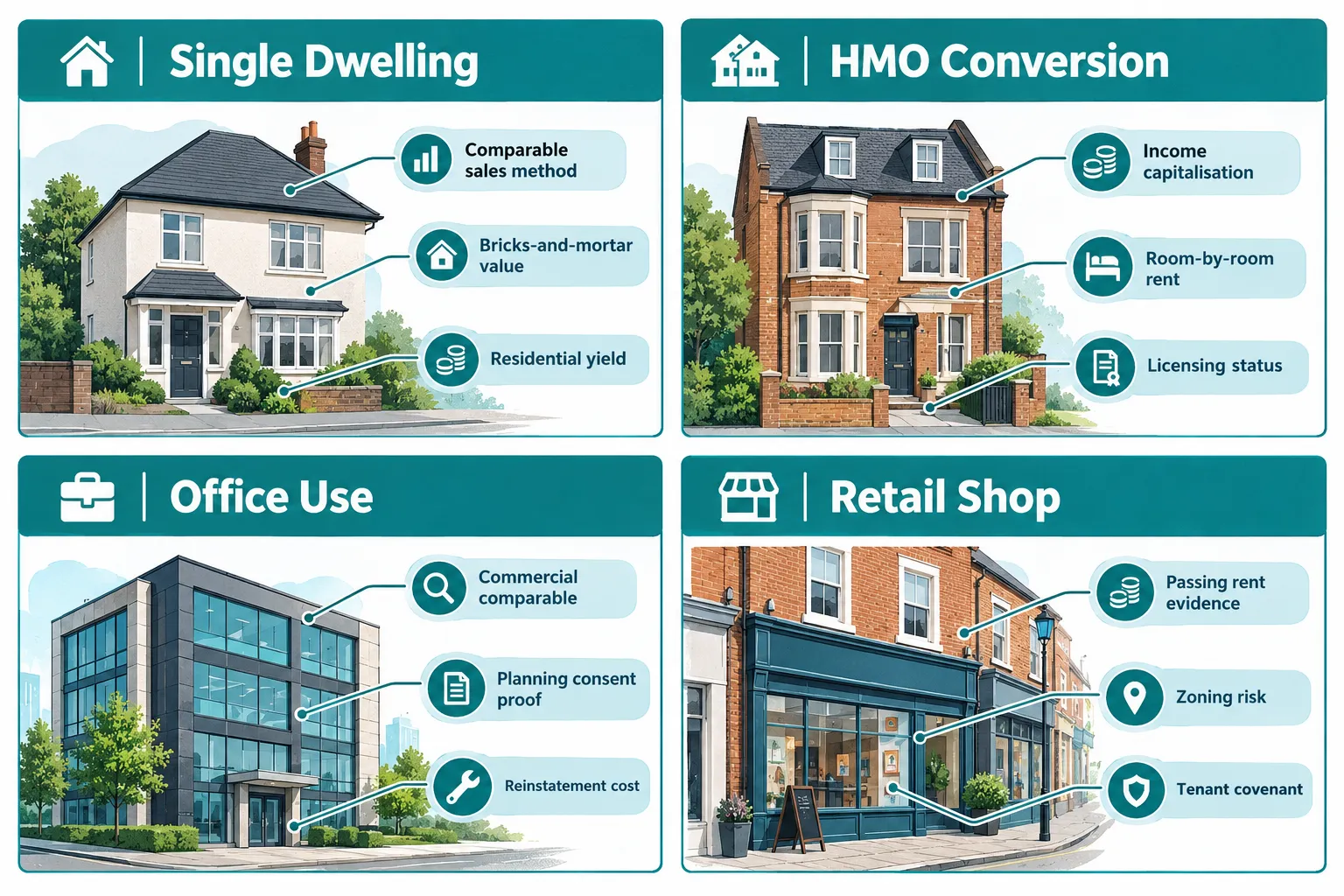
A standard residential house is valued by the comparable sales method: the surveyor finds recent sales of similar properties in the same area and adjusts for size, condition and location. That method works because there is a deep market of owner-occupiers and buy-to-let investors buying on broadly similar terms.
Once a property moves to a different use class, whether that is a C4 HMO, a sui generis large HMO, or a commercial class E or A1 use, the buyer pool changes entirely. Lenders, investors and owner-operators now assess the property on what it earns, not just what it looks like. A surveyor instructed to value such a property must follow the RICS Valuation, Global Standards (the Red Book) and select the method appropriate to the asset type.
For an HMO, that typically means an income capitalisation approach: the surveyor establishes the gross rental income from all rooms, deducts void allowances, management costs and maintenance, then capitalises the net income at a yield derived from comparable investment transactions. For a commercial conversion, office or retail, the surveyor will look at passing rents, lease terms and comparable yields for that use class in the local market.
This shift matters because the two methods can produce very different figures for the same building. A Victorian terrace worth £280,000 as a family home might be worth £350,000 as a licensed six-bedroom HMO in a university town, or it might be worth less if the conversion has been done poorly, the licensing is non-compliant, or the local HMO market is saturated.
For a broader look at why owners commission professional valuations in the first place, see 4 reasons why property owners hire surveyors.
How UK Surveyors Assess Conversion from House to HMO: The Income Approach in Practice
HMO investment has attracted sustained attention in 2026. Paragon Bank data reported by trade press shows that HMO gross yields exceeded 7% in Q2 2026, with some operators in Northern cities reporting gross figures above 10% on well-run properties [2][5]. That income premium over single-let buy-to-let is the core commercial driver behind most house-to-HMO conversions.
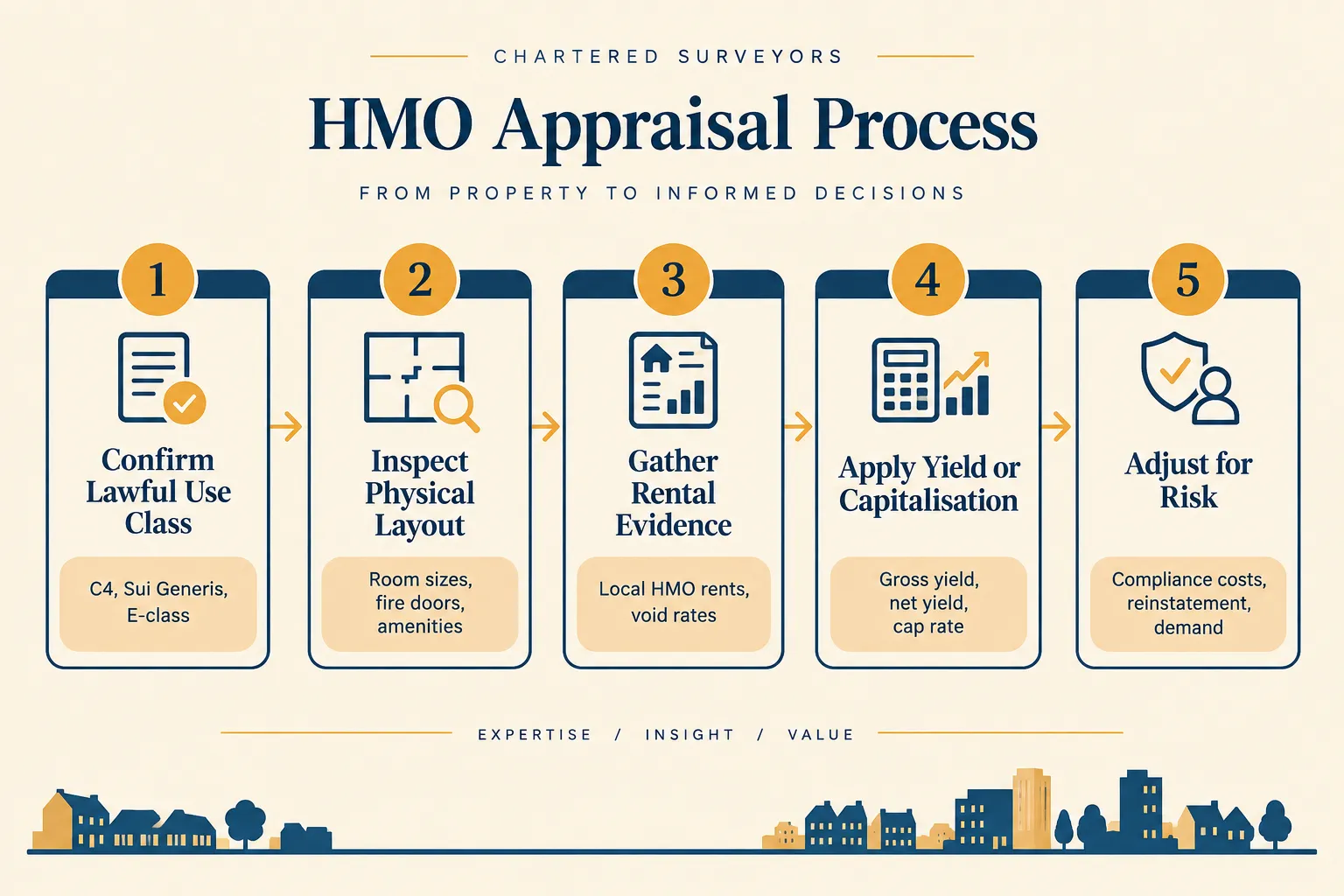
A RICS valuer assessing an HMO conversion works through the following steps.
Step 1, Confirm lawful use and planning consent
The first question is whether the change of use was lawful. A property housing between three and six unrelated occupants sharing facilities falls within Use Class C4 in England. In many local authority areas, a C4 HMO requires planning permission under an Article 4 Direction. Large HMOs of seven or more occupants are sui generis and always require planning consent.
If the conversion was carried out without the required permission, the property may have an unlawful use. Most mortgage lenders will not lend against an unlawful use, and the surveyor must flag this prominently in any valuation report. The value attributed to the HMO income stream is at risk if enforcement action could revert the property to residential use.
Step 2, Check mandatory and additional licensing
All HMOs in England with five or more occupants forming two or more households require a mandatory HMO licence under the Housing Act 2004. Many councils also operate additional or selective licensing schemes covering smaller HMOs. A surveyor will ask to see the current licence, check its expiry date and confirm that the property meets the conditions attached to it.
An unlicensed HMO is a significant valuation risk. The local authority can serve a rent repayment order, and tenants can reclaim up to 12 months' rent. Any income stream that is legally at risk cannot be capitalised at full face value.
Step 3, Assess the physical layout and compliance
The surveyor inspects the property against the HMO Management Regulations 2006 and the council's own room-size standards. Minimum room sizes (currently 6.51 sq m for a single adult), adequate kitchen and bathroom provision, fire detection systems, fire doors and emergency lighting all affect whether the current room count is sustainable.
A property that appears to generate income from eight rooms but whose layout only meets the standard for six will be valued on six rooms. Overcrowding or non-compliant room sizes are not income; they are a liability.
Step 4, Gather local rental evidence
The surveyor needs market rent evidence for comparable HMO rooms in the same area. This is not always easy to find, HMO transactions are less frequently recorded in Land Registry data than standard residential sales. Surveyors draw on letting agent data, their own comparable databases and published market reports [1][3].
HMO market reports show that average room rents vary significantly by city. Manchester, Leeds, Birmingham and Liverpool have shown strong room-rent growth through 2025 and into 2026, underpinning investor confidence [10]. London room rents are higher in absolute terms but yield compression means the income premium over single-let is narrower.
Step 5, Apply a yield or gross income multiplier
Once a sustainable net income figure is established, the surveyor selects a capitalisation rate. This is derived from comparable HMO investment sales, properties sold with their HMO use intact, to investors, in the same or similar markets.
In Q1, Q2 2026, surveyors in Northern England and the Midlands have been working with gross yields in the 7-10% range for quality, compliant HMOs [2][5]. That implies a gross income multiplier of roughly 10-14 times annual gross rent. Net yields, after costs, are typically 5-8% for well-run properties.
The professional landlord valuations in 2026 article covers how building surveyors assess institutional buy-to-let investments, which shares methodology with HMO valuation.
Assessing Conversion from House to Office or Shop
Office and retail conversions follow a different path. The planning framework for commercial uses falls under Use Class E (which consolidated offices, retail, cafés and light industrial in September 2020) and, for some uses, sui generis or F-class designations.
Office conversions
A house converted to an office is typically valued on a rent per square foot basis, using comparable office lettings in the local market. The surveyor will consider:
- The lease terms achievable (length, rent review pattern, tenant covenant strength)
- The quality of fit-out and whether it meets modern occupier expectations
- Permitted development rights: since 2013, Class MA and its predecessors have allowed office-to-residential conversions under permitted development in many cases, which affects the exit value and therefore the investment value of an office
For a detailed look at structural and valuation issues in office conversions, see building surveys for office-to-resi conversions and the companion piece on expert witness valuations for office-to-residential conversions.
Retail (shop) conversions
A residential property converted to a shop is valued on passing rent and comparable retail yields. The surveyor will look at Zone A rents (the retail industry's method of weighting frontage value) for comparable units on the same or similar streets. Retail yields have widened in many secondary locations since 2020, meaning that a shop conversion does not automatically generate a higher value than the residential use it replaced.
The surveyor must also consider reinstatement risk, the cost and feasibility of converting the property back to residential use if the commercial tenant vacates or the commercial market deteriorates. A property with a shop front and altered internal layout may be harder to sell as a family home, reducing the residential comparator value and therefore the floor under the investment.
Costs, Risk Adjustments and the Valuation Uplift That Is Not Purely Mechanical
The income premium from an HMO or commercial conversion is real, but it does not translate directly into a pound-for-pound increase in capital value. A surveyor assessing property value after a change of use must account for several deductions and risk adjustments.
| Factor | Effect on Valuation |
|---|---|
| Conversion and fit-out costs | Reduce net gain; must be deducted from any uplift |
| Licensing and compliance costs | Ongoing; affect net income and therefore capitalised value |
| Management costs | HMOs typically cost 12-15% of gross rent to manage professionally |
| Void rates | Higher room turnover than single-let; surveyor applies a void allowance |
| Reinstatement cost | Cost to revert to prior use; affects purchaser's risk appetite |
| Purchaser pool | Narrower market of specialist investors; may require a liquidity discount |
| Enforcement risk | Unlawful or non-compliant use reduces value materially |
| Article 4 Direction | Limits future HMO supply; can support values in restricted areas |
The net effect is that a well-executed, fully compliant HMO conversion in a high-demand location, a university city in the North or Midlands, for example, can generate a meaningful capital value uplift over the single-let residential comparator [10]. An HMO that is poorly converted, under-licensed or in a saturated market may be worth less than the equivalent single-let house, because the specialist purchaser will price in the cost of remediation and the narrower exit options.
For context on how surveyors apply valuation techniques in recovering regional markets, the article on valuation techniques for stabilising house prices using the RICS Q1 2026 survey is worth reading alongside this one.
Regional Variation: Where Change of Use Adds the Most Value
Location is not a secondary consideration, it is often the primary one. Surveyors working on property value after a change of use will reach different conclusions in different markets.
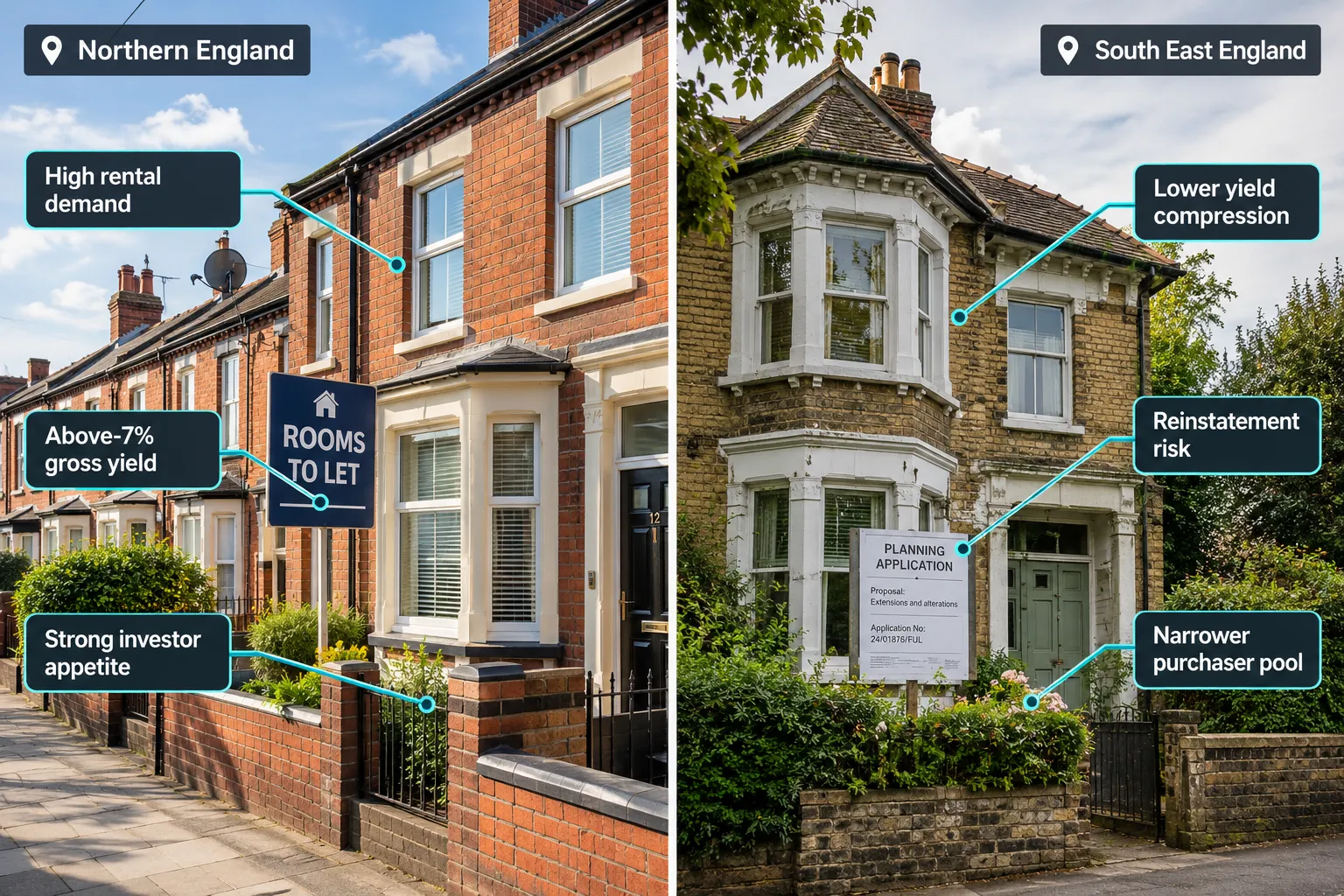
Northern England and the Midlands have shown the strongest yield compression and investor appetite for HMOs through 2025 and into 2026 [2][10]. Cities such as Manchester, Leeds, Sheffield, Birmingham and Nottingham combine large student and young professional populations with relatively lower purchase prices, producing gross yields that justify the income-capitalisation premium over residential value.
London and the South East present a different picture. Purchase prices are high relative to achievable room rents, meaning gross yields are lower, often 5-6% for HMOs in inner London, and the income-capitalisation value may not exceed the residential comparator by a meaningful margin. The surveyor's analysis here is more likely to show that the HMO use adds modest value, or that the property is worth more to an owner-occupier than to an HMO investor.
Scotland and Wales have their own licensing and planning frameworks. Scottish HMO licensing is mandatory for all HMOs of three or more unrelated persons, and the licensing authority is the local council. Welsh HMOs are subject to Rent Smart Wales requirements. A surveyor must apply the correct regulatory framework for the jurisdiction.
For regional valuation context, see regional divergence in UK property valuations.
What Surveyors Look for in a Change of Use Valuation Report
A RICS-compliant valuation report for a property that has undergone a change of use should address the following:
- Basis of value: Market Value as defined in the Red Book, or Existing Use Value for commercial properties
- Assumed use: The report must state whether it values the property in its current use or on an alternative use basis
- Planning and licensing status: Confirmed lawful use, licence details, any conditions or restrictions
- Income evidence: Actual passing rents, market rents, void history
- Comparable transactions: HMO investment sales or commercial lettings used as comparables
- Yield selection: Rationale for the capitalisation rate applied
- Risk adjustments: Compliance costs, reinstatement, liquidity discount if applicable
- Special assumptions: If the valuation assumes a licence will be granted, or that works will be completed, these must be stated explicitly
A valuation that does not address these points is unlikely to withstand scrutiny in a mortgage application, a dispute or litigation. For the standards applied in disputed valuations, see expert witness roles in high-value property valuation disputes.
FAQ
Does a change of use always increase property value?
No. The income from an HMO, office or shop can produce a higher capitalised value than the residential comparator, but only if the conversion is lawful, compliant, well-executed and in a location with genuine occupier demand. Poorly converted or non-compliant properties can be worth less than the equivalent residential use.
Can a standard residential mortgage be used to buy an HMO?
Generally not. Most lenders require a specialist HMO mortgage product for properties with four or more lettable rooms. The lender's valuer will assess the property on its HMO income, not on residential comparables.
What happens if planning permission was not obtained for the change of use?
The property has an unlawful use. The local authority can issue an enforcement notice requiring reversion to the prior lawful use. Most mortgage lenders will not lend against an unlawful use, and the surveyor must reflect the enforcement risk in the valuation.
How does an Article 4 Direction affect HMO values?
An Article 4 Direction removes permitted development rights for C3 to C4 conversions in a defined area, meaning planning permission is required. This restricts the supply of new HMOs, which can support values for existing licensed HMOs in the same area, a factor surveyors note when selecting comparable yields.
What is reinstatement risk and why does it matter?
Reinstatement risk is the cost and difficulty of converting a property back to its prior use if the current use becomes unviable. A heavily altered commercial conversion may be expensive to return to residential use, reducing the floor value and therefore the risk-adjusted investment value.
Do surveyors need specialist knowledge to value HMOs?
Yes. RICS guidance expects valuers to have competence in the asset type they are valuing. An HMO valuation requires knowledge of HMO licensing law, room-size standards, local rental markets and HMO investment transaction evidence. A general residential valuer without that knowledge should decline the instruction or seek specialist input.
Conclusion
Property value after a change of use is not a simple uplift calculation. A surveyor's assessment of a conversion from house to HMO, office or shop rests on planning status, licensing compliance, physical layout, rental evidence, yield selection and a series of risk adjustments that reflect the realities of the specialist purchaser market.
HMO gross yields above 7% in Q2 2026 confirm that the income premium over single-let residential is real and sustained [2][5]. That income premium is the foundation of the value uplift that change-of-use conversions can generate, but it is only realised when the conversion is lawful, the licensing is in order, the layout meets current standards and the location supports genuine occupier demand.
For owners, investors and lenders, the practical steps are clear:
- Confirm planning consent and licensing before commissioning a valuation.
- Instruct a RICS-registered valuer with demonstrable experience in the relevant use class.
- Provide full income and void data, not just headline room rents.
- Understand that the valuation reflects net income capitalised at a market yield, not gross income at face value.
- Factor in reinstatement costs and the narrower purchaser pool when assessing the true return on a conversion.
A surveyor who applies these principles will produce a valuation that is defensible at mortgage, at sale and, if necessary, in a dispute.
References
[1] Hmo Market Report – thehmomortgagebroker.co.uk
[2] Hmo Properties Drive Landlord Yields Above 7 In Q2 2026 – propertywire.com
[3] Best Yield For Landlords – foxdavidson.co.uk
[5] Paragon Hmo Yields Landlord Returns Above 7 – landlordknowledge.co.uk
[10] Best Places To Buy An Hmo In The Uk – foxdavidson.co.uk