

Last updated: July 24, 2026
Quick Answer: Expert witness valuations in 2026 must now formally account for carbon performance and ESG factors under the RICS fourth-edition global sustainability standard, effective from April 2026. Chartered surveyors providing expert witness evidence are required to apply these carbon adjustments systematically, and failure to do so risks undermining the credibility of their reports in legal and dispute proceedings. The cautious 2026 property market makes this more consequential, not less, because buyers, lenders, and tribunals are scrutinising sustainability credentials more closely than at any previous point.
Key Takeaways
- The RICS fourth-edition ESG and sustainability standard became mandatory for accredited valuers from April 2026, requiring systematic carbon and ESG factor integration in all qualifying valuations.
- Expert witness valuations differ from standard Red Book valuations in their purpose, format, and the level of evidential rigour they must withstand in court or tribunal settings.
- The RICS Sustainability Report 2025 recorded a decline in the Sustainable Building Index from +41 in 2024 to +30 in 2025, signalling market caution rather than collapse.
- Approximately 46% of construction professionals reported not measuring carbon emissions across projects in 2025, up from 34% in 2024, creating a data gap that directly affects valuation accuracy.
- Carbon adjustments in valuations are not yet universally mandated by UK statute, but RICS professional standards make them effectively compulsory for RICS-accredited valuers.
- The CLEAR initiative (Carbon Lifecycle Emissions Assessment and Reporting), launched in April 2026, is expected to standardise carbon measurement methodology across international markets.
- Properties with poor EPC ratings or high embodied carbon face measurable downward adjustments in 2026 valuations; high-performing green assets command a demonstrable premium.
- Expert witness valuations typically cost more than standard valuations due to the additional research, report format, and professional liability involved.
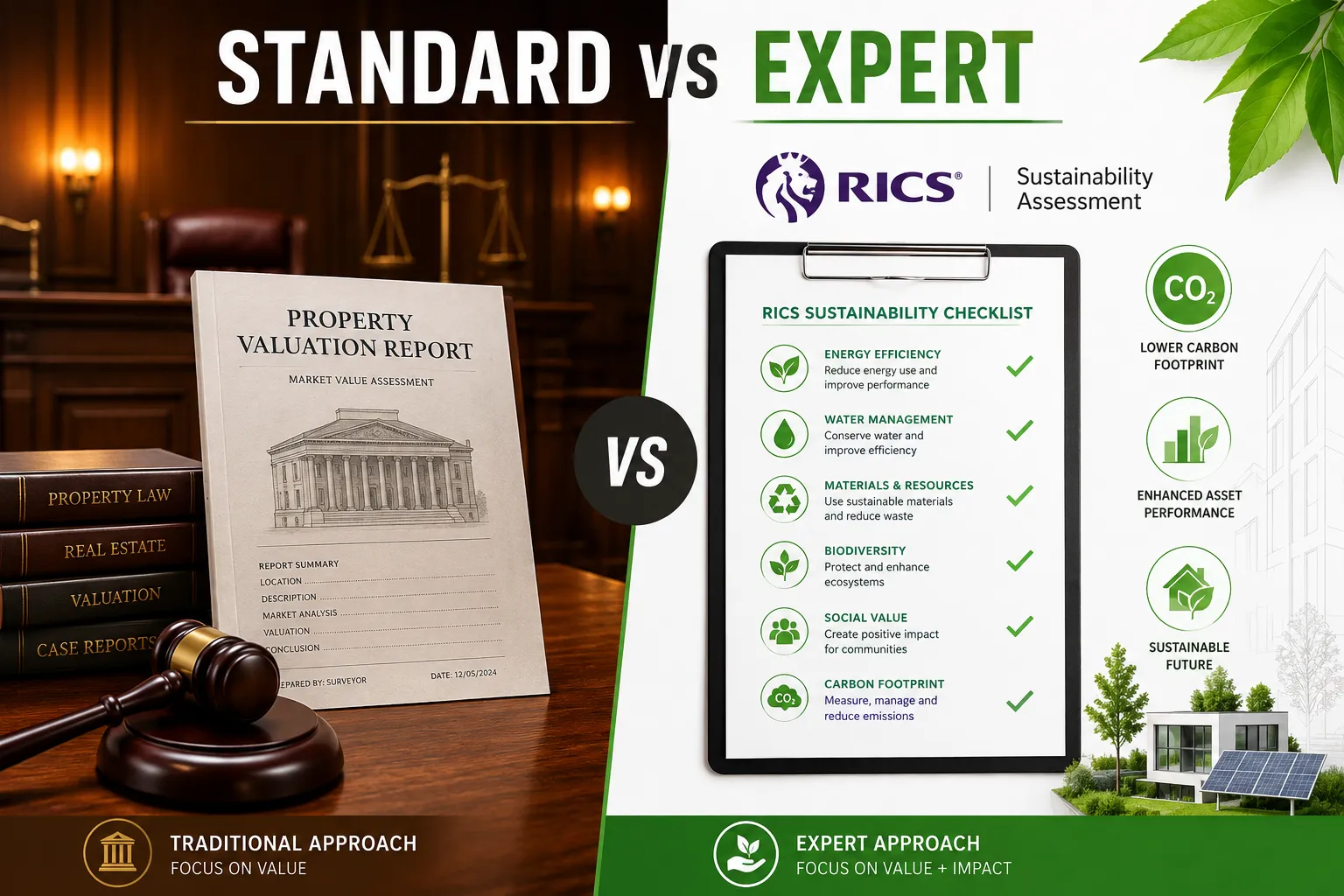
What Is an Expert Witness Valuation in Real Estate?
An expert witness valuation is a formal property valuation prepared by a qualified chartered surveyor specifically for use as evidence in legal, tribunal, or dispute resolution proceedings. Unlike a standard mortgage or purchase valuation, it must meet the procedural requirements of the Civil Procedure Rules (CPR Part 35 in England and Wales) and withstand cross-examination.
The key distinctions are:
- Purpose: Produced for courts, arbitration panels, tax tribunals, matrimonial proceedings, or compulsory purchase disputes rather than for lending or purchase decisions.
- Format: Structured as an expert's report with a declaration of independence, methodology explanation, and the expert's overriding duty to the court rather than to the instructing party.
- Scrutiny level: The valuer may be called to give oral evidence and defend every figure and assumption under questioning.
Common mistake: Instructing a valuer who is highly experienced in standard residential valuations but unfamiliar with CPR Part 35 requirements. The report may be technically sound but procedurally inadmissible. For disputes involving inheritance tax or capital gains, see the inheritance tax valuation and capital gains valuation services as starting points for understanding the valuation type needed.
What's the Difference Between a Standard Valuation and an Expert Witness Valuation?
A standard Red Book valuation establishes market value for a client's practical purpose (mortgage, sale, insurance). An expert witness valuation establishes value for evidential purposes and must demonstrate the reasoning process transparently enough for a judge or arbitrator to evaluate it independently.
| Feature | Standard Valuation | Expert Witness Valuation |
|---|---|---|
| Primary duty | To the client | To the court/tribunal |
| Format | Red Book compliant report | CPR Part 35 expert report |
| Carbon/ESG disclosure | Required from April 2026 | Required plus reasoned justification |
| Cross-examination risk | None | High |
| Cost range (estimate) | £300,£800 residential | £1,500,£5,000+ depending on complexity |
The carbon adjustment reasoning is especially important in expert witness reports because opposing counsel will probe whether the adjustment is evidence-based or speculative. Surveyors must cite comparable market transactions and the RICS ESG standard to defend any figure applied.
How Does the RICS Sustainability Report 2025 Affect Property Valuations?
The RICS Sustainability Report 2025 directly informs valuation practice by documenting where the market is heading on green assets and carbon performance. Its findings feed into the fourth-edition RICS ESG and sustainability global standard, which became mandatory for accredited valuers from April 2026.
Three findings from the 2025 report have the most direct impact on valuations:
- The Sustainable Building Index fell to +30 from +41. This indicates that demand for green assets is still net positive but growing more slowly. Valuers cannot assume an automatic green premium without transaction evidence.
- 46% of construction professionals did not measure carbon in 2025. This data gap means valuers must apply professional judgment where hard data is absent, and must document that judgment explicitly.
- Mandatory carbon disclosure recommendations. The report advocates for compulsory carbon assessment disclosures, signalling the direction of future regulation even where current statute does not yet require it.
For valuers preparing expert witness reports, these findings mean that any valuation produced from April 2026 without a documented ESG and carbon consideration risks being challenged as non-compliant with current RICS standards.
What Are Carbon Adjustments in Property Valuation?
Carbon adjustments are quantified modifications to a property's assessed market value that reflect its carbon performance, either positively or negatively. They sit within the broader ESG framework but focus specifically on operational carbon (energy use in occupation) and, increasingly, embodied carbon (carbon locked into building materials).
How adjustments are applied in practice:
- A property with an EPC rating of F or G may receive a downward adjustment reflecting anticipated capital expenditure to meet minimum energy efficiency standards, future regulatory risk, and reduced buyer pool.
- A property with an EPC A rating, solar generation, and a certified low embodied carbon construction may receive an upward adjustment where comparable market evidence supports a premium.
- Where transaction evidence is thin (as it often is in 2026 for highly specialist green assets), valuers use a cost-based approach, estimating the cost of bringing the property to a benchmark standard and reflecting that as a deduction.
Edge case: Carbon adjustments for commercial property are more developed than for residential. In residential expert witness valuations, the adjustment methodology must be explained with particular care because residential comparable evidence rarely isolates carbon performance as a standalone variable.
Why Is the 2026 Real Estate Market Cautious?
The 2026 UK property market is cautious primarily because of the convergence of three pressures: persistent affordability constraints following the 2022-2024 interest rate cycle, increased regulatory compliance costs (including the new RICS ESG requirements), and uncertainty about the pace of mandatory retrofit legislation.
This caution is not uniform. Key patterns in 2026 include:
- Lenders tightening ESG due diligence on commercial and buy-to-let portfolios, which increases the scrutiny on valuations supporting those loans.
- Buyers discounting energy-inefficient properties more aggressively than in previous years, particularly in the owner-occupier market.
- A slowdown in green development starts partly reflected in the RICS index decline, as developers wait for clearer regulatory signals before committing to high-specification sustainable builds.
For property professionals advising clients on market positioning, the guide to preparing your property for market covers practical steps that also affect ESG-related value factors.

How Do RICS Guidelines Handle ESG in Valuations?
The fourth edition of the RICS ESG and sustainability global standard, effective from April 2026, provides a structured framework for incorporating ESG factors into valuation advice. It applies to all RICS-accredited valuers globally, with jurisdiction-specific sections for the UK, EU, and Australia.
Key elements of the standard:
- Valuers must systematically consider ESG factors as part of every qualifying valuation instruction, not just when a client specifically requests it.
- The standard distinguishes clearly between valuation (the valuer's core role) and strategic ESG advisory (a separate service). A valuer is not expected to prescribe a sustainability strategy; they are expected to reflect market evidence of ESG impacts on value.
- Physical climate risks (flood risk, overheating risk) must be assessed and incorporated where they are material to value.
- The standard emphasises proportionality: the depth of ESG analysis should match the complexity and risk profile of the asset.
Practical guidance on costs: The standard clarifies when capital and operational expenditure linked to ESG factors (such as retrofit costs) may be reflected in the valuation, and where the limits of the valuer's role lie. This is particularly relevant for expert witness work, where the boundary between valuation evidence and advisory opinion must be clearly maintained.
Who Needs Expert Witness Valuations and Why?
Expert witness valuations are needed whenever a property's value is disputed in a formal legal or quasi-legal setting. The most common scenarios in 2026 include:
- Matrimonial and divorce proceedings, where the court requires independent evidence of property value. See matrimonial valuations for context on this specific use case.
- Inheritance tax disputes with HMRC, where the taxpayer and the revenue disagree on the open market value at the date of death.
- Compulsory purchase order (CPO) compensation claims, where a landowner challenges the acquiring authority's offer.
- Leasehold enfranchisement disputes, particularly where the premium calculation is contested. The leasehold extension and enfranchisement valuations page explains the valuation basis for these cases.
- Commercial lease dilapidations and rent review arbitrations.
In all of these, the 2026 requirement to address carbon and ESG factors adds a layer of complexity. A valuer who ignores a property's EPC rating or flood risk in an expert witness report may find that opposing counsel uses the RICS standard to undermine the report's authority.
What Mistakes Do Valuers Make With Carbon Adjustments?
The most common errors in carbon adjustment methodology are not technical; they are evidential. Valuers make adjustments that are defensible in principle but cannot be supported by market transaction data.
Top five mistakes:
- Applying a blanket percentage deduction for poor EPC ratings without identifying comparable sales evidence to support the quantum.
- Conflating embodied carbon with operational carbon in the adjustment narrative, which confuses the reader and weakens cross-examination resilience.
- Failing to document the absence of data when comparable evidence is limited. The RICS standard requires professional judgment to be recorded, not just applied silently.
- Treating the CLEAR initiative standards as already mandatory when they are still being developed. Referencing them as a benchmark is appropriate; treating them as binding is premature.
- Omitting physical climate risk (flood, overheating) from the ESG section of the report, which the 2026 standard explicitly requires to be considered.
For a broader view of what good valuation practice looks like, the top three things considered during a property valuation provides a useful baseline.
Can Carbon Credits Increase Property Value?
Carbon credits do not currently increase the assessed market value of a property in standard UK valuation practice. The reason is straightforward: RICS Red Book valuations are based on market evidence, and there is no established market in the UK where carbon credit ownership demonstrably increases property sale prices at a measurable level.
However, there are narrow circumstances where carbon-related income streams may be relevant:
- Agricultural land with verified carbon sequestration agreements (such as Woodland Carbon Code or Peatland Code credits) may have an enhanced income stream that a valuer can capitalise as part of the investment value.
- Commercial buildings with certified on-site renewable generation that generates Renewable Energy Guarantees of Origin (REGOs) may have a marginally enhanced income profile.
Decision rule: If the carbon credit generates a verifiable, transferable income stream that a market participant would pay for, it may be reflected in value. If it is a theoretical future benefit without a current market, it should not be included in market value but may be noted as a special assumption.
What Happens If an Expert Witness Valuation Disagrees With the Bank's Appraisal?
When an expert witness valuation produces a figure materially different from a lender's mortgage valuation, the discrepancy itself becomes evidence. Courts and tribunals are accustomed to receiving conflicting expert evidence and will assess each report on the quality of its methodology and the credibility of its comparable evidence.
In 2026, a common source of disagreement is the treatment of carbon and ESG factors. A lender's valuation panel surveyor may apply a conservative or no adjustment for EPC performance, while an independent expert witness may apply a more substantial adjustment based on emerging market evidence of green premiums or brown discounts.
What tribunals look for:
- Is the methodology consistent with current RICS standards?
- Is the comparable evidence cited genuinely comparable?
- Has the valuer addressed the ESG factors required by the April 2026 standard?
- Is the adjustment quantum proportionate to the evidence?
For clients facing a situation where their valuation is lower than expected, the guide on what to do if your home valuation is less than an offer covers the practical options available.
Are Carbon Adjustments Required by Law in 2026?
Carbon adjustments are not directly required by UK statute in 2026. There is no Act of Parliament that compels a valuer to apply a specific carbon adjustment to a property valuation. However, RICS professional standards make them effectively mandatory for RICS-accredited valuers, because:
- The fourth-edition RICS ESG standard (effective April 2026) requires ESG factors, including carbon performance, to be systematically considered and documented.
- Failure to comply with a mandatory RICS standard exposes the valuer to disciplinary proceedings and professional liability.
- In expert witness proceedings, a report that ignores RICS mandatory standards will be vulnerable to challenge.
The regulatory direction is clear. The RICS Sustainability Report 2025 explicitly recommends mandatory carbon assessment disclosures and stricter building regulations aligned with national decarbonisation pathways. Statute is expected to follow RICS guidance, not precede it, in this area.
What Properties Are Most Affected by Carbon Valuation Adjustments?
The properties most affected by carbon adjustments in 2026 are those at the extremes of the energy performance spectrum and those with significant physical climate risk exposure.
Most affected (downward pressure):
- Pre-1919 solid wall properties without insulation, particularly in the private rented sector where minimum EPC requirements are tightening.
- Commercial offices below EPC B in major UK cities, where institutional tenants are increasingly refusing to lease sub-standard stock.
- Properties in designated flood zones where the Environment Agency's updated flood risk mapping (post-2024) has materially changed the risk profile.
Most affected (upward potential):
- Newly built homes certified to Future Homes Standard or Passivhaus specification.
- Retrofitted properties with documented whole-life carbon assessments and EPC A ratings.
- Commercial assets with verified net-zero operational carbon and third-party sustainability certifications (BREEAM Outstanding, WELL Platinum).
For community and sustainability-focused developments, the community housing projects and sustainability page covers how these principles apply in practice.
How Much Do Expert Witness Valuations Cost?
Expert witness valuations cost more than standard valuations because they require additional research, a more detailed report format, and carry greater professional liability exposure. The following are indicative estimates based on typical market rates in 2026 and should be verified with individual surveyors.
- Residential expert witness valuation: Typically £1,500 to £3,500 depending on property value, complexity, and whether the matter is likely to proceed to a hearing.
- Commercial expert witness valuation: Typically £3,000 to £10,000 or more for complex assets, specialist properties, or cases requiring extensive comparable research.
- Additional costs: If the valuer is required to attend court or tribunal to give oral evidence, a daily rate (often £1,500 to £3,000 per day for a senior RICS-qualified expert) applies separately.
Carbon and ESG complexity adds cost. A valuation that requires a whole-life carbon assessment, physical climate risk modelling, or analysis of specialist green building certifications will sit at the higher end of these ranges. Instructing parties should clarify at the outset whether the brief includes ESG analysis or whether that is a separate instruction.
How Do I Become an Expert Witness for Property Valuations?
Becoming a property expert witness requires RICS membership (MRICS or FRICS), substantial post-qualification experience in the relevant property type, and specific training in expert witness procedure.
The typical pathway:
- Achieve MRICS status through the Assessment of Professional Competence (APC) with a valuation specialism.
- Build a track record of complex valuation instructions over at least five to ten years.
- Complete CPD training in CPR Part 35 (England and Wales), expert witness duties, and report writing for legal proceedings.
- Register with a recognised expert witness directory or chambers referral service.
- From 2026, ensure currency with the RICS ESG and sustainability standard, as this is now a baseline competency for any valuation expert witness instruction.
The CLEAR initiative's emerging standards will also become a required area of knowledge as they are formalised. Early-career surveyors interested in this pathway can explore early careers programmes to understand the professional development route.
Frequently Asked Questions
Q: Do all property valuations now require a carbon assessment under RICS rules?
A: From April 2026, RICS-accredited valuers must systematically consider ESG and carbon factors in all qualifying valuations. The depth of analysis is proportionate to the asset type and risk profile, but it cannot be omitted entirely.
Q: Can an expert witness valuation be challenged if it ignores the RICS ESG standard?
A: Yes. In court or tribunal proceedings, opposing counsel can argue that a valuation report failing to address the mandatory April 2026 RICS ESG standard is non-compliant with current professional requirements, which undermines its evidential weight.
Q: Is the CLEAR initiative already binding on UK valuers?
A: No. The CLEAR (Carbon Lifecycle Emissions Assessment and Reporting) initiative launched in April 2026 and is still developing its standards. Valuers should be aware of it and may reference it, but it is not yet a binding standard.
Q: What is a "brown discount" in property valuation?
A: A brown discount is a downward adjustment applied to a property's value because of poor energy performance or high carbon emissions. It reflects the cost and risk that a buyer would associate with a non-compliant or energy-inefficient property.
Q: How long does an expert witness valuation take to produce?
A: Typically four to eight weeks from instruction to delivery of the final report, depending on complexity. Urgent instructions for imminent hearings may be possible at additional cost, but the quality of comparable research should not be compressed.
Q: Does a green premium always apply to EPC A-rated properties?
A: Not automatically. A green premium requires supporting market transaction evidence. In thin markets or specialist property types, the evidence base may not yet support a quantified premium, and the valuer must document this limitation explicitly.
Q: Who appoints the expert witness valuer in a dispute?
A: Either party may appoint their own expert, or the court may direct the parties to use a single joint expert (SJE). In the latter case, the SJE's duty is solely to the court, not to either instructing party.
Q: Are residential properties subject to the same RICS ESG requirements as commercial ones?
A: The mandatory RICS ESG standard applies primarily to commercial property valuations. Residential valuations are subject to RICS Red Book requirements, which increasingly incorporate sustainability guidance, but the commercial standard is more prescriptive in its current form.
Conclusion
Expert Witness Valuations Under RICS Sustainability Report 2025: Carbon Adjustments in Cautious 2026 Markets represents one of the most significant shifts in UK valuation practice in a generation. The combination of the mandatory April 2026 RICS ESG standard, the data gaps highlighted in the 2025 Sustainability Report, and a property market that is cautious rather than buoyant creates both risk and opportunity for property professionals.
Actionable next steps:
- Property owners in dispute: Instruct only RICS-accredited valuers who can demonstrate current competency in the April 2026 ESG standard. Ask specifically how they intend to address carbon adjustments in their expert witness report.
- Landlords and investors: Commission an independent valuation that explicitly addresses your portfolio's ESG performance before any dispute arises, so you have a defensible baseline figure. The independent property valuation guide explains what to expect.
- Property professionals: Update your CPD to include the CLEAR initiative, the fourth-edition RICS ESG standard, and whole-life carbon assessment methodology. These are no longer optional specialisms; they are baseline competencies for credible expert witness work in 2026.
- Homebuyers and homeowners: If your property has a poor EPC rating, understand that a carbon-aware valuation may reflect a brown discount. Addressing energy performance before a sale or dispute is now a financially material decision, not just an environmental one.
The surveyors best placed to provide credible expert witness valuations in 2026 are those who treat carbon adjustment methodology not as a compliance box to tick, but as a substantive analytical skill backed by market evidence.
.cg-wrap{font-family:Arial,sans-serif;max-width:520px;margin:2rem auto;background:#f7f9fc;border:1px solid #d0d8e4;border-radius:8px;padding:1.5rem}
.cg-wrap h3{margin:0 0 1rem;font-size:1.1rem;color:#1a2e4a}
.cg-row{margin-bottom:1rem}
.cg-row label{display:block;font-size:.85rem;color:#3a4a5c;margin-bottom:.3rem;font-weight:600}
.cg-row select,.cg-row input{width:100%;padding:.5rem;border:1px solid #b0bcc8;border-radius:5px;font-size:.9rem;box-sizing:border-box}
.cg-btn{background:#1a2e4a;color:#fff;border:none;padding:.65rem 1.4rem;border-radius:5px;cursor:pointer;font-size:.95rem;width:100%}
.cg-btn:hover{background:#2c4a72}
.cg-result{margin-top:1.2rem;padding:1rem;background:#fff;border-left:4px solid #1a2e4a;border-radius:4px;display:none}
.cg-result p{margin:.3rem 0;font-size:.9rem;color:#1a2e4a}
.cg-note{font-size:.75rem;color:#6a7a8c;margin-top:.8rem}
Carbon Adjustment Indicator Tool
Estimates the likely direction and scale of carbon-related valuation adjustment under RICS 2026 ESG standards. For guidance only.
Indicative only. Not a substitute for a RICS-accredited expert witness valuation.
function cgCalc(){
var epc=document.getElementById(‘cg-epc’).value;
var type=document.getElementById(‘cg-type’).value;
var flood=document.getElementById(‘cg-flood’).value;
if(!epc||!type){alert(‘Please select EPC rating and property type.’);return;}
var adj=0;
var dir=’Neutral’;
if(epc===’A’)adj+=2;
else if(epc===’B’)adj+=1;
else if(epc===’C’)adj+=0;
else if(epc===’D’)adj-=2;
else if(epc===’E’)adj-=4;
else if(epc===’F’)adj-=7;
else if(epc===’G’)adj-=10;
if(flood===’med’)adj-=1;
if(flood===’high’)adj-=3;
if(type===’com’&&(epc===’F’||epc===’G’))adj-=3;
if(adj>0)dir=’Positive (green premium likely)’;
else if(adj<0)dir='Negative (brown discount likely)';
else dir='Neutral (no material adjustment indicated)';
var low=Math.abs(adj)-1;var high=Math.abs(adj)+1;
if(low<0)low=0;
var rangeText=adj===0?'Adjustment range: 0%':'Indicative range: '+low+'% to '+high+'% of assessed value';
document.getElementById('cg-direction').innerHTML='Direction: ‘+dir;
document.getElementById(‘cg-range’).innerHTML=’‘+rangeText+’‘;
document.getElementById(‘cg-note2′).textContent=’Based on RICS ESG standard (April 2026). Actual adjustment requires comparable market evidence.’;
var r=document.getElementById(‘cg-result’);r.style.display=’block’;
}