

Last updated: July 24, 2026
Quick Answer: A party wall survey is a formal assessment carried out under the Party Wall etc. Act 1996 before building work that affects a shared boundary or structure. For extensions and alterations in 2026, RICS-compliant party wall surveys protect both building owners and adjoining neighbours by documenting existing conditions and setting agreed terms for the work. Skipping this process can result in injunctions, costly disputes, and personal liability for damage.
Key Takeaways
- The Party Wall etc. Act 1996 applies to extensions, loft conversions, basement works, and any excavation within 3 to 6 metres of a neighbour's foundations.
- You must serve written notice on all adjoining owners before starting notifiable work, typically at least two months in advance for party wall work, one month for excavations.
- A party wall award (not just a survey) is the legally binding document that governs how work proceeds; a schedule of condition supports it.
- RICS-regulated surveyors follow a defined professional framework; using an unqualified person carries significant legal and financial risk.
- Costs for a party wall survey in 2026 typically range from around £700 to £2,000 per adjoining owner, depending on complexity and location.
- Failing to serve notice does not make the work illegal, but it removes all legal protections and exposes the building owner to injunctions and damage claims.
- A conservatory on a shared boundary may trigger the Act; a single-storey rear extension often does too, depending on foundation depth and proximity.
- Both parties can agree to appoint a single "agreed surveyor," which reduces cost and speeds up the process.
What Is a Party Wall Survey and Why Do You Need One for Your Extension
A party wall survey is a professional inspection and documentation process carried out by a qualified surveyor under the Party Wall etc. Act 1996. It records the existing condition of the party wall and adjoining property before construction begins, creating a baseline that protects both the building owner and the neighbour if damage is later alleged.
For extensions and alterations, the survey forms part of a broader party wall process that includes serving notices, potentially appointing surveyors, and issuing a party wall award. Without this process, you have no documented evidence of pre-existing conditions, no agreed working method, and no legal framework for resolving disputes.
The party wall survey is not optional when the Act applies. It is the mechanism through which your legal obligations are met and your project is protected.
When the Act applies to extensions:
- Building on or at the boundary line
- Cutting into a party wall (for beams, flashings, or DPC)
- Excavating within 3 metres of an adjoining building's foundations to a depth below their foundations
- Excavating within 6 metres where the new foundations would cut a 45-degree line from the neighbour's foundations
What Are the RICS Requirements for Party Wall Surveys in 2026
RICS (the Royal Institution of Chartered Surveyors) sets the professional standards that govern how chartered surveyors conduct party wall work. In 2026, the core legal framework remains the Party Wall etc. Act 1996, but RICS guidance, particularly the RICS Surveying Safely guidance and professional conduct rules, shapes how compliant surveyors operate.
Core RICS compliance requirements for party wall surveys in 2026:
- The surveyor must be independent and impartial, acting in a quasi-judicial role
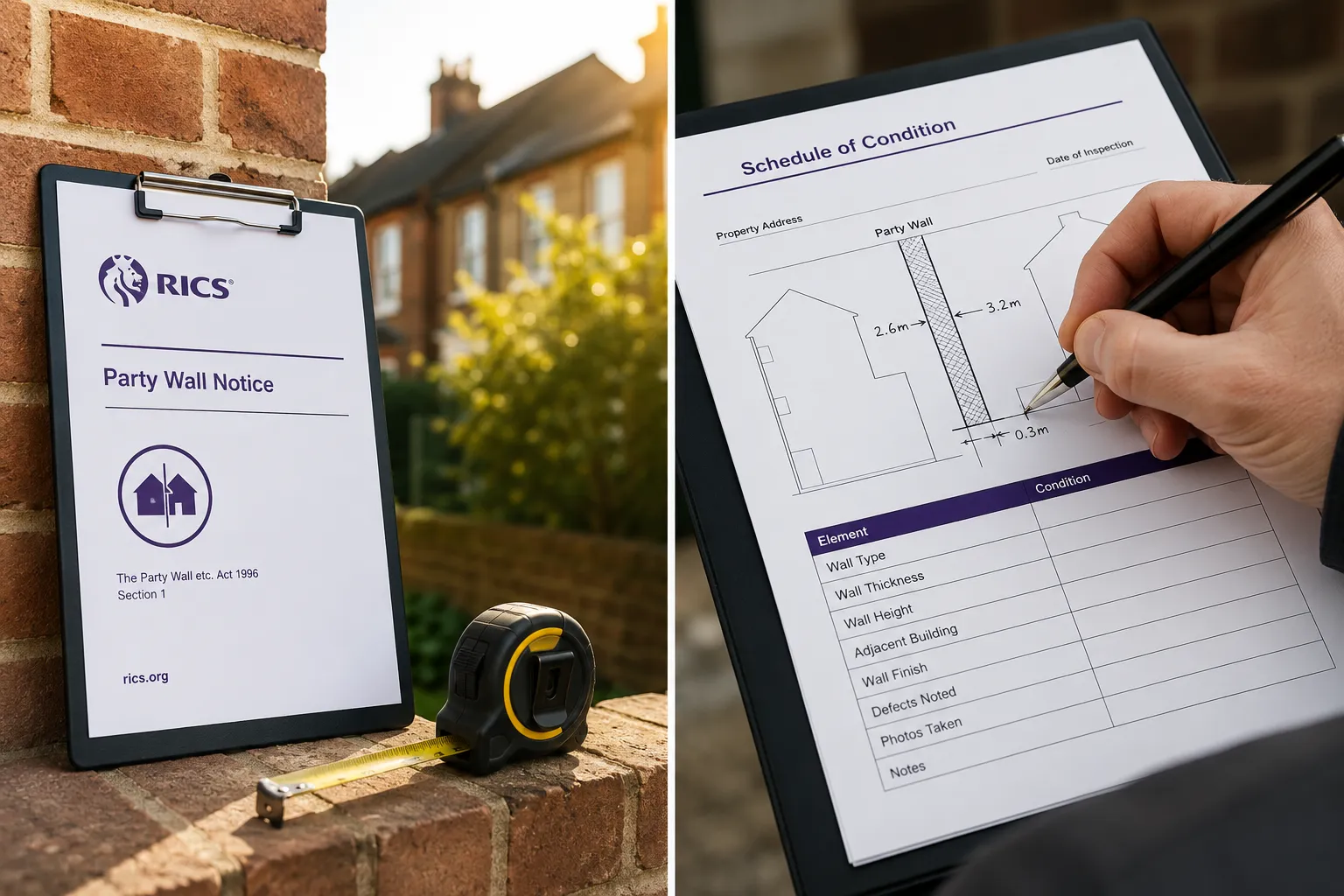
- A schedule of condition must be prepared before work starts, recording the state of the adjoining property with photographs and written descriptions
- The party wall award must be issued before notifiable work commences
- Surveyors must hold appropriate professional indemnity insurance
- All communications and awards must be in writing and served correctly on all parties
RICS members are also bound by the Rules of Conduct, which require competence, transparency, and avoidance of conflicts of interest. If a surveyor is appointed by both parties (an "agreed surveyor"), they must remain neutral throughout.
For a deeper look at what your party wall rights actually are, it is worth reviewing the Act's specific provisions alongside RICS guidance before appointing anyone.
Key point for 2026: RICS has continued to emphasise digital record-keeping and photographic schedules of condition as best practice. Surveyors who rely solely on written notes without photographic evidence may face challenges if disputes arise.
Do I Need a Party Wall Survey for a Single-Storey Extension
Yes, in many cases a single-storey rear extension does trigger the Party Wall etc. Act 1996 and requires a party wall survey. Whether it applies depends on the foundation depth, the proximity to the boundary, and whether any work cuts into or builds on a shared wall.
Scenarios where a single-storey extension triggers the Act:
- The extension is built up to or on the boundary line (line of junction work under Section 1)
- Foundations are excavated within 3 metres of the neighbour's foundations and go deeper
- The extension involves cutting into a shared wall for a new beam or lintel
Scenarios where it may not apply:
- The extension is set back from the boundary with no excavation near the neighbour's foundations
- No shared wall is affected
If you are unsure, a brief consultation with a chartered surveyor before you start is far cheaper than dealing with a dispute mid-build. Many surveyors offer a free initial assessment to confirm whether the Act applies to your specific project.
Party Wall Survey vs Party Wall Award: Which Do I Need
These two terms are often confused. A party wall survey is the physical inspection and documentation of the adjoining property's condition. A party wall award is the legally binding document that authorises the work and sets out the conditions under which it must be carried out.
In practice, you need both. The survey (specifically the schedule of condition) feeds into the award. The award cannot be properly prepared without a survey of the existing conditions.
| Document | What it is | Legal status |
|---|---|---|
| Schedule of condition | Photographic and written record of existing property state | Evidence document |
| Party wall award | Binding agreement on how work proceeds | Legally enforceable |
| Party wall notice | Written notification to neighbour | Triggers the process |
You can read more about party wall awards and how they work to understand what the final document should contain.
How Much Does a Party Wall Survey Cost
Party wall survey costs in 2026 typically range from around £700 to £2,000 per adjoining owner for straightforward residential extensions, though complex projects or multiple adjoining owners can push costs higher. The building owner (the person doing the work) usually pays the surveyor's fees for both sides.
Factors that affect cost:
- Number of adjoining owners affected
- Complexity of the proposed works
- Whether an agreed surveyor or two separate surveyors are appointed
- Location (London and the South East tend to be higher)
- Whether disputes arise and require additional correspondence
Choosing an agreed surveyor, one neutral professional appointed by both parties, is usually the most cost-effective route for straightforward projects. For a detailed breakdown, see this guide on the cost of a party wall agreement.
Common mistake: Some building owners try to minimise costs by delaying the appointment of surveyors. This often backfires, as last-minute appointments can delay construction starts and increase fees due to urgency.
What Happens If I Don't Get a Party Wall Survey Before Building
Proceeding without serving notice or obtaining a party wall award does not make the work illegal, but it removes every legal protection the Act provides. The adjoining owner can apply to the courts for an injunction to stop the work, and you become personally liable for any damage, with no agreed baseline to dispute claims against.
The consequences of ignoring the Party Wall Act can include:
- Court injunctions halting construction mid-project
- Liability for all legal costs of the adjoining owner
- Difficulty selling the property later (solicitors routinely check for party wall compliance)
- No protection if the neighbour makes exaggerated damage claims
Even if work has already started without notice, it is possible to retrospectively serve notice and appoint surveyors. This is not ideal, but it is better than continuing without any process in place.
How Long Does a Party Wall Survey Take
The party wall process typically takes between two and six weeks from serving notice to issuing the award, assuming the neighbour responds promptly and there are no disputes. The notice period itself is a minimum of two months for party wall works and one month for excavations under Section 6.
Typical timeline:
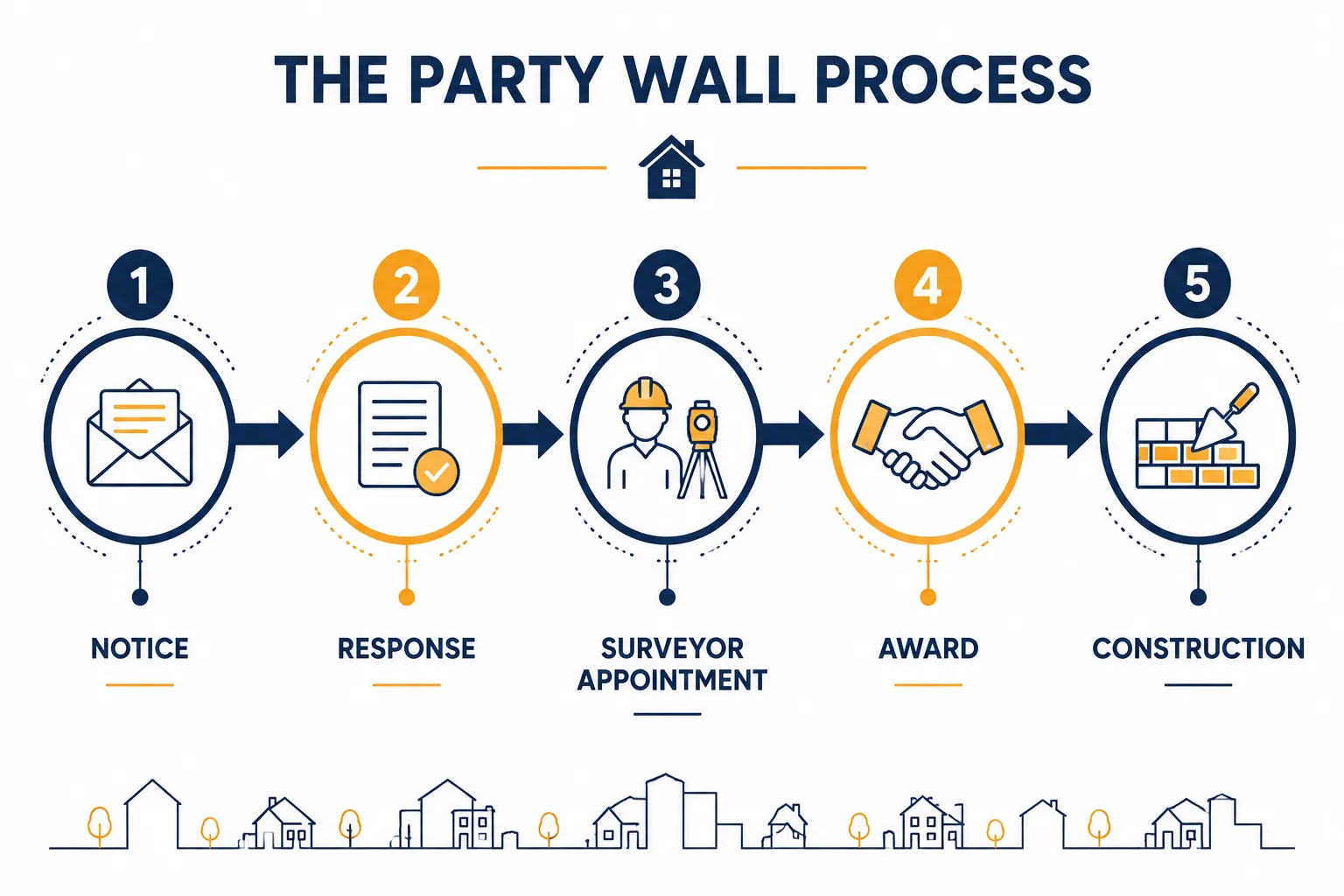
- Serve written notice on adjoining owner(s)
- Neighbour has 14 days to respond (consent or dissent)
- If they dissent or do not respond, surveyors are appointed
- Schedule of condition inspection is carried out
- Party wall award is drafted, agreed, and served
If a neighbour disputes the award or is uncooperative, the process can extend to several months. Planning ahead and serving notice early is the single most effective way to avoid delays to your build programme.
Party Wall Survey for Loft Conversion: What's Required
Loft conversions frequently trigger the Party Wall etc. Act, particularly in terraced and semi-detached properties. The key triggers are steel beams bearing on the party wall, raising the party wall, and any work that cuts into or alters the shared structure.
For a full guide on party wall agreements for loft conversions, the process mirrors that for extensions: serve notice, appoint surveyors if required, carry out a schedule of condition, and obtain an award before work starts.
Specific considerations for loft conversions:
- Steel beams (typically RSJs) bearing into the party wall require notice under Section 2
- Raising the party wall height triggers Section 2
- A schedule of condition should include the neighbour's loft space, not just the rooms below
Can I Do a Party Wall Survey Myself or Do I Need a Surveyor
Technically, the Act does not require a surveyor to be professionally qualified, but appointing an unqualified person carries serious risk. RICS-regulated surveyors bring professional indemnity insurance, legal knowledge, and impartiality, all of which matter if a dispute arises.
The adjoining owner is entitled to appoint their own surveyor, and if you appoint someone unqualified, they may reject that appointment and insist on a qualified professional. This can create delays and additional costs.
Choose a qualified surveyor if:
- The works are complex (basement, loft, rear extension with deep foundations)
- The neighbour is already concerned or uncooperative
- There is any existing damage to the party wall
- You are a landlord or developer with commercial interests at stake
For straightforward cases where both parties agree, an agreed surveyor who is RICS-regulated is the most efficient and cost-effective option.
What Should Be Included in a Party Wall Survey Checklist
A complete party wall survey checklist for RICS compliance in 2026 should cover the following:
Pre-notice stage:
- Confirm whether the Act applies to the proposed works
- Identify all adjoining owners (including freeholders and leaseholders)
- Prepare accurate drawings of the proposed works
Notice stage:
- Serve written notice in the correct form for each section of the Act
- Allow the correct notice period (one or two months depending on work type)
- Record proof of service (recorded delivery or in-person with witness)
Survey and award stage:
- Carry out a detailed schedule of condition with photographs
- Draft the party wall award with clear working hours, access arrangements, and damage provisions
- Serve the award on all parties before work commences
During construction:
- Keep a copy of the award on site
- Follow any conditions specified in the award
- Report any damage immediately and document it
Post-construction:
- Carry out a post-works inspection if required by the award
- Retain all documents for at least six years
Does a Conservatory Need a Party Wall Survey
A conservatory can trigger the Party Wall etc. Act, but it depends on its location and foundation depth. If the conservatory is built on the boundary line or involves excavation near the neighbour's foundations, the Act applies.
A lightweight conservatory set back from the boundary with shallow strip foundations may not trigger the Act at all. However, if the conservatory is attached to a shared wall or built up to the boundary, Section 1 (line of junction) notices are likely required.
Decision rule: If in doubt, ask a chartered surveyor before you start. A brief consultation is far less costly than an injunction or a neighbour dispute mid-build.
How Do I Notify My Neighbour About Party Wall Work
Written notice must be served on all adjoining owners before notifiable work starts. The notice must include your name and address, the address of the property where work is being carried out, a description of the proposed works, and the planned start date.
Notices can be delivered by hand (with a witness), by recorded post, or by a process server. Email is not formally recognised under the Act unless the neighbour has explicitly agreed to receive notices electronically.
If the neighbour does not respond within 14 days, they are deemed to have dissented, and the dispute resolution process begins automatically. For guidance on what happens if a neighbour refuses party wall works, the Act provides a clear mechanism that does not require the neighbour's consent to proceed, only compliance with the process.
Common Mistakes People Make With Party Wall Surveys
Even experienced developers make avoidable errors. The most frequent mistakes include:
- Serving notice too late: Leaving less than the statutory notice period before the planned start date forces delays or exposes the project to legal challenge.
- Identifying the wrong adjoining owners: Forgetting to notify a leaseholder as well as a freeholder (both must be notified if applicable) is a common oversight.
- Using an unqualified surveyor: Appointing someone without RICS accreditation or appropriate indemnity insurance creates risk for both parties.
- Not completing a schedule of condition: Without a photographic baseline, any damage claim becomes a dispute about what existed before.
- Assuming consent means no award is needed: Even if a neighbour consents, a schedule of condition is still strongly advisable to protect against later claims.
For a broader look at common misconceptions about party wall agreements, many homeowners are surprised to learn that consent does not remove all obligations under the Act.
Frequently Asked Questions
Q: Does the Party Wall Act apply to internal alterations?
A: Generally no. Internal alterations that do not affect the structural integrity of the party wall or involve excavation near the boundary do not trigger the Act. However, removing a chimney breast on a party wall or inserting a beam into a shared wall does apply.
Q: Can my neighbour stop my extension by refusing to engage with the party wall process?
A: No. If a neighbour dissents or fails to respond, the Act provides a dispute resolution mechanism through appointed surveyors. The work can proceed once a valid party wall award is in place, regardless of whether the neighbour agrees with the project.
Q: Who pays for the party wall survey?
A: The building owner (the person carrying out the work) pays the surveyor's fees for both sides in most cases. If the adjoining owner appoints their own surveyor unreasonably or causes unnecessary costs, this can be addressed in the award.
Q: Is a party wall agreement the same as planning permission?
A: No. These are entirely separate processes. Planning permission is granted by the local authority and governs whether you can build. A party wall agreement is a private legal process between neighbours under the 1996 Act. You may need both.
Q: How long is a party wall award valid?
A: A party wall award does not expire, but it is specific to the works described. If the scope of work changes significantly, a new or amended award may be needed. The award's conditions remain enforceable throughout the construction period.
Q: Do I need a party wall survey if I'm buying a house where work has already been done?
A: You should check whether the Act was complied with. Missing party wall documentation can affect your mortgage, insurance, and ability to sell. For buyers, understanding the Party Wall Act when buying a house is an important part of due diligence.
Conclusion
Party wall surveys for extensions and alterations are not a bureaucratic formality, they are a practical safeguard that protects your project, your finances, and your relationship with neighbours. The RICS compliance checklist for 2026 outlined above covers every stage from confirming whether the Act applies to retaining documents after completion.
Actionable next steps:
- Confirm whether your proposed works trigger the Party Wall etc. Act 1996 by consulting a RICS-regulated surveyor before finalising your plans.
- Identify all adjoining owners (freeholders and leaseholders) and prepare to serve written notice at least two months before your planned start date.
- Decide whether an agreed surveyor or separate surveyors are appropriate for your situation, for straightforward projects with cooperative neighbours, an agreed surveyor saves time and money.
- Ensure a full schedule of condition is carried out before any work begins, with photographs and written records.
- Keep all party wall documentation for at least six years after completion.
Starting the party wall process early, ideally at the same time as your planning application, is the single most effective way to keep your project on schedule and avoid costly disputes.
References
- Party Wall etc. Act 1996. UK Parliament. legislation.gov.uk
- RICS. (2011). Party Wall Legislation and Procedure (6th ed.). RICS Guidance Note. rics.org
- Ministry of Housing, Communities & Local Government. (2016). Party Wall etc. Act 1996: explanatory booklet. GOV.UK. gov.uk
.pw-wrap{font-family:Arial,sans-serif;max-width:520px;margin:24px auto;border:2px solid #1a3a5c;border-radius:8px;padding:20px;background:#f8fafc}
.pw-wrap h3{color:#1a3a5c;margin:0 0 14px;font-size:1.1rem}
.pw-label{display:block;font-size:.9rem;font-weight:bold;color:#1a3a5c;margin:10px 0 4px}
.pw-select,.pw-btn{width:100%;padding:8px 10px;border-radius:5px;border:1px solid #b0bec5;font-size:.9rem;box-sizing:border-box}
.pw-btn{background:#1a3a5c;color:#fff;border:none;margin-top:14px;cursor:pointer;font-weight:bold}
.pw-btn:hover{background:#274f7a}
.pw-result{margin-top:14px;padding:12px;border-radius:5px;font-size:.9rem;display:none}
.pw-yes{background:#e8f5e9;border-left:4px solid #2e7d32;color:#1b5e20}
.pw-no{background:#fff3e0;border-left:4px solid #e65100;color:#bf360c}
Does My Project Need a Party Wall Survey?
function pwCheck(){
var w=document.getElementById(‘pw-work’).value;
var b=document.getElementById(‘pw-boundary’).value;
var r=document.getElementById(‘pw-result’);
if(!w||!b){r.style.display=’block’;r.className=’pw-result pw-no’;r.innerHTML=’Please select both options to get a result.’;return;}
var likely=(w===’ext’||w===’loft’||w===’basement’)||(w===’conservatory’&&b===’yes’);
var no=(w===’internal’)||(w===’conservatory’&&b===’no’);
r.style.display=’block’;
if(no){r.className=’pw-result pw-no’;r.innerHTML=’Act likely does not apply. No party wall notice is probably needed, but confirm with a chartered surveyor if foundations are close to the boundary.’;}
else if(likely){r.className=’pw-result pw-yes’;r.innerHTML=’Party Wall Act likely applies. Serve written notice on adjoining owners before starting. A RICS-regulated surveyor can confirm and manage the process.’;}
else{r.className=’pw-result pw-yes’;r.innerHTML=’May apply, professional advice recommended. Book a consultation with a RICS-regulated party wall surveyor to confirm your obligations.’;}
}
Tags: party wall survey, party wall act, RICS compliance, extensions and alterations, party wall award, schedule of condition, chartered surveyor, loft conversion party wall, party wall notice, building regulations, UK property law, adjoining owner rights